
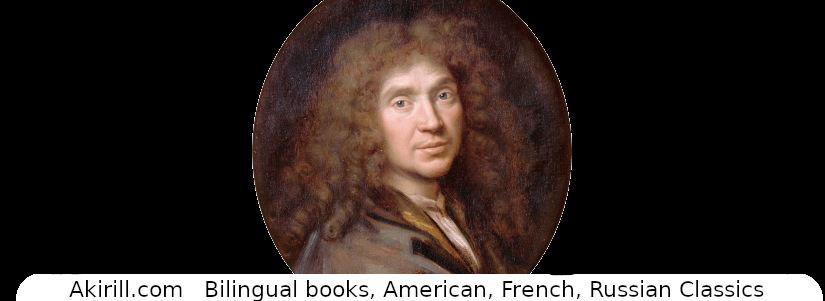
The Miser also called The School for lies is a five-act comedy in prose written by Molière which was first performed on September 9, 1968 in the theater of the Palais Royal in Paris. This play is now available in our French/English bilingual book section for your pleasure.

At the time, the Molière’s company was under the protection of Louis XV. We know that many scraps of dialogue and incidents are borrowed from the comedy Aulularia by Plautus on which it is loosely based as well as from contemporary Italian farces.
Actually the character of Harpagon is drawn from the latin play Aulularia in which the miser Euclio keeps changing the hiding place of his pot of gold out of fear of having it stolen but he also created the love affair between Elise and Valère based on the same play. The father as usurer was based on a play of Francois le Metel de Boisrobert of 1655 called “La Belle Plaideuse” . As for the father and son in love with the same woman, the idea came from the play of Jean Donneau de Visé of 1665 called “La mère Coquette”
The miser whose name is Harpagon is obsessed with the wealth he has amassed and always ready to save on expenses. The name Harpagon is interesting as it is a name adapted from the Greek which means a hook or grappling iron. Harpagon is an old widower with a son and daughter trying to arrange a marriage for himself with a young woman. The young woman in turn is in love with his son. At the same time Harpagon tries to arrange a wedding between his daughter to a wealthy man of his choosing, but his daughter is in love with Valere who is their steward. Then Harpagon’s gold is stolen. Satire and farce blend in a fast plot and make an interesting in amusing reading.
They were many adaptation of the play due to the fact that Moliere humor doesn’t translate very well and require free adaptation to succeed in other countries. Already in 1670 a German translation called Der Geizige appeared in Frankfurt, then in 1672 Thomas Shadwell adapted the play calling it “The Miser” and adding 8 new characters. An even more popular version which was based on both Plautus and Moliere was created by Henry Fielding in 1732. The play was also adapted to Italian Operas in 1775, 1776 and 1814. Vasily Pashkevich based his 18th century comic opera on this play in Russia and the first Arabic adaptation was done by the Lebanese Marun Al Naqqash in 1817.
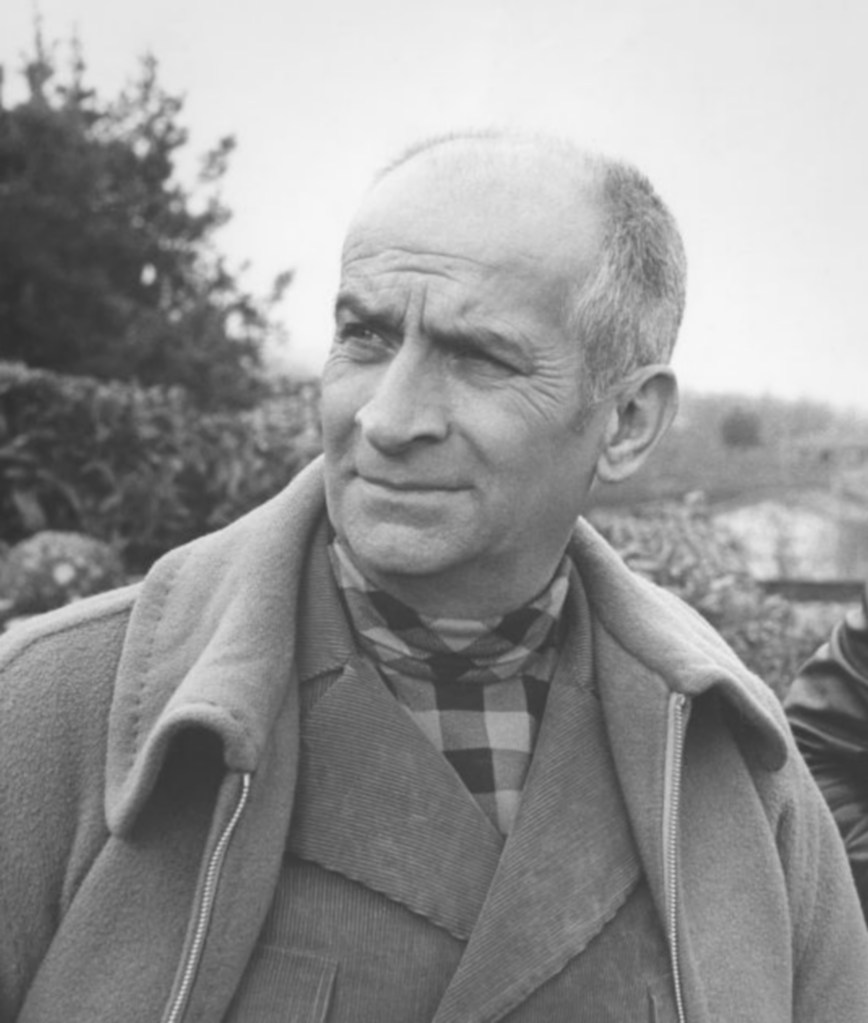
There were also many audio and film adaptations. As example, the Lincoln center produced an audio recording of this play in 1969, and a movie produced and starring Louis de Funès was produced in 1980.
| You can find this book on our French/English bilingual books page. Read “The Miser” bilingual book. They are also on our French Literature page available in French, or in English. |
Beginning of the play”The Miser”

ACT I.
SCENE I.——VALÈRE, ÉLISE.
Val. What, dear Élise! you grow sad after having given me such dear tokens of your love; and I see you sigh in the midst of my joy! Can you regret having made me happy? and do you repent of the engagement which my love has forced from you?
Eli. No, Valère, I do not regret what I do for you; I feel carried on by too delightful a power, and I do not even wish that things should be otherwise than they are. Yet, to tell you the truth, I am very anxious about the consequences; and I greatly fear that I love you more than I should.
Val. What can you possibly fear from the affection you have shown me?
Eli. Everything; the anger of my father, the reproaches of my family, the censure of the world, and, above all, Valère, a change in your heart! I fear that cruel coldness with which your sex so often repays the too warm proofs of an innocent love.
Val. Alas! do not wrong me thus; do not judge of me by others. Think me capable of everything, Élise, except of falling short of what I owe to you. I love you too much for that; and my love will be as lasting as my life!
Eli. Ah! Valère, all men say the same thing; all men are alike in their words; their actions only show the difference that exists between them.
Val. Then why not wait for actions, if by them alone you can judge of the truthfulness of my heart? Do not suffer your anxious fears to mislead you, and to wrong me. Do not let an unjust suspicion destroy the happiness which is to me dearer than life; but give me time to show you by a thousand proofs the sincerity of my affection.
Eli. Alas! how easily do we allow ourselves to be persuaded by those we love. I believe you, Valère; I feel sure that your heart is utterly incapable of deceiving me, that your love is sincere, and that you will ever remain faithful to me. I will no longer doubt that happiness is near. If I grieve, it will only be over the difficulties of our position, and the possible censures of the world.
Val. But why even this fear?
Eli. Oh, Valère! if everybody knew you as I do, I should not have much to fear. I find in you enough to justify all I do for you; my heart knows all your merit, and feels, moreover, bound to you by deep gratitude. How can I forget that horrible moment when we met for the first time? Your generous courage in risking your own life to save mine from the fury of the waves; your tender care afterwards; your constant attentions and your ardent love, which neither time nor difficulties can lessen! For me you neglect your parents and your country; you give up your own position in life to be a servant of my father! How can I resist the influence that all this has over me? Is it not enough to justify in my eyes my engagement to you? Yet, who knows if it will be enough to justify it in the eyes of others? and how can I feel sure that my motives will be understood?
Val. You try in vain to find merit in what I have done; it is by my love alone that I trust to deserve you. As for the scruples you feel, your father himself justifies you but too much before the world; and his avarice and the distant way in which he lives with his children might authorise stranger things still. Forgive me, my dear Élise, for speaking thus of your father before you; but you know that, unfortunately, on this subject no good can be said of him. However, if I can find my parents, as I fully hope I shall, they will soon be favourable to us. I am expecting news of them with great impatience; but if none comes I will go in search of them myself.
Eli. Oh no! Valère, do not leave me, I entreat you. Try rather to ingratiate yourself in my father’s favour.
Val. You know how much I wish it, and you can see how I set about it. You know the skilful manoeuvres I have had to use in order to introduce myself into his service; under what a mask of sympathy and conformity of tastes I disguise my own feelings to please him; and what a part I play to acquire his affection. I succeed wonderfully well, and I feel that to obtain favour with men, there are no better means than to pretend to be of their way of thinking, to fall in with their maxims, to praise their defects, and to applaud all their doings. One need not fear to overdo it, for however gross the flattery, the most cunning are easily duped; there is nothing so impertinent or ridiculous which they will not believe, provided it be well seasoned with praise. Honesty suffers, I acknowledge; but when we have need of men, we may be allowed without blame to adapt ourselves to their mode of thought; and if we have no other hope of success but through such stratagem, it is not after all the fault of those who flatter, but the fault of those who wish to be flattered.
Eli. Why do you not try also to gain my brother’s goodwill, in case the servant should betray our secret?
Val. I am afraid I cannot humour them both. The temper of the father is so different from that of the son that it would be difficult to be the confidant of both at the same time. Rather try your brother yourself; make use of the love that exists between you to enlist him in our cause. I leave you, for I see him coming. Speak to him, sound him, and see how far we can trust him.
Eli. I greatly fear I shall never have the courage to speak to him of my secret.
| You can find this book in our French/English bilingual books. Read “The Miser” bilingual book. They are also on our French Literature page available in French, or in English. |
I hope you enjoyed this article
| Help the site stay free, buy us a cup of coffee |  | Aidez-nous à maintenir le site gratuit en nous offrant une tasse de café |
| If you liked this article, subscribe , put likes, write comments!. |
| Share on social networks |
| Check out Our Latest Posts |
 AKirill, Learn, apprenez, translation, traduction, livres bilingues, bilingual books
2 thoughts on “Discover the Miser (L’Avare) by Molière”