
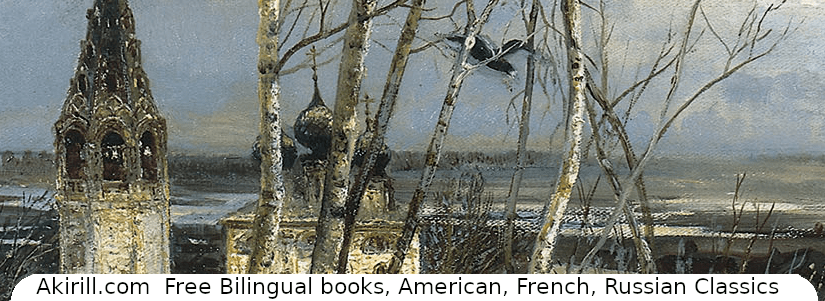
“The Rooks Have Arrived” is considered Savrasov’s most famous work. In this painting the Russian artist showed an example of a new vision of the world, very realistic and superior to the classics. “The Rooks Have Arrived” opened the way for the lyrical style in Russian painting, and marked a new milestone in the development of Russian landscape painting”. Connoisseurs of painting liked the painting so much that the artist had to repeat the painting several times.
“The Rooks Have Arrived” (Грачи прилетели) is an oil on canvas of 62X48.5 cm painted by Alexei Savrasov (Алексей Саврасов) in 1871. It is a realistic landscape which is now in the State Tretyakov Gallery.
The picture depicts a spring day, overcast, but according to the first messengers of spring which are the rooks, the spring is already felt and is not far away. The first spring birds fuss on three gnarled birch trees: Young couples build new nests, old birds renew last year’s ones.
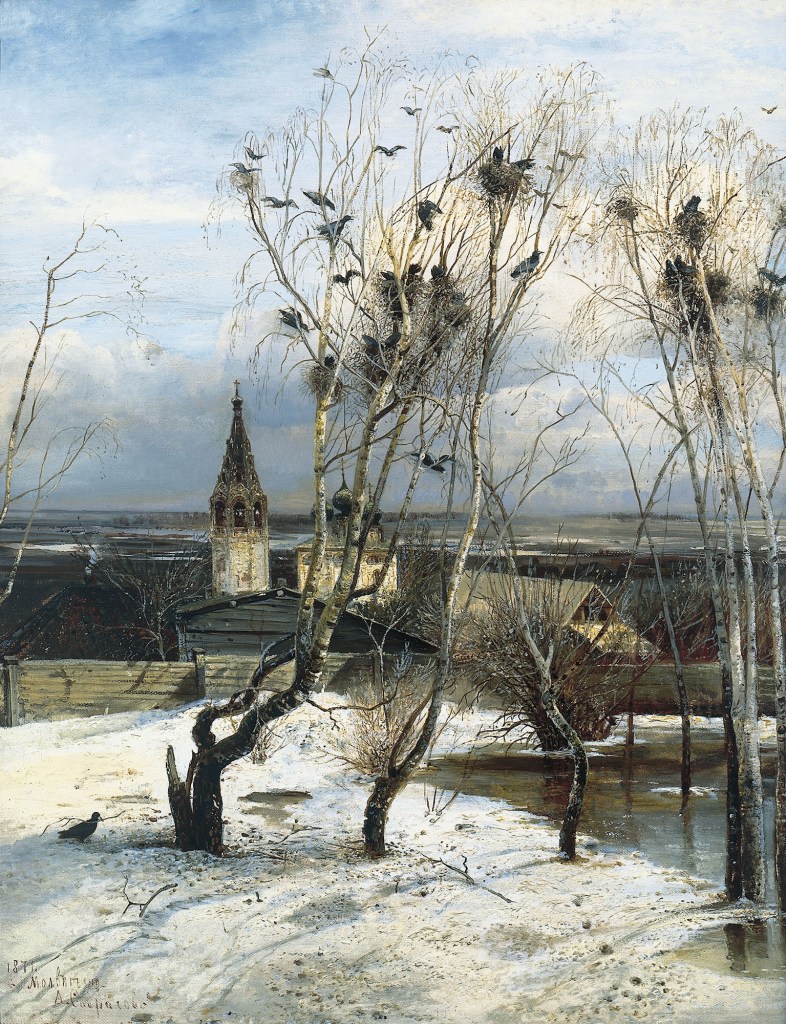
Alexei Savrasov, began to write the future masterpiece in March 1871 in the village of Molvitino (now renamed Susanino) where he made only sketches, finalizing the main part in his Moscow workshop.
Almost half of the canvas is occupied by the sky. Cumulus clouds roam it, the colors of the sky change from whitish-gray to pale blue, a very spring color. It gives the picture an extraordinary lightness.
The sun brightly illuminates birch trunks, a wooden fence, the roofs of village huts, and the hipped bell tower of the Resurrection Church. Another sign that, despite the abundance of gray and bluish shades, Savrasov depicted a sunny day are the thin shadows from tree trunks on the snow.

In the foreground of the picture are several twisted, still bare birches. Their thin branches are directed upwards, towards the sun. There are many black rooks making their nests, flying from branch to branch, busying themselves. It is the arrival of these rooks that is a symbol of the coming spring. They are known to be migratory birds. They leave their nests in autumn, but return to these warm lands again in spring. We can also see the traces of birds on the snow. There is a willow hidden behind the bare birches which also serves as a metaphor for the resurrection: with its branches, an analogue of palm branches in a cold climate, Palm Sunday was traditionally celebrated in Rus’.
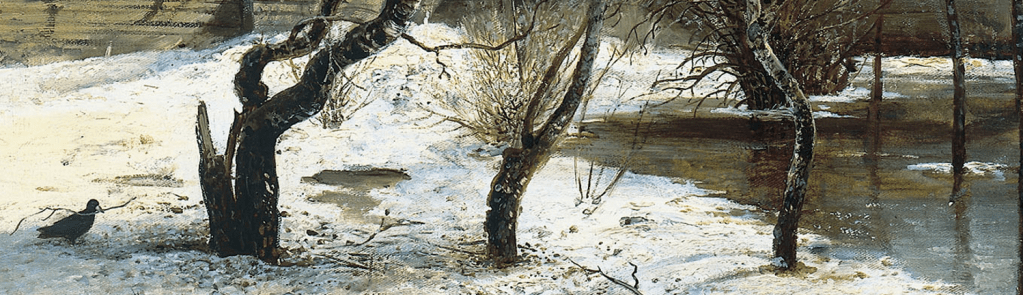
At the foot of the birches there are dark, thawed patches in the snow, and small puddles can already be seen, which is a sign that it is getting warmer outside. To convey the color of snow, the artist uses various shades of white, bluish, gray. In the distance, in the sun, the icy crust seems even light golden.
Blue-gray sky is reflected in the pond, which has already got rid of the ice. Bare trees are also visible in it. Savrasov added a little pale green color in the area where a juniper bush is visible in the water. .
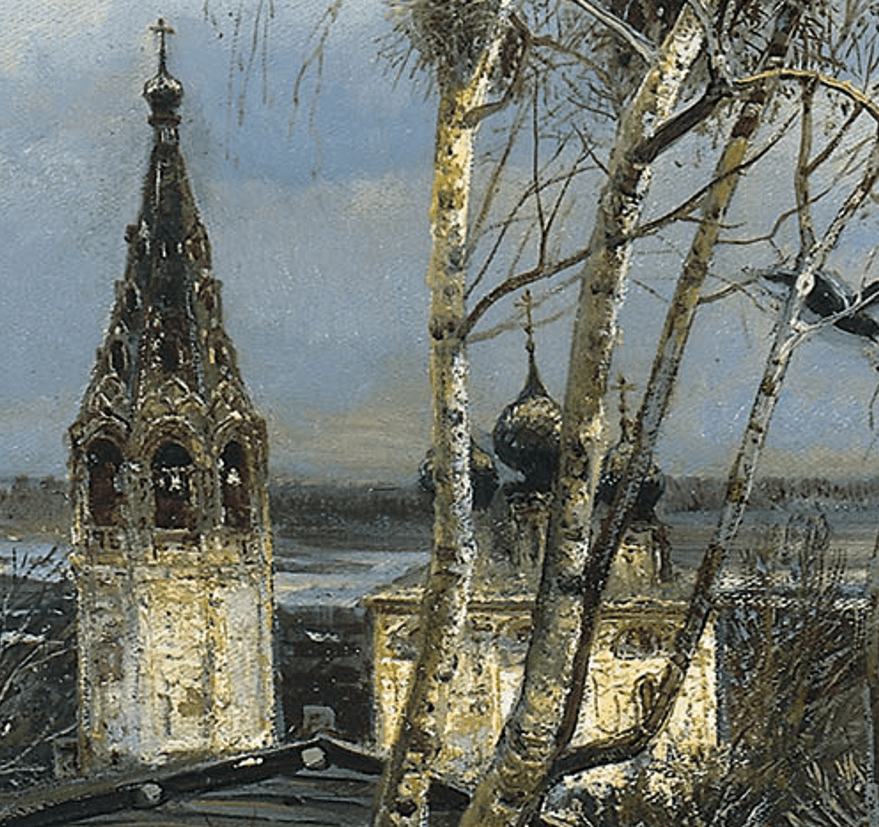
There is an inconspicuous rural church with a hipped bell tower visible behind the birches reminding us of the resurrection of Christ. . The walls of the temple and the hexagonal bell tower are white, peeling plaster is visible here and there. The architecture of the church suggests that we have before us an ancient building that has stood in the village for hundreds of years. It is the Orthodox Church of the Resurrection of Christ in the village of Molvitino (now Susanino). The church was built at the end of the 17th century and still stands there now.

Behind the church, endless fields open up with snow that has not completely melted yet.
On the bottom left the artist signed his painting.

To enhance the spatial sound of the image, Savrasov slightly disturbed the perspective. The foreground of the picture is depicted in such a way that the artist seems to be close to the ground. But from this angle , the horizon would have to be quite low, while in the picture it is depicted approximately in the middle of the canvas, at the level of church domes. This was done by the artist in order to better show the flat distances, which play an important semantic and figurative role in the picture.
In this painting, the artist most accurately and believably depicted the Russian landscape, the Russian soul, and their nature.
| Help the site stay free, buy us a cup of coffee |  | Aidez-nous à maintenir le site gratuit en nous offrant une tasse de café |
In 1997, when the 100th anniversary of the death of the great artist was celebrated, the Central Bank of Russia issued a commemorative silver coin with a portrait of Alexei Savrasov depicted on it and a fragment of his famous painting “The Rooks Have Arrived”.
I hope you enjoyed this article
| If you liked this article, subscribe , put likes, write comments! |
| Share on social networks |
| Check out Our Latest Posts |
 AKirill, Learn, apprenez, translation, traduction, livres bilingues, bilingual books
2 thoughts on “Discover the famous painting “The Rooks Have Arrived” by Alexey Savrasov”