

The renowned Russian artist known for his exceptional work during the latter half of the 19th century, Ivan Kramskoi (Иван Николаевич Крамской), is credited with creating numerous remarkable portraits and historical canvases. One of his notable paintings, titled “Portrait of an Unknown Woman,” (Неизвестная) was crafted in 1883 and is housed in the esteemed collection of the State Tretyakov Gallery. This piece measuring 75.5×99 cm is widely regarded as one of Ivan Kramskoi’s most significant and renowned works. By bestowing the canvas with such a name, the artist enveloped it in an air of mystery and fascination. Ideologically and artistically, the content of the “Portrait of an Unknown Woman” image allowed the artist to produce a piece that straddled the line between a portrait and a thematic painting. It should be noted that this portrait is often mistakenly called ” Stranger ” in Russian due to the poem of the same name by Alexander Blok . In English this portrait is also called the Unknown Woman, An Unknown Lady or Stranger

The extraordinary artwork, commonly referred to as “Portrait of an Unknown Woman” or “Stranger,” made its first appearance in St. Petersburg in 1883 at the 11th exhibition of the Peredvizhniki, hosted at the Imperial Academy of Sciences. Its introduction had a profound impact on all who gazed upon the painting.
This piece depicts a woman who defies societal norms. Kramskoi illustrates the emergence of a distinct sense of self in a woman of his time. She confidently and directly gazes at others, displaying a strong sense of self-worth, even if her dignity remains unacknowledged by others.
Who is shown in the canvas?

There exist several theories concerning the identity of the subject depicted in Ivan Kramskoi’s painting “Portrait of an Unknown Woman”, each supported by diverse interpretations. Despite the absence of definitive explanations provided by the artist himself, numerous art historians have put forward various possibilities. Some argue that the painting could have been inspired by the character from Leo Tolstoy’s “Anna Karenina”, while others propose a connection to Fyodor Dostoevsky’s novel “The Idiot”.


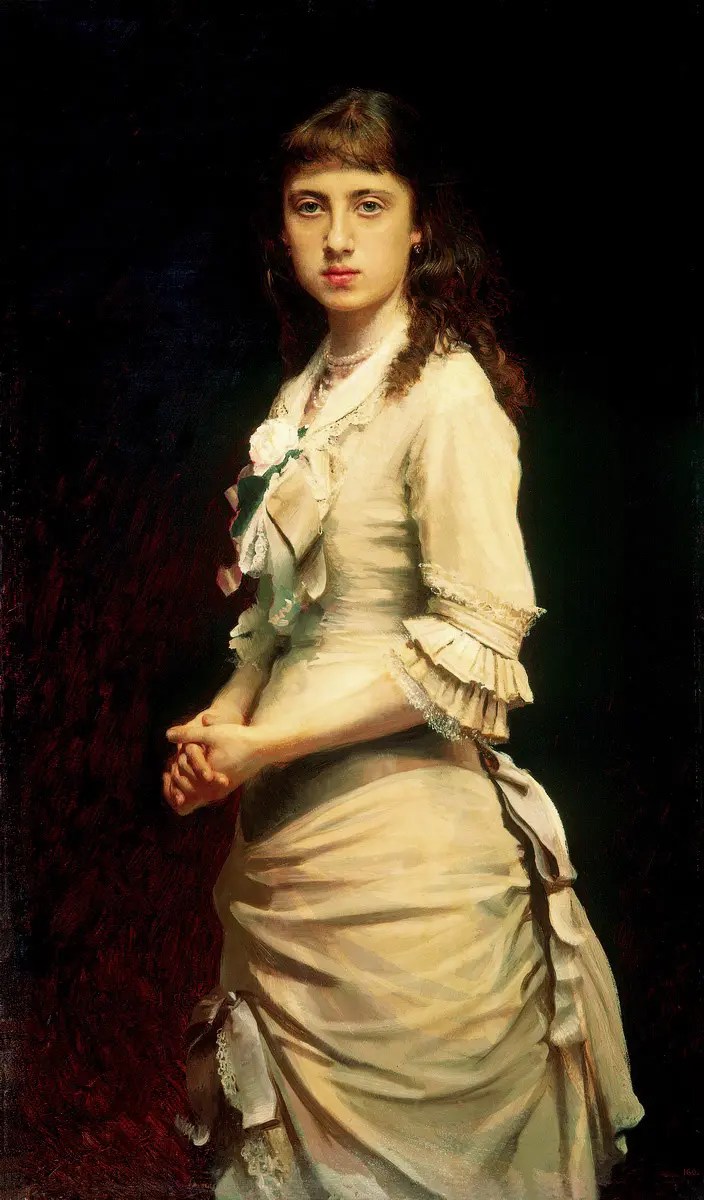
Additionally, the resemblance of the depicted figure to Kramskoi’s niece as well as his daughter has led to further speculations. However, the notion of Kramskoi portraying his own daughter in such a controversial manner raises questions about a loving father’s intentions.
There exists an unconfirmed legend suggesting that the prototype for the female subject in the painting was Matryona Savvishna, a peasant girl from Kursk who allegedly married a nobleman named Bestuzhev (whose first name is unspecified, adding to the legendary nature of the tale). Kramskoi reportedly encountered her in St. Petersburg and was enamored by her beauty. Nonetheless, in the private collection of Dušan Friedrich in Prague, there is a sketch portraying the same woman, presumably in a more authentic manner.
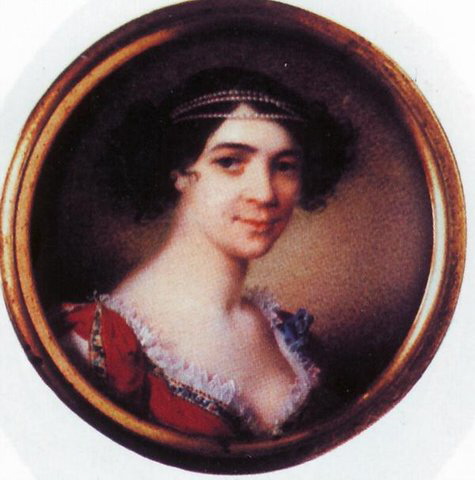
It could also have been the maid of honor to the Empress, a Georgian princess, who was known for her beauty and intellect, as well as her tragic fate. Her allure captivated Emperor Alexander I and Prince Golitsyn, leading to romantic entanglements with both men. After giving birth to a daughter whose paternity remained uncertain, Varvara Turkestanishvili or Turkestanova took her own life.
This poignant tale deeply moved Kramskoi, who, upon encountering a cameo bearing Varvara’s likeness, felt compelled to immortalize her in his painting.
Some scholars assert that his subject was a young Georgian woman, there are alternative claims suggesting that the artwork portrays a Lezgin woman from Kusara.

Furthermore, the mention of Princess Catherine Dolgorukova as a potential prototype for the enigmatic woman in the painting adds another layer of complexity. Despite the suggestion that Kramskoi intended to paint her portrait, the lack of resemblance in existing photographs of the princess challenges this theory. As a result, uncertainty shrouds the true identity of the woman in “Portrait of an Unknown Woman”, compelling art enthusiasts to continue pondering over this captivating mystery.
Composition
The painting depicts a young woman journeying in an open carriage along Nevsky Prospect, , behind her is the Anichkov Palace, and somewhere there is the Anichkov Bridge. Positioned to her right, is the Alexandrinsky Theater. Moreover, one can observe the frosty air and a gentle, slightly pinkish fog, which delicately “softens” the outlines of the buildings in the background. The artist adeptly captured a winter day in St. Petersburg.
This caused widespread outrage as, according to the social norms of the time, it was deemed inappropriate for a young woman from respectable society to travel alone in a carriage along the streets. The young woman, exuding charm and confidence, not only sits proudly in the carriage alone but also reclines comfortably, carrying herself as if she were receiving visitors in her own salon. Her demeanor appears arrogant, as if she is asserting her superiority. Such behavior was not condoned for ladies of the upper class, leading to opposition against the painting, including from Pavel Tretyakov.

The young woman seated exudes remarkable beauty, with delicate, slightly darker features graced by a gentle blush. Her appearance is strikingly unconventional for Russia, resembling more closely that of an oriental woman. She possesses slender and elegant features, accentuated by luscious, expressive lips, dark eyebrows, and large black eyes framed by luxurious lashes, reminiscent of a character from the Arabian Nights tales.

She is dressed in the latest fashions from the 1880s. Her attire, including a Skobelev coat adorned with sable fur and blue satin ribbons, as well as gloves and a fur muff crafted from fine leather, all conspicuously announce her considerable wealth. This is further underscored by the prominent gold bracelet adorning her wrist, a piece of jewelry alone worth a small fortune. In summary, the young woman embodies the epitome of fashion, style, and beauty.
It is hardly surprising that onlookers were inclined to perceive her not as a woman of high society, but rather as the mistress of a wealthy man, or simply as a courtesan. Indeed, authentic hereditary aristocrats of that time presented a noticeably different appearance. In the aristocratic circles of that era, it was customary to adhere to traditional values. True noblewomen could not justify substantial expenditures on lavish attire, let alone on jewelry. Hence, a style that set apart genuine members of the upper class became prevalent. What was considered “stylish” for them was modesty, discretion, and restraint. They deliberately aimed to lag somewhat behind the latest trends, even if they had the means to acquire them. As for extravagant jewelry, etiquette dictated that it should be kept to a minimum. Flaunting opulence was covertly deemed ill-mannered.
In 2013, they set up this cool 3D sculpture of a painting by Alexander Taratynov in the courtyard of the Tsarskoye Selo Duty Stables as part of the “Painting in 3D” project. How awesome is that?


We put a lot of effort into the quality of the articles and translations, support us with a like and a subscription or sponsor us if you like them. We are also on Facebook and Twitter
- Poèmes et peinture, semaine du 29 mars 2026
- Poems and painting, Week of March 29, 2026
- Poèmes et peinture, semaine du 22 mars 2026
- Poems and painting, Week of March 22, 2026
- Poèmes et peinture, semaine du 15 mars 2026
- Poems and painting, Week of March 15, 2026
© 2024 Akirill.com – All Rights Reserved
 AKirill, Learn, apprenez, translation, traduction, livres bilingues, bilingual books
2 thoughts on “Discover the painting “Portrait of an Unknown Woman” by Ivan Nikolaevich Kramskoi”