On this site we hope to help you learn, and to remove the difficulties caused by the difference of culture and language. Sur ce site nous espérons vous aider à apprendre, et à enlever la barrière causée par les différents languages et cultures.
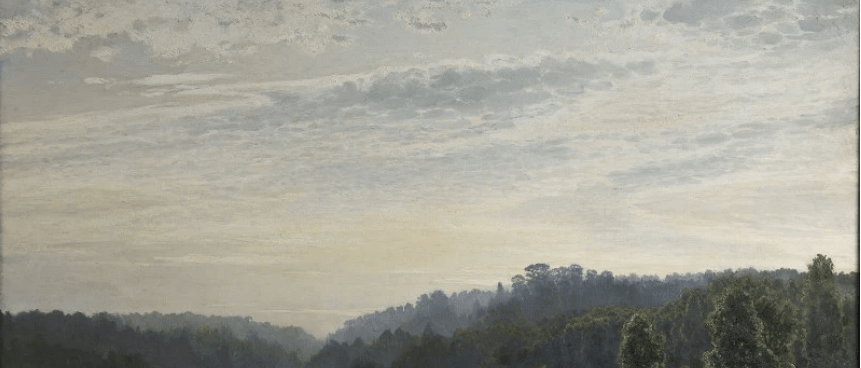
“Foggy morning” (Туманное утро) is a monumental oil on canvas of 108X144.5 cm, painted in 1885 by I. I. Shishkin (И.И.Шишкин ). The painting is situated in the Nizhny Novgorod Art Museum, Nizhny Novgorod. It is a beautiful panoramic view of an early morning on the bank of the river.
Even though Shiskin painted mainly the life of the Russian forest, he sometimes painted fields and meadows. This painting is not typical for Shishkin because usually his paintings depict nature in the prime of the summer beauty in the middle of the day.
“Foggy Morning” is a very harmonious work painted in greenish-silver tones. The painting depicts a full-flowing river, on the banks of which a forest grows. The painting captures the beginning of a new day and the peaceful state of the nature during an early morning on the bank of a river..
The river is framed by picturesque banks of emerald color and is shown in rich green tones, as well as silvery color representing the fog.
Somewhere in the distance the forest is shrouded in fog, but here, on the left bank of the river, on which the author showed small shrubs and wildflowers, the fog is barely visible. The mirror surface of the silent river reflects the sky and the majestic crowns of curly trees. The dense wall of the forest is more like a woven green tent, which stretches as far as the horizon. The trees in the forest on the opposite bank are depicted very majestically. Windless weather only adds to their power. The forest is drawn very densely. In the distance an heavy morning fog has not yet dissipated, and a bluish veil covers part of the forest and the river banks.
The sky is high and bottomless and you can’t even see the clouds floating on it. After all, these clouds turned into a white lace veil that descended right to the tops of the trees. Sunlight envelops every cloud and from this the white lace veil becomes golden heralding the dawn of the coming of a nice day.
The characteristic elaboration of details is impressive and we can admire the variety of color shades which convey the play of shadows and light.
In this painting, the painter conveys the beauty of a summer morning as well as the fragility and uniqueness of the moment.
Un autre superbe musée à visiter virtuellement est le Musée d’Orsey. Saviez-vous que le musée se trouvait dans une ancienne gare ? Vous pourrez également visiter l’une des plus grandes collections au monde de peintures et sculptures européennes de la fin du XIXe et du début du XXe siècle qui sont exposées dans ce musée.
La particularité du musée d’Orsey est que les expositions sont classées par ordre chronologique et non par personnalité, ce qui nous donne l’impression de visiter le passé et de voir l’histoire se dérouler devant nos yeux.
C’est la première chose que l’on voit sur la page et en cliquant sur l’icône jaune en bas à droite de l’image on peut directement visiter le musée.
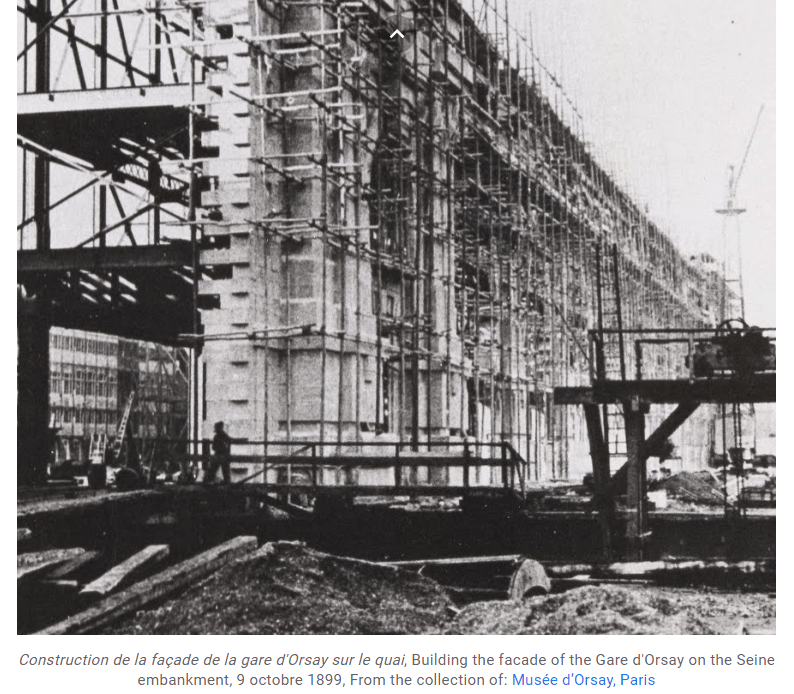
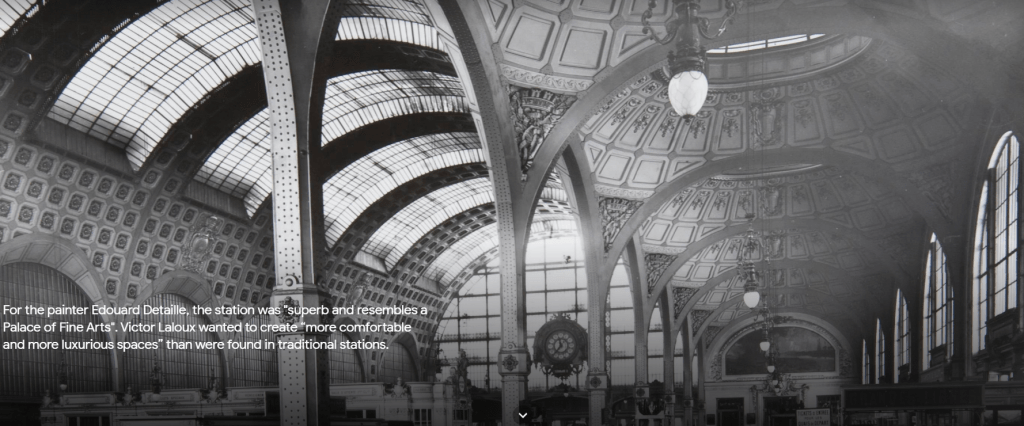
Mais il y a d’autres parties intéressantes sur la page. Voici l’histoire du Musée d’Orsey que j’ai beaucoup aimé
Et voici quelques photos de ma visite de l’histoire du musée
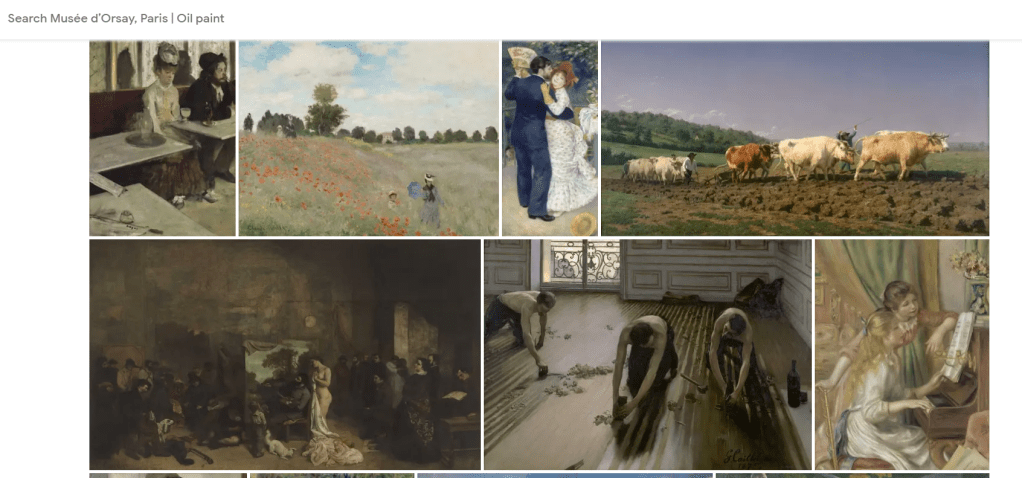
Ensuite, vous pouvez visiter les peintures par catégories.
Et voici quelques photos des peintures que j’ai visitées. Si vous passez la souris sur un tableau, le nom du tableau et de l’artiste s’affiche. Vous pouvez aussi cliquer sur le tableau qui le mettra sur une page entière avec ses détails.
Pour revenir au Musée d’Orsey virtuel je vous conseille de cliquer sur la flèche de retour de votre navigateur, je n’ai pas trouvé d’autre chemin pour revenir au musée.
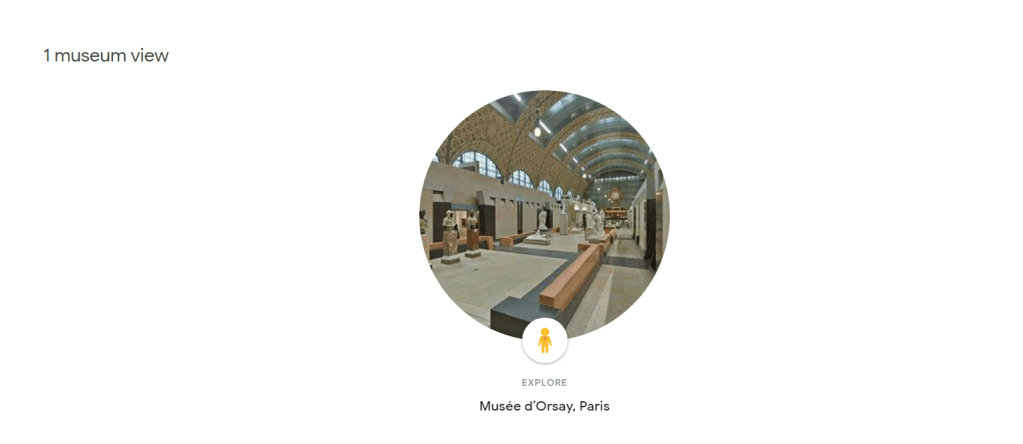
La dernière partie est la visite virtuelle du musée proposée à la première ouverture du site
C’est aussi une belle visite, et voici quelques photos que j’en ai prises
Another beautiful museum to visit virtually is the Musée d’Orsey. Did you know that the museum was in an old gare station? Also you can enjoy one of the world’s largest collections of European paintings and sculptures of the late nineteenth and early twentieth centuries which are exposed in this museum.
The peculiarity of the Musée d’Orsey is that the exhibits are arranged in chronological order instead of according to personalities which give us the feeling of visiting the past and seeing history as it is being written.
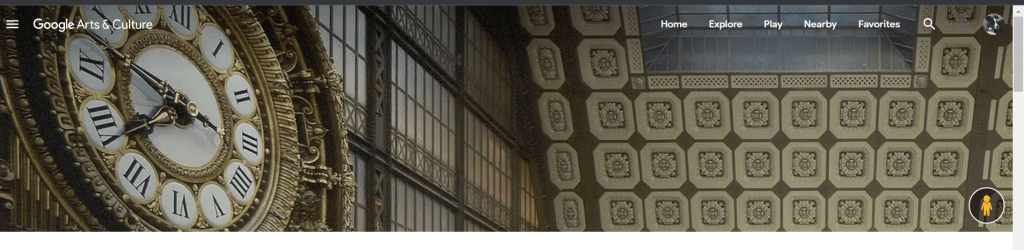
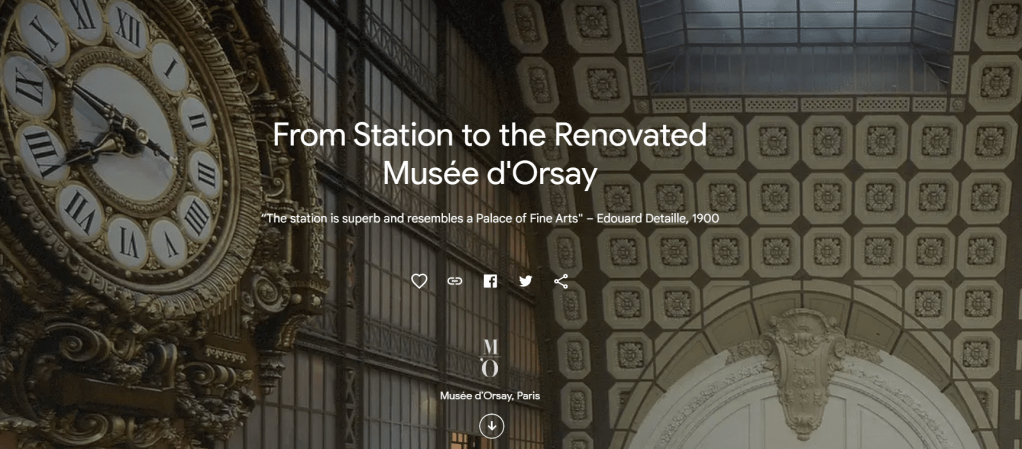
This is the first thing we see on the page and by clicking on the yellow icon on the bottom right of the picture we can directly visit the museum.
But there are other interesting part on the page. The following is the history of the Musée d’Orsey which I really liked
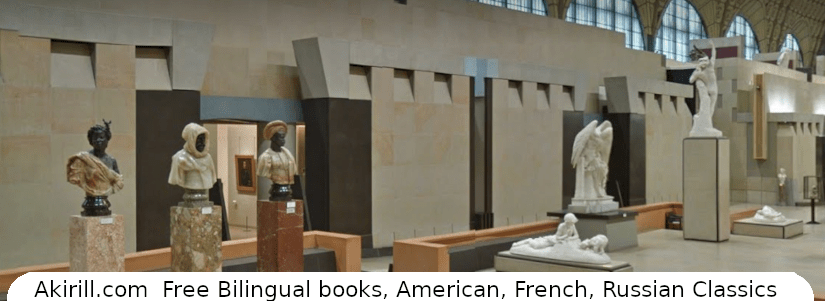
These are a few pictures from my visit of the history of the museum
Then you can visit the paintings by categories
And here are a few pictures of the paintings I visited. If you pass the mouse on a painting the name of the painting and artist shows up. You can also click on the painting which will put it on a whole page with its details.
To go back to the virtual Musée d’Orsey I would advise to click on the go back arrow from your browser, I couldn’t find another way back to the museum.
The last part is the virtual visit of the museum as offer when you first open the site
It is also a beautiful visit, and here a few pictures I took of it
Le tableau « Calme » (Притихло), appelé « paysages d’humeur » est l’une des œuvres les plus célèbres et les plus significatives de Nikolai Dubovskoy (Николай Дубовской). Il s’agit d’un paysage qui est une huile sur toile de 76,5 X 128 cm achevé en 1890 et appartenant aujourd’hui au Musée d’État russe de Saint-Pétersbourg. La peinture a été exposée pour la première fois à la 18ème exposition de l’Association de l’Exposition d’Art Itinérante avec un grand succès. L’empereur Alexandre III l’a immédiatement acheté, et Nikolaï Dubovskoy a dû en faire une répétition pour Pavel Tretiakov qui voulait également l’acheter. La répétition de 86 X143 cm se trouve à la Galerie d’État Tretiakov à Moscou.
Nikolai Dubovskoy – Quiet – 1890
Lors de la peinture du tableau «Calme», l’artiste a utilisé un croquis peint sur la côte baltique. Dans l’une de ses lettres, Nikolai Dubovskoy a écrit: « Le motif de la création de cette image était ce sentiment excitant qui a pris possession de moi à plusieurs reprises en observant la nature à un moment de silence avant un gros orage ou dans les intervalles entre deux orages, quand il est difficile de respirer, quand vous sentez votre insignifiance à l’approche des éléments. Cet état de nature – le silence avant un orage – peut être exprimé en un mot, «Calme». C’est le titre de mon tableau. »
Il y a plusieurs autres répétitions de l’auteur de la peinture. L’une de 1896, se trouve au musée d’art de Poltava. Une autre, datée de 1913-1915, appartient au musée d’art régional de Samara.
Il y a aussi une répétition d’auteur non datée qui se trouve au Musée régional des beaux-arts de Rostov, ainsi qu’au Musée national d’art de Biélorussie. Il y a une répétition intitulée « Un nuage approche » de 1912 qui se trouve au Musée Novocherkassk de l’histoire des Cosaques du Don.
La collection Musée-Réserve historique, artistique et architectural de Vladimir-Souzdal comprend également une répétition de l’huile sur toile de 69 × 112 cm des années 1890, et dans la galerie d’art régionale de Vologda, il y a une répétition de « Calme. Un nuage arrive », daté de 1912.
A cloud is coming (1912, NMIDC)
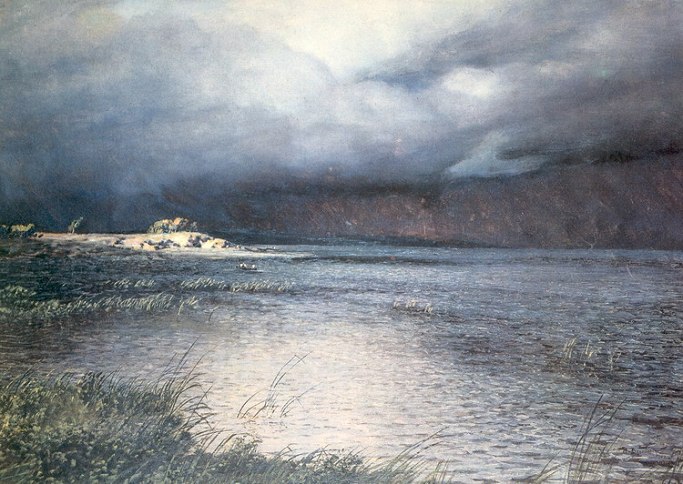
Une autre de 1890, également une huile sur toile de 85,6 × 133 cm est dans la collection du Zimmerli Museum de l’Université Rutgers situé à New Brunswic, New Jersey, États-Unis.
Quiet (1890, Zimmerli Museum, USA)
Description de la peinture
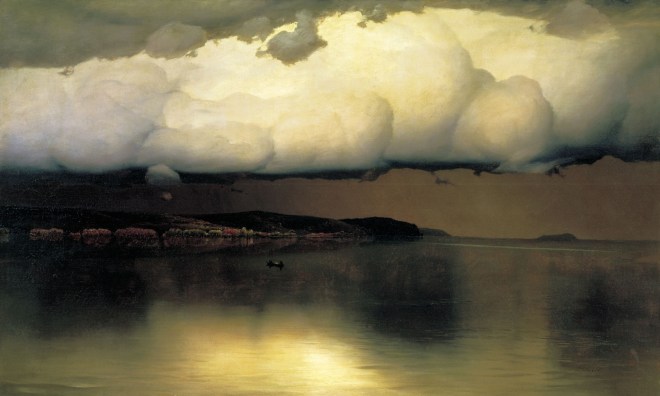
La peinture représente un paysage marin. Des nuages d’orage occupant presque toute la partie supérieure, pendent au-dessus de l’eau. Leur partie supérieure éclairée par le soleil ressemble à du coton blanc et la partie inférieure est remplie de noirceur inquiétante.
Nikolai Dubovskoy – Quiet – 1890
Il n’y a pas de vent, et les nuages clairs et sombres se reflètent dans l’eau lisse et noircie.
Au loin, vous pouvez voir la bande sombre de la côte, sur laquelle se trouvent des maisons d’un village. Les cimes rouge orangé vif des arbres et des buissons, se détachant sur le fond d’une forêt sombre, soulignent la tension de l’atmosphère.
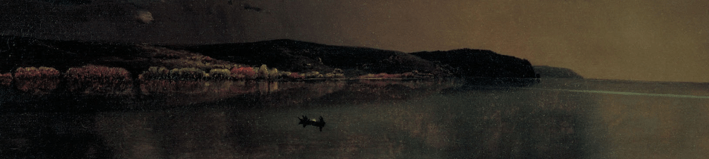
Nikolai Dubovskoy – Quiet – 1890 -part boat
Si vous regardez de près, sur la surface lisse et presque brillante de l’eau, vous pouvez voir un petit bateau qui se déplace vers le rivage avec un rameur. Mais la terre est encore loin, ce qui ne peut qu’inspirer la peur chez le propriétaire de ce bateau. Il semble que ce petit navire soit tellement sans défense contre un orage qui approche qu’il est sur le point de se perdre quelque part dans les vagues de la mer.
L’état de nature tendu avant la tempête est clairement ressenti, en regardant les nuages de pluie menaçants, il semble que quelque chose de terrible est sur le point de se produire. Mais le sentiment d’impuissance d’une personne devant les éléments naturels, exprimé par Dubovsky dans le tableau « Calme », ne doit pas être pris comme son contenu principal. On ne peut pas supposer que le but de l’artiste était la glorification des éléments et son pouvoir sur les gens. En témoigne le fait que pour l’image, il n’a pas choisi la tempête elle-même, mais le moment qui la précède. Un petit bateau se dirigeant vers le rivage et s’efforçant de l’atteindre le plus rapidement possible ne souligne pas du tout l’impuissance d’une personne car nous ne savons pas si le rameur atteindra le rivage en toute sécurité, cependant, dès que nous le remarquons, nous ne pouvons que souhaiter qu’il atteigne le rivage en toute sécurité.
J’espère que vous avez apprécié cette peinture autant que moi
Si vous avez aimé cet article, abonnez-vous, mettez des likes, écrivez des commentaires!
The painting “Quiet” (Притихло), which is referred as “landscapes of mood” is one of the most famous and most significant works of Nikolai Dubovskoy (Николай Дубовской). It is a landscape which is an oil on canvas of 76.5 X 128 cm completed in 1890 and now belonging to the State Russian Museum of Saint Petersburg. The painting was first exposed at the 18th exhibition of the Association of Traveling Art Exhibition with great success. Emperor Alexander III immediately purchased it, and Nikolai Dubovskoy had to make a copy for Pavel Tretyakov who also wanted to buy it. The copy of 86 X143 cm is in the State Tretyakov Gallery in Moscow.
Nikolai Dubovskoy – Quiet – 1890
When painting the painting “Quiet”, the artist used a sketch painted on the Baltic coast. In one of his letters, Nikolai Dubovskoy wrote: “The motive for creating this picture was that exciting feeling that took possession of me many times when observing nature at a moment of silence before a big thunderstorm or in the intervals between two thunderstorms, when it is difficult to breathe, when you feel your insignificance at the approach of the elements. This state in nature – the silence before a thunderstorm – can be expressed in one word, “Quiet”. This is the title of my painting.”
There are several more author’s repetitions of the painting. One from 1896, is in the Poltava Art Museum. Another one, dated 1913-1915, belongs to the Samara Regional Art Museum.
There is also an undated author’s repetition is in the Rostov Regional Museum of Fine Arts, as well as in The National Art Museum of Belarus. There is a repetition called “A cloud is approaching” from 1912 which is in the Novocherkassk Museum of the History of the Don Cossacks.
The collection Vladimir-Suzdal Historical, Artistic and Architectural Museum-Reserve also include a repetition of the oil on canvas of 69 × 112 cm from 1890s, and in the Vologda Regional Art Gallery there is a repetition of “Quiet. A cloud is coming”, dated 1912.
A cloud is coming (1912, NMIDC)
Another one from 1890, also an oil on canvas of 85.6 × 133 cm is in the collection of the Zimmerli Museum of Rutgers University situated in New Brunswic, New Jersey, USA.
Quiet (1890, Zimmerli Museum, USA)
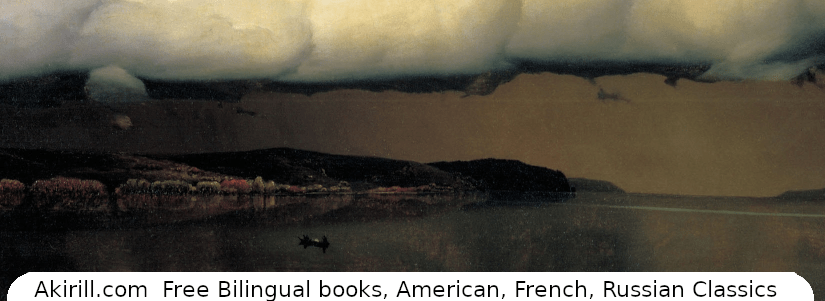
The painting depicts a seascape. Thunderclouds occupying almost the entire upper part, hang over the water. Their upper part illuminated by the sun, resembles white cotton wool, and the lower part is filled with ominous blackness.
Nikolai Dubovskoy – Quiet – 1890
There is no wind, and light and dark clouds are reflected in the smooth and blackened water.
In the distance you can see the dark strip of the coast, on which there are houses of some village. Bright orange-red crowns of trees and bushes, standing out against the background of a dark forest, emphasize the tension of the atmosphere.
Nikolai Dubovskoy – Quiet – 1890 -part boat
If you look closely, on a smooth, almost glossy surface of the water, you can see a tiny boat that is moving towards the shore with a rower. But the land is still far away, which cannot but inspire fear in the owner of this boat. It seems that this small ship is so defenseless against an approaching thunderstorm that it is about to get lost somewhere in the sea waves.
The tense state of nature before the storm is clearly felt, looking at the menacing rain clouds, it seems that something terrible is about to happen. But the feeling of a person’s helplessness in front of the natural elements, expressed by Dubovsky in the painting “Quiet”, should not be taken as its main content. It cannot be assumed that the artist’s goal was the glorification of the elements and its power over people. This is evidenced by the fact that for the image he chose not the storm itself, but the moment preceding it. A small boat heading towards the shore and striving to reach it as quickly as possible does not at all emphasize the impotence of a person as we do not know whether the rower will reach the shore safely, however, as soon as we notice him, we cannot but wish that he reaches the shore safely.
I hope you enjoyed this painting as much as I did
If you liked this article, subscribe , put likes, write comments!
Saviez-vous que vous pouviez visiter le Louvre depuis votre maison ou n’importe quel endroit avec une bonne connexion Internet.
Le Louvre est l’un des musées d’art les plus visités au monde. Il abrite certaines des œuvres d’art les plus connues, notamment la Joconde et la Vénus de Milo, et comprend les meilleures œuvres d’art jusqu’au milieu du XIXe siècle, ainsi que des expositions de civilisations anciennes. Ses collections contiennent de l’art de l’Europe occidentale à l’Iran en passant par la Grèce, l’Égypte et le Moyen-Orient ; de l’Antiquité à 1848.
C’est la première page où choisir votre langue (en haut à gauche) et l’exposition que vous souhaitez visiter virtuellement.
Did you know you could visit the Louvre from your house or any place with a good internet.
The Louvre is one of the most visited art museum in the world. It is the home of some of the best-known works of art, including the Mona Lisa and the Venus de Milo and include the best works of art until the middle of the nineteenth century, as well as exhibits from ancient civilizations. Its collections contains art from Western Europe to Iran through Greece, Egypt and the Middle East; from antiquity to 1848.
This is the first page where to chose your language (on the top left) and the exposition you wish to virtually visit.
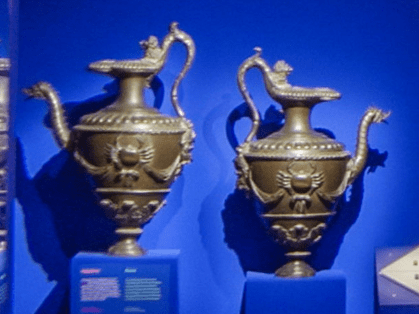
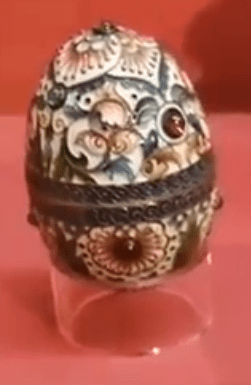
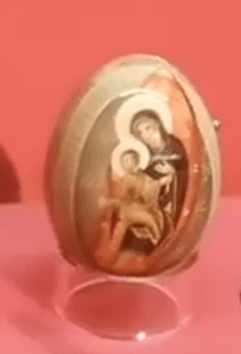
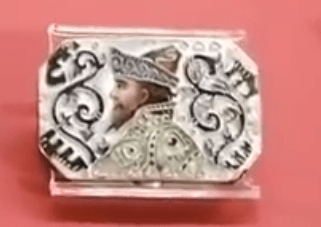
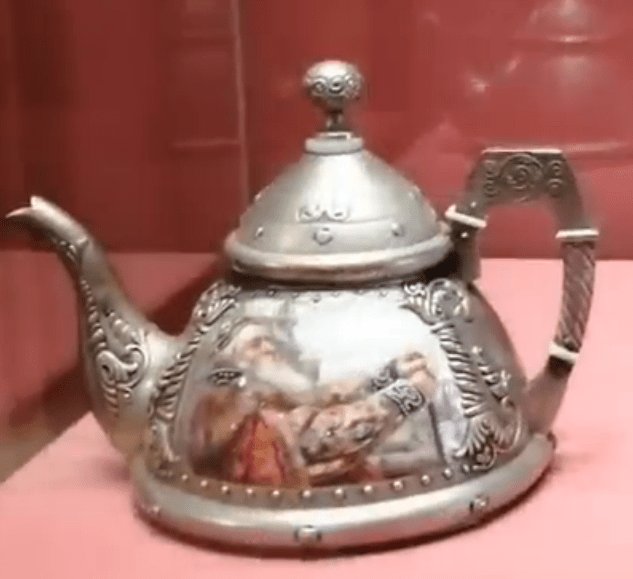
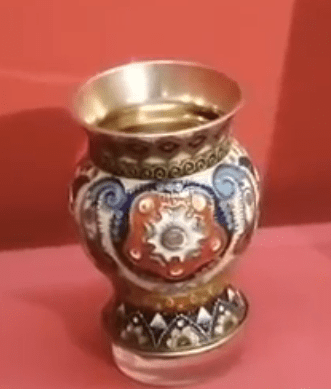
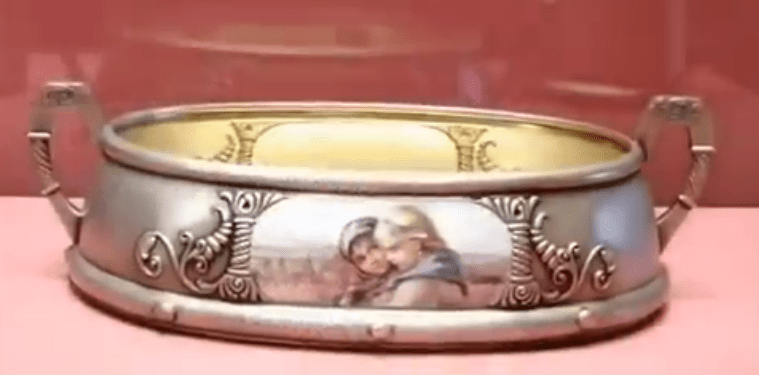
J’ai trouvé une vidéo très courte et agréable d’émail de Moscou à l’exposition Fabergé. J’aurais souhaité de la musique mais il y a des explications en russe pour ceux qui la comprennent. J’ai mis quelques photos de la vidéo et un lien pour que vous puissiez la regarder vous-même et j’espère l’apprécier autant que moi. Le signe montré à la fin de la vidéo dit: Service à thé et café O. Kurlyukov’s compagnie. Moscou. 1908-1917 . Argent, émail, nacre; monnayage, peinture, dorure.
I found a very short and nice video of a Moscow enamel at the Faberge exhibition. I would have wish for music but there are explanation in Russian for those who understand it. I put a few pictures of the video and a link so you can watch it yourself and I hope enjoy it as I did. The sign showed at the the end of the video say: Tea and coffee service O. Kurlyukov’s firm. Moscow. 1908-1917 . Silver, enamel, mother of pearl; coinage, painting, gilding.
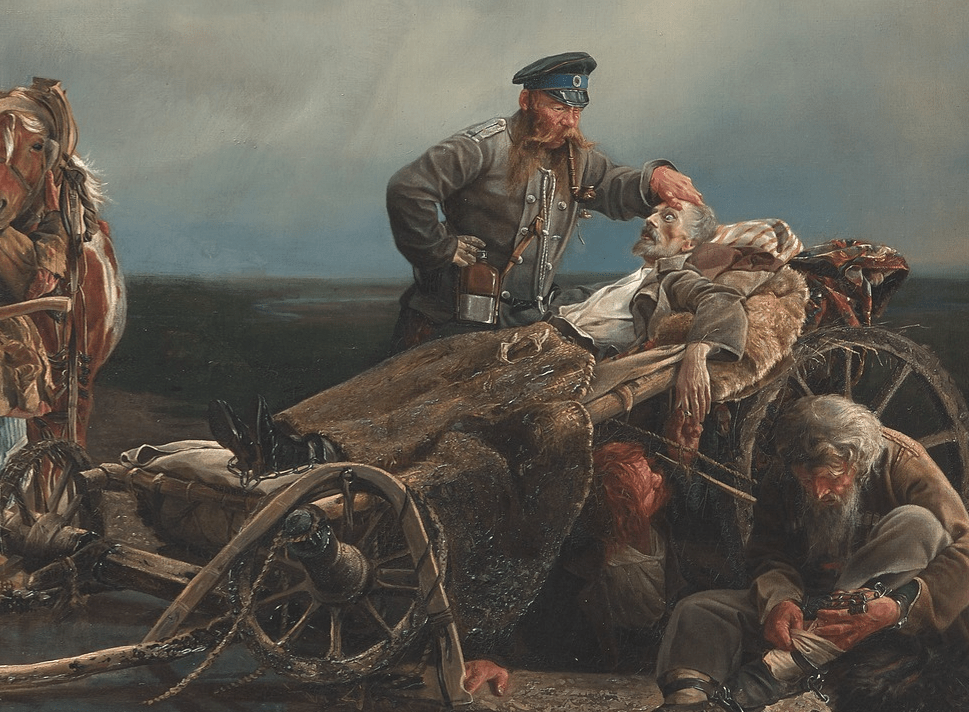
“The Halt of the Prisoners” (Привал арестантов) is a genre painting by the Russian artist Valery Yakobi (Валерия Якоби) completed in 1861. It is an oil on canvas of 98.6 × 143.5 cm situated at the State Tretyakov Gallery. It is difficult to imagine Russian genre painting of the 60s of the XIX century without this painting by Valery Ivanovich Jacobi, who created the true story of the royal penal servitude. It is one of the masterpieces of the 19th century, and this painting by Valery Jacobi immediately entered the history of art.
The painting “Halt of Prisoners” was presented by Valery Yakobi at the end of his studies at the Academy of Arts . For this painting, the Academy awarded him the title of class artist of the 1st degree and also a large gold medal .
In 1861-1862, the canvas was exhibited with great success at the exhibition of the Academy of Arts – the writer Fyodor Dostoevsky noted that Jacobi’s painting “amazes with amazing fidelity” and the public likes it “more than anyone else at the current exhibition”
This work made a great impression on the public, which rather vividly accepted the reforms of Emperor Alexander II.
Critics called this work frank and topical. Everyone was unanimous in their statements: the master managed to portray the actual problems of society. This work became the pinnacle of the artist’s work.
Valery Jacobi was the first of the Russian artists who turned to such a topic. The choice of subject was not accidental. Valery Ivanovich spent his childhood and youth in the east of Russia, where he personally observed the convicts who were driven past the house where the artist lived. Memories were so firmly planted in his head that the picture recreated from memory is striking in its realism and strength.
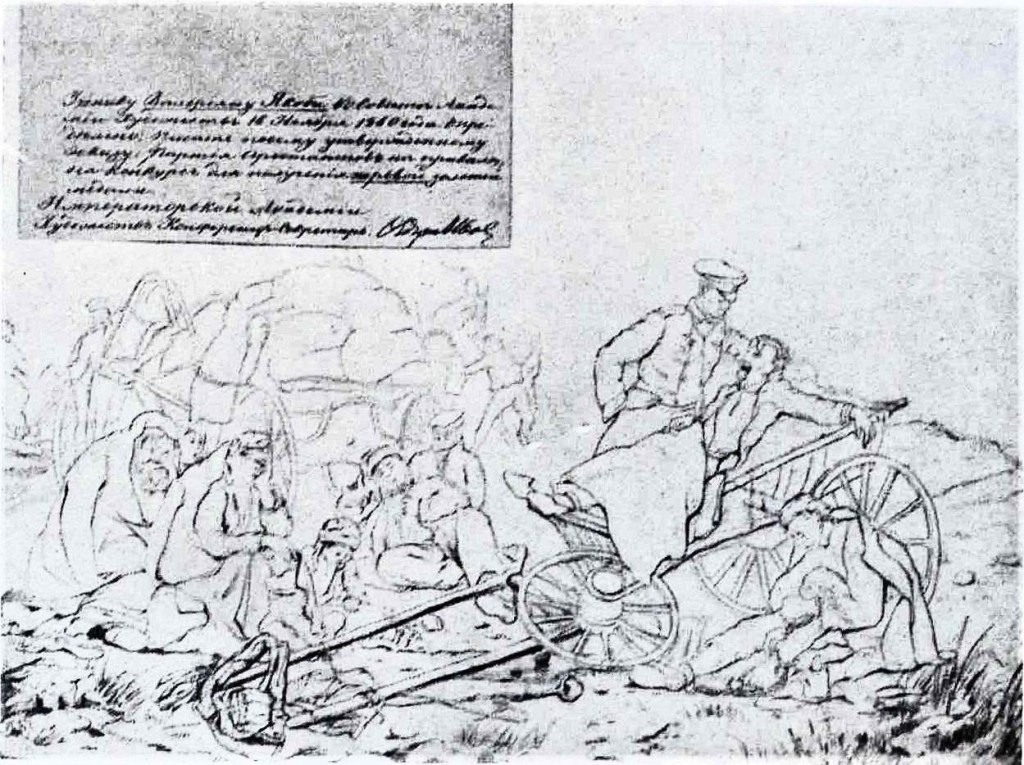
The collection of the State Tretyakov Gallery also contains a graphic sketch for the painting “Halt of Prisoners”
This first compositional sketch for the future canvas was submitted by Valery Jacobi for approval to the Council of the Academy of Arts in 1860. It is made in a purely contour technique, and the figures are outlined by a continuous line .
According to the description of art historian Alexei Sidorov, “from one edge of the figures, this line is thin and resembles a stroke of a cutter or a dry needle in a sketch engraving on copper; from the other edge of the same figures, the line tightens, becomes thicker, blacker, to a certain extent gives the figures <…> relief”; such an interpretation resembles a “marble bas-relief ” .
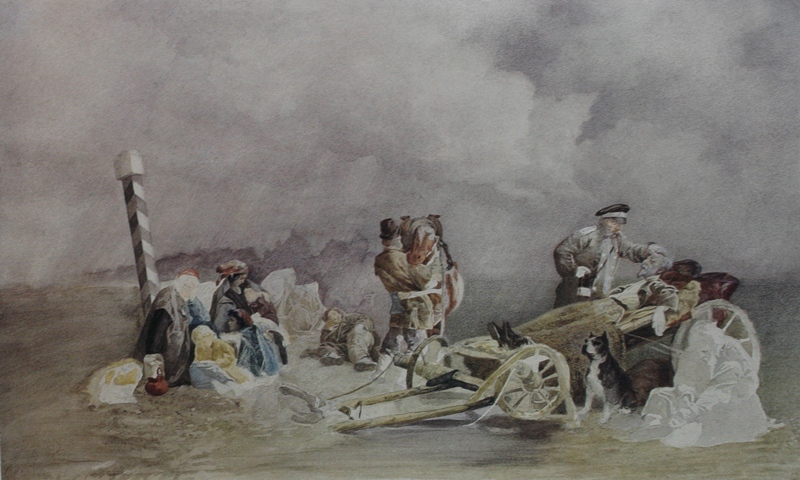
Another sketch of 36.5 × 58.7 cm , was executed in watercolor and white on paper. It is dated from 1861, and is kept in the State Russian Museum . In addition, the Russian Museum owns a reduced copy of the painting of the same name . It is an oil , paper on canvas, from the late 1860s – 1870s which is 53 × 75 cm , and was received in 1963 from the State Museum of the Revolution.
The painting depicts a group of prisoners stopping for a break. Probably, this halt was forced and caused by the breakdown of one of the carts.
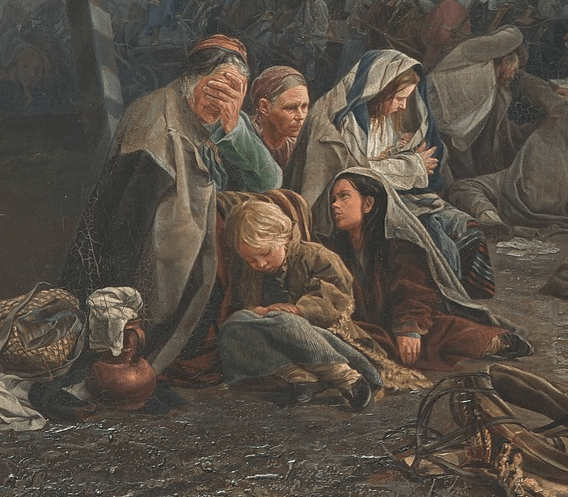
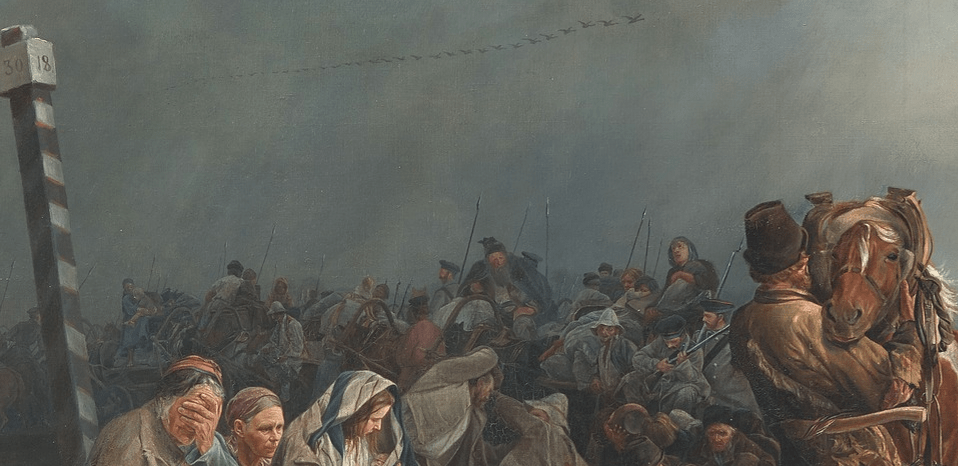
Jacobi concentrates his main attention on the group around the deceased prisoner and the relatives who followed him along the stage, sitting at the milestone. At the same time, the artist uses a traditional academic technique, highlighting the main characters of the picture with light, grouping them in the spirit of classical “pyramids”. He managed to convey a complex range of feelings: from the despair of a family that has lost a person for whom they set off on a grueling journey, to the indifference of a gendarmerie officer who leaned over a dead prisoner. The rest of the exiles are depicted without detail, in gloomy silhouettes. The contrast of a dark stormy sky and bright light breaking through the dense cover of clouds, the predominance of gray and brown tones enhances the drama of the scene.
The Charter “On the Exiles” fixed and regulated the procedure for escorting, the issues of transporting exiles on carts, preventing escapes, women, freemen and the dead.
In this work, Jacobi managed with extraordinary persuasiveness to present various social types – from a tramp to an intellectual-political prisoner, whose life was cut short on the way.
On a broken road under a leaden sky with low rain clouds, standing by the cart is a stage officer, who with indifferent calmness ascertains the death of a prisoner (by opening his eyes), in order to leave him on the road and move on faster.
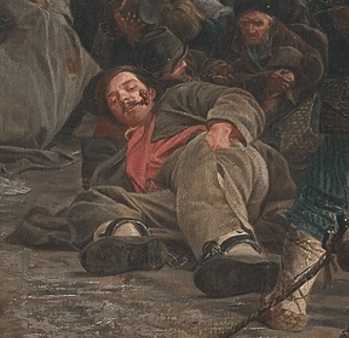
The central character of the composition is the deceased prisoner. He has an intelligent appearance, but is so emaciated that he looks like an old man. The dead prisoner is covered with matting . On his left hand, hanging lifelessly down, he wears a ring. The effect of the hopelessness of life is enhanced by another detail: another prisoner crept under the cart and is trying to pull off the ring from the finger of the deceased. In such a critical situation, the human essence is manifested.
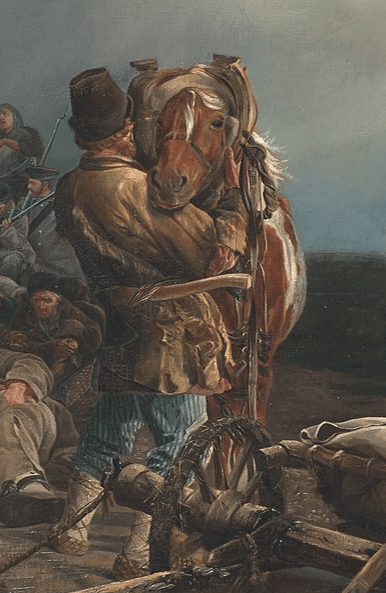
A man, dressed in a heavily torn caftan , is holding a harnessed horse.
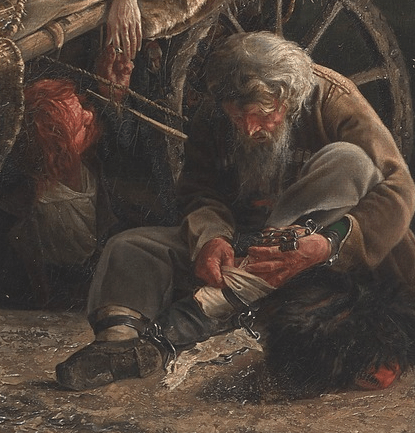
On the right side of the picture in the foreground is a seated prisoner in rags, who examines the wound on his leg, rubbed with shackles .
In the left corner of the picture are the families of prisoners who voluntarily went into exile along with their husbands and fathers. They are exhausted and weakened. However, no one retreats and they will go all the way to the end, but not everyone will return. They are already mourning the dead…
Nearby, a prisoner is seen smoking a pipe. It seems that he is completely indifferent to his own fate, he just goes with the flow, not thinking about tomorrow.
The plot continues with a group of fighting people and a long line of exiles, escorted by a convoy, lost in the distance… This horizontal line is emphasized by a thin parallel line of a flock of birds, dissolving into the clouds. The whole scene is depicted by the artist against the backdrop of an open autumn steppe, under a sky covered with heavy gray clouds. The bleak landscape only enhances the gloomy impression that the picture makes ….
I hope you enjoyed this painting as much as I did
If you liked this article, subscribe , put likes, write comments!.

























 AKirill, Learn, apprenez, translation, traduction, livres bilingues, bilingual books