
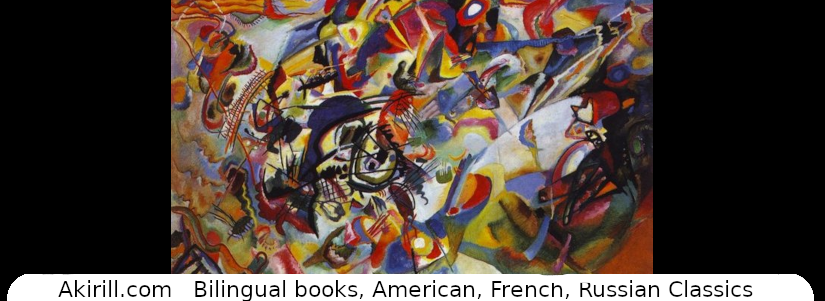
Wassily Vasilyevich Kandinsky is the founder and theorist of abstract art, and one of the most influential artists of the 20th century. Even though he was not the first to paint a canvas of this kind, he was the first to give a theoretical justification to the new trend. In 1912, he wrote and published his seminal study On the Spiritual in Art, which became the theoretical basis of abstractionism.

Kandinsky was a synesthetic which means he heard colors and saw sounds and he was looking for an universal synthesis of music and painting. Through drawings he imitated the flow and depth of musical work and the coloring reflected the theme of deep contemplation.
“Composition VII” is called the pinnacle of his work. It is a huge canvas of 2 by 3 meters created in 1913. The process for writing Composition VII was very meticulously done and there were more than 30 sketches, watercolors and oils paintings of preparatory work. The raison of such an important preparative work was that the artist had set himself the task of combining several biblical themes in the final composition. These were “The Last Judgement”, “The Flood”, “The Resurrection from the Dead” and “The Garden of Eden”.
To understand Kandinsky is easy as he has already described everything with such fine explanations that there is a decoding of every spot, every point, and every turn of the line leaving you only to look at the canvas and feel.
And if you look at the picture from the position of Kandinsky’s attitude to form and color, you notice that the dominant colors of the canvas is red which is a symbol of strength, then blue which is the color of peace and white symbolizing eternity. There is also a yellow color which the author has always characterized as frivolous and rapidly scattered.
The color content is supported by a well-thought-out composition of the work which is a diagonally unfolding form, closed in the rectangular space of the canvas. The central motif was declared to be an oval shape by the artist, and is crossed by many irregular rectangles.
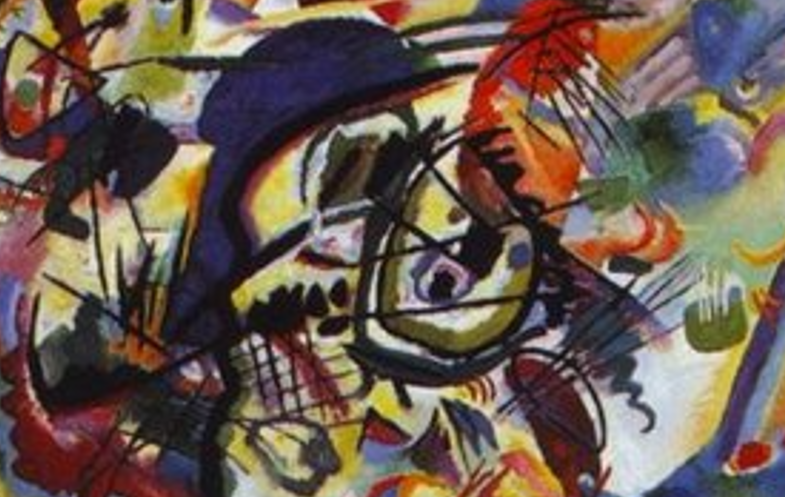
The idea of the human soul is displayed in the semantic center of the canvas as a circle marked with a purple spot and black lines and strokes next to it. It draws in itself, like a funnel, spewing out some rudiments of forms, spreading in countless metamorphoses
Art historians determined thanks to his notes and works that the VII composition is a combination of several themes (“The Resurrection from the Dead”, “Judgment Day”, “The Flood” and “The Garden of Eden”) expressed as a symbiosis of pure painting
| If you liked this article, subscribe , put likes, write comments!. |
| Share on social networks |
| Check out Our Latest Posts |
- Poèmes et peinture, semaine du 29 mars 2026
- Poems and painting, Week of March 29, 2026
- Poèmes et peinture, semaine du 22 mars 2026
- Poems and painting, Week of March 22, 2026
- Poèmes et peinture, semaine du 15 mars 2026
- Poems and painting, Week of March 15, 2026
Sources: История одного шедевра: «Композиция VII» Кандинского
 AKirill, Learn, apprenez, translation, traduction, livres bilingues, bilingual books