
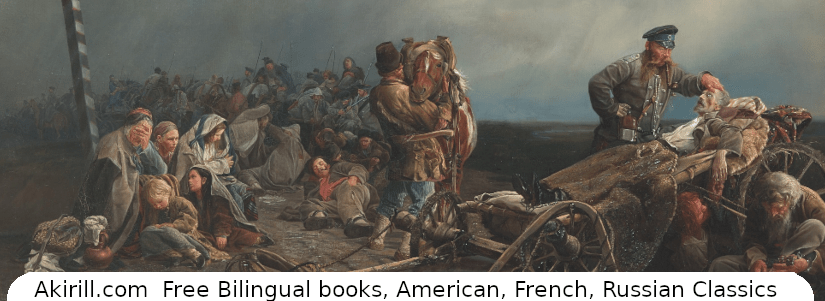
“The Halt of the Prisoners” (Привал арестантов) is a genre painting by the Russian artist Valery Yakobi (Валерия Якоби) completed in 1861. It is an oil on canvas of 98.6 × 143.5 cm situated at the State Tretyakov Gallery. It is difficult to imagine Russian genre painting of the 60s of the XIX century without this painting by Valery Ivanovich Jacobi, who created the true story of the royal penal servitude. It is one of the masterpieces of the 19th century, and this painting by Valery Jacobi immediately entered the history of art.
The painting “Halt of Prisoners” was presented by Valery Yakobi at the end of his studies at the Academy of Arts . For this painting, the Academy awarded him the title of class artist of the 1st degree and also a large gold medal .
In 1861-1862, the canvas was exhibited with great success at the exhibition of the Academy of Arts – the writer Fyodor Dostoevsky noted that Jacobi’s painting “amazes with amazing fidelity” and the public likes it “more than anyone else at the current exhibition”
This work made a great impression on the public, which rather vividly accepted the reforms of Emperor Alexander II.
Critics called this work frank and topical. Everyone was unanimous in their statements: the master managed to portray the actual problems of society. This work became the pinnacle of the artist’s work.

Valery Jacobi was the first of the Russian artists who turned to such a topic. The choice of subject was not accidental. Valery Ivanovich spent his childhood and youth in the east of Russia, where he personally observed the convicts who were driven past the house where the artist lived. Memories were so firmly planted in his head that the picture recreated from memory is striking in its realism and strength.
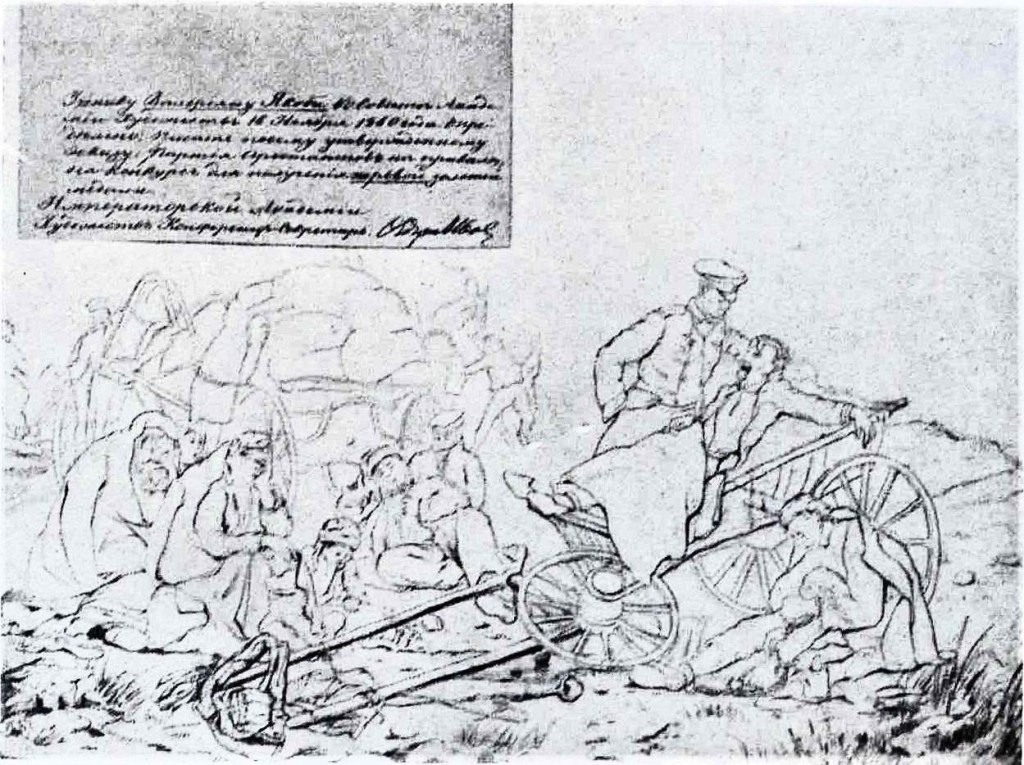
The collection of the State Tretyakov Gallery also contains a graphic sketch for the painting “Halt of Prisoners”
This first compositional sketch for the future canvas was submitted by Valery Jacobi for approval to the Council of the Academy of Arts in 1860. It is made in a purely contour technique, and the figures are outlined by a continuous line .
According to the description of art historian Alexei Sidorov, “from one edge of the figures, this line is thin and resembles a stroke of a cutter or a dry needle in a sketch engraving on copper; from the other edge of the same figures, the line tightens, becomes thicker, blacker, to a certain extent gives the figures <…> relief”; such an interpretation resembles a “marble bas-relief ” .
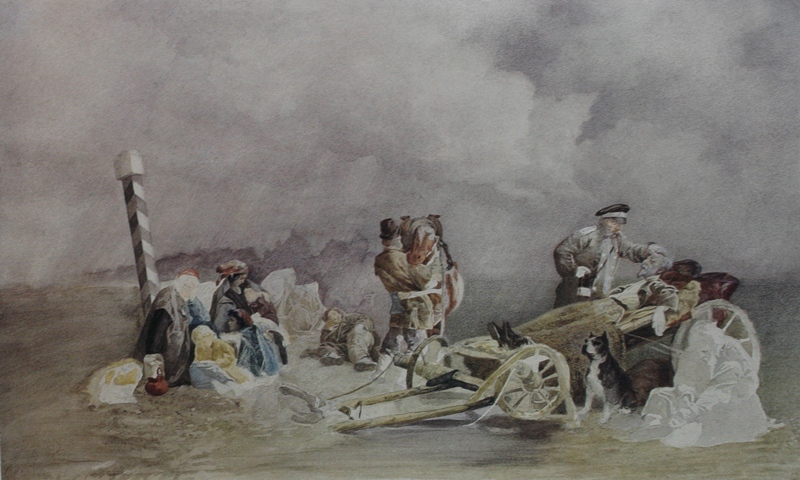
Another sketch of 36.5 × 58.7 cm , was executed in watercolor and white on paper. It is dated from 1861, and is kept in the State Russian Museum . In addition, the Russian Museum owns a reduced copy of the painting of the same name . It is an oil , paper on canvas, from the late 1860s – 1870s which is 53 × 75 cm , and was received in 1963 from the State Museum of the Revolution.
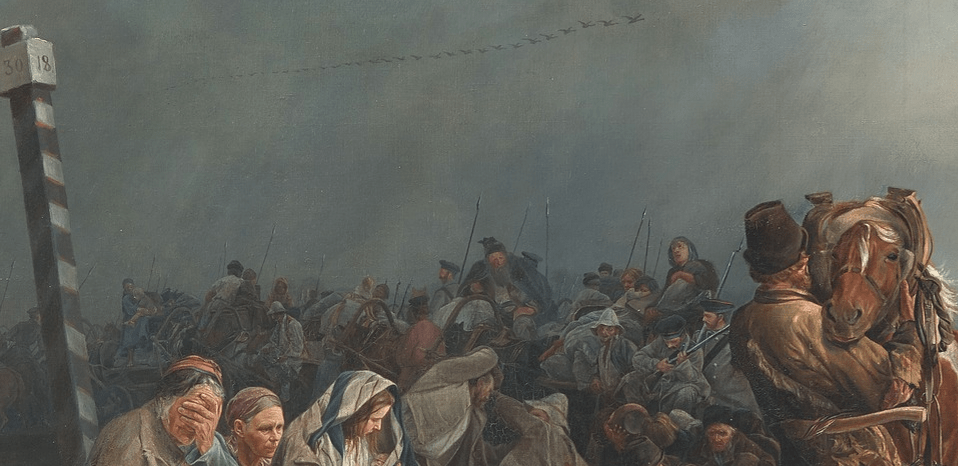
The painting depicts a group of prisoners stopping for a break. Probably, this halt was forced and caused by the breakdown of one of the carts.
Jacobi concentrates his main attention on the group around the deceased prisoner and the relatives who followed him along the stage, sitting at the milestone. At the same time, the artist uses a traditional academic technique, highlighting the main characters of the picture with light, grouping them in the spirit of classical “pyramids”. He managed to convey a complex range of feelings: from the despair of a family that has lost a person for whom they set off on a grueling journey, to the indifference of a gendarmerie officer who leaned over a dead prisoner. The rest of the exiles are depicted without detail, in gloomy silhouettes. The contrast of a dark stormy sky and bright light breaking through the dense cover of clouds, the predominance of gray and brown tones enhances the drama of the scene.
| Help the site stay free, buy us a cup of coffee |  | Aidez-nous à maintenir le site gratuit en nous offrant une tasse de café |
The Charter “On the Exiles” fixed and regulated the procedure for escorting, the issues of transporting exiles on carts, preventing escapes, women, freemen and the dead.
In this work, Jacobi managed with extraordinary persuasiveness to present various social types – from a tramp to an intellectual-political prisoner, whose life was cut short on the way.
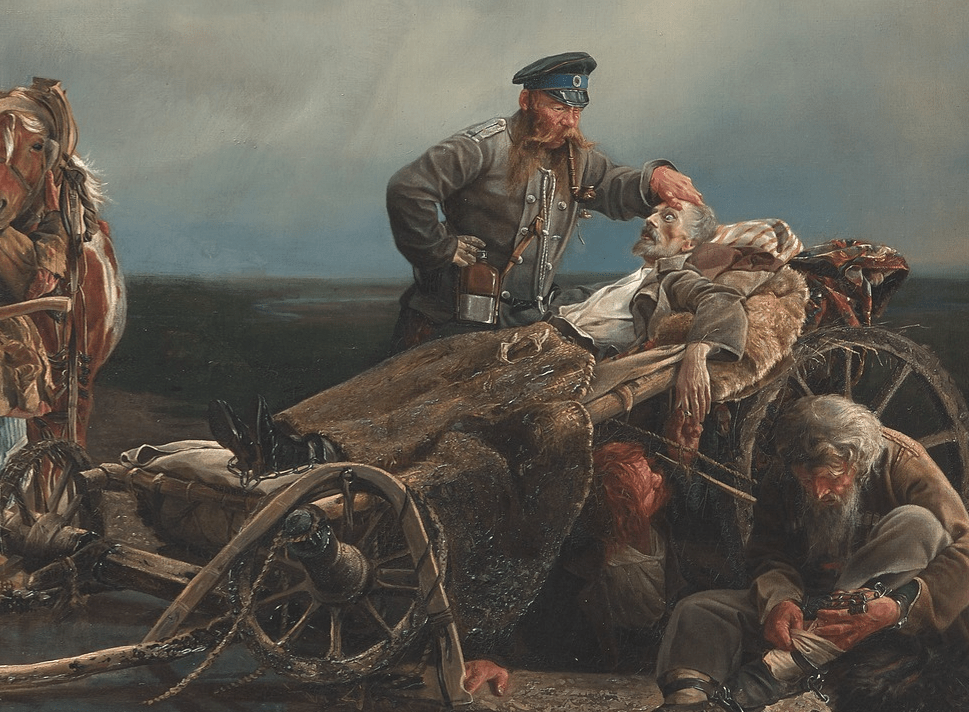
On a broken road under a leaden sky with low rain clouds, standing by the cart is a stage officer, who with indifferent calmness ascertains the death of a prisoner (by opening his eyes), in order to leave him on the road and move on faster.
The central character of the composition is the deceased prisoner. He has an intelligent appearance, but is so emaciated that he looks like an old man. The dead prisoner is covered with matting . On his left hand, hanging lifelessly down, he wears a ring. The effect of the hopelessness of life is enhanced by another detail: another prisoner crept under the cart and is trying to pull off the ring from the finger of the deceased. In such a critical situation, the human essence is manifested.
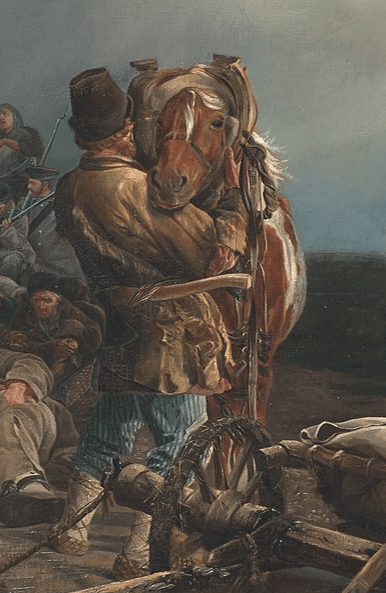
A man, dressed in a heavily torn caftan , is holding a harnessed horse.
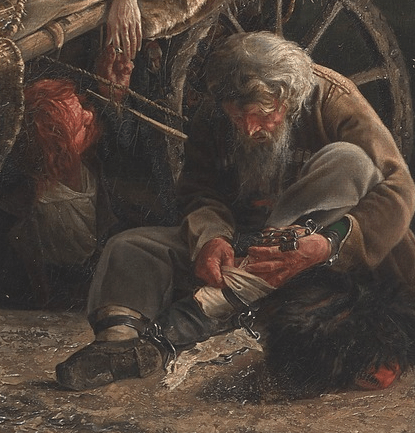
On the right side of the picture in the foreground is a seated prisoner in rags, who examines the wound on his leg, rubbed with shackles .
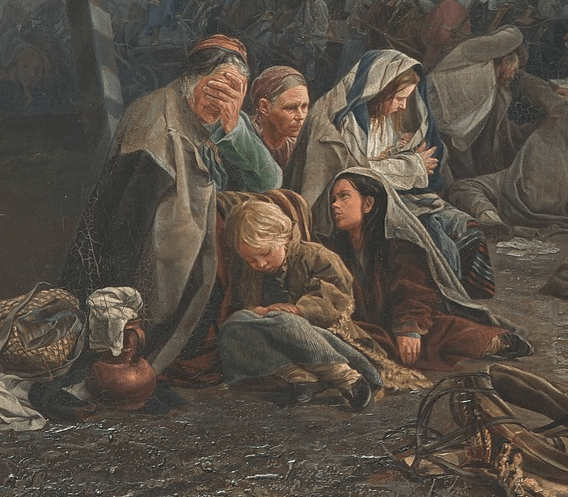
In the left corner of the picture are the families of prisoners who voluntarily went into exile along with their husbands and fathers. They are exhausted and weakened. However, no one retreats and they will go all the way to the end, but not everyone will return. They are already mourning the dead…
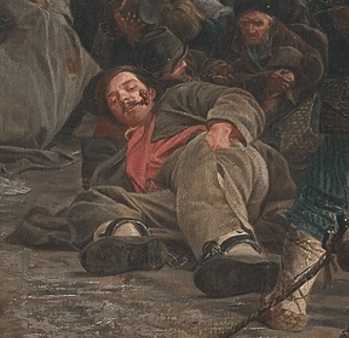
Nearby, a prisoner is seen smoking a pipe. It seems that he is completely indifferent to his own fate, he just goes with the flow, not thinking about tomorrow.
The plot continues with a group of fighting people and a long line of exiles, escorted by a convoy, lost in the distance… This horizontal line is emphasized by a thin parallel line of a flock of birds, dissolving into the clouds. The whole scene is depicted by the artist against the backdrop of an open autumn steppe, under a sky covered with heavy gray clouds. The bleak landscape only enhances the gloomy impression that the picture makes ….
I hope you enjoyed this painting as much as I did
| If you liked this article, subscribe , put likes, write comments!. |
| Share on social networks |
| Check out Our Latest Posts |
 AKirill, Learn, apprenez, translation, traduction, livres bilingues, bilingual books