

“Plowman L.N. Tolstoy on arable land” was painted by Ilya Efimovich Repin in 1887. It is an oil painting on cardboard of 27.8 X 40.3 cm situated in the State Tretyakov Gallery in Moscow. It is a household portrait painted in a realistic style, which is similar to a photograph. This painting, despite the ambiguous opinion of his contemporaries and numerous caricatures, remains one of the canonical images of the outstanding classic of Russian literature.
The lithograph from the painting was published in 1887 by A. A. Ilyin’s Cartographic Establishment. . We know that the publication aroused the displeasure of the Tolstoy family, who considered it undesirable “to distribute a picture depicting him in his most intimate life, because of a letter dated september 28, 1887 in which the family’s wish “not to expose this drawing to the public, not to distribute and not to sell” was expressed. Only on November 10, 1887 will Tolstoy agree to the publication as a result of his correspondence with V.V. Stasov, V.G. Chertkov, I.E. Repin and N.N..

For a week in August 1887, Repin stayed with the Tolstoys in Yasnaya Polyana. There he painted two large pictorial portraits of Tolstoy, and in addition, the artist made many drawings from the inhabitants of Yasnaya Polyana and a small pictorial painting “Plowman L.N. Tolstoy on arable land”. This small picture has not only artistic significance, but also documentary value.
We know that in the 1970s, a profound turning point took place in Tolstoy’s life. Like the hero of his story “After the Ball” Ivan Vasilyevich, the writer was painfully looking for an answer to the question: “How to live?”. He strove to leave that circle of wealthy people who do not know labor, but to which he belonged by birth. Tolstoy wanted to fill his life with work; He created novels, taught children at the school he founded, plowed the land, helping the poorest peasants, learned to make boots, etc. He considered simple physical labor to heal a person both physically and spiritually.
Repin recalled how the painting “Plowman L.N. Tolstoy on arable land” appeared:
“One hot August day, in the very sun, after breakfast, Lev Nikolayevich was going to plow the widow’s field … For six hours, without rest, he plowed the black earth with a plow, then going uphill, then going down the sloping terrain to the ravine. I had an album in my hands, and, without wasting time, I stood in front of the middle of the line of his passage and caught the features of the moment the entire cortege passes by me. This lasted less than a minute, and, to double the time, I made a transition through the plowing to the opposite point, about twenty paces away, and stood there again, waiting for the group. I checked only the contours and size ratios of the shapes; shadows after, from one point, at one moment.”
Repin made a sketch in his notebook, on which he later painted the original. The work was created in his usual technique: without fine detail, he was able to convey the impression of live action.

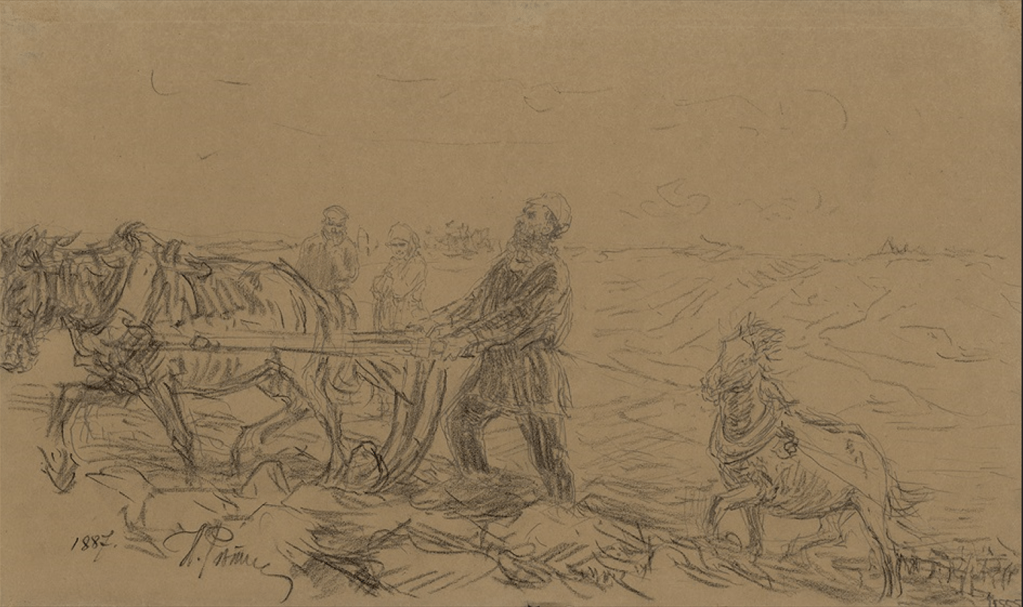
Another, less known sketch also attributed to Repin has been preserved. On this one, the famous plowman seems arrogant, and the peasants watching him look with irony. Each of the horse appears to have its own character: one meekly “corrects its service”, the other seems to demonstrate liveliness and rebelliousness .
Description of the painting
In the center are two white horses. One is harnessed to the plow, the second pulls the harrow. The horses are not from the master’s stables: the ridge and mosses appear, the bellies sag, which is typical when feeding with hay alone.
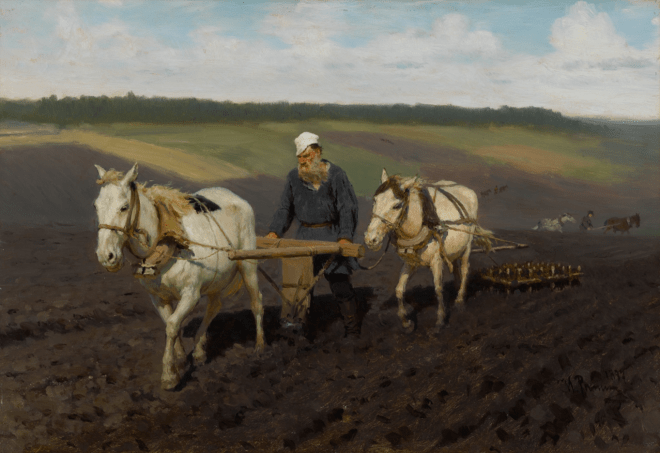
The whole appearance of Tolstoy, his demeanor is emphasized, simple, ordinary, everyday and at the same time deeply meaningful, individual. He does not look at the viewer, giving all his attention to his work. It gives the impression of a randomly seen scene. In Tolstoy we see a purely Russian face, more like a peasant than an aristocratic gentleman, ugly, with irregular features, but very significant, intelligent; a taut, proportionate figure, in which one can see the peculiar grace and free naturalness of a well-mannered person – such is that versatile and extremely specific characteristic of Tolstoy’s appearance, which makes him unlike anyone else. The careful fixation of all these features allowed Repin to convincingly convey through the external appearance the essence of the nature of the person being portrayed, all its complexity and inconsistency. Having portrayed the famous writer, busy with simple peasant labor , the artist managed to convey the calm and everyday life of what is happening.
Using soft colors, Repin gave a natural shade to the plowed land, greenish-yellow fields that have not yet been touched by a plow, a gray strip of forest on the horizon.
| Help the site stay free, buy us a cup of coffee |  | Aidez-nous à maintenir le site gratuit en nous offrant une tasse de café |
The plot of Repin’s work was widely replicated during the lifetime of the classic. It could be seen on knife handles, porcelain, cologne bottles, various embroideries and souvenirs. In 1908, a whole series was published to coincide with the writer’s anniversary. Sometimes such popularity gave rise to jokes. One of them: “They report to Tolstoy:“ Sir, it’s time to plow. ”
I hope you enjoyed this painting as much as I did. You can also check out our article about Leo Nikolayevich Tolstoy: Who is Leo Nikolayevich Tolstoy?
| If you liked this article, subscribe , put likes, write comments!. |
| Share on social networks |
| Check out Our Latest Posts |
 AKirill, Learn, apprenez, translation, traduction, livres bilingues, bilingual books