
| Livres bilingues | Read in English | Nous contacter |
| Littérature américaine | Littérature française | Littérature russe |
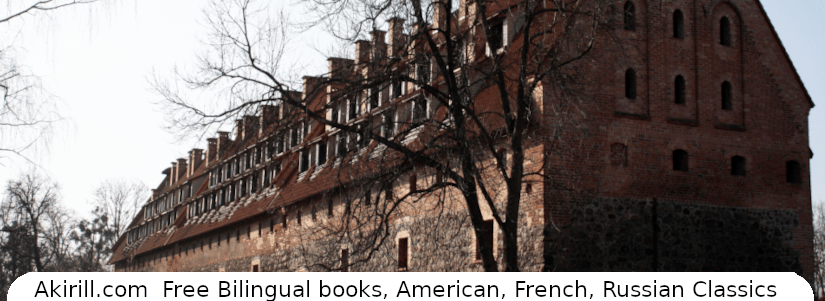
Le château de Preussisch Eylau est un château de l’Ordre Teutonique construit en 1325 et situé à Bagralionovsk, près de Kaliningrad. Il a reçu le statut de site du patrimoine culturel d’importance régionale par décret du gouvernement de Kaliningrad le 23 mars 2007. Le 11 octobre 2022, il a été vendu 7,6 millions de roubles à la société “GreenArtDevelopment” quatre ans après sa mise en vente. aux enchères

Dans les documents historiques, la première mention du château se produit en 1326, où il est appelé “Ile”, dans les archives de 1342 le nom mentionné est “Iladia”, en 1400 il s’appelle “Preissish-Ilov” (Preussisch-eylau). nom qui lui est resté.
Le grand maître de l’Ordre Teutonique Werner von Orseln ordonna la construction du château d’Ile en 1325. Le but principal de la forteresse était de protéger la capitale de la région Krulevets (Koenigsberg) du sud. Le commandant de Balga, maître Arnold von Eilenstein a supervisé la construction du château de Preussisch Eylau, qui à l’origine a été réalisé en pierres et en briques sur le site de la forteresse prussienne de Sutvrit.
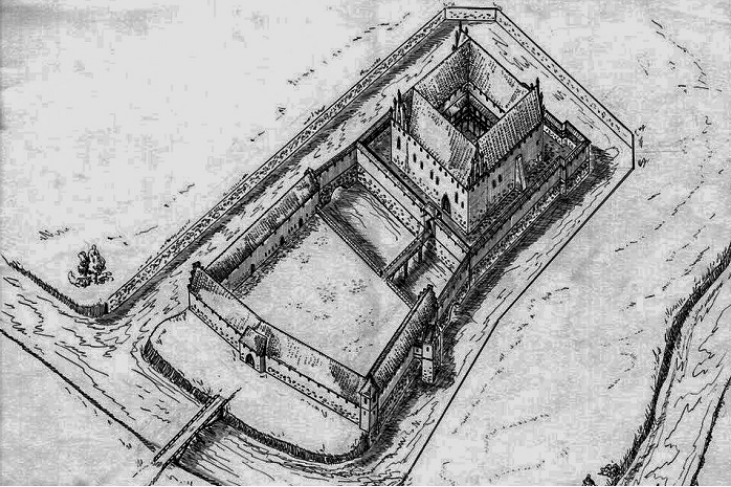
Un barrage avec un moulin a été construit, le niveau de l’eau est monté et le château s’est retrouvé sur une île. En 1330, une fortification en pierre de forme carrée de 41 m x 43 m a été édifiée, entourée de douves, d’une porte herse, d’une tour et d’un pont-levis. Un grand forburg de 120 x 140 mètres, qui était entouré de ses propres douves et d’un mur de forteresse de 1,6 mètre d’épaisseur avec un passage défensif, a été attaché à la fortification du côté est. Il y avait des écuries, une brasserie, des locaux pour les soldats de l’ordre, des ateliers de fabrication d’armes, une boulangerie, et d’autres dépendances.
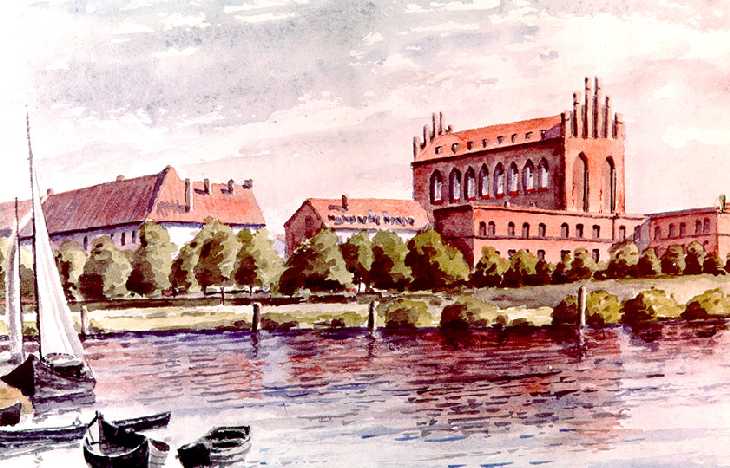
By Sendker -, CC BY-SA 3.0,
L’entrée principale de la citadelle du château Preussisch-Eylau se trouvait dans l’aile est du forburg. La chapelle du château qui était un attribut obligatoire d’un château d’ordre typique se trouvait dans l’aile sud, et une tour sanitaire se trouvait dans la partie nord.
Le premier étage était occupé par des dépendances, dont la cuisine, située sous le réfectoire, et des pièces de service. Au deuxième étage de l’aile ouest se trouvaient le logement et la résidence des frères de l’ordre, qui comprenait un réfectoire, une salle de réunion, les chambres des moines et les chambres occupées par le régisseur du château. Le troisième étage remplissait des fonctions défensives et était équipé d’un passage militaire et de meurtrières. Il y avait aussi une petite tour de guet ronde dans le coin nord-est. Pour avoir un accès facile à l’eau il y avait un puits dans la cour du château.
Jusqu’en 1347 le château de Preussisch Eylau fut la résidence de l’Ordre Pfleger, puis il abrita l’administration du Kammerat, appartenant à la commanderie de Balga.
En 1400, après avoir été frappé par la foudre, toutes les parties en bois du château ont brûlé. Puis le château de Preussisch Eylau passa au Grand Maître de l’Ordre Teutonique Heinrich von Plauen pour le service militaire en 1429.
/Photo: mif-mira.ru
Le château de Preussisch Eylau a été capturé et partiellement endommagé par la population rebelle en 1454 mais il a été repris la même année et les dégâts ont été réparés.
Il a encore été attaqué en mai 1455 par une armée alliée à la Pologne qui n’est pas parvenue à s’en emparer alors que la garnison protégeant le château n’était composée que de deux douzaines de chevaliers et de soixante miliciens. Un siège n’a pas non plus réussi puisque de l’aide a été envoyée au château et que l’armée alliée à la Pologne a été vaincue.
Il y eut une autre tentative infructueuse de prendre le château en octobre 1455.
Le château de Preussisch Eylau et les terres environnantes ont été transférés à Heinrich Reuss von Plauen pour une utilisation à vie en 1492.
Plus de 4000 mercenaires polonais attaquèrent à nouveau le château en 1519, mais la garnison du château dirigée par le chevalier Friedrich Truchses Weltburg et le commandant de Courlande Firike repoussa les attaques successives.

Le château devint la résidence du domaine départemental de Hauptmann Preussisch Eylau en 1525 après une réforme et l’abolition de l’Ordre Teutonique. Puis il reçut les droits de la ville en 1585, et en 1587 ses armoiries.
À la fin du XVIIIe siècle, le château avait perdu sa vocation et une partie de son bâtiment a été démontée et utilisée pour construire de nouvelles structures.
Un incendie a endommagé le château de Preussisch Eylau en 1802 mais il ne fut pas restauré et le Forburg fut utilisé à des fins économiques. En 1814, il a été acheté par Heinrich Sigismund Valentini qui a construit une nouvelle maison à un kilomètre au nord-ouest du château après que le château ai commencé à s’effondrer dû à l’absence d’une partie du toit.
En 1831, un nouveau manoir Henrettenhof a été construit dans le style néoclassique. Il se trouve sur les fondations du fort de la forteresse Preussisch Eylau entre l’aile est, et la grange.
| Help the site stay free, buy us a cup of coffee |  | Aidez-nous à maintenir le site gratuit en nous offrant une tasse de café |
L’ancien manoir situé sur le territoire du château de Preussisch Eylau a été donné au magistrat de la ville de Preussisch-Eylau en 1932, et cette même année un musée couvrant la période de l’histoire de la région de l’âge de pierre aux événements de la Première Guerre mondiale y a été ouvert. Malheureusement, dans la période d’après-guerre, le bâtiment a été complètement démantelé.
Pendant la Seconde Guerre mondiale, le château n’a pas été gravement endommagé, et les quartiers d’habitation ont été utilisés jusqu’au début des années 1960.
Le château de Preussisch Eylau et le forburg ont été transférés à l’union des consommateurs du district en 1961 et ont été utilisés comme entrepôts.
En 1964, les bâtiments du château et le forburg ont été examinés par des employés des ateliers centraux scientifiques et de restauration du ministère de la Culture de l’URSS. L’état du château était très mauvais, car il n’a jamais été réparé après la guerre.
Un stand de tir a été construit à l’emplacement de l’aile ouest, qui a été démolie dans les années 1990. Dans le forburg survivant, le toit a commencé à s’effondrer à cause de chevrons pourris, des trous sont apparus en 1989 et en août 1990, la partie centrale a brûlé.
Au début des années 1990, il a été décidé de transformer le forburg en hôtel avec bar, mais l’idée a été abandonné.
Le 5 juin 2016, un incendie s’est déclaré dans le château, détruisant une partie de la toiture.
Le 29 août 2018, les autorités régionales ont tenté de vendre le château lors d’une vente aux enchères, mais elles n’y sont pas parvenues.
Ils ont de nouveau tenté de vendre le bâtiment en 2020, mais n’ont pas trouvé d’acheteur. Enfin, le château a été vendu pour 7,6 millions de roubles lors de la vente aux enchères de la société GreenArt Development en 2022. «GreenArtDevelopment» est enregistré à Saint-Pétersbourg et est engagé dans la location et la gestion immobilière.
J’espère que cet article vous a plu
| Si vous avez aimé cet article, abonnez-vous, mettez des likes, écrivez des commentaires ! |
| Partager sur les réseaux sociaux |
| Découvrez nos derniers messages |
 AKirill, Learn, apprenez, translation, traduction, livres bilingues, bilingual books