
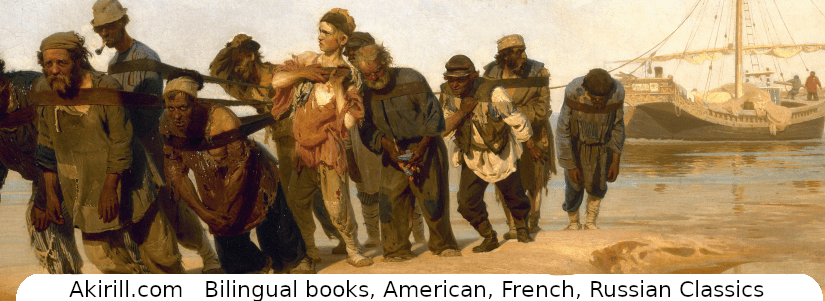
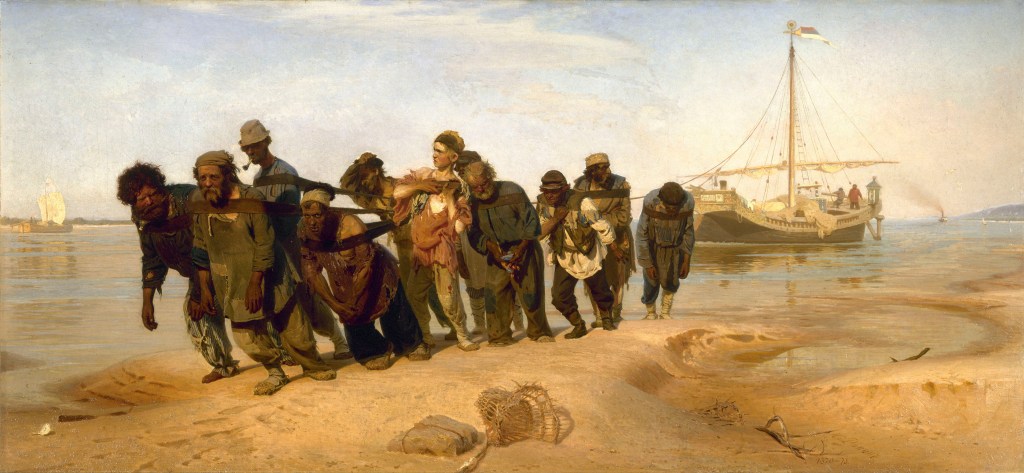
“Barge Haulers on the Volga” is a cult painting by the great Russian painter Ilya Efimovich Repin. The main canvas size is 62 cm by 97 cm and is exposed in the Tretyakov Gallery. The painting was created in the period 1870-1873, and drew international praise for his realistic portrayal of the hardships of working men. Art historians define the genre of this painting as naturalism with elements of critical realism.
One of Repin’s conflicts was his unwillingness to preach and express any moralizing with his works. He tried to follow the ideas of pure art having at the same time his civic position and unconditionally conveyed it in his works. The Barge Haulers on the Volga are devoid of moralizing and demonstrate human history, on the one hands, but also, as it were, push the stories of these people into the background, exposing the nerve of slave labor and class division.
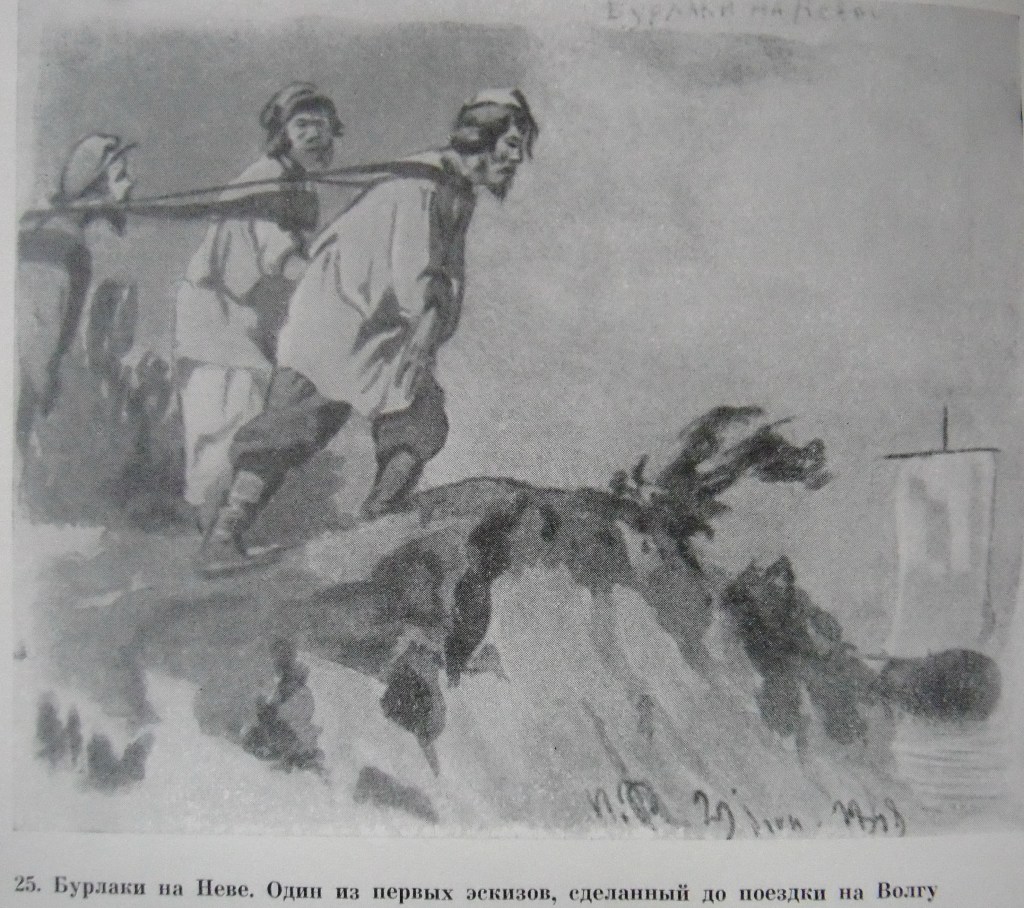
The idea for the painting came to Ilyia Repin back in 1869 when he saw barge haulers on the Neva and was stuck by their stern and exhausted appearance. These are ship workers which duties included everything related to the ship and cargo as loading and unloading goods, pulling a heavy ship from the shoals, closing up holes, bailing out water. Barge hauling was officially banned in 1929, and before the Russian revolution, barge haulers could still be found on small rivers and impassable sections of large rivers.
In May 1870, Ilya went to the Volga where he made close acquaintance with barge haulers and drew many sketches of figures and landscapes. In the same year, Ilya Repin made sketches of the composition representing two solutions, mainly differing in the direction of movement of the barge gang.
Summer 1872 Repin returned to the Volga in the village of Shiryaevo and rewrote the picture while retaining its composition.
It is often believed that Repin wrote his barge haulers as an illustration to a poem by Nikolai Alekseevitch Nekrasov, but the truth is that Repin did not know of this poem until 2 years after he finished his canvas and didn’t agree with it.
The main difference between Repin’s “Barge Haulers” and other paintings of barge haulers is that in other paintings they are represented as a dark mass, people with indistinguishable faces, similar to each other, like ants pulling a huge load into a anthill but in Repin’s “Barge Haulers” each burlak is a personality, an individual, not like anybody else.
In the 30th, a second rise in the popularity of “Barge haulers on the Volga” happened in the URSS. “Barge haulers on the Volga” became a true icon, a standard of pictorial writing and a cult object of social realism in the URSS. The illustration of “Barge haulers on the Volga” filled all the textbooks of the Soviet era, and were one of the main illustrations of the cruel oppression of the people by the criminal tsarist regime.
What can we see in “Barge haulers on the Volga” ?
There is eleven men, their number being decided according to the weight of the loaded vessel, at a rate of about 250 pounds per person. They are pulling a barge behind them can be seen as symbolizing the Russian Empire.
The barge haulers are compositionally combined into 3 clearly visible groups.
The first group consists of four figures with Kanin at the head, the second, also of four figures, among which the image of the young barge hauler Larka stands out and dominates, and, finally, the last group of three, less significant and expressive figures.
In the first group, we see how strong and masterfully everything is arranged. There is a compact unity, but with a great complexity of the outer contour, which gives it vitality. The heads are placed in such a way that each of them is clearly visible against a free background, and depicting the figures in a strong tilt, Repin raises their heads so that their faces are visible. Depicting the faces of the barge haulers of the first group frontally, I. Repin only makes the far right (Ilka Sailor) look directly at the audience. Kanin is looking somewhere in the distance, and the redhead’s gaze is turned to Kanin. This achieves freedom of expression. The main characters do not pose, but live their lives. Their appeal to the audience would have made them reasoners, which was especially dangerous in the positive image of the sage Kanin.

The stall – the second most powerful image in the picture along with Kanin – visually represents the center of the entire figured part of the composition. To the right and to the left of it is an equal number of figures of barge haulers. The group with Larka is built on sharp contrasts of images. The youth of Larka, his impatience and irritation of youth are opposed, on the one hand, by the exhaustion of a consumptive, and on the other, by the phlegmatic calm of an experienced old man who knows how to adapt to any situation. Leaning against his neighbor’s shoulder, he calmly fills his pipe. The stall is the most captivating image in its lyricism and youthful charm. It is also highlighted in color. His pink youthful body, rags of a red falling shirt and trousers form a bright colorful spot among the dark figures of barge haulers.
Placed next to the Stall, the figure of a consumptive, with its strong inclination, connects the second group with the first and at the same time frees up the necessary space in front of the Stall.

The last figure in the third group, depicted frontally, with a lowered head, corresponds with the extreme figure of the first group, as if closing the entire mass of the gang. The result is a kind of rhythm of wave-like movement.

Who are the people of the artel?
The sketches were preserved where Repin indicated the names of some of the characters.
Rasstriga-Kanin, the bump of the artel is the first on the right side of the canvas. He used to sing in a church choir, but had been deprived of church dignity and “pulling the strap” for 10 years. In the artel of barge haulers he built a career. Thanks to his intelligence and perseverance, he became the leader of the team, the “bump”. He knows the coastline best of all, and sets the pace for the whole group. The barge haulers did each step synchronously with the right foot, then pulling up the left. From this the whole artel moved as one. If someone lost his stride, people collided with their shoulders, and the bump gave the command “hay – straw” (сено — солома), resuming movement in step. To keep the rhythm on the narrow paths over the cliffs, great skill was required from the foreman.
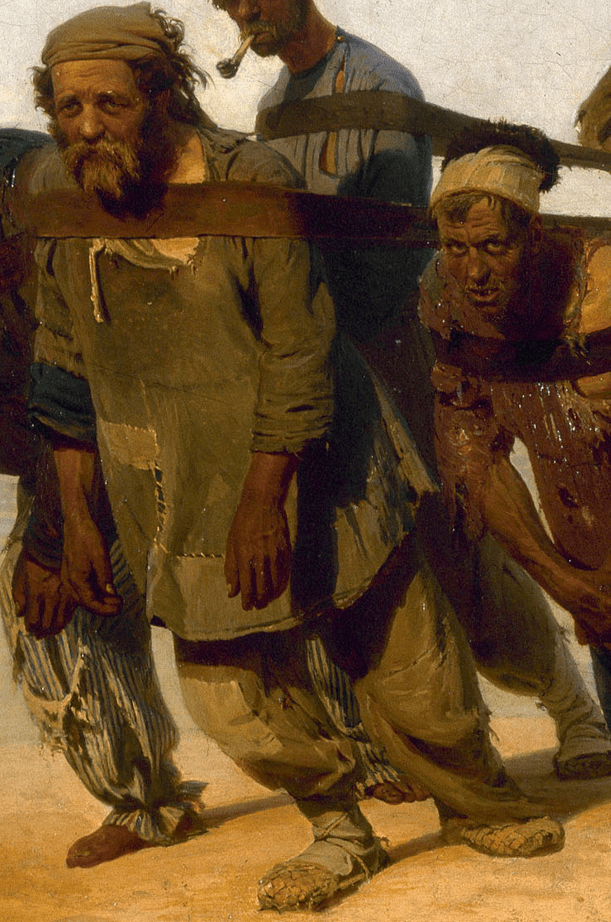
Next to him is a black-bearded giant, he is tanned and overgrown with curly hair. He is the “podshishelny”, the right hand of the brigadier and the strongest man in the whole artel. He is a Nizhny Novgorod fighter. In winter, he earns by participating in fisticuffs. And in spring-autumn “pulls the strap”. He is not more than 40 years old, and still has enough physical strength. He is put in the first team, as one of the strongest and most conscientious.

A little behind Rasstriga-Kanin on his left is Ilka the sailor, who was something like an accountant, bought provisions and gave the barge haulers their salaries. He knows how to work hard, so he is also in the front row. But it is clear that he is a mean person. He alone pierces us with an unkind look. This one easily swears and sends you to hell.

“Bondage” is the second hack and walks behind the Stall. He is clearly lazy, he walks straight, not straining in his work and trying to shift part of his burden onto the shoulders of others. He managed to squander the salary for the entire trip and being indebted to the artel, worked for food. Yet, he still manages to smoke a pipe, He is the best dressed of all. His shirt is not rags, like those of his comrades. He is wearing a real hat, not a tied rag. Most likely, he is from the peasants who has a wife or mother at home whom take care of his clothes.
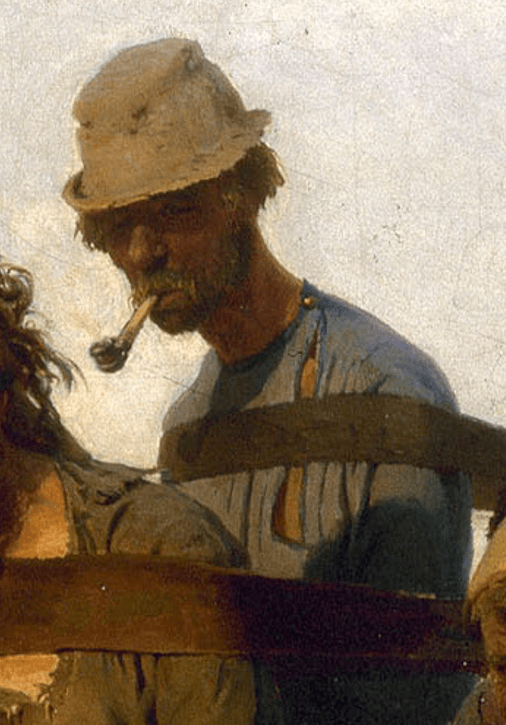
Behind Ilka the sailor is Larka, the cook and falcon headman (who is responsible for the cleanliness of the latrine on the ship) and the youngest member of the artel. The young village boy Larka is especially striking to us. Maybe his family sent him to earn extra money or he left home and is trying to feed himself. Obviously, this is almost the first time he pulls the strap. Considering his duties to be more than sufficient, Larka sometimes quarreled and defiantly refused to pull the strap. And now he looks at the barge hauler next to him, who is clearly groveling in the line. The lasy guy is even smoking a pipe

“Hackers” is simply a negligent one, who on occasion is not averse to sifting part of the burden onto the shoulders of others.

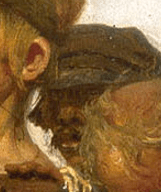
Behind him, the head of Kalmyk is visible. According to Repin, it was “a barge hauler with eyes as if cut through by sedge.” He also had a large, smart, intelligent forehead, showing that this is not a simpleton … He wore a shirt without belt, the ports have come off on bare black legs.
Behind him is a man of about 60 years old. He is emaciated, desperately wiping sweat from his forehead with his sleeve. Most likely, he is ill with consumption, and this might be his last burlach season.

In the last group we first see the overseer, he makes sure that others are not lazy and pull the strap along with everyone else. Contrary to the others he wears boots, and his clothes are newer.
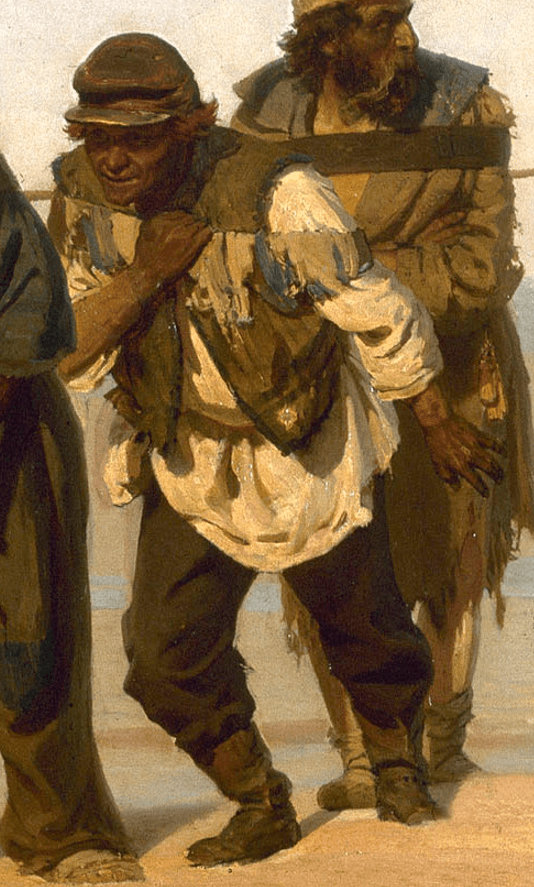
The penultimate one, is a tall Greek who looks angrily at the barge, where the owner is shouting something to the barge haulers

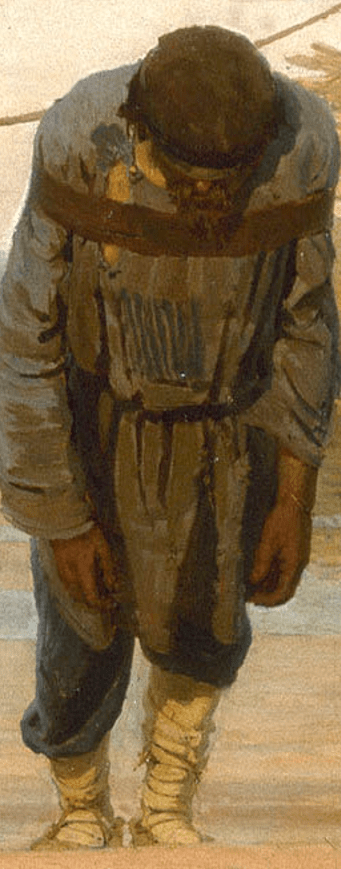
“Inert” is the person with the most depressing appearance and comes last. It feels like he’s about to collapse. His hands are limply lowered. The head is so low on the chest that the face is not visible. Usually the last in the “team” were experienced, but weak or sick. They normally walked a little apart, in their own rhythm and looked at their feet. Since their function was to ensure that the string did not touch the stones. So his downcast posture and lagging behind the rest does not mean that he is ill.
Other details
The flag on sailing ship since the time of Peter the Great was hoisted on the stern flagpole (On warships, the state black-yellow-white flag, on merchant ships, the commercial white-blue-red flag). On the mast a weather vane was hung by which the sailors determined the direction and strength of the wind. Repin accustomed to the state military flag, confused that on the trade tricolor, the white strip should be at the top, and not the bottom, as usual. Only ten years later, in 1883, the white-blue-red tricolore became the national Russian flag. But it is also said that the order of the stripes on the flag was not treated too carefully, and it was sometimes raised upside down as in the painting.

It is interesting that Repin, who studied the life of barge haulers, quite correctly depicted how the tow line looked and the place of his fastening which is the very top of the mast. By attaching the rope to the top of the mast, barge haulers let the mast carry the bulk of the weight of the towline. With such an attachment, the force vector is the same as if the bark is under sail, that is, the pilot has the Opportunity to control the movement of the ship with the help of the rudder.

The pilot, is the man at the helm of the ship, and actually her captain. He earns more than the entire artel put together. He gives instructions to barge haulers and maneuvers both the rudder and the blocks that regulate the length of the tow line.
“The waterpipe”, water dispenser, is the carpenter who caulks and repairs the ships, monitors the safety of the goods, and bears financial responsibility for it during loadings and unloading. Under his contract, he does not have the right to leave the ship during the voyage and replaces the owner, managing on his behalf.

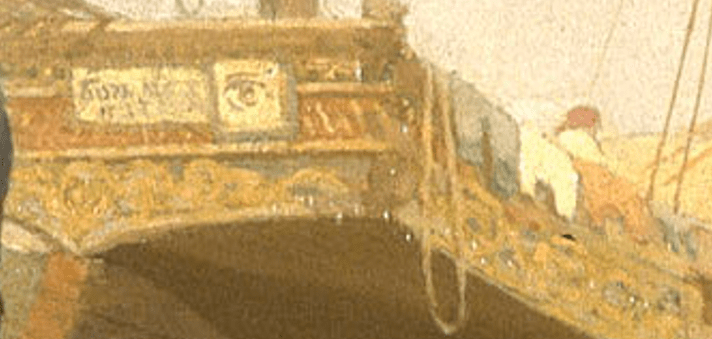
Since the 16th century, it was customary to decorate the Volga ships with intricate carvings since it was believed that they helped the ship to rise against the current and this ship was no exception and had beautiful carvings.
When Dostoevsky saw “Barge Haulers on the Volga”, he was very glad that Ilya Repin did not put any social protest in it. Dostoevsky wrote in his diary that they were “Barge haulers, real barge haulers and nothing more,” and he added that “None of them shouts from the picture to the viewer: “Look how unhappy I am and to what extent you owe the people!”
The familiar figures of the barge haulers on the bank of the Volga are an eternal symbol of unlimited patience, hard work for the sake of survival, a strap that the working people had to pull all their lives and sad echoes of the past in the present.
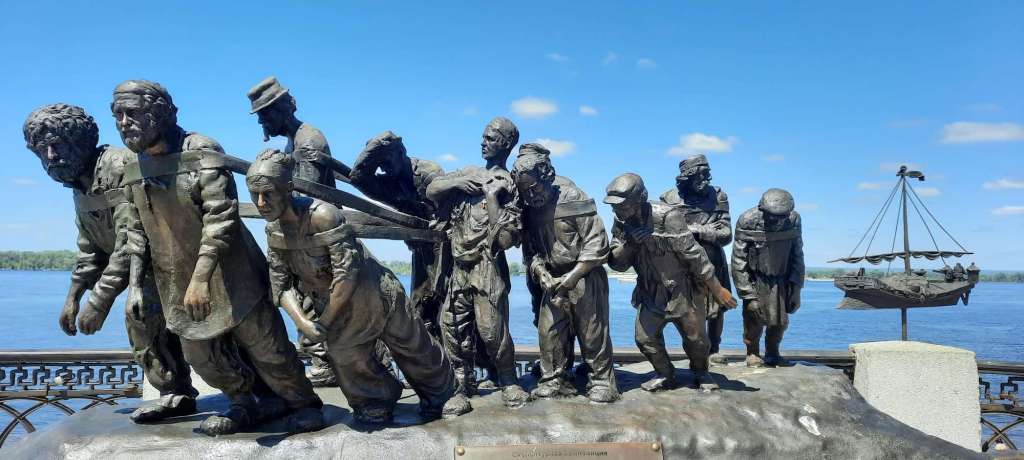
You can find a beautiful sculpture of the painting of “Barge Haulers on the Volga” by Ilya Repin in Samara.
I hope you enjoyed this canvas as much as I did.
| If you liked this article, subscribe , put likes, write comments!. |
| Share on social networks |
| Check out Our Latest Posts |

 AKirill, Learn, apprenez, translation, traduction, livres bilingues, bilingual books