
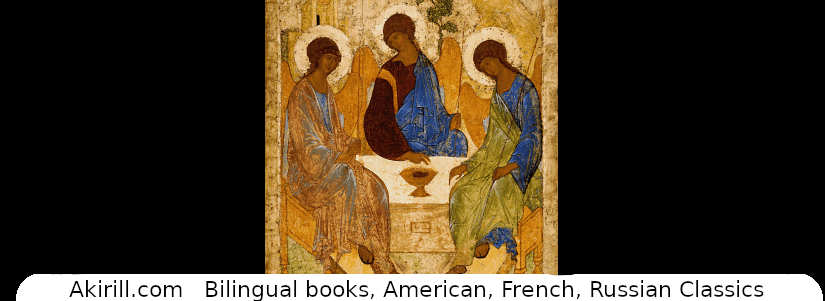
Trinity – Andrei Rublev

Bilingual booksLire en FrançaisContact us
American LiteratureFrench LiteratureRussian Literature

“Trinity” which is also called “Hospitality of Abraham” is an icon of the Holy Trinity, painted by Andrei Rublev in the 15th century.  It is one of the most famous Russian icons, and also the most famous  of his works. It is one of two (together with frescoes in Vladimir ) surviving works, which, according to scientists  , authentically belong to him. It is now in one of the halls of the Tretyakov Gallery.

Andrei Rublev, whose “Trinity” is perceived by many as the very proof of the existence of God, was canonized by the Russian Orthodox Church in 1988. Posthumously, he became the first canonized artist. 

The famous icon “Trinity” by Andrei Rublev left the Tretyakov Gallery for the first time since 1917 and was transported to the Trinity-Sergius Lavra for two days on July 17, 2022.

Today, on July 19, 2022, “The Holy Trinity icon of St. Andrei Rublev has returned to the State Tretyakov Gallery and is now being studied by restorers. The museum added that: “There are no visible signs of deterioration in the condition of this most important work of ancient Russian art”. And after a detailed and comprehensive examination of the icon, a decision will be made on the timing of the return of the “Trinity” to the gallery’s exposition.

Троица – Андрей Рублев

Andrei Rublev was born in the late 60s of the XIV century in the small town of Radonezh, not far from the Trinity-Sergius Lavra. Historians think that in his youth Andrei was a novice of this monastery, and then he took the rank of a monk. In 1380 during the Battle of Kulikovoin , Rublev was already a member of the princely artel of craftsmen, who moved from city to city and was engaged in the construction and decoration of churches. Like any medieval master, he did not sign his works, and his name was rarely mentioned in the annals. Nevertheless, careful research by historians of ancient Russian art suggests that he was a monk of the Trinity-Sergius Monastery, for the Trinity Cathedral of which he painted his masterpiece

There are 2 opinions on the issue of dating the icon. It could have been painted for the wooden church of the Trinity Monastery, built by hegumen Nikon after the invasion of Edigey. In this case Scholars date the icon to 1412. But others determine the 20s. 15th century linking its origin with the stone cathedral of the monastery, founded in 1422. It is possible that Hegumen Nikon, who became the abbot of the Trinity-Sergius Monastery after Sergius of Radonezh didn’t like that the newly erected white-stone Trinity Cathedral was not decorated with paintings. Anticipating his imminent death and wishing to complete the decoration of the cathedral during his lifetime, Nikon called for work Andrei Rublev and Daniil Cherny.

Trinity Cathedral of the Trinity-Sergius Lavra

They were famous painters, “fair grandees, superior to all and perfect in virtue.” Their work consisted not only in painting the temple with frescoes, they also had to paint a large number of icons for a high multi-tiered iconostasis. During his lifetime, Hegumen Nikon wanted not only to see the temple decorated, but he also wanted to have an icon painted, which was to become the main monument “in praise of Sergius of Radonezh”

This board of the icon painter quickly became a model for all subsequent creators of images of the Holy Trinity and by 1551, the Stoglavy Cathedral announced that all future images must comply with it. In 1575, Tsar Ivan the Terrible ordered to decorate it with a gold salary, which is also called a golden riza. A salary is an overhead decoration fixed on top of an icon painting, covering the entire icon board on top of the paint layer, except for a few significant elements. It closes the pictorial image, leaving open faces, arms and legs. Subsequently, the salaries were also changed by other kings, and the icon itself was updated in accordance with the ideas of the artists of those times. 
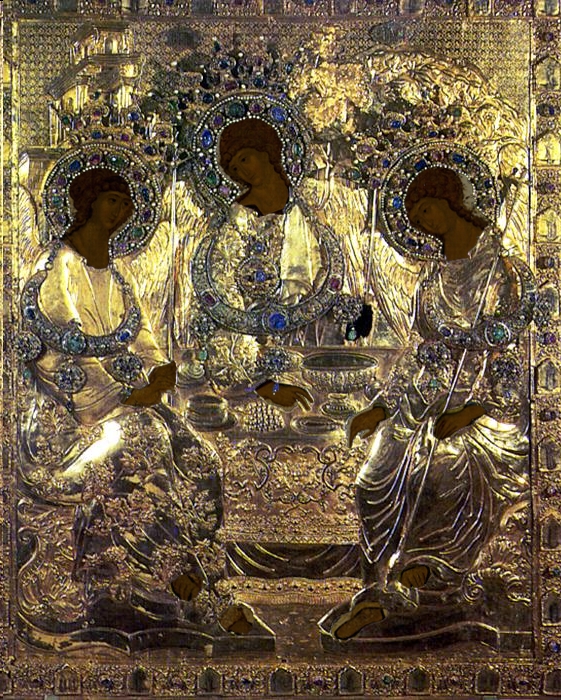
Авторство: монтаж участника shakko. Собственная работа, CC BY-SA 3.0
How the public saw “Trinity” before 1904: salary plus darkened drying oil (photo collage).

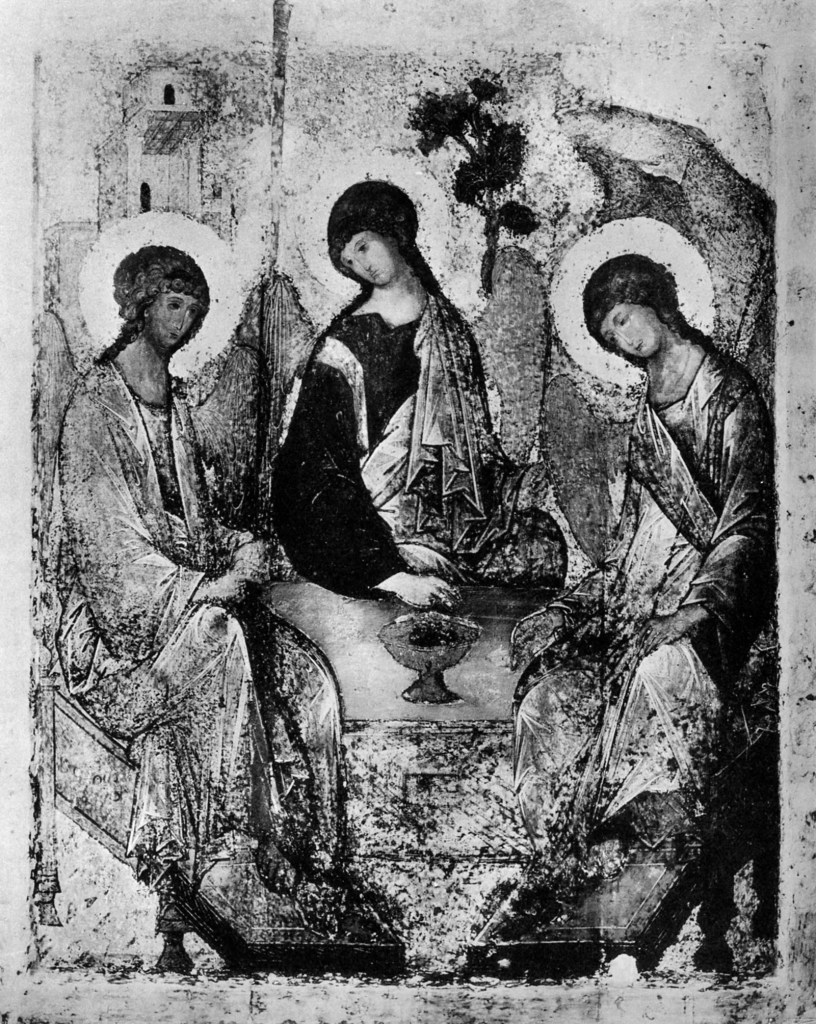
The restoration of the original appearance of the work was taken up only by 1904. Here we can see the Icon in 1904 with the salary just removed. The original painting is hidden under a layer of writing from the late 19th century. 

And a photo of “Trinity” after the completion of clearing Guryanov. 1904.
“Airy”, transparent colors, in which our contemporary often sees a special author’s intention, creating the color and atmosphere of Rublev’s “Trinity”, making the figures of angels thin and incorporeal are a consequence of restorations and renovations.

On the instructions of the Commission for the Protection of Monuments of Art and Antiquities of the Trinity-Sergius Lavra, they returned to the restoration of the Trinity in 1918. At that time the icon was already significantly damaged and needed special storage, however, it was transferred to the collection of the Tretyakov Gallery only in 1929. During the war, in 1941, the Trinity was evacuated to Novosibirsk, and returned from the evacuation in October 1944.

Each year the Icon is transferred to the church on the feast of the Trinity, but in 2007 the Icon was taken to the building on Krymsky Val because it had been damaged during transportation and needed additional reinforcement.

Now the icon is stored in a special icon case and its condition is stable, but there are irreversible damages.

The Holy Trinity of Rublev is written according to a biblical story from the Old Testament, according to which three pilgrim angels came to Abraham with the good news: he will have a son who will become the progenitor of the entire Jewish people. But there are also many important references to all the key biblical points. The picture embodies a lot, while remaining quite simple.

The form that most clearly expresses the idea of ​​the consubstantiality of the three hypostases of the Holy Trinity, in the Rublev icon, is the circle which is the basis of the composition.

On the Icon we see three angels gathered around the table, on which the sacrificial bowl stands,  for a quiet, unhurried conversation. 
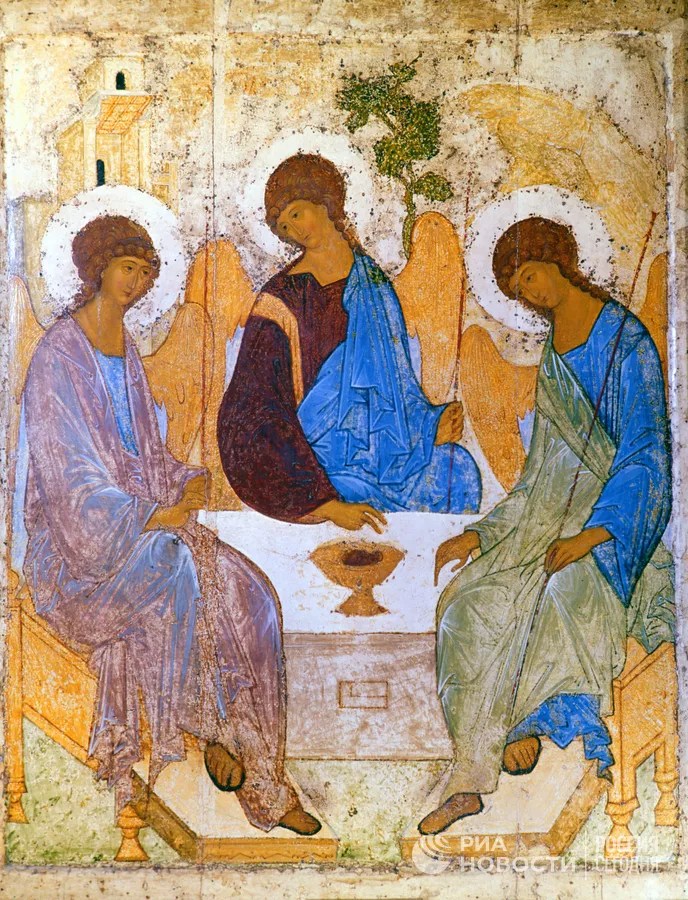
 Three angels are the embodiment of the one God. This is indicated by a number of important symbols. First, they are dressed in azure robes which symbolizes their unearthly essence. The prototype of the Father is an angel sitting in the middle. This is indicated by his regal purple robes decorated with clavius ​​(vertical stripes from the shoulder to the bottom edge). The middle angel is determined not only by its central position, but also by its monumentality. The turn of the head and the bend of the right hand of the central angel express the imperious and powerful motor principle, which is the initial and decisive moment of the composition. But since each of the wanderers has scepters of power, one can speak of a trinity.

God the Son is symbolized here by the angel sitting on the right. His head is lowered most humbly, and his hand is closest to the bowl. if we recall the biblical phrase “And a branch will come from the root of Jesse, and a branch will grow from its root”, then it immediately becomes clear that the right angel personifies God the Son. Also according to Ulyanov, “… the right angel’s himation is girded from right to left. And according to Russian custom, on a dead man, clothes were fastened not on the right side, as in life, but on the left side, like on a woman.”

The third angel, located on the left, becomes the personification of the Holy Spirit.

The combination of blue and red is inherent only in the clothes of the middle and left angels symbolizing the dogma about the procession of the grace of the Holy Spirit, The contours and folds of their robes are fragile and weightless, the harmony of blue, cornflower blue, pale green, golden yellow colors is pure, behind their backs are wings, in their hands are thin staffs, and around their heads are luminous halos. 

The image contains more than the divine wanderers. In the background, a church or an entrance to the house of Abraham is visible, and the silhouette of a tree which could be the tree of knowledge from the garden of Eden, and at the same time it could be the oak under which Abraham rested.  

Looking more closely, you will be able to see a mountain, located in the upper right corner, that becomes a symbol of Golgotha, to which Jesus ascended with his cross. An ancient symbol of everything sublime, in the Bible, “mountain” is the image of “rapture of the spirit”, therefore the most significant events take place on it.

The icon “Trinity” by Andrei Rublev is inscribed in a circular composition. Italian artists of those times also inscribed groups of angelic entities in a circular composition for greater symbolism. But Rublev’s composition is strikingly different from the classical one. The circle is imperceptible at first sight, and looking at this work of art in more detail, it can be noted that everything here is inscribed in a circular structure, symbolizing the trinity, as well as eternity, infinity.

Even the heads of the angels are bowed, allowing the overall silhouette to organically form a single circle. It has long symbolized eternity, the vicious circle of human existence, from the birth of the world to the end, which becomes a new beginning. In the context of the three angels, it is also interpreted as a symbol of the trinity of the Christian God.

Many researchers draw attention to the fact that the “Trinity” was created during the period of confrontation between the Russian princes and the Tatar-Mongol yoke and pointed to the need for unity. Peace, harmony, and love, this is what Andrei Rublev called his contemporaries to. It was a call to unite all Russian people – a call based on a deep philosophical awareness of the structure of the world, the moral cohesion of people.

I hope you enjoyed this Icon as much as I did

Help the site stay free, buy us a cup of coffeeAidez-nous à maintenir le site gratuit en nous offrant une tasse de café

If you liked this article, subscribe , put likes, write comments!.
Share on social networks
Check out Our Latest Posts

Trinité – Andreï Roublev

Livres bilinguesRead in EnglishContactez-nous
Littérature américaineLittérature françaiseLittérature russe

La « Trinité » , également appelée « Hospitalité d’Abraham »  , est une icône de la Sainte Trinité, peinte par Andrei Rublev au XVe siècle. C’est l’une des icônes russes les plus célèbres, et aussi la plus célèbre de ses œuvres. C’est l’une des deux œuvres survivantes (avec les fresques de Vladimir) qui, selon les scientifiques, lui appartiennent authentiquement. Elle est maintenant dans l’une des salles de la galerie Tretiakov.

Andrei Rublev, dont la « Trinité » est perçue par beaucoup comme la preuve même de l’existence de Dieu, a été canonisé par l’Église orthodoxe russe en 1988. À titre posthume, il est devenu le premier artiste canonisé. 

La célèbre icône “Trinity” d’Andrei Rublev a quitté la galerie Tretiakov pour la première fois depuis 1917 et a été transportée dans la laure Trinity-Sergius pour deux jours le 17 juillet 2022.

Aujourd’hui, le 19 juillet 2022, “L’icône de la Sainte Trinité de Saint Andrei Rublev est revenue à la Galerie nationale Tretiakov et est actuellement étudiée par les restaurateurs. Le musée a ajouté que: “Il n’y a aucun signe visible de détérioration de l’état de cette œuvre la plus importante de l’art russe ancien”. Et après un examen détaillé et complet de l’icône, une décision sera prise sur le moment du retour de la «Trinité» dans l’exposition de la galerie.

Троица – Андрей Рублев Trinité : Andreï Roublev

Andrei Rublev est né à la fin des années 60 du XIVe siècle dans la petite ville de Radonezh, non loin de la Trinity-Sergius Lavra. Les historiens pensent que dans sa jeunesse Andrei était un novice de ce monastère, puis il a pris le rang de moine. En 1380, lors de la bataille de Kulikovoin, Rublev était déjà membre de l’artel princier des artisans, qui se déplaçait de ville en ville et s’occupait de la construction et de la décoration des églises. Comme tout maître médiéval, il ne signait pas ses œuvres, et son nom était rarement mentionné dans les annales. Néanmoins, des recherches minutieuses menées par des historiens de l’art russe ancien suggèrent qu’il était un moine du monastère de la Trinité-Sergius, pour la cathédrale de la Trinité dont il a peint son chef-d’œuvre.

Il y a 2 opinions sur la question de la datation de l’icône. Elle aurait pu être peinte pour l’église en bois du monastère de la Trinité, construite par l’higoumène Nikon après l’invasion d’Edigey. Dans ce cas, les érudits datent l’icône à 1412. Mais d’autres déterminent les années 20 du 15ème siècle reliant son origine à la cathédrale en pierre du monastère, fondée en 1422. Il est possible que l’hégumène Nikon, qui devint l’abbé du monastère de la Trinité-Sergius après Sergius de Radonezh, n’ait pas aimé que la Trinité en pierre blanche nouvellement érigée ne soit pas décorée de peintures. Anticipant sa mort imminente et souhaitant achever de son vivant la décoration de la cathédrale, Nikon fait appel à Andrei Rublev et Daniil Cherny.

Cathédrale de la Trinité de la Laure Trinité-Sergius

C’étaient des peintres célèbres, « beaux grands, supérieurs à tous et parfaits en vertu ». Leur travail consistait non seulement à peindre le temple avec des fresques, ils devaient également peindre un grand nombre d’icônes pour une iconostase à plusieurs niveaux. De son vivant, Hegumen Nikon voulait non seulement voir le temple décoré, mais il voulait aussi faire peindre une icône, qui devait devenir le monument principal “à la louange de Sergius de Radonezh”

Cette planche du peintre d’icônes devint rapidement un modèle pour tous les créateurs ultérieurs d’images de la Sainte Trinité et en 1551, la cathédrale Stoglavy annonça que toutes les images futures devaient s’y conformer. En 1575, le tsar Ivan le Terrible ordonna de le décorer d’un salaire en or,  également appelé riza en or. Un salaire est une décoration suspendue fixée au-dessus d’une peinture d’icônes, couvrant l’ensemble du panneau d’icônes au-dessus de la couche de peinture, à l’exception de quelques éléments significatifs. Il ferme l’image picturale, laissant ouverts les visages, les bras et les jambes. Par la suite, les salaires ont également été modifiés par d’autres rois et l’icône elle-même a été mise à jour conformément aux idées des artistes de l’époque. 

Авторство: монтаж участника shakko. Собственная работа, CC BY-SA 3.0
Comment le public voyait « Trinity » avant 1904 : salaire plus huile siccative noircie (photocollage).

La restauration de l’aspect original de l’œuvre n’a été entreprise qu’en 1904. Ici, nous pouvons voir l’icône en 1904 avec le salaire juste supprimé. La peinture originale est cachée sous une couche de peinture de la fin du XIXe siècle. 

Троица – Андрей Рублев Trinité : Andreï Roublev

Et une photo de “Trinity” après l’achèvement du nettoyage de Guryanov. 1904.

Троица – Андрей Рублев Trinité : Andreï Roublev

Les couleurs «aérées», transparentes, dans lesquelles nos contemporains voient souvent l’intention d’un auteur particulier, créant la couleur et l’atmosphère de la «Trinité» de Rublev, rendant les figures d’anges minces et incorporelles sont une conséquence des restaurations et des rénovations.

Sur les instructions de la Commission pour la protection des monuments d’art et des antiquités de la laure Trinité-Sergius, ils sont revenus à la restauration de la Trinité en 1918. A cette époque, l’icône était déjà considérablement endommagée et nécessitait un stockage spécial, cependant, elle n’a été transféré à la collection de la galerie Tretiakov qu’en 1929. Pendant la guerre, en 1941, la Trinité a été évacuée à Novossibirsk et est revenue de l’évacuation en octobre 1944.

Chaque année, l’icône est transférée à l’église lors de la fête de la Trinité, mais en 2007, l’icône a été transportée au bâtiment de Krymsky Val car elle avait été endommagée pendant le transport et avait besoin de renforts supplémentaires.

Maintenant, l’icône est stockée dans un boîtier d’icône spécial et son état est stable, mais il y a des dommages irréversibles.

La Sainte Trinité de Rublev est écrite selon une histoire biblique de l’Ancien Testament, selon laquelle trois anges pèlerins sont venus à Abraham avec la bonne nouvelle : il aura un fils qui deviendra l’ancêtre de tout le peuple juif. Mais il y a aussi de nombreuses références importantes à tous les points clés de la Bible. L’Icon incarne beaucoup, tout en restant assez simple.

La forme qui exprime le plus clairement l’idée de la consubstantialité des trois hypostases de la Sainte Trinité, dans l’icône Rublev, est le cercle qui est à la base de la composition.

Sur l’Icône, nous voyons trois anges réunis autour de la table, sur laquelle se dresse le bol sacrificiel, pour une conversation calme et sans hâte. 

Троица – Андрей Рублев Trinité : Andreï Roublev

Trois anges sont l’incarnation du Dieu unique.  Ceci est indiqué par un certain nombre de symboles importants. Tout d’abord, ils sont vêtus de robes d’azur qui symbolisent leur essence surnaturelle. Le prototype du Père est un ange assis au milieu. Ceci est indiqué par ses robes violettes royales décorées de clavius ​​​​(rayures verticales de l’épaule au bord inférieur).  L’ange du milieu est déterminé non seulement par sa position centrale, mais aussi par sa monumentalité. Le tour de tête et la courbure de la main droite de l’ange central expriment le principe moteur impérieux et puissant, qui est le moment initial et décisif de la composition. Mais puisque chacun des anges possède des sceptres de pouvoir, on peut parler d’une trinité.

Dieu le Fils est symbolisé ici par l’ange assis à droite. Sa tête est baissée très humblement et sa main est la plus proche du bol. Si nous nous souvenons de la phrase biblique “Et une branche sortira de la racine de Jessé, et une branche poussera de sa racine”, alors il devient immédiatement clair que l’ange droit personnifie Dieu le Fils. Aussi selon Oulianov, « … l’himation de l’ange droit est ceint de droite à gauche. Et selon la coutume russe, sur un homme mort, les vêtements n’étaient pas attachés du côté droit, comme dans la vie, mais du côté gauche, comme sur une femme.

Le troisième ange, situé à gauche, devient la personnification du Saint-Esprit.

La combinaison du bleu et du rouge n’est inhérente qu’aux vêtements des anges du milieu et de gauche symbolisant le dogme de la procession de la grâce du Saint-Esprit. Les contours et les plis de leurs robes sont fragiles et légers, l’harmonie des couleurs bleu, bleu bleuet, vert pâle, jaune doré est pure, derrière leur dos se trouvent des ailes, dans leurs mains de fins bâtons et autour de leur tête des auréoles lumineuses. 

L’image contient plus que les anges divins. En arrière-plan, une église ou une entrée de la maison d’Abraham est visible, et la silhouette d’un arbre qui pourrait être l’arbre de la connaissance du jardin d’Eden, et en même temps ce pourrait être le chêne sous lequel Abraham s’est reposé .  

En regardant de plus près, vous pourrez voir une montagne, située dans le coin supérieur droit, qui devient un symbole du Golgotha, vers lequel Jésus est monté avec sa croix. Ancien symbole de tout ce qui est sublime, dans la Bible, la «montagne» est l’image du «ravissement de l’esprit», c’est pourquoi les événements les plus significatifs s’y déroulent.

L’icône “Trinity” d’Andrei Rublev est inscrite dans une composition circulaire. Les artistes italiens de cette époque ont également inscrit des groupes d’entités angéliques dans une composition circulaire pour un plus grand symbolisme. Mais la composition de Rublev est remarquablement différente de la composition classique. Le cercle est imperceptible à première vue, et en regardant cette œuvre d’art plus en détail, on peut constater que tout ici s’inscrit dans une structure circulaire, symbolisant la trinité, ainsi que l’éternité, l’infini.

Même les têtes des anges sont inclinées, permettant à la silhouette globale de former organiquement un seul cercle. Il a longtemps symbolisé l’éternité, le cercle vicieux de l’existence humaine, de la naissance du monde à la fin, qui devient un nouveau commencement. Dans le contexte des trois anges, il est également interprété comme un symbole de la trinité du Dieu chrétien.

De nombreux chercheurs attirent l’attention sur le fait que la «Trinité» a été créée pendant la période de confrontation entre les princes russes et le joug tatar-mongol et ont souligné le besoin d’unité. Paix, harmonie et amour, voilà ce à quoi Andrei Rublev appelait ses contemporains. C’était un appel à unir tout le peuple russe, un appel basé sur une profonde conscience philosophique de la structure du monde, de la cohésion morale des peuples.

J’espère que vous avez apprécié cette icône autant que moi

Help the site stay free, buy us a cup of coffeeAidez-nous à maintenir le site gratuit en nous offrant une tasse de café

If you liked this article, subscribe , put likes, write comments!.
Share on social networks
Check out Our Latest Posts