Découvrez le tableau “Sirin et Alkonost – Oiseaux de Joie et de Tristesse” de Vasnetsov

Livres bilinguesRead in EnglishNous contacter
Littérature américaineLittérature françaiseLittérature russe

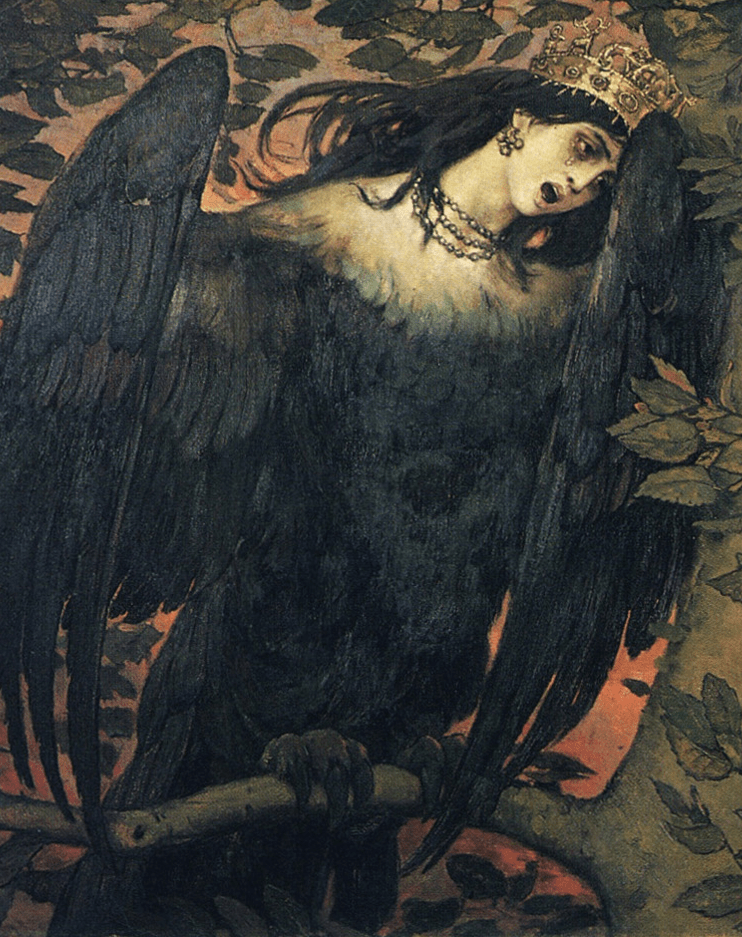
« Sirin et Alkonost » « Сирин и Алконост » de Viktor Mikhailovich Vasnetsov (Виктор Михайлович Васнецов) est une grande huile sur toile de 133 X 250 cm peinte en 1896. Ce n’est pas la peinture la plus populaire de l’artiste, mais sa symbolique est étonnante . “Sirin et Alkonost” est maintenant stocké dans la galerie nationale Tretiakov .

Viktor Vasnetsov a peint “Sirin et Alkonost – Oiseaux de Joie et de Tristesse”, avant les bouleversements révolutionnaires qui allaient se produire dans l’Empire russe semblant prévoir les changements qui se produiraient dans sa patrie. Sirin et Alkonost sont deux symboles inséparables, une paire d’opposés. Chagrin et joie, malheur et bonheur, noir et blanc… Dans ce tableau, Alkonost peut être vu comme symbolisant la victoire du bien sur le mal et, Sirin comme l’angoisse due aux changements.
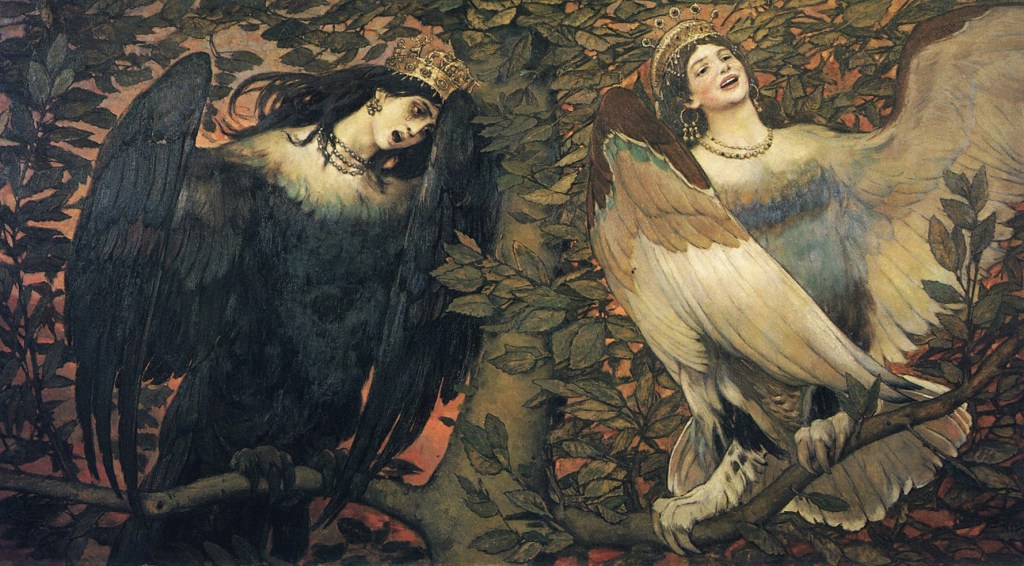
Sirin et Alkonost sont des femmes-oiseaux mythiques similaires, comme des jumelles, mais en même temps, elles sont complètement différentes. Sirin est le messager noir de la tristesse, qui aspire à un paradis perdu, et Alkonost est le messager lumineux de la joie et du plaisir. Selon les croyances slaves, l’oiseau Sirin a volé dans le verger de pommiers, étant triste et en pleurs. Et dans l’après-midi, l’oiseau Alkonost a volé dans le même verger, se réjouissant et riant, ressentant la joie d’une récolte abondante. Alkonost a brossé la rosée vivante de ses ailes, conférant aux fruits des propriétés magiques et curatives.

Les branches avec des femmes-oiseaux assises dessus se trouvent de différents côtés du tronc d’un arbre. Sirin, qui est la personnification de l’effacement et de la tristesse, est du côté gauche, “mauvais”, selon les légendes slaves, mais c’est un côté qui est étroitement uni au cœur. Alkonost, qui incarne la béatitude, les rêves, et la joie est du bon « bon » côté.

Brève description de la peinture

Au premier plan des peintures se trouvent deux demoiselles oiseaux Sirin et Alkonost assises sur des branches qui proviennent du même arbre et au même niveau, mais sur les côtés opposés du tronc.

L’arrière-plan de l’image montre un ciel orange matinal contrastant avec les deux oiseaux-jeunes filles et l’arbre.

Sirin


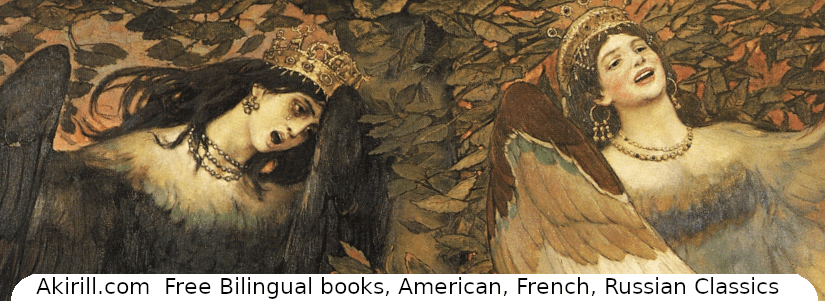
Perché sur la gauche de l’arbre, le premier des oiseaux fantastiques, Sirin est représenté avec un visage, un cou et des épaules humains tandis que le reste de son corps ressemble à un oiseau. Son visage est pâle et ses yeux sont remplis de larmes. Elle a le plumage et les cheveux foncés. Ses ailes sont fermées de manière protectrice, comme si elles se cachaient de l’aube à venir. Elle est adornée d’une belle couronne d’or ornée d’animaux, de boucles d’oreilles dorées et d’un triple collier.

Alkonost
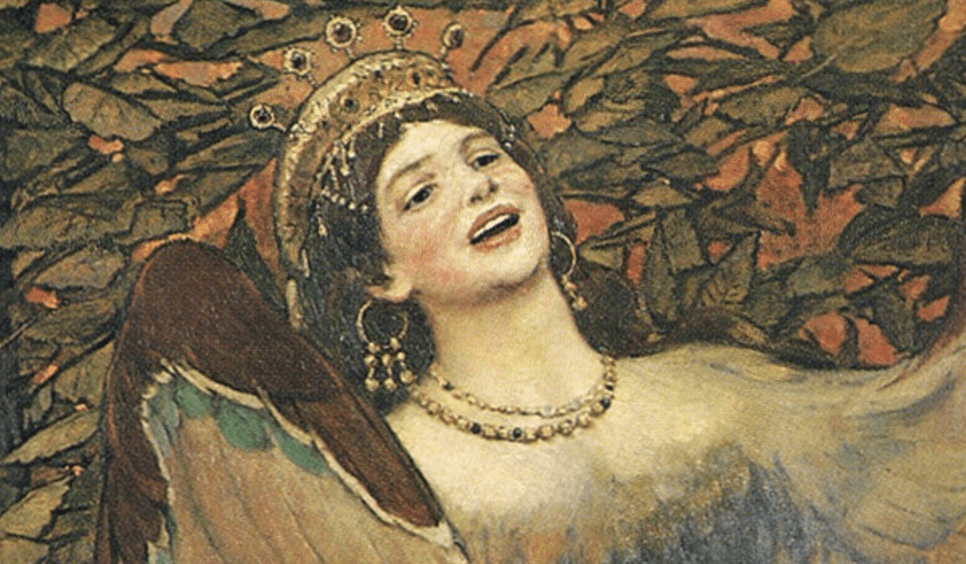
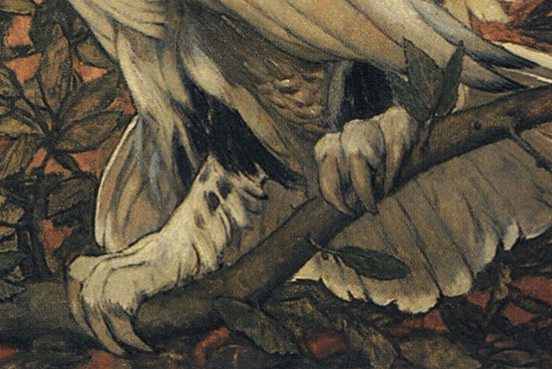
On peut voir qu’Alkonost représente la joie et le bonheur car elle a un plumage de couleur claire, seul le haut de ses ailes étant brun. En tant que «jumelle opposée», elle a un corps d’oiseau et des ailes avec un visage et une épaule humain. Son visage est heureux et on dirait qu’elle chante. Elle porte une couronne d’or, des boucles d’oreilles et deux colliers. Ses ailes sont ouvertes, mais comme sa «jumelle opposée», elle a de puissantes griffes.

Dans le tableau, Sirin, aspirant au passé, et Alkonost, ouverte à l’avenir, sont fusionnés en un tout unique et indivisible. Elles, comme des compagnons inoubliables, accompagnent les gens tout au long de leur existence, modérant les grandes joies et soulageant les chagrins lourds. Ainsi, selon le maître, une grande harmonie de vie se forme.

J’espère que vous avez apprécié cet article, vous pouvez également consulter d’autres peintures de Viktor Mikhailovich Vasnetsov.


Si vous avez aimé cet article, abonnez-vous, mettez des likes, écrivez des commentaires !

Partager sur les réseaux sociaux

Découvrez nos derniers messages

Discover the painting “Sirin and Alkonost – Birds of Sorrow and Joy” from Vasnetsov

Bilingual booksLire en FrançaisContact us
American LiteratureFrench LiteratureRussian Literature

“Sirin and Alkonost” «Сирин и Алконост» by Viktor Mikhailovich Vasnetsov (Виктор Михайлович Васнецов) is a large oil on canvas of 133 X 250 cm painted in 1896. It is not the artist’s most popular painting, but its symbolism is amazing. “Sirin and Alkonost” is now stored in the State Tretyakov Gallery.

Viktor Vasnetsov painted “Sirin and Alkonost – Birds of Sorrow and Joy”, before the revolutionary upheavals that were soon to happen in the Russian Empire and seemed to foresee the changes that would take place in his homeland. Sirin and Alkonost are two inseparable symbols, a pair of opposites. Grief and joy, misfortune and happiness, black and white… In this painting, Alkonost can be seen as symbolizing the victory of good over evil and, Sirin as the anxiety due to changes.

Sirin and Alkonost are similar mythical bird-maidens, like twins, but at the same time, they are completely different. Sirin is the dark messenger of sadness, who is longing for a lost paradise, and Alkonost is the bright messenger of joy and pleasure. According to Slavic beliefs,  the Sirin bird flies into the apple orchard, being sad and crying. And in the afternoon, the Alkonost bird flies to the same orchard,  rejoicing and laughing, feeling the joy of a bountiful harvest. Alkonost brushes the live dew from its wings endowing the fruits with magical, healing properties.

The branches with bird-maidens sitting on them are on different sides of a tree trunk. Sirin, who is the personification of fading and sadness, is on the left, “bad” side, according to Slavic legends, but it is a side that is closely united with the heart. Alkonost, who embodies bliss, dreams, joy is on the right “good” side.

Short description of the painting

In the forefront of the paintings are two bird-maidens Sirin and Alkonost seated on branches which are from the same tree and at the same level, but on opposite sides of the trunk.

The background of the painting shows a morning orange sky contrasting with the two bird-maidens and tree.

Sirin


Perched on the left of the tree, the first of the fantastic birds, Sirin is depicted with a human face, neck and shoulders while the rest of her body resembles a bird. Her face is pale and her eyes are filled with tears. She has dark plumage and hair. Her wings are closed in a protective manner, as if hiding from the coming dawn. She is adorned with a beautiful golden crown decorated with animals, golden earrings and a triple necklace.

Alkonost

We can see that Alkonost represents joy and happiness because she has a light colored plumage, with only the top of her wings being brown. As her “opposite twin” she has a bird body and wings with human face and shoulder. Her face is happy and it looks like she is singing. She is wearing a golden crown, earrings and two necklaces Her wings are opened, but like her “opposite twin” she has powerful claws.

In the painting,  Sirin, aspiring to the past, and Alkonost, open to the future, are merged into a single and indivisible whole. They, like unforgettable companions, accompany people throughout their existence, moderating great joy and alleviating heavy grief. Thus, according to the master, a great harmony of life is formed.

I hope you enjoyed this article, you can also check out other paintings by Viktor Mikhailovich Vasnetsov.

If you liked this article, subscribe , put likes, write comments!
Share on social networks
Check out Our Latest Posts

Discover the painting of “The Flying Carpet” by Vasnetsov

Bilingual booksLire en FrançaisContact us
American LiteratureFrench LiteratureRussian Literature

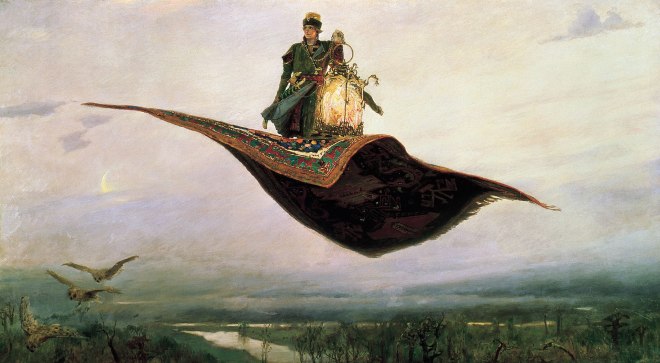
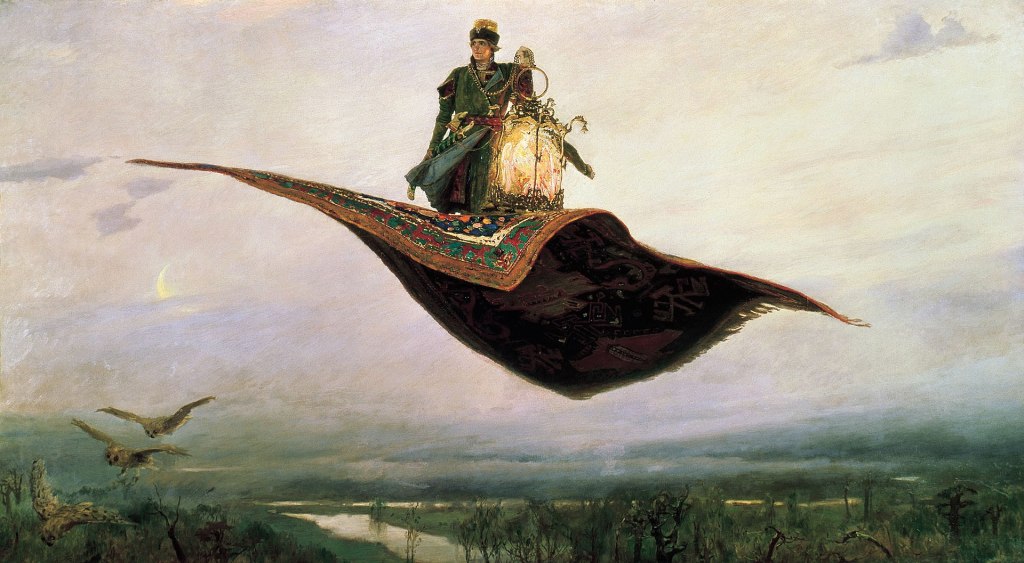
“ Flying Carpet ” is an oil on canvas of 165×297 cm painted by the famous painter Viktor Mikhailovich Vasnetsov in 1880, This painting is currently in the Nizhny Novgorod State Art Museum.

This is the second picture of Vasnetsov, in which he turned to fairy tales and myths. We already wrote about his first picture which was “The Knight at the Crossroads“.

The plot of the “ Flying Carpet ” is the fairy tale story of Ivan Tsarevich, who went after the Firebird, which got into the habit of stealing apples in the royal garden.

According to Vasnetsov himself, the picture was supposed to express the greatness of Russian traditions and to represent a symbol of victory over space. “ Flying Carpet ” reflects faith in the bright future of the Russian people, and in this work, the painter put all his love for folk art and his own understanding of the wisdom of folk epics.

The story of the “Flying Carpet” began with Savva Mamontov, a philanthropist who was the chairman of the board of the Donetsk railway. He ordered three canvases that would reflect the endless possibilities for people to move after the construction of the Donetsk railway track, and insisted on a fantastic plot, which was displayed in Vasnetsov’s canvas “Flying Carpet”. In this painting, the magical means of transportation was to become a symbol of the fastest transport, an allegorical illustration of the awakening of a new railway direction.

However, the members of the board considered fairy-tale motifs inappropriate in the working atmosphere of the office, so the philanthropist bought the canvas and for a long time, the painting remained in Mamontov’s personal collection.

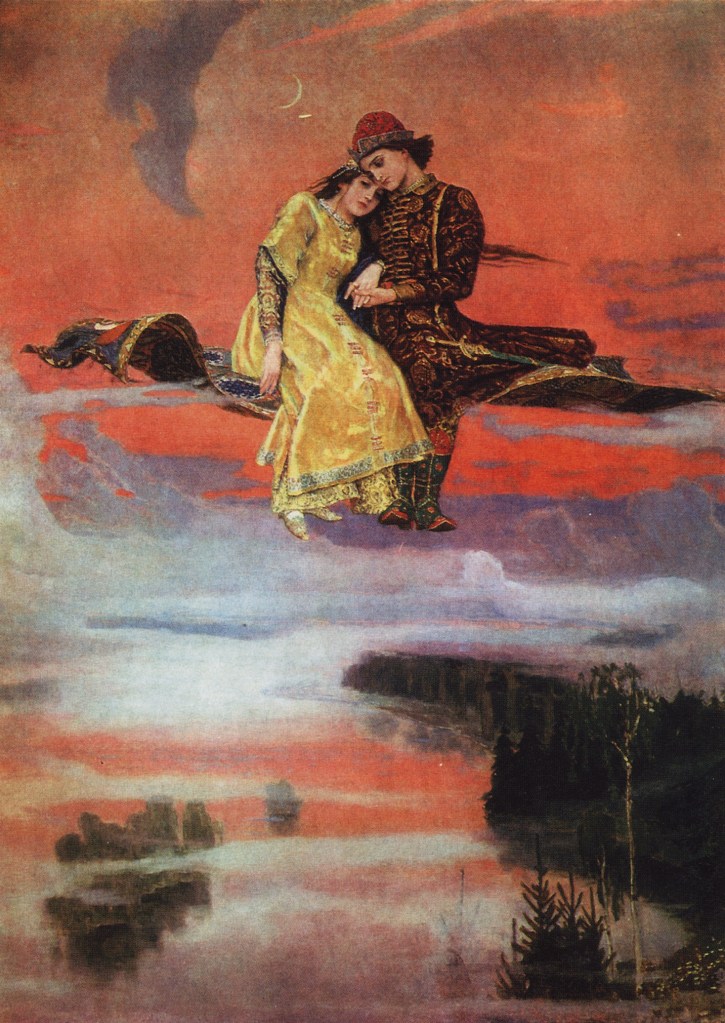
At first, the artist’s idea was different from the final version of the painting. Two people were supposed to fly on the carpet – the Tsarevich and his beloved, who bowed her head on Ivan’s shoulder.

But after a long search, Vasnetsov left only one hero on the carpet, handing him a cage with an unprecedented trophy – a firebird.

Each image in this picture has its own symbolic meaning. If you look closely at the canvas, you will immediately notice that the upper part of the picture is brighter and more saturated. The pink shades with which the sun adorned the sky symbolically indicate the victory of the hero of the fairy tale, who overcame all difficulties. He was able to escape from the chase and caught the Firebird, which got into the habit of stealing apples in the royal garden. But the Firebird is the only full-fledged source of light in the picture. Even the moon, visible in the background, cannot compare with it. And to depict the real world, Vasnetsov used already dark and gloomy halftones and shades. 

Each character is made so realistically that looking at this canvas, it involuntarily seems that such a carpet really exists somewhere.

Ivan Tsarevich, the Firebird and the Flying Carpet stand out as a bright colorful spot against the background of a lifeless and dull landscape. Bright colors symbolize the triumph of a person’s dream come true.

The magic carpet is depicted in flight and the tsar stands on it to his full height. Ivan himself is the personification of courage. The carpet simply hurries across the sky, and this is visible thanks to the way the clothes of the prince and his hair are moving.

The flying carpet is accompanied by three birds. They are depicted in the same colors as the world around them. These large owls fly in front of the carpet and may show him the way. The magic carpet is full of outlandish patterns, some of which are painfully reminiscent of magical runes and may be the reason why the carpet can fly. This magical carpet itself looks like a huge bird with a curved head and wide-open wings with the corners of the weaving product playing the role of its two wings and the canvas slightly arched upwards making this part similar to the back of a bird. When looking at the picture, it is noticeable that the carpet floats smoothly through the air. It soars over the expanses of Russia, majestically rises above the forests and thick fog. Watching this work, one can appreciate how wide the country is. 

Ivan Tsarevich standing on the carpet like a captain on a heavenly ship is a sign of victory, self-confidence. He is not afraid to fall, and confidently looks into the distance. It serves as proof that there are no insurmountable obstacles. It can be seen that Ivan Tsarevich hurries through the boundless plains with rivers and fields. He returns from a long journey to the thirtieth kingdom where he managed to capture the magical firebird.

The whole facial expression and posture of Ivan Tsarevich expresses pride from the test he has passed. His appearance is interesting and his clothes delight and amazes with their wealth and luxury. He is dressed in a caftan with long robe which is embroidered with beautiful patterns. The whole caftan is decorated with gilding, and there are many precious stones on the cap. Such clothes were worn in Russia only by noble and rich people. On the prince’s belt is an embroidered bag containing the key to the cage. The sword-treasurer shimmers from the gilding with which it is decorated, and a thick chain hangs around the neck of the hero of the picture, to which a gold cage was attached. 

Viktor Vasnetsov has depicted the cage in detail. It is all openwork and wonderful, and at the top, each lattice ends with unusual figures of dragons, in whose teeth there are bells. When the cage sways, a pleasant and melodic ringing is heard.

A beautiful Firebird sits on a thin and graceful perch, and from this firebird an unusual bright light spreads around. The artist uses white for its image, which symbolizes its purity. The Firebird is a symbol of happiness, joy and good luck, but unfortunately, not every person manages to catch one. The shining Firebird in the cage is like a big lantern that lights the way home. Even on a dark night, it shows the way to Tsarevich Ivan, who having achieved his goal, strives to go home.

Everything that happens in the picture takes the viewer to the end of the day, at its very sunset, when the crescent of the moon is already beginning to weakly break through the clouds. You can see not only the sky, but also what lies far below: this is a wonderful forest, and magnificent fields, and a gentle river.

This painting of “The Flying Carpet”, painted in 1880, has become so popular today that its reproductions can be found not only in many private houses and apartments, but also in institutions such as schools, kindergartens or clinics in Russia. And not only an adult, but also every child, without hesitation, will say who its author is and what it is called.

I hope you enjoyed this painting as much as I did

Help the site stay free, buy us a cup of coffeeAidez-nous à maintenir le site gratuit en nous offrant une tasse de café

If you liked this article, subscribe , put likes, write comments!.
Share on social networks
Check out Our Latest Posts

Découvrez le tableau de « Le tapis volant » de Vasnetsov

Livres bilinguesRead in EnglishNous contacter
Littérature américainelittérature FrançaisLittérature russe

« Le Tapis volant ” est une gigantesque huile sur toile de 165×297 cm peinte par le célèbre peintre Viktor Mikhailovich Vasnetsov en 1880, Cette peinture est actuellement au Musée d’art d’État de Nijni Novgorod.

C’est la deuxième image de Vasnetsov, dans laquelle il s’est tourné vers les contes de fées et les mythes. Nous avons déjà écrit sur sa première photo qui était « Le Chevalier à la croisée des chemins ».

L’intrigue du ” Tapis volant ” est l’histoire de conte de fées d’Ivan Tsarevich, qui a poursuivi un phoenix, qui a pris l’habitude de voler des pommes dans le jardin royal.

Selon Vasnetsov lui-même, l’image était censée exprimer la grandeur des traditions russes et représenter un symbole de victoire sur l’espace. « Le Tapis volant ” reflète la foi dans l’avenir brillant du peuple russe, et dans cette œuvre, le peintre a mis tout son amour pour l’art populaire et sa propre compréhension de la sagesse des épopées populaires.

L’histoire du « tapis volant » a commencé avec Savva Mamontov, un philanthrope qui était le président du conseil d’administration du chemin de fer de Donetsk. Il a commandé trois toiles qui refléteraient les possibilités infinies pour les gens de se déplacer après la construction de la voie ferrée de Donetsk, et a insisté sur une intrigue fantastique, qui a été exposée dans la toile de Vasnetsov « Tapis volant ». Dans ce tableau, le moyen de transport magique devait devenir un symbole du transport le plus rapide, une illustration allégorique de l’éveil d’une nouvelle direction ferroviaire.

Cependant, les membres du conseil d’administration ont considéré les motifs de conte de fées inappropriés dans l’atmosphère de travail du bureau, de sorte que le philanthrope a acheté la toile et pendant longtemps, le tableau est resté dans la collection personnelle de Mamontov.

Au début, l’idée de l’artiste était différente de la version finale du tableau. Deux personnes étaient censées voler sur le tapis – le tsarévitch et sa bien-aimée, qui inclinait la tête sur l’épaule d’Ivan.

Mais après une longue recherche, Vasnetsov n’a laissé qu’un seul héros sur le tapis, lui remettant une cage avec un trophée sans précédent – un oiseau de feu.

Chaque image de cette image a sa propre signification symbolique. Si vous regardez attentivement la toile, vous remarquerez immédiatement que la partie supérieure de l’image est plus lumineuse et plus saturée. Les nuances roses avec lesquelles le soleil ornent le ciel indiquent symboliquement la victoire du héros du conte de fées, qui a surmonté toutes les difficultés. Il a pu échapper à la poursuite et a attrapé l’oiseau de feu, qui a pris l’habitude de voler des pommes dans le jardin royal. Mais l’oiseau de feu est la seule source de lumière à part entière sur l’image. Même la lune, visible en arrière-plan, ne peut pas se comparer à lui. Et pour dépeindre le monde réel, Vasnetsov a utilisé des demi-tons et des nuances déjà sombres.

Chaque personnage est fait de manière si réaliste qu’en regardant cette toile, il semble involontairement qu’un tel tapis existe vraiment quelque part.

Ivan Tsarevich, l’oiseau de feu et le tapis volant se distinguent comme un point coloré et lumineux sur le fond d’un paysage sans vie et terne. Les couleurs vives symbolisent le triomphe du rêve d’une personne devenu réalité.

Le tapis magique est représenté en vol et le prince se tient dessus debout. Ivan lui-même est la personnification du courage. Le tapis se presse simplement à travers le ciel, et ce qui est visible grace aux mouvements des vêtements du tsar et de ses cheveux.

Le tapis volant est accompagné de trois oiseaux. Ils sont représentés dans les mêmes couleurs que le monde qui les entoure. Ces grands hiboux volent devant le tapis et peuvent lui montrer le chemin. Le tapis magique est plein de motifs bizarres, dont certains rappellent douloureusement les runes magiques. Cela peut être la raison pour laquelle le tapis peut voler. Ce tapis magique lui-même ressemble à un énorme oiseau avec une tête incurvée et des ailes grandes ouvertes avec les coins du produit de tissage jouant le rôle de ses deux ailes, de plus la toile légèrement arquée vers le haut rend cette partie similaire au dos d’un oiseau. En regardant l’image, on remarque que le tapis semble flotter en douceur et rapidement dans l’air. Il s’élève au-dessus des étendues de la Russie, s’élève majestueusement au-dessus des forêts et du brouillard épais. En regardant ce travail, on peut apprécier à quel point le pays est vaste.

Ivan Tsarévitch debout sur le tapis comme un capitaine sur un navire céleste, est un signe de victoire, de confiance en soi. Il n’a pas peur de tomber et regarde avec confiance au loin. C’est la preuve qu’il n’y a pas d’obstacles insurmontables. On peut voir qu’Ivan Tsarévitch se dépêche à travers les plaines sans limites avec des rivières et des champs. Il revient d’un long voyage vers le trentième royaume où il a réussi à capturer l’oiseau de feu magique.

Toute l’expression faciale et la posture d’Ivan Tsarevich exprime la fierté du test qu’il a réussi. Son apparence est intéressante et ses vêtements ravissent et étonnent par leur richesse et leur luxe. Il est vêtu d’un caftan avec une longue robe qui est brodée de beaux motifs. Tout le caftan est décoré de dorures, et il y a beaucoup de pierres précieuses sur le bonnet. De tels vêtements n’étaient portés en Russie que par des gens nobles et riches. Sur la ceinture du prince se trouve un sac brodé contenant la clé de la cage. L’épée-trésorier scintille de la dorure avec laquelle elle est décorée, et une épaisse chaîne pend autour du cou du héros de l’image, à laquelle une cage en or a été attachée.

Viktor Vasnetsov a représenté la cage en détail. Tout est ajouré et merveilleux, et au sommet, chaque treillis se termine par des figures inhabituelles de dragons, dans les dents desquels il y a des cloches. Lorsque la cage se balance, une sonnerie agréable et mélodique se fait entendre.

Le bel oiseau de feu est assis sur un perchoir mince et gracieux, et autour de cet oiseau de feu une lumière brillante inhabituelle se propage. L’artiste utilise le blanc pour son image, qui symbolise sa pureté. L’oiseau de feu est un symbole de bonheur, de joie et de chance, mais malheureusement, tout le monde ne parvient pas à en attraper un. L’oiseau de feu brillant dans la cage est comme une grande lanterne qui éclaire le chemin du retour. Même par une nuit sombre, il montre le chemin au tsarévitch Ivan, qui, ayant atteint son objectif, s’efforce de rentrer chez lui.

Tout ce qui se passe dans l’image emmène le spectateur à la fin de la journée, à son coucher de soleil, lorsque le croissant de lune commence déjà à percer faiblement les nuages. Vous pouvez voir non seulement le ciel, mais aussi ce qui se trouve loin en dessous: c’est une forêt merveilleuse, et de magnifiques champs, et une rivière douce.

Cette peinture du « Tapis volant », peinte en 1880, est devenue si populaire aujourd’hui que ses reproductions peuvent être trouvées non seulement dans de nombreuses maisons et appartements privés, mais aussi dans des institutions telles que des écoles, des jardins d’enfants ou des cliniques en Russie. Et non seulement un adulte, mais aussi chaque enfant, sans hésitation, dira qui est son auteur et comment il s’appelle.

J’espère que vous avez apprécié cette peinture autant que moi

Help the site stay free, buy us a cup of coffeeAidez-nous à maintenir le site gratuit en nous offrant une tasse de café

If you liked this article, subscribe , put likes, write comments!.
Share on social networks
Check out Our Latest Posts

The Knight at the Crossroad by Viktor Mikhailovich Vasnetsov

Bilingual booksLire en FrançaisContact us
American LiteratureFrench LiteratureRussian Literature

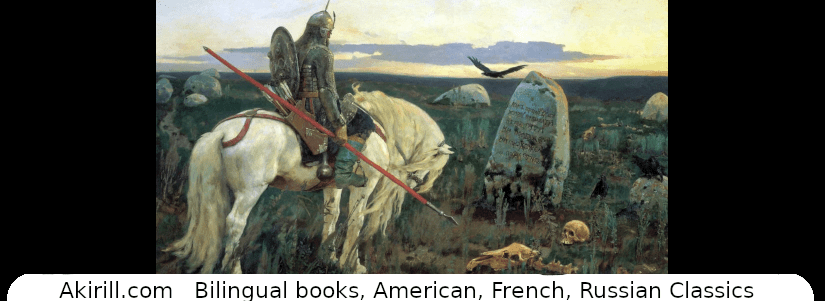
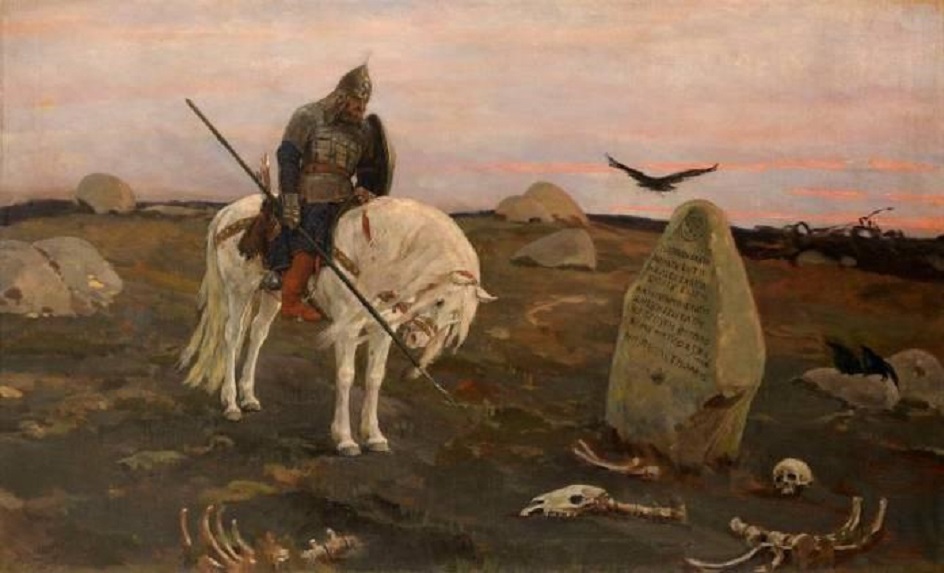
Viktor Mikhailovich Vasnetsov (Виктор Васнецов) is a famous Russian painter, founder of the fairy-tale epic genre . The master created several versions of The Knight at the Crossroads. The first one was completed in 1877 and is significantly different from the subsequent ones. “The knight at the Crossroads” («Витязь на распутье») is an oil on canvas of 167 by 308 cm and was completed in 1882. It is now in the St. Petersburg State Russian Museum.

This is one of the philosophical works of the painter, and it encourages the viewer not only to contemplate, but also to think. And to think not only about the fate of the hero, but also about the deeper and eternal problems of good and evil, justice and deceit But also about the problem of choosing a future path in life, which probably disturb every person.


The first pencil sketches of “The knight at the Crossroads” appeared in the early 1870s. His “Forerunner” can be considered the picture of Viktor Mikhailovich “Warrior in a helmet with chain mail”, painted by him in 1877. 

“The Knight at the Crossroads” is a painting by the famous Russian artist Viktor Mikhailovich Vasnetsov. His inspiration for the creation of “The Knight at the Crossroads” was the old Russian epic “Ilya Muromets and the Robbers”: Once on the path of the hero there was a stone with a curious inscription.

«Витязь на распутье» Виктора Васнецова

According to the prediction, if Ilya turns in one direction – he will be killed, in the other – he will marry, in the third – he will gain wealth.

The man decided to try his luck and drove along the road that was supposed to bring him death. He met forty robbers, but managed to cope with them. Then he returned to the stone and wrote that the prediction did not come true. The same happened with other tracks. It seemed that the hero managed to deceive fate itself …

part of «Витязь на распутье» Виктора Васнецова

Ahead, the artist depicted a black cloud which can be a warning to Ilya Muromets of danger. But then the sky is clear and a little pinkish, probably the dawn, giving us hope. It might show that the path will be difficult and dangerous, but still lead to good. Probably, the knight will still decide to go ahead and defeat all dangers.

Initially, the author conceived to draw “The Knight at the Crossroads” facing the viewer. However, later Vasnetsov changed his mind and focused not on the key character, but on his confusion and difficulty in choosing a path. 

part of «Витязь на распутье» Виктора Васнецова

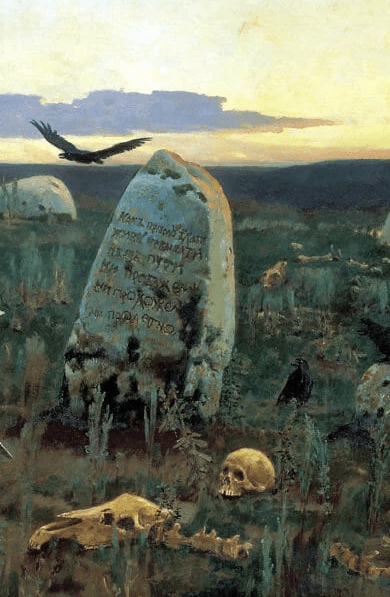
In front of the hero there is a stone on which it is written that if you go straight, it is impossible for anyone to stay alive. Because many years have passed, all other inscriptions on the stone have been erased. Ilya Muromets understands that he has only one path that will lead him to death.

Usually fairy tales and epics talk about three roads that are offered to the traveler to choose from. However, on his canvas, Vasnetsov decided to deviate from this important point. With this technique, he visually strengthened the disturbing plot of the picture, leaving the epic hero without an alternative choice of path.

Almost immediately behind the stone, solid earth turns into unsteady swampy soil. In the future, there is nothing that could inspire gratifying hope. There is a narrow path that goes to the left, winding between boulders. It leads to no one knows where and gradually dissolves. The prophetic stone says nothing about it. There is no third road, as it should be in fairy tales.

«Витязь на распутье» Виктора Васнецова


In the center of the work is Ilya Muromets. He is known as the most courageous and strong hero in Russia. His back is turned to us, so we do not see his face. His strong body is now relaxed and his shoulders slumped as if he had traveled for a very long time and was tired. We can see that he did not rush his horse across the wide field since only the tips of his boots were inserted into the stirrups. The hero is dressed in battle armor. Behind him is a large heavy round shield. A brown leather quiver, decorated with metal decorative overlays, is attached to the belt. The quiver is full of arrows. A massive mace hangs from the side. In his right hand, the knight holds a long, sharp spear on a red shaft. It is lowered with the tip down, the slightly bent arm of the hero weakly squeezes it. The warrior is calm and self-confident, ready even for an unexpected meeting with the enemy. On his feet he has high light green boots with a gilded edging at the top of the top.

The whole image speaks of his meditation, the figure of the hero is majestic and powerful. Thoughtfulness is visible in the bowed head. His spear is also tilted down. The author shows the unity between him and his brave friend, the horse, because despite the fact that the horse stands confidently, its head is tilted.

part of «Витязь на распутье» Виктора Васнецова

The spear that the warrior holds in his hand deserves special attention. The canvas depicts an infantry spear which is intended for foot soldiers. The riders were armed with cavalry. It is noteworthy that in previous studies there was no such feature.  Perhaps the rider is ready to lose his horse at any moment, and therefore it is the infantry spear in his hand.

The heroic horse is a match for the hero himself. It is strong, sleek, with a thick mane hanging almost to the ground, a silky tail, and powerful legs that firmly step on the ground. And now he meekly and patiently stands, with its head down, as if it was making a difficult decision. or maybe waiting for the decision of his master.

part of «Витязь на распутье» Виктора Васнецова

The terrain is depicted as swampy, there is almost no vegetation, stones are also scattered in the most gloomy tones.

Bones of people and animals are scattered across the field. And right in front of the stone we see the skulls of a man and a horse. Apparently, at one time they decided to cross the line on which the stone-prophet stands, but the prediction came true. Now black crows are circling over the field in anticipation of new prey.

The beautiful picture captures the moment of doom. At that moment, the knight does not yet know how his journey will end, and whether what the inscription on the stone predicts will come true. The picturesque plot of Vasnetsov’s creation fascinates with its fabulousness, tragedy, faith in the triumph of good over evil and darkness. and let us wonder if fate determines the fate of a person, or if we are responsible for our own lives.

I hope you enjoyed this painting as much as I did

Help the site stay free, buy us a cup of coffeeAidez-nous à maintenir le site gratuit en nous offrant une tasse de café

If you liked this article, subscribe , put likes, write comments!.
Share on social networks
Check out Our Latest Posts