On this site we hope to help you learn, and to remove the difficulties caused by the difference of culture and language. Sur ce site nous espérons vous aider à apprendre, et à enlever la barrière causée par les différents languages et cultures.
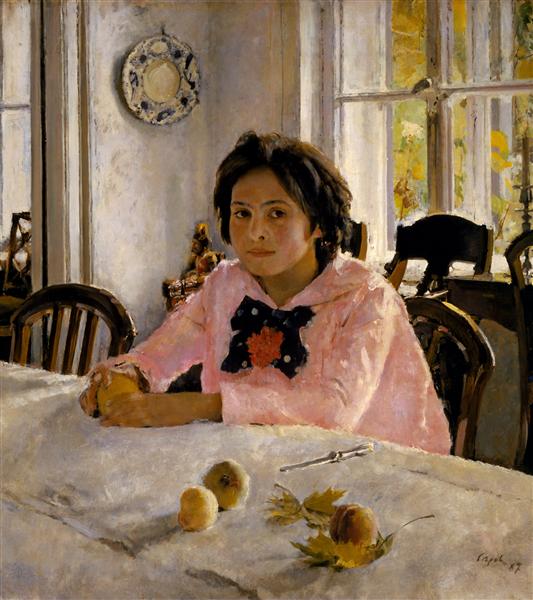
The painting “Girl with Peaches” («Девочка с персиками») is a recognized masterpiece of the Russian artist Valentin Aleksandrovich Serov (1865-1911) (Серов Валентин Александрович). It was painted in 1887 and is an oil on canvas measuring 91 x 85 cm, now located in the State Tretyakov Gallery in Moscow. This is one of the first and most significant works in the direction of Russian impressionism for which it paved the way. This picture combines several genres: there is a landscape , a still life , and a portrait .
Girl with Peaches
Valentin Serov first went to the Abramtsevo estate in 1875 with his mother, and growing up continued to often visit the estate.
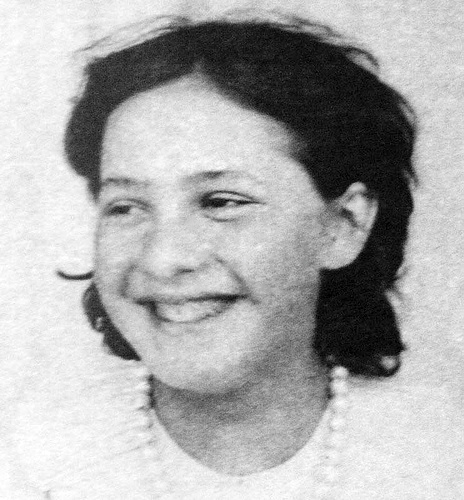
Serov wrote “Girl with Peaches” when he was not yet 22 years old. Valentin Aleksandrovich sought to create not just a portrait, but a living picture that reflected a moment in life. He was inspired by the beauty and spontaneity of Verusha, and invited the 11-year-old Vera Mamontova to pose after seeing her running into the house, taking a peach, and sitting down at the table. Vera posed for Serov every day for almost two months.
Vera Mamontov. Photo from 1888
The expressiveness of the picture is given by bright details, a play of highlights and a young image of the heroine of the portrait. The artist placed the girl in an atmosphere of a carefree sunny day, ripe peaches and a cozy dining room. The peculiarity of this portrait was that Serov added to it elements of a still life (fruits on the table, a knife, leaves) and a landscape (a garden outside the window). This technique allowed to expand the general meaning of the picture.
In the center of the composition is Mamontov’s daughter Verochka. She is sitting at a large table covered with a white tablecloth, and there are several chairs with high backs nearby. The objects in the room indicate that the girl lives in a wealthy family, and many chairs in the dining room are reminiscent of a large family.
The girl is dressed in a light pink loose blouse with a turn-down collar and a puffy bow. This bow tells about the romantic and bright character of the girl. There is no feeling that she was preparing to pose. The artist deliberately left her hair the way they were, sticking out in unruly curls. She certainly frolicked in the garden and wants to run to play again. It seems hard for her to sit still. There is a blush on her cheeks, making her look like the peaches that lying on the table. The happy look of the girl says that she lives among people who love her.
Girl with Peaches – part Verochka
She holds a peach in her hands, which look very tanned. We can say that the girl spent the summer outdoors outside the city. Three more fruits and a silver carving knife lie on the table nearby. The peaches are beautifully combined with yellow leaves which talks about the time of fruit ripening. It can be seen that the objects were not laid out on purpose, but the moment was chosen spontaneously. The peaches have their own history. They were raised in a greenhouse by a gardener specially hired by the owner of the estate. These fruits indicate the prosperity of the owners of the estate and a penchant for the exotic.
Girl with Peaches – part peaches
The girl is surrounded by various objects. We see the backs of the chairs around the dining table. Behind the girl is a figure of a grenadier, reminiscent of the children in the house.
There is a painted plate on the wall. The plate is drawn as a tribute to Savva Mamontov, who was fond of pottery arts.
Girl with Peaches – part plate
Another detail that reflects an outstanding intuitive impressionist in Serov is as if a random edge to the composition. The door on the girl’s right, a half of a chair cut by the frame give the image a look of reality, spontaneous and relaxed. The art historian Mark Copshitzer noted, ” a chair, part of which is captured on canvas, has its continuation beyond the space of the painting, it marks the beginning of the whole world which did not appear on the painting, with its chairs and tables, and other peaches, and the other girls”.
Girl with Peaches
Outside the window, the garden begins to turn yellow. Summer is coming to an end. Maple leaves, in turn, are depicted because the artist began work on the canvas in the height of summer, and finished only in September. In addition, maple autumn leaves create a special contrast in comparison with ripe peaches, reminiscent of the transience of everything and the need to enjoy the sun, as well as everything that happens around.
Serov achieved a fantastic effect of lightness and freshness by placing the light source behind the model. Shining through the leaves, the sun’s rays reflecting off the tablecloths and the girl’s blouse, it adds pink and gold to the space around the subject. Warm, delicate colors, soft reflected light, a lot of air were unusual for Russian painting of those years.
The main difference from the canvases of other portrait painters is the fullness of light. The main character sits in front of the window and is well lit, sun glare on all objects, on hair and clothes. Light dissolves the contours of objects, this brings the work closer to the canvases of the French Impressionists.
The statement of the author himself about the idea of the picture has been preserved. He wrote that he wanted to achieve a special freshness in his painting. The girl was supposed to look in the picture the same as on that summer day. The bright image of Vera coincided with how the artist imagined beauty. The author dreamed of conveying on canvas the joy of life that surrounds the girl and lives in her.
The artist succeeded superbly. Together with him we admire the carefree world of childhood. These moments are especially valuable because they pass quickly. The transience of time is reminiscent of autumn leaves in the foreground of the picture and the coming autumn outside the window. You can feel the philosophical message in the picture. The artist shows the transience of time. Summer changes very quickly, and youth also passes quickly.
I hope you enjoyed this painting as much as I did.
Le tableau “Fille aux Pêches” (“Девочка с персиками”) est un chef-d’œuvre reconnu de l’artiste russe Valentin Aleksandrovich Serov (1865-1911) (Серов Валентин Александрович). Il a été peint en 1887 et est une peinture à l’huile sur toile mesurant 91 x 85 cm, maintenant situé dans la Galerie nationale Tretiakov à Moscou. C’est l’une des premières et des plus importantes œuvres dans la direction de l’impressionnisme russe auquel elle a ouvert la voie. Ce tableau mêle plusieurs genres : il y a un paysage, une nature morte, et un portrait.
La Fille aux Pêches
Valentin Serov est allé pour la première fois au domaine d’Abramtsevo en 1875 avec sa mère et, en grandissant, il a continué à visiter souvent le domaine.
Serov a peint “La Fille aux Pêches” alors qu’il n’avait pas encore 22 ans. Valentin Aleksandrovich a cherché à créer non seulement un portrait, mais une image vivante qui reflètait un moment de la vie. Il a été inspiré par la beauté et la spontanéité de Verusha et a invité Vera Mamontova, 11 ans, à poser après l’avoir vue courir dans la maison, prendre une pêche et s’asseoir à table. Vera a posé pour Serov tous les jours pendant près de deux mois.
Vera Mamontov. Photo from 1888
L’expressivité de l’image est donnée par des détails lumineux, un jeu de reflets et la jeune image de l’héroïne du portrait. L’artiste a placé la jeune fille dans une atmosphère de journée ensoleillée insouciante, avec des pêches mûres et dans une salle à manger confortable. La particularité de ce portrait était que Serov y a ajouté des éléments de nature morte (des fruits sur la table, un couteau, des feuilles) et, un paysage (un jardin à l’extérieur de la fenêtre). Cette technique a permis d’élargir le sens général de l’image.
Au centre de la composition se trouve la fille de Mamontov, Verochka. Elle est assise à une grande table recouverte d’une nappe blanche, et il y a plusieurs chaises à haut dossier à proximité. Les objets dans la pièce indiquent que la jeune fille vit dans une famille aisée, et de nombreuses chaises dans la salle à manger rappellent une famille nombreuse.
La fille est vêtue d’un chemisier ample rose clair avec un col rabattu et un nœud bouffant. Ce nœud bouffant raconte le caractère romantique et lumineux de la fille. Il n’y a aucun sentiment qu’elle se préparait à poser. L’artiste a délibérément laissé ses cheveux tels qu’ils étaient, formant des boucles indisciplinées. Elle a certainement gambadé dans le jardin et veut courir pour rejouer. Il semble difficile pour elle de rester assise. Il y a une rougeur sur ses joues, la faisant ressembler aux pêches qui se trouvent sur la table. Le regard heureux de la jeune fille dit qu’elle vit parmi des gens qui l’aiment.
La Fille aux Pêches – partie Verochka
Elle tient une pêche dans ses mains, qui ont l’air très bronzées. On peut dire que la jeune fille a passé l’été à l’extérieur de la ville. Trois autres fruits et un couteau à découper en argent reposent sur la table à proximité. Les pêches sont magnifiquement combinées avec des feuilles jaunes qui parlent du moment de la maturation des fruits. On voit que les objets n’ont pas été disposés exprès, mais le moment a été choisi spontanément. Les pêches ont leur propre histoire. Elles ont été élevés dans une serre par un jardinier spécialement engagé par le propriétaire du domaine. Ces fruits témoignent de la prospérité des propriétaires du domaine et d’un penchant pour l’exotisme.
La Fille aux Pêches – partie peaches
La jeune fille est entourée de divers objets. On voit les dossiers des chaises autour de la table à manger. Derrière la fille se trouve une figure de grenadier, rappelant les enfants de la maison.
Il y a une assiette peinte sur le mur. L’assiette est dessinée en hommage à Savva Mamontov, qui aimait les arts de la poterie.
La Fille aux Pêches – partie assiette
Un autre détail qui reflète un impressionniste intuitif exceptionnel chez Serov est le bord aléatoire de la composition. La porte à droite de la jeune fille, une moitié de chaise coupée par le cadre donnent à l’image un aspect de réalité, spontané et détendu. L’historien de l’art Mark Copshitzer a noté : « une chaise, dont une partie est capturée sur toile, a sa continuation au-delà de l’espace du tableau, elle marque le début du monde entier qui n’apparaissait pas sur la toile, avec ses chaises et ses tables, et d’autres pêches, et les autres filles ».
La Fille aux Pêches
Derrière la fenêtre, le jardin commence à jaunir. L’été touche à sa fin. Les feuilles d’érable, à leur tour, sont représentées parce que l’artiste a commencé à travailler sur la toile au plus fort de l’été et n’a terminé qu’en septembre. De plus, les feuilles d’érable d’automne créent un contraste particulier par rapport aux pêches mûres, rappelant la fugacité de tout et la nécessité de profiter du soleil, ainsi que de tout ce qui se passe autour.
Serov a obtenu un fantastique effet de légèreté et de fraîcheur en plaçant la source lumineuse derrière le modèle. Brillant à travers les feuilles, les rayons du soleil se reflétant sur la nappe et le chemisier de la fille, il ajoute du rose et de l’or à l’espace autour du sujet. Des couleurs chaudes et délicates, une douce lumière réfléchie, beaucoup d’air étaient inhabituels pour la peinture russe de ces années.
La principale différence avec les toiles des autres portraitistes est la plénitude de la lumière. Le personnage principal est assis devant la fenêtre et est bien éclairé, les reflets du soleil sur tous les objets, sur les cheveux et les vêtements. La lumière dissout les contours des objets, ce qui rapproche l’œuvre des toiles des impressionnistes français.
La déclaration de l’auteur lui-même sur l’idée de l’image a été conservée. Il a écrit qu’il voulait obtenir une fraîcheur particulière dans sa peinture. La fille était censée avoir l’air sur la peinture de la même manière que ce jour d’été. L’image lumineuse de Vera coïncidait avec la façon dont l’artiste imaginait la beauté. L’auteur rêvait de transmettre sur toile la joie de vivre qui entourait et habitait la jeune fille.
L’artiste a superbement réussi. Avec lui, nous admirons le monde insouciant de l’enfance. Ces moments sont particulièrement précieux car ils passent vite. La fugacité du temps est rappelée par les feuilles d’automne au premier plan de l’image et par l’automne qui vient à l’extérieur de la fenêtre. Vous pouvez sentir le message philosophique dans l’image. L’artiste montre la fugacité du temps. L’été change très vite et la jeunesse passe aussi vite.
J’espère que vous avez apprécié ce tableau autant que moi.
A musical slide show of the photos I took during a little walk I had in Strasbourg. I followed the trams tracks from Elsau to the “Parc de l’Etoile” . The map is under the video if you want more details.
I hope you enjoyed the photos.
If you liked this article, subscribe , put likes, write comments!.
Un diaporama musical des photos que j’ai prises lors d’une petite balade à Strasbourg. J’ai suivi les voies des trams d’Elsau jusqu’au « Parc de l’Etoile ». La carte est sous la vidéo si vous voulez plus de détails.
This week I added more books of Dostoevsky in English as well as a few books from George Orwell, and “War and Peace” by Tolstoy, in Russian. You can find them on our English Literature page or on our Russian Literature page.
I hope you’ll find something to enjoy
If you liked this article, don’t forget to like and share.
Cette semaine j’ai ajouté plus de livres de Dostoïevski en anglais ainsi que quelques livres de George Orwell, et “La Guerre et la Paix” de Tolstoï, en russe. Vous pouvez les trouver sur notre page Littérature Anglaise ou sur notre page Littérature Russe .
J’espère que vous trouverez quelque chose à apprécier
Si vous avez aimé cet article, n’oubliez pas de liker et de partager.
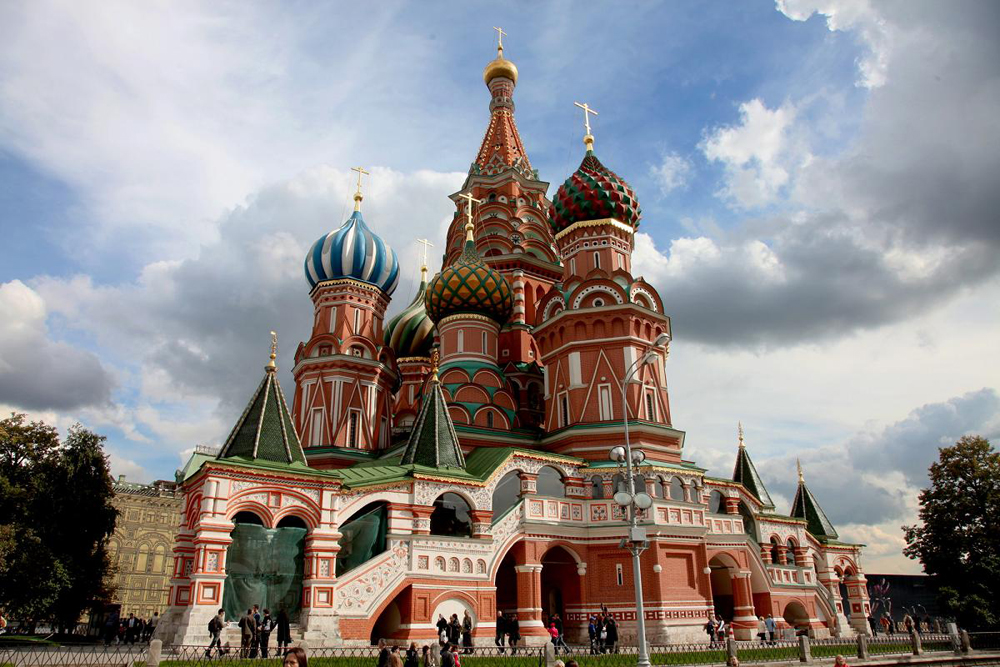
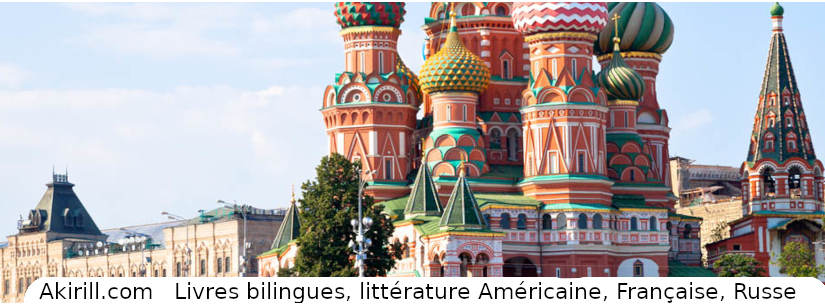
Saint Basil’s Cathedral, an architectural treasure of Moscow
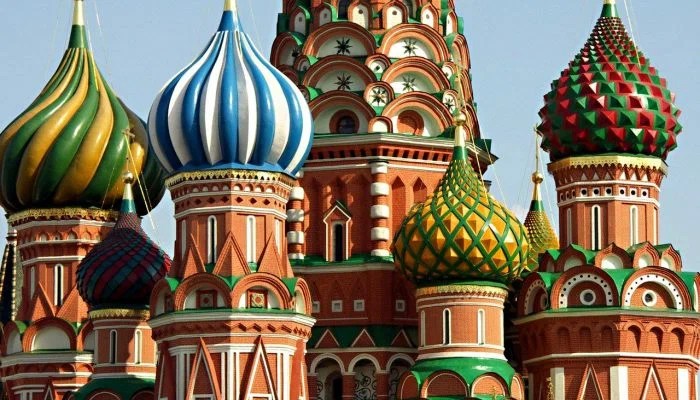
The extraordinarily beautiful and mysterious St. Basil’s Cathedral, or the Cathedral of the Intercession of the Virgin, on the Moat, flaunting on Red Square, is one of the most significant monuments of ancient Russian architecture of the 16th century. Neither before nor after it was built any such structure. It looks like a vault of eight churches, which surrounds the highest – the ninth. Such a temple still does not exist anywhere else in Russia. Even the bright pattern of the domes of the cathedral makes it look like a blooming Garden of Eden.
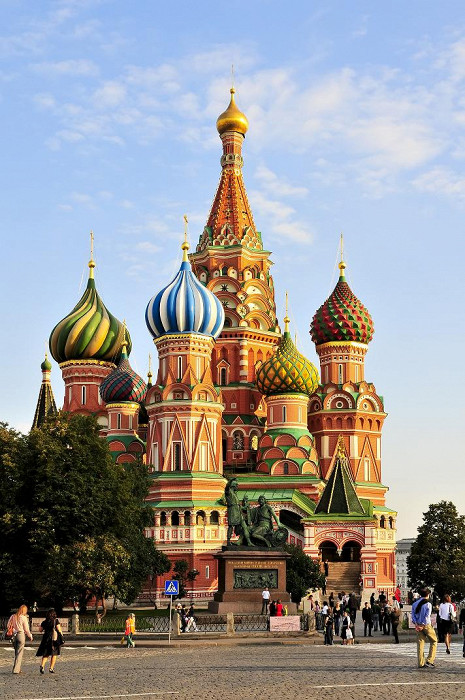
Saint Basil’s Cathedral
Each temple has its own entrance and lighting, however, the cathedral is a single building. The complexity and amazing combination of details of the St. Basil’s Cathedral are unparalleled in Russian architecture and had a huge impact on the development of Russian national architecture.
The cathedral was erected in 1555–1561. at the behest of Tsar Ivan the Terrible in honor of the conquest of the Kazan kingdom. It is believed that the architects who created it were deprived of sight. Even Stalin did not allow the building to be demolished, and during the war the temple was hidden from shelling. The cathedral is included in the Russian list of UNESCO World Heritage Sites and is a branch of the State Historical Museum.
The upper tier of the cathedral resembles a labyrinth, and the base is an eight-pointed star.
The cathedral unites ten churches (chapels), some of which were consecrated in honor of the saints, whose days of memory fell on the decisive battles for Kazan.
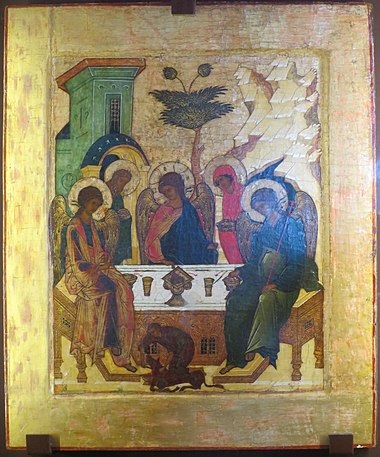
The central church was built in honor of the Intercession of the Virgin , around which separate churches are grouped in honor of: the Holy Trinity , the Entry of the Lord into Jerusalem , St. Nicholas of Velikoretsky , the Three Patriarchs: Alexander, John and Paul the New, Gregory of Armenia , Cyprian and Justina , Alexander Svirsky and Varlaam Khutynsky , placed on the same base-basement, and a chapel in honor of St. Basil the Blessed, after whose name the temple received a second, more well-known name.
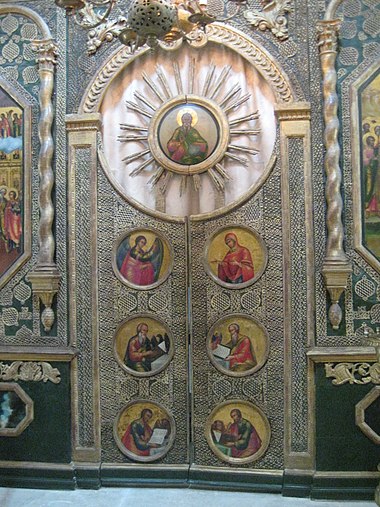
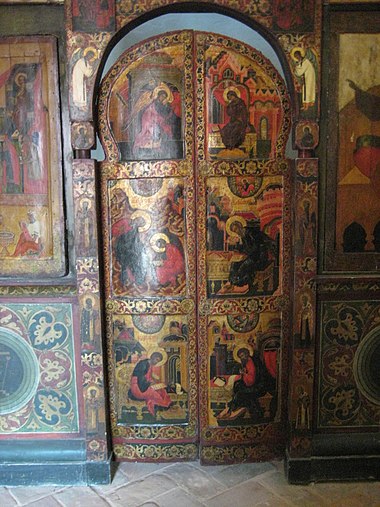
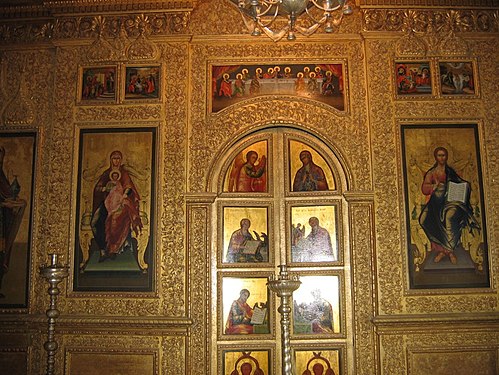
Royal Doors in the Church of the Intercession of the Blessed Virgin Mary, 2009Royal Doors of the Church of Cyprian and Justina 2012Royal Doors of the Church of the Entry of the Lord into Jerusalem, 2011Royal doors of the iconostasis of the Church of Varlaam Khutynsky, 2011Royal Doors of the Church of St. Nicholas Velikoretsky, 2007
The thickness of the walls of the foundation of St. Basil’s Cathedral reaches three meters. It is this thickness that allows it to securely hold as many as nine buildings. If you look at the foundation of the church, you can see that 8 small temples form an eight-pointed star – a symbol of the Virgin. There are larger churches in the ensemble of small churches. They are strictly oriented to the cardinal points and form symmetry. The main temple, with a huge dome and a tent, is the Protection of the Virgin, Her intercession.
During the campaigns of Ivan the Terrible to Kazan on today’s Red Square, “camping” wooden churches were erected in memory of the victories won.
On the day of the memory of Cyprian and Justina ( October 2, 1552), the next campaign ended with a victory over the Kazan Khanate and the annexation of the city to the Muscovite state. It was, the day after the Intercession of the Most Holy Theotokos, and Ivan the Terrible ordered to unite all the “marching” wooden churches into one stone temple in the name of the Intercession of the Virgin – Intercession Cathedral, but it stood only less than a year before to be dismantled, and finally a stone cathedral was laid in its place.
Already, in the autumn of 1554 were the first reliable mention of the construction of the Church of the Intercession of the Mother of God. The construction of this temple began in 1555 and lasted 6 years. The temple was built of brick, and its foundations , plinth and a number of details are made of white stone. In the western part of the cathedral there is a flat brick ceiling.
A legend about the architects Barma and Postnik which names became known only in 1895 told that they had been blinded by order of the the Tsar Ivan the Terrible so that they could no longer build such a temple, but Postnik could not be blinded, since for several years after the construction of the cathedral he participated in the creation of the Kazan Kremlin.
By 1559, in the fall, the temple main part was erected, and at the same period, all but the central church were consecrated.
Despite the apparent grandiosity from the outside of St. Basil’s Cathedral the inside is quite small, accommodating a very small number of people during the service. That is because according to the plan of its creators, it should not have been too spacious, since during major church holidays the entire Red Square was the church, the place of execution, on which the clergy ascended, became a lectern, and the Pokrovsky Cathedral turned into the altar of an open-air temple. After all, there is no temple in Heavenly Jerusalem, but “there is only His Throne” … and the Intercession Cathedral – turned into an altar of a church in the open.
Finally, on June 29, 1561 according to the old calendar, the central Intercession Church of the cathedral was once consecrated in the name of the Intercession of the Most Holy Theotokos.
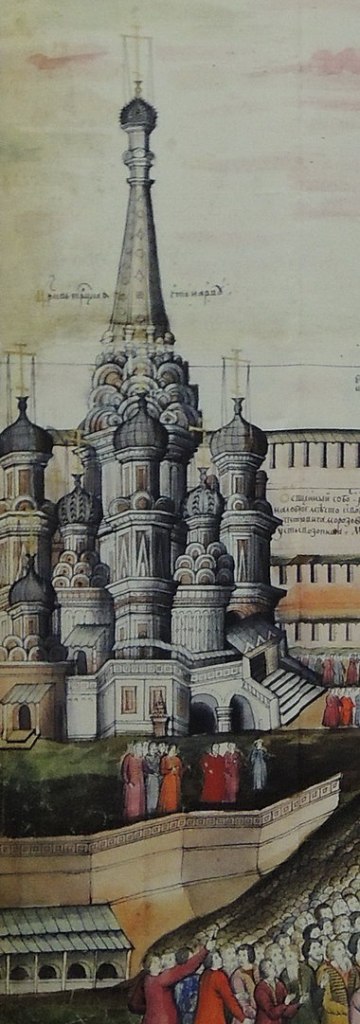
St. Basil’s Cathedral from the Book of the election of the Tsar and Grand Duke Mikhail Fedorovich, 1672 1673
The first changes to the Cathedral of the Intercession of the Virgin, on the Moat, took place almost immediately after construction and were associated with the name of the famous Moscow saint – St. Basil the Blessed. Before the appearance of a stone cathedral on this site, there was a wooden Trinity Church, where St. Basil often came to pray. In 1558, a lower church was added to the Pokrovsky Cathedral over the burial place of the Moscow miracle worker – St. Basil the Blessed. To build this temple, the builders dismantled part of the original cathedral.
Some historians believe that the cathedral was originally conceived as a likeness of the seven-tower Blachernae monastery with the Church of the Virgin , in which the miracle of the Intercession once took place . By its presence and location, it was supposed to assert a new state ideology: ” Moscow is the third Rome ” , and the eight chapel was there because of the dimension of the foundation” . Others believe that the very idea of a multi-chapel cathedral belonged to Metropolitan Macarius , who planned to recreate in the center of Moscow the image of the holy city of Jerusalem.
In the middle of the 16th century, the cathedral was painted in the fresco technique and imitated brickwork. There were no porches, and the St. Basil’s Church bell tower had a different look. It gave the cathedral a strict but elegant appearance which could be compare to a memorial with the eight separates churches symbolizing the days of the decisive battles for Kazan.
The original roof of the church burned downed at the end of the 16th century and the figured domes of the cathedral appeared instead of the original roof.
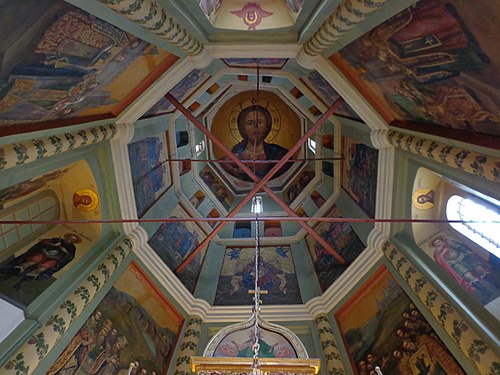
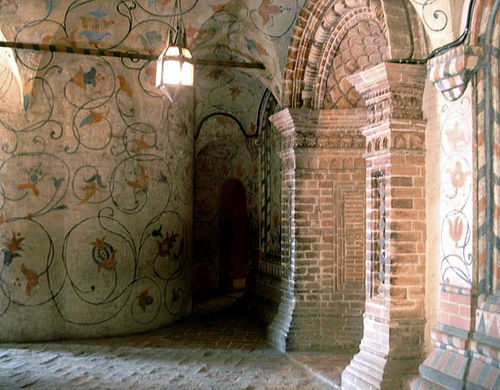
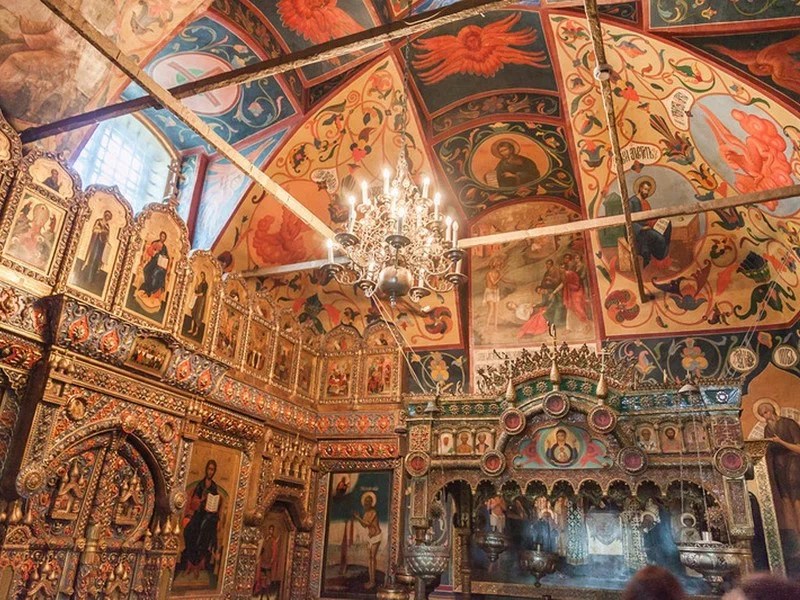
The Intercession Cathedral is richly decorated with wall paintings, has an impressive collection of ancient Russian icon painting and masterpieces of church applied art.
Until the reconstruction of the Great Bell Tower in the Kremlin in 1660, the cathedral was the tallest building in Moscow.
In the 1670 the wooden churches on Red Square were closed, then the cathedral was supplemented by a hipped bell tower, its heads were covered with iron, the porch was covered with tiles , and a bright colorful ornamental painting appeared on the cathedral. Finally the chapel of Blessed John of Moscow was added in 1672
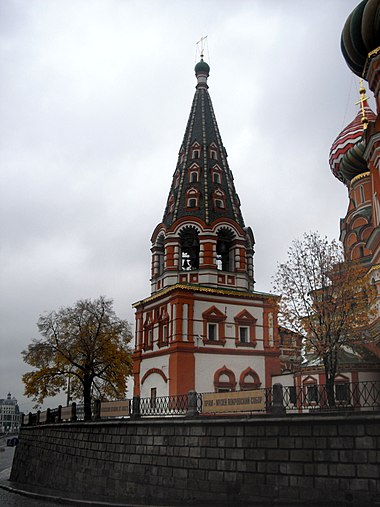
Bell tower
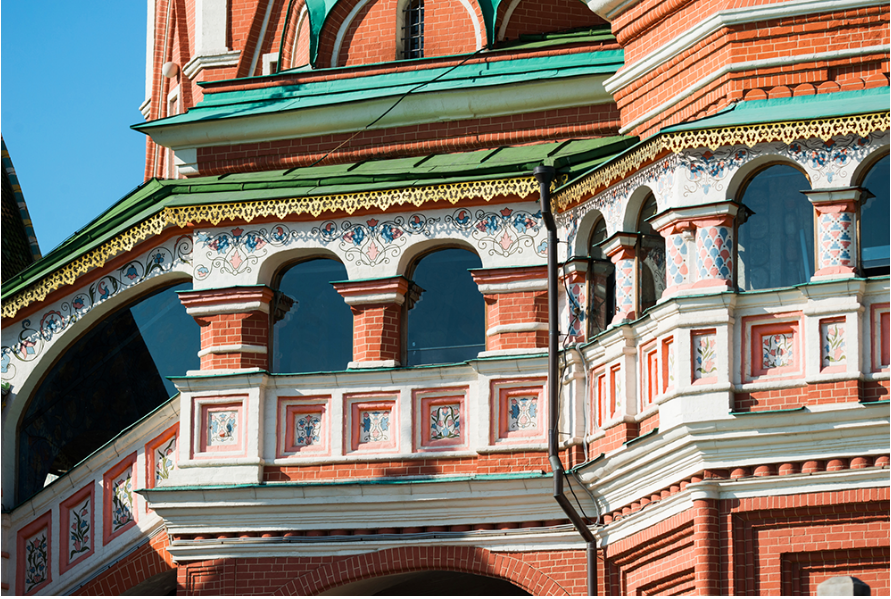
The cathedral was seriously renovated in 1680, with brick galleries replacing the wooden ones and the outer and inner galleries, platforms and parapets of the porches being painted with grass ornaments motifs.
In the 18 and 19 centuries Divine services were regularly performed in St. Basil’s Cathedral. As a rule, they were performed in an annex – a temple built in honor of St. Basil the Blessed, because the rest of the temples were cold. That is why the people got accustomed to the name – St. Basil’s Cathedral.
Divine services in the temple continued until the beginning of the 20th century. The last rector was Father John Vostorgov, now canonized among the saints in the host of new martyrs and confessors
In 1737, the temple almost completely burned out because of one of the strongest fires in Moscow. The restoration of the architecture and interiors of the cathedral was done under the leadership of the architect Ivan Michurin.
Painting by Giacomo Quarenghi “The Intercession Cathedral and the Spasskaya Tower of the Kremlin”, 1797
The cathedral was seriously repaired and rebuilt by decree of Catherine II from 1784 to 1786, and it was then that the walls of St. Basil’s Cathedral were painted with multi-colored paints and acquired their modern look. Before it was mainly painted in red and white colors.
After the Patriotic War of 1812, Alexander I decided to restore the temple and in 1817, the architect Osip Bove , while reconstructing Red Square with shopping malls, laid out the retaining wall of the temple with “wild” stone and installed a cast-iron fence. First along Moskvoretskaya Street, then in 1834, on the south side of the temple.
Red_Square_in_Moscow_(1801)_by_Fedor_Alekseev
In 1880, a manor on Pyatnitskaya street was added to the temple . Until 1918, the last rector of the temple , Father John lived in it .
In the 1890s, the temple was again seriously reconstructed. The floors were strengthened, and the Cathedral sacristy was decorated with colored stained-glass windows, designed by the architect Andrei Pavlinov.
Postcard early 20th century
In 1918, the Intercession Cathedral became one of the first cultural objects taken under state protection as a monument of national and world significance. It is during this period that services were stopped in the upper churches and the museumification began.
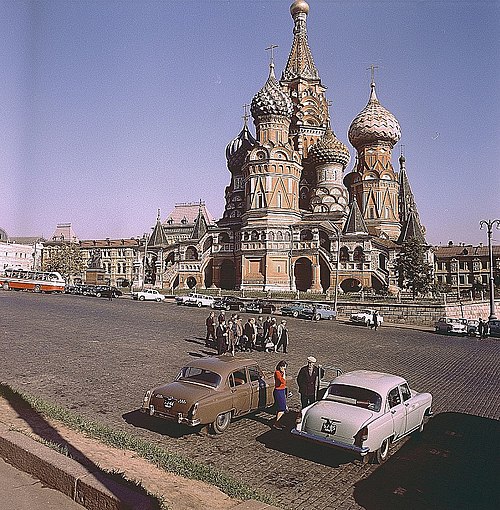
1965
Archpriest John Kuznetsov became the first caretaker of the museum. In the 1920s, the cathedral was in dear need of repair and restoration work was carried out, led by architects Nikolai Kurdyukov and Alexander Alexandrovich Zhelyabuzhsky.
Basil’s Cathedral and the monument to Minin and Pozharsky
After the decision of 1923 to establish a historical and architectural museum in the cathedral, this one was opened to visitors on May 21, 1923.
Beginning in 1923 and until 1949 research was carried out in the museum because of legends which attributed to the temple a network of underground passages. And in 1924, walled-up room with a deep hole in the floor under the chapel of John the Merciful was found by the restorer and architect Dmitry Sukhov and the speleologist-historian Ignatius Stelletsky.
The window-loopholes of the room were bricked up both from the side of the river and from the side of Red Square. Ignatius Stelletsky wrote that the embrasures had the same approaches as for the cannons in the towers of Kitay-gorod and any of the monasteries which led him to the idea that in the 16th century the lower part of St. Basil’s Cathedral was intended for combat.
The Pokrovsky Cathedral museum became a branch of the State Historical Museum in 1928 and in 1929 the divine services were banned in the cathedral, and the bells were removed and melted down.
During the Great Patriotic War, the museum did not stop its work, although it was closed to visitors. St. Basil’s Cathedral was carefully disguised to save it from bombing. There is a legend that after the war, Stalin was offered to remove the cathedral under the pretext that it was interfering with the parade. It is believed that Kaganovich showed Stalin a model of the square, and in his presence he removed the model of the temple, suggesting that it be demolished. Stalin abruptly interrupted him: “Lazar, put it in its place!” Since then, no one has raised questions about the inviolability of the cathedral.
The cathedral began to be restored, on September 7, 1947, and the museum reopened on the day of the celebration of the 800th anniversary of Moscow.
From 1954 to 1955 the “brick-like” painting of the 16th century was returned to the cathedral, and at the same time the white-stone details of the décor was restored.
On November 18, 1991, the Russian Orthodox Church was allowed to hold regular services in the Kremlin cathedrals and St. Basil’s Cathedral but the first divine service took place on the patronal feast of the Intercession of the Most Holy Theotokos on October 1, 1991
Beginning in 2001 and ending ten years later the interiors of ten churches were restored, the icon of the Intercession of the Most Holy Theotokos was restored, and the basements were restored to their original appearance.
If you liked this article, subscribe , put likes, write comments!Share on social networksand you can alsoCheck out Our Latest Posts
La cathédrale Saint-Basile, un trésor architectural de Moscou
La cathédrale Saint-Basile, extraordinairement belle et mystérieuse, ou la cathédrale de l’Intercession de la Vierge, sur les douves, s’étalant sur la Place Rouge, est l’un des monuments les plus importants de l’architecture russe ancienne du XVIe siècle. Ni avant ni après une telle structure n’a été construite. Elle ressemble à une voûte de huit églises, qui entoure la plus haute – la neuvième. Un tel temple n’existe toujours pas ailleurs en Russie. Même le motif lumineux des dômes de la cathédrale le fait ressembler à un jardin d’Eden en fleurs.
Saint Basil’s Cathedral
Chaque temple a sa propre entrée et son propre éclairage, cependant, la cathédrale est un seul bâtiment. La complexité et l’incroyable combinaison de détails de la cathédrale Saint-Basile sont sans précédent dans l’architecture Russe et ont eu un impact énorme sur le développement de l’architecture nationale russe.
La cathédrale a été érigée en 1555-1561. à la demande du tsar Ivan le Terrible en l’honneur de la conquête du royaume de Kazan. On pense que les architectes qui l’ont créé ont été privés de la vue. Même Staline n’a pas autorisé la démolition du bâtiment et pendant la guerre, le temple a été caché des bombardements. La cathédrale est inscrite sur la liste Russe des sites du patrimoine mondial de l’UNESCO et est une branche du Musée historique d’État.
Le niveau supérieur de la cathédrale ressemble à un labyrinthe et la base est une étoile à huit branches.
La cathédrale réunit dix églises (chapelles), dont certaines ont été consacrées en l’honneur des saints, dont les jours de mémoire sont tombés sur les batailles décisives pour Kazan.
L’église centrale a été construite en l’honneur de l’Intercession de la Vierge, autour de laquelle des églises séparées sont regroupées en l’honneur de : la Sainte Trinité, l’Entrée du Seigneur à Jérusalem, Saint-Nicolas de Velikoretsky, les Trois Patriarches : Alexandre, Jean et Paul le Nouveau, Grégoire d’Arménie, Cyprien et Justine, Alexandre Svirsky et Varlaam Khutynsky, placés sur le même soubassement, et une chapelle en l’honneur de saint Basile le Bienheureux, du nom duquel le temple reçut un second nom bien mieux connu.
Royal Doors in the Church of the Intercession of the Blessed Virgin Mary, 2009Royal Doors of the Church of Cyprian and Justina 2012Royal Doors of the Church of the Entry of the Lord into Jerusalem, 2011Royal doors of the iconostasis of the Church of Varlaam Khutynsky, 2011Royal Doors of the Church of St. Nicholas Velikoretsky, 2007
L’épaisseur des murs de la fondation de la cathédrale Saint-Basile atteint trois mètres. C’est cette épaisseur qui lui permet de tenir en toute sécurité jusqu’à neuf bâtiments. Si vous regardez les fondations de l’église, vous pouvez voir que 8 petits temples forment une étoile à huit branches – un symbole de la Vierge. Il y a de plus grandes églises dans l’ensemble des petites églises. Elles sont strictement orientés vers les points cardinaux et forment une symétrie. Le temple principal, avec un immense dôme et une tente, est la Protection de la Vierge, Son intercession.
Pendant les campagnes d’Ivan le Terrible à Kazan sur l’actuelle Place Rouge, des églises en bois de «camping» ont été érigées en mémoire des victoires remportées.
Le jour de la mémoire de Cyprien et Justine (2 octobre 1552), la campagne suivante se termina par une victoire sur le khanat de Kazan et l’annexion de la ville à l’État Moscovite. C’était le lendemain de l’intercession du Très Saint Théotokos, et Ivan le Terrible a ordonné de réunir toutes les églises en bois «en marche» en un seul temple de pierre au nom de l’intercession de la Vierge – la cathédrale de l’Intercession, mais elle n’est restée que moins d’un an avant d’être démantelée, et finalement une cathédrale en pierre a été posée à sa place.
Déjà, à l’automne 1554 était la première mention fiable de la construction de l’église de l’Intercession de la Mère de Dieu. La construction de ce temple a commencé en 1555 et a duré 6 ans. Le temple a été construit en brique et ses fondations, son socle et un certain nombre de détails sont en pierre blanche. Dans la partie ouest de la cathédrale, il y a un plafond en briques plates.
Une légende sur les architectes Barma et Postnik dont les noms ne furent connus qu’en 1895 racontait qu’ils avaient été aveuglés par ordre du Tsar Ivan le Terrible afin qu’ils ne puissent plus construire un tel temple, mais Postnik ne pouvait pas être aveuglé, car plusieurs années après la construction de la cathédrale, il a participé à la création du Kremlin de Kazan.
En 1559, à l’automne, la partie principale du temple a été érigée et, à la même période, toutes les églises sauf l’église centrale ont été consacrées.
Malgré l’apparente grandiosité de l’extérieur de la cathédrale Saint-Basile, l’intérieur est assez petit, pouvant accueillir un très petit nombre de personnes pendant le service.
En effet, selon le plan de ses créateurs, il n’aurait pas dû être trop spacieux, car pendant les grandes fêtes religieuses de l’église, toute la Place Rouge était l’église, le lieu d’exécution, sur lequel le clergé montait, devenait un lutrin, et la Cathédrale de Pokrovsky se transformait en l’autel d’un temple à ciel ouvert. Après tout, il n’y a pas de temple dans la Jérusalem Céleste, mais “il n’y a que Son Trône”… et la Cathédrale de l’Intercession – transformée en autel d’une église à ciel ouvert.
Enfin, le 29 juin 1561 selon l’ancien calendrier, l’église centrale d’intercession de la cathédrale a finallement été consacrée au nom de l’Intercession de la Très Sainte Théotokos.
St. Basil’s Cathedral from the Book of the election of the Tsar and Grand Duke Mikhail Fedorovich, 1672 1673
Les premiers changements apportés à la cathédrale de l’Intercession de la Vierge, sur les douves, ont eu lieu presque immédiatement après la construction et ont été associés au nom du célèbre saint de Moscou – Saint Basile le Bienheureux. Avant l’apparition d’une cathédrale de pierre sur ce site, il y avait une église de la Trinité en bois, où saint Basile venait souvent prier. En 1558, une église inférieure a été ajoutée à la cathédrale Pokrovsky au-dessus du lieu de sépulture du faiseur de miracles de Moscou – Saint-Basile le Bienheureux. Pour construire ce temple, les constructeurs ont démantelé une partie de la cathédrale d’origine.
Certains historiens pensent que la cathédrale a été conçue à l’origine comme une ressemblance du monastère des Blachernes à sept tours avec l’église de la Vierge, dans laquelle le miracle de l’Intercession a eu lieu. Par sa présence et son emplacement, elle était censée affirmer une nouvelle idéologie d’État : « Moscou est la troisième Rome », et la huitième chapelle était là en raison de la dimension de la fondation ». D’autres pensent que l’idée même d’une cathédrale à plusieurs chapelles appartenait au métropolite Macaire, qui prévoyait de recréer au centre de Moscou l’image de la ville sainte de Jérusalem.
Au milieu du XVIe siècle, la cathédrale fut peinte selon la technique de la fresque et imita la maçonnerie. Il n’y avait pas de porches, et le clocher de l’église Saint-Basile avait un aspect différent. Cela a donné à la cathédrale une apparence stricte mais élégante qui pourrait être comparée à un mémorial avec les huit églises séparées symbolisant les jours des batailles décisives pour Kazan .
Le toit d’origine de l’église a brûlé à la fin du 16ème siècle et les coupoles figurées de la cathédrale sont apparus à la place du toit d’origine.
La cathédrale de l’intercession est richement décorée de peintures murales, possède une impressionnante collection d’anciennes peintures d’icônes Russes et chefs-d’œuvre de l’art appliqué de l’église.
Jusqu’à la reconstruction du grand clocher du Kremlin en 1660, la cathédrale était le plus haut bâtiment de Moscou.
Dans les années de 1670, les églises en bois de la place Rouge ont été fermées, puis la cathédrale a été complétée par un clocher en croupe, ses têtes ont été recouvertes de fer, le porche a été recouvert de tuiles , et une peinture ornementale aux couleurs vives est apparue sur la cathédrale. Finallement la chapelle du bienheureux Jean de Moscou a été ajoutée en 1672.
Bell tower
La cathédrale a été sérieusement rénovée en 1680, avec des galeries en brique remplaçant celles en bois et les galeries extérieures et intérieures, les plates-formes et les parapets des porches étant peints avec des motifs d’ornements de plante.
Aux 18 et 19 siècles Des messes étaient régulièrement célébrées dans la cathédrale Saint-Basile. En règle générale, elles étaient exécutés dans une annexe – un temple construit en l’honneur de Saint Basile le Bienheureux, car le reste des temples était froid. C’est pourquoi les gens se sont habitués au nom de la cathédrale Saint-Basile.
Les messes dans le temple se sont poursuivis jusqu’au début du XXe siècle. Le dernier recteur était le père John Vostorgov, maintenant canonisé parmi les saints dans l’hôte de nouveaux martyrs et confesseurs
En 1737, le temple a presque complètement brûlé à cause de l’un des incendies les plus violents de Moscou. La restauration de l’architecture et des intérieurs de la cathédrale a été réalisée sous la direction de l’architecte Ivan Michurin.
Painting by Giacomo Quarenghi “The Intercession Cathedral and the Spasskaya Tower of the Kremlin”, 1797
La cathédrale a été sérieusement réparée et reconstruite par décret de Catherine II de 1784 à 1786, et c’est alors que les murs de la cathédrale Saint-Basile ont été peints avec des peintures multicolores et ont acquis leur aspect moderne. Avant, il était principalement peint en rouge et blanc.
Après la guerre patriotique de 1812, Alexandre Ier décide de restaurer le temple et en 1817, l’architecte Ossip Bove, tout en reconstruisant la Place Rouge avec des centres commerciaux, a aménagé le mur de soutènement du temple avec de la pierre “sauvage” et installé une clôture de fonte. D’abord le long de la rue Moskvoretskaya, puis en 1834, du côté sud du temple.
Red_Square_in_Moscow_(1801)_by_Fedor_Alekseev
En 1880, un manoir sur la rue Pyatnitskaya a été ajouté au temple. Jusqu’en 1918, le dernier recteur du temple, le père Jean y habita.
Dans les années 1890, le temple fut à nouveau sérieusement reconstruit. Les sols ont été renforcés et la sacristie de la cathédrale a été décorée de vitraux colorés, conçus par l’architecte Andrei Pavlinov.
Postcard early 20th century
En 1918, la cathédrale de l’Intercession est devenue l’un des premiers objets culturels pris sous la protection de l’État en tant que monument d’importance nationale et mondiale. C’est durant cette période que les messes furent arrêtées dans les églises hautes et que la muséification commença.
1965
L’archiprêtre John Kuznetsov est devenu le premier gardien du musée. Dans les années 1920, la cathédrale avait grand besoin de réparations et des travaux de restauration ont été dirigés par les architectes Nikolai Kurdyukov et Alexander Alexandrovich Zhelyabuzhsky.
Basil’s Cathedral and the monument to Minin and Pozharsky
Après la décision de 1923 d’établir un musée historique et architectural dans la cathédrale, celui-ci a ouvert aux visiteurs le 21 mai 1923.
A partir de 1923 et jusqu’en 1949, des recherches furent menées dans le musée à cause des légendes qui attribuaient au temple un réseau de passages souterrains. Et en 1924, une pièce murée avec un trou profond dans le sol sous la chapelle de Jean le Miséricordieux a été découverte par le restaurateur et architecte Dmitry Sukhov et le spéléologue-historien Ignatius Stelletsky.
Les meurtrières des fenêtres de la chambre étaient murées à la fois du côté du fleuve et du côté de la Place Rouge. Ignatius Stelletsky a écrit que les embrasures avaient les mêmes approches que pour les canons des tours de Kitay-gorod et de tous les monastères, ce qui l’a conduit à l’idée qu’au XVIe siècle, la partie inférieure de la cathédrale Saint-Basile était destinée au combat.
Le musée de la cathédrale Pokrovsky est devenu une branche du musée historique d’État en 1928 et en 1929, les messes ont été interdites dans la cathédrale, et les cloches ont été retirées et fondues.
Pendant la Grande Guerre patriotique, le musée n’a pas cessé ses travaux, bien qu’il ait été fermé aux visiteurs. La cathédrale Saint-Basile a été soigneusement déguisée pour la protéger des bombardements. Il y a une légende selon laquelle après la guerre, Staline s’est vu proposer d’enlever la cathédrale sous prétexte qu’elle interférait avec le défilé. On pense que Kaganovich a montré à Staline un modèle de la place et, en sa présence, il a enlevé le modèle du temple, suggérant qu’il soit démoli. Staline l’interrompit brusquement : « Lazar, remets-le à sa place ! Depuis lors, personne n’a soulevé de questions sur l’inviolabilité de la cathédrale.
La cathédrale a commencé à être restaurée, le 7 septembre 1947, et le musée a rouvert le jour de la célébration du 800e anniversaire de Moscou.
De 1954 à 1955, la peinture « en brique » du XVIe siècle a été restituée à la cathédrale, et en même temps les détails en pierre blanche du décor ont été restaurés.
Le 18 novembre 1991, l’Église orthodoxe russe a été autorisée à organiser des services réguliers dans les cathédrales du Kremlin et la cathédrale Saint-Basile, mais le premier service divin a eu lieu lors de la fête patronale de l’intercession du Très Saint Théotokos le 1er octobre 1991.
À partir de 2001 et se terminant dix ans plus tard, les intérieurs des dix églises ont été restaurés, l’icône de l’intercession du Très Saint Théotokos a été restaurée et les sous-sols ont retrouvé leur aspect d’origine.
Si cet article vous a plu, abonnez-vous, mettez des likes, écrivez des commentaires ! Partagez sur les réseaux sociaux et vous pouvez également consulter nos derniers articles
A beautiful video of the Repin museum complex in the village of Shiryaevo close to Samara. It was sent to me by a friend. I hope you’ll enjoy it as much as I did.





















 AKirill, Learn, apprenez, translation, traduction, livres bilingues, bilingual books