

Kikin chambers is one of the oldest building in Saint Petersburg. This building is included in the Unified State Register of Cultural Heritage Objects of Russia. The mansion which was rebuilt several times is on Stavropolskaya street between the former Leningrad Radio Engineering Research Institute and a residential building built at the beginning of our century.

It is the only house of Alexander Kikin that still exist nowadays.
Alexander Vasilyevich Kikin was a proeminent nobleman and one of the associates of Peter the Great. He accompanied the tsar in the Azov campaign, then went to study shipbuilding in Hollands. After having been appointed head of the Saint Petersburg Admiralty in 1708, he was awarded the rank of Peter’s adviser for the Admiralty in 1712.

Alexander became one of the richest person in Russia and began to build himself a mansion. Sadly when a conflict arose between Peter I and Tsarevich Alexei, Kikin helped Alexei hide abroad sealing his own fate. In 1718, before his mansion was finished, he was taken into custody, sentenced to be wheeled and died a painful death on the chopping block.
The chambers were confiscated and all the properties of Kikin went to the treasury. The Winter Palace stands on Kikin’s second land plot now.

The construction of the chambers began in 1714 and ended in 1720. It is presumed that A. Schluter was the architect of the building. Its construction was carried out in two stages. Initially, the central part of the house was two-story, and two one-story wings, which were intended for household needs, adjoined it on both sides.
The windows and doorways of the Kikin chambers were framed with platbands, and the roof was covered with flat tiles. The building had side risalits, which were ledges located in the center and on the sides of the facades. Their feature was the presence of intricate decorative curls, the so-called volutes and shoulder blades. They performed not only decorative functions, but also constructive, as they contributed to the strengthening of the wall. Kikin’s chambers were decorated with a front porch, to which small stairs led from both sides. White balusters gave them a special, solemn look. The building was decorated with pediments, and it was crowned with a high roof with a fracture. The internal layout of the structure was very similar to the arrangement of rooms in the Peterhof Grand Palace. In 1720 a second floor was built over the side wings.
After the construction of the chambers was completed, the famous Kunstkamera and the library of Peter I were placed inside where they stayed until 1727.
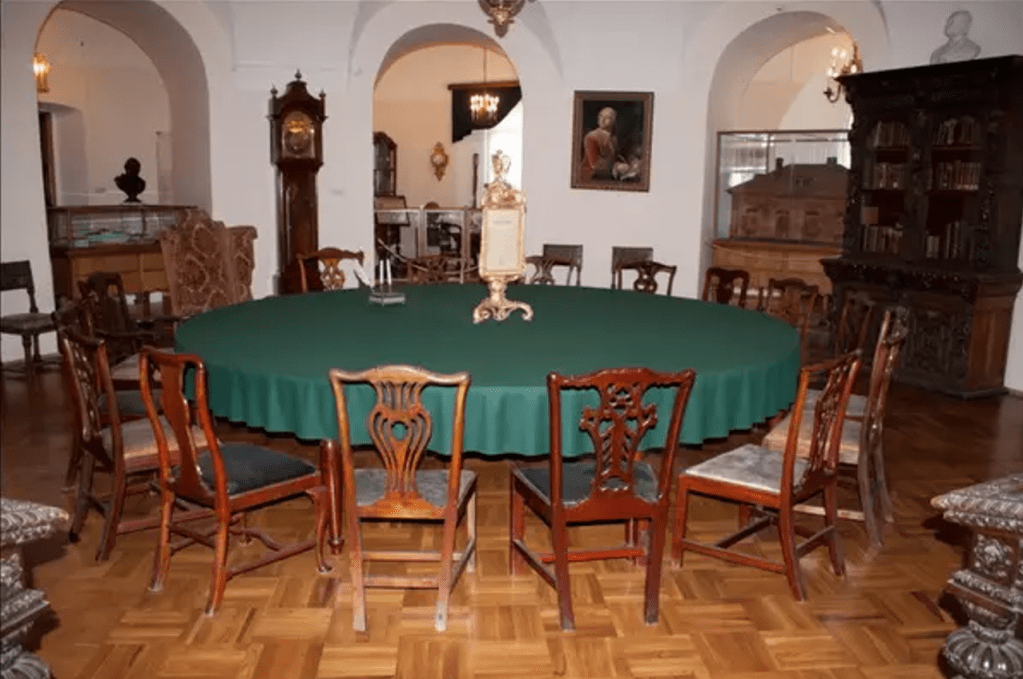

After the execution of the owner in 1718, there was a belief among the people that the ghost of Kikin was wandering in the house and few people wanted to see the collection belonging to the tsar. The tsar resorting to cunning, promised everyone who visited the the Kunstkamera a glass of vodka or a cup of coffee in order to popularize the natural sciences. It worked and the exposition had many visitors.
In addition, Natalya Alekseevna, the tsar sister set up one of the first city theater in part of the building.
There is a well-known legend which says that once Peter the Great, walking along the banks of the Neva, saw a branch of a tree, which miraculously grew into his trunk and decided to build a new building for the Kunstkamera where he transferred his collection in 1727.
In the 1720s, the Kikin Chambers were rebuilt by an unknown architect.
In 1733, a hospital, an office and the headquarters of the Horse Guards were opened in the Kikin Chambers. During the construction of barracks for the regiment of the Horse Guards next to the chambers, which were adapted for the regimental infirmary and office, F. B. Rastrelli erected a bell tower with a dome and a cross over the middle part of the chambers. The Great Hall was then used for the regimental church.
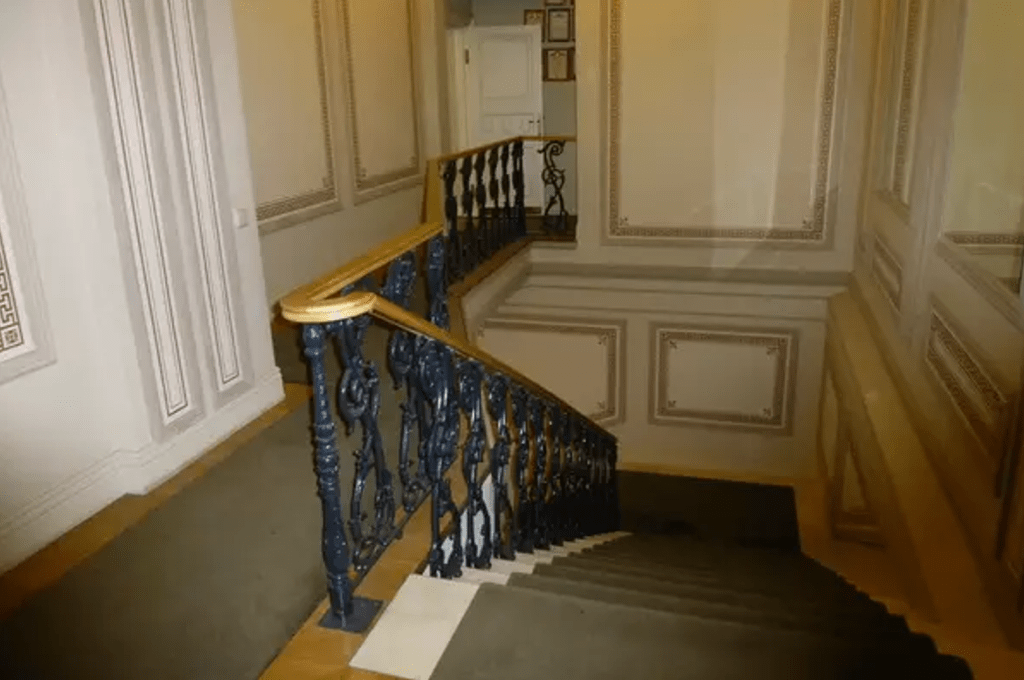
In the 19th century the building was seriously damaged. In 1829, Kikin’s chambers were reconstructed according to the project of Alexander Staubert. He was extremely negligent in his approach and destroyed all the rich baroque decor that adorned the facade of the house. The pilasters were removed, the superstructure-bell tower by Rastrelli was demolished. The walls were covered with plaster, and he added 2 rooms to the building from the side of the embankment. In 1874, two symmetrical staircases were added to the building from the Neva side.
| Help the site stay free, buy us a cup of coffee |  | Aidez-nous à maintenir le site gratuit en nous offrant une tasse de café |
During the Siege of Leningrad, the Kikin chambers were badly damaged by bombs and shells, and the building was repeatedly on fire. However, it was at this time that the plaster applied during the last restoration fell off, revealing the original facade of the early 18th century.
This made it possible to start recreating the facades in the forms of Petrine architecture.
Immediately after the war, the implementation of an ambitious project by the architect I. Benois began to restore the Kikin chambers to their historical appearance. The pilasters were returned to their places, later superstructures to the building were demolished, and pediments were attached to the chambers from two sides. The restoration was completed in 1956.
In 1979, the authorities of St. Petersburg transferred the Kikin Chambers to the Children’s Music School No. 12. Since 1995, the school has been transformed into the St. Petersburg Musical Lyceum, which is located in this building to this day.
| If you liked this article, subscribe , put likes, write comments!. |
| Share on social networks |
| Check out Our Latest Posts |
 AKirill, Learn, apprenez, translation, traduction, livres bilingues, bilingual books
This website was… how do you say it? Relevant!! Finally I have found something which helped me. Thank you!
LikeLike
You’re welcome. I’m glad I could help.
LikeLike