On this site we hope to help you learn, and to remove the difficulties caused by the difference of culture and language. Sur ce site nous espérons vous aider à apprendre, et à enlever la barrière causée par les différents languages et cultures.
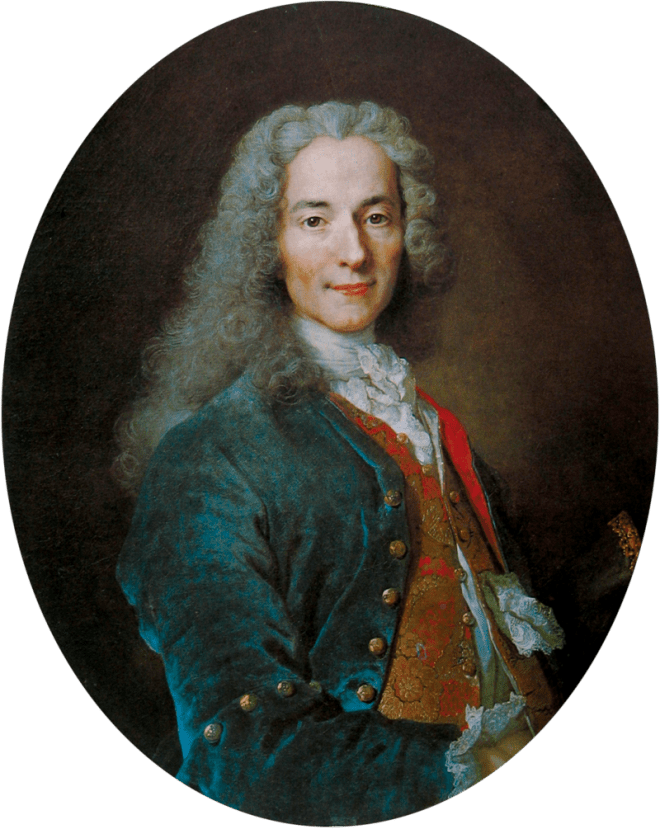
“Candide”, also called “l’Optimisme” is a French satire and the best-known work of Voltaire which was first published in 1759. It is a philosophical tale which is often hailed as a paradigmatic text of the Enlightenment, but it is also an ironic attack on its optimistic beliefs. Because the book openly derides government and church alike the work and its author were immediately denounced by both secular and religious authorities after its publication. Candide is now available in our bilingual book section (English/French)
The Grand Council of Geneva and the administrators of Paris banned “Candide” by the end of February 1759, but it nevertheless succeeded in selling twenty thousand to thirty thousand copies by the end of the year in over twenty editions, making it a best seller. In 1762, Candide was listed in the Index Librorum Prohibitorum, the Roman Catholic Church’s list of prohibited books. For a long time, the United States considered “Candide” a seminal work of Western literature and banned it well into the twentieth century.
“Candide” was inspired by a number of historical events, most notably the Seven Years’ War and the 1755 Lisbon earthquake, tsunami and resulting fires of All Saints’ Day.
Behind a playful facade lies very harsh criticism of contemporary European civilization where European governments such as France, Prussia, Portugal and England are each attacked ruthlessly by the author which angered many.
In 1953 “Candide was adapted for the Radio anthology program “On Stage”. It was also adapted as a comic operetta which first opened in Broadway as a musical on December 1st, 1956. In 1973, the BBC produced a television adaptation of “Candide” In addition to the above, “Candide” was also made into a number of minor films and theatrical adaptations throughout the twentieth century.
Candide, our young and naive hero is schooled in an optimistic philosophy by his tutor Pangloss. He falls in love with the baron’s daughter, Cunégonde, and is forced to leave the castle when the baron learns of their love. Candide joins the army and it is the beginning of s series of hardships and disasters that he will encounter. He experiences the horrors of war, rape, theft, hanging, shipwrecks, earthquakes, cannibalism, and slavery. These experiences erode Candide’s optimistic belief.
I HOW CANDIDE WAS BROUGHT UP IN A MAGNIFICENT CASTLE, AND HOW HE WAS EXPELLED THENCE. In a castle of Westphalia, belonging to the Baron of Thunder-ten-Tronckh, lived a youth, whom nature had endowed with the most gentle manners. His countenance was a true picture of his soul. He combined a true judgment with simplicity of spirit, which was the reason, I apprehend, of his being called Candide. The old servants of the family suspected him to have been the son of the Baron’s sister, by a good, honest gentleman of the neighborhood, whom that young lady would never marry because he had been able to prove only seventy-one quarterings, the rest of his genealogical tree having been lost through the injuries of time. The Baron was one of the most powerful lords in Westphalia, for his castle had not only a gate, but windows. His great hall, even, was[Pg 2] hung with tapestry. All the dogs of his farm-yards formed a pack of hounds at need; his grooms were his huntsmen; and the curate of the village was his grand almoner. They called him “My Lord,” and laughed at all his stories. The Baron’s lady weighed about three hundred and fifty pounds, and was therefore a person of great consideration, and she did the honours of the house with a dignity that commanded still greater respect. Her daughter Cunegonde was seventeen years of age, fresh-coloured, comely, plump, and desirable. The Baron’s son seemed to be in every respect worthy of his father. The Preceptor Pangloss[1] was the oracle of the family, and little Candide heard his lessons with all the good faith of his age and character. Pangloss was professor of metaphysico-theologico-cosmolo-nigology. He proved admirably that there is no effect without a cause, and that, in this best of all possible worlds, the Baron’s castle was the most magnificent of castles, and his lady the best of all possible Baronesses. “It is demonstrable,” said he, “that things cannot be otherwise than as they are; for all being created for an end, all is necessarily for the best end. Observe, that the nose has been formed to bear spectacles—thus we have spectacles. Legs are visibly designed for stockings[Pg 3]—and we have stockings. Stones were made to be hewn, and to construct castles—therefore my lord has a magnificent castle; for the greatest baron in the province ought to be the best lodged. Pigs were made to be eaten—therefore we eat pork all the year round. Consequently they who assert that all is well have said a foolish thing, they should have said all is for the best.” Candide listened attentively and believed innocently; for he thought Miss Cunegonde extremely beautiful, though he never had the courage to tell her so. He concluded that after the happiness of being born of Baron of Thunder-ten-Tronckh, the second degree of happiness was to be Miss Cunegonde, the third that of seeing her every day, and the fourth that of hearing Master Pangloss, the greatest philosopher of the whole province, and consequently of the whole world. One day Cunegonde, while walking near the castle, in a little wood which they called a park, saw between the bushes, Dr. Pangloss giving a lesson in experimental natural philosophy to her mother’s chamber-maid, a little brown wench, very pretty and very docile. As Miss Cunegonde had a great disposition for the sciences, she breathlessly observed the repeated experiments of which she was a witness; she clearly perceived [Pg 4]the force of the Doctor’s reasons, the effects, and the causes; she turned back greatly flurried, quite pensive, and filled with the desire to be learned; dreaming that she might well be a sufficient reason for young Candide, and he for her. She met Candide on reaching the castle and blushed; Candide blushed also; she wished him good morrow in a faltering tone, and Candide spoke to her without knowing what he said. The next day after dinner, as they went from table, Cunegonde and Candide found themselves behind a screen; Cunegonde let fall her handkerchief, Candide picked it up, she took him innocently by the hand, the youth as innocently kissed the young lady’s hand with particular vivacity, sensibility, and grace; their lips met, their eyes sparkled, their knees trembled, their hands strayed. Baron Thunder-ten-Tronckh passed near the screen and beholding this cause and effect chased Candide from the castle with great kicks on the backside; Cunegonde fainted away; she was boxed on the ears by the Baroness, as soon as she came to herself; and all was consternation in this most magnificent and most agreeable of all possible castles.
Cette semaine, j’ai mis à jour la page de tous nos articles (all our posts) , puis j’ai ajouté un livre de littérature américaine intitulé “The Red Badge of Courage” de Stephen Crane. Il est disponible en lecture ou en téléchargement en anglais et en français. J’ai aussi continué à travailler sur notre livre bilingue, donc nous pourrions en voir un nouveau avant la fin du mois.
This week I updated the page of all our posts, then I added a book of American Literature called “The Red Badge of Courage” by Stephen Crane. It is available to read or download in english and in French. I also continued to work on our bilingual book, so we might see a new one before the end of the month.
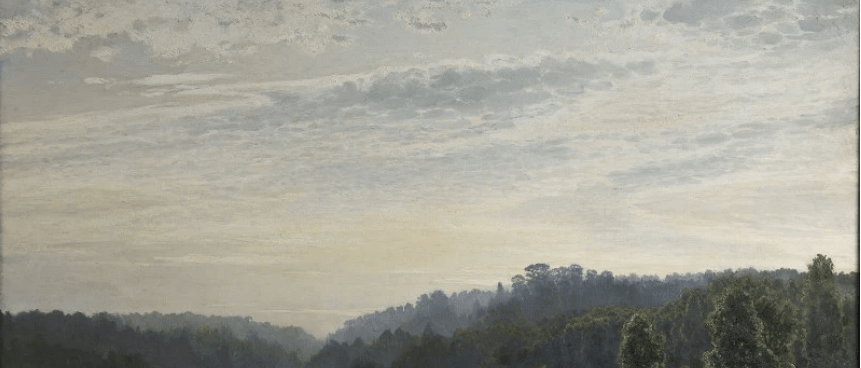
“Matin brumeux” (Туманное утро) est une huile sur toile monumentale de 108 X 144,5 cm, peinte en 1885 par I. I. Chichkine (И.И.Шишкин). Elle est située au Musée d’Art de Nizhny Novgorod, Nizhny Novgorod. C’est une belle vue panoramique d’un petit matin sur la rive de la rivière.
Même si Shiskin a peint principalement la vie de la forêt russe, il a parfois peint des champs et des prairies. Cette peinture n’est pas typique de Shishkin car généralement ses peintures dépeignent la nature à l’apogée de la beauté estivale au milieu de la journée.
« Matin brumeux » est une œuvre très harmonieuse peinte dans des tons verdâtres-argentés. Le tableau représente une rivière, sur les rives de laquelle pousse une forêt. La peinture capture le début d’une nouvelle journée et l’état paisible de la nature au petit matin au bord d’une rivière.
La rivière est encadrée par des rives pittoresques de couleur émeraude et est représentée dans de riches tons verts, ainsi que dans une couleur argentée représentant le brouillard.
Quelque part au loin, la forêt est enveloppée de brouillard, mais ici, sur la rive gauche de la rivière, sur laquelle l’auteur a montré de petits arbustes et des fleurs sauvages, le brouillard est à peine visible. La surface miroir de la rivière silencieuse reflète le ciel et les cimes majestueuses des arbres bouclés. Le mur dense de la forêt ressemble plus à une tente verte tissée, qui s’étend jusqu’à l’horizon. Les arbres de la forêt sur la rive opposée sont très majestueusement représentés. Le temps sans vent ne fait qu’ajouter à leur puissance. La forêt est dessinée très densément. Au loin un épais brouillard matinal ne s’est pas encore dissipé, et un voile bleuté recouvre une partie de la forêt et les berges du fleuve.
Le ciel est haut et sans fond et vous ne pouvez même pas voir les nuages flotter dessus. Après tout, ces nuages se sont transformés en un voile de dentelle blanche qui descend jusqu’à la cime des arbres. La lumière du soleil enveloppe chaque nuage et à partir de là, le voile de dentelle blanche devient doré annonçant l’aube et l’arrivée d’une belle journée.
L’élaboration caractéristique des détails est impressionnante et nous pouvons admirer la variété des nuances de couleurs qui traduisent le jeu des ombres et de la lumière.
Dans ce tableau, le peintre traduit la beauté d’un matin d’été ainsi que la fragilité et l’unicité de l’instant.
“Foggy morning” (Туманное утро) is a monumental oil on canvas of 108X144.5 cm, painted in 1885 by I. I. Shishkin (И.И.Шишкин ). The painting is situated in the Nizhny Novgorod Art Museum, Nizhny Novgorod. It is a beautiful panoramic view of an early morning on the bank of the river.
Even though Shiskin painted mainly the life of the Russian forest, he sometimes painted fields and meadows. This painting is not typical for Shishkin because usually his paintings depict nature in the prime of the summer beauty in the middle of the day.
“Foggy Morning” is a very harmonious work painted in greenish-silver tones. The painting depicts a full-flowing river, on the banks of which a forest grows. The painting captures the beginning of a new day and the peaceful state of the nature during an early morning on the bank of a river..
The river is framed by picturesque banks of emerald color and is shown in rich green tones, as well as silvery color representing the fog.
Somewhere in the distance the forest is shrouded in fog, but here, on the left bank of the river, on which the author showed small shrubs and wildflowers, the fog is barely visible. The mirror surface of the silent river reflects the sky and the majestic crowns of curly trees. The dense wall of the forest is more like a woven green tent, which stretches as far as the horizon. The trees in the forest on the opposite bank are depicted very majestically. Windless weather only adds to their power. The forest is drawn very densely. In the distance an heavy morning fog has not yet dissipated, and a bluish veil covers part of the forest and the river banks.
The sky is high and bottomless and you can’t even see the clouds floating on it. After all, these clouds turned into a white lace veil that descended right to the tops of the trees. Sunlight envelops every cloud and from this the white lace veil becomes golden heralding the dawn of the coming of a nice day.
The characteristic elaboration of details is impressive and we can admire the variety of color shades which convey the play of shadows and light.
In this painting, the painter conveys the beauty of a summer morning as well as the fragility and uniqueness of the moment.
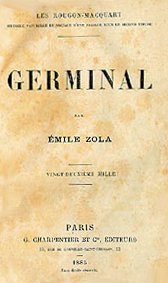
« Germinal » qui est considéré comme le chef-d’œuvre d’Émile Zola et est l’un des romans les plus significatifs de la tradition française. Ce livre est considéré comme l’un des meilleurs romans sur le mouvement ouvrier, et est l’un des premiers romans qui tentent de montrer la confrontation entre les capitalistes et la classe ouvrière. « Germinal » a été écrit entre avril 1884 et janvier 1885 et a été édité et traduit dans plus de cent pays.
« Germinal » fait désormais partie de nos livres bilingues (français/anglais)
Émile Zola in 1902
« Germinal », le 2e roman sur la classe ouvrière, est le 13e roman du célèbre cycle Rougeon-Macquart qui comprend 20 tomes. La série Rougeon-Macquart s’intéresse à l’influence de l’hérédité dans deux branches d’une famille sous le second Empire français. Le premier “Germinal” a été sérialisé entre novembre 1884 et février 1885 et a été publié sous forme de livre en mars 1885. Il a inspiré cinq adaptations cinématographiques et deux productions télévisuelles.
Émile Zola a très bien choisi le titre et les noms de ses personnages en utilisant certains pour faire un point. Par exemple « Germinal » tire son nom d’un mois printanier du calendrier républicain français. Germen qui est un mot latin signifiant graine, qui peut être considéré comme l’espoir des mineurs pour un avenir meilleur. Et le nom de la mine Voreux qui vient du latin Vorax lequel signifie “celui qui dévore” est aussi une comparaison intéressante. Un autre est Montsou, la ville fictive où se déroule l’histoire qui signifie beaucoup de sous.
Les événements décrits sont basés sur une histoire vraie qui s’est passée en 1884 dans les mines d’Anzin, en France, où Émile Zola est allé lui-même se faisant passer pour le secrétaire d’un membre de la Chambre des députés française pour faire ses recherches.
Etienne est un jeune mineur de charbon de la ville de Montsou. Il mène ses collègues dans une grève après que l’entreprise ai modifié la structure des salaires des travailleurs, essentiellement en baissant les salaires. La grève se poursuit au fil des semaines, tandis que les travailleurs meurent lentement de faim. Les grévistes écoutent Etienne qui prêche le socialisme. Ils sont devenus plus catégoriques dans leur résistance à M. Hennebeau à mesure que leur condition de vie empirait. Au bout d’un certain temps, la grève devient violente, détruisant des propriétés et menaçant les gardes et, les soldats tirent sur la foule. Quatorze ouvriers sont tués et vingt-cinq blessés. Enfin, les responsables de l’entreprise viennent régler la grève, renvoyant les briseurs de grève et mettant fin à la popularité d’Étienne. L’un des ouvriers a saboté le puits avant de partir. Après la reprise des travaux dans la mine, l’eau commence à se précipiter dans le puits à cause du sabotage. Certains hommes sont piégés en dessous lorsque la cage fait son dernier retour. Finallement, quelqu’un s’apprête à sauver les ouvriers enterrés qui sont considérés être encore en vie. Mais lors du sauvetage une explosion blesse plusieurs ouvriers et en tue un. Pendant ce temps, les travailleurs piégés se dispersent, essayant de trouver un lieu sûr. Seuls, deux amants entendent les tapotements des sauveteurs, et continuent de répondre pendant des jours. Malheureusement, l’un d’eux meurt avant que les sauveteurs ne les atteignent. Étienne qui était toujours en vie au moment des secours passe 6 semaines à l’hôpital puis décide de se rendre à Paris où plus de travail révolutionnaire l’attend.
Dans la plaine rase, sous la nuit sans étoiles, d’une obscurité et d’une épaisseur d’encre, un homme suivait seul la grande route de Marchiennes à Montsou, dix kilomètres de pavé coupant tout droit, à travers les champs de betteraves. Devant lui, il ne voyait même pas le sol noir, et il n’avait la sensation de l’immense horizon plat que par les souffles du vent de mars, des rafales larges comme sur une mer, glacées d’avoir balayé des lieues de marais et de terres nues. Aucune ombre d’arbre ne tachait le ciel, le pavé se déroulait avec la rectitude d’une jetée, au milieu de l’embrun aveuglant des ténèbres.
L’homme était parti de Marchiennes vers deux heures. Il marchait d’un pas allongé, grelottant sous le coton aminci de sa veste et de son pantalon de velours. Un petit paquet, noué dans un mouchoir à carreaux, le gênait beaucoup; et il le serrait contre ses flancs, tantôt d’un coude, tantôt de l’autre, pour glisser au fond de ses poches les deux mains à la fois, des mains gourdes que les lanières du vent d’est faisaient saigner. Une seule idée occupait sa tête vide d’ouvrier sans travail et sans gîte, l’espoir que le froid serait moins vif après le lever du jour. Depuis une heure, il avançait ainsi, lorsque sur la gauche, à deux kilomètres de Montsou, il aperçut des feux rouges, trois brasiers brûlant au plein air, et comme suspendus. D’abord, il hésita, pris de crainte; puis, il ne put résister au besoin douloureux de se chauffer un instant les mains.
Un chemin creux s’enfonçait. Tout disparut. L’homme avait à droite une palissade, quelque mur de grosses planches fermant une voie ferrée; tandis qu’un talus d’herbe s’élevait à gauche, surmonté de pignons confus, d’une vision de village aux toitures basses et uniformes. Il fit environ deux cents pas. Brusquement, à un coude du chemin, les feux reparurent près de lui, sans qu’il comprît davantage comment ils brûlaient si haut dans le ciel mort, pareils à des lunes fumeuses. Mais, au ras du sol, un autre spectacle venait de l’arrêter. C’était une masse lourde, un tas écrasé de constructions, d’où se dressait la silhouette d’une cheminée d’usine; de rares lueurs sortaient des fenêtres encrassées, cinq ou six lanternes tristes étaient pendues dehors, à des charpentes dont les bois noircis alignaient vaguement des profils de tréteaux gigantesques; et, de cette apparition fantastique, noyée de nuit et de fumée, une seule voix montait, la respiration grosse et longue d’un échappement de vapeur, qu’on ne voyait point.
Alors, l’homme reconnut une fosse. Il fut repris de honte: à quoi bon? il n’y aurait pas de travail. Au lieu de se diriger vers les bâtiments, il se risqua enfin à gravir le terri sur lequel brûlaient les trois feux de houille, dans des corbeilles de fonte, pour éclairer et réchauffer la besogne. Les ouvriers de la coupe à terre avaient dû travailler tard, on sortait encore les débris inutiles. Maintenant, il entendait les moulineurs pousser les trains sur les tréteaux, il distinguait des ombres vivantes culbutant les berlines, près de chaque feu.
—Bonjour, dit-il en s’approchant d’une des corbeilles.
Tournant le dos au brasier, le charretier était debout, un vieillard vêtu d’un tricot de laine violette, coiffé d’une casquette en poil de lapin; pendant que son cheval, un gros cheval jaune, attendait, dans une immobilité de pierre, qu’on eût vidé les six berlines montées par lui. Le manoeuvre employé au culbuteur, un gaillard roux et efflanqué, ne se pressait guère, pesait sur le levier d’une main endormie. Et, là-haut, le vent redoublait, une bise glaciale, dont les grandes haleines régulières passaient comme des coups de faux.
—Bonjour, répondit le vieux.
Un silence se fit. L’homme, qui se sentait regardé d’un oeil méfiant, dit son nom tout de suite.
—Je me nomme Étienne Lantier, je suis machineur… Il n’y a pas de travail ici?
Les flammes l’éclairaient, il devait avoir vingt et un ans, très brun, joli homme, l’air fort malgré ses membres menus.
Rassuré, le charretier hochait la tête.
—Du travail pour un machineur, non, non… Il s’en est encore présenté deux hier. Il n’y a rien.
Une rafale leur coupa la parole. Puis, Étienne demanda, en montrant le tas sombre des constructions, au pied du terri:
—C’est une fosse, n’est-ce pas?
Le vieux, cette fois, ne put répondre. Un violent accès de toux l’étranglait. Enfin, il cracha, et son crachat, sur le sol empourpré, laissa une tache noire.
—Oui, une fosse, le Voreux… Tenez! le coron est tout près.
A son tour, de son bras tendu, il désignait dans la nuit le village dont le jeune homme avait deviné les toitures. Mais les six berlines étaient vides, il les suivit sans un claquement de fouet, les jambes raidies par des rhumatismes; tandis que le gros cheval jaune repartait tout seul, tirait pesamment entre les rails, sous une nouvelle bourrasque, qui lui hérissait le poil.
Le Voreux, à présent, sortait du rêve. Étienne, qui s’oubliait devant le brasier à chauffer ses pauvres mains saignantes, regardait, retrouvait chaque partie de la fosse, le hangar goudronné du criblage, le beffroi du puits, la vaste chambre de la machine d’extraction, la tourelle carrée de la pompe d’épuisement. Cette fosse, tassée au fond d’un creux, avec ses constructions trapues de briques, dressant sa cheminée comme une corne menaçante, lui semblait avoir un air mauvais de bête goulue, accroupie là pour manger le monde.
Tout en l’examinant, il songeait à lui, à son existence de vagabond, depuis huit jours qu’il cherchait une place; il se revoyait dans son atelier du chemin de fer, giflant son chef, chassé de Lille, chassé de partout; le samedi, il était arrivé à Marchiennes, où l’on disait qu’il y avait du travail, aux Forges; et rien, ni aux Forges, ni chez Sonneville, il avait dû passer le dimanche caché sous les bois d’un chantier de charronnage, dont le surveillant venait de l’expulser, à deux heures de la nuit. Rien, plus un sou, pas même une croûte: qu’allait-il faire ainsi par les chemins, sans but, ne sachant seulement où s’abriter contre la bise? Oui, c’était bien une fosse, les rares lanternes éclairaient le carreau, une porte brusquement ouverte lui avait permis d’entrevoir les foyers des générateurs, dans une clarté vive. Il s’expliquait jusqu’à l’échappement de la pompe, cette respiration grosse et longue, soufflant sans relâche, qui était comme l’haleine engorgée du monstre.
Le manoeuvre du culbuteur, gonflant le dos, n’avait pas même levé les yeux sur Étienne, et celui-ci allait ramasser son petit paquet tombé à terre, lorsqu’un accès de toux annonça le retour du charretier. Lentement, on le vit sortir de l’ombre, suivi du cheval jaune, qui montait six nouvelles berlines pleines.
—Il y a des fabriques à Montsou? demanda le jeune homme.
Le vieux cracha noir, puis répondit dans le vent:
—Oh! ce ne sont pas les fabriques qui manquent. Fallait voir ça, il y a trois ou quatre ans! Tout ronflait, on ne pouvait trouver des hommes, jamais on n’avait tant gagné… Et voilà qu’on se remet à se serrer le ventre. Une vraie pitié dans le pays, on renvoie le monde, les ateliers ferment les uns après les autres… Ce n’est peut-être pas la faute de l’empereur; mais pourquoi va-t-il se battre en Amérique? Sans compter que les bêtes meurent du choléra, comme les gens.
Alors, en courtes phrases, l’haleine coupée, tous deux continuèrent à se plaindre. Étienne racontait ses courses inutiles depuis une semaine: il fallait donc crever de faim? bientôt les routes seraient pleines de mendiants. Oui, disait le vieillard, ça finirait par mal tourner, car il n’était pas Dieu permis de jeter tant de chrétiens à la rue.
—On n’a pas de la viande tous les jours.
—Encore si l’on avait du pain!
—C’est vrai, si l’on avait du pain seulement!
Leurs voix se perdaient, des bourrasques emportaient les mots dans un hurlement mélancolique.
—Tenez! reprit très haut le charretier en se tournant vers le midi, Montsou est là…
Et, de sa main tendue de nouveau, il désigna dans les ténèbres des points invisibles, à mesure qu’il les nommait. Là-bas, à Montsou, la sucrerie Fauvelle marchait encore, mais la sucrerie Hoton venait de réduire son personnel, il n’y avait guère que la minoterie Dutilleul et la corderie Bleuze pour les câbles de mine, qui tinssent le coup. Puis, d’un geste large, il indiqua, au nord, toute une moitié de l’horizon: les ateliers de construction Sonneville n’avaient pas reçu les deux tiers de leurs commandes habituelles; sur les trois hauts fourneaux des Forges de Marchiennes, deux seulement étaient allumés; enfin, à la verrerie Gagebois, une grève menaçait, car on parlait d’une réduction de salaire.
—Je sais, je sais, répétait le jeune homme à chaque indication. J’en viens.
—Nous autres, ça va jusqu’à présent, ajouta le charretier. Les fosses ont pourtant diminué leur extraction. Et regardez, en face, à la Victoire, il n’y a aussi que deux batteries de fours à coke qui flambent.
Il cracha, il repartit derrière son cheval somnolent, après l’avoir attelé aux berlines vides.
Maintenant, Étienne dominait le pays entier. Les ténèbres demeuraient profondes, mais la main du vieillard les avait comme emplies de grandes misères, que le jeune homme, inconsciemment, sentait à cette heure autour de lui, partout, dans l’étendue sans bornes. N’était-ce pas un cri de famine que roulait le vent de mars, au travers de cette campagne nue? Les rafales s’étaient enragées, elles semblaient apporter la mort du travail, une disette qui tuerait beaucoup d’hommes. Et, les yeux errants, il s’efforçait de percer les ombres, tourmenté du désir et de la peur de voir. Tout s’anéantissait au fond de l’inconnu des nuits obscures, il n’apercevait, très loin, que les hauts fourneaux et les fours à coke. Ceux-ci, des batteries de cent cheminées, plantées obliquement, alignaient des rampes de flammes rouges; tandis que les deux tours, plus à gauche, brûlaient toutes bleues en plein ciel, comme des torches géantes. C’était d’une tristesse d’incendie, il n’y avait d’autres levers d’astres, à l’horizon menaçant, que ces feux nocturnes des pays de la houille et du fer.
—Vous êtes peut-être de la Belgique? reprit derrière Étienne le charretier, qui était revenu.
Cette fois, il n’amenait que trois berlines. On pouvait toujours culbuter celles-là: un accident arrivé à la cage d’extraction, un écrou cassé, allait arrêter le travail pendant un grand quart d’heure. En bas du terri, un silence s’était fait, les moulineurs n’ébranlaient plus les tréteaux d’un roulement prolongé. On entendait seulement sortir de la fosse le bruit lointain d’un marteau, tapant sur de la tôle.
—Non, je suis du Midi, répondit le jeune homme.
Le manoeuvre, après avoir vidé les berlines, s’était assis à terre, heureux de l’accident; et il gardait sa sauvagerie muette, il avait simplement levé de gros yeux éteints sur le charretier, comme gêné par tant de paroles. Ce dernier, en effet, n’en disait pas si long d’habitude. Il fallait que le visage de l’inconnu lui convînt et qu’il fût pris d’une de ces démangeaisons de confidences, qui font parfois causer les vieilles gens tout seuls, à haute voix.
—Moi, dit-il, je suis de Montsou, je m’appelle Bonnemort.
—C’est un surnom? demanda Étienne étonné.
Le vieux eut un ricanement d’aise, et montrant le Voreux:
—Oui, oui… On m’a retiré trois fois de là-dedans en morceaux, une fois avec tout le poil roussi, une autre avec de la terre jusque dans le gésier, la troisième avec le ventre gonflé d’eau comme une grenouille… Alors, quand ils ont vu que je ne voulais pas crever, ils m’ont appelé Bonnemort, pour rire.
Sa gaieté redoubla, un grincement de poulie mal graissée, qui finit par dégénérer en un accès terrible de toux. La corbeille de feu, maintenant, éclairait en plein sa grosse tête, aux cheveux blancs et rares, à la face plate, d’une pâleur livide, maculée de taches bleuâtres. Il était petit, le cou énorme, les mollets et les talons en dehors, avec de longs bras dont les mains carrées tombaient à ses genoux. Du reste, comme son cheval qui demeurait immobile sur les pieds, sans paraître souffrir du vent, il semblait en pierre, il n’avait l’air de se douter ni du froid ni des bourrasques sifflant à ses oreilles. Quand il eut toussé, la gorge arrachée par un raclement profond, il cracha au pied de la corbeille, et la terre noircit.
Étienne le regardait, regardait le sol qu’il tachait de la sorte.
—Il y a longtemps, reprit-il, que vous travaillez à la mine?
Bonnemort ouvrit tout grands les deux bras.
—Longtemps, ah! oui!… Je n’avais pas huit ans, lorsque je suis descendu, tenez! juste dans le Voreux, et j’en ai cinquante-huit, à cette heure. Calculez un peu… J’ai tout fait là-dedans, galibot d’abord, puis herscheur, quand j’ai eu la force de rouler, puis haveur pendant dix-huit ans. Ensuite, à cause de mes sacrées jambes, ils m’ont mis de la coupe à terre, remblayeur, raccommodeur, jusqu’au moment où il leur a fallu me sortir du fond, parce que le médecin disait que j’allais y rester. Alors, il y a cinq années de cela, ils m’ont fait charretier… Hein? c’est joli, cinquante ans de mine, dont quarante-cinq au fond!
Tandis qu’il parlait, des morceaux de houille enflammés, qui, par moments, tombaient de la corbeille, allumaient sa face blême d’un reflet sanglant.
—Ils me disent de me reposer, continua-t-il. Moi, je ne veux pas, ils me croient trop bête!… J’irai bien deux années, jusqu’à ma soixantaine, pour avoir la pension de cent quatre-vingts francs. Si je leur souhaitais le bonsoir aujourd’hui, ils m’accorderaient tout de suite celle de cent cinquante. Ils sont malins, les bougres!… D’ailleurs, je suis solide, à part les jambes. C’est, voyez-vous, l’eau qui m’est entrée sous la peau, à force d’être arrosé dans les tailles. Il y a des jours où je ne peux pas remuer une patte sans crier.
Une crise de toux l’interrompit encore.
—Et ça vous fait tousser aussi? dit Étienne.
Mais il répondit non de la tête, violemment. Puis, quand il put parler:
—Non, non, je me suis enrhumé, l’autre mois. Jamais je ne toussais, à présent je ne peux plus me débarrasser… Et le drôle, c’est que je crache, c’est que je crache…
Un raclement monta de sa gorge, il cracha noir.
—Est-ce que c’est du sang? demanda Étienne, osant enfin le questionner.
Lentement, Bonnemort s’essuyait la bouche d’un revers de main.
—C’est du charbon… J’en ai dans la carcasse de quoi me chauffer jusqu’à la fin de mes jours. Et voilà cinq ans que je ne remets pas les pieds au fond. J’avais ça en magasin, paraît-il, sans même m’en douter. Bah! ça conserve!
Il y eut un silence, le marteau lointain battait à coups réguliers dans la fosse, le vent passait avec sa plainte, comme un cri de faim et de lassitude venu des profondeurs de la nuit. Devant les flammes qui s’effaraient, le vieux continuait plus bas, remâchant des souvenirs. Ah! bien sûr, ce n’était pas d’hier que lui et les siens tapaient à la veine! La famille travaillait pour la Compagnie des mines de Montsou, depuis la création; et cela datait de loin, il y avait déjà cent six ans. Son aïeul, Guillaume Maheu, un gamin de quinze ans alors, avait trouvé le charbon gras à Réquillart, la première fosse de la Compagnie, une vieille fosse aujourd’hui abandonnée, là-bas, près de la sucrerie Fauvelle. Tout le pays le savait, à preuve que la veine découverte s’appelait la veine Guillaume, du prénom de son grand-père. Il ne l’avait pas connu, un gros à ce qu’on racontait, très fort, mort de vieillesse à soixante ans. Puis, son père, Nicolas Maheu dit le Rouge, âgé de quarante ans à peine, était resté dans le Voreux, que l’on fonçait en ce temps-là: un éboulement, un aplatissement complet, le sang bu et les os avalés par les roches. Deux de ses oncles et ses trois frères, plus tard, y avaient aussi laissé leur peau. Lui, Vincent Maheu, qui en était sorti à peu près entier, les jambes mal d’aplomb seulement, passait pour un malin. Quoi faire, d’ailleurs? Il fallait travailler. On faisait ça de père en fils, comme on aurait fait autre chose. Son fils, Toussaint Maheu, y crevait maintenant, et ses petits-fils, et tout son monde, qui logeait en face, dans le coron. Cent six ans d’abattage, les mioches après les vieux, pour le même patron: hein? beaucoup de bourgeois n’auraient pas su dire si bien leur histoire!
—Encore, lorsqu’on mange! murmura de nouveau Étienne.
—C’est ce que je dis, tant qu’on a du pain à manger, on peut vivre.
Bonnemort se tut, les yeux tournés vers le coron, où des lueurs s’allumaient une à une. Quatre heures sonnaient au clocher de Montsou, le froid devenait plus vif.
—Et elle est riche, votre Compagnie? reprit Étienne.
Le vieux haussa les épaules, puis les laissa retomber, comme accablé sous un écroulement d’écus.
—Ah! oui, ah! oui… Pas aussi riche peut-être que sa voisine, la Compagnie d’Anzin. Mais des millions et des millions tout de même. On ne compte plus… Dix-neuf fosses, dont treize pour l’exploitation, le Voreux, la Victoire, Crèvecoeur, Mirou, Saint-Thomas, Madeleine, Feutry-Cantel, d’autres encore, et six pour l’épuisement ou l’aérage, comme Réquillart… Dix mille ouvriers, des concessions qui s’étendent sur soixante-sept communes, une extraction de cinq mille tonnes par jour, un chemin de fer reliant toutes les fosses, et des ateliers, et des fabriques!… Ah! oui, ah! oui, il y en a, de l’argent!
Un roulement de berlines, sur les tréteaux, fit dresser les oreilles du gros cheval jaune. En bas, la cage devait être réparée, les moulineurs avaient repris leur besogne. Pendant qu’il attelait sa bête, pour redescendre, le charretier ajouta doucement, en s’adressant à elle:
—Faut pas t’habituer à bavarder, fichu paresseux!… Si monsieur Hennebeau savait à quoi tu perds le temps!
Étienne, songeur, regardait la nuit. Il demanda:
—Alors, c’est à monsieur Hennebeau, la mine?
—Non, expliqua le vieux, monsieur Hennebeau n’est que le directeur général. Il est payé comme nous.
D’un geste, le jeune homme montra l’immensité des ténèbres.
—A qui est-ce donc, tout ça?
Mais Bonnemort resta un instant suffoqué par une nouvelle crise, d’une telle violence, qu’il ne pouvait reprendre haleine. Enfin, quand il eut craché et essuyé l’écume noire de ses lèvres, il dit, dans le vent qui redoublait:
—Hein? à qui tout ça?… On n’en sait rien. A des gens.
Et, de la main, il désignait dans l’ombre un point vague, un lieu ignoré et reculé, peuplé de ces gens, pour qui les Maheu tapaient à la veine depuis plus d’un siècle. Sa voix avait pris une sorte de peur religieuse, c’était comme s’il eût parlé d’un tabernacle inaccessible, où se cachait le dieu repu et accroupi, auquel ils donnaient tous leur chair, et qu’ils n’avaient jamais vu.
—Au moins si l’on mangeait du pain à sa suffisance! répéta pour la troisième fois Étienne, sans transition apparente.
—Dame, oui! si l’on mangeait toujours du pain, ce serait trop beau!
Le cheval était parti, le charretier disparut à son tour, d’un pas traînard d’invalide. Près du culbuteur, le manoeuvre n’avait point bougé, ramassé en boule, enfonçant le menton entre ses genoux, fixant sur le vide ses gros yeux éteints.
Quand il eut repris son paquet, Étienne ne s’éloigna pas encore. Il sentait les rafales lui glacer le dos, pendant que sa poitrine brûlait, devant le grand feu. Peut-être, tout de même, ferait-il bien de s’adresser à la fosse: le vieux pouvait ne pas savoir; puis, il se résignait, il accepterait n’importe quelle besogne. Où aller et que devenir, à travers ce pays affamé par le chômage? laisser derrière un mur sa carcasse de chien perdu? Cependant, une hésitation le troublait, une peur du Voreux, au milieu de cette plaine rase, noyée sous une nuit si épaisse. A chaque bourrasque, le vent paraissait grandir, comme s’il eût soufflé d’un horizon sans cesse élargi. Aucune aube ne blanchissait dans le ciel mort, les hauts fourneaux seuls flambaient, ainsi que les fours à coke, ensanglantant les ténèbres, sans en éclairer l’inconnu. Et le Voreux, au fond de son trou, avec son tassement de bête méchante, s’écrasait davantage, respirait d’une haleine plus grosse et plus longue, l’air gêné par sa digestion pénible de chair humaine.
“Germinal” which is considered Émile Zola’s masterpiece and is one of the most significant novel in the French tradition. It is considered one of the best novel about labor movement, and is one of the first novel which try to show the confrontation between the capitalists and the working class. “Germinal” was written between April 1884 and January 1885 and has been publisher and translated in over one hundred countries.
“Germinal” is now part of our bilingual book (French/English)
Émile Zola in 1902
“Germinal”, the 2nd novel about working class is the 13th novel of the famous cycle Rougeon-Macquart which include 20 volumes. The Rougeon-Macquart series focuses on the influence of heredity in two branches of a family during the second French Empire. First “Germinal” was serialized between November 1884 and February 1885 and was published as a book in March 1885. It has inspired five film adaptations and two televisions productions.
Émile Zola chose the title and the names of his characters very well using some to make a point. For example “Germinal” takes his name from a spring month of the French Republican calendar. Germen which is a latin word meaning seed, which can be seen as the miners’ hope for a better future. And the name of the mine Voreux which comes from the latin Vorax which means the one that devours is also an interesting comparison. Another one is Montsou, the fictional town where the story takes places which means many sous.
The events described are based on a true story which happened in 1884 in the mines at Anzin, in France, where Émile Zola went himself posing as a secretary for a member of the French Chamber of Deputies to do his research.
Etienne is a young coal miner of the city of Montsou. He is leading his coworkers in a strike after that the company changes the structure of the wages of the workers, essentially lowering wages. The strike wears on through the weeks, while the workers slowly starve. The strikers listen Etienne who preaches socialism. They became more adamant in their resistance to M. Hennebeau as the condition of their lives worsen. After a while, the strike becomes violent, destroying properties and threatening the guards and the soldiers fire into the mob. Fourteen workers are killed and twenty five wounded. Finally, company officials come to settle the strike, sending the strikebreakers away and ending Étienne’s popularity. One of the worker sabotage the shaft before to leave. After the work in the mine starts again water begins rushing into the shaft because of the sabotage Some men are trapped below when the cage makes its last trip up. Finally someone sets about to rescue the entombed workers who are assumed to be still alive. But during the rescue an explosion injures several of them and kills a worker. Meanwhile, the trapped workers scatter, trying to find a place of safety. Alone, two lovers hear the rescuers’ tapping, and continue answering for days. Sadly one of them dies before the rescuers reach them. Étienne who is still alive when help comes, decides to go to Paris, where more revolutionary work awaits him after spending 6 weeks in the hospital.
Over the open plain, beneath a starless sky as dark and thick as ink, a man walked alone along the highway from Marchiennes to Montsou, a straight paved road ten kilometres in length, intersecting the beetroot fields. He could not even see the black soil before him, and only felt the immense flat horizon by the gusts of March wind, squalls as strong as on the sea, and frozen from sweeping leagues of marsh and naked earth. No tree could be seen against the sky, and the road unrolled as straight as a pier in the midst of the blinding spray of darkness.
The man had set out from Marchiennes about two o’clock. He walked with long strides, shivering beneath his worn cotton jacket and corduroy breeches. A small parcel tied in a check handkerchief troubled him much, and he pressed it against his side, sometimes with one elbow, sometimes with the other, so that he could slip to the bottom of his pockets both the benumbed hands that bled beneath the lashes of the wind. A single idea occupied his head—the empty head of a workman without work and without lodging—the hope that the cold would be less keen after sunrise. For an hour he went on thus, when on the left, two kilometres from Montsou, he saw red flames, three fires burning in the open air and apparently suspended. At first he hesitated, half afraid. Then he could not resist the painful need to warm his hands for a moment.
The steep road led downwards, and everything disappeared. The man saw on his right a paling, a wall of coarse planks shutting in a line of rails, while a grassy slope rose on the left surmounted by confused gables, a vision of a village with low uniform roofs. He went on some two hundred paces. Suddenly, at a bend in the road, the fires reappeared close to him, though he could not understand how they burnt so high in the dead sky, like smoky moons. But on the level soil another sight had struck him. It was a heavy mass, a low pile of buildings from which rose the silhouette of a factory chimney; occasional gleams appeared from dirty windows, five or six melancholy lanterns were hung outside to frames of blackened wood, which vaguely outlined the profiles of gigantic stages; and from this fantastic apparition, drowned in night and smoke, a single voice arose, the thick, long breathing of a steam escapement that could not be seen.
Then the man recognized a pit. His despair returned. What was the good? There would be no work. Instead of turning towards the buildings he decided at last to ascend the pit bank, on which burnt in iron baskets the three coal fires which gave light and warmth for work. The labourers in the cutting must have been working late; they were still throwing out the useless rubbish. Now he heard the landers push the wagons on the stages. He could distinguish living shadows tipping over the trams or tubs near each fire.
“Good day,” he said, approaching one of the baskets.
Turning his back to the fire, the carman stood upright. He was an old man, dressed in knitted violet wool with a rabbit-skin cap on his head; while his horse, a great yellow horse, waited with the immobility of stone while they emptied the six trains he drew. The workman employed at the tipping-cradle, a red-haired lean fellow, did not hurry himself; he pressed on the lever with a sleepy hand. And above, the wind grew stronger—an icy north wind—and its great, regular breaths passed by like the strokes of a scythe.
“Good day,” replied the old man. There was silence. The man, who felt that he was being looked at suspiciously, at once told his name.
“I am called Étienne Lantier. I am an engine-man. Any work here?”
The flames lit him up. He might be about twenty-one years of age, a very dark, handsome man, who looked strong in spite of his thin limbs.
The carman, thus reassured, shook his head.
“Work for an engine-man? No, no! There were two came yesterday. There’s nothing.”
A gust cut short their speech. Then Étienne asked, pointing to the sombre pile of buildings at the foot of the platform:
“A pit, isn’t it?”
The old man this time could not reply: he was strangled by a violent cough. At last he expectorated, and his expectoration left a black patch on the purple soil.
“Yes, a pit. The Voreux. There! The settlement is quite near.”
In his turn, and with extended arm, he pointed out in the night the village of which the young man had vaguely seen the roofs. But the six trams were empty, and he followed them without cracking his whip, his legs stiffened by rheumatism; while the great yellow horse went on of itself, pulling heavily between the rails beneath a new gust which bristled its coat.
The Voreux was now emerging from the gloom. Étienne, who forgot himself before the stove, warming his poor bleeding hands, looked round and could see each part of the pit: the shed tarred with siftings, the pit-frame, the vast chamber of the winding machine, the square turret of the exhaustion pump. This pit, piled up in the bottom of a hollow, with its squat brick buildings, raising its chimney like a threatening horn, seemed to him to have the evil air of a gluttonous beast crouching there to devour the earth. While examining it, he thought of himself, of his vagabond existence these eight days he had been seeking work. He saw himself again at his workshop at the railway, delivering a blow at his foreman, driven from Lille, driven from everywhere. On Saturday he had arrived at Marchiennes, where they said that work was to be had at the Forges, and there was nothing, neither at the Forges nor at Sonneville’s. He had been obliged to pass the Sunday hidden beneath the wood of a cartwright’s yard, from which the watchman had just turned him out at two o’clock in the morning. He had nothing, not a penny, not even a crust; what should he do, wandering along the roads without aim, not knowing where to shelter himself from the wind? Yes, it was certainly a pit; the occasional lanterns lighted up the square; a door, suddenly opened, had enabled him to catch sight of the furnaces in a clear light. He could explain even the escapement of the pump, that thick, long breathing that went on without ceasing, and which seemed to be the monster’s congested respiration.
The workman, expanding his back at the tipping-cradle, had not even lifted his eyes on Étienne, and the latter was about to pick up his little bundle, which had fallen to the earth, when a spasm of coughing announced the carman’s return. Slowly he emerged from the darkness, followed by the yellow horse drawing six more laden trams.
“Are there factories at Montsou?” asked the young man.
The old man expectorated, then replied in the wind:
“Oh, it isn’t factories that are lacking. Should have seen it three or four years ago. Everything was roaring then. There were not men enough; there never were such wages. And now they are tightening their bellies again. Nothing but misery in the country; every one is being sent away; workshops closing one after the other. It is not the Emperor’s fault, perhaps; but why should he go and fight in America? without counting that the beasts are dying from cholera, like the people.”
Then, in short sentences and with broken breath, the two continued to complain. Étienne narrated his vain wanderings of the past week: must one, then, die of hunger? Soon the roads would be full of beggars.
“Yes,” said the old man, “this will turn out badly, for God does not allow so many Christians to be thrown on the street.”
“We don’t have meat every day.”
“But if one had bread!”
“True, if one only had bread.”
Their voices were lost, gusts of wind carrying away the words in a melancholy howl.
“Here!” began the carman again very loudly, turning towards the south. “Montsou is over there.”
And stretching out his hand again he pointed out invisible spots in the darkness as he named them. Below, at Montsou, the Fauvelle sugar works were still going, but the Hoton sugar works had just been dismissing hands; there were only the Dutilleul flour mill and the Bleuze rope walk for mine-cables which kept up. Then, with a large gesture he indicated the north half of the horizon: the Sonneville workshops had not received two-thirds of their usual orders; only two of the three blast furnaces of the Marchiennes Forges were alight; finally, at the Gagebois glass works a strike was threatening, for there was talk of a reduction of wages.
“I know, I know,” replied the young man at each indication. “I have been there.”
“With us here things are going on at present,” added the carman; “but the pits have lowered their output. And see opposite, at the Victoire, there are also only two batteries of coke furnaces alight.”
He expectorated, and set out behind his sleepy horse, after harnessing it to the empty trams.
Now Étienne could oversee the entire country. The darkness remained profound, but the old man’s hand had, as it were, filled it with great miseries, which the young man unconsciously felt at this moment around him everywhere in the limitless tract. Was it not a cry of famine that the March wind rolled up across this naked plain? The squalls were furious: they seemed to bring the death of labour, a famine which would kill many men. And with wandering eyes he tried to pierce shades, tormented at once by the desire and by the fear of seeing. Everything was hidden in the unknown depths of the gloomy night. He only perceived, very far off, the blast furnaces and the coke ovens. The latter, with their hundreds of chimneys, planted obliquely, made lines of red flame; while the two towers, more to the left, burnt blue against the blank sky, like giant torches. It resembled a melancholy conflagration. No other stars rose on the threatening horizon except these nocturnal fires in a land of coal and iron.
“You belong to Belgium, perhaps?” began again the carman, who had returned behind Étienne.
This time he only brought three trams. Those at least could be tipped over; an accident which had happened to the cage, a broken screw nut, would stop work for a good quarter of an hour. At the bottom of the pit bank there was silence; the landers no longer shook the stages with a prolonged vibration. One only heard from the pit the distant sound of a hammer tapping on an iron plate.
“No, I come from the South,” replied the young man.
The workman, after having emptied the trams, had seated himself on the earth, glad of the accident, maintaining his savage silence; he had simply lifted his large, dim eyes to the carman, as if annoyed by so many words. The latter, indeed, did not usually talk at such length. The unknown man’s face must have pleased him that he should have been taken by one of these itchings for confidence which sometimes make old people talk aloud even when alone.
“I belong to Montsou,” he said, “I am called Bonnemort.”
“Is it a nickname?” asked Étienne, astonished.
The old man made a grimace of satisfaction and pointed to the Voreux:
“Yes, yes; they have pulled me three times out of that, torn to pieces, once with all my hair scorched, once with my gizzard full of earth, and another time with my belly swollen with water, like a frog. And then, when they saw that nothing would kill me, they called me Bonnemort for a joke.”
His cheerfulness increased, like the creaking of an ill-greased pulley, and ended by degenerating into a terrible spasm of coughing. The fire basket now clearly lit up his large head, with its scanty white hair and flat, livid face, spotted with bluish patches. He was short, with an enormous neck, projecting calves and heels, and long arms, with massive hands falling to his knees. For the rest, like his horse, which stood immovable, without suffering from the wind, he seemed to be made of stone; he had no appearance of feeling either the cold or the gusts that whistled at his ears. When he coughed his throat was torn by a deep rasping; he spat at the foot of the basket and the earth was blackened.
Étienne looked at him and at the ground which he had thus stained.
“Have you been working long at the mine?”
Bonnemort flung open both arms.
“Long? I should think so. I was not eight when I went down into the Voreux and I am now fifty-eight. Reckon that up! I have been everything down there; at first trammer, then putter, when I had the strength to wheel, then pikeman for eighteen years. Then, because of my cursed legs, they put me into the earth cutting, to bank up and patch, until they had to bring me up, because the doctor said I should stay there for good. Then, after five years of that, they made me carman. Eh? that’s fine—fifty years at the mine, forty-five down below.”
While he was speaking, fragments of burning coal, which now and then fell from the basket, lit up his pale face with their red reflection.
“They tell me to rest,” he went on, “but I’m not going to; I’m not such a fool. I can get on for two years longer, to my sixtieth, so as to get the pension of one hundred and eighty francs. If I wished them good evening to-day they would give me a hundred and fifty at once. They are cunning, the beggars. Besides, I am sound, except my legs. You see, it’s the water which has got under my skin through being always wet in the cuttings. There are days when I can’t move a paw without screaming.”
A spasm of coughing interrupted him again.
“And that makes you cough so?” said Étienne.
But he vigorously shook his head. Then, when he could speak:
“No, no! I caught cold a month ago. I never used to cough; now I can’t get rid of it. And the queer thing is that I spit, that I spit——”
The rasping was again heard in his throat, followed by the black expectoration.
“Is it blood?” asked Étienne, at last venturing to question him.
Bonnemort slowly wiped his mouth with the back of his hand.
“It’s coal. I’ve got enough in my carcass to warm me till I die. And it’s five years since I put a foot down below. I stored it up, it seems, without knowing it; it keeps you alive!”
There was silence. The distant hammer struck regular blows in the pit, and the wind passed by with its moan, like a cry of hunger and weariness coming out of the depths of the night. Before the flames which grew low, the old man went on in lower tones, chewing over again his old recollections. Ah, certainly: it was not yesterday that he and his began hammering at the seam. The family had worked for the Montsou Mining Company since it started, and that was long ago, a hundred and six years already. His grandfather, Guillaume Maheu, an urchin of fifteen then, had found the rich coal at Réquillart, the Company’s first pit, an old abandoned pit to-day down below near the Fauvelle sugar works. All the country knew it, and as a proof, the discovered seam was called the Guillaume, after his grandfather. He had not known him—a big fellow, it was said, very strong, who died of old age at sixty. Then his father, Nicolas Maheu, called Le Rouge, when hardly forty years of age had died in the pit, which was being excavated at that time: a landslip, a complete slide, and the rock drank his blood and swallowed his bones. Two of his uncles and his three brothers, later on, also left their skins there. He, Vincent Maheu, who had come out almost whole, except that his legs were rather shaky, was looked upon as a knowing fellow. But what could one do? One must work; one worked here from father to son, as one would work at anything else. His son, Toussaint Maheu, was being worked to death there now, and his grandsons, and all his people, who lived opposite in the settlement. A hundred and six years of mining, the youngsters after the old ones, for the same master. Eh? there were many bourgeois that could not give their history so well!
“Anyhow, when one has got enough to eat!” murmured Étienne again.
“That is what I say. As long as one has bread to eat one can live.”
Bonnemort was silent; and his eyes turned towards the settlement, where lights were appearing one by one. Four o’clock struck in the Montsou tower and the cold became keener.
“And is your company rich?” asked Étienne.
The old man shrugged his shoulders, and then let them fall as if overwhelmed beneath an avalanche of gold.
“Ah, yes! Ah, yes! Not perhaps so rich as its neighbour, the Anzin Company. But millions and millions all the same. They can’t count it. Nineteen pits, thirteen at work, the Voreux, the Victoire, Crévecœur, Mirou, St. Thomas, Madeleine, Feutry-Cantel, and still more, and six for pumping or ventilation, like Réquillart. Ten thousand workers, concessions reaching over sixty-seven communes, an output of five thousand tons a day, a railway joining all the pits, and workshops, and factories! Ah, yes! ah, yes! there’s money there!”
The rolling of trams on the stages made the big yellow horse prick his ears. The cage was evidently repaired below, and the landers had got to work again. While he was harnessing his beast to re-descend, the carman added gently, addressing himself to the horse:
“Won’t do to chatter, lazy good-for-nothing! If Monsieur Hennebeau knew how you waste your time!”
Étienne looked thoughtfully into the night. He asked:
“Then Monsieur Hennebeau owns the mine?”
“No,” explained the old man, “Monsieur Hennebeau is only the general manager; he is paid just the same as us.”
With a gesture the young man pointed into the darkness.
“Who does it all belong to, then?”
But Bonnemort was for a moment so suffocated by a new and violent spasm that he could not get his breath. Then, when he had expectorated and wiped the black froth from his lips, he replied in the rising wind:
“Eh? all that belong to? Nobody knows. To people.”
And with his hand he pointed in the darkness to a vague spot, an unknown and remote place, inhabited by those people for whom the Maheus had been hammering at the seam for more than a century. His voice assumed a tone of religious awe; it was as if he were speaking of an inaccessible tabernacle containing a sated and crouching god to whom they had given all their flesh and whom they had never seen.
“At all events, if one can get enough bread to eat,” repeated Étienne, for the third time, without any apparent transition.
“Indeed, yes; if we could always get bread, it would be too good.”
The horse had started; the carman, in his turn, disappeared, with the trailing step of an invalid. Near the tipping-cradle the workman had not stirred, gathered up in a ball, burying his chin between his knees, with his great dim eyes fixed on emptiness.
When he had picked up his bundle, Étienne still remained at the same spot. He felt the gusts freezing his back, while his chest was burning before the large fire. Perhaps, all the same, it would be as well to inquire at the pit, the old man might not know. Then he resigned himself; he would accept any work. Where should he go, and what was to become of him in this country famished for lack of work? Must he leave his carcass behind a wall, like a strayed dog? But one doubt troubled him, a fear of the Voreux in the middle of this flat plain, drowned in so thick a night. At every gust the wind seemed to rise as if it blew from an ever-broadening horizon. No dawn whitened the dead sky. The blast furnaces alone flamed, and the coke ovens, making the darkness redder without illuminating the unknown. And the Voreux, at the bottom of its hole, with its posture as of an evil beast, continued to crunch, breathing with a heavier and slower respiration, troubled by its painful digestion of human flesh.
Cette semaine j’ai ajouté un livre de IA Krylov, en anglais et en russe. C’est Krilof et ses fables qui sont de jolis contes pour enfants comme pour adultes. La version anglaise contient moins d’histoires mais contient des images du livre original, et j’ai corrigé les erreurs dans le texte OCR et l’ai rendu similaire au livre original. Lire Krilof et ses fables en anglais
This week I added a book from I. A. Krylov, in english and in Russian. It is Krilof and his fables which are nice tales for children as well as adult. The English version has less tales but has pictures from the original book, and I corrected the mistakes in the OCR text and made it similar to the original book. Read Krilof and his fables in English
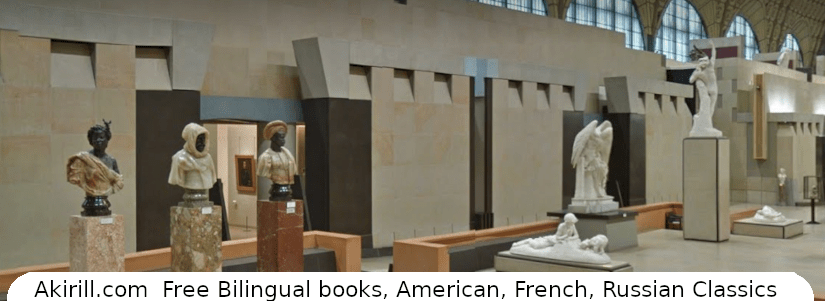
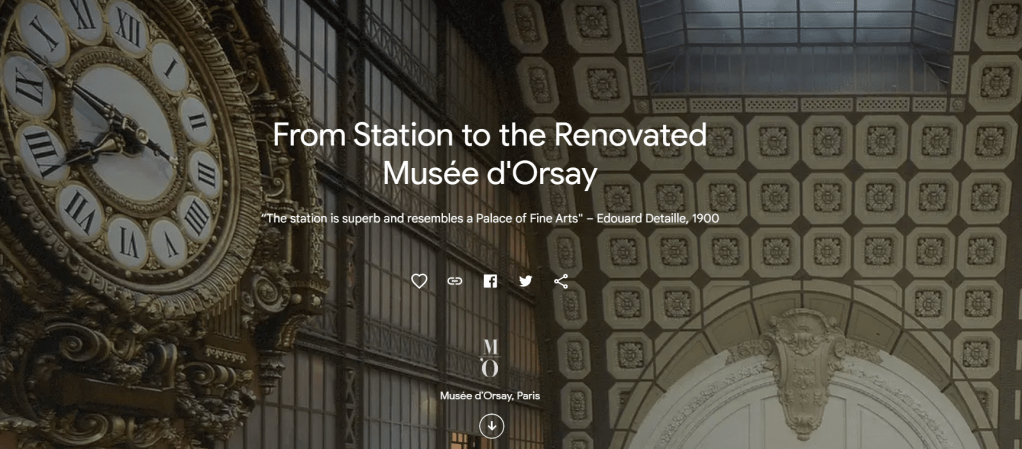
Un autre superbe musée à visiter virtuellement est le Musée d’Orsey. Saviez-vous que le musée se trouvait dans une ancienne gare ? Vous pourrez également visiter l’une des plus grandes collections au monde de peintures et sculptures européennes de la fin du XIXe et du début du XXe siècle qui sont exposées dans ce musée.
La particularité du musée d’Orsey est que les expositions sont classées par ordre chronologique et non par personnalité, ce qui nous donne l’impression de visiter le passé et de voir l’histoire se dérouler devant nos yeux.
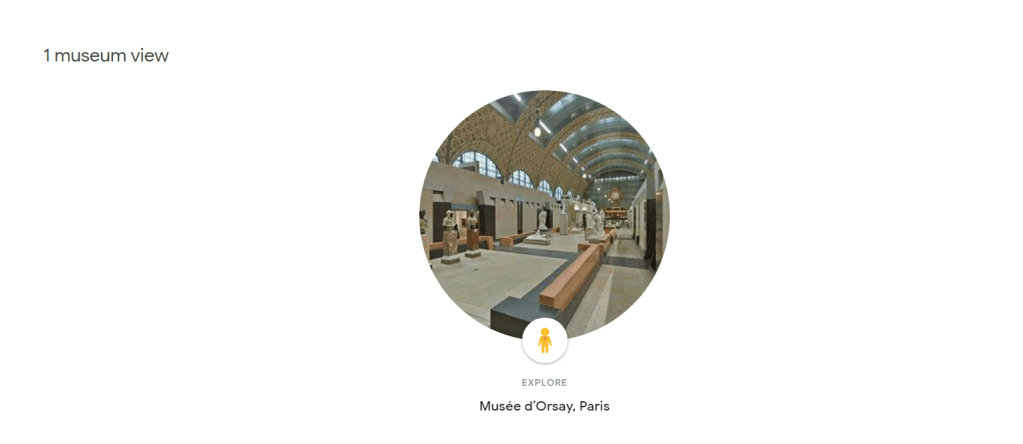
C’est la première chose que l’on voit sur la page et en cliquant sur l’icône jaune en bas à droite de l’image on peut directement visiter le musée.
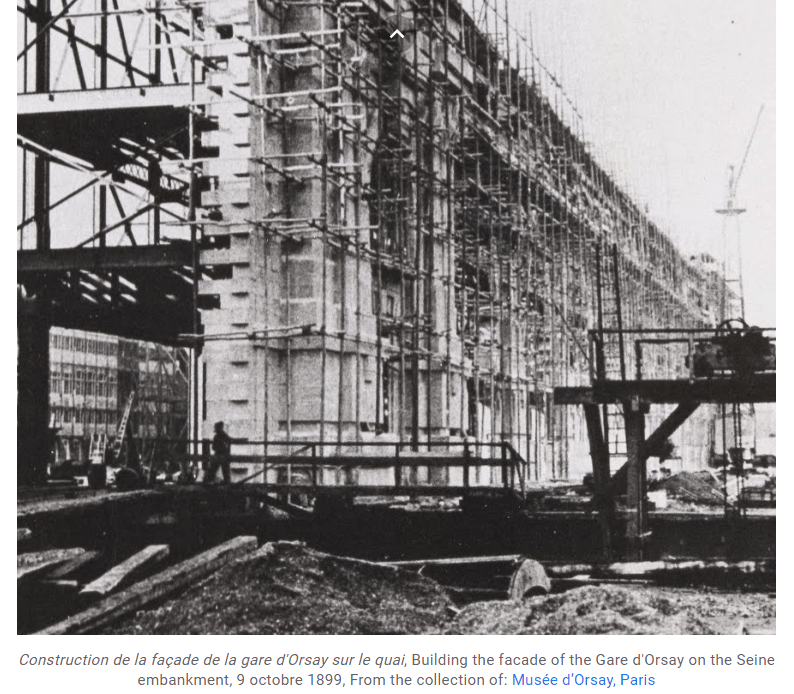
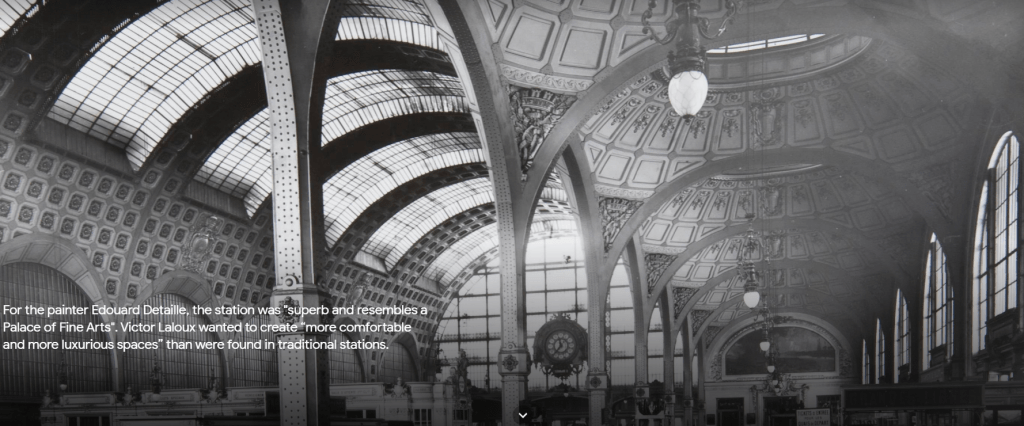
Mais il y a d’autres parties intéressantes sur la page. Voici l’histoire du Musée d’Orsey que j’ai beaucoup aimé
Et voici quelques photos de ma visite de l’histoire du musée
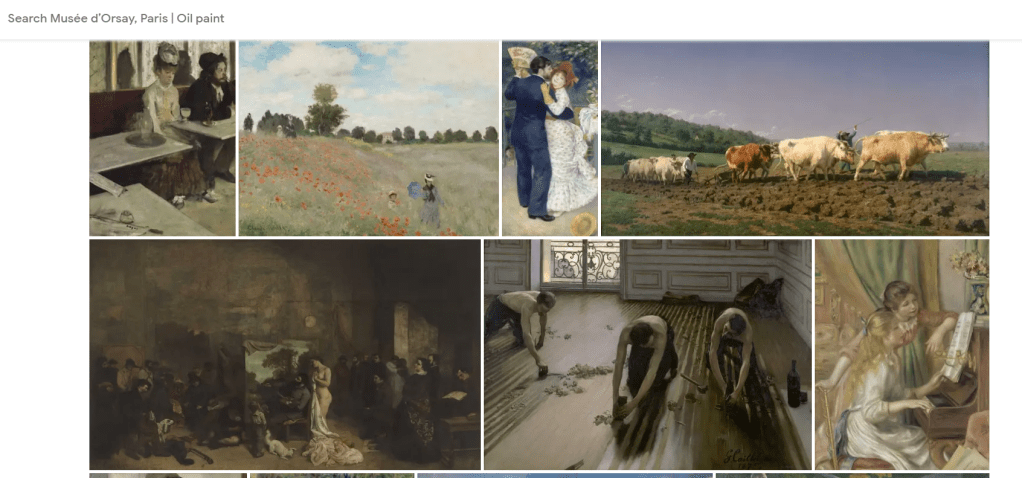
Ensuite, vous pouvez visiter les peintures par catégories.
Et voici quelques photos des peintures que j’ai visitées. Si vous passez la souris sur un tableau, le nom du tableau et de l’artiste s’affiche. Vous pouvez aussi cliquer sur le tableau qui le mettra sur une page entière avec ses détails.
Pour revenir au Musée d’Orsey virtuel je vous conseille de cliquer sur la flèche de retour de votre navigateur, je n’ai pas trouvé d’autre chemin pour revenir au musée.
La dernière partie est la visite virtuelle du musée proposée à la première ouverture du site
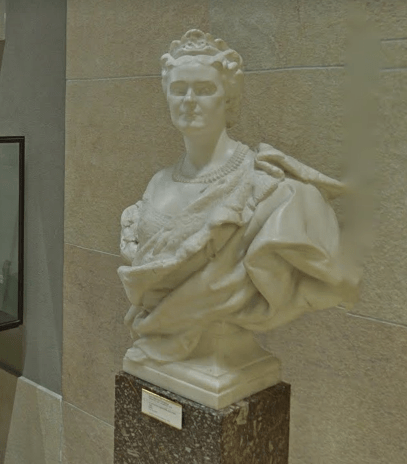
C’est aussi une belle visite, et voici quelques photos que j’en ai prises














 AKirill, Learn, apprenez, translation, traduction, livres bilingues, bilingual books