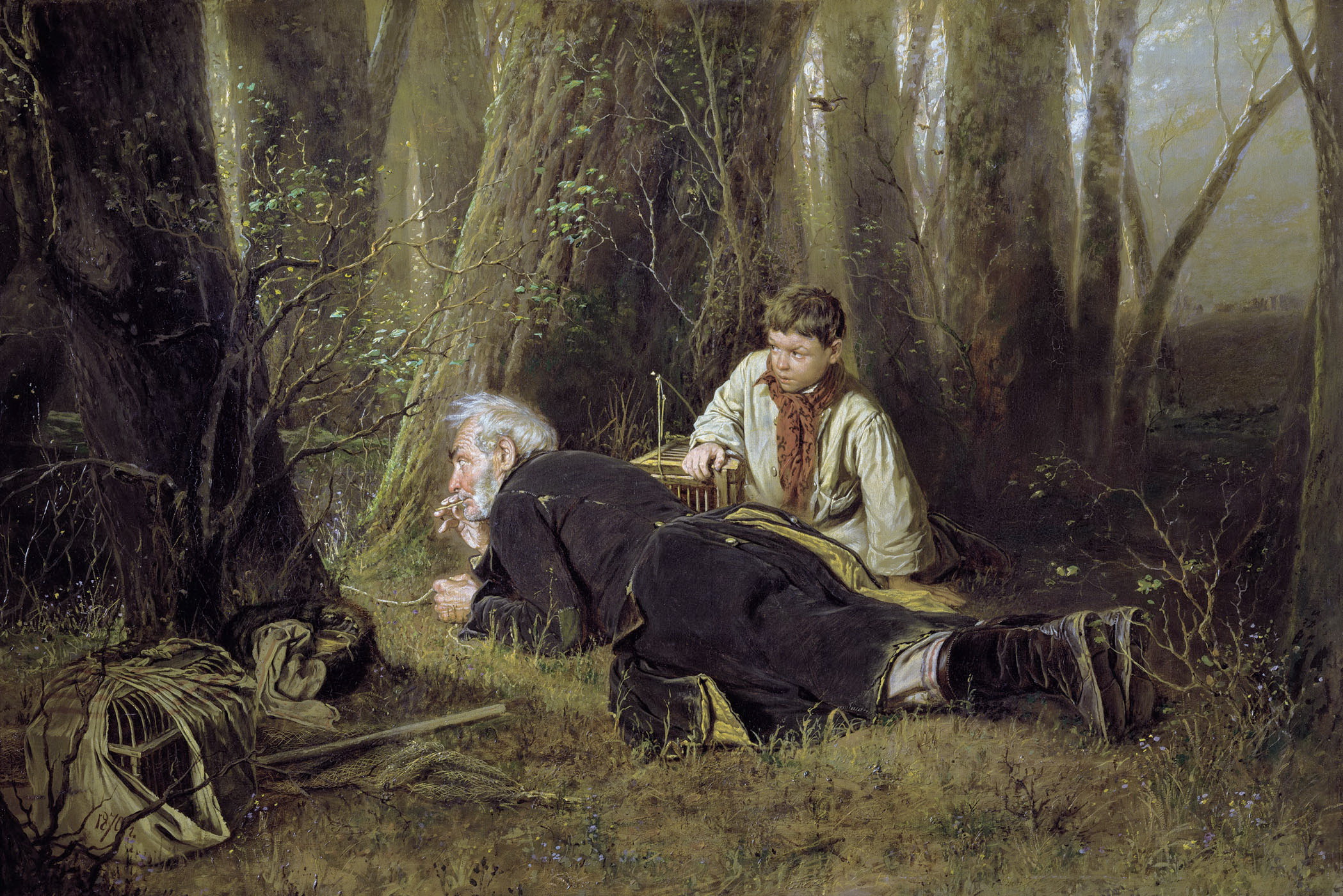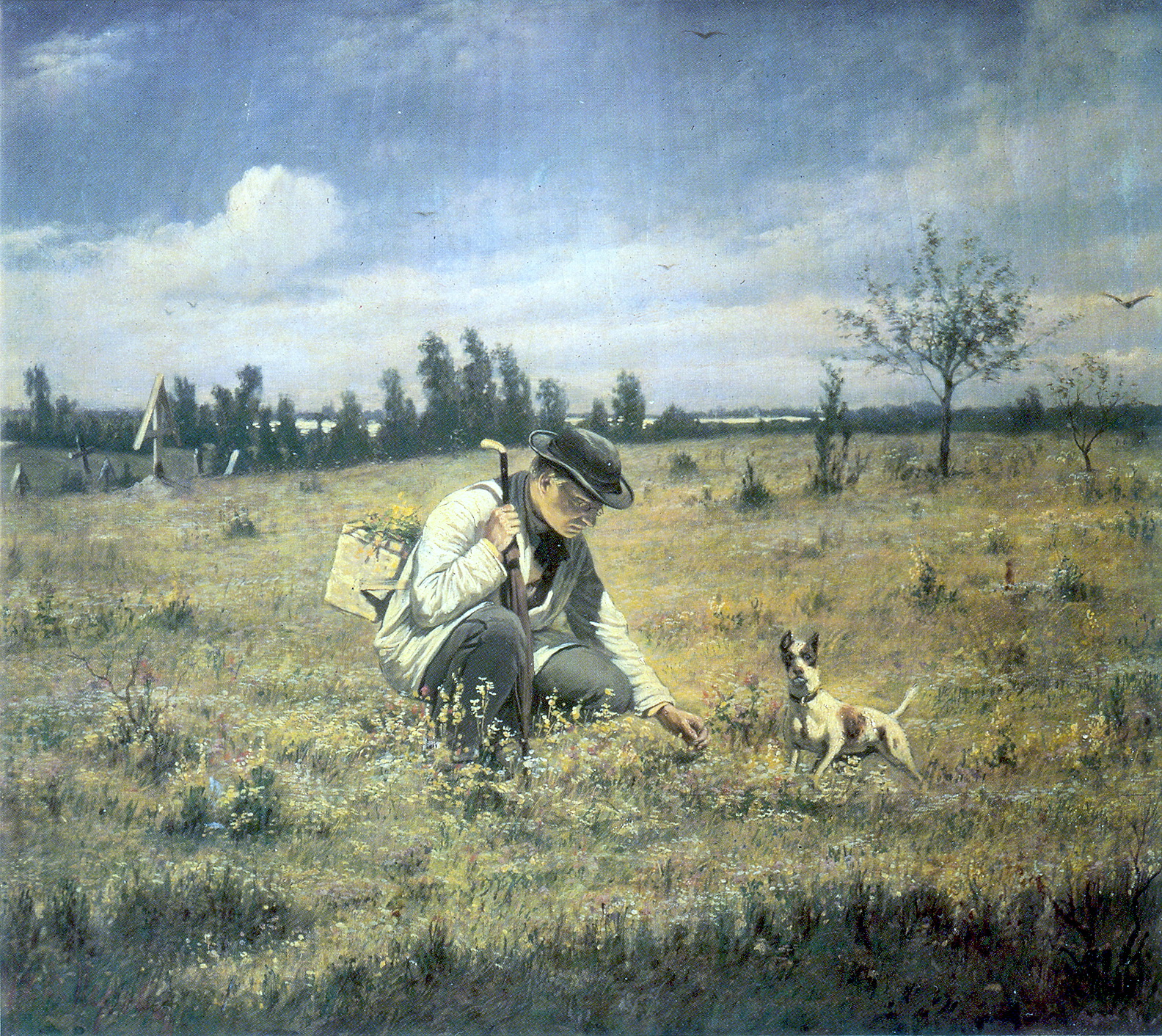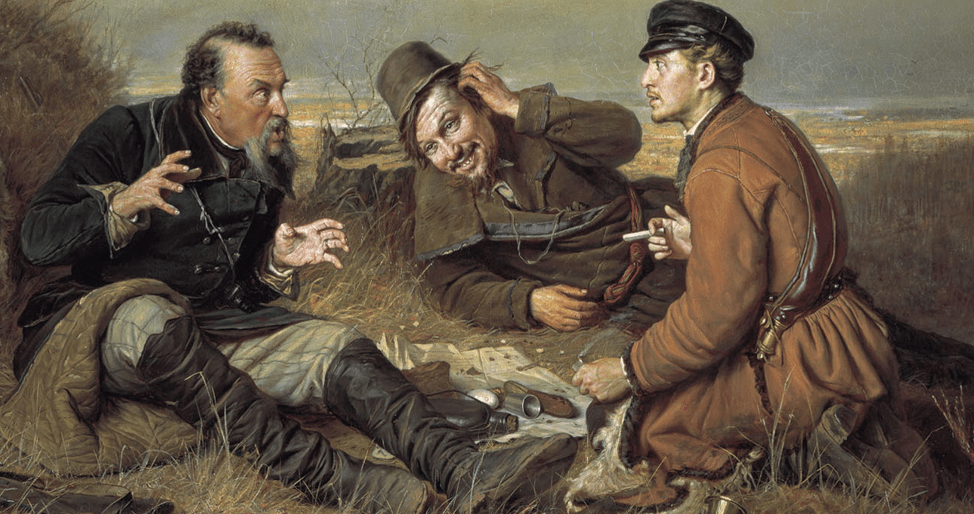
On this site we hope to help you learn, and to remove the difficulties caused by the difference of culture and language. Sur ce site nous espérons vous aider à apprendre, et à enlever la barrière causée par les différents languages et cultures.
Viktor Mikhailovich Vasnetsov (Виктор Васнецов) is a famous Russian painter, founder of the fairy-tale epic genre . The master created several versions of The Knight at the Crossroads. The first one was completed in 1877 and is significantly different from the subsequent ones. “The knight at the Crossroads” («Витязь на распутье») is an oil on canvas of 167 by 308 cm and was completed in 1882. It is now in the St. Petersburg State Russian Museum.
This is one of the philosophical works of the painter, and it encourages the viewer not only to contemplate, but also to think. And to think not only about the fate of the hero, but also about the deeper and eternal problems of good and evil, justice and deceit But also about the problem of choosing a future path in life, which probably disturb every person.
“Warrior in a helmet with chain mail” 1877“The knight at the Crossroads” 1882
The first pencil sketches of “The knight at the Crossroads” appeared in the early 1870s. His “Forerunner” can be considered the picture of Viktor Mikhailovich “Warrior in a helmet with chain mail”, painted by him in 1877.
“The Knight at the Crossroads” is a painting by the famous Russian artist Viktor Mikhailovich Vasnetsov. His inspiration for the creation of “The Knight at the Crossroads” was the old Russian epic “Ilya Muromets and the Robbers”: Once on the path of the hero there was a stone with a curious inscription.
«Витязь на распутье» Виктора Васнецова
According to the prediction, if Ilya turns in one direction – he will be killed, in the other – he will marry, in the third – he will gain wealth.
The man decided to try his luck and drove along the road that was supposed to bring him death. He met forty robbers, but managed to cope with them. Then he returned to the stone and wrote that the prediction did not come true. The same happened with other tracks. It seemed that the hero managed to deceive fate itself …
part of «Витязь на распутье» Виктора Васнецова
Ahead, the artist depicted a black cloud which can be a warning to Ilya Muromets of danger. But then the sky is clear and a little pinkish, probably the dawn, giving us hope. It might show that the path will be difficult and dangerous, but still lead to good. Probably, the knight will still decide to go ahead and defeat all dangers.
Initially, the author conceived to draw “The Knight at the Crossroads” facing the viewer. However, later Vasnetsov changed his mind and focused not on the key character, but on his confusion and difficulty in choosing a path.
part of «Витязь на распутье» Виктора Васнецова
In front of the hero there is a stone on which it is written that if you go straight, it is impossible for anyone to stay alive. Because many years have passed, all other inscriptions on the stone have been erased. Ilya Muromets understands that he has only one path that will lead him to death.
Usually fairy tales and epics talk about three roads that are offered to the traveler to choose from. However, on his canvas, Vasnetsov decided to deviate from this important point. With this technique, he visually strengthened the disturbing plot of the picture, leaving the epic hero without an alternative choice of path.
Almost immediately behind the stone, solid earth turns into unsteady swampy soil. In the future, there is nothing that could inspire gratifying hope. There is a narrow path that goes to the left, winding between boulders. It leads to no one knows where and gradually dissolves. The prophetic stone says nothing about it. There is no third road, as it should be in fairy tales.
«Витязь на распутье» Виктора Васнецова
In the center of the work is Ilya Muromets. He is known as the most courageous and strong hero in Russia. His back is turned to us, so we do not see his face. His strong body is now relaxed and his shoulders slumped as if he had traveled for a very long time and was tired. We can see that he did not rush his horse across the wide field since only the tips of his boots were inserted into the stirrups. The hero is dressed in battle armor. Behind him is a large heavy round shield. A brown leather quiver, decorated with metal decorative overlays, is attached to the belt. The quiver is full of arrows. A massive mace hangs from the side. In his right hand, the knight holds a long, sharp spear on a red shaft. It is lowered with the tip down, the slightly bent arm of the hero weakly squeezes it. The warrior is calm and self-confident, ready even for an unexpected meeting with the enemy. On his feet he has high light green boots with a gilded edging at the top of the top.
The whole image speaks of his meditation, the figure of the hero is majestic and powerful. Thoughtfulness is visible in the bowed head. His spear is also tilted down. The author shows the unity between him and his brave friend, the horse, because despite the fact that the horse stands confidently, its head is tilted.
part of «Витязь на распутье» Виктора Васнецова
The spear that the warrior holds in his hand deserves special attention. The canvas depicts an infantry spear which is intended for foot soldiers. The riders were armed with cavalry. It is noteworthy that in previous studies there was no such feature. Perhaps the rider is ready to lose his horse at any moment, and therefore it is the infantry spear in his hand.
The heroic horse is a match for the hero himself. It is strong, sleek, with a thick mane hanging almost to the ground, a silky tail, and powerful legs that firmly step on the ground. And now he meekly and patiently stands, with its head down, as if it was making a difficult decision. or maybe waiting for the decision of his master.
part of «Витязь на распутье» Виктора Васнецова
The terrain is depicted as swampy, there is almost no vegetation, stones are also scattered in the most gloomy tones.
Bones of people and animals are scattered across the field. And right in front of the stone we see the skulls of a man and a horse. Apparently, at one time they decided to cross the line on which the stone-prophet stands, but the prediction came true. Now black crows are circling over the field in anticipation of new prey.
The beautiful picture captures the moment of doom. At that moment, the knight does not yet know how his journey will end, and whether what the inscription on the stone predicts will come true. The picturesque plot of Vasnetsov’s creation fascinates with its fabulousness, tragedy, faith in the triumph of good over evil and darkness. and let us wonder if fate determines the fate of a person, or if we are responsible for our own lives.
Viktor Mikhailovich Vasnetsov (Виктор Васнецов) est un célèbre peintre russe, fondateur du genre épique des contes de fées. Le maître a créé plusieurs versions du tableau “Le Chevalier à la Croisée des Chemins “. Le premier a été achevé en 1877 et est sensiblement différent des suivants. “Le Chevalier à la Croisée des Chemins” (“Витязь на распутье”) est une huile sur toile de 167 sur 308 cm et a été achevée en 1882. Elle se trouve maintenant au Musée russe d’État de Saint-Pétersbourg.
C’est l’une des œuvres philosophiques du peintre, et elle encourage le spectateur non seulement à contempler, mais aussi à réfléchir. Et à penser non seulement au sort du héros, mais aussi aux problèmes plus profonds et éternels du bien et du mal, ainsi que celui de la justice et de la tromperie. Mais aussi au problème du choix d’un futur chemin dans la vie, qui dérange probablement tout le monde.
“Warrior in a helmet with chain mail” 1877“The knight at the Crossroads” 1882
Les premières esquisses au crayon de la toile: “Le Chevalier à la Croisée des Chemins” apparaissent au début des années 1870. Son “précurseur” peut être considéré comme l’image de Viktor Mikhailovich “Guerrier Dans un Casque avec une Cotte de Mailles”, peinte par lui en 1877.
“Le chevalier à la Croisée des Chemins” est une peinture du célèbre artiste russe Viktor Mikhailovich Vasnetsov. Son inspiration pour la création de: “Le chevalier à la croisée des chemins” était la vieille épopée russe “Ilya Muromets et les voleurs”: Une fois sur le chemin du héros, il y avait une pierre avec une curieuse inscription.
«Витязь на распутье» Виктора Васнецова
Selon la prédiction, si Ilya va dans une direction – il sera tué, dans l’autre – il se mariera, dans la troisième – il gagnera de la richesse.
L’homme a décidé de tenter sa chance et a conduit le long de la route qui était censée lui apporter la mort. Il a rencontré quarante voleurs, mais a réussi à faire face à eux. Puis il retourna à la pierre et écrivit que la prédiction ne s’était pas réalisée. La même chose s’est produite avec les autres routes. Il semblait que le héros avait réussi à tromper le destin lui-même…
part of «Витязь на распутье» Виктора Васнецова
Devant, l’artiste est représenté un nuage noir qui peut être un avertissement de danger pour Ilya Muromets. Mais ensuite le ciel est clair et un peu rosé, sans doute l’aube, qui nous redonne espoir. Cela pourrait montrer que le chemin sera difficile et dangereux, mais qu’il mènera toujours au bien. Probablement, le chevalier décidera toujours d’aller de l’avant et de vaincre tous les dangers.
Initialement, l’auteur a conçu de dessiner “Le chevalier à la croisée des chemins” face au spectateur. Cependant, plus tard, Vasnetsov a changé d’avis et s’est concentré non pas sur le personnage clé, mais sur sa confusion et sa difficulté à choisir une voie.
part of «Витязь на распутье» Виктора Васнецова
Devant le héros se trouve une pierre sur laquelle il est écrit que si vous allez tout droit, il est impossible à quiconque de rester en vie. Parce que de nombreuses années se sont écoulées, toutes les autres inscriptions sur la pierre ont été effacées. Ilya Muromets comprend qu’il n’a qu’un seul chemin qui le mènera à la mort.
Habituellement, les contes de fées et les épopées parlent de trois routes proposées au voyageur. Cependant, sur sa toile, Vasnetsov a décidé de s’écarter de ce point important. Avec cette technique, il a renforcé visuellement l’intrigue inquiétante de l’image, laissant le héros épique sans autre choix de chemin.
Presque immédiatement derrière la pierre, la terre solide se transforme en sol marécageux instable. Dans l’avenir, il n’y a rien qui puisse inspirer un espoir gratifiant. Il y a un chemin étroit qui part à gauche en serpentant entre des rochers. Elle mène on ne sait où et se dissout peu à peu. La pierre prophétique n’en dit rien. Il n’y a pas de troisième route, comme il se doit dans les contes de fées.
«Витязь на распутье» Виктора Васнецова
Au centre de l’œuvre se trouve Ilya Muromets. Il est connu comme le héros le plus courageux et le plus fort de Russie. Il nous tourne le dos, nous ne voyons donc pas son visage. Son corps fort est maintenant détendu et ses épaules affaissées comme s’il avait voyagé pendant très longtemps et qu’il était fatigué. On peut voir qu’il n’a pas précipité son cheval à travers le vaste champ puisque seuls les bouts de ses bottes sont insérés dans les étriers. Le héros est vêtu d’une armure de combat. Derrière lui se trouve un grand bouclier rond et lourd. Un carquois en cuir marron, orné de superpositions décoratives en métal, est attaché à sa ceinture. Le carquois est plein de flèches. Une masse massive pend sur le côté. Dans sa main droite, le chevalier tient une longue lance pointue sur un manche rouge. Elle est abaissée avec la pointe vers le bas, le bras légèrement plié du héros la serre faiblement. Le guerrier est calme et sûr de lui, prêt même pour une rencontre inattendue avec l’ennemi. Aux pieds, il a de hautes bottes vert clair avec un liseré doré en haut du haut.
Toute l’image parle de sa méditation, la figure du héros est majestueuse et puissante. La méditation est visible dans la tête inclinée. Sa lance est également inclinée vers le bas. L’auteur montre l’unité entre lui et son brave ami, le cheval, car malgré le fait que le cheval se tient avec confiance, sa tête est inclinée.
part of «Витязь на распутье» Виктора Васнецова
La lance que le guerrier tient dans sa main mérite une attention particulière. La toile représente une lance d’infanterie destinée aux fantassins. Les cavaliers étaient armés de lances de cavalerie. Il est à noter que dans les études précédentes, il n’y avait pas une telle caractéristique. Peut-être que le cavalier est prêt à perdre son cheval à tout moment, et c’est donc la raison de la lance d’infanterie dans sa main.
Le cheval héroïque est un match pour le héros lui-même. Il est fort, élégant, avec une crinière épaisse qui pend presque jusqu’au sol, une queue soyeuse et des pattes puissantes qui marchent fermement sur le sol. Et maintenant, il se tient docilement et patiemment, la tête baissée, comme s’il prenait une décision difficile. ou peut-être attent-il la décision de son maître.
part of «Витязь на распутье» Виктора Васнецова
Le terrain est dépeint comme marécageux, il n’y a presque pas de végétation, les pierres sont également dispersées dans les tons les plus sombres.
Des ossements de personnes et d’animaux sont éparpillés sur le terrain. Et juste devant la pierre, nous voyons les crânes d’un homme et d’un cheval. Apparemment, à un moment donné, ils ont décidé de franchir la ligne sur laquelle se tient le prophète de pierre, mais la prédiction s’est réalisée. Maintenant, des corbeaux noirs tournent autour du champ en prévision d’une nouvelle proie.
La belle image capture le moment de malheur. À ce moment, le chevalier ne sait pas encore comment son voyage se terminera et si ce que prédit l’inscription sur la pierre se réalisera. L’intrigue pittoresque de la création de Vasnetsov fascine par son caractère fabuleux, sa tragédie, sa foi dans le triomphe du bien sur le mal et les ténèbres. et nous nous demandons si le destin détermine le sort d’une personne, ou si nous sommes responsables de notre propre vie.
J’espère que vous avez apprécié ce tableau autant que moi
“Trinity” which is also called “Hospitality of Abraham” is an icon of the Holy Trinity, painted by Andrei Rublev in the 15th century. It is one of the most famous Russian icons, and also the most famous of his works. It is one of two (together with frescoes in Vladimir ) surviving works, which, according to scientists , authentically belong to him. It is now inone of the halls of the Tretyakov Gallery.
Andrei Rublev, whose “Trinity” is perceived by many as the very proof of the existence of God, was canonized by the Russian Orthodox Church in 1988. Posthumously, he became the first canonized artist.
The famous icon “Trinity” by Andrei Rublev left the Tretyakov Gallery for the first time since 1917 and was transported to the Trinity-Sergius Lavra for two days on July 17, 2022.
Today, on July 19, 2022, “The Holy Trinity icon of St. Andrei Rublev has returned to the State Tretyakov Gallery and is now being studied by restorers. The museum added that: “There are no visible signs of deterioration in the condition of this most important work of ancient Russian art”. And after a detailed and comprehensive examination of the icon, a decision will be made on the timing of the return of the “Trinity” to the gallery’s exposition.
Троица – Андрей Рублев
Andrei Rublev was born in the late 60s of the XIV century in the small town of Radonezh, not far from the Trinity-Sergius Lavra. Historians think that in his youth Andrei was a novice of this monastery, and then he took the rank of a monk. In 1380 during the Battle of Kulikovoin , Rublev was already a member of the princely artel of craftsmen, who moved from city to city and was engaged in the construction and decoration of churches. Like any medieval master, he did not sign his works, and his name was rarely mentioned in the annals. Nevertheless, careful research by historians of ancient Russian art suggests that he was a monk of the Trinity-Sergius Monastery, for the Trinity Cathedral of which he painted his masterpiece
There are 2 opinions on the issue of dating the icon. It could have been painted for the wooden church of the Trinity Monastery, built by hegumen Nikon after the invasion of Edigey. In this case Scholars date the icon to 1412. But others determine the 20s. 15th century linking its origin with the stone cathedral of the monastery, founded in 1422. It is possible that Hegumen Nikon, who became the abbot of the Trinity-Sergius Monastery after Sergius of Radonezh didn’t like that the newly erected white-stone Trinity Cathedral was not decorated with paintings. Anticipating his imminent death and wishing to complete the decoration of the cathedral during his lifetime, Nikon called for work Andrei Rublev and Daniil Cherny.
Trinity Cathedral of the Trinity-Sergius Lavra
They were famous painters, “fair grandees, superior to all and perfect in virtue.” Their work consisted not only in painting the temple with frescoes, they also had to paint a large number of icons for a high multi-tiered iconostasis. During his lifetime, Hegumen Nikon wanted not only to see the temple decorated, but he also wanted to have an icon painted, which was to become the main monument “in praise of Sergius of Radonezh”
This board of the icon painter quickly became a model for all subsequent creators of images of the Holy Trinity and by 1551, the Stoglavy Cathedral announced that all future images must comply with it.In 1575, Tsar Ivan the Terrible ordered to decorate it with a gold salary, which is also called a golden riza. A salary is an overhead decoration fixed on top of an icon painting, covering the entire icon board on top of the paint layer, except for a few significant elements. It closes the pictorial image, leaving open faces, arms and legs. Subsequently, the salaries were also changed by other kings, and the icon itself was updated in accordance with the ideas of the artists of those times.
The restoration of the original appearance of the work was taken up only by 1904. Here we can see the Icon in 1904 with the salary just removed. The original painting is hidden under a layer of writing from the late 19th century.
And a photo of “Trinity” after the completion of clearing Guryanov. 1904.
“Airy”, transparent colors, in which our contemporary often sees a special author’s intention, creating the color and atmosphere of Rublev’s “Trinity”, making the figures of angels thin and incorporeal are a consequence of restorations and renovations.
On the instructions of the Commission for the Protection of Monuments of Art and Antiquities of the Trinity-Sergius Lavra, they returned to the restoration of the Trinity in 1918. At that time the icon was already significantly damaged and needed special storage, however, it was transferred to the collection of the Tretyakov Gallery only in 1929. During the war, in 1941, the Trinity was evacuated to Novosibirsk, and returned from the evacuation in October 1944.
Each year the Icon is transferred to the church on the feast of the Trinity, but in 2007 the Icon was taken to the building on Krymsky Val because it had been damaged during transportation and needed additional reinforcement.
Now the icon is stored in a special icon case and its condition is stable, but there are irreversible damages.
The Holy Trinity of Rublev is written according to a biblical story from the Old Testament, according to which three pilgrim angels came to Abraham with the good news: he will have a son who will become the progenitor of the entire Jewish people. But there are also many important references to all the key biblical points. The picture embodies a lot, while remaining quite simple.
The form that most clearly expresses the idea of the consubstantiality of the three hypostases of the Holy Trinity, in the Rublev icon, is the circle which is the basis of the composition.
On the Icon we see three angels gathered around the table, on which the sacrificial bowl stands, for a quiet, unhurried conversation.
Three angels are the embodiment of the one God.This is indicated by a number of important symbols. First, they are dressed in azure robes which symbolizes their unearthly essence. The prototype of the Father is an angel sitting in the middle. This is indicated by his regal purple robes decorated with clavius (vertical stripes from the shoulder to the bottom edge). The middle angel is determined not only by its central position, but also by its monumentality. The turn of the head and the bend of the right hand of the central angel express the imperious and powerful motor principle, which is the initial and decisive moment of the composition. But since each of the wanderers has scepters of power, one can speak of a trinity.
God the Son is symbolized here by the angel sitting on the right. His head is lowered most humbly, and his hand is closest to the bowl. if we recall the biblical phrase “And a branch will come from the root of Jesse, and a branch will grow from its root”, then it immediately becomes clear that the right angel personifies God the Son. Also according to Ulyanov, “… the right angel’s himation is girded from right to left. And according to Russian custom, on a dead man, clothes were fastened not on the right side, as in life, but on the left side, like on a woman.”
The third angel, located on the left, becomes the personification of the Holy Spirit.
The combination of blue and red is inherent only in the clothes of the middle and left angels symbolizing the dogma about the procession of the grace of the Holy Spirit, The contours and folds of their robes are fragile and weightless, the harmony of blue, cornflower blue, pale green, golden yellow colors is pure, behind their backs are wings, in their hands are thin staffs, and around their heads are luminous halos.
The image contains more than the divine wanderers. In the background, a church or an entrance to the house of Abraham is visible, and the silhouette of a tree which could be the tree of knowledge from the garden of Eden, and at the same time it could be the oak under which Abraham rested.
Looking more closely, you will be able to see a mountain, located in the upper right corner, that becomes a symbol of Golgotha, to which Jesus ascended with his cross. An ancient symbol of everything sublime, in the Bible, “mountain” is the image of “rapture of the spirit”, therefore the most significant events take place on it.
The icon “Trinity” by Andrei Rublev is inscribed in a circular composition. Italian artists of those times also inscribed groups of angelic entities in a circular composition for greater symbolism. But Rublev’s composition is strikingly different from the classical one. The circle is imperceptible at first sight, and looking at this work of art in more detail, it can be noted that everything here is inscribed in a circular structure, symbolizing the trinity, as well as eternity, infinity.
Even the heads of the angels are bowed, allowing the overall silhouette to organically form a single circle. It has long symbolized eternity, the vicious circle of human existence, from the birth of the world to the end, which becomes a new beginning. In the context of the three angels, it is also interpreted as a symbol of the trinity of the Christian God.
Many researchers draw attention to the fact that the “Trinity” was created during the period of confrontation between the Russian princes and the Tatar-Mongol yoke and pointed to the need for unity. Peace, harmony, and love, this is what Andrei Rublev called his contemporaries to. It was a call to unite all Russian people – a call based on a deep philosophical awareness of the structure of the world, the moral cohesion of people.
La « Trinité » , également appelée « Hospitalité d’Abraham » , est une icône de la Sainte Trinité, peinte par Andrei Rublev au XVe siècle. C’est l’une des icônes russes les plus célèbres, et aussi la plus célèbre de ses œuvres. C’est l’une des deux œuvres survivantes (avec les fresques de Vladimir) qui, selon les scientifiques, lui appartiennent authentiquement. Elle est maintenant dans l’une des salles de la galerie Tretiakov.
Andrei Rublev, dont la « Trinité » est perçue par beaucoup comme la preuve même de l’existence de Dieu, a été canonisé par l’Église orthodoxe russe en 1988. À titre posthume, il est devenu le premier artiste canonisé.
La célèbre icône “Trinity” d’Andrei Rublev a quitté la galerie Tretiakov pour la première fois depuis 1917 et a été transportée dans la laure Trinity-Sergius pour deux jours le 17 juillet 2022.
Aujourd’hui, le 19 juillet 2022, “L’icône de la Sainte Trinité de Saint Andrei Rublev est revenue à la Galerie nationale Tretiakov et est actuellement étudiée par les restaurateurs. Le musée a ajouté que: “Il n’y a aucun signe visible de détérioration de l’état de cette œuvre la plus importante de l’art russe ancien”. Et après un examen détaillé et complet de l’icône, une décision sera prise sur le moment du retour de la «Trinité» dans l’exposition de la galerie.
Троица – Андрей Рублев Trinité : Andreï Roublev
Andrei Rublev est né à la fin des années 60 du XIVe siècle dans la petite ville de Radonezh, non loin de la Trinity-Sergius Lavra. Les historiens pensent que dans sa jeunesse Andrei était un novice de ce monastère, puis il a pris le rang de moine. En 1380, lors de la bataille de Kulikovoin, Rublev était déjà membre de l’artel princier des artisans, qui se déplaçait de ville en ville et s’occupait de la construction et de la décoration des églises. Comme tout maître médiéval, il ne signait pas ses œuvres, et son nom était rarement mentionné dans les annales. Néanmoins, des recherches minutieuses menées par des historiens de l’art russe ancien suggèrent qu’il était un moine du monastère de la Trinité-Sergius, pour la cathédrale de la Trinité dont il a peint son chef-d’œuvre.
Il y a 2 opinions sur la question de la datation de l’icône. Elle aurait pu être peinte pour l’église en bois du monastère de la Trinité, construite par l’higoumène Nikon après l’invasion d’Edigey. Dans ce cas, les érudits datent l’icône à 1412. Mais d’autres déterminent les années 20 du 15ème siècle reliant son origine à la cathédrale en pierre du monastère, fondée en 1422. Il est possible que l’hégumène Nikon, qui devint l’abbé du monastère de la Trinité-Sergius après Sergius de Radonezh, n’ait pas aimé que la Trinité en pierre blanche nouvellement érigée ne soit pas décorée de peintures. Anticipant sa mort imminente et souhaitant achever de son vivant la décoration de la cathédrale, Nikon fait appel à Andrei Rublev et Daniil Cherny.
Cathédrale de la Trinité de la Laure Trinité-Sergius
C’étaient des peintres célèbres, « beaux grands, supérieurs à tous et parfaits en vertu ». Leur travail consistait non seulement à peindre le temple avec des fresques, ils devaient également peindre un grand nombre d’icônes pour une iconostase à plusieurs niveaux. De son vivant, Hegumen Nikon voulait non seulement voir le temple décoré, mais il voulait aussi faire peindre une icône, qui devait devenir le monument principal “à la louange de Sergius de Radonezh”
Cette planche du peintre d’icônes devint rapidement un modèle pour tous les créateurs ultérieurs d’images de la Sainte Trinité et en 1551, la cathédrale Stoglavy annonça que toutes les images futures devaient s’y conformer. En 1575, le tsar Ivan le Terrible ordonna de le décorer d’un salaire en or, également appelé riza en or. Un salaire est une décoration suspendue fixée au-dessus d’une peinture d’icônes, couvrant l’ensemble du panneau d’icônes au-dessus de la couche de peinture, à l’exception de quelques éléments significatifs. Il ferme l’image picturale, laissant ouverts les visages, les bras et les jambes. Par la suite, les salaires ont également été modifiés par d’autres rois et l’icône elle-même a été mise à jour conformément aux idées des artistes de l’époque.
La restauration de l’aspect original de l’œuvre n’a été entreprise qu’en 1904. Ici, nous pouvons voir l’icône en 1904 avec le salaire juste supprimé. La peinture originale est cachée sous une couche de peinture de la fin du XIXe siècle.
Троица – Андрей Рублев Trinité : Andreï Roublev
Et une photo de “Trinity” après l’achèvement du nettoyage de Guryanov. 1904.
Троица – Андрей Рублев Trinité : Andreï Roublev
Les couleurs «aérées», transparentes, dans lesquelles nos contemporains voient souvent l’intention d’un auteur particulier, créant la couleur et l’atmosphère de la «Trinité» de Rublev, rendant les figures d’anges minces et incorporelles sont une conséquence des restaurations et des rénovations.
Sur les instructions de la Commission pour la protection des monuments d’art et des antiquités de la laure Trinité-Sergius, ils sont revenus à la restauration de la Trinité en 1918. A cette époque, l’icône était déjà considérablement endommagée et nécessitait un stockage spécial, cependant, elle n’a été transféré à la collection de la galerie Tretiakov qu’en 1929. Pendant la guerre, en 1941, la Trinité a été évacuée à Novossibirsk et est revenue de l’évacuation en octobre 1944.
Chaque année, l’icône est transférée à l’église lors de la fête de la Trinité, mais en 2007, l’icône a été transportée au bâtiment de Krymsky Val car elle avait été endommagée pendant le transport et avait besoin de renforts supplémentaires.
Maintenant, l’icône est stockée dans un boîtier d’icône spécial et son état est stable, mais il y a des dommages irréversibles.
La Sainte Trinité de Rublev est écrite selon une histoire biblique de l’Ancien Testament, selon laquelle trois anges pèlerins sont venus à Abraham avec la bonne nouvelle : il aura un fils qui deviendra l’ancêtre de tout le peuple juif. Mais il y a aussi de nombreuses références importantes à tous les points clés de la Bible. L’Icon incarne beaucoup, tout en restant assez simple.
La forme qui exprime le plus clairement l’idée de la consubstantialité des trois hypostases de la Sainte Trinité, dans l’icône Rublev, est le cercle qui est à la base de la composition.
Sur l’Icône, nous voyons trois anges réunis autour de la table, sur laquelle se dresse le bol sacrificiel, pour une conversation calme et sans hâte.
Троица – Андрей Рублев Trinité : Andreï Roublev
Trois anges sont l’incarnation du Dieu unique. Ceci est indiqué par un certain nombre de symboles importants. Tout d’abord, ils sont vêtus de robes d’azur qui symbolisent leur essence surnaturelle. Le prototype du Père est un ange assis au milieu. Ceci est indiqué par ses robes violettes royales décorées de clavius (rayures verticales de l’épaule au bord inférieur). L’ange du milieu est déterminé non seulement par sa position centrale, mais aussi par sa monumentalité. Le tour de tête et la courbure de la main droite de l’ange central expriment le principe moteur impérieux et puissant, qui est le moment initial et décisif de la composition. Mais puisque chacun des anges possède des sceptres de pouvoir, on peut parler d’une trinité.
Dieu le Fils est symbolisé ici par l’ange assis à droite. Sa tête est baissée très humblement et sa main est la plus proche du bol. Si nous nous souvenons de la phrase biblique “Et une branche sortira de la racine de Jessé, et une branche poussera de sa racine”, alors il devient immédiatement clair que l’ange droit personnifie Dieu le Fils. Aussi selon Oulianov, « … l’himation de l’ange droit est ceint de droite à gauche. Et selon la coutume russe, sur un homme mort, les vêtements n’étaient pas attachés du côté droit, comme dans la vie, mais du côté gauche, comme sur une femme.
Le troisième ange, situé à gauche, devient la personnification du Saint-Esprit.
La combinaison du bleu et du rouge n’est inhérente qu’aux vêtements des anges du milieu et de gauche symbolisant le dogme de la procession de la grâce du Saint-Esprit. Les contours et les plis de leurs robes sont fragiles et légers, l’harmonie des couleurs bleu, bleu bleuet, vert pâle, jaune doré est pure, derrière leur dos se trouvent des ailes, dans leurs mains de fins bâtons et autour de leur tête des auréoles lumineuses.
L’image contient plus que les anges divins. En arrière-plan, une église ou une entrée de la maison d’Abraham est visible, et la silhouette d’un arbre qui pourrait être l’arbre de la connaissance du jardin d’Eden, et en même temps ce pourrait être le chêne sous lequel Abraham s’est reposé .
En regardant de plus près, vous pourrez voir une montagne, située dans le coin supérieur droit, qui devient un symbole du Golgotha, vers lequel Jésus est monté avec sa croix. Ancien symbole de tout ce qui est sublime, dans la Bible, la «montagne» est l’image du «ravissement de l’esprit», c’est pourquoi les événements les plus significatifs s’y déroulent.
L’icône “Trinity” d’Andrei Rublev est inscrite dans une composition circulaire. Les artistes italiens de cette époque ont également inscrit des groupes d’entités angéliques dans une composition circulaire pour un plus grand symbolisme. Mais la composition de Rublev est remarquablement différente de la composition classique. Le cercle est imperceptible à première vue, et en regardant cette œuvre d’art plus en détail, on peut constater que tout ici s’inscrit dans une structure circulaire, symbolisant la trinité, ainsi que l’éternité, l’infini.
Même les têtes des anges sont inclinées, permettant à la silhouette globale de former organiquement un seul cercle. Il a longtemps symbolisé l’éternité, le cercle vicieux de l’existence humaine, de la naissance du monde à la fin, qui devient un nouveau commencement. Dans le contexte des trois anges, il est également interprété comme un symbole de la trinité du Dieu chrétien.
De nombreux chercheurs attirent l’attention sur le fait que la «Trinité» a été créée pendant la période de confrontation entre les princes russes et le joug tatar-mongol et ont souligné le besoin d’unité. Paix, harmonie et amour, voilà ce à quoi Andrei Rublev appelait ses contemporains. C’était un appel à unir tout le peuple russe, un appel basé sur une profonde conscience philosophique de la structure du monde, de la cohésion morale des peuples.
J’espère que vous avez apprécié cette icône autant que moi
The painting “Girl with Peaches” («Девочка с персиками») is a recognized masterpiece of the Russian artist Valentin Aleksandrovich Serov (1865-1911) (Серов Валентин Александрович). It was painted in 1887 and is an oil on canvas measuring 91 x 85 cm, now located in the State Tretyakov Gallery in Moscow. This is one of the first and most significant works in the direction of Russian impressionism for which it paved the way. This picture combines several genres: there is a landscape , a still life , and a portrait .
Girl with Peaches
Valentin Serov first went to the Abramtsevo estate in 1875 with his mother, and growing up continued to often visit the estate.
Serov wrote “Girl with Peaches” when he was not yet 22 years old. Valentin Aleksandrovich sought to create not just a portrait, but a living picture that reflected a moment in life. He was inspired by the beauty and spontaneity of Verusha, and invited the 11-year-old Vera Mamontova to pose after seeing her running into the house, taking a peach, and sitting down at the table. Vera posed for Serov every day for almost two months.
Vera Mamontov. Photo from 1888
The expressiveness of the picture is given by bright details, a play of highlights and a young image of the heroine of the portrait. The artist placed the girl in an atmosphere of a carefree sunny day, ripe peaches and a cozy dining room. The peculiarity of this portrait was that Serov added to it elements of a still life (fruits on the table, a knife, leaves) and a landscape (a garden outside the window). This technique allowed to expand the general meaning of the picture.
In the center of the composition is Mamontov’s daughter Verochka. She is sitting at a large table covered with a white tablecloth, and there are several chairs with high backs nearby. The objects in the room indicate that the girl lives in a wealthy family, and many chairs in the dining room are reminiscent of a large family.
The girl is dressed in a light pink loose blouse with a turn-down collar and a puffy bow. This bow tells about the romantic and bright character of the girl. There is no feeling that she was preparing to pose. The artist deliberately left her hair the way they were, sticking out in unruly curls. She certainly frolicked in the garden and wants to run to play again. It seems hard for her to sit still. There is a blush on her cheeks, making her look like the peaches that lying on the table. The happy look of the girl says that she lives among people who love her.
Girl with Peaches – part Verochka
She holds a peach in her hands, which look very tanned. We can say that the girl spent the summer outdoors outside the city. Three more fruits and a silver carving knife lie on the table nearby. The peaches are beautifully combined with yellow leaves which talks about the time of fruit ripening. It can be seen that the objects were not laid out on purpose, but the moment was chosen spontaneously. The peaches have their own history. They were raised in a greenhouse by a gardener specially hired by the owner of the estate. These fruits indicate the prosperity of the owners of the estate and a penchant for the exotic.
Girl with Peaches – part peaches
The girl is surrounded by various objects. We see the backs of the chairs around the dining table. Behind the girl is a figure of a grenadier, reminiscent of the children in the house.
There is a painted plate on the wall. The plate is drawn as a tribute to Savva Mamontov, who was fond of pottery arts.
Girl with Peaches – part plate
Another detail that reflects an outstanding intuitive impressionist in Serov is as if a random edge to the composition. The door on the girl’s right, a half of a chair cut by the frame give the image a look of reality, spontaneous and relaxed. The art historian Mark Copshitzer noted, ” a chair, part of which is captured on canvas, has its continuation beyond the space of the painting, it marks the beginning of the whole world which did not appear on the painting, with its chairs and tables, and other peaches, and the other girls”.
Girl with Peaches
Outside the window, the garden begins to turn yellow. Summer is coming to an end. Maple leaves, in turn, are depicted because the artist began work on the canvas in the height of summer, and finished only in September. In addition, maple autumn leaves create a special contrast in comparison with ripe peaches, reminiscent of the transience of everything and the need to enjoy the sun, as well as everything that happens around.
Serov achieved a fantastic effect of lightness and freshness by placing the light source behind the model. Shining through the leaves, the sun’s rays reflecting off the tablecloths and the girl’s blouse, it adds pink and gold to the space around the subject. Warm, delicate colors, soft reflected light, a lot of air were unusual for Russian painting of those years.
The main difference from the canvases of other portrait painters is the fullness of light. The main character sits in front of the window and is well lit, sun glare on all objects, on hair and clothes. Light dissolves the contours of objects, this brings the work closer to the canvases of the French Impressionists.
The statement of the author himself about the idea of the picture has been preserved. He wrote that he wanted to achieve a special freshness in his painting. The girl was supposed to look in the picture the same as on that summer day. The bright image of Vera coincided with how the artist imagined beauty. The author dreamed of conveying on canvas the joy of life that surrounds the girl and lives in her.
The artist succeeded superbly. Together with him we admire the carefree world of childhood. These moments are especially valuable because they pass quickly. The transience of time is reminiscent of autumn leaves in the foreground of the picture and the coming autumn outside the window. You can feel the philosophical message in the picture. The artist shows the transience of time. Summer changes very quickly, and youth also passes quickly.
I hope you enjoyed this painting as much as I did.
Le tableau “Fille aux Pêches” (“Девочка с персиками”) est un chef-d’œuvre reconnu de l’artiste russe Valentin Aleksandrovich Serov (1865-1911) (Серов Валентин Александрович). Il a été peint en 1887 et est une peinture à l’huile sur toile mesurant 91 x 85 cm, maintenant situé dans la Galerie nationale Tretiakov à Moscou. C’est l’une des premières et des plus importantes œuvres dans la direction de l’impressionnisme russe auquel elle a ouvert la voie. Ce tableau mêle plusieurs genres : il y a un paysage, une nature morte, et un portrait.
La Fille aux Pêches
Valentin Serov est allé pour la première fois au domaine d’Abramtsevo en 1875 avec sa mère et, en grandissant, il a continué à visiter souvent le domaine.
Serov a peint “La Fille aux Pêches” alors qu’il n’avait pas encore 22 ans. Valentin Aleksandrovich a cherché à créer non seulement un portrait, mais une image vivante qui reflètait un moment de la vie. Il a été inspiré par la beauté et la spontanéité de Verusha et a invité Vera Mamontova, 11 ans, à poser après l’avoir vue courir dans la maison, prendre une pêche et s’asseoir à table. Vera a posé pour Serov tous les jours pendant près de deux mois.
Vera Mamontov. Photo from 1888
L’expressivité de l’image est donnée par des détails lumineux, un jeu de reflets et la jeune image de l’héroïne du portrait. L’artiste a placé la jeune fille dans une atmosphère de journée ensoleillée insouciante, avec des pêches mûres et dans une salle à manger confortable. La particularité de ce portrait était que Serov y a ajouté des éléments de nature morte (des fruits sur la table, un couteau, des feuilles) et, un paysage (un jardin à l’extérieur de la fenêtre). Cette technique a permis d’élargir le sens général de l’image.
Au centre de la composition se trouve la fille de Mamontov, Verochka. Elle est assise à une grande table recouverte d’une nappe blanche, et il y a plusieurs chaises à haut dossier à proximité. Les objets dans la pièce indiquent que la jeune fille vit dans une famille aisée, et de nombreuses chaises dans la salle à manger rappellent une famille nombreuse.
La fille est vêtue d’un chemisier ample rose clair avec un col rabattu et un nœud bouffant. Ce nœud bouffant raconte le caractère romantique et lumineux de la fille. Il n’y a aucun sentiment qu’elle se préparait à poser. L’artiste a délibérément laissé ses cheveux tels qu’ils étaient, formant des boucles indisciplinées. Elle a certainement gambadé dans le jardin et veut courir pour rejouer. Il semble difficile pour elle de rester assise. Il y a une rougeur sur ses joues, la faisant ressembler aux pêches qui se trouvent sur la table. Le regard heureux de la jeune fille dit qu’elle vit parmi des gens qui l’aiment.
La Fille aux Pêches – partie Verochka
Elle tient une pêche dans ses mains, qui ont l’air très bronzées. On peut dire que la jeune fille a passé l’été à l’extérieur de la ville. Trois autres fruits et un couteau à découper en argent reposent sur la table à proximité. Les pêches sont magnifiquement combinées avec des feuilles jaunes qui parlent du moment de la maturation des fruits. On voit que les objets n’ont pas été disposés exprès, mais le moment a été choisi spontanément. Les pêches ont leur propre histoire. Elles ont été élevés dans une serre par un jardinier spécialement engagé par le propriétaire du domaine. Ces fruits témoignent de la prospérité des propriétaires du domaine et d’un penchant pour l’exotisme.
La Fille aux Pêches – partie peaches
La jeune fille est entourée de divers objets. On voit les dossiers des chaises autour de la table à manger. Derrière la fille se trouve une figure de grenadier, rappelant les enfants de la maison.
Il y a une assiette peinte sur le mur. L’assiette est dessinée en hommage à Savva Mamontov, qui aimait les arts de la poterie.
La Fille aux Pêches – partie assiette
Un autre détail qui reflète un impressionniste intuitif exceptionnel chez Serov est le bord aléatoire de la composition. La porte à droite de la jeune fille, une moitié de chaise coupée par le cadre donnent à l’image un aspect de réalité, spontané et détendu. L’historien de l’art Mark Copshitzer a noté : « une chaise, dont une partie est capturée sur toile, a sa continuation au-delà de l’espace du tableau, elle marque le début du monde entier qui n’apparaissait pas sur la toile, avec ses chaises et ses tables, et d’autres pêches, et les autres filles ».
La Fille aux Pêches
Derrière la fenêtre, le jardin commence à jaunir. L’été touche à sa fin. Les feuilles d’érable, à leur tour, sont représentées parce que l’artiste a commencé à travailler sur la toile au plus fort de l’été et n’a terminé qu’en septembre. De plus, les feuilles d’érable d’automne créent un contraste particulier par rapport aux pêches mûres, rappelant la fugacité de tout et la nécessité de profiter du soleil, ainsi que de tout ce qui se passe autour.
Serov a obtenu un fantastique effet de légèreté et de fraîcheur en plaçant la source lumineuse derrière le modèle. Brillant à travers les feuilles, les rayons du soleil se reflétant sur la nappe et le chemisier de la fille, il ajoute du rose et de l’or à l’espace autour du sujet. Des couleurs chaudes et délicates, une douce lumière réfléchie, beaucoup d’air étaient inhabituels pour la peinture russe de ces années.
La principale différence avec les toiles des autres portraitistes est la plénitude de la lumière. Le personnage principal est assis devant la fenêtre et est bien éclairé, les reflets du soleil sur tous les objets, sur les cheveux et les vêtements. La lumière dissout les contours des objets, ce qui rapproche l’œuvre des toiles des impressionnistes français.
La déclaration de l’auteur lui-même sur l’idée de l’image a été conservée. Il a écrit qu’il voulait obtenir une fraîcheur particulière dans sa peinture. La fille était censée avoir l’air sur la peinture de la même manière que ce jour d’été. L’image lumineuse de Vera coïncidait avec la façon dont l’artiste imaginait la beauté. L’auteur rêvait de transmettre sur toile la joie de vivre qui entourait et habitait la jeune fille.
L’artiste a superbement réussi. Avec lui, nous admirons le monde insouciant de l’enfance. Ces moments sont particulièrement précieux car ils passent vite. La fugacité du temps est rappelée par les feuilles d’automne au premier plan de l’image et par l’automne qui vient à l’extérieur de la fenêtre. Vous pouvez sentir le message philosophique dans l’image. L’artiste montre la fugacité du temps. L’été change très vite et la jeunesse passe aussi vite.
J’espère que vous avez apprécié ce tableau autant que moi.
A beautiful video of the Repin museum complex in the village of Shiryaevo close to Samara. It was sent to me by a friend. I hope you’ll enjoy it as much as I did.
Une belle vidéo du complexe du musée Repin dans le village de Shiryaevo près de Samara. Elle m’a été envoyé par un ami. J’espère que vous l’apprécierez autant que moi.
Si vous avez aimé cet article, abonnez-vous, mettez des likes, écrivez des commentaires !
“Barge Haulers on the Volga” is a cult painting by the great Russian painter Ilya Efimovich Repin. The main canvas size is 62 cm by 97 cm and is exposed in the Tretyakov Gallery. The painting was created in the period 1870-1873, and drew international praise for his realistic portrayal of the hardships of working men. Art historians define the genre of this painting as naturalism with elements of critical realism.
One of Repin’s conflicts was his unwillingness to preach and express any moralizing with his works. He tried to follow the ideas of pure art having at the same time his civic position and unconditionally conveyed it in his works. The Barge Haulers on the Volga are devoid of moralizing and demonstrate human history, on the one hands, but also, as it were, push the stories of these people into the background, exposing the nerve of slave labor and class division.
Barge Haulers on the Volga by Ilya Repin
The idea for the painting came to Ilyia Repin back in 1869 when he saw barge haulers on the Neva and was stuck by their stern and exhausted appearance. These are ship workers which duties included everything related to the ship and cargo as loading and unloading goods, pulling a heavy ship from the shoals, closing up holes, bailing out water. Barge hauling was officially banned in 1929, and before the Russian revolution, barge haulers could still be found on small rivers and impassable sections of large rivers.
In May 1870, Ilya went to the Volga where he made close acquaintance with barge haulers and drew many sketches of figures and landscapes. In the same year, Ilya Repin made sketches of the composition representing two solutions, mainly differing in the direction of movement of the barge gang.
Barge haulers on the Neva. One of the first sketches
Summer 1872 Repin returned to the Volga in the village of Shiryaevo and rewrote the picture while retaining its composition.
It is often believed that Repin wrote his barge haulers as an illustration to a poem by Nikolai Alekseevitch Nekrasov, but the truth is that Repin did not know of this poem until 2 years after he finished his canvas and didn’t agree with it.
The main difference between Repin’s “Barge Haulers” and other paintings of barge haulers is that in other paintings they are represented as a dark mass, people with indistinguishable faces, similar to each other, like ants pulling a huge load into a anthill but in Repin’s “Barge Haulers” each burlak is a personality, an individual, not like anybody else.
In the 30th, a second rise in the popularity of “Barge haulers on the Volga” happened in the URSS. “Barge haulers on the Volga” became a true icon, a standard of pictorial writing and a cult object of social realism in the URSS. The illustration of “Barge haulers on the Volga” filled all the textbooks of the Soviet era, and were one of the main illustrations of the cruel oppression of the people by the criminal tsarist regime.
What can we see in “Barge haulers on the Volga” ?
There is eleven men, their number being decided according to the weight of the loaded vessel, at a rate of about 250 pounds per person. They are pulling a barge behind them can be seen as symbolizing the Russian Empire.
The barge haulers are compositionally combined into 3 clearly visible groups.
The first group consists of four figures with Kanin at the head, the second, also of four figures, among which the image of the young barge hauler Larka stands out and dominates, and, finally, the last group of three, less significant and expressive figures.
In the first group, we see how strong and masterfully everything is arranged. There is a compact unity, but with a great complexity of the outer contour, which gives it vitality. The heads are placed in such a way that each of them is clearly visible against a free background, and depicting the figures in a strong tilt, Repin raises their heads so that their faces are visible. Depicting the faces of the barge haulers of the first group frontally, I. Repin only makes the far right (Ilka Sailor) look directly at the audience. Kanin is looking somewhere in the distance, and the redhead’s gaze is turned to Kanin. This achieves freedom of expression. The main characters do not pose, but live their lives. Their appeal to the audience would have made them reasoners, which was especially dangerous in the positive image of the sage Kanin.
Part of Barge Haulers on the Volga by Ilya Repin
The stall – the second most powerful image in the picture along with Kanin – visually represents the center of the entire figured part of the composition. To the right and to the left of it is an equal number of figures of barge haulers. The group with Larka is built on sharp contrasts of images. The youth of Larka, his impatience and irritation of youth are opposed, on the one hand, by the exhaustion of a consumptive, and on the other, by the phlegmatic calm of an experienced old man who knows how to adapt to any situation. Leaning against his neighbor’s shoulder, he calmly fills his pipe. The stall is the most captivating image in its lyricism and youthful charm. It is also highlighted in color. His pink youthful body, rags of a red falling shirt and trousers form a bright colorful spot among the dark figures of barge haulers.
Placed next to the Stall, the figure of a consumptive, with its strong inclination, connects the second group with the first and at the same time frees up the necessary space in front of the Stall.
Part of Barge Haulers on the Volga by Ilya Repin
The last figure in the third group, depicted frontally, with a lowered head, corresponds with the extreme figure of the first group, as if closing the entire mass of the gang. The result is a kind of rhythm of wave-like movement.
Part of Barge Haulers on the Volga by Ilya Repin
Who are the people of the artel?
The sketches were preserved where Repin indicated the names of some of the characters.
Rasstriga-Kanin, the bump of the artel is the first on the right side of the canvas. He used to sing in a church choir, but had been deprived of church dignity and “pulling the strap” for 10 years. In the artel of barge haulers he built a career. Thanks to his intelligence and perseverance, he became the leader of the team, the “bump”. He knows the coastline best of all, and sets the pace for the whole group. The barge haulers did each step synchronously with the right foot, then pulling up the left. From this the whole artel moved as one. If someone lost his stride, people collided with their shoulders, and the bump gave the command “hay – straw” (сено — солома), resuming movement in step. To keep the rhythm on the narrow paths over the cliffs, great skill was required from the foreman.
Rasstriga-Kanin, the bump of the artel – Part of Barge Haulers on the Volga by Ilya Repin
Next to him is a black-bearded giant, he is tanned and overgrown with curly hair. He is the “podshishelny”, the right hand of the brigadier and the strongest man in the whole artel. He is a Nizhny Novgorod fighter. In winter, he earns by participating in fisticuffs. And in spring-autumn “pulls the strap”. He is not more than 40 years old, and still has enough physical strength. He is put in the first team, as one of the strongest and most conscientious.
the “podshishelny”, the right hand of the brigadier – Part of Barge Haulers on the Volga by Ilya Repin
A little behind Rasstriga-Kanin on his left is Ilka the sailor, who was something like an accountant, bought provisions and gave the barge haulers their salaries. He knows how to work hard, so he is also in the front row. But it is clear that he is a mean person. He alone pierces us with an unkind look. This one easily swears and sends you to hell.
Ilka the sailor – Part of Barge Haulers on the Volga by Ilya Repin
“Bondage” is the second hack and walks behind the Stall. He is clearly lazy, he walks straight, not straining in his work and trying to shift part of his burden onto the shoulders of others. He managed to squander the salary for the entire trip and being indebted to the artel, worked for food. Yet, he still manages to smoke a pipe, He is the best dressed of all. His shirt is not rags, like those of his comrades. He is wearing a real hat, not a tied rag. Most likely, he is from the peasants who has a wife or mother at home whom take care of his clothes.
Bondage – Part of Barge Haulers on the Volga by Ilya Repin
Behind Ilka the sailor is Larka, the cook and falcon headman (who is responsible for the cleanliness of the latrine on the ship) and the youngest member of the artel. The young village boy Larka is especially striking to us. Maybe his family sent him to earn extra money or he left home and is trying to feed himself. Obviously, this is almost the first time he pulls the strap. Considering his duties to be more than sufficient, Larka sometimes quarreled and defiantly refused to pull the strap. And now he looks at the barge hauler next to him, who is clearly groveling in the line. The lasy guy is even smoking a pipe
Larka, the cook and falcon headman – Part of Barge Haulers on the Volga by Ilya Repin
“Hackers” is simply a negligent one, who on occasion is not averse to sifting part of the burden onto the shoulders of others.
Hackers – Part of Barge Haulers on the Volga by Ilya Repin
Behind him, the head of Kalmyk is visible. According to Repin, it was “a barge hauler with eyes as if cut through by sedge.” He also had a large, smart, intelligent forehead, showing that this is not a simpleton … He wore a shirt without belt, the ports have come off on bare black legs.
head of Kalmyk – Part of Barge Haulers on the Volga by Ilya Repin
Behind him is a man of about 60 years old. He is emaciated, desperately wiping sweat from his forehead with his sleeve. Most likely, he is ill with consumption, and this might be his last burlach season.
a man of about 60 years old – Part of Barge Haulers on the Volga by Ilya Repin
In the last group we first see the overseer, he makes sure that others are not lazy and pull the strap along with everyone else. Contrary to the others he wears boots, and his clothes are newer.
overseer – Part of Barge Haulers on the Volga by Ilya Repin
The penultimate one, is a tall Greek who looks angrily at the barge, where the owner is shouting something to the barge haulers
a tall Greek who – Part of Barge Haulers on the Volga by Ilya Repin
“Inert” is the person with the most depressing appearance and comes last. It feels like he’s about to collapse. His hands are limply lowered. The head is so low on the chest that the face is not visible. Usually the last in the “team” were experienced, but weak or sick. They normally walked a little apart, in their own rhythm and looked at their feet. Since their function was to ensure that the string did not touch the stones. So his downcast posture and lagging behind the rest does not mean that he is ill.
Inert – Part of Barge Haulers on the Volga by Ilya Repin
Other details
The flag on sailing ship since the time of Peter the Great was hoisted on the stern flagpole (On warships, the state black-yellow-white flag, on merchant ships, the commercial white-blue-red flag). On the mast a weather vane was hung by which the sailors determined the direction and strength of the wind. Repin accustomed to the state military flag, confused that on the trade tricolor, the white strip should be at the top, and not the bottom, as usual. Only ten years later, in 1883, the white-blue-red tricolore became the national Russian flag. But it is also said that the order of the stripes on the flag was not treated too carefully, and it was sometimes raised upside down as in the painting.
the flag – Part of Barge Haulers on the Volga by Ilya Repin
It is interesting that Repin, who studied the life of barge haulers, quite correctly depicted how the tow line looked and the place of his fastening which is the very top of the mast. By attaching the rope to the top of the mast, barge haulers let the mast carry the bulk of the weight of the towline. With such an attachment, the force vector is the same as if the bark is under sail, that is, the pilot has the Opportunity to control the movement of the ship with the help of the rudder.
the tow line – Part of Barge Haulers on the Volga by Ilya Repin
The pilot, is the man at the helm of the ship, and actually her captain. He earns more than the entire artel put together. He gives instructions to barge haulers and maneuvers both the rudder and the blocks that regulate the length of the tow line.
“The waterpipe”, water dispenser, is the carpenter who caulks and repairs the ships, monitors the safety of the goods, and bears financial responsibility for it during loadings and unloading. Under his contract, he does not have the right to leave the ship during the voyage and replaces the owner, managing on his behalf.
the pilot and waterpipe – Part of Barge Haulers on the Volga by Ilya Repin
Since the 16th century, it was customary to decorate the Volga ships with intricate carvings since it was believed that they helped the ship to rise against the current and this ship was no exception and had beautiful carvings.
carvings – Part of Barge Haulers on the Volga by Ilya Repin
When Dostoevsky saw “Barge Haulers on the Volga”, he was very glad that Ilya Repin did not put any social protest in it. Dostoevsky wrote in his diary that they were “Barge haulers, real barge haulers and nothing more,” and he added that “None of them shouts from the picture to the viewer: “Look how unhappy I am and to what extent you owe the people!”
The familiar figures of the barge haulers on the bank of the Volga are an eternal symbol of unlimited patience, hard work for the sake of survival, a strap that the working people had to pull all their lives and sad echoes of the past in the present.
You can find a beautiful sculpture of the painting of “Barge Haulers on the Volga” by Ilya Repin in Samara.
Sculpture of the painting of “Barge Haulers on the Volga” by Ilya Repin in Samara
I hope you enjoyed this canvas as much as I did.
If you liked this article, subscribe , put likes, write comments!.
“Transporteurs de barges sur la Volga” est un tableau culte du grand peintre russe Ilya Efimovich Repin. La taille de la toile principale est de 62 cm sur 97 cm et est exposée dans la galerie Tretiakov. Le tableau a été créé dans la période 1870-1873 et a suscité des éloges internationalles pour sa représentation réaliste des difficultés des travailleurs. Les historiens de l’art définissent le genre de cette peinture comme du naturalisme avec des éléments de réalisme critique.
L’un des conflits de Repin était sa réticence à prêcher et à exprimer toute moralisation avec ses œuvres. Il a essayé de suivre les idées de l’art pur en ayant à la fois sa position civique et l’a inconditionnellement véhiculée dans ses œuvres. Les Barge Haulers sur la Volga sont dépourvus de moralisation et démontrent l’histoire humaine, d’une part, mais aussi, pour ainsi dire, repoussent les histoires de ces personnes à l’arrière-plan, exposant le nerf du travail des esclaves et de la division de classe.
“Transporteurs de barges sur la Volga” par Ilya Repin
L’idée de la peinture est venue à Ilyia Repine en 1869 lorsqu’il a vu des transporteurs de barges sur la Neva et a été marqué par leur apparence sévère et épuisée. Ce sont des ouvriers du navire dont les tâches comprenaient tout ce qui concernait le navire et la cargaison, comme le chargement et le déchargement des marchandises, le retrait d’un navire lourd des hauts-fonds, la fermeture de trous, le renflouement de l’eau. Le transport de barge par les transporteurs a été officiellement interdit en 1929, et avant la révolution russe, on pouvait encore trouver des transporteurs par barge sur les petites rivières et les sections infranchissables des grands fleuves.
En mai 1870, Ilya se rendit sur la Volga où il fit la connaissance étroite des transporteurs de barges et dessina de nombreux croquis de personnages et de paysages. La même année, Ilya Repin a réalisé des croquis de la composition représentant deux solutions, différant principalement par le sens de déplacement du gang des barges.
Transporteurs de chalands sur la Neva. Une des premières esquisses
Été 1872, Repin retourna sur la Volga dans le village de Shiryaevo près de Samara et réécrivit l’image tout en conservant sa composition.
On croit souvent que Repin a écrit ses transporteurs de barges comme illustration d’un poème de Nikolai Alekseevitch Nekrasov, mais la vérité est que Repin n’a eu connaissance de ce poème que 2 ans après avoir terminé sa toile et n’était pas d’accord avec le poème.
La principale différence entre les «transporteurs de barges» de Repin et d’autres peintures de transporteurs de barges est que dans d’autres peintures, ils sont représentés comme une masse sombre, des gens aux visages indiscernables, semblables les uns aux autres, comme des fourmis tirant une énorme charge dans une fourmilière mais dans Repin « transporteurs de barges » chaque burlak est une personnalité, un individu, pas comme les autres.
Dans les années 30, une deuxième augmentation de la popularité des “Transporteurs de barges sur la Volga” s’est produite en URSS. Les “Transporteurs de barges sur la Volga” sont devenus une véritable icône, un standard de l’écriture picturale et un objet culte du réalisme social en URSS. L’illustration des «transporteurs de barges sur la Volga» remplissait tous les manuels de l’ère soviétique et constituait l’une des principales illustrations de la cruelle oppression du peuple par le régime tsariste criminel.
Que voit-on dans « Transporteurs de barges sur la Volga » ?
Il y a onze hommes, leur nombre étant déterminé d’après le poids du navire chargé, à raison d’environ 250 livres par personne. Ils tirent une péniche derrière eux et peuvent être considérés comme symbolisant l’Empire russe.
Les transporteurs de barge sont combinés en composition en 3 groupes clairement visibles.
Le premier groupe est composé de quatre personnages avec Kanin en tête, le second, également de quatre personnages, parmi lesquels l’image du jeune transporteur de barges Larka se détache et domine, et, enfin, le dernier groupe de trois, avec des figures moins significatives et expressives.
Dans le premier groupe, on voit à quel point tout est fort et magistralement arrangé. Il y a une unité compacte, mais avec une grande complexité du contour extérieur, ce qui lui donne de la vitalité. Les têtes sont placées de manière à ce que chacune d’elles soit clairement visible sur un fond libre, et représentant les personnages dans une forte inclinaison, Repin lève la tête pour que leurs visages soient visibles. Représentant frontalement les visages des transporteurs de barges du premier groupe, I. Repin ne fait que regarder directement le public à l’extrême droite (Ilka Sailor). Kanin regarde quelque part au loin, et le regard du rouquin est tourné vers Kanin. Cela permet d’atteindre la liberté d’expression. Les personnages principaux ne posent pas, mais vivent leur vie. Leur attrait pour le public en aurait fait des raisonneurs, ce qui était particulièrement dangereux dans l’image positive du sage Kanin.
Partie de « Transporteurs de barges sur la Volga » par Ilya Repin
“La stalle” – la deuxième image la plus puissante de l’image avec Kanin – représente visuellement le centre de toute la partie figurée de la composition. À droite et à gauche de celui-ci se trouve un nombre égal de figures de transporteurs de barges. Le groupe avec Larka est construit sur de forts contrastes d’images. La jeunesse de Larka, son impatience et son irritation de jeunesse s’opposent, d’une part, à l’épuisement d’un phtisique, et d’autre part, au calme flegmatique d’un vieil homme expérimenté qui sait s’adapter à toutes les situations. Appuyé contre l’épaule de son voisin, il bourre calmement sa pipe. L’étal est l’image la plus captivante par son lyrisme et son charme juvénile. Il est également mis en évidence en couleur. Son corps rose juvénile, les chiffons d’une chemise et d’un pantalon rouges tombants forment une tache colorée et lumineuse parmi les silhouettes sombres des transporteurs de barges.
Placée à côté du “Stall”, la figure d’un phtisique, avec sa forte inclinaison, relie le second groupe au premier et libère en même temps l’espace nécessaire devant le “Stall”.
Partie de « Transporteurs de barges sur la Volga » par Ilya Repin
La dernière figure du troisième groupe, représentée de face, la tête baissée, correspond à la figure extrême du premier groupe, comme si elle fermait toute la masse du gang. Le résultat est une sorte de rythme de mouvement ondulatoire.
Partie de « Transporteurs de barges sur la Volga » par Ilya Repin
Qui sont les gens de l’artel ?
Les croquis ont été conservés où Repin a indiqué les noms de certains des personnages.
Rasstriga-Kanin, le “bump” de l’artel est le premier sur le côté droit de la toile. Il avait l’habitude de chanter dans une chorale d’église, mais a été privé de la dignité de l’église et “a tiré la sangle” pendant 10 ans. Dans l’artel des transporteurs de barges, il a construit une carrière. Grâce à son intelligence et à sa persévérance, il est devenu le leader de l’équipe, le “bump”. C’est lui qui connaît le mieux le littoral et donne le rythme à tout le groupe. Les transporteurs de barge ont fait chaque pas de manière synchrone avec le pied droit, puis en tirant vers le haut le gauche. A partir de là, tout l’artel s’est déplacé comme un seul. Si quelqu’un perdait sa foulée, les gens se heurtaient aux épaules et le “bump” donnait l’ordre «foin – paille» (сено — солома), reprenant le mouvement au pas. Pour garder le rythme sur les sentiers étroits au-dessus des falaises, une grande habileté était requise de la part du contremaître.
Rasstriga-Kanin, the bump of the artel – Partie de « Transporteurs de barges sur la Volga » par Ilya Repin
À côté de lui se trouve un géant à barbe noire, il est bronzé et recouvert de cheveux bouclés. Il est le « podshishelny », le bras droit du brigadier et l’homme le plus fort de tout l’artel. C’est un combattant de Nizhny Novgorod. En hiver, il gagne en participant à des combats. Et au printemps-automne “tire la sangle”. Il n’a pas plus de 40 ans et a encore assez de force physique. Il est placé dans l’équipe première, comme l’un des plus forts et des plus consciencieux.
the “podshishelny”, the right hand of the brigadier – Partie de « Transporteurs de barges sur la Volga » par Ilya Repin
Un peu derrière Rasstriga-Kanin, à sa gauche, se trouve Ilka le marin, qui était comme un comptable, achetait des vivres et donnait leurs salaires aux transporteurs de barges. Il sait travailler dur, donc il est aussi au premier rang. Mais il est clair que c’est une personne agressive. Lui seul nous transperce d’un regard méchant. Celui-ci jure facilement et vous envoie en enfer.
Ilka the sailor – Partie de « Transporteurs de barges sur la Volga » par Ilya Repin
“Bondage” est le deuxième hack et marche derrière le Stall. Il est clairement paresseux, il marche droit, ne se fatigue pas dans son travail et essaie de déplacer une partie de son fardeau sur les épaules des autres. Il a réussi à dilapider le salaire pour tout le voyage et étant redevable à l’artel, maintenant il travaille pour se nourrir. Pourtant, il arrive toujours à fumer la pipe, c’est le mieux habillé de tous. Sa chemise n’est pas en guenilles, comme celles de ses camarades. Il porte un vrai chapeau, pas un chiffon noué. Très probablement, il fait partie des paysans qui ont une femme ou une mère à la maison qui s’occupe de ses vêtements.
Bondage – Partie de « Transporteurs de barges sur la Volga » par Ilya Repin
Derrière Ilka le marin se trouve Larka, le chef cuisinier et faucon (qui est responsable de la propreté des latrines sur le navire) et le plus jeune membre de l’artel. Le jeune garçon du village Larka nous frappe particulièrement. Peut-être que sa famille l’a envoyé gagner de l’argent supplémentaire ou qu’il a quitté la maison et essaie de se nourrir. Évidemment, c’est presque la première fois qu’il tire sur la sangle. Considérant ses devoirs plus que suffisants, Larka se dispute parfois et refuse avec défi de tirer la sangle. Maintenant, Il regarde le transporteur de péniche à côté de lui, qui clairement ne se donne pas trop de mal dans la ligne. L’homme paresseux fume même une pipe.
Larka, the cook and falcon headman – Partie de « Transporteurs de barges sur la Volga » par Ilya Repin
Les “hackers” sont simplement des négligents, qui parfois ne sont pas opposés à rejeter une partie du fardeau sur les épaules des autres.
Hackers -Partie de « Transporteurs de barges sur la Volga » par Ilya Repin
Derrière lui, la tête de Kalmouk est visible. Selon Repin, c’était “un transporteur de péniches avec des yeux comme s’ils étaient traversés par des carex”. Il avait également un front large, ingénieux et intelligent; montrant que ce n’est pas un homme stupide… Il portait une chemise sans ceinture, les ports se sont décollés sur ses jambes noires nues.
head of Kalmyk – Partie de « Transporteurs de barges sur la Volga » par Ilya Repin
Derrière lui se trouve un homme d’environ 60 ans. Il est émacié, essuyant désespérément la sueur de son front avec sa manche. Très probablement, il souffre de consommation, et ce pourrait être sa dernière saison de burlach.
a man of about 60 years old – Partie de « Transporteurs de barges sur la Volga » par Ilya Repin
Dans le dernier groupe, nous voyons d’abord le superviseur, il s’assure que les autres ne sont pas paresseux et tire la sangle avec tout le monde. Contrairement aux autres il porte des bottes, et ses vêtements sont plus neufs.
overseer – Partie de « Transporteurs de barges sur la Volga » par Ilya Repin
L’avant-dernier, est un grand Grec qui regarde avec colère la barge, où le propriétaire crie quelque chose aux transporteurs de barge.
a tall Greek who -Partie de « Transporteurs de barges sur la Volga » par Ilya Repin
“Inerte” est la personne avec l’apparence la plus déprimante et vient en dernier. On dirait qu’il est sur le point de s’effondrer. Ses mains sont mollement baissées. La tête est si basse sur la poitrine que le visage n’est pas visible.
Habituellement, les derniers membres de «l’équipe» étaient expérimentés, mais faibles ou malades. Ils marchaient normalement un peu à l’écart, à leur rythme et regardaient leurs pieds, puisque leur fonction était de s’assurer que la ficelle ne touchait pas les pierres. Ainsi, sa posture abattue et à la traîne ne signifie pas qu’il est malade.
Inert – Partie de « Transporteurs de barges sur la Volga » par Ilya Repin
Autres détails
Le drapeau sur les voiliers depuis l’époque de Pierre le Grand était hissé sur le mât de poupe (sur les navires de guerre, le drapeau d’État noir-jaune-blanc, sur les navires marchands, le drapeau commercial blanc-bleu-rouge). Au mât était accrochée une girouette par laquelle les marins déterminaient la direction et la force du vent. Repin, habitué au drapeau militaire de l’État, confond que sur le tricolore commercial, la bande blanche doit être en haut et non en bas, comme d’habitude. Seulement dix ans plus tard, en 1883, le drapeau tricolore blanc-bleu-rouge est devenu le drapeau national russe. Mais on dit aussi que l’ordre des rayures sur le drapeau n’était pas traité avec trop de soin, et qu’il était parfois soulevé à l’envers comme dans le tableau.
the flag – Partie de « Transporteurs de barges sur la Volga » par Ilya Repin
Il est intéressant de noter que Repin, qui a étudié la vie des transporteurs de barges, a décrit assez correctement à quoi ressemblait le câble de remorquage et l’endroit de sa fixation qui est tout en haut du mât. En attachant la corde au sommet du mât, les transporteurs de barges laissent le mât supporter l’essentiel du poids de la remorque. Avec une telle fixation, le vecteur de force est le même que si la barque était sous voile, c’est-à-dire que le pilote a la possibilité de contrôler le mouvement du navire à l’aide du gouvernail.
the tow line – Partie de « Transporteurs de barges sur la Volga » par Ilya Repin
Le pilote est l’homme à la barre du navire, et en fait son capitaine. Il gagne plus que tout l’artel réuni. Il donne des instructions aux haleurs de barge et manœuvre à la fois le gouvernail et les poulies qui règlent la longueur de la ligne de remorquage.
“La pipe à eau”, distributeur d’eau, est le charpentier qui calfate et répare les navires, surveille la sécurité des marchandises et en assume la responsabilité financière lors des chargements et déchargements. Aux termes de son contrat, il n’a pas le droit de quitter le navire pendant le voyage et se substitue au propriétaire, gérant en son nom.
the pilot and waterpipe – Partie de « Transporteurs de barges sur la Volga » par Ilya Repin
Depuis le XVIe siècle, il était de coutume de décorer la coque des bateaux de la Volga avec des sculptures complexes car on croyait qu’elles aidaient le navire à s’élever à contre-courant et ce navire ne faisait pas exception et avait de belles sculptures.
carvings – Partie de « Transporteurs de barges sur la Volga » par Ilya Repin
Lorsque Dostoïevski a vu «Transporteurs de barges sur la Volga», il était très heureux qu’Ilya Repine n’y ait mis aucune protestation sociale. Dostoïevski écrivit dans son journal qu’ils étaient «des transporteurs de péniches, de vrais transporteurs de péniches et rien de plus», et il ajouta que «aucun d’eux ne crie de l’image au spectateur:« Regardez comme je suis malheureux et dans quelle mesure vous devez au peuple !”
Les figures familières des transporteurs de barges sur la rive de la Volga sont un symbole éternel de patience illimitée, de travail acharné pour survivre, une sangle que les travailleurs ont dû tirer toute leur vie et de tristes échos du passé dans le présent.
Vous pouvez trouver une magnifique sculpture de la peinture de “Barge Haulers on the Volga” par Ilya Repin à Samara.
Sculpture de la peinture de “Transporteurs de barges sur la Volga” par Ilya Repin à Samara
J’espère que vous avez apprécié cette toile autant que moi.
Si vous avez aimé cet article, abonnez-vous, mettez des likes, écrivez des commentaires !