On this site we hope to help you learn, and to remove the difficulties caused by the difference of culture and language. Sur ce site nous espérons vous aider à apprendre, et à enlever la barrière causée par les différents languages et cultures.
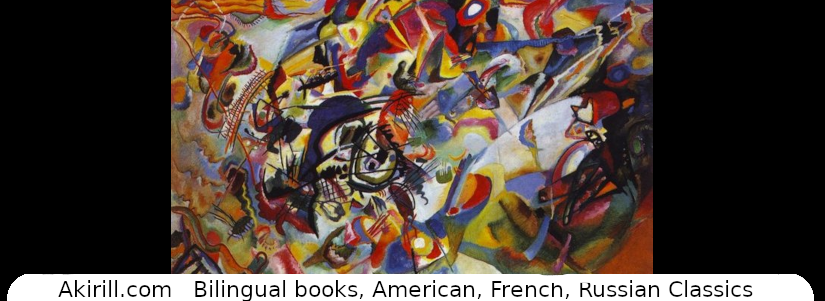
Wassily Vasilyevich est le fondateur et théoricien de l’art abstrait, et l’un des artistes les plus influents du XXe siècle. Même s’il na pas été pas le premier à peindre une toile de ce genre, il a été le premier à donner une justification théorique à la nouvelle tendance. En 1912, il a rédigé et publié son étude phare Sur le spirituel dans l’Art, qui est devenu la base théorique de l’abstractionnisme.
Composition VII of Wassily Vasilyevich Kandinsky
Kandinsky était un synesthésique, c’est-à-dire qu’il entendait les couleurs et voyait les sons et il cherchait une synthèse universelle de la musique et de la peinture. À travers des dessins, il imitait le flux et la profondeur du travail musical et la coloration reflétait le thème de la contemplation profonde.
“Composition VII” est appelé le summum de son travail. C’est une immense toile de 2 mètres sur 3 créée en 1913. Le processus d’écriture de Composition VII a été très méticuleux et il y avait plus de 30 croquis, aquarelles et peintures à l’huile de travail préparatoire. La raison d’un tel travail préparatoire important était que l’artiste s’était donné pour tâche de combiner plusieurs thèmes bibliques dans la composition finale. Ce sont: “le Jugement Dernier”, “le Déluge”, “la Résurrection d’Entre les Morts” et “le Jardin d’Eden”.
Comprendre Kandinsky est facile car il a déjà tout décrit avec des explications si fines qu’il y a un décryptage de chaque endroit, de chaque point et de chaque tour de ligne ne vous laissant qu’à regarder la toile et à ressentir.
Et si vous regardez l’image du point de vue de l’attitude de Kandinsky envers les formes et les couleurs, vous remarquez que les couleurs dominantes de la toile sont le rouge qui est un symbole de force, puis le bleu qui est la couleur de la paix et le blanc symbolisant l’éternité. Il y a aussi une couleur jaune que l’auteur a toujours qualifiée de frivole et rapidement dispersée.
Le contenu chromatique est soutenu par une composition bien pensée de l’œuvre qui est une forme se déroulant en diagonale, fermée dans l’espace rectangulaire de la toile. Le motif central a été déclaré ovale par l’artiste et est traversé par de nombreux rectangles irréguliers.
L’idée de l’âme humaine est affichée au centre sémantique de la toile sous la forme d’un cercle marqué d’une tache violette et de lignes et de traits noirs à côté. Elle aspire en elle-même, comme un entonnoir, crachant quelques rudiments de formes, se répandant en d’innombrables métamorphoses
Les historiens de l’art ont déterminé grâce à ses notes et à ses travaux que la composition VII est une combinaison de plusieurs thèmes (“La Résurrection d’Entre les Morts”, “le Jugement Dernier”, “le Déluge” et “le Jardin d’Eden”) exprimés comme une symbiose de la peinture pure.
If you liked this article, subscribe , put likes, write comments!.
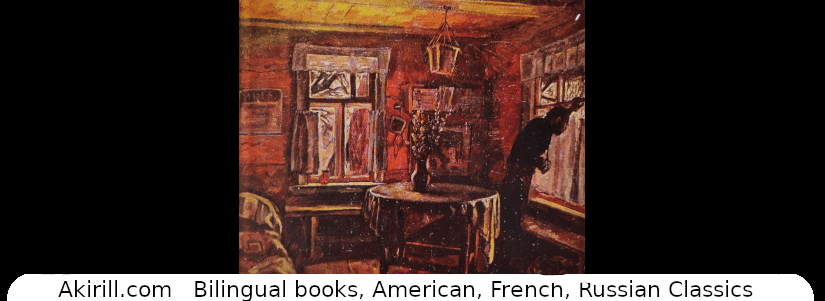
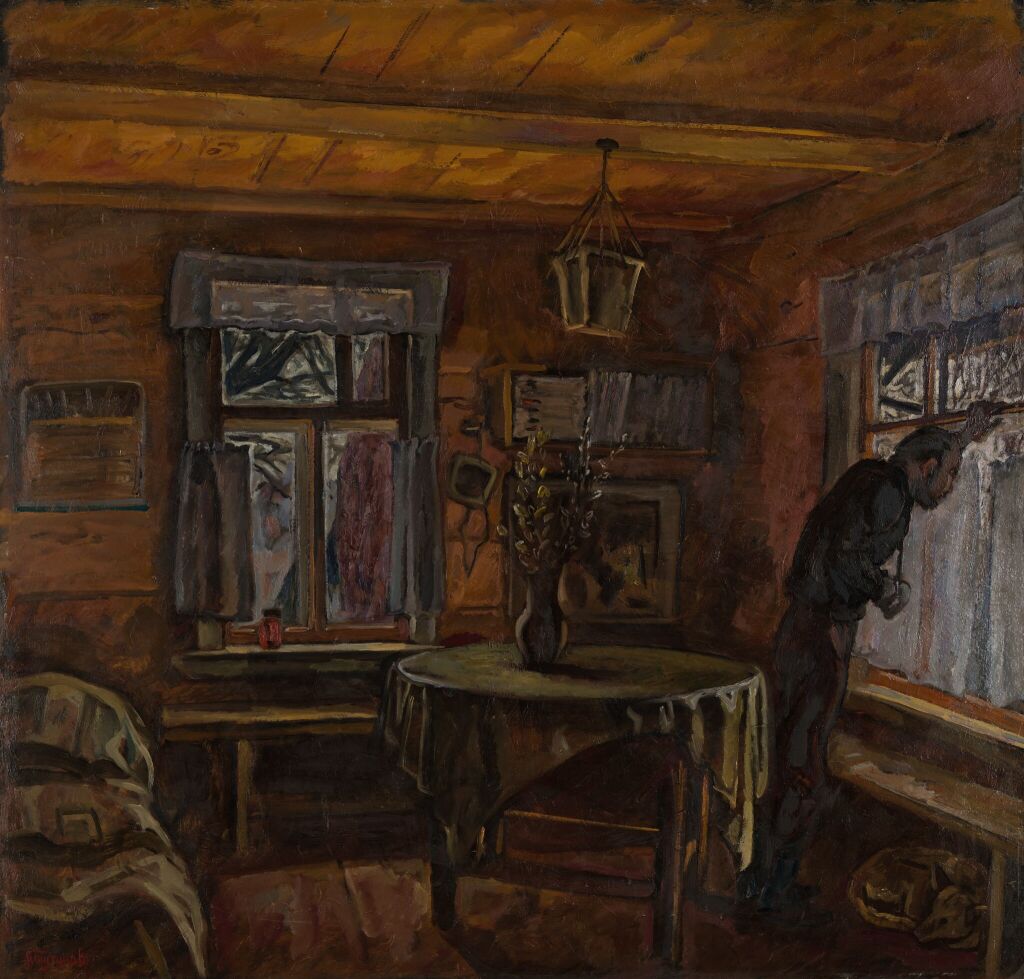
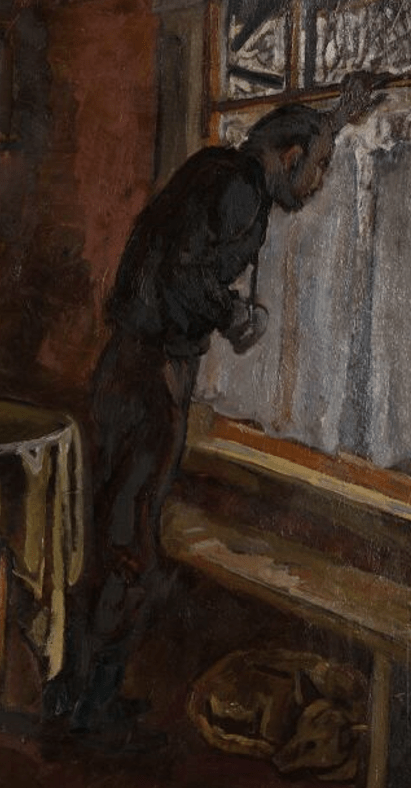
The painting of “Popkov in Priluki” was painted by Andrey Tutunov, after the tragic death of his friend the artist Popkov in 1974.
ПОПКОВ В ПРИЛУКАХ – 1974 “From the collection of the Tretyakov Gallery”.
The interior of the house is filled with peace and comfort of a village house which is represented by the warm honey color of the old boards reflecting the color of the objects in the room and only slightly contrasting with the cold light coming out of the windows. This painting is a reproduction of his own house with old wild boards on the walls, ceiling and floor. The windows have lace curtains, there is a table covered with a tablecloth with a bouquet of willow and wooden benches standing along the walls. The sleeping dog under the bench close to his owner is depicted with the same warm wood colors as the inside of the house.
But even the special harmony of close color cannot dispel the feeling of anxiety and doom coming from the lonely figure of Viktor Popkov standing by the window.
His regard is tense as if looking out for some kind of danger, his arm is hanging in a sling, his shoulder rounded and he is very thin which gives the image a poignant premonition of impending disaster
Le tableau de “Popkov à Priluki” a été peint par Andrey Tutunov, après la mort tragique de son ami l’artiste Popkov en 1974.
ПОПКОВ В ПРИЛУКАХ – 1974 « De la collection de la Galerie Tretiakov ».
L’intérieur de la maison est rempli de paix et du confort d’une maison de village, qui est représenté par la couleur miel chaude des vieilles planches reflétant la couleur des objets de la pièce et, ne contrastant que légèrement avec la lumière froide sortant des fenêtres. Ce tableau est une reproduction de sa propre maison avec de vieilles planches sauvages sur les murs, le plafond et le sol. Les fenêtres ont des rideaux de dentelle, il y a une table recouverte d’une nappe avec un bouquet de saules et des bancs en bois placés le long des murs. Le chien endormi sous le banc près de son propriétaire est représenté avec les mêmes couleurs de bois chaudes que l’intérieur de la maison.
Mais même l’harmonie particulière des couleurs proches ne peut dissiper le sentiment d’anxiété et de malheur émanant de la silhouette solitaire de Viktor Popkov debout près de la fenêtre.
Son regard est tendu comme s’il guettait une sorte de danger, son bras est suspendu en écharpe, ses épaules sont arrondies et il est très maigre ce qui donne à l’image une poignante prémonition d’une catastrophe imminente
La Galerie nationale Tretiakov est un musée d’art de Moscou fondé en 1856 par Pavel Tretiakov. Il a été ouvert au public en 1867 et transféré à Moscou en 1892. En 2018, l’exposition comprenait plus de 180 000 objets, dont des peintures, des sculptures et des objets en métaux précieux créés du XIe au XXe siècle.
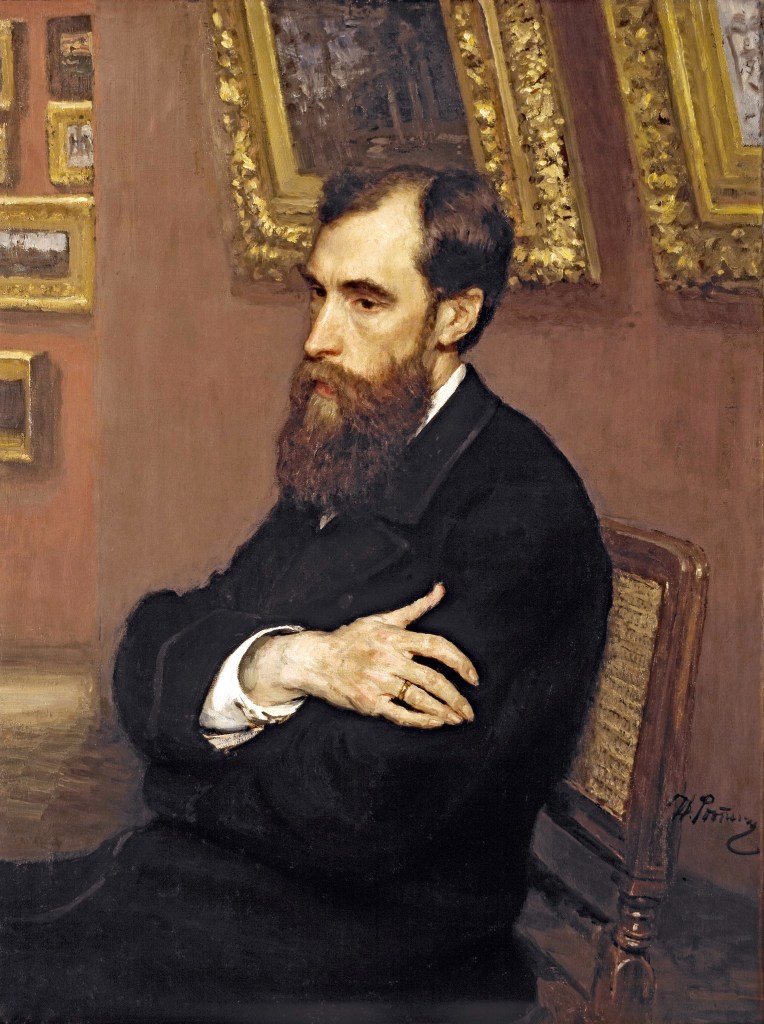
Après avoir créé la manufacture de lin de Kostroma, qui était une entreprise assez prospère, Pavel Mikhailovitch Tretyakov et son frère Sergei se sont intéressés à la collection de peintures.
Galerie Nationale Tretiakov
Ainsi, la galerie a été fondée en 1856, avec l’acquisition de “La Tentation” de Nikolai Schilder et “Escarmouche avec des contrebandiers finlandais” de Vasily Khudyakov, de Pavel Tretyuakov. Il a dit:
Pour moi, qui aime vraiment et ardemment la peinture, il n’y a pas de meilleur désir que de créer un dépôt public et accessible des beaux-arts, faisant profiter au plus grand nombre, tout le plaisir. Je voudrais vous lqisser la galerie nationale, c’est-à-dire composée de peintures d’artistes russes
Son frère Sergei s’intéressait davantage aux toiles de maîtres d’Europe occidentale élargissant les expositions.
En 1867, la galerie municipale de Moscou de Pavel et Sergueï Tretiakov, qui contenait à l’époque 1276 peintures, 471 dessins, 10 sculptures d’artistes russes et 84 peintures de maîtres étrangers, a été ouverte au public.
En 1859, après que les frères aient acheté plus de 140 œuvres de la série de peintures et de croquis du Turkestan de Vasily Vereshchagin, ils ont manqué de places pour l’exposition. Un bâtiment de deux étages adjacent au mur sud du manoir et tourné vers l’église Saint-Nicolas de Tolmachi a été construit. Sa construction a été dirigée par l’architecte Alexander Kaminsky. En 1874, la collection y fut déplacée et la galerie ouverte au public.
À la fin des années 1880, le bâtiment de la galerie a été complété à plusieurs reprises en raison de la collection croissante qui occupait déjà 14 salles et dépassait constamment ses possibilités d’exposition.
Et en 1882, la zone d’exposition est à nouveau agrandie aux dépens du jardin entourant la maison. Trois nouvelles salles sont apparues en bas et à l’étage qui étaient situées à un angle par rapport à l’ancien bâtiment de la Galerie, parallèlement à Maly Tolmachecsky Lane.
Elle fut suivie en 1885 par l’apparition de trois salles au dernier étage et de cinq au bas.
En 1892, la quatrième extension a été achevée et deux grandes et une petites salles ont été ajoutées à l’étage supérieur, et trois petites en dessous. et, après la mort de son frère Sergei, Pavel a fait don à Moscou de la galerie, qui contenait à l’époque plus de 2000 œuvres de peinture, de sculpture et de graphisme.
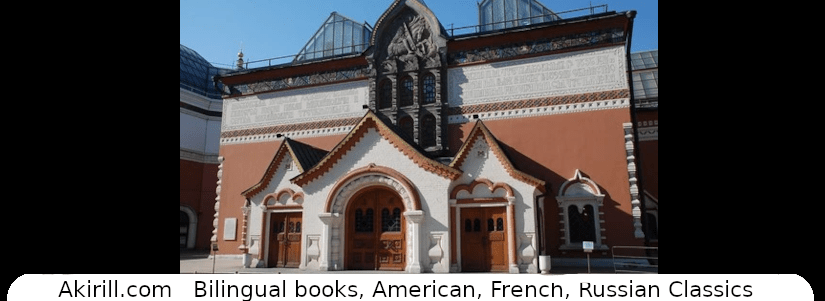
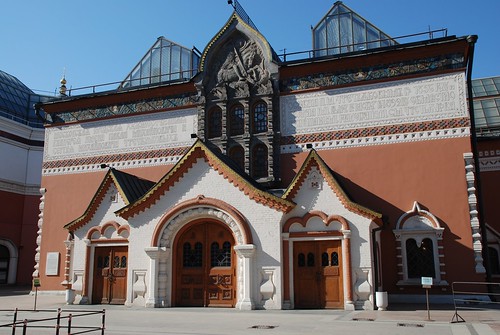
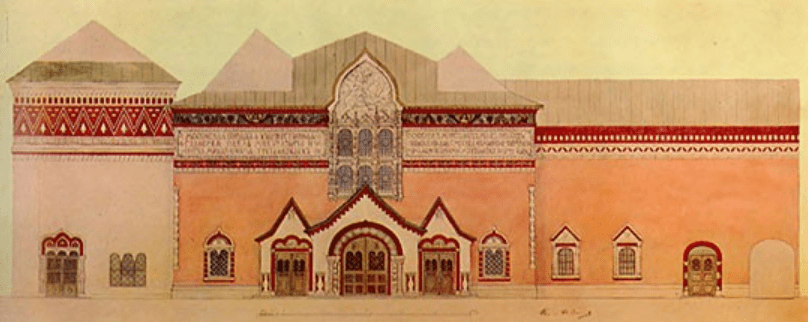
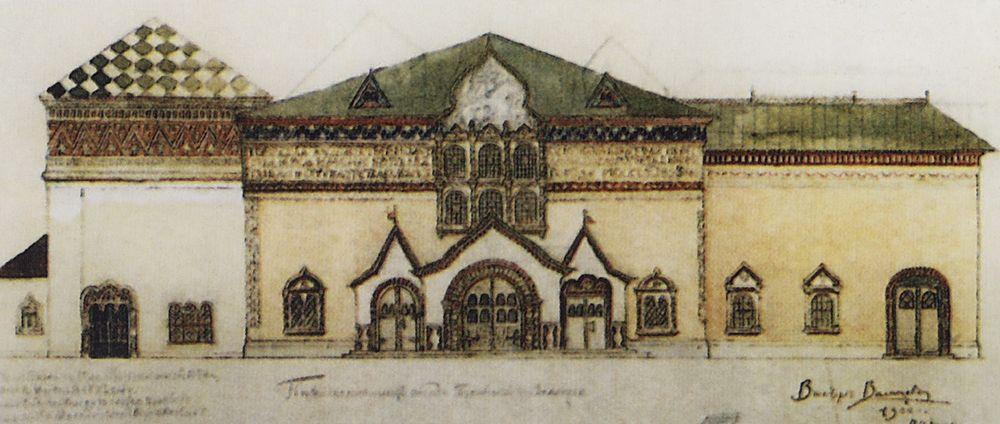
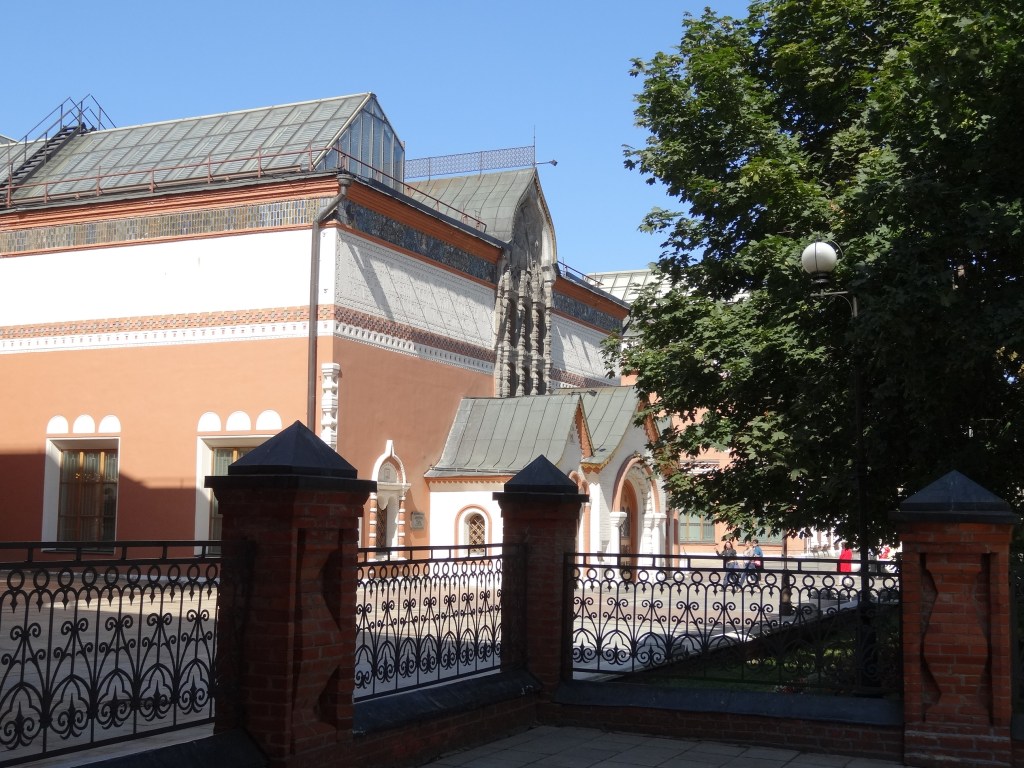
En mai 1900, lors d’une réunion du Conseil de la galerie qui comprenait les artistes VM Vasnetov, VD Polenov et un certain nombre d’architectes moscovites, il fut décidé que la façade de la galerie devait être construite dans le «style russe». Les travaux sont confiés à VM Vasnetsov et la construction de la nouvelle façade qui devient l’emblème de la galerie Tretiakov débute en 1902 et s’achève en 1904.
En avril 1913, Emmanuilovitch Grabar, artiste, architecte et historien de l’art de premier plan, a été élu administrateur de la galerie Tretiakov. Ses réformes ont transformé la galerie Tretiakov en un musée de style européen avec une exposition construite sur une base chronologique et en décembre 1913, à l’occasion du quinzième anniversaire de la mort du fondateur de la galerie, le musée réformé a été ouvert au public.
Auteur : photographe phototype anonyme P. P. Pavlova – Album de bâtiments appartenant à l’administration publique de la ville de Moscou.
En juin 1918, la galerie Tretiakov a été déclarée propriété de l’État de la République fédérative soviétique de Russie et est devenue connue sous le nom de galerie nationale Tretiakov. Entre 1918 et 1922, la collection de la galerie a augmenté de près de 50% grâce aux nombreuses contributions du State Museum Fund. Mais l’inconvénient était que de nombreuses salles d’exposition étaient consacrées au stockage des peintures.
A.V. Shchusev est devenu le directeur de la galerie en 1926 et, a beaucoup fait pour agrandir les locaux existants et en construire un nouveau. Ainsi, en 1927, la Galerie a reçu l’ancienne maison de Sokolikov située sur Maly Tolomachevsky Lane. En 1928 après sa restructuration, il est transformé en bâtiment de service qui abrite l’administration de la Galerie ainsi qu’un département scientifique, une bibliothèque, un département des manuscrits et un fonds graphique. Il a été rattaché à la Galerie plus tard avec une extension spéciale.
En 1928, le chauffage et la ventilation sont reconstruits et en 1929 la galerie est enfin électrifiée. En effet avant cette date, la Galerie n’était ouverte aux visiteurs que le jour.
En 1929, le bâtiment de l’église Saint-Nicolas de Tolmachi ferma et il fut transféré à la galerie en 1932. Il devint un entrepôt de peintures jusqu’à ce qu’il soit relié aux salles d’exposition par un nouveau bâtiment de deux étages dont le dernier étage avait été spécialement conçu pour exposer le tableau de AA Ivanov “L’apparition du Christ au peuple”. Et un nouveau passage entre les salles a été créé pour assurer la continuité de la vue, ce qui a entraîné une augmentation de la surface d’exposition et un nouveau concept de placement des œuvres.
AA Ivanov “L’apparition du Christ au peuple”
En 1936, selon le projet de l’architecte A.V. Shchusev, un nouveau bâtiment à deux étages est apparu sur le côté nord du bâtiment principal. Il comprenait 4 salles spacieuses à chaque étage qui étaient utilisées pour des expositions et qui ont été incluses dans le parcours principal de l’exposition depuis 1940.
Dans la nuit du 11 au 12 août 1941, deux bombes explosives sont tombées sur le bâtiment à la suite d’un raid aérien allemand. Les bombes ont détruit le revêtement en verre à plusieurs endroits du toit et le plafond entre les étages du hall supérieur N 6 et du hall inférieur N 49 s’est effondré. Les planchers du garde-robe du sous-sol ont été brisés, l’entrée principale a été endommagée et le système de chauffage et de ventilation est tombé en panne.
Un deuxième bombardement dans la nuit du 12 au 13 1941 a détruit un immeuble résidentiel de deux étages à côté de la Galerie.
La restauration de la galerie a commencé en 1942 et en 1944 sur 52 salles, 40 avaient été rénovées.
En mai 1956, le 100e anniversaire de la galerie a été célébré et en 1955-1957, la salle A.A. Ivanov a été achevée.
Vers le milieu des années 1980, le besoin de se développer à nouveau se fait sentir en raison de l’augmentation du nombre de visiteurs.
En 1985, un dépôt a été mis en service après 2 ans de construction. Et en 1986, la reconstruction du bâtiment principal de la galerie Tretiakov a commencé sur la base de l’idée de préserver l’aspect historique du bâtiment.
En 1989, sur le côté sud du bâtiment principal, un nouveau bâtiment abritant une salle de conférence, un centre d’information et de calcul, un studio pour enfants et des salles d’exposition a été construit. Comme la plupart des systèmes et services d’ingénierie y étaient concentrés, on l’appelait le Corps of Engineers.
La reconstruction a duré de 1985 à 1995 et comprenait l’ensemble muséal de l’église Saint-Nicolas de Tomachi qui est un monument architectural du XVIIe siècle.
The State Tretyakov Gallery is a Moscow art museum which was founded in 1856 by Pavel Tretyakov. It was opened to the public in 1867 and transferred to Moscow in 1892. As of 2018, the exposition consisted of more than 180 000 items, including paintings, sculptures and items made out of precious metals created from the 11th to the 20th century.
After having created the Kostroma Linen Manufactory, which was quite a successful business, Pavel Mikhailovitch Tretyakov and his brother Sergei became interested in collecting paintings.
State Tretyakov Gallery
So, the gallery was founded in 1856, with the acquisition of “The Temptation” by Nikolai Schilder and “Skirmish with Finnish Smugglers” by Vasily Khudyakov, by Pavel Tretyuakov. He said:
For me, who truly and ardently love painting, there can be no better desire than to start a public, accessible repository of fine arts, bringing benefit to many, all pleasure. I would like to leave you the national gallery, that is, consisting of paintings by Russian artists
His brother Sergei was more interested in canvases of Western European masters widening the exhibitions.
In 1867 the Moscow City Gallery of Pavel and Sergei Tretyakov which at the time contained 1276 paintings, 471 drawings, 10 sculpture by Russian artists and 84 paintings by foreign masters was opened to the public.
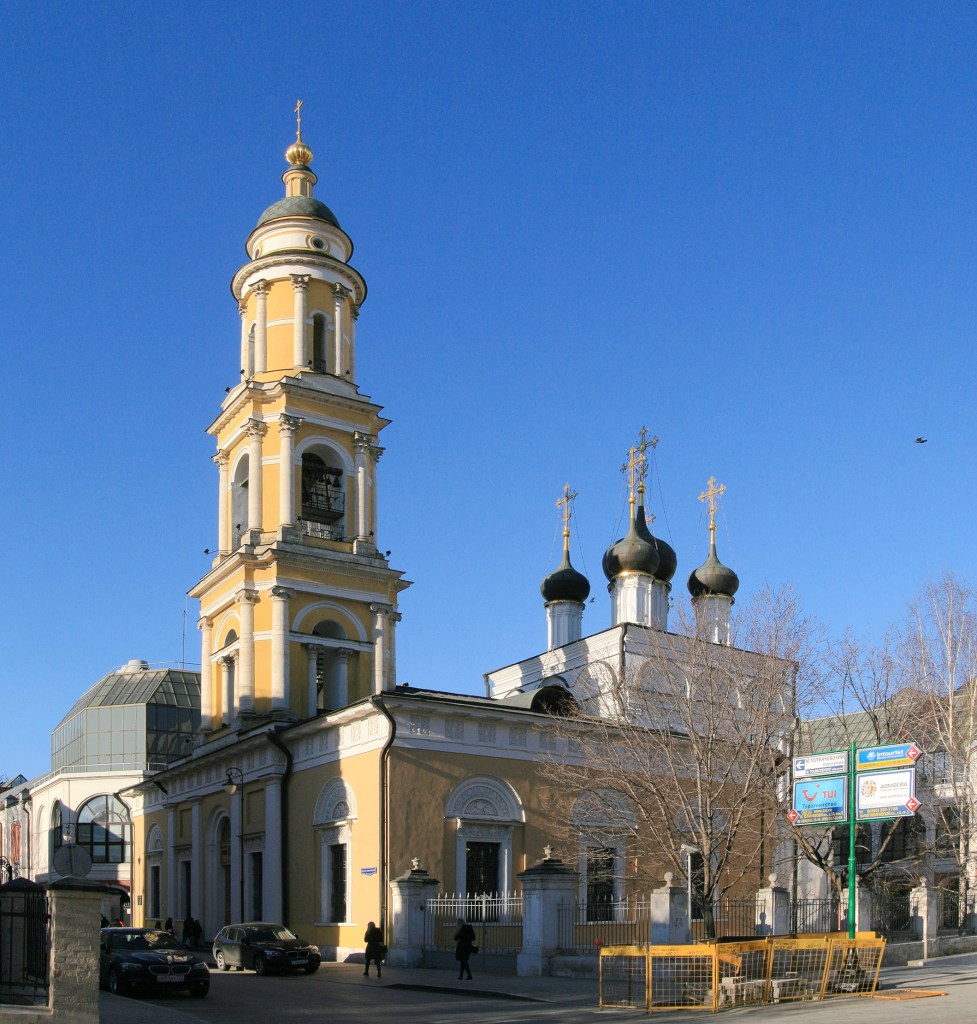
In 1859, after that the brothers purchased more than 140 works from the Turkestan series of paintings and sketches by Vasily Vereshchagin they ran out of places for the exposition. A two-story building adjacent to southern wall of the mansion and turned toward the Church of St Nicholas in Tolmachi was build. Its construction was headed by the architect Alexander Kaminsky . In 1874 the collection was moved there and the gallery opened to the public.
By the end of the 1880s, the gallery building was repeatedly completed due to the growing collection which already occupied 14 rooms and constantly surpassed its exposition possibilities.
In 1882, the exposition area was expanded again at the expense of the garden surrounding the house. Three new halls appeared downstairs and upstairs which were located at an angle to the old building of the Gallery, parallel to Maly Tolmachecsky Lane.
It was followed in 1885 by the apparition of three halls on the top floor and five in the bottom.
In 1892 the fourth extension was completed and two large and one small halls were added on the upper floor, and three small ones below. and, after the death of his brother Sergei, Pavel donated the gallery, which at the time contained more than 2000 works of painting, sculpture and graphics, to Moscow.
In may 1900, at a meeting of the Council of the gallery which included the artists V. M. Vasnetov, V. D. Polenov and a number of Moscow architects it was decided that the facade of the gallery should be built in the “Russian Style”. The work was entrusted to V. M. Vasnetsov and the construction of the new façade which became the emblem of the Tretyakov Gallery began in 1902 and ended in 1904.
On April 1913 Emmanuilovitch Grabar who was a prominent artist, architect and art historian was elected as a trustee of the Tretyakov Gallery. His reforms turned the Tretyakov Gallery into a Europeean-style museum with exposition built on a chronological basis and in december 1913, on the fifteenth anniversary of the death of the founder of the gallery, the reformed museum was opened to the public.
On June 1918 the Tretyakov Gallery was declared a State property of the Russian Federative Soviet Republic and became known as the State Tretyakov Gallery. Between 1918 and 1922, the gallery collection increased by almost 50% thanks to the numerous contributions from the State Museum Fund. But the drawback was that many exhibition halls were given over to storage for paintings.
A. V. Shchusev became the director of the gallery in 1926 and did a lot to expand the existing premises and build a new one. So in 1927, the Gallery received the former house of Sokolikov situated on Maly Tolomachevsky Lane. In 1928 after its restructuring, it was turned into a service building which housed the administration of the Gallery as well as a scientific department, a library, a department of manuscripts, and graphics funds. It was attached to the Gallery later with a special extension .
In 1928, the heating and ventilation was rebuilt and in 1929 the Gallery was finally electrified. Effectively before that time, the Gallery had been opened to visitors only during the daytime.
In 1929 the building of the Church of St Nicholas in Tolmachi closed and it was transferred to the Gallery in 1932. It became a storehouse for paintings until it was connected to the exposition halls by a newly built two story of which the top floor had been specially designed to display A. A. Ivanov’s painting “The Appearance of Christ to the People”. And a new passage between the halls was created to ensure the continuity of the view which resulted in an increased area of exposition and a new concept for the placement of works.
A. A. Ivanov’s painting “The Appearance of Christ to the People”
In 1936, according to the project of the architect A.V. Shchusev, a new two story building appeared on the north side of the main building. It included 4 spacious halls on each floor which were used for exhibitions and have been included in the main exhibition route since 1940.
On the night of August 11-12, 1941 two high-explosive bombs fell on the building as a result of a German air raid. The bombs destroyed the glass covering in several places of the roof and the interfloor ceiling of the upper hall N 6 and the lower one N 49 collapsed. The floors in the basement wardrobe were smashed, the main entrance was damaged and the heating and ventilation system failed.
A second bombing in the night of 12-13, 1941 destroyed a two story residential building next to the Gallery.
The restauration of the Gallery began in 1942 and by 1944 out of 52 halls, 40 had been renovated.
In May 1956, the 100th anniversary of the Gallery was celebrated and in 1955-1957, the A.A. Ivanov Hall was completed.
By the mid 1980 the need to expand again was felt because of the increased number of visitors.
In 1985 a depository was out in operation after 2 years of construction. And in 1986 the reconstruction of the main building of the Tretyakov Gallery began based on he idea of preserving the historical appearance of the building.
In 1989, on the south side of the main building a new building housing a conference hall, an information and computing center, a children’s studio and exhibition halls was built. Since most of the engineering systems and services were concentrated there it was called the Corps of Engineers.
The reconstruction lasted from 1985 to 1995 and included the museum ensemble of the church of St. Nicholas in Tomachi which is an architectural monument of the 17th century.
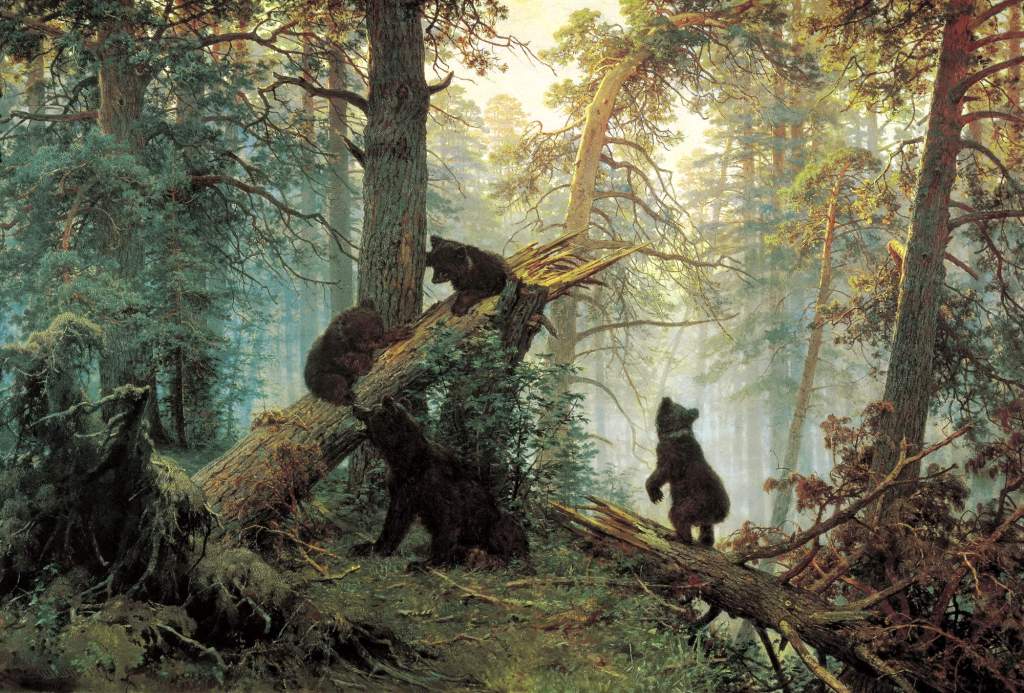
“Morning in a Pine Forest” is a legendary painting by Ivan Ivanovitch Shishkin. It was painted in 1889 on the island of Gorodomlya and is an oil painting on canvas of 139 X 213 cm which now resides in the Tretyakov Gallery in Moscow. This work looks so believable that it seems like a photo taken somewhere in the forest.
It is presumed that the painting was suggested to Shishkin by Savitsky, who later acted as a co-author and depicted the figures of cubs according to Shishkin’s sketches.
Originally, it was titled “Bear Family in the Forest” and signed by both Shiskin and Savitsky who painted the bears but they had an argument and Shishkin personally erased Savitsky’s name from the painting using turpentine.
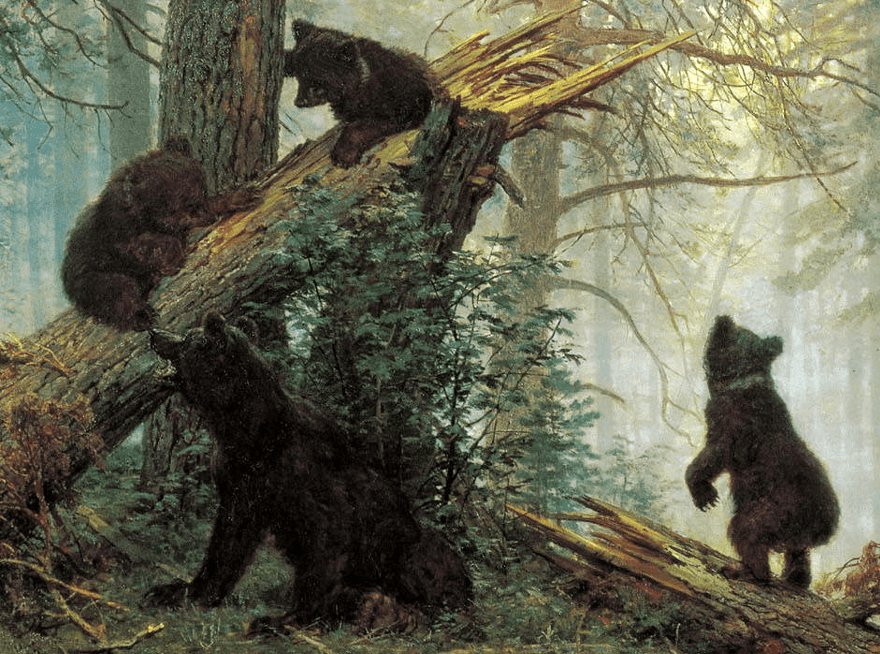
In the foreground of the picture is a mother bear and her three cubs. These dangerous, and formidable strong animals personify Russia itself and harmoniously fit into the landscape.
In the background of the picture we see golden hues which are the first rays of the sun, indicating the beginning of the morning. The bottom of the picture is still dark, fog creeps on the ground. The warm golden-yellow hues contrast brightly with the darkness of a gloomy forest, creating the image of a mysterious forest that descended from the pages of Russian fairy tales.
Shishkin painted the smallest details of the forest; branches, leaves, pine needles, roots … Everything is extremely realistic, and the forest looks like a very powerful force, but the picture still gives an impression of magie due to the effect of the fog which gives an atmosphere of mystery.
From the painting “Morning in a Pine Forest” comes an amazing calmness and serenity.
Reproductions of “Morning in a Pine Forest” was widely replicated in the URSS making it a well known picture often under the name of “Three Bears”.
We hope you enjoyed this painting as much as we did.
If you liked this article, subscribe , put likes, write comments!.
“Matin Dans Une Forêt De Pins” est un tableau légendaire d’Ivan Ivanovitch Shishkin. Il a été peint en 1889 sur l’île de Gorodomlya et, est une peinture à l’huile sur toile de 139 X 213 cm qui réside maintenant dans la galerie Tretyakov à Moscou. Ce travail a l’air si crédible qu’il ressemble à une photo prise quelque part dans la forêt.
On suppose que la peinture a été suggérée à Shishkin par Savitsky, qui a ensuite agi en tant que co-auteur et a représenté les figures des oursons selon les croquis de Shishkin.
À l’origine, il était intitulé “Famille d’Ours dans la Forêt” et signé par Shiskin et Savitsky qui a peint les ours, mais ils se sont disputés et Shishkin a personnellement effacé le nom de Savitsky du tableau à l’aide de térébenthine.
Au premier plan de l’image se trouve une maman ourse et ses trois oursons. Ces animaux forts dangereux et redoutables personnifient la Russie elle-même et s’intègrent harmonieusement dans le paysage.
En arrière-plan de l’image, on voit des teintes dorées qui sont les premiers rayons du soleil, indiquant le début du matin. Le bas de l’image est encore sombre, le brouillard rampe sur le sol. Les teintes chaudes jaune doré contrastent vivement avec l’obscurité d’une forêt sombre, créant l’image d’une forêt mystérieuse issue des pages de contes de fées russes.
Shishkin a peint les moindres détails de la forêt; branches, feuilles, aiguilles de pin, racines… Tout est extrêmement réaliste, et la forêt ressemble à une force très puissante, mais la photo donne tout de même une impression de magie due à l’effet du brouillard qui donne une atmosphère de mystère.
De la peinture “Matin Dans Une Forêt De Pins” vient un calme et une sérénité étonnants.
Les reproductions de “Matin Dans Une Forêt De Pins” ont été largement reproduites dans l’URSS, ce qui en fait une image bien connue souvent sous le nom de “Trois Ours”.
Nous espérons que vous avez apprécié ce tableau autant que nous.
Si vous avez aimé cet article, abonnez-vous, mettez des likes, écrivez des commentaires !.
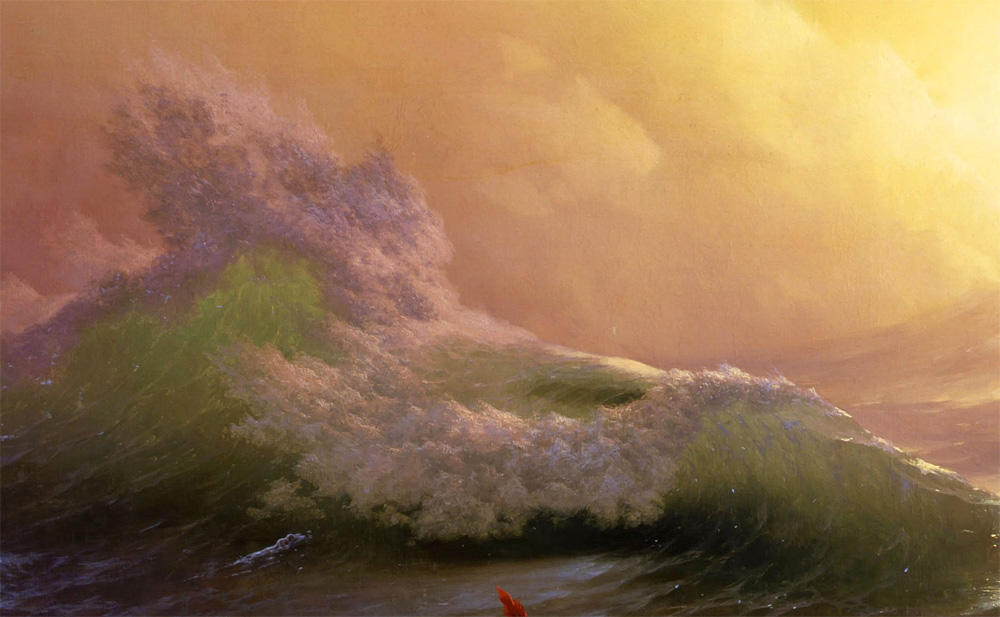
The canvas of “The 9th Wave” by Ivan Aivazovsky is recognized all over the world as an unsurpassed masterpiece and is one of the most famous work of this great Russian artist, who especially liked to paint on the marine theme. This painting is both an ode to the invincible and unpredictable water element and, the indestructible human spirit.
The canvas ‘The 9th Wave’ will not leave anyone indifferent, the 9th wave is a symbol of doom, the desire of survive is a symbol of hope. They create in the picture more than just a confrontation, they ask a question that the viewer has to answer.
The 9th wave is a symbol of fatal danger, the highest rise of a formidable, irresistible force. The symbol of the 9th wave comes from the old folk belief that during a sea storm the 9th wave is the strongest and most dangerous, often fatal. The term is often used in a figurative and metaphorical sense.
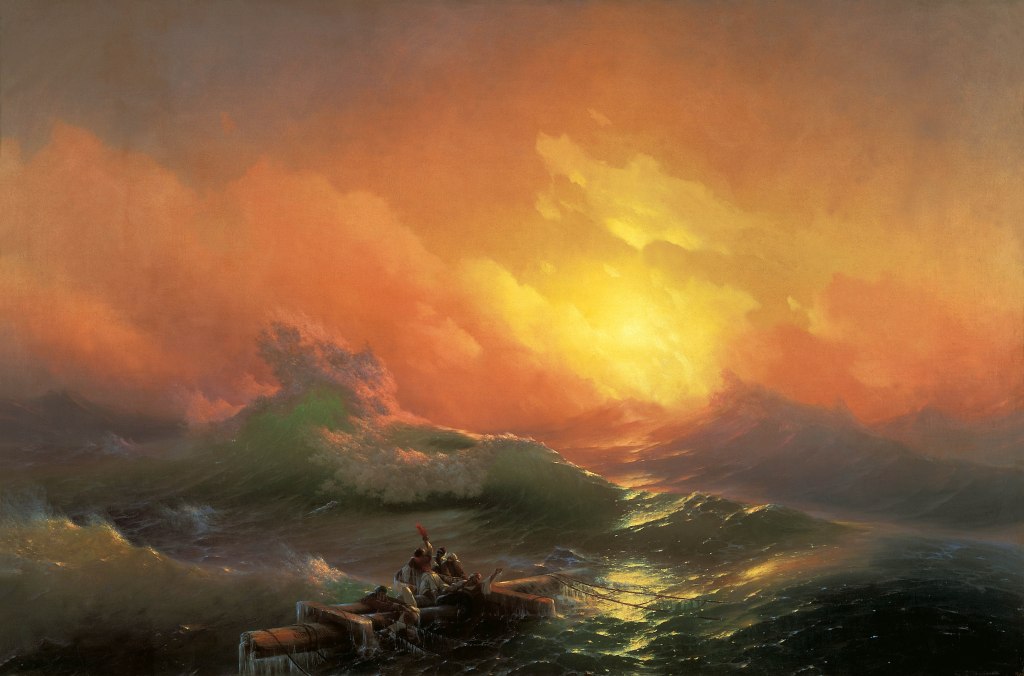
The artist painted “The 9th Wave” in 1850 in Feodosia and this canvas is perhaps the most outstanding work of art of the marine painter and of all Russian painting. It was painted in oil on canvas and measure 221 X 332cm. It was painted in only 11 days and was immediately bought by Nicholas I for the Hermitage. In 1897, the canvas was transferred to the collection of the State Russian Museum in St Petersburg where it is still today.
In the canvas the night storm has passed and now people are clinging the mast in their last strength in the struggle for their lives. They are exhausted and waiting to see what the new day will bring them. The painting does not depict the storm but its consequences.
It is believed that “The 9th Wave” was created according of the artist’s own recollections after surviving a shipwreck in the Bay of Biscay in 1844.
The main characteristic of the canvas is its duality. “The 9th Wave” canvas can be interpreted with a share of optimism in which men survived the shipwreck or it can be perceived as the triumph of the elements over man.
When we look at the canvas, we see the first rays of the sun breaking through which brings hope of survival to the sailors who have been wrecked.
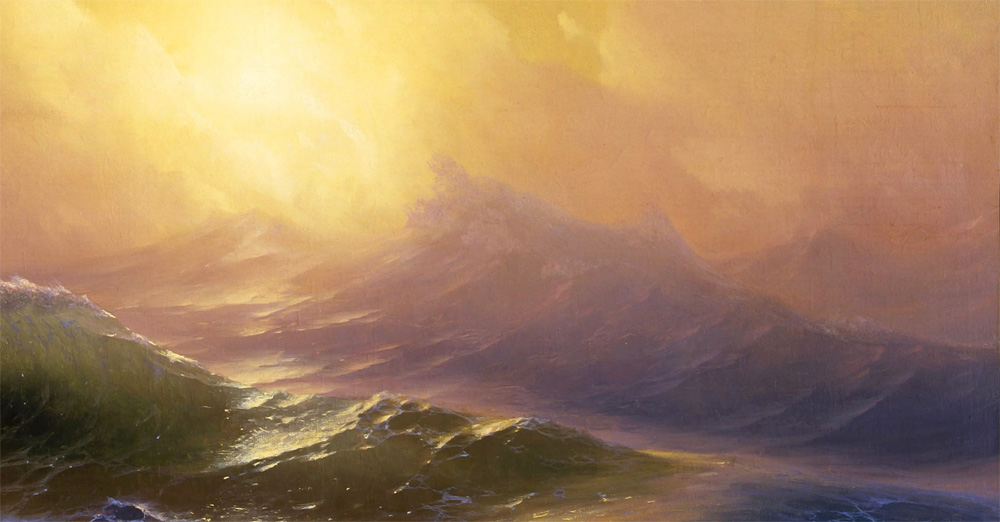
The glare of the sun’s rays on the restless sea is so mysterious that it gives the canvas volume and realism. The coloring of the canvas is amazing and it is sometimes impossible to determine where the sea begins and the sky ends.
The image of the sea speaks of the last night storm which destroyed the ship, and the dark abyss of the waves brings fear. But the sea is not calm yet, we can see larges waves inflated by the wind. It seems that the waves oscillate, there the 9th wave, the huge last wave of the outgoing storm is coming and the survivors are waiting for it with fear.
The fragment of the mast is huge showing us the size of the sunken ship. It looks like a cross, which can be interpreted as a symbol of salvation or a symbol of crucifixion. On it are only a small handful of people showing us the size of the catastrophe and when we take into account the fact that the average crew of a ship at that time was more than a hundred people, the whole horror of the night storm is felt.
The red handkerchief which is waved by one of the surviving sailors may symbolize an antithesis to the white flag and people’s unwillingness to surrender or it can symbolize new blood
The picture on an emotional level shows the superiority of the elements over the fragile life of a person.
This canvas has now become legend itself and has been at many exhibitions held in different countries of the world I hope you enjoyed it.
You can also read our article about the painting “The Black Sea” by Ivan Aivazovsky
La peinture de “La 9ème Vague” d’Ivan Aïvazovski est reconnue dans le monde entier comme un chef-d’œuvre inégalé et est l’une des œuvres les plus célèbres de ce grand artiste russe, qui aimait particulièrement peindre le thème marin. Ce tableau est à la fois une ode à l’invincible et imprévisible élément de l’eau et, à l’indestructible esprit humain .
Le tableau ‘La 9ème Vague’ ne laissera personne indifférent, la 9ème vague est un symbole de malheur, le désir de survivre est un symbole d’espoir. Ils créent dans l’image plus qu’une simple confrontation, ils posent une question à laquelle le spectateur doit répondre.
La 9ème vague est un symbole de danger mortel, la plus haute montée d’une force redoutable et irrésistible. Le symbolisme de la 9ème vague vient de la vieille croyance populaire selon laquelle, lors d’une tempête en mer, la 9ème vague est la plus forte et la plus dangereuse, souvent mortelle. Le terme est souvent utilisé dans un sens figuratif et métaphorique.
L’artiste a peint “La 9ème Vague” en 1850 à Feodosia et cette toile est peut-être l’œuvre d’art la plus remarquable du peintre de marine et de toute la peinture russe. Elle a été peinte à l’huile sur toile et mesure 221 X 332cm. La toile a été peinte en seulement 11 jours et a été immédiatement acheté par Nicolas Ier pour l’Ermitage. En 1897, ‘la 9ème Vague” a été transférée à la collection du Musée d’État Russe de Saint-Pétersbourg où elle se trouve encore aujourd’hui.
Sur la toile, la tempête nocturne est passée et maintenant les gens s’accrochent au mât avec leurs dernières forces dans la lutte pour leur vie. Ils sont épuisés et attendent de voir ce que le nouveau jour leur apportera. La toile ne représente pas la tempête mais ses conséquences.
On pense que la “9ème Vague” a été créée selon les propres souvenirs de l’artiste après avoir survécu à un naufrage dans le golfe de Gascogne en 1844.
La principale caractéristique de la peinture est sa dualité. La peinture de “La 9ème Vague” peut être interprétée avec une part d’optimisme dans laquelle les hommes ont survécu au naufrage ou elle peut être perçue comme le triomphe des éléments sur l’homme.
Quand on regarde le tableau, on voit percer les premiers rayons du soleil qui apportent l’espoir de survie aux marins naufragés.
L’éclat des rayons du soleil sur la mer agitée est si mystérieux qu’il donne au tableau volume et réalisme. La coloration de la toile est étonnante et il est parfois impossible de déterminer où commence la mer et où finit le ciel.
L’image de la mer parle de la dernière tempête nocturne qui a détruit le navire, et l’abîme sombre des vagues fait peur. Mais la mer n’est pas encore calme, on voit de grosses vagues gonflées par le vent. Il semble que les vagues oscillent, là, la 9ème vague, l’énorme dernière vague de la tempête sortante arrive et les survivants l’attendent avec peur.
Le fragment du mât est énorme nous montrant la taille du navire coulé. Il ressemble à une croix, qui peut être interprétée comme un symbole de salut ou un symbole de crucifixion. Il n’y a qu’une petite poignée de personnes ce qui nous montrent l’ampleur de la catastrophe et quand on tient compte du fait que l’équipage moyen d’un navire à cette époque était de plus d’une centaine de personnes, toute l’horreur de la tempête nocturne se fait sentir .
Le mouchoir rouge qui est agité par l’un des marins survivants peut symboliser une antithèse au drapeau blanc et la réticence des gens à se rendre ou il peut symboliser du sang neuf.
L’image sur le plan émotionnel montre la supériorité des éléments sur la vie fragile d’une personne.
Cette toile est maintenant devenue une légende elle-même et a fait l’objet de nombreuses expositions organisées dans différents pays du monde. J’espère qu’elle vous a plu.
Vous pouvez également lire notre article sur le tableau “La Mer Noire” d’Ivan Aïvazovski
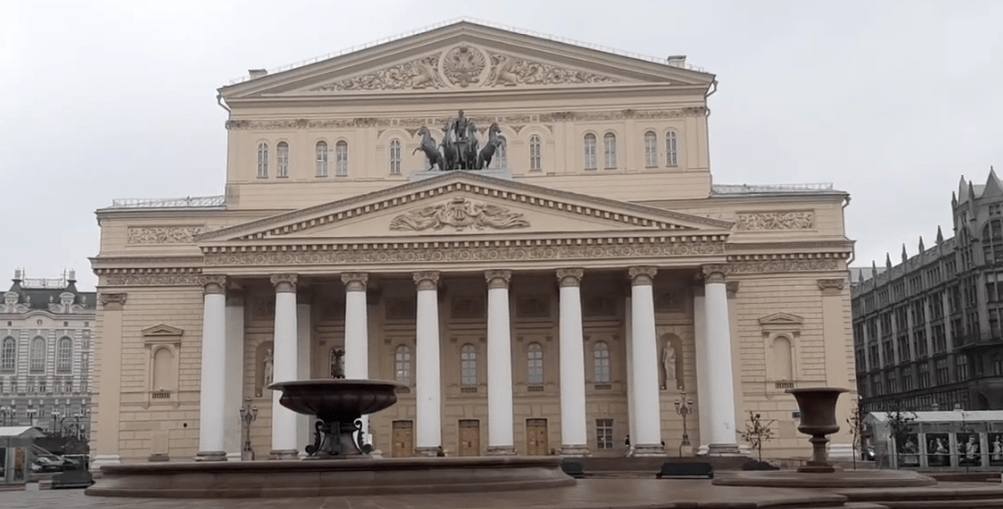
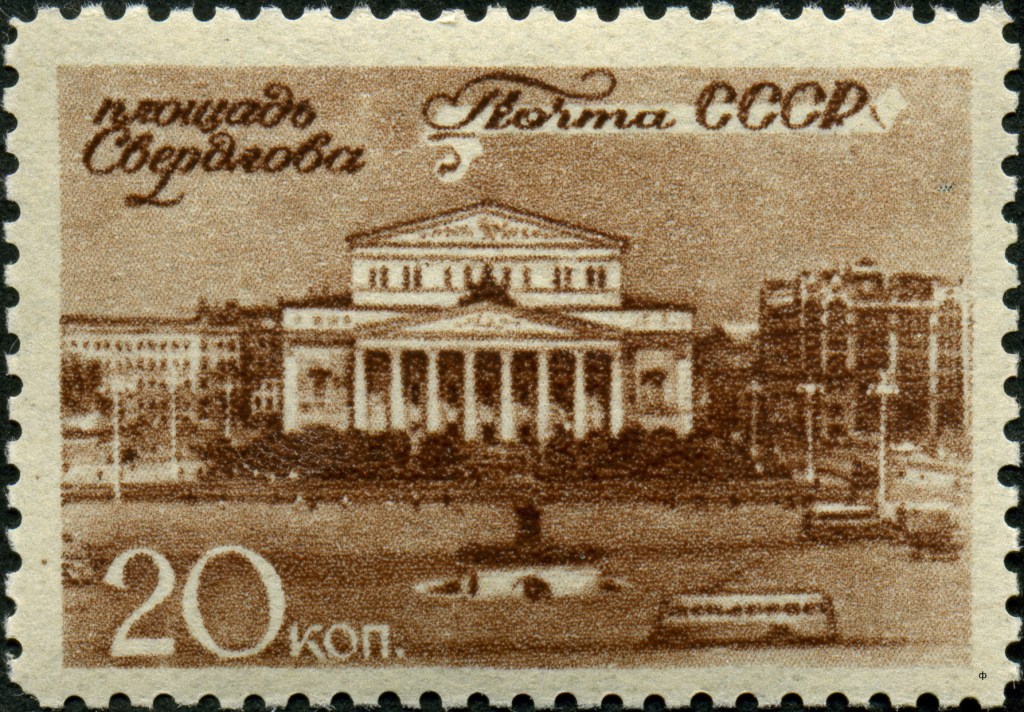
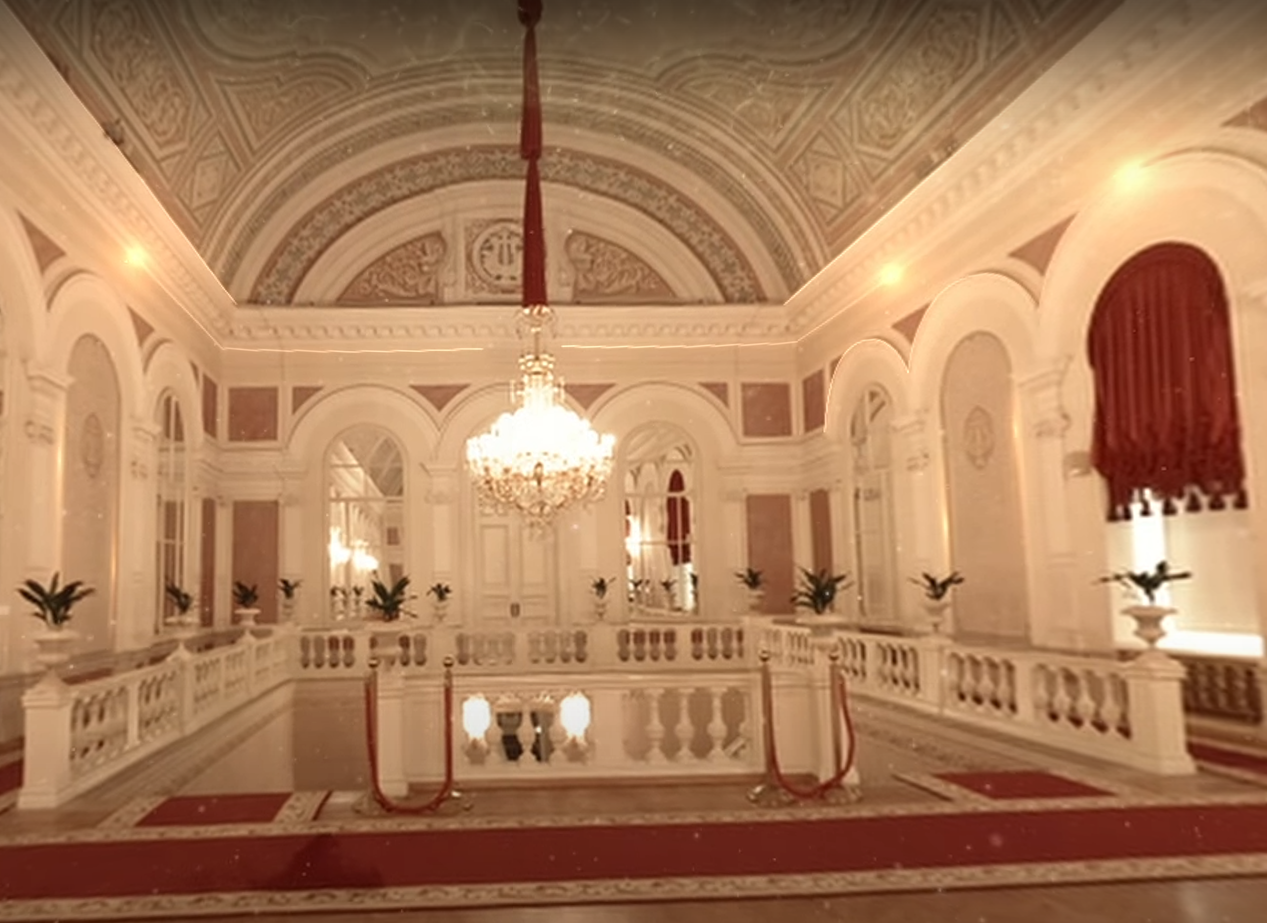
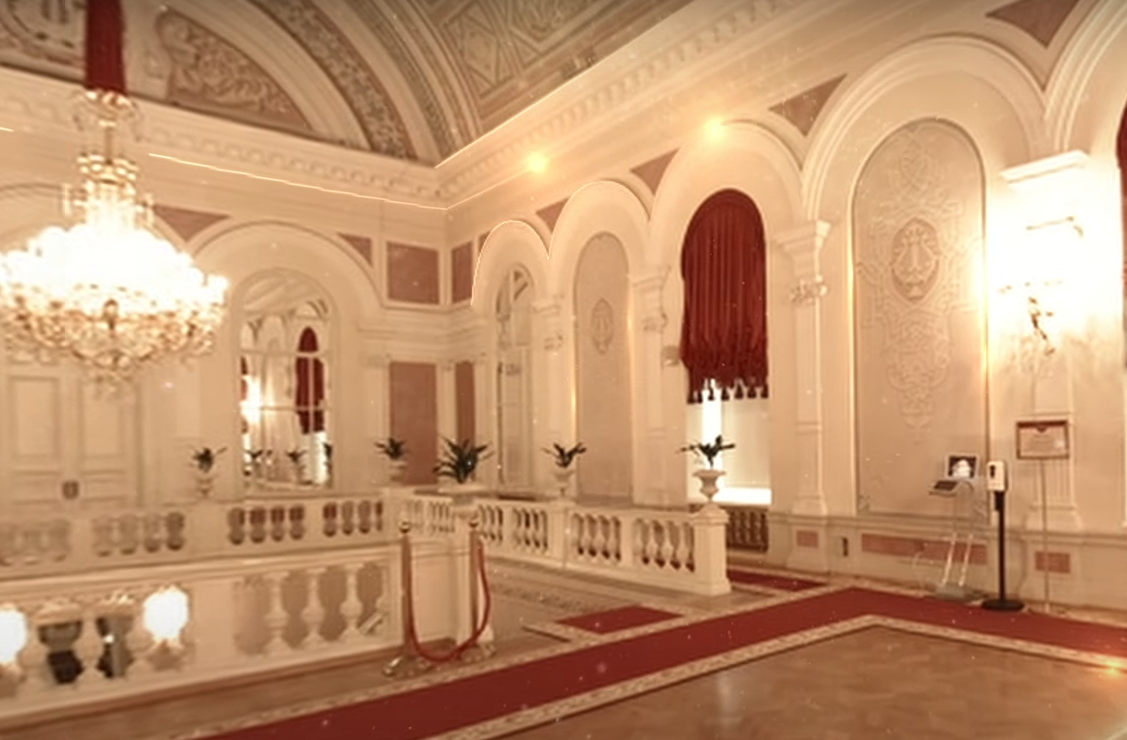
Le théâtre Bolchoï est l’un des théâtres d’opéra et de ballet les plus importants au monde et la fierté de Moscou. Plus de 800 œuvres ont été mises en scène dans le théâtre.
Le théâtre Bolchoï a deux dates de naissance : mars 1776 et janvier 1825.
Saviez-vous qu’en francais le théâtre Bolchoï veut dire le grand théâtre?
Le 28 mars 1776, Catherine II a signé un privilège gouvernemental à Pyotr Vasilyevich Urusov pour le maintien de spectacles, mascarades, bals et autres événements pendant une période de 10 ans. Cette date est considérée comme le jour de la fondation du théâtre Bolchoï russe.
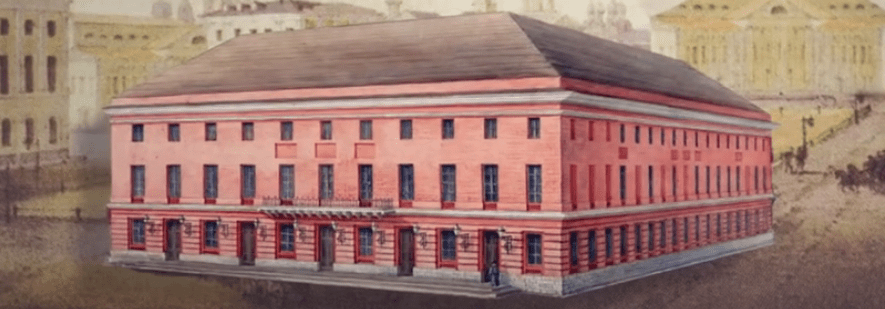
Le prince a commencé la construction du théâtre de la rue Petrovka et le théâtre a été nommé Petrovsky. après la rue Malheureusement, il a brûlé avant d’ouvrir et le prince a remis l’entreprise à son partenaire anglais, Mikhail Maddox. Ainsi, le théâtre Petrovky a été construit sous sa direction et l’inauguration du théâtre Petrovsky a eu lieu le 30 décembre 1780.
Ils ont donné un prologue solennel «Wanderers», écrit par A, Ablesimov, et un grand ballet pantomimique «Magic School», mis en scène par I. Paradise sur la musique de J. Startzer. Après le répertoire s’est formé principalement à partir d’opéras comiques russes et italiens avec des ballets et des ballets individuels
“Cet immense bâtiment, construit pour le plaisir et l’amusement populaire… selon les meilleurs architectes et l’approbation des connaisseurs de théâtre, a été construit et mené à bien avec tant de force et de rentabilité qu’il surpasse presque tous les nobles théâtres européens.”
C’est ainsi que le journal Moskovskie a répondu à l’ouverture du théâtre Petrovsky
Le bâtiment, conçu par l’architecte Christian Rozberg, a été construit en seulement 5 mois. Le théâtre disposait d’un auditorium à trois niveaux de loges, d’une galerie, d’un parterre avec vingt rangées de bancs et d’un spacieux « parquet » entre les parterres et la scène, où des chaises étaient installées pour les visiteurs « spéciaux », et les autres publics pouvaient se tenir debout. Il a accueilli près d’un millier de personnes.
En outre, il y avait des espaces de bureau nécessaires, de nombreux foyers et salles, y compris la “salle de la mascarade”.
En 1788, la Rotonde a été ajoutée au bâtiment et a été le centre de la vie culturelle et sociale dès le début de son existence.
En 1794, en raison de difficultés financières, Maddox a été contraint de transférer le théâtre au trésor public et le théâtre Petrovsky devient l’Impérial.
En 1802-1803, le théâtre a été donné au prince Volkonsky qui était le propriétaire de l’une des meilleures troupes de théâtre de Moscou. Mais en 1804, le théâtre revint sous la juridiction du conseil d’administration et le prince Volkonsky fut nommé son directeur.
Une fois de plus après 25 ans, le 8 octobre 1805, le théâtre Petrovsky a brûlé. Les troupes ont commencé à se produire sur scène privée jusqu’à ce que le nouveau théâtre Arbat soit construit par K. I. Rossi sur la place Arbat en 1808.
N’ayant existé que quatre ans, le bâtiment du théâtre a brûlé lors de l’incendie de Moscou en 1812.
Après cela, le théâtre était situé sur Znamenka dans la maison d’Apraksin, qui avait été construite en 1792 par l’architecte F. Camporesi. La salle de théâtre de la maison d’Apraksin était exiguë et inconfortable, au lieu de chaises, il y avait des bancs recouverts de rêche matériel et il y a eu plusieurs incendies dans le théâtre.
Quelques années plus tard, en 1818, les troupes ont été dotées d’un théâtre rénové sur Mokhovaya, où elles s’étaient autrefois produites avant la guerre de 1812.
En 1819, un concours est annoncé pour la construction d’un nouveau théâtre. Andrei Mikhailov a été reconnu vainqueur mais son projet était trop cher et a été repensé par Osip Bove. Il a conservé la base de la composition de Mikhailov, mais a changé la proportion du bâtiment et a fait des ajustements importants à sa décoration extérieure et intérieure.
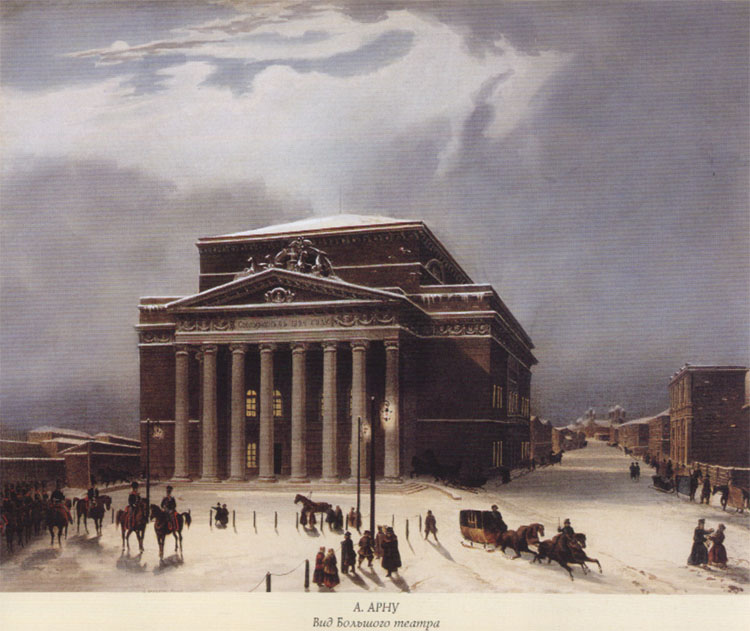
Le théâtre allait devenir le centre de composition du temple de la ville de l’Empire, glorifiant la victoire de la guerre patriotique. La construction a commencé en 1820 et le nouveau “Théâtre Bolchoï Petrovky” a ouvert le 6 janvier 1825 avec la représentation “Le triomphe des Muses” qui a été un grand succès. Les rôles ont été interprétés par les meilleurs acteurs moscovites : le tragédien PS Mochalov, NV Lavrov, F. Gyullen-Sor. Le critique de théâtre Sergei Timofeevich Aksakov a conservé des souvenirs de cette découverte:
Le théâtre Bolchoï Petrovky, qui a surgi de vieilles ruines carbonisées… m’a étonné et ravi… Un magnifique bâtiment immense, exclusivement dédié à mon art préféré, déjà avec son apparence seule m’a conduit à de joyeuses excitations »
En 1842, le théâtre passe sous la direction de la Direction des théâtres impériaux de Saint-Pétersbourg. Alexei Nikolaevich Verstovsky a été nommé directeur du bureau du théâtre de Moscou jusqu’en 1859 et une troupe d’opéra est arrivée à Moscou en provenance de Saint-Pétersbourg.
En 1943, une reconstruction majeure du bâtiment du théâtre a été réalisée selon le projet de l’architecte Alexander Stepanovich Nikitin. Les chapiteaux loniques du portique ont été remplacés par des chapiteaux de type Érechthéion, la ligne de loges latérales a été reconstruite ainsi que les couloirs et la partie scène, où apparaissait l’arrière-scène.
Le 11 mars 1853, le théâtre a de nouveau brûlé et seuls les murs extérieurs du bâtiment et la colonnade du portique ont survécu.
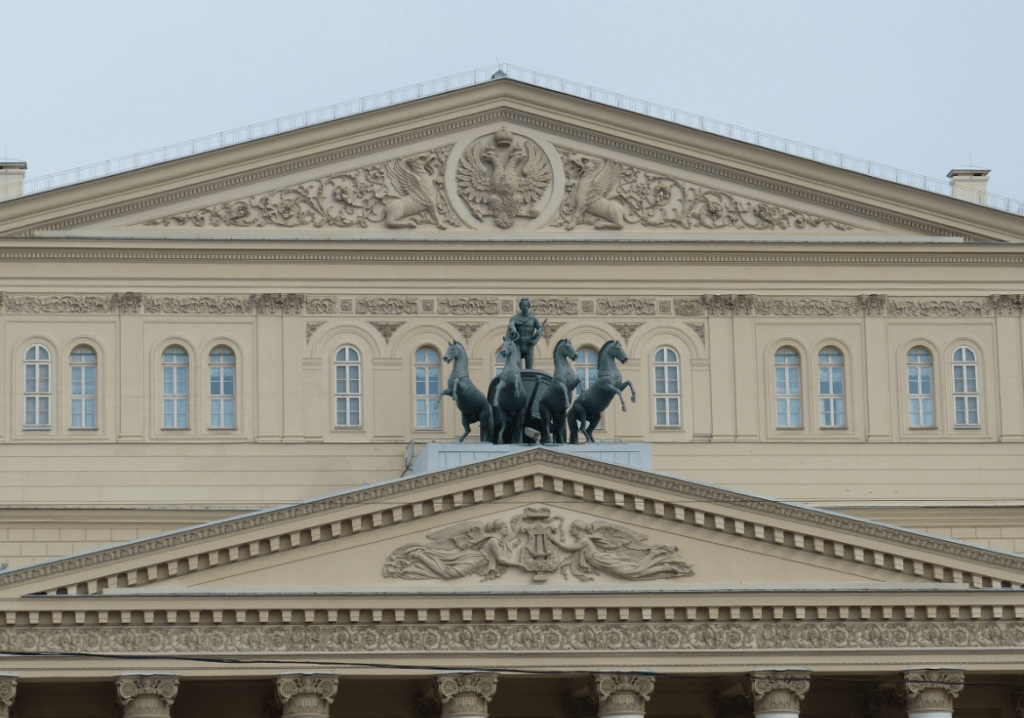
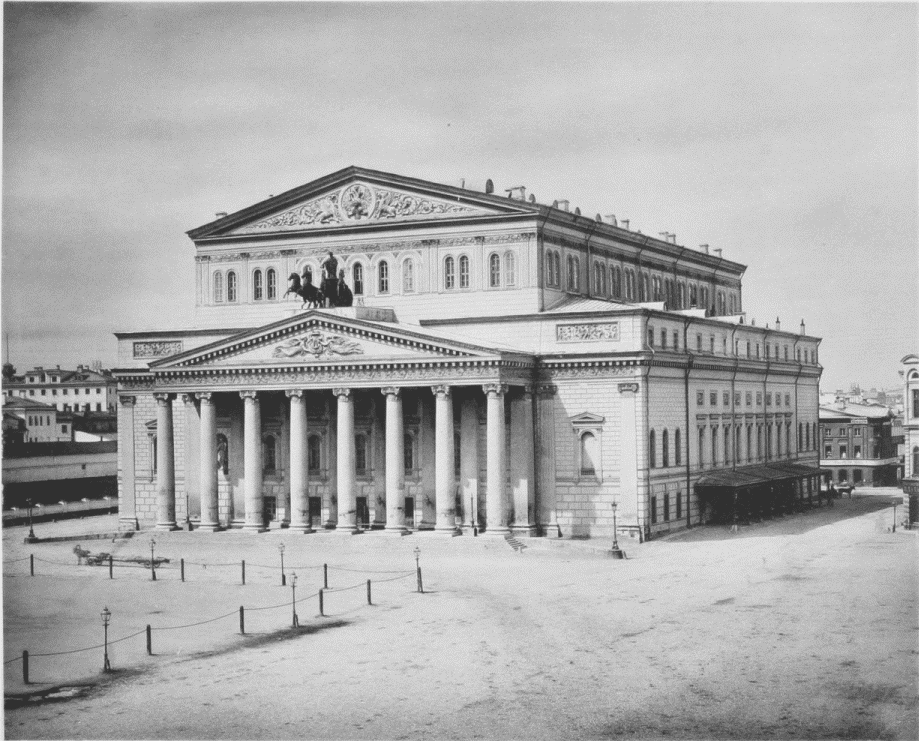
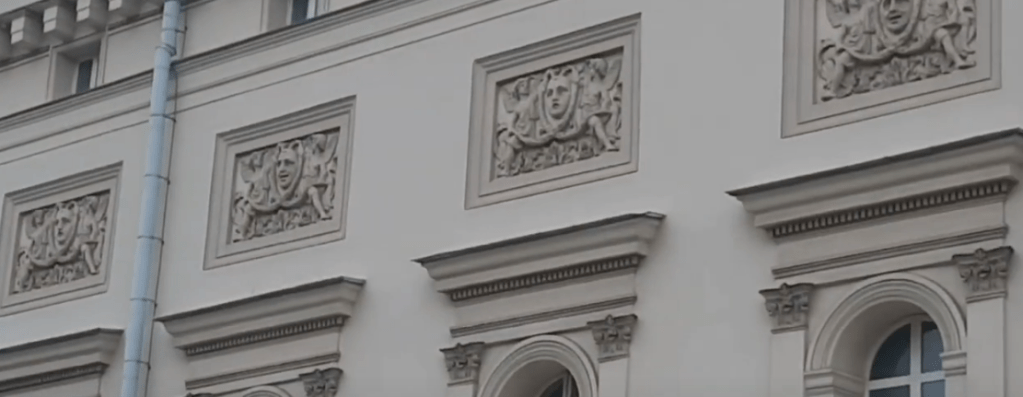
Albert Kavos était le nouvel architecte et le Théâtre a été restauré en trois ans. Le volume du bâtiment et l’agencement ont été conservés, mais la hauteur a été légèrement augmentée. Albert Kavos a modifié les proportions et a redessiné entièrement le décor architectural, dessinant les façades dans l’esprit de l’éclectisme des premiers temps. Au lieu de la sculpture en albâtre d’Apollon qui est mort dans l’incendie, un quadrige en bronze de Pyotr Klodt a été placé au-dessus de l’entrée du portique, et un aigle à deux têtes en plâtre qui est l’emblème d’État de l’Empire russe a été placé sur le fronton.
L’architecte théâtral accorda une attention particulière à l’auditorium et à la partie scénique, et dans la seconde moitié du XIXe siècle, le théâtre Bolchoï était considéré comme l’un des meilleurs au monde en termes de propriétés acoustiques grâce à Albert Kavos qui avait conçu l’auditorium comme un immense instrument de musique.
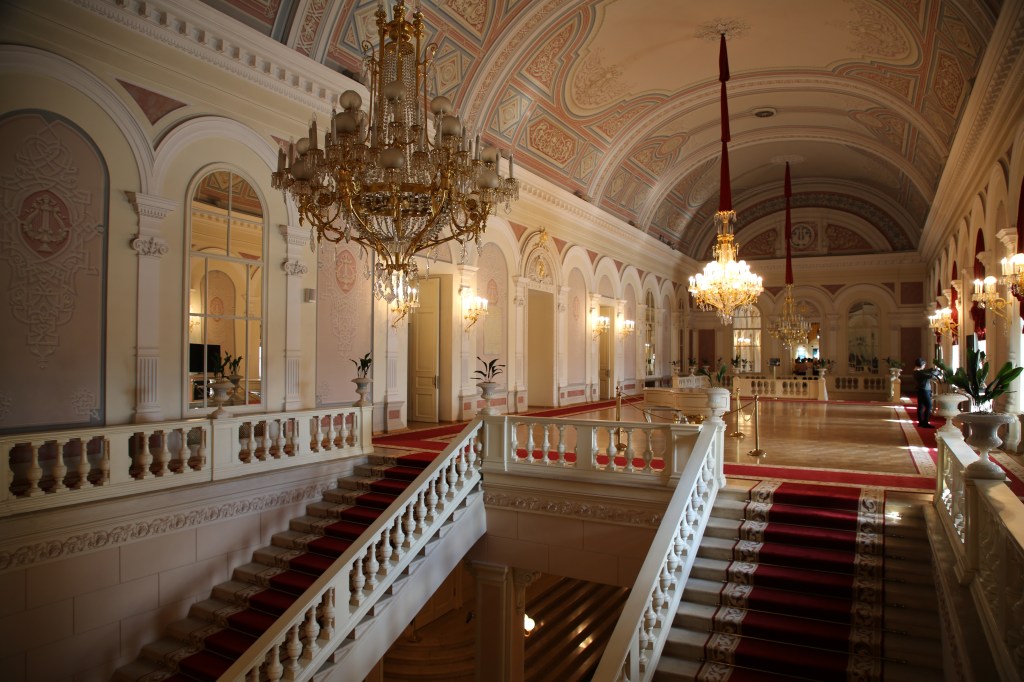
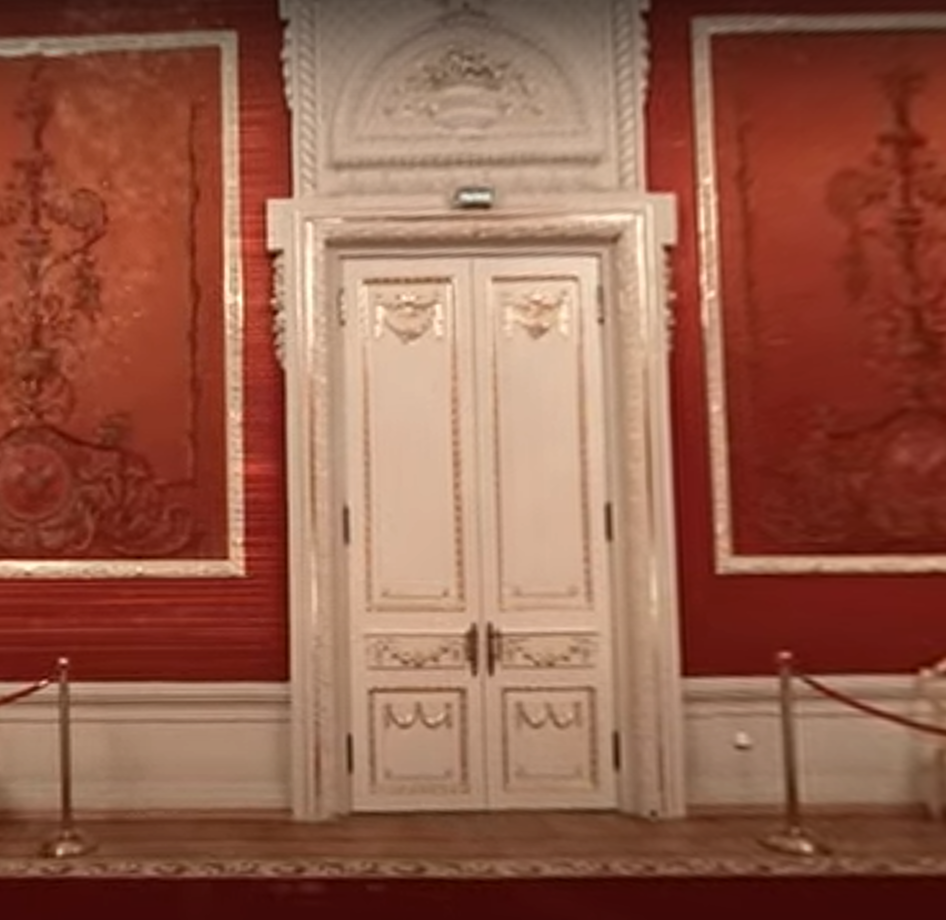
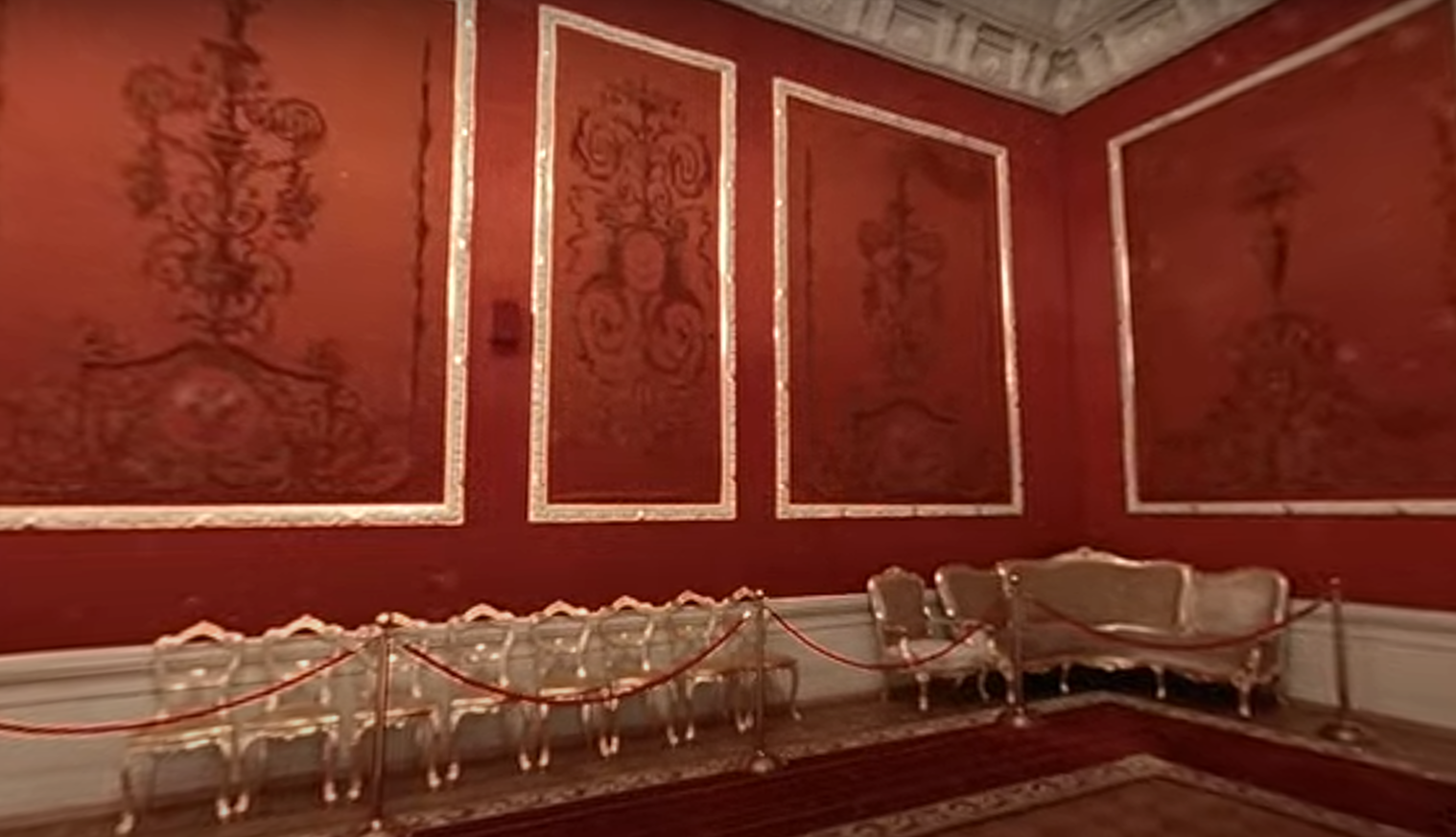
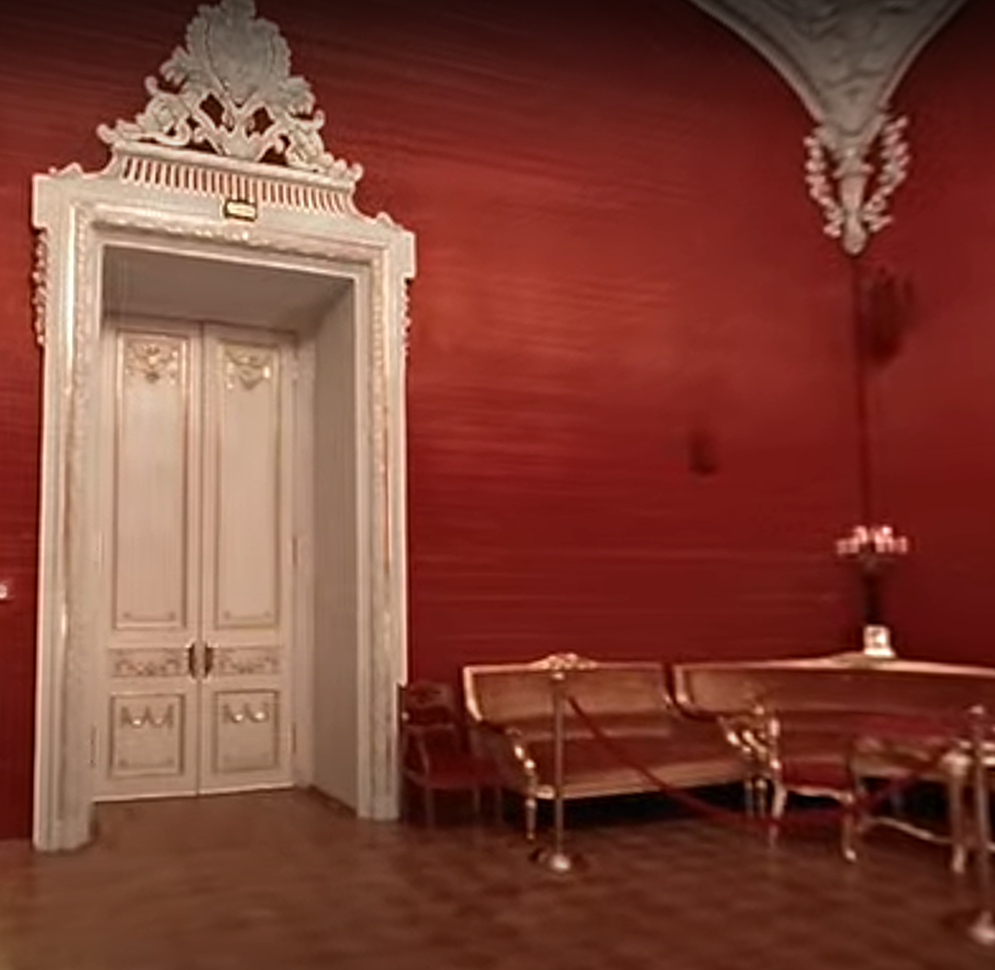
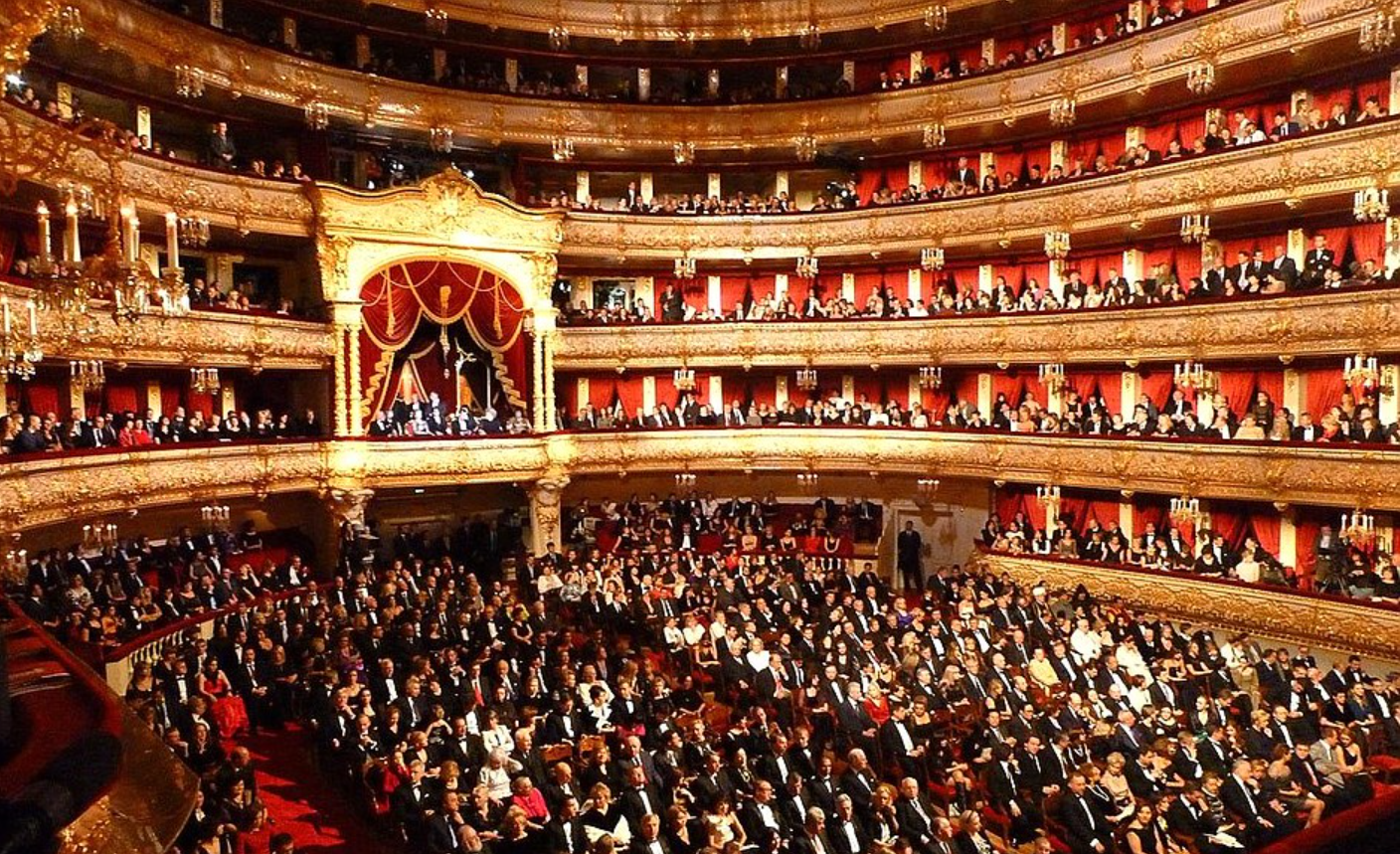
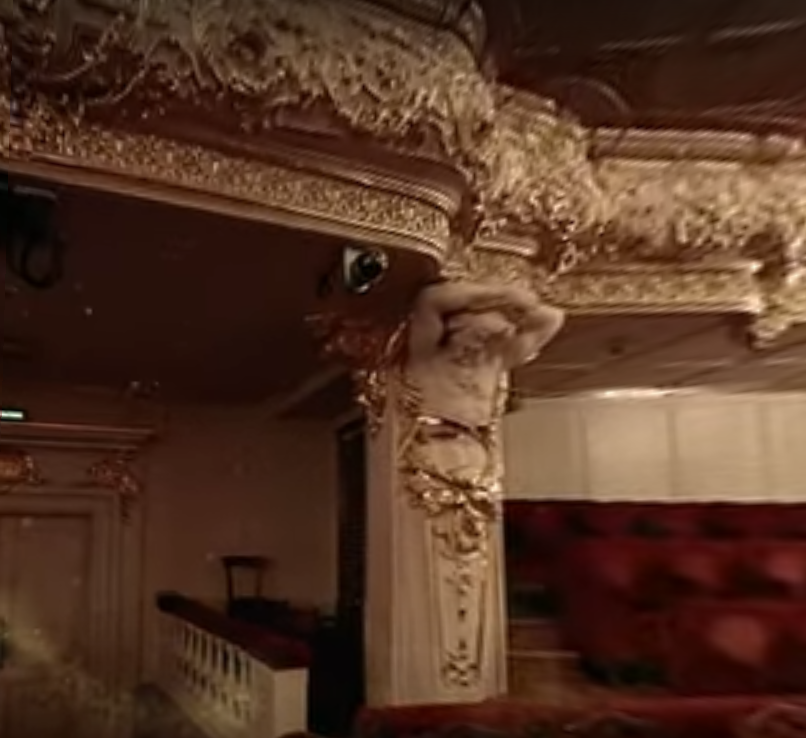
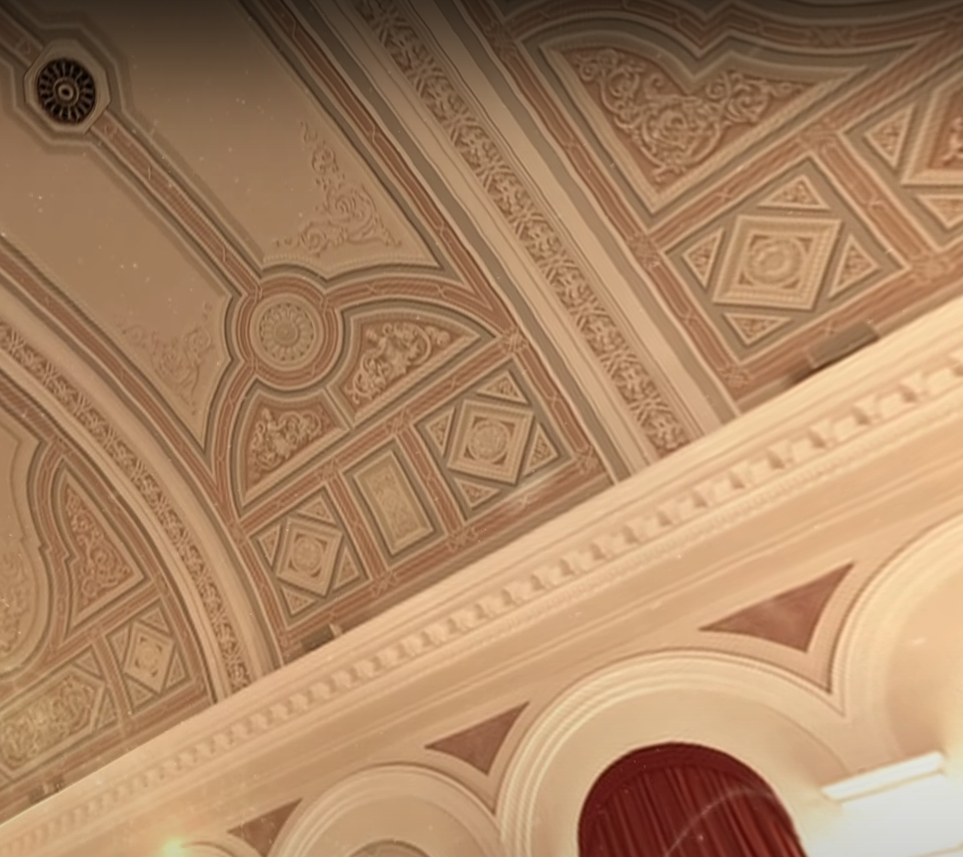
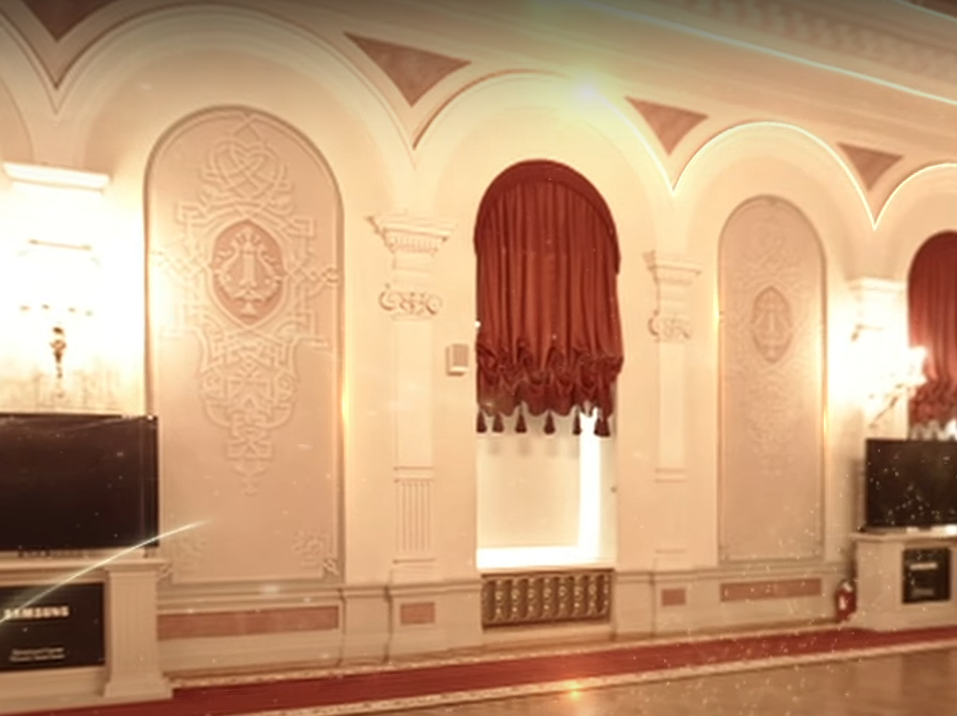
L’espace de l’auditorium a été considérablement agrandi, ce qui a permis de faire des pavillons avant. La salle a gagné un niveau supplémentaire et est devenue six niveaux pouvant accueillir près de 2300 spectateurs. De part et d’autre, près de la scène, se trouvaient des boîtes aux lettres destinées à la famille royale, au ministère de la cour et à la direction du théâtre. La loge d’apparat du tsar faisait un peu saillie dans la salle et en devenait le centre, en face de la scène. La barrière de la loge royale était soutenue par des consoles en forme d’atlantes coudées. Même des décennies plus tard, tous ceux qui entraient dans cette salle étaient émerveillés par la splendeur framboise-or.
Le lustre de l’auditorium était à l’origine éclairé par 300 lampes à huile. Les lampes ont été soulevées à travers un trou dans le plafond pour être allumées, et autour de ce trou l’académicien Alexei Titov a peint “Apollon et les Muses” mais au lieu d’une des muses caconiques, la muse des hymnes sacrés de Polyhymnia, Titov a représenté le muse de la peinture inventée par lui, avec une palette et un pinceau dans ses mains.
La rapidité de la reconstruction du bâtiment était due au fait que la construction devait être achevée par la célébration à l’occasion du couronnement de l’empereur Alexandre II. Le 20 août 1856, le théâtre a rouvert avec l’opéra de Belini; “Le Puritani” reflétant les goûts de la noblesse de la cour. La splendeur de l’auditorium, le public mondain qui l’emplit et qui fut accueilli par les membres de la famille impériale fut capté par le futur peintre de la cour Romanov Mihai Zichy et, nombre de ses aquarelles furent écrites pour l’album du couronnement qui devint l’une des publications les plus impressionnantes de Russie en poids et en taille.
L’un des événements les plus importants de l’histoire du Ballet du Bolchoï dans la seconde moitié du XIXe siècle a été la production du ballet “Don Quichotte”, dont la première a eu lieu le 14 décembre 1869.
Le 20 février 1877 eut lieu la première mondiale du ballet de Piotr Ilyish Tchaïkovski, le « Lac des cygnes ». Près de 20 ans plus tard, la performance canonique, connue dans le monde entier, a été mise en scène par Petipa et Lev Ivanov.
Tchaïkovski a fait ses débuts au théâtre Bolchoï en tant qu’auteur non seulement de ballet mais aussi d’opéra. Et le 18 janvier 1869, la première de l’opéra “Voyevoda” a eu lieu.
Le 3 février 1884 eut lieu la première mondiale de l’opéra “Mazeppa” et le 19 janvier 1887 la première représentation de l’opéra “Cherevichki” dans lequel Tchaïkovski fit ses débuts en tant que chef d’orchestre avec un grand succès.
Dans les années 1886-1893, l’arrière du bâtiment a été reconstruit sur le projet de l’architecte Eduard Karlovich Gernet et, par conséquent, les colonnes du portique conservées par Kavos se sont retrouvées à l’intérieur de l’entrepôt.
En 1890, une enquête a révélé que les fondations du théâtre reposaient sur des pilotis en bois pourris, elles ont donc été reconstruites en 1894-1898 suite aux projets des architectes Ivan Ivanovich Rerberg, Konstantin Viktorovich Tersky et Karl Yakovlevich Mayevsky.
Une étape sans précédent dans l’histoire du développement du théâtre Bolchoï est associée à Vladimir Telyakovsky. Sous sa direction, le théâtre a atteint un niveau et une importance mondiale. Une nouvelle ère s’ouvrait dans la vie de la société, et donc dans les arts. Le romantisme et le mélodrame appartenaient au passé et le théâtre musical prenait de nouvelles caractéristiques.
le théâtre Bolchoï au 19th century
À partir de 1918, le théâtre Bolchoï a été qualifié d’académique et pendant plusieurs années après la révolution, les disputes sur son sort n’ont pas cessé. Enfin, en 1922, le Présidium du Comité exécutif central panrusse décida de considérer la fermeture du théâtre comme économiquement inopportune.
En 1921, l’état catastrophique du mur semi-circulaire de l’auditorium, qui servait de support aux voûtes des couloirs et à l’ensemble de l’auditorium, est découvert. Les travaux de renforcement du mur ont commencé sous la direction de I. I. Resberg. Le 18 février 1921, l’inauguration du Beethoven Hall a eu lieu. Pendant de nombreuses années, il a servi de plate-forme pour les concerts de chambre des artistes de l’orchestre et des solistes de la troupe d’opéra. En 1922, les artistes du Bolchoï ont commencé à se produire sur la scène du soi-disant Nouveau Théâtre (ancien Théâtre Nezlobin)
Au milieu des années 1920, le Bolchoï n’avait plus à prouver son droit à l’existence, son statut etait tellement renforcé qu’en 1925, il a été décidé de fêter son centenaire en grand. L’ouverture du bâtiment du théâtre Bolchoï Petrovsky, qui a eu lieu en 1825, a été prise comme point de départ.
En 1928, il a été décidé d’éliminer la hiérarchie des rangs des visiteurs et l’architecte PA Tolstykh a replanifié un certain nombre d’escaliers et d’autres locaux du bâtiment.
le théâtre Bolchoï
Depuis le 15 avril 1941, le théâtre Bolchoï, a été reconstruit et le 22 juin 1941 a eu lieu la première de l’opéra Roméo et Juliette de Gounod.
Pendant la Grande Guerre patriotique, d’octobre 1941 à juillet 1943, le théâtre Bolchoï a été évacué à Kuibyshev (ancienne et actuelle Samara), où il donne des représentations d’Eugène Onéguine, du Lac des Cygnes, de La Traviata, d’Aida, de Carmen, de la Dame de Pique…
Pendant son séjour à Kuibyshev, le théâtre Bolchoï a fait don de 198 litres de sang, lavé mille ensembles d’uniformes militaires d’hiver et envoyé sept brigades au front, donnant 1140 concerts. Le Bolchoï a développé des activités d’usine amateur, fournit une aide matérielle aux familles des soldats de première ligne, collecté des fonds pour une colonne de chars et pour la construction d’un escadron, souscrit à un prêt militaire.
Le 22 octobre 1941, une bombe a frappé le bâtiment du théâtre Bolchoï, l’onde de choc est passé obliquement entre les colonnes du portique et percé le mur de façade causant des dégâts importants dans le vestibule.
Malgré les difficultés de la guerre, les travaux de restauration ont commencé dans le théâtre pendant l’hiver 1942, et même si le bâtiment historique était fermé, des représentations ont été jouées à Moscou.
En 1944, Leonid Lavrovsky, en tant que directeur artistique de la troupe de ballet, et la première danseuse étoile Gallerina Ulanova, ont déménagé au Théâtre Bolchoï, soulignant le statut du théâtre en tant que principal théâtre musical de Russie.
À la fin des années 1940 et au début des années 1950, le rôle prioritaire dans la formation du répertoire lyrique a été donné à l’opéra classique russe. Les productions des années d’après-guerre se distinguent par leur ampleur épique et l’ampleur de leurs décisions scéniques.
En 1955, un nouveau rideau de brocart luxueux conçu par FF Fedorovsky est apparu sur la scène du théâtre. C’était la décoration principale de la scène pendant 50 ans.
En 1956, Assaf Messere, s’appuyant sur la production d’Alexander Gorsky, Petipa et Lev Ivanov, met en scène sa propre version du ballet “Swan Lake”. C’est cette version qui a été présentée lors de la tournée légendaire de la troupe de ballet à Londres, qui est entrée dans l’histoire, après quoi elle a commencé à s’appeler le Ballet du Bolchoï dans le monde entier.
En ballet, l’ère de Youri Grigorovich, qui a dirigé la Balshoi Ballet Company de 1964 à 1995 a été très réussie. Il a créé ses propres éditions de presque tous les ballets classiques du répertoire, mis en scène des danses dans plusieurs représentations d’opéra et composé 5 ballets originaux : Casse-Noisette de Tchaïkovski en 1966, Spartacus de Khatchatourian en 1968, Ivan le Terrible sur la musique de Prokofiev en 1975, Angara d’Eshpay en 1976 et The Golden Age de Chostakovitch en 1982.
De 1995 à 2002, une nouvelle scène du théâtre Bolchoï a été construite rue Bolshaya Dmitrovka, maison 4, bâtiment 2 comprenant 879 places. La nouvelle scène s’est ouverte le 29 novembre 2002 avec l’opéra de NA Rimsky-Korsakov “The snow Maiden”.
En 2001, Alexander Vedernikov a été nommé nouveau directeur musical du théâtre et la pratique de la location de spectacles a été introduite. L’implication du Bolchoï dans le processus théâtral mondial a été facilitée par sa participation à des productions communes, qui sont également devenues de plus en plus courantes au fil des ans.
Le 1er juillet 2005, la scène historique du théâtre Bolchoï a été fermée pour reconstruction et a rouvert le 28 octobre 2011 avec un concert de gala avec la participation de danseurs d’opéra et de ballet dans la représentation de “Ruslan et Lyudmila” mise en scène par Dmitri Chernyakov.
Depuis 2013, Vladimir Urin est le directeur général du Théâtre Bolchoï, et sa première année, un orgue à vent a été produit par la société allemande de facture d’orgues Glatter-Götz, a été installé au théâtre Bolchoï.
En 2014, Tugan Sokhiev a été nommé au poste de chef d’orchestre et directeur musical du Bolchoï, qui partageait largement le répertoire et la politique du personnel précédemment introduits.
En juillet 2016, le Théâtre Bolchoï a lancé une série de retransmissions de rue de ses représentations. Elles ont été réalisées sur un écran spécial tous temps monté sur la façade principale du théâtre et, ont été programmées pour coïncider avec le 5e anniversaire de l’achèvement de la restauration.
En 2020, la coopération avec M. Chernyakov s’est poursuivie avec la production de l’opéra Sadko ; Le spectacle est devenu l’un des plus marquants de l’histoire récente du théâtre Bolchoï et a été présenté avec un grand succès dans de nombreux pays.
En mars 2020, au milieu du verrouillage causé par la pandémie de coronavirus, le théâtre Bolchoï a lancé une série d’émissions en ligne sur sa chaîne YouTube officielle. Le premier jour, le ballet “Le Lac des cygnes” a été regardé par plus d’un million de personnes.
























 AKirill, Learn, apprenez, translation, traduction, livres bilingues, bilingual books