

Mark Twain
Children’s book – Mark Twain – Contents
< < < Chapter XI
Chapter XIII > > >
Chapter XII

It must a been close on to one o’clock when we got below the island at last, and the raft did seem to go mighty slow. If a boat was to come along we was going to take to the canoe and break for the Illinois shore; and it was well a boat didn’t come, for we hadn’t ever thought to put the gun in the canoe, or a fishing-line, or anything to eat. We was in ruther too much of a sweat to think of so many things. It warn’t good judgment to put everything on the raft.
If the men went to the island I just expect they found the camp fire I built, and watched it all night for Jim to come. Anyways, they stayed away from us, and if my building the fire never fooled them it warn’t no fault of mine. I played it as low down on them as I could.
When the first streak of day began to show we tied up to a towhead in a big bend on the Illinois side, and hacked off cottonwood branches with the hatchet, and covered up the raft with them so she looked like there had been a cave-in in the bank there. A tow-head is a sandbar that has cottonwoods on it as thick as harrow-teeth.
We had mountains on the Missouri shore and heavy timber on the Illinois side, and the channel was down the Missouri shore at that place, so we warn’t afraid of anybody running across us. We laid there all day, and watched the rafts and steamboats spin down the Missouri shore, and up-bound steamboats fight the big river in the middle. I told Jim all about the time I had jabbering with that woman; and Jim said she was a smart one, and if she was to start after us herself she wouldn’t set down and watch a camp fire—no, sir, she’d fetch a dog. Well, then, I said, why couldn’t she tell her husband to fetch a dog? Jim said he bet she did think of it by the time the men was ready to start, and he believed they must a gone up-town to get a dog and so they lost all that time, or else we wouldn’t be here on a towhead sixteen or seventeen mile below the village—no, indeedy, we would be in that same old town again. So I said I didn’t care what was the reason they didn’t get us as long as they didn’t.
When it was beginning to come on dark we poked our heads out of the cottonwood thicket, and looked up and down and across; nothing in sight; so Jim took up some of the top planks of the raft and built a snug wigwam to get under in blazing weather and rainy, and to keep the things dry. Jim made a floor for the wigwam, and raised it a foot or more above the level of the raft, so now the blankets and all the traps was out of reach of steamboat waves. Right in the middle of the wigwam we made a layer of dirt about five or six inches deep with a frame around it for to hold it to its place; this was to build a fire on in sloppy weather or chilly; the wigwam would keep it from being seen. We made an extra steering-oar, too, because one of the others might get broke on a snag or something. We fixed up a short forked stick to hang the old lantern on, because we must always light the lantern whenever we see a steamboat coming down-stream, to keep from getting run over; but we wouldn’t have to light it for up-stream boats unless we see we was in what they call a “crossing”; for the river was pretty high yet, very low banks being still a little under water; so up-bound boats didn’t always run the channel, but hunted easy water.
This second night we run between seven and eight hours, with a current that was making over four mile an hour. We catched fish and talked, and we took a swim now and then to keep off sleepiness. It was kind of solemn, drifting down the big, still river, laying on our backs looking up at the stars, and we didn’t ever feel like talking loud, and it warn’t often that we laughed—only a little kind of a low chuckle. We had mighty good weather as a general thing, and nothing ever happened to us at all—that night, nor the next, nor the next.
Every night we passed towns, some of them away up on black hillsides, nothing but just a shiny bed of lights; not a house could you see. The fifth night we passed St. Louis, and it was like the whole world lit up. In St. Petersburg they used to say there was twenty or thirty thousand people in St. Louis, but I never believed it till I see that wonderful spread of lights at two o’clock that still night. There warn’t a sound there; everybody was asleep.
Every night now I used to slip ashore towards ten o’clock at some little village, and buy ten or fifteen cents’ worth of meal or bacon or other stuff to eat; and sometimes I lifted a chicken that warn’t roosting comfortable, and took him along. Pap always said, take a chicken when you get a chance, because if you don’t want him yourself you can easy find somebody that does, and a good deed ain’t ever forgot. I never see pap when he didn’t want the chicken himself, but that is what he used to say, anyway.
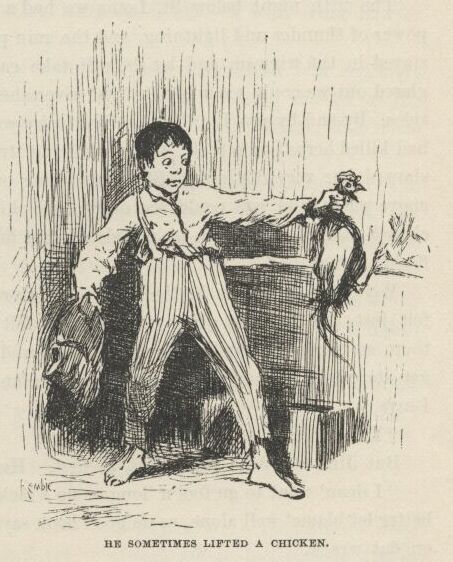
Mornings before daylight I slipped into cornfields and borrowed a watermelon, or a mushmelon, or a punkin, or some new corn, or things of that kind. Pap always said it warn’t no harm to borrow things if you was meaning to pay them back some time; but the widow said it warn’t anything but a soft name for stealing, and no decent body would do it. Jim said he reckoned the widow was partly right and pap was partly right; so the best way would be for us to pick out two or three things from the list and say we wouldn’t borrow them any more—then he reckoned it wouldn’t be no harm to borrow the others. So we talked it over all one night, drifting along down the river, trying to make up our minds whether to drop the watermelons, or the cantelopes, or the mushmelons, or what. But towards daylight we got it all settled satisfactory, and concluded to drop crabapples and p’simmons. We warn’t feeling just right before that, but it was all comfortable now. I was glad the way it come out, too, because crabapples ain’t ever good, and the p’simmons wouldn’t be ripe for two or three months yet.
We shot a water-fowl now and then that got up too early in the morning or didn’t go to bed early enough in the evening. Take it all round, we lived pretty high.
The fifth night below St. Louis we had a big storm after midnight, with a power of thunder and lightning, and the rain poured down in a solid sheet. We stayed in the wigwam and let the raft take care of itself. When the lightning glared out we could see a big straight river ahead, and high, rocky bluffs on both sides. By and by says I, “Hel-lo, Jim, looky yonder!” It was a steamboat that had killed herself on a rock. We was drifting straight down for her. The lightning showed her very distinct. She was leaning over, with part of her upper deck above water, and you could see every little chimbly-guy clean and clear, and a chair by the big bell, with an old slouch hat hanging on the back of it, when the flashes come.
Well, it being away in the night and stormy, and all so mysterious-like, I felt just the way any other boy would a felt when I see that wreck laying there so mournful and lonesome in the middle of the river. I wanted to get aboard of her and slink around a little, and see what there was there. So I says:
“Le’s land on her, Jim.”
But Jim was dead against it at first. He says:
“I doan’ want to go fool’n ’long er no wrack. We’s doin’ blame’ well, en we better let blame’ well alone, as de good book says. Like as not dey’s a watchman on dat wrack.”
“Watchman your grandmother,” I says; “there ain’t nothing to watch but the texas and the pilot-house; and do you reckon anybody’s going to resk his life for a texas and a pilot-house such a night as this, when it’s likely to break up and wash off down the river any minute?” Jim couldn’t say nothing to that, so he didn’t try. “And besides,” I says, “we might borrow something worth having out of the captain’s stateroom. Seegars, I bet you—and cost five cents apiece, solid cash. Steamboat captains is always rich, and get sixty dollars a month, and they don’t care a cent what a thing costs, you know, long as they want it. Stick a candle in your pocket; I can’t rest, Jim, till we give her a rummaging. Do you reckon Tom Sawyer would ever go by this thing? Not for pie, he wouldn’t. He’d call it an adventure—that’s what he’d call it; and he’d land on that wreck if it was his last act. And wouldn’t he throw style into it?—wouldn’t he spread himself, nor nothing? Why, you’d think it was Christopher C’lumbus discovering Kingdom-Come. I wish Tom Sawyer was here.”
Jim he grumbled a little, but give in. He said we mustn’t talk any more than we could help, and then talk mighty low. The lightning showed us the wreck again just in time, and we fetched the stabboard derrick, and made fast there.
The deck was high out here. We went sneaking down the slope of it to labboard, in the dark, towards the texas, feeling our way slow with our feet, and spreading our hands out to fend off the guys, for it was so dark we couldn’t see no sign of them. Pretty soon we struck the forward end of the skylight, and clumb on to it; and the next step fetched us in front of the captain’s door, which was open, and by Jimminy, away down through the texas-hall we see a light! and all in the same second we seem to hear low voices in yonder!
Jim whispered and said he was feeling powerful sick, and told me to come along. I says, all right, and was going to start for the raft; but just then I heard a voice wail out and say:
“Oh, please don’t, boys; I swear I won’t ever tell!”
Another voice said, pretty loud:
“It’s a lie, Jim Turner. You’ve acted this way before. You always want more’n your share of the truck, and you’ve always got it, too, because you’ve swore ’t if you didn’t you’d tell. But this time you’ve said it jest one time too many. You’re the meanest, treacherousest hound in this country.”
By this time Jim was gone for the raft. I was just a-biling with curiosity; and I says to myself, Tom Sawyer wouldn’t back out now, and so I won’t either; I’m a-going to see what’s going on here. So I dropped on my hands and knees in the little passage, and crept aft in the dark till there warn’t but one stateroom betwixt me and the cross-hall of the texas. Then in there I see a man stretched on the floor and tied hand and foot, and two men standing over him, and one of them had a dim lantern in his hand, and the other one had a pistol. This one kept pointing the pistol at the man’s head on the floor, and saying:
“I’d like to! And I orter, too—a mean skunk!”
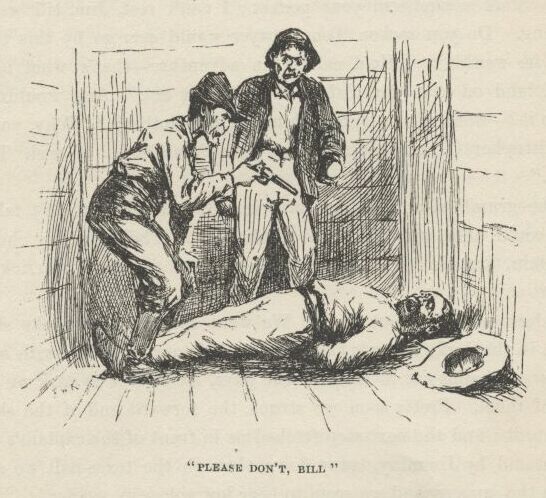
The man on the floor would shrivel up and say, “Oh, please don’t, Bill; I hain’t ever goin’ to tell.”
And every time he said that the man with the lantern would laugh and say:
“’Deed you ain’t! You never said no truer thing ’n that, you bet you.” And once he said: “Hear him beg! and yit if we hadn’t got the best of him and tied him he’d a killed us both. And what for? Jist for noth’n. Jist because we stood on our rights—that’s what for. But I lay you ain’t a-goin’ to threaten nobody any more, Jim Turner. Put up that pistol, Bill.”
Bill says:
“I don’t want to, Jake Packard. I’m for killin’ him—and didn’t he kill old Hatfield jist the same way—and don’t he deserve it?”
“But I don’t want him killed, and I’ve got my reasons for it.”
“Bless yo’ heart for them words, Jake Packard! I’ll never forgit you long’s I live!” says the man on the floor, sort of blubbering.
Packard didn’t take no notice of that, but hung up his lantern on a nail and started towards where I was there in the dark, and motioned Bill to come. I crawfished as fast as I could about two yards, but the boat slanted so that I couldn’t make very good time; so to keep from getting run over and catched I crawled into a stateroom on the upper side. The man came a-pawing along in the dark, and when Packard got to my stateroom, he says:
“Here—come in here.”
And in he come, and Bill after him. But before they got in I was up in the upper berth, cornered, and sorry I come. Then they stood there, with their hands on the ledge of the berth, and talked. I couldn’t see them, but I could tell where they was by the whisky they’d been having. I was glad I didn’t drink whisky; but it wouldn’t made much difference anyway, because most of the time they couldn’t a treed me because I didn’t breathe. I was too scared. And, besides, a body couldn’t breathe and hear such talk. They talked low and earnest. Bill wanted to kill Turner. He says:
“He’s said he’ll tell, and he will. If we was to give both our shares to him now it wouldn’t make no difference after the row and the way we’ve served him. Shore’s you’re born, he’ll turn State’s evidence; now you hear me. I’m for putting him out of his troubles.”
“So’m I,” says Packard, very quiet.
“Blame it, I’d sorter begun to think you wasn’t. Well, then, that’s all right. Le’s go and do it.”
“Hold on a minute; I hain’t had my say yit. You listen to me. Shooting’s good, but there’s quieter ways if the thing’s got to be done. But what I say is this: it ain’t good sense to go court’n around after a halter if you can git at what you’re up to in some way that’s jist as good and at the same time don’t bring you into no resks. Ain’t that so?”
“You bet it is. But how you goin’ to manage it this time?”
“Well, my idea is this: we’ll rustle around and gather up whatever pickins we’ve overlooked in the staterooms, and shove for shore and hide the truck. Then we’ll wait. Now I say it ain’t a-goin’ to be more’n two hours befo’ this wrack breaks up and washes off down the river. See? He’ll be drownded, and won’t have nobody to blame for it but his own self. I reckon that’s a considerble sight better ’n killin’ of him. I’m unfavorable to killin’ a man as long as you can git aroun’ it; it ain’t good sense, it ain’t good morals. Ain’t I right?”

“Yes, I reck’n you are. But s’pose she don’t break up and wash off?”
“Well, we can wait the two hours anyway and see, can’t we?”
“All right, then; come along.”
So they started, and I lit out, all in a cold sweat, and scrambled forward. It was dark as pitch there; but I said, in a kind of a coarse whisper, “Jim!” and he answered up, right at my elbow, with a sort of a moan, and I says:
“Quick, Jim, it ain’t no time for fooling around and moaning; there’s a gang of murderers in yonder, and if we don’t hunt up their boat and set her drifting down the river so these fellows can’t get away from the wreck there’s one of ’em going to be in a bad fix. But if we find their boat we can put all of ’em in a bad fix—for the sheriff ’ll get ’em. Quick—hurry! I’ll hunt the labboard side, you hunt the stabboard. You start at the raft, and—”
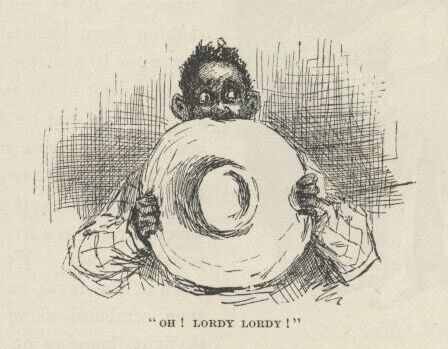
“Oh, my lordy, lordy! raf’’? Dey ain’ no raf’ no mo’; she done broke loose en gone I—en here we is!”
Children’s book – Mark Twain – Contents
< < < Chapter XI
Chapter XIII > > >
| If you liked this site, subscribe , put likes, write comments! Share on social networks |
- Poèmes et peinture, semaine du 8 mars 2026
- Poems and painting, Week of March 8, 2026
- Poèmes et peinture, semaine du 1er mars 2026
- Poems and painting, Week of March 1st, 2026
- Poèmes et peinture, semaine du 22 février 2026
- Poems and painting, Week of February 22, 2026
© 2023 Akirill.com – All Rights Reserved
 AKirill, Learn, apprenez, translation, traduction, livres bilingues, bilingual books