

Mark Twain
Children’s book – Mark Twain – Contents
< < < Chapter XVIII
Chapter XX > > >
Chapter XIX

Two or three days and nights went by; I reckon I might say they swum by, they slid along so quiet and smooth and lovely. Here is the way we put in the time. It was a monstrous big river down there—sometimes a mile and a half wide; we run nights, and laid up and hid daytimes; soon as night was most gone we stopped navigating and tied up—nearly always in the dead water under a towhead; and then cut young cottonwoods and willows, and hid the raft with them. Then we set out the lines. Next we slid into the river and had a swim, so as to freshen up and cool off; then we set down on the sandy bottom where the water was about knee deep, and watched the daylight come. Not a sound anywheres—perfectly still—just like the whole world was asleep, only sometimes the bullfrogs a-cluttering, maybe. The first thing to see, looking away over the water, was a kind of dull line—that was the woods on t’other side; you couldn’t make nothing else out; then a pale place in the sky; then more paleness spreading around; then the river softened up away off, and warn’t black any more, but gray; you could see little dark spots drifting along ever so far away—trading scows, and such things; and long black streaks—rafts; sometimes you could hear a sweep screaking; or jumbled up voices, it was so still, and sounds come so far; and by and by you could see a streak on the water which you know by the look of the streak that there’s a snag there in a swift current which breaks on it and makes that streak look that way; and you see the mist curl up off of the water, and the east reddens up, and the river, and you make out a log-cabin in the edge of the woods, away on the bank on t’other side of the river, being a woodyard, likely, and piled by them cheats so you can throw a dog through it anywheres; then the nice breeze springs up, and comes fanning you from over there, so cool and fresh and sweet to smell on account of the woods and the flowers; but sometimes not that way, because they’ve left dead fish laying around, gars and such, and they do get pretty rank; and next you’ve got the full day, and everything smiling in the sun, and the song-birds just going it!
A little smoke couldn’t be noticed now, so we would take some fish off of the lines and cook up a hot breakfast. And afterwards we would watch the lonesomeness of the river, and kind of lazy along, and by and by lazy off to sleep. Wake up by and by, and look to see what done it, and maybe see a steamboat coughing along up-stream, so far off towards the other side you couldn’t tell nothing about her only whether she was a stern-wheel or side-wheel; then for about an hour there wouldn’t be nothing to hear nor nothing to see—just solid lonesomeness. Next you’d see a raft sliding by, away off yonder, and maybe a galoot on it chopping, because they’re most always doing it on a raft; you’d see the axe flash and come down—you don’t hear nothing; you see that axe go up again, and by the time it’s above the man’s head then you hear the k’chunk!—it had took all that time to come over the water. So we would put in the day, lazying around, listening to the stillness. Once there was a thick fog, and the rafts and things that went by was beating tin pans so the steamboats wouldn’t run over them. A scow or a raft went by so close we could hear them talking and cussing and laughing—heard them plain; but we couldn’t see no sign of them; it made you feel crawly; it was like spirits carrying on that way in the air. Jim said he believed it was spirits; but I says:
“No; spirits wouldn’t say, ‘Dern the dern fog.’”
Soon as it was night out we shoved; when we got her out to about the middle we let her alone, and let her float wherever the current wanted her to; then we lit the pipes, and dangled our legs in the water, and talked about all kinds of things—we was always naked, day and night, whenever the mosquitoes would let us—the new clothes Buck’s folks made for me was too good to be comfortable, and besides I didn’t go much on clothes, nohow.
Sometimes we’d have that whole river all to ourselves for the longest time. Yonder was the banks and the islands, across the water; and maybe a spark—which was a candle in a cabin window; and sometimes on the water you could see a spark or two—on a raft or a scow, you know; and maybe you could hear a fiddle or a song coming over from one of them crafts. It’s lovely to live on a raft. We had the sky up there, all speckled with stars, and we used to lay on our backs and look up at them, and discuss about whether they was made or only just happened. Jim he allowed they was made, but I allowed they happened; I judged it would have took too long to make so many. Jim said the moon could a laid them; well, that looked kind of reasonable, so I didn’t say nothing against it, because I’ve seen a frog lay most as many, so of course it could be done. We used to watch the stars that fell, too, and see them streak down. Jim allowed they’d got spoiled and was hove out of the nest.
Once or twice of a night we would see a steamboat slipping along in the dark, and now and then she would belch a whole world of sparks up out of her chimbleys, and they would rain down in the river and look awful pretty; then she would turn a corner and her lights would wink out and her powwow shut off and leave the river still again; and by and by her waves would get to us, a long time after she was gone, and joggle the raft a bit, and after that you wouldn’t hear nothing for you couldn’t tell how long, except maybe frogs or something.
After midnight the people on shore went to bed, and then for two or three hours the shores was black—no more sparks in the cabin windows. These sparks was our clock—the first one that showed again meant morning was coming, so we hunted a place to hide and tie up right away.
One morning about daybreak I found a canoe and crossed over a chute to the main shore—it was only two hundred yards—and paddled about a mile up a crick amongst the cypress woods, to see if I couldn’t get some berries. Just as I was passing a place where a kind of a cowpath crossed the crick, here comes a couple of men tearing up the path as tight as they could foot it. I thought I was a goner, for whenever anybody was after anybody I judged it was me—or maybe Jim. I was about to dig out from there in a hurry, but they was pretty close to me then, and sung out and begged me to save their lives—said they hadn’t been doing nothing, and was being chased for it—said there was men and dogs a-coming. They wanted to jump right in, but I says:
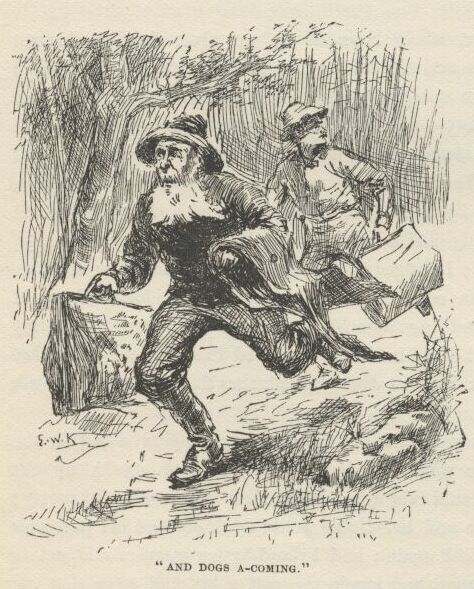
“Don’t you do it. I don’t hear the dogs and horses yet; you’ve got time to crowd through the brush and get up the crick a little ways; then you take to the water and wade down to me and get in—that’ll throw the dogs off the scent.”
They done it, and soon as they was aboard I lit out for our towhead, and in about five or ten minutes we heard the dogs and the men away off, shouting. We heard them come along towards the crick, but couldn’t see them; they seemed to stop and fool around a while; then, as we got further and further away all the time, we couldn’t hardly hear them at all; by the time we had left a mile of woods behind us and struck the river, everything was quiet, and we paddled over to the towhead and hid in the cottonwoods and was safe.
One of these fellows was about seventy or upwards, and had a bald head and very gray whiskers. He had an old battered-up slouch hat on, and a greasy blue woollen shirt, and ragged old blue jeans britches stuffed into his boot-tops, and home-knit galluses—no, he only had one. He had an old long-tailed blue jeans coat with slick brass buttons flung over his arm, and both of them had big, fat, ratty-looking carpet-bags.
The other fellow was about thirty, and dressed about as ornery. After breakfast we all laid off and talked, and the first thing that come out was that these chaps didn’t know one another.
“What got you into trouble?” says the baldhead to t’other chap.
“Well, I’d been selling an article to take the tartar off the teeth—and it does take it off, too, and generly the enamel along with it—but I stayed about one night longer than I ought to, and was just in the act of sliding out when I ran across you on the trail this side of town, and you told me they were coming, and begged me to help you to get off. So I told you I was expecting trouble myself, and would scatter out with you. That’s the whole yarn—what’s yourn?
“Well, I’d ben a-running’ a little temperance revival thar ’bout a week, and was the pet of the women folks, big and little, for I was makin’ it mighty warm for the rummies, I tell you, and takin’ as much as five or six dollars a night—ten cents a head, children and niggers free—and business a-growin’ all the time, when somehow or another a little report got around last night that I had a way of puttin’ in my time with a private jug on the sly. A nigger rousted me out this mornin’, and told me the people was getherin’ on the quiet with their dogs and horses, and they’d be along pretty soon and give me ’bout half an hour’s start, and then run me down if they could; and if they got me they’d tar and feather me and ride me on a rail, sure. I didn’t wait for no breakfast—I warn’t hungry.”
“Old man,” said the young one, “I reckon we might double-team it together; what do you think?”
“I ain’t undisposed. What’s your line—mainly?”
“Jour printer by trade; do a little in patent medicines; theater-actor—tragedy, you know; take a turn to mesmerism and phrenology when there’s a chance; teach singing-geography school for a change; sling a lecture sometimes—oh, I do lots of things—most anything that comes handy, so it ain’t work. What’s your lay?”
“I’ve done considerble in the doctoring way in my time. Layin’ on o’ hands is my best holt—for cancer and paralysis, and sich things; and I k’n tell a fortune pretty good when I’ve got somebody along to find out the facts for me. Preachin’s my line, too, and workin’ camp-meetin’s, and missionaryin’ around.”
Nobody never said anything for a while; then the young man hove a sigh and says:
“Alas!”
“What ’re you alassin’ about?” says the bald-head.
“To think I should have lived to be leading such a life, and be degraded down into such company.” And he begun to wipe the corner of his eye with a rag.
“Dern your skin, ain’t the company good enough for you?” says the baldhead, pretty pert and uppish.
“Yes, it is good enough for me; it’s as good as I deserve; for who fetched me so low when I was so high? I did myself. I don’t blame you, gentlemen—far from it; I don’t blame anybody. I deserve it all. Let the cold world do its worst; one thing I know—there’s a grave somewhere for me. The world may go on just as it’s always done, and take everything from me—loved ones, property, everything; but it can’t take that. Some day I’ll lie down in it and forget it all, and my poor broken heart will be at rest.” He went on a-wiping.
“Drot your pore broken heart,” says the baldhead; “what are you heaving your pore broken heart at us f’r? we hain’t done nothing.”
“No, I know you haven’t. I ain’t blaming you, gentlemen. I brought myself down—yes, I did it myself. It’s right I should suffer—perfectly right—I don’t make any moan.”
“Brought you down from whar? Whar was you brought down from?”
“Ah, you would not believe me; the world never believes—let it pass—’tis no matter. The secret of my birth—”
“The secret of your birth! Do you mean to say—”
“Gentlemen,” says the young man, very solemn, “I will reveal it to you, for I feel I may have confidence in you. By rights I am a duke!”
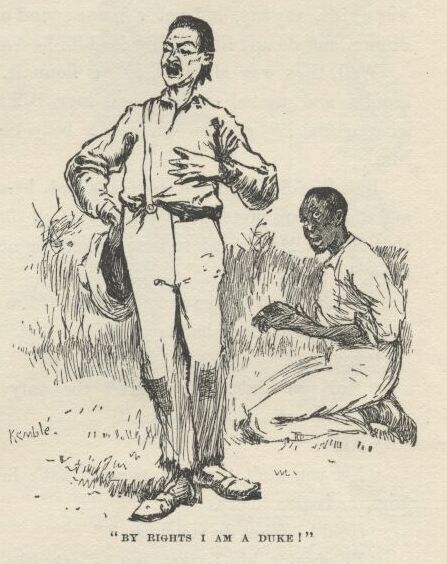
Jim’s eyes bugged out when he heard that; and I reckon mine did, too. Then the baldhead says: “No! you can’t mean it?”
“Yes. My great-grandfather, eldest son of the Duke of Bridgewater, fled to this country about the end of the last century, to breathe the pure air of freedom; married here, and died, leaving a son, his own father dying about the same time. The second son of the late duke seized the titles and estates—the infant real duke was ignored. I am the lineal descendant of that infant—I am the rightful Duke of Bridgewater; and here am I, forlorn, torn from my high estate, hunted of men, despised by the cold world, ragged, worn, heart-broken, and degraded to the companionship of felons on a raft!”
Jim pitied him ever so much, and so did I. We tried to comfort him, but he said it warn’t much use, he couldn’t be much comforted; said if we was a mind to acknowledge him, that would do him more good than most anything else; so we said we would, if he would tell us how. He said we ought to bow when we spoke to him, and say “Your Grace,” or “My Lord,” or “Your Lordship”—and he wouldn’t mind it if we called him plain “Bridgewater,” which, he said, was a title anyway, and not a name; and one of us ought to wait on him at dinner, and do any little thing for him he wanted done.
Well, that was all easy, so we done it. All through dinner Jim stood around and waited on him, and says, “Will yo’ Grace have some o’ dis or some o’ dat?” and so on, and a body could see it was mighty pleasing to him.
But the old man got pretty silent by and by—didn’t have much to say, and didn’t look pretty comfortable over all that petting that was going on around that duke. He seemed to have something on his mind. So, along in the afternoon, he says:
“Looky here, Bilgewater,” he says, “I’m nation sorry for you, but you ain’t the only person that’s had troubles like that.”
“No?”
“No you ain’t. You ain’t the only person that’s ben snaked down wrongfully out’n a high place.”
“Alas!”
“No, you ain’t the only person that’s had a secret of his birth.” And, by jings, he begins to cry.
“Hold! What do you mean?”
“Bilgewater, kin I trust you?” says the old man, still sort of sobbing.
“To the bitter death!” He took the old man by the hand and squeezed it, and says, “That secret of your being: speak!”
“Bilgewater, I am the late Dauphin!”
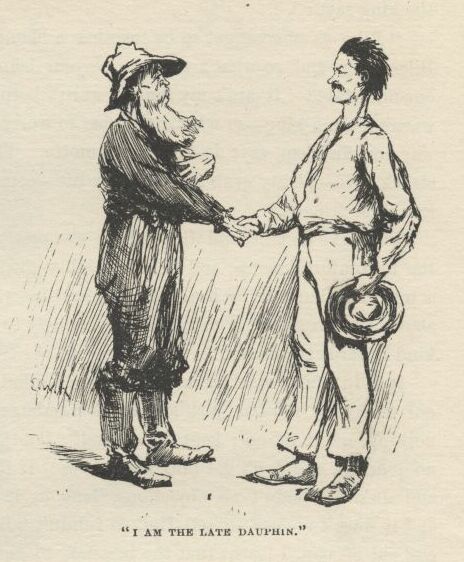
You bet you, Jim and me stared this time. Then the duke says:
“You are what?”
“Yes, my friend, it is too true—your eyes is lookin’ at this very moment on the pore disappeared Dauphin, Looy the Seventeen, son of Looy the Sixteen and Marry Antonette.”
“You! At your age! No! You mean you’re the late Charlemagne; you must be six or seven hundred years old, at the very least.”
“Trouble has done it, Bilgewater, trouble has done it; trouble has brung these gray hairs and this premature balditude. Yes, gentlemen, you see before you, in blue jeans and misery, the wanderin’, exiled, trampled-on, and sufferin’ rightful King of France.”
Well, he cried and took on so that me and Jim didn’t know hardly what to do, we was so sorry—and so glad and proud we’d got him with us, too. So we set in, like we done before with the duke, and tried to comfort him. But he said it warn’t no use, nothing but to be dead and done with it all could do him any good; though he said it often made him feel easier and better for a while if people treated him according to his rights, and got down on one knee to speak to him, and always called him “Your Majesty,” and waited on him first at meals, and didn’t set down in his presence till he asked them. So Jim and me set to majestying him, and doing this and that and t’other for him, and standing up till he told us we might set down. This done him heaps of good, and so he got cheerful and comfortable. But the duke kind of soured on him, and didn’t look a bit satisfied with the way things was going; still, the king acted real friendly towards him, and said the duke’s great-grandfather and all the other Dukes of Bilgewater was a good deal thought of by his father, and was allowed to come to the palace considerable; but the duke stayed huffy a good while, till by and by the king says:
“Like as not we got to be together a blamed long time on this h-yer raft, Bilgewater, and so what’s the use o’ your bein’ sour? It ’ll only make things oncomfortable. It ain’t my fault I warn’t born a duke, it ain’t your fault you warn’t born a king—so what’s the use to worry? Make the best o’ things the way you find ’em, says I—that’s my motto. This ain’t no bad thing that we’ve struck here—plenty grub and an easy life—come, give us your hand, duke, and le’s all be friends.”
The duke done it, and Jim and me was pretty glad to see it. It took away all the uncomfortableness and we felt mighty good over it, because it would a been a miserable business to have any unfriendliness on the raft; for what you want, above all things, on a raft, is for everybody to be satisfied, and feel right and kind towards the others.
It didn’t take me long to make up my mind that these liars warn’t no kings nor dukes at all, but just low-down humbugs and frauds. But I never said nothing, never let on; kept it to myself; it’s the best way; then you don’t have no quarrels, and don’t get into no trouble. If they wanted us to call them kings and dukes, I hadn’t no objections, ’long as it would keep peace in the family; and it warn’t no use to tell Jim, so I didn’t tell him. If I never learnt nothing else out of pap, I learnt that the best way to get along with his kind of people is to let them have their own way.
Children’s book – Mark Twain – Contents
< < < Chapter XVIII
Chapter XX > > >
| If you liked this site, subscribe , put likes, write comments! Share on social networks |
- Oh Pacha … et quelques photos de nos oiseaux secourus
- Oh Pacha … and a few pictures of our rescued birds
- Vidéo courte et photos de Teash et Pacha, notre corbeau et notre corneille secourus.
- Short video and pictures of Teash and Pacha our rescued crow and raven
- Photos de Teash notre corneille secourue
- Pictures of Teash our rescued crow
© 2023 Akirill.com – All Rights Reserved

