

French Literature – Children Books – Émile Zola – His Excellency Eugène Rougon – Contents
< < < The Fortune of the Rougons by Émile Zola
Chapter II > > >
1876
Les Rougon-Macquart
Order advised by Émile Zola: 2
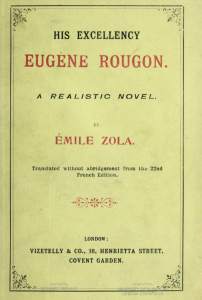
HIS EXCELLENCY
CHAPTER I
THE CORPS LÉGISLATIF
For a moment the President remained standing amidst the slight commotion which his entrance had caused. Then he took his seat, saying carelessly and in an undertone: ‘The sitting has commenced.’
He next began to arrange the legislative bills lying upon the desk in front of him. On his left, a short-sighted clerk, with his nose close to the paper he held, read the minutes of the previous sitting in a rapid and confused manner, none of the deputies paying attention to him. In the buzzing noise that filled the Chamber, these minutes were only heard by the ushers, who maintained a very dignified and decorous bearing which contrasted with the lounging attitudes of the deputies.
There were not a hundred members present. Some were reclining in their red velvet-covered seats, with listless eyes, already half-asleep. Others, leaning over their desks, as though wearied by the compulsory labour of a public sitting, were beating a gentle tattoo on the mahogany with their finger-tips. Through the ceiling-window, which revealed a crescent of grey sky, the light of a rainy May afternoon streamed down perpendicularly upon the pompous severity of the Chamber. It spread over the desks in a sheet of gloomy ruddiness, brightening into a rosy glow here and there where some seat remained unoccupied; while, behind the President, the statues and sculpture-work showed in clear white patches.
One of the deputies on the third row to the right still remained standing in the narrow passage between the seats. He was rubbing his rough fringe of grizzly beard with a thoughtful air, but as an usher came by, he stopped him and asked a question in an undertone.
‘No, Monsieur Kahn,’ replied the usher, ‘the President of the Council of State has not yet arrived.’
M. Kahn thereupon sat down, and, abruptly turning to his neighbour on the left, inquired, ‘Tell me, Béjuin, have you seen Rougon this morning?’
M. Béjuin, a small, thin man of dark complexion and silent demeanour, raised his head nervously as though his thoughts were altogether elsewhere. He had drawn out the slide of his desk, and was writing a letter on some blue paper with a business heading formed of these words: ‘Béjuin and Co. The Saint-Florent Cut-Glass Works.’
‘Rougon?’ he repeated. ‘No, I haven’t seen him. I did not have time to go over to the State Council.’
Then he quietly reverted to his work, consulting a memorandum-book, and beginning a second letter, amidst the confused buzzing murmur of the clerk, who was finishing his reading of the minutes.
M. Kahn leant back in his seat and crossed his arms. He had a face with strongly marked features, and his big but well-shaped nose testified to a Jewish descent. He seemed out of sorts. He gazed upwards at the gilt rose-work on the ceiling and listened to the plashing of a shower which at that moment burst down upon the skylight; and then with vaguely wondering eyes he seemed to be examining the intricate ornamentation of the great wall in front of him. His glance lingered for a few seconds upon two panels hung with green velvet and decked with gilt borders and emblems. Then, after he had scanned the columns between which allegorical statues of Liberty and Public Order showed their marble faces and pupil-less eyes, his attention was turned to a curtain of green silk which concealed a fresco representing King Louis Philippe taking the oath to the Constitution.
By this time the clerk had sat down; nevertheless, the scene remained one of noisy confusion. The President was still leisurely arranging his papers. He again and again pressed his hand on his bell, but its loud ringing failed to check any of the private conversations that were going on. However, he at last stood up amidst all the hubbub and for a moment remained waiting and silent.
‘Gentlemen,’ he began, ‘I have received a letter——’ Then he stopped short to ring his bell again, and once more kept silent, his grave, bored face looking down from the monumental desk which spread out beneath him with panels of red marble bordered with white. His frock-coat, which was buttoned up, showed conspicuously against the bas-relief behind him, rising like a black bar between the peplum-robed figures of Agriculture and Industry with antique profiles.
‘Gentlemen,’ he resumed, when he had succeeded in obtaining something like silence, ‘I have received a letter from Monsieur de Lamberthon, in which he apologises for not being able to attend to-day’s sitting.’
At this a laugh resounded on the sixth row of seats in front of the desk. It came from a deputy who could not have been more than twenty-eight years old. He was fair and effeminately pretty, and was trying with his white hands to stifle an outburst of girlish rippling laughter. One of his colleagues, a man of huge build, came up to him and whispered in his ear: ‘Is it really true that Lamberthon has found his wife? Tell me all about it, La Rouquette.’
The President, however, had taken up a handful of papers. He was speaking in monotonous tones, and stray fragments of sentences reached the far end of the Chamber. ‘There are applications for leave of absence from Monsieur Blachet, Monsieur Buquin-Lecomte, Monsieur de la Villardière—’
While the Chamber was granting these different requests, M. Kahn, who had probably grown weary of examining the green silk curtain stretched before the seditious portrait of Louis Philippe, turned to glance at the galleries. Above the wall of yellow marble veined with lake red, there was a gallery with hand-rests of amaranthine velvet spanning the spaces from one column to another; and higher up a mantle of embossed leather failed to conceal the gaps left by the suppression of a second tier of seats which had been assigned to journalists and the general public previous to the Empire. The narrow, gloomy boxes between the massive yellowish marble pillars, which stood in somewhat heavy splendour round the semicircle, were for the most part empty, although here and there they were brightened by the light-tinted toilettes of some ladies.
‘Ah! so Colonel Jobelin has come!’ murmured M. Kahn.
And forthwith he smiled at the colonel, who had perceived him. Colonel Jobelin was wearing the dark-blue frock-coat which he had adopted as a kind of civilian uniform ever since his retirement from the service. He sat quite alone in the questors’ gallery, and his rosette as an officer of the Legion of Honour was so large as to look almost like the bow of a cravat.
But M. Kahn’s eyes had already strayed to a young man and woman who were nestling in a corner of the gallery of the Council of State. The young man was continually bending his head and whispering to the young woman, who smiled with a gentle air, but did not turn to look at him, her eyes being fixed upon the allegorical figure of Public Order.
‘I say, Béjuin,’ M. Kahn remarked, nudging his colleague with his knee.
M. Béjuin, who was now busy with his fifth letter, again raised his head with an expression of absent-mindedness.
‘Look up there,’ continued M. Kahn; ‘don’t you see little Escorailles and pretty Madame Bouchard? I’ll be bound he’s making love to her. What eyes she’s got! All Rougon’s friends seem to have made a point of coming to-day. There’s Madame Correur and the Charbonnels up there in the public gallery.’
However, the bell sounded again for some moments, and an usher called out in a fine bass voice: ‘Silence, gentlemen!’
Then the deputies began to listen, and the President spoke the following words, not a syllable of which was lost: ‘Monsieur Kahn asks permission to publish the speech which he delivered on the bill for the establishment of a municipal tax upon vehicles and horses in Paris.’
A murmur ran along the benches, and then the different conversations were resumed. Quitting his own place, M. La Rouquette came and sat down near M. Kahn. ‘So you work for the people, eh?’ he said playfully, and, without waiting for a reply, he added: ‘You haven’t seen or heard anything of Rougon, have you? Everyone is talking about the matter, but it seems that nothing is definitely settled yet.’ Then he turned round and glanced at the clock. ‘Twenty minutes past two already!’ he exclaimed. ‘Well, I should certainly be off now, if it were not for the reading of that confounded report. Is it really to come off to-day?’
‘We have all been notified to that effect,’ M. Kahn replied, ‘and I have heard nothing of any change of plans. You had better remain. The 400,000 francs[1] for the baptism will be voted straight off.’
‘No doubt,’ said La Rouquette. ‘Old General Legrain, who has lost the use of both legs, has had himself carried here by his servant, and is now in the Conference Hall waiting till the vote comes on. The Emperor is quite right in reckoning upon the devotion of the whole Corps Législatif. All our votes ought to be given him upon this solemn occasion.’
While speaking the young deputy did his utmost to assume the expression of a serious politician. His doll-like face, which was ornamented by a few pale hairs, wagged gravely over his collar, and he seemed to be relishing the flavour of the two last sentences he had uttered—sentences which he had remembered from somebody else’s speech. Then he suddenly broke into a laugh. ‘Good gracious!’ he exclaimed, ‘what frights those Charbonnels are!’
M. Kahn and himself thereupon began to make merry at the Charbonnels’ expense. The wife was wearing an outrageous yellow shawl, and her husband sported a country-cut frock-coat which looked as though it had been hewn into shape with an axe. They were both very short, stout and red, and were eagerly pressing forward, with their chins almost resting upon the balustrade of the gallery in order to get a better view of the proceedings, which, judging by their blank, staring eyes, were utterly unintelligible to them.
‘If Rougon gets the sack,’ said La Rouquette, ‘I wouldn’t give a couple of sous for the Charbonnels’ case. It will be just the same with Madame Correur.’ Then he inclined his head towards M. Kahn’s ear, and continued in a very low tone: ‘You, now, who know Rougon, just tell me who and what that Madame Correur is. She formerly kept a lodging-house, didn’t she? Rougon used to lodge with her, and it is even said that she lent him money. What does she do now?’
M. Kahn assumed a very grave expression and slowly rubbed his beard. ‘Madame Correur is a highly respectable lady,’ he replied curtly.
This answer checked La Rouquette’s curiosity. He bit his lips with the expression of a school-boy who has just been lectured. For a moment they both looked in silence at Madame Correur, who was sitting near the Charbonnels. She was wearing a very showy dress of mauve silk, with a profusion of lace and ornaments. Her face showed too much colour, her forehead was covered with little fair dollish curls, and her plump neck, still very comely in spite of her eight-and-forty years, was fully exposed to view.
Just at this moment, however, the sudden sound of a door opening and a rustle of skirts at the far end of the Chamber caused all heads to turn. A tall girl exquisitely beautiful, but strangely dressed in an ill-made sea-green satin gown, had entered the box assigned to the diplomatic body, followed by an elderly lady in black.
‘Ah! there’s the fair Clorinde!’ said M. La Rouquette, who had risen to bow at random.
M. Kahn had also risen; but he stooped towards M. Béjuin, who was now enclosing his letters in envelopes: ‘Countess Balbi and her daughter are there,’ he said. ‘I am going up to ask them if they have seen Rougon.’
The President meanwhile had taken a fresh handful of papers from his desk. Without ceasing his perusal of them he cast a glance at the beautiful Clorinde Balbi, whose arrival had given rise to a buzz of comments in the Chamber. Then, while he passed the papers one by one to a clerk, he said in monotonous tones, never even pausing to punctuate his words: ‘Presentation of a bill to continue certain extra duties in the town of Lille … of a bill to unite into one single commune the communes of Doulevant-le-Petit and Ville-en-Blaisais (Haute-Marne)——’
When M. Kahn came back again he seemed quite disconsolate. ‘Really, no one appears to have seen anything of him,’ he said to his colleagues, Béjuin and La Rouquette, whom he met at the foot of the semicircle. ‘I hear that the Emperor sent for him yesterday evening, but I haven’t been able to learn the result of their interview. There is nothing so provoking as being unable to get a satisfactory account of what happens.’
La Rouquette turned round and whispered into M. Béjuin’s ear: ‘Poor Kahn is terribly afraid lest Rougon should get into disfavour at the Tuileries. He might fish for his railway if that should occur.’
In reply M. Béjuin, who was of a taciturn disposition, said very gravely: ‘The day when Rougon retires from the Council of State, we shall all be losers.’ Then he beckoned to one of the ushers and gave him the letters which he had just written, to post.
The three deputies remained standing on the left of the President’s desk, discreetly discussing the disfavour with which Rougon was threatened. It was an intricate story. A distant relation of the Empress, one Señor Rodriguez, had been claiming a sum of two million francs from the French Government since the year 1808. During the war with Spain, a vessel freighted with sugar and coffee, and belonging to this Rodriguez, who was a shipowner, had been taken in the Bay of Biscay by a French frigate, the Vigilante, and brought to Brest. Acting upon information received from a local commission, the administrative officials had declared the capture to be a valid one, without referring the matter to the Prize Committee. Rodriguez, however, had promptly appealed to the Council of State, and, after his death, his son, under every successive Government, had vainly tried to bring the matter to an issue until the day came when a word from his distant cousin, Eugénie de Montijo, now all-powerful, had secured the insertion of his action in the official cause list.
Of this the three deputies talked, while the President’s monotonous voice still resounded above their heads: ‘Presentation of a bill authorising the department of Calvados to borrow 300,000 francs … of a bill authorising the town of Amiens to borrow 200,000 francs for the purpose of making new promenades … of a bill authorising the department of Côtes-du-Nord to borrow 345,000 francs to cover the deficiencies in the revenues of the last five years.’
‘The truth is,’ said M. Kahn, again lowering his voice, ‘that this Rodriguez had a very artful method of managing his business. He and a son-in-law of his, residing at New York, were the owners of vessels which sailed either under the American flag or the Spanish, according as one or the other might subject them to the least risk during their passage. Rougon told me that the captured vessel was exclusively the property of Rodriguez, and that there is no valid ground whatever for the claims that are made.’
‘And then,’ interposed M. Béjuin, ‘the steps that were taken by the officials cannot be impugned. The administrative officer at Brest was perfectly right in declaring the capture a valid one in accordance with the customs of the port, without referring the matter to the Prize Committee.’
Then they lapsed into silence for a moment while La Rouquette, with his back resting against the marble wall, raised his head, and tried to attract the attention of the fair Clorinde. ‘But,’ he asked naïvely, ‘why does Rougon object to the two millions being paid to Rodriguez? What difference would it make to him?’
‘It is a matter of conscience,’ said M. Kahn solemnly.
M. La Rouquette glanced at his colleagues one after the other, but, seeing them both so grave, he did not even venture to smile.
‘Then, too,’ continued M. Kahn, as though he were dwelling upon some thought which he had not expressed aloud, ‘Rougon has had a good deal of bother since Marsy has been Minister of the Interior. They have never been able to get on together. Rougon himself told me that, if it had not been for his attachment to the Emperor, for whom he has already done so much, he would long ago have retired into private life. He no longer seems welcome at the Tuileries, and he feels that a change has become necessary for him.’
‘He is acting like an honourable man,’ remarked M. Béjuin.
‘Yes, indeed,’ said M. La Rouquette, with a wise look, ‘if he wants to retire, the opportunity is a good one. All the same, his friends will be greatly grieved. Just look at the colonel up there, with his anxious face! He has been hoping to fasten the ribbon of Commander of the Legion of Honour round his neck on the 15th of next August. And pretty Madame Bouchard, too, swore that worthy Monsieur Bouchard should be head of department at the Ministry of the Interior before six months were over. Little Escorailles, Rougon’s pet, was to put the nomination under Monsieur Bouchard’s napkin on Madame’s birthday. But where have they got to, pretty Madame Bouchard and little Escorailles?’
The three deputies looked about for them, and at last discovered them ensconced at the back of the gallery, in the front part of which they had been seated at the opening of the sitting. They had taken refuge in the gloom there behind a bald old gentleman, and were both very quiet, though very red.
However, the President was now coming to the end of his reading.
‘A bill,’ said he, ‘to sanction an increase in the rate of interest upon a loan authorised by an Act of the 9th of June, 1853, and to impose an extraordinary rate in the department of La Manche.’
Just then M. Kahn ran forward to meet a deputy who was entering the Chamber, and as he brought him along he exclaimed, ‘Here is Monsieur de Combelot. He will give us some news.’
M. de Combelot, an imperial chamberlain whom the department of the Landes had chosen as deputy upon the formally expressed desire of the Emperor, bowed with a discreet air while waiting to be questioned. He was a tall, handsome man, with a very white skin, and an inky black beard which had been the means of winning him great favour among the ladies.
‘Well,’ asked M. Kahn, ‘what do they say at the Tuileries? What has the Emperor decided upon?’
‘Well, indeed,’ replied M. de Combelot in a guttural tone, ‘they say a good many things. The Emperor has the warmest friendship for the President of the Council of State. Their interview was undoubtedly of the most cordial nature. Yes, indeed, most cordial.’
Then he stopped, after carefully weighing his words, as it were, so as to satisfy himself that he had not said too much.
‘Then the resignation is withdrawn?’ asked M. Kahn, with glistening eyes.
‘I did not say that,’ replied the chamberlain, uneasily. ‘I know nothing about it. You understand that my position is a peculiar one——’
He did not finish what he was going to say, but contented himself with smiling, and then hurried off to take his seat. M. Kahn shrugged his shoulders, and remarked to M. La Rouquette, ‘But you, surely, ought to be posted on what is going on. Doesn’t your sister, Madame de Llorentz, give you any information?’
‘Oh, my sister is even more reserved than Monsieur de Combelot,’ replied the young deputy, with a laugh. ‘Since she has become one of the ladies-in-waiting, she has put on quite a minister’s gravity; though yesterday, indeed, she assured me that the resignation would be accepted. By the way, I can tell you a funny story in connection with this matter. It appears that some lady was sent to Rougon to try to influence him. Now, you would never guess what Rougon did! He turned her out of doors, although she was a delicious creature!’
‘Rougon is a very steady fellow,’ M. Béjuin declared solemnly.
M. La Rouquette shook with laughter, and, protesting against M. Béjuin’s estimate of Rougon, asserted that he could have disproved it by evidence had he chosen. ‘And so, Madame Correur, for instance,’ said he.
‘Pooh! you don’t know the truth of that story,’ replied M. Kahn.
‘And the fair Clorinde?’
‘Nonsense, nonsense! Rougon is much too clever a fellow to forget himself with such a wild creature as that!’
Then the three men drew closer, and talked on without any mincing of words. They repeated the stories which were told about those two Italian women—mother and daughter—who were semi-adventuresses and semi-great ladies, and were to be met everywhere, at all parties and gatherings, at the houses of state ministers, in the stage-boxes of minor theatres, on the sands at fashionable watering-places, and even in out-of-the-way hostelries. The mother, it was said, had been the mistress of a royal personage; and the daughter, with an ignorance of French customs and etiquette which had earned her the reputation of being an eccentric, badly brought-up wench, galloped about on horseback till she foundered her mounts, made a display of her dirty stockings and damaged boots on rainy days, and looked around her for a husband with the boldest of smiles. M. La Rouquette told how she had come one night to a ball at the Sardinian Minister’s, in the character of the huntress Diana, with so scanty a costume that she had been all but asked in marriage the next morning by old Monsieur de Nougarède, a profligate senator. During the narration of this story, the three deputies cast frequent glances at the fair Clorinde, who, in spite of the regulations, was examining the members of the Chamber one after another through a large pair of opera-glasses.
‘No, no!’ M. Kahn repeated, ‘Rougon would never be such a fool! He says, though, that she is very intelligent, and he has nicknamed her “Mademoiselle Machiavelli.” She amuses him, but that’s all.’
‘At the same time Rougon is wrong in not marrying,’ said M. Béjuin. ‘It settles a man.’
Then they all three set to work to discuss the sort of woman that it was desirable Rougon should marry. She ought to be a woman of some age, thirty-five at the least, they said, rich, and competent to maintain her house on a footing of high decorum.
Hubbub still prevailed in the Chamber, and the three deputies became so absorbed in the stories they were telling, that they ceased to notice what was taking place around them. Away in the distance, the voices of ushers could be faintly heard calling out, ‘To the sitting, gentlemen, to the sitting.’
Fresh deputies were entering from all sides by way of the folding doors of massive mahogany, whose panels gleamed with golden stars. The Chamber, previously half empty, was now gradually filling. The little scattered groups of members talking to each other from one row of seats to another, with an expression of weariness on their faces, or dozing, or trying to conceal their yawns, were now disappearing amid the increasing crowd and general shaking of hands. As the members took their seats, they exchanged smiles; there was a general, almost family likeness about them. By the expression of their faces one and all seemed impressed by the duties they had to fulfil. A stout man, on the last row to the left, had fallen asleep, but was awakened by his neighbour; and, when the latter whispered a few words in his ear, he hastily rubbed his eyes, and assumed a more decorous attitude. The sitting, after dragging on wearily through a series of petty tedious details, was at last about to become supremely interesting.
M. Kahn and his two colleagues were being gradually driven towards their seats by the increasing crowd, almost without being aware of it. They went on with their conversation, every now and then suppressing a laugh. M. La Rouquette began a fresh story about the fair Clorinde. She had taken a strange whim into her head one day, he said; it was to have her room hung with black, spangled with silver tears, and to hold a reception of her friends there; she herself lying in bed, covered up with black drapery which allowed scarcely anything more than her nose to appear.
As M. Kahn at last took his seat, his memory suddenly returned to him. ‘La Rouquette is a foolish chatterbox,’ he muttered; ‘he has made me miss Rougon.’ Then he turned towards his neighbour and exclaimed angrily. ‘You really might have reminded me, Béjuin!’
Rougon, who had just been introduced with the customary ceremonial, had already taken his seat between two members of the Council of State on the Government bench, a sort of huge mahogany box, situated beneath the President’s desk and occupying the place of the suppressed tribune. His broad shoulders tightly distended his uniform of green cloth, ornamented with gold braid at the neck and sleeve-cuffs. His face, with thick grizzly hair clustering over his square brow, was turned towards the Chamber, but his eyes were hidden by their heavy drooping lids. The commonplace plainness of his big nose, fleshy lips, and long cheeks, which his six-and-forty years had not yet furrowed with a single wrinkle, was every now and then irradiated with something like beauty by an expression of great strength. He sat perfectly quiet, leaning back with his chin resting on his coat collar, noticing nobody, and seeming quite indifferent and a little weary.
‘He looks just as he does every day,’ M. Béjuin remarked.
The deputies were all leaning over to observe Rougon. Whispered remarks on his appearance buzzed from ear to ear. In the galleries especially his entrance had caused lively excitement. The Charbonnels, in their desire to let their presence be known, craned their enraptured faces forward at the risk of falling over; Madame Correur coughed slightly and drew out a handkerchief which she gently waved, while pretending to carry it to her lips; Colonel Jobelin straightened himself; and pretty Madame Bouchard, after tying her bonnet-strings afresh, again hurried down to the front row of the State Council gallery, while M. d’Escorailles remained behind quite still and seemingly much annoyed. As for the fair Clorinde, she did not beat about the bush. Seeing that Rougon did not raise his eyes, she began to tap her opera-glass against the marble column beside which she was leaning, and as these tactics did not succeed in attracting his attention, she said to her mother, in such a clear ringing voice that every one in the Chamber heard her: ‘He’s in the sulks, the fat sly fellow!’
Several deputies looked round and smiled, and Rougon himself glanced up at the fair Clorinde. As he nodded his head almost imperceptibly towards her, she triumphantly clapped her hands, and leant back, laughing and talking quite loudly to her mother, quite careless of the men down below who were staring at her.
Before Rougon dropped his eyes again he glanced slowly round the gallery, where his comprehensive gaze at once took in Madame Bouchard, Colonel Jobelin, Madame Correur, and the Charbonnels. However, his face remained expressionless. He again let his chin drop and half-closed his eyes as he stifled a slight yawn.
‘I’ll go and have a word with him now,’ M. Kahn whispered into M. Béjuin’s ear.
But as he was rising from his seat, the President, who during the last few moments had been looking round to see if all the deputies were in their places, rang his bell authoritatively. Then all at once there was profound silence. A fair-haired member in the first row of seats now stood up, holding a large sheet of paper upon which he kept his eyes fixed as he spoke.
‘I have the honour,’ he said in a sing-song voice, ‘to present a report upon the bill by which it is proposed to include among the estimates of the Ministry of State for 1856 a sum of 400,000 francs, to defray the expenses of the ceremonies and rejoicings connected with the baptism of the Prince Imperial.’
Then he slowly stepped forward as though about to lay the paper on the table of the Chamber, but the deputies cried out unanimously: ‘Read it! Read it!’
The deputy who had prepared the report waited till the President gave his sanction. Then he commenced in a voice that seemed affected by emotion: ‘Gentlemen, the bill which has been brought before us is one of those which make the customary formalities of voting seem dilatory, since they check the enthusiastic impulses of the Corps Législatif.’
‘Hear! hear!’ cried several members.
‘In the humblest families,’ continued the speaker in carefully modulated tones, ‘the birth of a son and heir, with all the ideas of transmission which are attached to that title, is a source of such sweet joy that the trials of the past are forgotten, and hope alone hovers over the cradle of the new-born child. What, then, shall we say of such a happy event when it not only prompts the rejoicing of a family but that of a great nation, and is an event of European interest?’
This piece of rhetoric thrilled the Chamber with emotion. Rougon, who appeared to be asleep, could see none but beaming faces in front of him. Some deputies accentuated their attention, holding their hands to their ears so that they might lose nothing of this carefully prepared report. Its author, after a slight pause, raised his voice as he continued, ‘To-day, gentlemen, it is indeed the great family of France that invites all its members to give expression to their joy; and what pomp and circumstance would be magnificent enough if it were possible by display to express the grandeur of our legitimate hopes?’ Here the reporter paused again.
‘Hear! hear!’ cried the deputies.
‘That’s very nicely put,’ M. Kahn remarked; ‘isn’t it, Béjuin?’
M. Béjuin was wagging his head with his eyes fixed on the cut-glass chandelier which hung from the window-ceiling in front of the President’s seat. He was in a state of blissful rapture.
Meanwhile in the gallery the fair Clorinde kept her opera-glass to her eyes and lost not a single expression of the reporter’s face. The Charbonnels’ eyes were moist, and Madame Correur had assumed a decorously attentive attitude, while the colonel expressed his approbation by nodding his head, and pretty Madame Bouchard ventured to lean against M. d’Escorailles’ knees. The President and the clerk and the ushers listened solemnly, without making the slightest gesture.
‘The cradle of the Prince Imperial,’ resumed the reporter, ‘is henceforth our security for the future; for, by perpetuating the dynasty which we have all acclaimed, it assures the prosperity of our country, its repose and stability, and, through ours, that of the rest of Europe.’
Cries of ‘Hush! hush!’ were necessary to subdue the burst of enthusiastic applause which broke out at this touching reference to the cradle.
‘Once before a scion of this illustrious race seemed equally intended for a great destiny, but his time and our own have no similarity. Peace is the result of the wise and skilful rule of which we are now reaping the fruits, even as the genius of war dictated that epic poem which forms the story of the first Empire.
‘Hailed at his birth by the guns which from north to south proclaimed the successes of our arms, the King of Rome was not even permitted to serve his country; so, indeed, Providence then decreed——’
‘What’s that he’s saying? He’s putting his foot in it,’ said sceptical M. La Rouquette. ‘That’s very clumsy; he’ll spoil his speech.’
The deputies certainly seemed uneasy. Why was this historical reference dragged in to damp their enthusiasm? Several of them blew their noses. The author of the report, however, only smiled when he saw the chilling effect of his last sentences. He raised his voice and pursued his antithesis, carefully modulating his tones, evidently quite confident that he would make his point.
‘But, coming to us at one of those momentous times when the birth of a single life may be regarded as the salvation of all, the Child of France to-day gives to us and to all future generations the right and the privilege of living and dying at our ancestral firesides. Such is the promise vouchsafed to us by the divine kindness.’
This seemed exquisite. Everybody understood, and a murmur of pleasure travelled through the Chamber. The assurance of an everlasting peace was very charming. The tranquillised members once more resumed the pleased expressions of men revelling in rhetoric. There was nothing to disturb them. Europe belonged to their master.
‘The Emperor,’ continued the speaker with fresh vigour, ‘having become the arbiter of Europe, was about to sign that noble peace which, bringing together the productive forces of the different nations, is as much an alliance of peoples as of monarchs,[2] when God was pleased to crown his happiness as well as his glory. Is it not allowable to think that, at that moment, he foresaw many fair and prosperous years while gazing upon that cradle where slumbers, though now but an infant, the heir who is destined to carry on his great policy?’
This, too, was thought very pretty. Such a hope might be justifiably entertained, so the deputies said, as they nodded their heads approvingly. The report, however, was now beginning to seem a trifle long, and several members looked solemn again. Some of them even glanced at the gallery like practical matter-of-fact politicians who felt rather ashamed of being thus seen spending their time in an unbusiness-like way. Others ceased to pay attention, and reverted to their own affairs, or again tapped the mahogany of their desks with their finger-tips; while through the minds of others there flitted vague recollections of other sittings when professions of devotion had been lavished on some other cradle.
As for M. La Rouquette, he turned very frequently to look at the clock, and when the hand pointed to a quarter to three an expression of desperation passed over his face. He would miss an appointment! Meantime M. Kahn and M. Béjuin sat motionless side by side, with crossed arms and blinking eyes, which wandered from the great velvet panels to the bas-relief of white marble across which the President’s frock-coat stretched like a black bar. In the diplomatists’ gallery the fair Clorinde was still gazing through her opera-glass, making a lengthy examination of Rougon, who preserved the majestic mien of a sleeping bull.
However, the author of the report showed no signs of hurry, but listened to himself as he read on, indulging the while in a rhythmic beatifical motion of the shoulders.
‘Let us then display full and complete confidence, and may the Corps Législatif, upon this great and solemn occasion, bear in mind that the Emperor and itself have a common origin, which almost confers upon it a family-right above that which the other State bodies may possess to share in its Sovereign’s joy.
‘The Corps Législatif, which, like himself, is the offspring of the willing vote of the people, becomes now the mouthpiece of the nation in offering to the august child the homage of its unchangeable respect, of its devotion which nothing can destroy, and of that boundless love which converts political faith into a religion whose duties are blessed.’
The mention of homage and religion and duties seemed to betoken that the speaker was drawing to a conclusion. The Charbonnels therefore ventured to exchange remarks in low tones, and Madame Correur stifled a slight cough in her handkerchief; while Madame Bouchard quietly returned to the rear of the Council of State gallery, and resumed her seat near M. Jules d’Escorailles.
And, indeed, the reporter suddenly changed his tone and came down from the solemn to the familiar, as he quickly gabbled out: ‘We propose to you, gentlemen, the adoption of the bill, such as it has been brought forward by the Council of State.’
Then he resumed his seat amidst general applause. Shouts of ‘Hear, hear!’ rang out from all sides. M. de Combelot, whose smiling attention had not waned for an instant, even cried, ‘Long live the Emperor!’ but the exclamation was lost amid the hubbub; however, Colonel Jobelin received almost an ovation as he stood at the edge of the gallery, and clapped his withered hands, in spite of the regulations to the contrary. Everybody enthusiastically congratulated everybody else. Work was over, and from row to row kindly remarks were exchanged, while a crowd of friends thronged round the author of the report and energetically shook both his hands.
But above the confusion came a cry of ‘Deliberate! deliberate!’
The President had been standing at his desk, apparently expecting this cry. He rang his bell, and as the Chamber suddenly became respectfully attentive, he said: ‘Gentlemen, a large number of members desire that we should at once deliberate upon this measure.’
‘Yes, yes,’ cried the Chamber with one voice.
But there was no deliberation. They proceeded to vote at once. The two clauses of the measure which were successively put to the Chamber were immediately passed by the deputies rising in their places. The President had scarcely finished reading each clause before all the members rose in a mass with much stamping of feet, as though under the influence of some thrill of enthusiasm. Then the urn-shaped ballot-boxes were passed round by the ushers who, threading their way between the seats, received the votes in these zinc receptacles. The 400,000 francs were voted unanimously by the 239 members present.
‘That’s good work done,’ said M. Béjuin naïvely, and he began to laugh as though he had said something witty.
‘It’s past three o’clock; I’m off,’ exclaimed M. La Rouquette, passing in front of M. Kahn.
The Chamber was emptying. The deputies were all making for the doors and seemed to vanish through the walls. The next business consisted of matters of mere local interest, and there was soon no one left on the benches except a few willing deputies who had probably nothing to do elsewhere, and these resumed either their interrupted naps or their conversation at the point where it had been broken off, the sitting concluding, as it had begun, in the midst of listless indifference. Gradually, too, the general buzzing subsided as though the Corps Législatif had dropped off to sleep in some quiet corner of Paris.
‘You had better try to get a word with Delestang as you go away,’ said M. Kahn to M. Béjuin. ‘He came with Rougon, and must know something.’
‘Yes, you are right; that’s Delestang yonder,’ replied M. Béjuin, gazing at the councillor who was sitting on Rougon’s left; ‘I never know them in those confounded uniforms.’
‘I shall stop here so as to have a chance of getting hold of the great man,’ added M. Kahn. ‘It’s necessary that we should know the truth.’
The President was putting to the vote an interminable string of bills, which were passed by the members rising in their places. They all stood up and then sat down again quite mechanically, without ceasing to converse and even without ceasing to sleep. The proceedings were becoming so wearisome that most of the spectators whom curiosity had brought to the gallery took their departure. Only Rougon’s friends remained. They were still hoping that he would speak.
Suddenly, a deputy, whose correctly trimmed whiskers bespoke the provincial lawyer, arose. This at once stopped the monotonous mechanism of the voting. Surprise made all the members turn and look at the one who had risen. ‘Gentlemen,’ said he, standing in his place, ‘I ask permission to explain the reasons which, to my great regret, have compelled me to differ from the majority of the Committee.’
His voice was so shrill and comical that the fair Clorinde had to stifle a laugh with her hands. Below in the Chamber itself, the astonishment was increasing. What was the man talking about? By dint of inquiries, the others ascertained that the President had just brought before the Chamber a bill authorising the department of the Pyrénées-Orientales to borrow 250,000 francs wherewith to build a Palace of Justice at Perpignan. The speaker, who was a general councillor of the department, was opposing the bill. The matter seemed likely to be interesting, so the deputies began to listen.
The member with the correctly trimmed whiskers spoke, however, with great circumspection. He used the most guarded language, and referred with the greatest respect to all the authorities; but the expenses of the department, he said, were very heavy, and he dwelt at length upon the financial situation of the Pyrénées-Orientales. Moreover, he did not think that any necessity for a new Palace of Justice had been satisfactorily demonstrated. He continued in this strain for a quarter of an hour, and on sitting down seemed quite overcome with emotion. Then Rougon again slowly dropped his eyelids which he had temporarily raised.
However, the reporter of the Committee which had examined the bill got up. He was a little animated old man who spoke in clear, incisive tones like one who is sure of his ground. He began with a complimentary reference to his honourable colleague, with whom he regretted to find himself in disagreement. But really, he went on to say, the department of the Pyrénées-Orientales was not nearly so heavily burdened as had been alleged, and he brought forward fresh figures which showed the financial position of the department in an entirely different light. Moreover, the absolute necessity for a new Palace of Justice could not be denied. And he entered into details. The old Palace, he said, was situated in such a densely populated neighbourhood that the noise of the streets prevented the judges from hearing counsel speak. Then it was too small; and when the Assizes were being held, and there happened to be a large number of witnesses in attendance, they were obliged to remain on the landings exposed to the solicitations of interested parties who might desire to influence them. The speaker concluded by mentioning as an irresistible argument the fact that the measure had been introduced at the instigation of the Keeper of the Seals himself.
Rougon was sitting quite still, his hands clasped upon his legs and his head resting against the mahogany desk. At the outset of the discussion his shoulders had seemed to sink lower than before, but when the first speaker rose to reply, he raised his big frame without actually getting on to his feet, and said in a husky voice: ‘The honourable member who reported upon this measure forgot to mention that it has also received the approval of the Minister of the Interior and the Minister of Finance.’
Then he let himself drop again and resumed the attitude of a drowsy bull. A slight murmur ran through the Chamber, and the deputy who had risen to reply sat down with a low bow. The bill was passed, and those members who had shown any interest in the debate once more assumed an expression of indifference.
Rougon had spoken. From one section of the gallery to another Colonel Jobelin exchanged glances with the Charbonnels, while Madame Correur made ready to leave her place, just as she would have quitted her box at the theatre before the fall of the curtain, if the hero of the play had delivered his last speech. M. d’Escorailles and Madame Bouchard had already taken their departure. Clorinde stood by the velvet-covered balustrade, her majestic figure showing conspicuously as she slowly wrapped her lace shawl about her, glancing round the deputies’ seats as she did so. The rain was no longer beating down upon the window, but the sky remained overcast. The mahogany desks looked quite black in that sombre light, and a shadowy mist streamed over the seats, which the bald heads of some of the deputies lighted up here and there with patches of white. Against the marble-work below the vague, pale allegorical figures, the President and the clerks and ushers, all in black and ranged in a line, showed like the stiff silhouettes of a shadow-pantomime. The whole Chamber became blurred in the suddenly waning light.
‘Oh, come along!’ exclaimed Clorinde, pushing her mother out of the gallery; ‘it is enough to kill one in here!’
She quite startled the drowsy ushers in the corridor by the strange fashion in which she had twisted her shawl round her hips.
When they got downstairs into the hall the ladies met Colonel Jobelin and Madame Correur.
‘We are waiting for him here,’ said the colonel. ‘Perhaps he will come out this way. But in any case I have signalled to Kahn and Béjuin to come and give me some information.’
Madame Correur stepped up to the Countess Balbi. ‘Ah! it would be a great misfortune,’ she said in a disconsolate voice without attempting to explain her meaning.
The colonel raised his eyes to heaven. ‘The country has need of men like Rougon,’ he resumed after a short pause. ‘The Emperor would make a great mistake.’
Then there was another pause. Clorinde tried to peep into the ‘Salle des Pas Perdus,’ but an usher promptly closed the door. So she came back to her mother, who was standing silent in her black veil. ‘What a bore it is having to wait like this!’ she muttered.
Some soldiers now made their appearance, and Colonel Jobelin thereupon announced that the sitting was over. Next the Charbonnels came into sight at the top of the staircase, and made their way down very carefully one after the other and each clinging to the balustrade. As soon as M. Charbonnel saw the colonel he called out: ‘He didn’t say much, but he completely shut them up.’
‘He hadn’t a proper chance,’ the colonel whispered when the other reached him, ‘otherwise you would have heard something fine. He wants warming up.’
However, the soldiers had formed a double line from the Chamber to the gallery leading to the President’s mansion. Then a procession made its appearance while the drummers beat a salute. At the head walked two ushers, dressed in black with cocked hats under their arms, chains about their necks, and swords with steel hilts at their sides. Then came the President, escorted by two officers. The clerks of the Chamber and the President’s secretary followed. As the President passed the fair Clorinde he smiled at her like a homme du monde, notwithstanding the pomp of his procession.
‘Ah, you are there!’ cried M. Kahn, running up with a distracted look.
Though the public were at that time excluded from the ‘Salle des Pas Perdus,’ he took them all into it and conducted them to one of the large glass doors which opened upon the garden. He seemed very much annoyed. ‘I have missed him again!’ he cried. ‘He slipped out into the Rue de Bourgogne while I was waiting for him in the Général Foy gallery. But it really makes no difference; we shall get to know everything all the same. I have sent Béjuin after Delestang.’
They waited for another ten long minutes. The deputies were all coming away looking careless and unconcerned. Some of them lingered to light cigars and others stood in little groups, laughing and shaking hands. Madame Correur had stepped aside to inspect the ‘Laocoon’; and while the Charbonnels threw back their heads to look at a sea-gull which a whimsical artist had painted on the frame of a fresco, as though it were flying out of the picture, the fair Clorinde, standing in front of the great bronze figure of Minerva, examined the arms and bosom of the gigantic goddess with an air of interest. Meantime in a corner by the glass door Colonel Jobelin and M. Kahn were carrying on an animated conversation in low tones.
‘Ah, there’s Béjuin!’ suddenly exclaimed the latter. Then they all drew together with an expression of anxiety. M. Béjuin was breathing heavily. ‘Well?’ they asked him.
‘Well! the resignation has been accepted, and Rougon retires.’
It was a crushing blow. An interval of deep silence followed. However, Clorinde, who, to employ her nervous fingers, was knotting a corner of her shawl, caught sight of pretty Madame Bouchard walking slowly along the garden, upon M. d’Escorailles’ arm, with her head inclined over his shoulder. They had come down before the others, and, taking advantage of an open door, were now strolling like lovers under the lacework of fresh young leaves, in the quiet walks usually utilised for serious meditation. Clorinde beckoned to them.
‘The great man has retired!’ she said to the smiling young woman.
At this Madame Bouchard abruptly dropped her cavalier’s arm, and turned very pale and grave, while M. Kahn, surrounded by Rougon’s alarmed friends, despairingly raised his arms to heaven, unable to say a single word.
< < < The Fortune of the Rougons by Émile Zola
Chapter II > > >
French Literature – Children Books – Émile Zola – His Excellency Eugène Rougon – Contents
Copyright holders – Public Domain Book
| If you liked this site, subscribe , put likes, write comments! Share on social networks Check out Our Latest Posts |
© 2023 Akirill.com – All Rights Reserved
 AKirill, Learn, apprenez, translation, traduction, livres bilingues, bilingual books