

Fables Française – Les Fables de La Fontaine
<<< Précédent / Table des matières / Suivant >>>
Democritus And The People Of Abdera
Attention : il ne s’agit pas d’une traduction mot à mot, mais des deux versions présentées côte à côte : Les Fables de La Fontaine et Fables of La Fontaine
Démocrite et les Abdéritains
Que j’ai toujours haï les pensers du vulgaire!
Qu’il me semble profane, injuste et téméraire,
Mettant de faux milieux entre la chose et lui,
Et mesurant par soi ce qu’il voit en autrui!
Le maître d’Épicure en fit l’apprentissage.
Son pays le crut fou. Petits esprits! Mais quoi!
Aucun n’est prophète chez soi.
Ces gens étaient les fous; Démocrite, le sage.
L’erreur alla si loin qu’Abdère députa
Vers Hippocrate, et l’invita,
Par lettres et par ambassade,
A venir rétablir la raison du malade.
Notre concitoyen, disaient-ils en pleurant,
Perd l’esprit: la lecture a gâté Démocrite.
Nous l’estimerions plus s’il était ignorant.
Aucun nombre, dit-il, les mondes ne limite:
Peut-être même ils sont remplis
De Démocrites infinis.
Non content de ce songe, il y joint les atomes,
Enfants d’un cerveau creux, invisibles fantômes;
Et, mesurant les cieux sans bouger d’ici-bas,
Il connaît l’univers, et ne se connaît pas.
Un temps fut qu’il savait accorder les débats:
Maintenant il parle à lui-même.
Venez, divin mortel, sa folie est extrême.
Hippocrate n’eut pas trop de foi pour ces gens;
Cependant il partit. Et voyez, je vous prie,
Quelles rencontres dans la vie
Le sort cause. Hippocrate arriva dans le temps
Que celui qu’on disait n’avoir raison ni sens
Cherchait, dans l’homme et dans la bête,
Quel siège a la raison, soit le cœur, soit la tête.
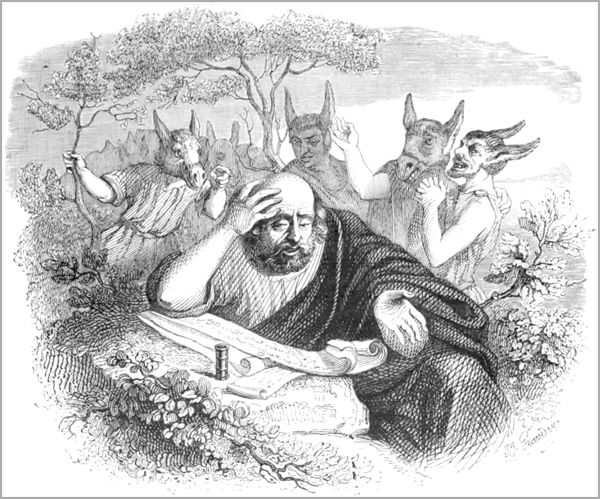
Sous un ombrage épais, assis près d’un ruisseau,
Les labyrinthes d’un cerveau
L’occupoient. Il avait à ses pieds maint volume,
Et ne vit presque pas son ami s’avancer,
Attaché selon sa coutume.
Leur compliment fut court, ainsi qu’on peut penser:
Le sage est ménager du temps et des paroles.
Ayant donc mis à part les entretiens frivoles,
Et beaucoup raisonné sur l’homme et sur l’esprit,
Ils tombèrent sur la morale.
Il n’est pas besoin que j’étale
Tout ce que l’un et l’autre dit.
Le récit précédent suffit
Pour montrer que le peuple est juge récusable.
En quel sens est donc véritable
Ce que j’ai lu dans certain lieu,
Que sa voix est la voix de Dieu?
Democritus And The People Of Abdera
How do I hate the tide of vulgar thought!
Profane, unjust, with childish folly fraught;
It breaks and bends the rays of truth divine,
And by its own conceptions measures mine.
Famed Epicurus’ master tried
The power of this unstable tide.
His country said the sage was mad–
The simpletons! But why?
No prophet ever honour had
Beneath his native sky.
Democritus, in truth, was wise;
The mass were mad, with faith in lies.
So far this error went,
That all Abdera sent
To old Hippocrates
To cure the sad disease.
‘Our townsman,’ said the messengers,
Appropriately shedding tears,
‘Hath lost his wits! Democritus,
By study spoil’d, is lost to us.
Were he but fill’d with ignorance,
We should esteem him less a dunce.
He saith that worlds like this exist,
An absolutely endless list,–
And peopled, even, it may be,
With countless hosts as wise as we!
But, not contented with such dreams,
His brain with viewless “atoms” teems,
Instinct with deathless life, it seems.
And, never stirring from the sod below,
He weighs and measures all the stars;
And, while he knows the universe,
Himself he doth not know.
Though now his lips he strictly bars,
He once delighted to converse.
Come, godlike mortal, try thy art divine
Where traits of worst insanity combine!’
Small faith the great physician lent,
But still, perhaps more readily, he went.
And mark what meetings strange
Chance causes in this world of change!
Hippocrates arrived in season,
Just as his patient (void of reason!)
Was searching whether reason’s home,
In talking animals and dumb,
Be in the head, or in the heart,
Or in some other local part.
All calmly seated in the shade,
Where brooks their softest music made,
He traced, with study most insane,
The convolutions of a brain;
And at his feet lay many a scroll–
The works of sages on the soul.
Indeed, so much absorb’d was he,
His friend, at first, he did not see.
A pair so admirably match’d,
Their compliments erelong despatch’d.
In time and talk, as well as dress,
The wise are frugal, I confess.
Dismissing trifles, they began
At once with eagerness to scan
The life, and soul, and laws of man;
Nor stopp’d till they had travell’d o’er all
The ground, from, physical to moral.
My time and space would fail
To give the full detail.
But I have said enough to show
How little ’tis the people know.
How true, then, goes the saw abroad–
Their voice is but the voice of God?
| If you liked this site, subscribe , put likes, write comments! Share on social networks |
© 2026 Akirill.com – All Rights Reserved

