

Fables Française – Les Fables de La Fontaine
<<< Précédent / Table des matières / Suivant >>>
The Pashaw And The Merchant
Attention : il ne s’agit pas d’une traduction mot à mot, mais des deux versions présentées côte à côte : Les Fables de La Fontaine et Fables of La Fontaine
Le Bassa et le Marchand
Un marchand grec en certaine contrée
Faisoit trafic. Un bassa l’appuyait;
De quoi le Grec en bassa le payait,
Non en marchand: tant c’est chère denrée
Qu’un protecteur! Celui-ci coûtait tant,
Que notre Grec s’alloit partout plaignant.
Trois autres Turcs d’un rang moindre en puissance,
Lui vont offrir leur support en commun.
Eux trois voulaient moins de reconnaissance
Qu’à ce marchand il n’en coûtait pour un.
Le Grec écoute; avec eux il s’engage;
Et le bassa du tout est averti;
Même on lui dit qu’il jouera, s’il est sage,
A ces gens-là quelque méchant parti,
Les prévenant, les chargeant d’un message
Pour Mahomet, droit en son paradis,
Et sans tarder; sinon ces gens unis
Le préviendront, bien certains qu’à la ronde
Il a des gens tout prêts pour le venger:
Quelque poison l’enverra protéger
Les trafiquants qui sont en l’autre monde.
Sur cet avis le Turc se comporta
Comme Alexandre, et, plein de confiance,
Chez le marchand tout droit il s’en alla,
Se mit à table. On vit tant d’assurance
En ses discours et dans tout son maintien,
Qu’on ne crut point qu’il se doutât de rien.
Ami, dit-il, je sais que tu me quittes;
Même l’on veut que j’en craigne les suites;
Mais je te crois un trop homme de bien:
Tu n’as point l’air d’un donneur de breuvage.
Je n’en dis pas là-dessus davantage.
Quant à ces gens qui pensent t’appuyer,
Écoute-moi; sans tant de dialogue
Et de raisons qui pourraient t’ennuyer,
Je ne te veux conter qu’un apologue.
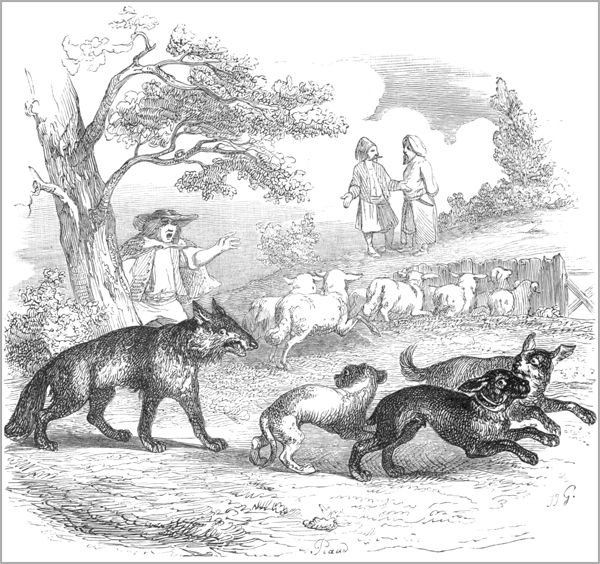
Il étoit un berger, son chien et son troupeau.
Quelqu’un lui demanda ce qu’il prétendait faire
D’un dogue de qui l’ordinaire
Était un pain entier. Il fallait bien et beau
Donner cet animal au seigneur du village.
Lui, berger, pour plus de ménage,
Aurait deux ou trois mâtinaux,
Qui, lui dépensant moins, veilleraient aux troupeaux
Bien mieux que cette bête seule.
Il mangeait plus que trois; mais on ne disait pas
Qu’il avait aussi triple gueule
Quand les loups livraient des combats.
Le berger s’en défait; il prend trois chiens de taille
A lui dépenser moins, mais à fuir la bataille.
Le troupeau s’en sentit; et tu te sentiras
Du choix de semblable canaille.
Si tu fais bien, tu reviendras à moi.
Le Grec le crut.
Ceci montre aux provinces
Que, tout compté, mieux vaut en bonne foi
S’abandonner à quelque puissant roi
Que s’appuyer sur plusieurs petits princes.
The Pashaw And The Merchant
A trading Greek, for want of law,
Protection bought of a pashaw;
And like a nobleman he paid,
Much rather than a man of trade–
Protection being, Turkish-wise,
A costly sort of merchandise.
So costly was it, in this case,
The Greek complain’d, with tongue and face.
Three other Turks, of lower rank,
Would guard his substance as their own,
And all draw less upon his bank,
Than did the great pashaw alone.
The Greek their offer gladly heard,
And closed the bargain with a word.
The said pashaw was made aware,
And counsel’d, with a prudent care
These rivals to anticipate,
By sending them to heaven’s gate,
As messengers to Mahomet–
Which measure should he much delay,
Himself might go the self-same way,
By poison offer’d secretly,
Sent on, before his time, to be
Protector to such arts and trades
As flourish in the world of shades.
On this advice, the Turk–no gander–
Behaved himself like Alexander.
Straight to the merchant’s, firm and stable,
He went, and took a seat at table.
Such calm assurance there was seen,
Both in his words and in his mien,
That e’en that weasel-sighted Grecian
Could not suspect him of suspicion.
‘My friend,’ said he, ‘I know you’ve quit me,
And some think caution would befit me,
Lest to despatch me be your plan:
But, deeming you too good a man
To injure either friends or foes
With poison’d cups or secret blows,
I drown the thought, and say no more.
But, as regards the three or four
Who take my place,
I crave your grace
To listen to an apologue.
‘A shepherd, with a single dog,
Was ask’d the reason why
He kept a dog, whose least supply
Amounted to a loaf of bread
For every day. The people said
He’d better give the animal
To guard the village seignior’s hall;
For him, a shepherd, it would be
A thriftier economy
To keep small curs, say two or three,
That would not cost him half the food,
And yet for watching be as good.
The fools, perhaps, forgot to tell
If they would fight the wolf as well.
The silly shepherd, giving heed,
Cast off his dog of mastiff breed,
And took three dogs to watch his cattle,
Which ate far less, but fled in battle.
His flock such counsel lived to rue,
As doubtlessly, my friend, will you.
If wise, my aid again you’ll seek–‘
And so, persuaded, did the Greek.
Not vain our tale, if it convinces
Small states that ’tis a wiser thing
To trust a single powerful king,
Than half a dozen petty princes.
| If you liked this site, subscribe , put likes, write comments! Share on social networks |
© 2026 Akirill.com – All Rights Reserved

