

Fables Française – Les Fables de La Fontaine
<<< Précédent / Table des matières / Suivant >>>
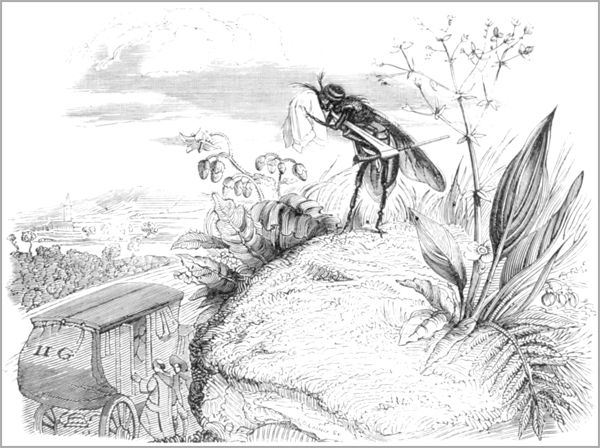
The Coach And The Fly
Attention : il ne s’agit pas d’une traduction mot à mot, mais des deux versions présentées côte à côte : Les Fables de La Fontaine et Fables of La Fontaine
Le Coche et la Mouche
Dans un chemin montant, sablonneux, malaisé,
Et de tous les côtés au soleil exposé,
Six forts chevaux tiraient un coche.
Femmes, moine, vieillards, tout était descendu:
L’attelage suait, soufflait, était rendu.
Une mouche survient, et des chevaux s’approche;
Prétend les animer par son bourdonnement;
Pique l’un, pique l’autre, et pense à tout moment
Qu’elle fait aller la machine;
S’assied sur le timon, sur le nez du cocher.
Aussitôt que le char chemine,
Et qu’elle voit les gens marcher,
Elle s’en attribue uniquement la gloire,
Va, vient, fait l’empressée; il semble que ce soit
Un sergent de bataille allant en chaque endroit
Faire avancer ses gens et hâter la victoire.
La mouche, en ce commun besoin,
Se plaint qu’elle agit seule, et qu’elle a tout le soin;
Qu’aucun n’aide aux chevaux à se tirer d’affaire.
Le moine disait son bréviaire:
Il prenait bien son temps! une femme chantait:
C’étoit bien de chansons qu’alors il s’agissait!
Dame mouche s’en va chanter à leurs oreilles,
Et fait cent sottises pareilles.
Après bien du travail, le coche arrive au haut:
Respirons maintenant! dit la mouche aussitôt:
J’ai tant fait que nos gens sont enfin dans la plaine.
Çà, messieurs les chevaux, payez-moi de ma peine.
Ainsi certaines gens, faisant les empressés,
S’introduisent dans les affaires:
Ils font partout les nécessaires,
Et, partout importuns, devraient être chassés.
The Coach And The Fly
Upon a sandy, uphill road,
Which naked in the sunshine glow’d,
Six lusty horses drew a coach.
Dames, monks, and invalids, its load,
On foot, outside, at leisure trode.
The team, all weary, stopp’d and blow’d:
Whereon there did a fly approach,
And, with a vastly business air.
Cheer’d up the horses with his buzz,–
Now pricked them here, now prick’d them there,
As neatly as a jockey does,–
And thought the while–he knew ’twas so–
He made the team and carriage go,–
On carriage-pole sometimes alighting–
Or driver’s nose–and biting.
And when the whole did get in motion,
Confirm’d and settled in the notion,
He took, himself, the total glory,–
Flew back and forth in wondrous hurry,
And, as he buzz’d about the cattle,
Seem’d like a sergeant in a battle,
The files and squadrons leading on
To where the victory is won.
Thus charged with all the commonweal,
This single fly began to feel
Responsibility too great,
And cares, a grievous crushing weight;
And made complaint that none would aid
The horses up the tedious hill–
The monk his prayers at leisure said–
Fine time to pray!–the dames, at will,
Were singing songs–not greatly needed!
Thus in their ears he sharply sang,
And notes of indignation ran,–
Notes, after all, not greatly heeded.
Erelong the coach was on the top:
‘Now,’ said the fly, ‘my hearties, stop
And breathe;–I’ve got you up the hill;
And Messrs. Horses, let me say,
I need not ask you if you will
A proper compensation pay.’
Thus certain ever-bustling noddies
Are seen in every great affair;
Important, swelling, busy-bodies,
And bores ’tis easier to bear
Than chase them from their needless care.
| If you liked this site, subscribe , put likes, write comments! Share on social networks |
© 2026 Akirill.com – All Rights Reserved

