

Fables Française – Les Fables de La Fontaine
<<< Précédent / Table des matières / Suivant >>>
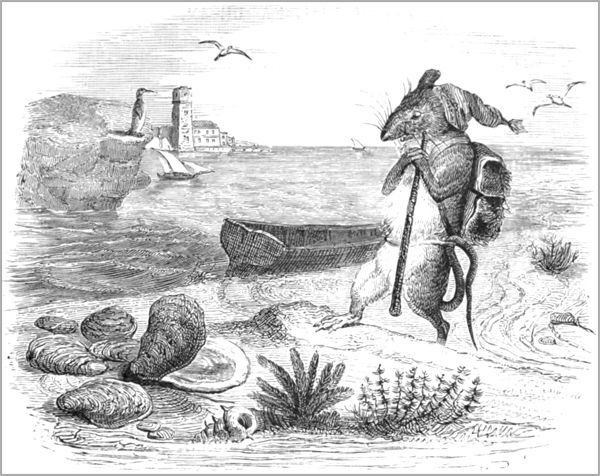
The Rat And The Oyster
Attention : il ne s’agit pas d’une traduction mot à mot, mais des deux versions présentées côte à côte : Les Fables de La Fontaine et Fables of La Fontaine
Le Rat et l’Huître
Un rat, hôte d’un champ, rat de peu de cervelle,
Des lares paternels un jour se trouva soûl.
Il laisse là le champ, le grain, et la javelle,
Va courir le pays, abandonne son trou.
Sitôt qu’il fut hors de la case:
Que le monde, dit-il, est grand et spacieux!
Voilà les Apennins, et voici le Caucase!
La moindre taupinée était mont à ses yeux.
Au bout de quelques jours, le voyageur arrive
En un certain canton où Téthys sur la rive
Avoit laissé mainte huître; et notre rat d’abord
Crut voir, en les voyant, des vaisseaux de haut bord.
Certes, dit-il, mon père était un pauvre sire!
Il n’osait voyager, craintif au dernier point.
Pour moi, j’ai déjà vu le maritime empire:
J’ai passé les déserts, mais nous n’y bûmes point.
D’un certain magister le rat tenait ces choses,
Et les disait à travers champs;
N’étant pas de ces rats qui, les livres rongeants,
Se font savants jusques aux dents.
Parmi tant d’huîtres toutes closes
Une s’était ouverte, et, bâillant au soleil,
Par un doux zéphyr réjouie,
Humoit l’air, respirait, était épanouie,
Blanche, grasse, et d’un goût, à la voir, nonpareil.
D’aussi loin que le rat voit cette huître qui bâille:
Qu’aperçois-je? dit-il; c’est quelque victuaille!
Et, si je ne me trompe à la couleur du mets,
Je dois faire aujourd’hui bonne chère, ou jamais.
Là-dessus, maître rat, plein de belle espérance,
Approche de l’écaille, allonge un peu le cou,
Se sent pris comme aux lacs; car l’huître tout d’un coup
Se referme. Et voilà ce que fait l’ignorance.
Cette fable contient plus d’un enseignement:
Nous y voyons premièrement
Que ceux qui n’ont du monde aucune expérience
Sont, aux moindres objets, frappés d’étonnement;
Et puis nous y pouvons apprendre
Que tel est pris qui croyait prendre.
The Rat And The Oyster
A country rat, of little brains,
Grown weary of inglorious rest,
Left home with all its straws and grains,
Resolved to know beyond his nest.
When peeping through the nearest fence,
‘How big the world is, how immense!’
He cried; ‘there rise the Alps, and that
Is doubtless famous Ararat.’
His mountains were the works of moles,
Or dirt thrown up in digging holes!
Some days of travel brought him where
The tide had left the oysters bare.
Since here our traveller saw the sea,
He thought these shells the ships must be.
‘My father was, in truth,’ said he,
‘A coward, and an ignoramus;
He dared not travel: as for me,
I’ve seen the ships and ocean famous;
Have cross’d the deserts without drinking,
And many dangerous streams unshrinking;
Such things I know from having seen and felt them.’
And, as he went, in tales he proudly dealt them,
Not being of those rats whose knowledge
Comes by their teeth on books in college.
Among the shut-up shell-fish, one
Was gaping widely at the sun;
It breathed, and drank the air’s perfume,
Expanding, like a flower in bloom.
Both white and fat, its meat
Appear’d a dainty treat.
Our rat, when he this shell espied,
Thought for his stomach to provide.
‘If not mistaken in the matter,’
Said he, ‘no meat was ever fatter,
Or in its flavour half so fine,
As that on which to-day I dine.’
Thus full of hope, the foolish chap
Thrust in his head to taste,
And felt the pinching of a trap–
The oyster closed in haste.
We’re first instructed, by this case,
That those to whom the world is new
Are wonder-struck at every view;
And, in the second place,
That the marauder finds his match,
And he is caught who thinks to catch.
| If you liked this site, subscribe , put likes, write comments! Share on social networks |
© 2026 Akirill.com – All Rights Reserved

