

Fables Française – Les Fables de La Fontaine
<<< Précédent / Table des matières / Suivant >>>
The Fortune-Tellers
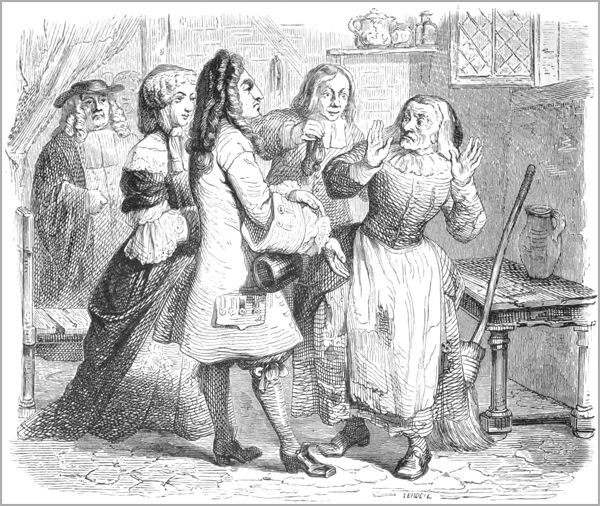
Attention : il ne s’agit pas d’une traduction mot à mot, mais des deux versions présentées côte à côte : Les Fables de La Fontaine et Fables of La Fontaine
Les Devineresses
C’est souvent du hasard que naît l’opinion,
Et c’est l’opinion qui fait toujours la vogue.
Je pourrois fonder ce prologue
Sur gens de tous états: tout est prévention,
Cabale, entêtement; point ou peu de justice.
C’est un torrent: qu’y faire? il faut qu’il ait son cours
Cela fut, et sera toujours.
Une femme, à Paris, faisait la pythonisse:
On l’allait consulter sur chaque événement;
Perdait-on un chiffon, avait-on un amant,
Un mari vivant trop, au gré de son épouse,
Une mère fâcheuse, une femme jalouse;
Chez la devineuse on courait
Pour se faire annoncer ce que l’on désirait.
Son fait consistait en adresse:
Quelques termes de l’art, beaucoup de hardiesse,
Du hasard quelquefois, tout cela concourait,
Tout cela bien souvent faisait crier miracle.
Enfin, quoique ignorante à vingt et trois carats,
Elle passait pour un oracle.
L’oracle étoit logé dedans un galetas:
Là, cette femme emplit sa bourse,
Et, sans avoir d’autre ressource,
Gagne de quoi donner un rang à son mari;
Elle achète un office, une maison aussi.
Voilà le galetas rempli
D’une nouvelle hôtesse, à qui toute la ville,
Femmes, filles, valets, gros messieurs, tout enfin
Allait, comme autrefois, demander son destin;
Le galetas devint l’antre de la Sibylle.
L’autre femelle avoit achalandé ce lieu.
Cette dernière femme eut beau faire, eut beau dire,
Moi devine[53]! on se moque: eh! messieurs, sais-je lire?
Je n’ai jamais appris que ma Croix de par Dieu.
Point de raisons: fallut deviner et prédire,
Mettre à part force bons ducats,
Et gagner malgré soi plus que deux avocats.
Le meuble et l’équipage aidaient fort à la chose:
Quatre siéges boiteux, un manche de balai,
Tout sentait son sabbat et sa métamorphose.
Quand cette femme auroit dit vrai
Dans une chambre tapissée,
On s’en serait moqué: la vogue était passée
Au galetas; il avait le crédit.
L’autre femme se morfondit.
L’enseigne fait la chalandise.
J’ai vu dans le palais une robe mal mise
Gagner gros: les gens l’avaient prise
Pour maître tel, qui traînait après soi
Force écoutants. Demandez-moi pourquoi.
The Fortune-Tellers
‘Tis oft from chance opinion takes its rise,
And into reputation multiplies.
This prologue finds pat applications
In men of all this world’s vocations;
For fashion, prejudice, and party strife,
Conspire to crowd poor justice out of life.
What can you do to counteract
This reckless, rushing cataract?
‘Twill have its course for good or bad,
As it, indeed, has always had.
A dame in Paris play’d the Pythoness
With much of custom, and, of course, success.
Was any trifle lost, or did
Some maid a husband wish,
Or wife of husband to be rid,
Or either sex for fortune fish,
Resort was had to her with gold,
To get the hidden future told.
Her art was made of various tricks,
Wherein the dame contrived to mix,
With much assurance, learned terms.
Now, chance, of course, sometimes confirms;
And just as often as it did,
The news was anything but hid.
In short, though, as to ninety-nine per cent.,
The lady knew not what her answers meant,
Borne up by ever-babbling Fame,
An oracle she soon became.
A garret was this woman’s home,
Till she had gain’d of gold a sum
That raised the station of her spouse–
Bought him an office and a house.
As she could then no longer bear it,
Another tenanted the garret.
To her came up the city crowd,–
Wives, maidens, servants, gentry proud,–
To ask their fortunes, as before;
A Sibyl’s cave was on her garret floor:
Such custom had its former mistress drawn
It lasted even when herself was gone.
It sorely tax’d the present mistress’ wits
To satisfy the throngs of teasing cits.
‘I tell your fortunes! joke, indeed!
Why, gentlemen, I cannot read!
What can you, ladies, learn from me,
Who never learn’d my A, B, C?’
Avaunt with reasons! tell she must,–
Predict as if she understood,
And lay aside more precious dust
Than two the ablest lawyers could.
The stuff that garnish’d out her room–
Four crippled chairs, a broken broom–
Help’d mightily to raise her merits,–
Full proof of intercourse with spirits!
Had she predicted e’er so truly,
On floor with carpet cover’d duly,
Her word had been a mockery made.
The fashion set upon the garret.
Doubt that?–none bold enough to dare it!
The other woman lost her trade.
All shopmen know the force of signs,
And so, indeed, do some divines.
In palaces, a robe awry
Has sometimes set the wearer high;
And crowds his teaching will pursue
Who draws the greatest listening crew.
Ask, if you please, the reason why.

| If you liked this site, subscribe , put likes, write comments! Share on social networks |
© 2026 Akirill.com – All Rights Reserved

