

Fyodor Mikhailovich Dostoyevsky (Фёдор Михайлович Достоевский) was born on October 30 (November 11), 1821 in Moscow. His early works contributed to the emergence of the genre of psychological prose. In his novels, the author aims to portray and study the “inner world of a person” and “the most subtle movements of his soul”.
His most important books are “Idiot”, “Crime and Punishment”, “Demons”, “The Brothers Karamazov” and “Teenager”. These novels have become classics of world literature and are among the most famous and widely read works of literature.
Dostoevsky’s works have had an impact on world literature, and his most significant ones have been repeatedly filmed and staged in theatres.

Fyodor Mikhailovich Dostoyevsky was the second son of seven children. He was raised with love in a pious family. Alena Frolovna, their nanny had a clear and cheerful character. Fyodor remembers that she told them beautiful stories. She is mentioned in his novel “The Demons”. His parents, during family evenings, read aloud, among other Joukovi, Karamzin, Pouchkine, and the history of the Russian state, of which Dostoyevsky already knew all the main episodes by the age of 10. The History of the Russian State is a multi-volume work by N. M. Karamzin describing the history of Russia from antiquity through the reign of Ivan the Terrible and the Times of Troubles. His parents started to teach him when he was 4 years old.
According to the writer, childhood was the best period of his life.
In June 1828 the Dostoyevskys became a noble family, and in 1832 Dostoyevsky became familiar with rural Russia for the first time. We find the impressions of this trip in his novels: “Poor People”, “Demons”, as well as in “the Diary of a Writer”
In 1834, together with his brother Mikhail, he entered one of the best private educational institutions in Moscow. He certainly started thinking about literature as a profession thanks to his Russian language teacher Nikolai Ivanovich Bilevich, who studied at the same time as Gogol, attended literary meetings, composed poetry and translated Schiller
His mother died on February 27, 1837 after a long illness. Likewise, Pushkin, whose works he had read since childhood, died that same year.
Then he entered the main engineering school, although he dreamed of poetry and imagined himself already composing a novel. During his studies, he devoted all his free time to reading the works of Homer, Corneilles, and many other writers. Dostoyevsky was better educated than many Russian writers of his time.
In June 1839, Dostoyevsky’s father died. There are two versions of his death. According to the official version, the writer’s father died in the field of apoplexy. Another version is based on rumors: MA Dostoyevsky was killed by his own serfs. Both versions are described in detail by Dostoyevsky’s biographer LI Saraskina. Some say that Dostoyevsky’s tetanic fits began after his father’s death.
After graduating, Dostoyevsky worked only one year as an engineer-lieutenant before resigning to devote himself to literature.

Bauman –
His literary activity began successfully in 1845 with his first novel “The Poor”, he was cordially accepted into Belinski’s circle and became famous. He left it a year later following a skirmish over his misunderstood new novel “Double”. Later, Dostoyevsky became a member of the literary and philosophical circle of the Beketov brothers. Thanks to his great fame he had many acquaintances who became prototypes of the heroes of his future works.
The writings of Dostoyevsky’s early period belonged to various genres.
Humorous story: “A novel in nine letters” in 1845
A physiological essay: “Petersburg’s Chronicle ” in 1847.
Short stories: “Mr.. Prokharchin” in 1846, “Crawlers” in 1847, “Honest Thief” in 1848
A Christmas Tale: “Christmas Tree and Wedding” in 1848.
Tragic stories: “Someone Else’s Wife and Husband”, and “Jealous Husband” in 1848.
Several novels: “Mistress” in 1847, “Weak heart” in 1848, “White nights” in 1848, an epistolary novel “Poor People” in 1846.
Many creative endeavors and ideas of the young writer found their wider embodiment in his later works.
In the fall of 1848 Dostoyevsky became a member of the Petrashevsky’s circle. It is a secret society which brings together the partisans of French utopian socialism, including Fourier and Saint-Simon. Their goal was to create an illegal printer to facilitate a coup in Russia. This did not succeed, and in 1849 Fyodor was arrested and sentenced to death after spending 8 months in prison in the Peter and Paul Fortress. On the day of his execution, he learned that his sentence has been changed to 8 years in prison. At the end of the same month, Emperor Nicholas I reduced his sentence from 8 years to 4 years. Dostoyevsky was exiled to forced labor in Siberia, deprived of his noble rank and his fortune. At the end of his sentence, he was promoted to private.
Dostoyevsky found it very difficult to endure the suffering and loneliness during his years of hard labor, and it left an indelible impression on him.
On February 18, 1855, Emperor Nicholas I died. Dostoyevsky wrote a loyal poem dedicated to his widow, Empress Alexandra Feodorovna, and thus became a non-commissioned officer.
In 1856, the new Emperor Alexander II granted a pardon to all Petrashevites, and in 1857 Dostoyevsky was pardoned. By receiving this complete amnesty he was able to publish his works again.
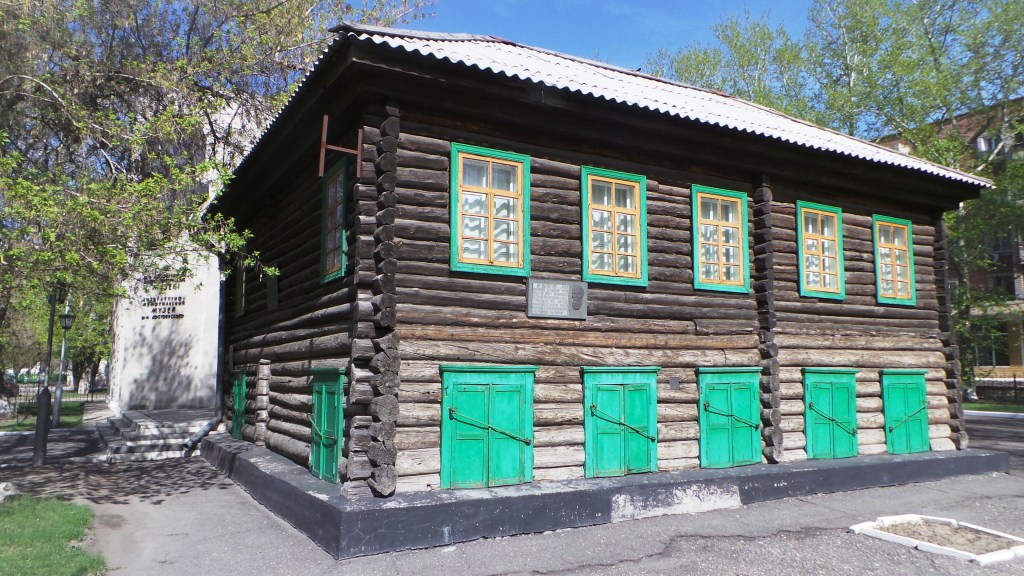
Автор: Yakov Fedorov – собственная работа, CC BY-SA 3.0,
On February 6, 1857 Dostoyevsky married Maria Dmitrievna Isaïeva.
About his experience of forced labor Dostoyevsky wrote “Notes from the House of the Dead” where he spoke about the life of convicts. This book was a shock for the public of Saint Petersburg, and restored literary recognition to Dostoyevsky.
In 1859 “Uncle’s Dream” and “The Village of Stepanchikovo and its Inhabitants” were published in magazines.
Together with his older brother Dostoyevsky started publishing his own literary and political magazine called Vremya in 1861. After 1862 the publication closed, and instead the Dostoyevsky brothers started publishing another magazine called Epoch.
These journals strengthened the positions of the brothers in the literary world and it was on their pages that the works of Dostoyevsky were published.
Dostoevsky undertook his first trip abroad in 1862 visiting Germany, France, England, Switzerland, Italy and Austria. During this period he became interested in the game of roulette and will write ‘The Gambler’.
In 1864 Dostoyevsky’s wife and older brother died. It was during this period that the destruction of socialist illusions of youth occurs and a critical perception of bourgeois-liberal values by the writer is formed.
In 1865, six months after his brother’s death, Epoch ceased publication. Assuming responsibility for Epoch’s debts and experiencing financial difficulties, Dostoyevsky was forced to accept the disadvantageous terms of the contract for the publication of collected works with the publisher FT Stellovsky and began work on the novel “Crime and Punishment”. However, because of his contract, he risks losing his copyright and royalties on his publications for 9 years if he did not provide a novel before November 1, 1866 (One month). His friend AP Milyukov came to his rescue and found him the best stenographer Anna Grigitievna to enable him to write his novel quickly. “The Gambler” was written in 26 days, from October 4 to 29 in Saint Petersburg.
Anna Grigorievna Snitkina became his wife on February 15, 1867 in the Trinity Cathedral.
After the publication of his novel “Crime and Punishment” Dostoyevsky and his wife went to live abroad to prevent creditors from taking this money from them. The novel “Idiot” was written in Geneva, Vevey and Milan and finished in Florence. “ Idiot” is one of the works that Dostoyevsky. had the most difficulty writing.
From 1872 to 1878 the writer lived in the city of Staraya Russa, Novgorod province. This period is very productive for him and he will write “Demons” in 1872, the beginning of the “Journal d’un auteur” in 1873, “Teenager” in 1875 and “Soft” in 1876.
He will write his last novel, “The Brothers Karamazov” in Saint Petersburg,
He died on January 28 (February 7), 1881, two days after a visit from his sister Vera Mikhailovna, who had come to see him to ask him to give up his share of the Ryazan estate, which he had inherited from his aunt. There was a stormy scene that may have been the cause of the exacerbation of his emphysema.
He was buried in the Tikhvin Cemetery of the Alexander Nevsky Lavra in Saint Petersburg.
If you want to read some of his beautiful books visit our Russian Literature page and find some of his books. More will be added later.
Read Dostoyevsky
If you liked this article, don’t forget to like and share.
Subscribe to not miss anything
Sources:
Fyodor Dostoyevsky – biography, news, personal life
Fyodor Dostoyevsky – about the author
Biography of D ostoyevsky Fyodor Mikhailovich
 AKirill, Learn, apprenez, translation, traduction, livres bilingues, bilingual books