Découvrez les 2 belles peintures “Paysannes dans la forêt” d’Alexey Ivanovich Korzukhin

Livres bilinguesRead in EnglishNous contacter
Littérature américaineLittérature françaiseLittérature russe

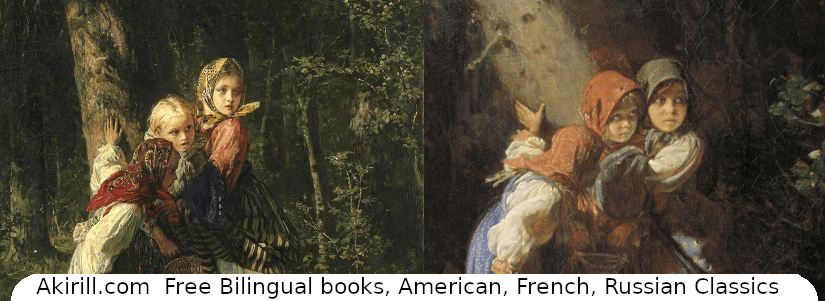
Aujourd’hui nous allons découvrir deux beaux tableaux d’Alexey Ivanovich Korzukhin (Алексей Иванович Корзухин) intitulés “Paysannes dans la forêt” peint en 1877 et une seconde fois en 1878.

On a cru très longtemps que le fond du tableau avait été réalisé par Chichkine mais après une longue étude minutieuse de la toile, il a été prouvé que ce dernier n’avait rien à voir avec l’œuvre de Korzukhin. 
Alexey Ivanovich Korzukhin est un peintre russe du 19ème siècle, originaire de la province de Perm qui a peint des toiles sur la vie paysanne difficile, et la cathédrale du Christ Sauveur.
Alexey Ivanovich Korzukhin (Алексей Иванович Корзухин)
Alexey Ivanovich Korzukhin

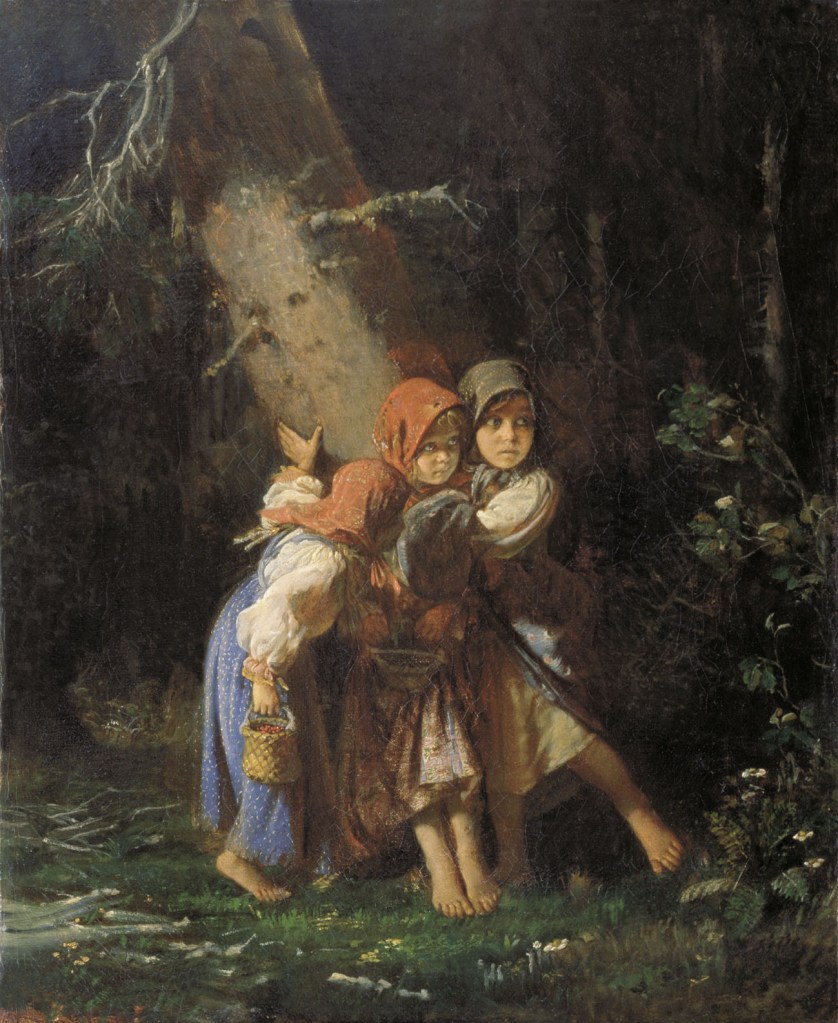
“Paysannes dans la forêt” (Крестьянские девочки в лесу), une peinture de genre russe, est une huile sur toile de 94 X 68,6 cm, peinte en 1877 par Alexey Ivanovich Korzukhin et a été vendue aux enchères pour 266,5 milliers de dollars en avril 2011.

La deuxième peinture de “Paysannes dans la forêt”, également une peinture de genre russe, est une huile sur toile de 43 X 36 cm, peinte en 1878 par Alexey Ivanovich Korzukhin et maintenant dans le State Art Gallery de Perm.

“Filles paysannes dans la forêt” 1877

“Filles paysannes dans la forêt” 1877

Sur ce tableau, vous pouvez voir, trois petites filles pieds nus qui sont allées dans la forêt pour ramasser des champignons et des baies. Elles ont été tellement emportées par cette occupation qu’elles n’ont pas remarqué comment elles ont erré dans un coin de forêt dense et maintenant elles sont appuyées contre un arbre, pressées les unes contre les autres et scrutant attentivement la forêt sombre. Elles ont probablement entendu une sorte de bruit qui les a beaucoup effrayées, peut-être une bête sauvage, ou peut-être un chasseur qui se promène près d’elles.

La posture des filles ainsi que leurs expressions faciales trahissent leurs peurs, leur tension et leur confusion qui est accentuée par les effets de lumière et d’ombre qui mettent en valeur les visages des enfants . Mais derrière la frayeur, se lit aussi la curiosité inhérente aux enfants. Les filles regardent dans le sombre fourré de la forêt, essayant de voir et de comprendre qui ou quoi pourrait s’y cacher et si cela vaut la peine d’en avoir peur.

L’anxiété et l’excitation se dégagent de l’image et même le tronc d’arbre qui penche intensifie l’expression de l’état anxieux et instable de ces petites filles.

“Filles paysannes dans la forêt” 1878

"Filles paysannes dans la forêt" 1878
“Filles paysannes dans la forêt” 1878

Dans ce deuxième tableau de “Filles paysannes dans la forêt”, comme dans le premier, trois petites filles sont allées dans la forêt pour des baies. Elles sont habillées plus simplement et vous pouvez voir que soit des framboises, soit des fraises ont été ramassées, car l’un des paniers est déjà presque plein.

Comme dans le premier tableaux les petites filles sont effrayées par un bruit, se cramponnent les unes aux autres et s’adossent à un vieil arbre puissant. Mais ce tableau est plus sombre, plus dramatique. Les petites filles semblent avoir plus peur cherchant protection dans l’arbre penché.

Dans ce tableau, Korzukhin renforce le drame de l’événement en cours en utilisant des effets de lumière et d’ombre, et le fourré de la forêt effraie par son obscurité. 

La première toile est plus dynamique, plus lumineuse et pittoresque tandis que la seconde est plus sombre et plus dramatique.

J’espère que vous avez apprécié ces peintures autant que moi, écrivez laquelle était votre préférée dans les commentaires.

Si vous avez aimé cet article, abonnez-vous, mettez des likes, écrivez des commentaires !

Partager sur les réseaux sociaux

Découvrez nos derniers posts

Discover the 2 beautiful paintings of “Peasant Girls in the Forest” by Alexey Ivanovich Korzukhin

Bilingual booksLire en FrançaisContact us
American LiteratureFrench LiteratureRussian Literature

Today we will discover two beautiful paintings of Alexey Ivanovich Korzukhin (Алексей Иванович Корзухин) called “Peasant Girls in the Forest” painted in 1877 and a second time in 1878.

It was believed for a very long time that the background of the picture was made by Shishkin but after a long painstaking study of the canvas, it was proved that the latter had nothing to do with Korzukhin’s work. 

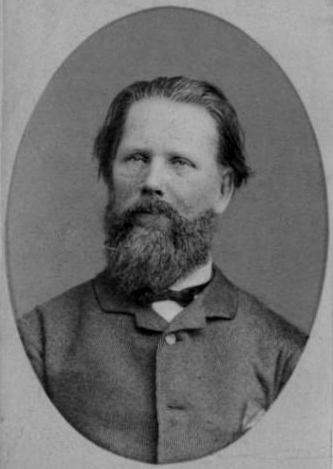
Alexey Ivanovich Korzukhin is a Russian painter of the 19th century, originally from the Perm province who  painted canvases about the difficult peasant life, and the Cathedral of Christ the Savior.

Alexey Ivanovich Korzukhin (Алексей Иванович Корзухин)
Alexey Ivanovich Korzukhin

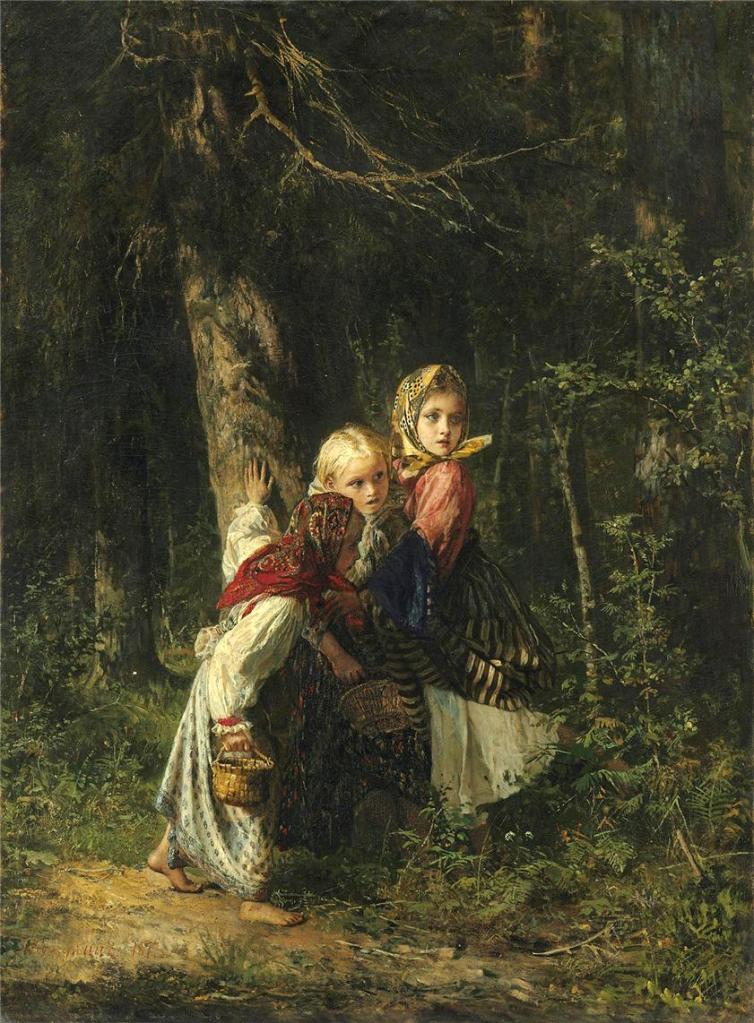
“Peasant Girls in the Forest” (Крестьянские девочки в лесу) , a Russian genre painting, is an oil on canvas of 94 X 68.6 cm , painted in 1877 by Alexey Ivanovich Korzukhin and was sold at an auction for $266.5 thousands in April 2011.

The second “Peasant Girls in the Forest”, also a Russian genre painting, is an oil on canvas of 43 X 36 cm, painted in 1878 by Alexey Ivanovich Korzukhin and now in the State Art Gallery of Perm.

“Peasant Girls in the Forest” 1877

"Peasant Girls in the Forest" 1877
“Peasant Girls in the Forest” 1877

On this painting, you can see, three barefoot little girls who went to the forest to collect mushrooms and berries. They were so carried away by this occupation that they did not notice how they wandered into a dense forest thicket and now they are leaning against a tree, pressed against each other and carefully peering into dark forest. They probably heard some kind of noise that scared them a lot, maybe a wild beast, or maybe a hunter who is wandering close to them.

The posture of the girls as well as their facial expressions betrays their fears, tension and confusion which is emphasized by the light and shade effects that highlight the faces of the children. But behind the fright, the curiosity inherent in children is also read. The girls peer into the dark forest thicket, trying to see and understand who or what might be hiding there and whether it is worth being afraid of it.

Anxiety and excitement emanates from the picture and even the falling tree trunk intensifies the anxious and unstable state of these little girl.

“Peasant Girls in the Forest” 1878

"Peasant Girls in the Forest" 1878
“Peasant Girls in the Forest” 1878

In this second painting of “Peasant girls in the Forest” as in the first three girls went to the forest for berries. They are dressed more simply and you can see that either raspberries or strawberries were collected, as one of the basket is already almost full.

As in the first paintings the little girls are frightened by a noise and clung to each other leaning their backs against an old powerful tree. But this painting is darker, more dramatic. The little girls seem to be more frightened, and seeking protection in the leaning tree.

In this painting, Korzukhin enhances the drama of the ongoing event by using light and shadow effects, and the forest thicket frightens with its darkness. 

The first canvas is more dynamic, brighter and picturesque while the second is darker and more dramatic.

I hope you enjoyed these paintings as much as I did, write which one was your favorite in the comments.

If you liked this article, subscribe , put likes, write comments!
Share on social networks
Check out Our Latest Posts

Discover the painting “Halt of the prisoners” by Valery Ivanovich Jacobi

Bilingual booksLire en FrançaisContact us
American LiteratureFrench LiteratureRussian Literature

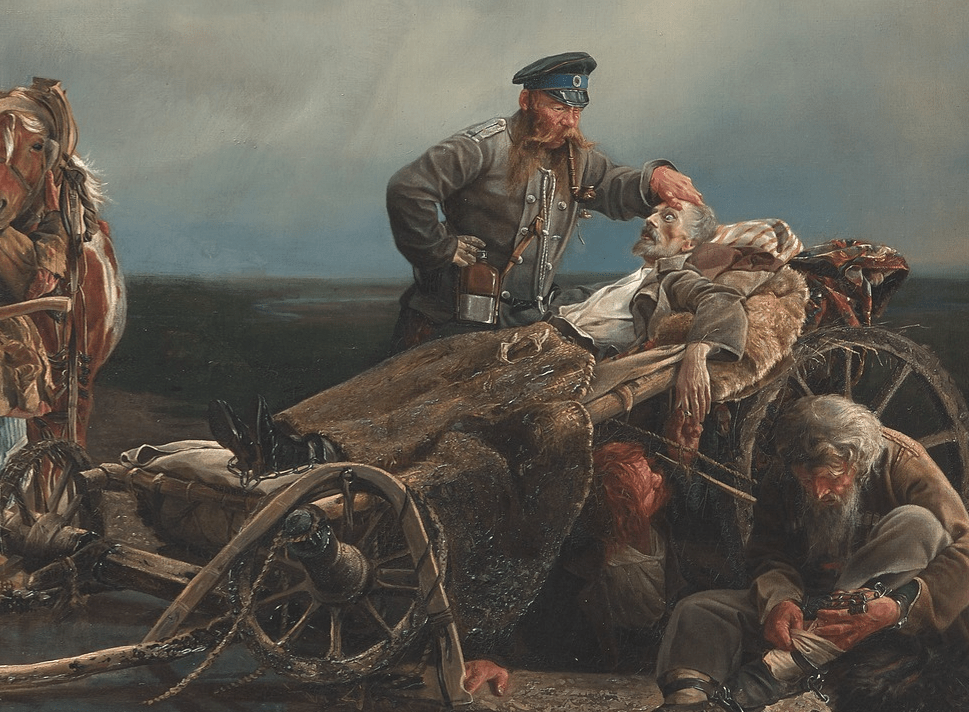
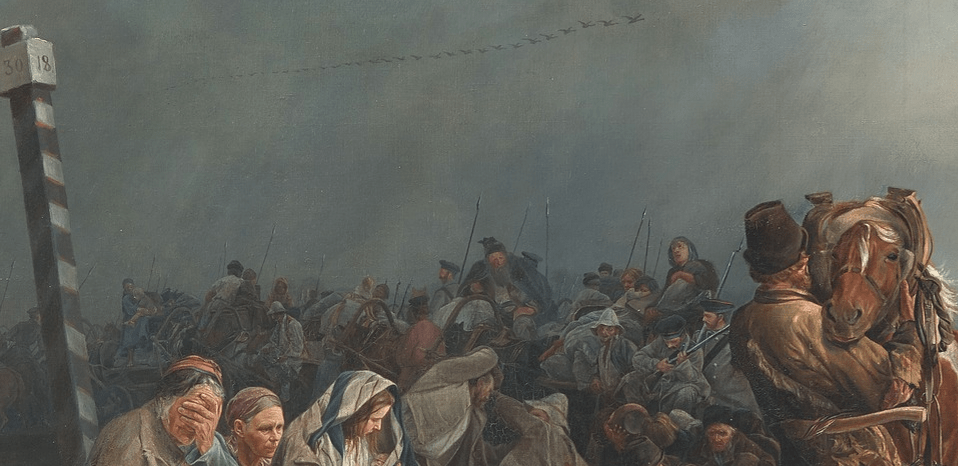
“The Halt of the Prisoners” (Привал арестантов) is a genre painting by the Russian artist Valery Yakobi  (Валерия Якоби) completed in 1861. It is an oil on canvas of 98.6 × 143.5 cm situated at the State Tretyakov Gallery.  It is difficult to imagine Russian genre painting of the 60s of the XIX century without this painting by Valery Ivanovich Jacobi, who created the true story of the royal penal servitude.  It is one of the masterpieces of the 19th century, and this painting by Valery Jacobi immediately entered the history of art. 

The painting “Halt of Prisoners” was presented by Valery Yakobi at the end of his studies at the Academy of Arts . For this painting, the Academy awarded him the title of class artist of the 1st degree and also a large gold medal  . 

In 1861-1862, the canvas was exhibited with great success at the exhibition of the Academy of Arts  – the writer Fyodor Dostoevsky noted that Jacobi’s painting “amazes with amazing fidelity” and the public likes it “more than anyone else at the current exhibition”  

 This work made a great impression on the public, which rather vividly accepted the reforms of Emperor Alexander II. 

Critics called this work frank and topical. Everyone was unanimous in their statements: the master managed to portray the actual problems of society. This work became the pinnacle of the artist’s work. 

Valery Jacobi was the first of the Russian artists who turned to such a topic.  The choice of subject was not accidental. Valery Ivanovich spent his childhood and youth in the east of Russia, where he personally observed the convicts who were driven past the house where the artist lived. Memories were so firmly planted in his head that the picture recreated from memory is striking in its realism and strength.

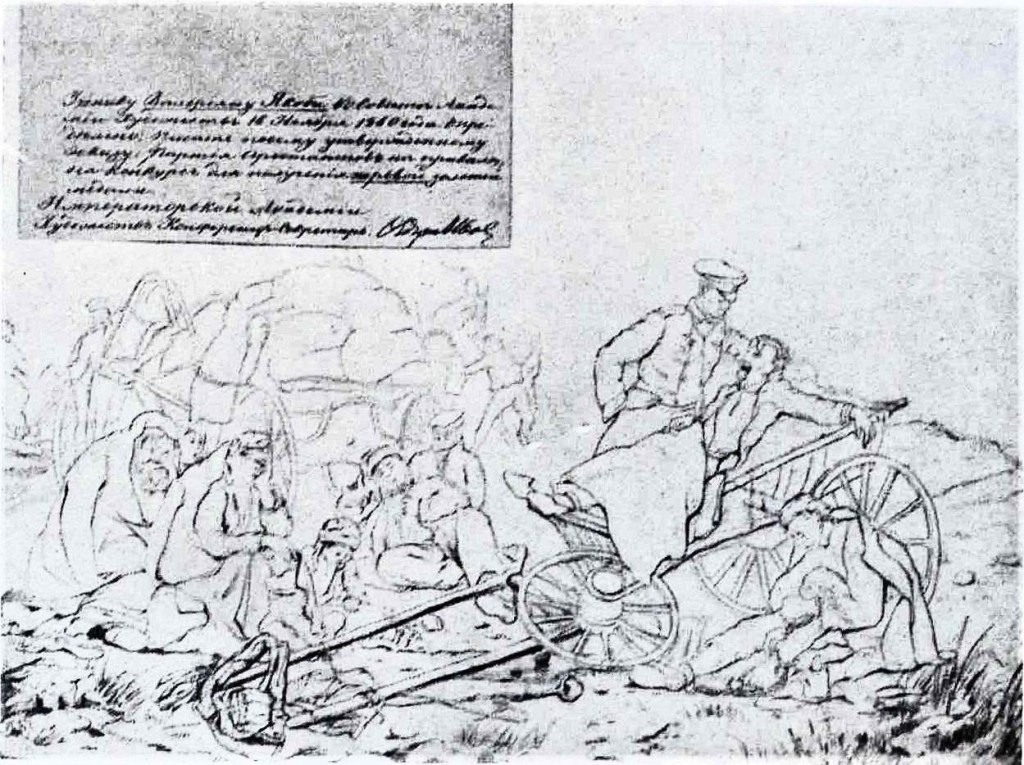
The collection of the State Tretyakov Gallery also contains a graphic sketch for the painting “Halt of Prisoners”

This first compositional sketch for the future canvas was submitted by Valery Jacobi for approval to the Council of the Academy of Arts in 1860. It is made in a purely contour technique, and the figures are outlined by a continuous line  . 

According to the description of art historian Alexei Sidorov, “from one edge of the figures, this line is thin and resembles a stroke of a cutter or a dry needle in a sketch engraving on copper; from the other edge of the same figures, the line tightens, becomes thicker, blacker, to a certain extent gives the figures <…> relief”; such an interpretation resembles a “marble bas-relief ”  .

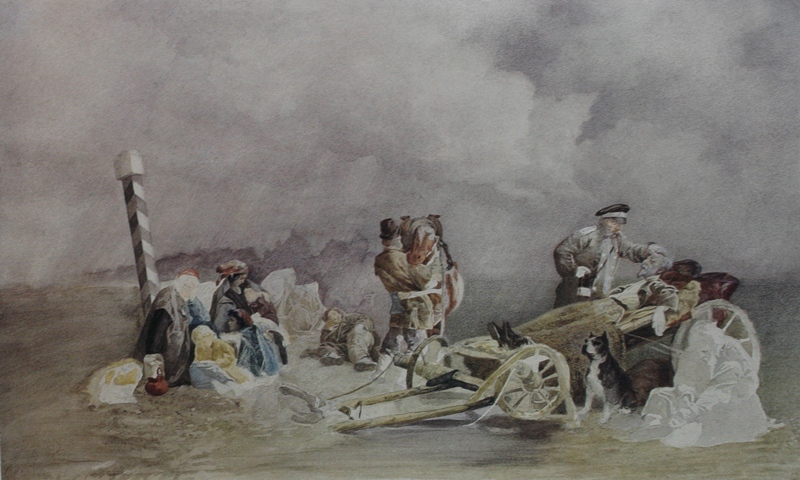
Another sketch of 36.5 × 58.7 cm  , was executed in watercolor and white on paper. It is dated from 1861, and is kept in the State Russian Museum  . In addition, the Russian Museum owns a reduced copy of the painting of the same name . It is an oil , paper on canvas, from the late 1860s – 1870s which is 53 × 75 cm , and was received in 1963 from the State Museum of the Revolution.

The painting depicts a group of prisoners stopping for a break. Probably, this halt was forced and caused by the breakdown of one of the carts. 

Jacobi concentrates his main attention on the group around the deceased prisoner and the relatives who followed him along the stage, sitting at the milestone. At the same time, the artist uses a traditional academic technique, highlighting the main characters of the picture with light, grouping them in the spirit of classical “pyramids”. He managed to convey a complex range of feelings: from the despair of a family that has lost a person for whom they set off on a grueling journey, to the indifference of a gendarmerie officer who leaned over a dead prisoner. The rest of the exiles are depicted without detail, in gloomy silhouettes. The contrast of a dark stormy sky and bright light breaking through the dense cover of clouds, the predominance of gray and brown tones enhances the drama of the scene. 

Help the site stay free, buy us a cup of coffeeAidez-nous à maintenir le site gratuit en nous offrant une tasse de café

The Charter “On the Exiles” fixed and regulated the procedure for escorting, the issues of transporting exiles on carts, preventing escapes, women, freemen and the dead.

In this work, Jacobi managed with extraordinary persuasiveness to present various social types – from a tramp to an intellectual-political prisoner, whose life was cut short on the way.

 On a broken road under a leaden sky with low rain clouds, standing by the cart is a stage officer, who with indifferent calmness ascertains the death of a prisoner (by opening his eyes), in order to leave him on the road and move on faster. 

The central character of the composition is the deceased prisoner. He has an intelligent appearance, but is so emaciated that he looks like an old man. The dead prisoner is covered with matting . On his left hand, hanging lifelessly down, he wears a ring. The effect of the hopelessness of life is enhanced by another detail: another prisoner crept under the cart and is trying to pull off the ring from the finger of the deceased. In such a critical situation, the human essence is manifested.

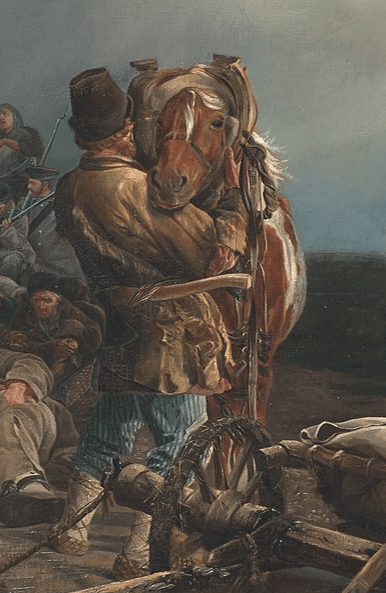
A man, dressed in a heavily torn caftan , is holding a harnessed horse. 

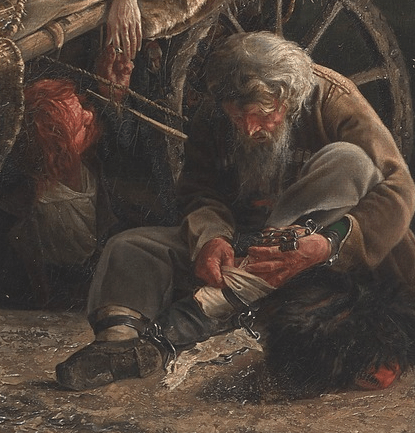
On the right side of the picture in the foreground is a seated prisoner in rags, who examines the wound on his leg, rubbed with shackles . 

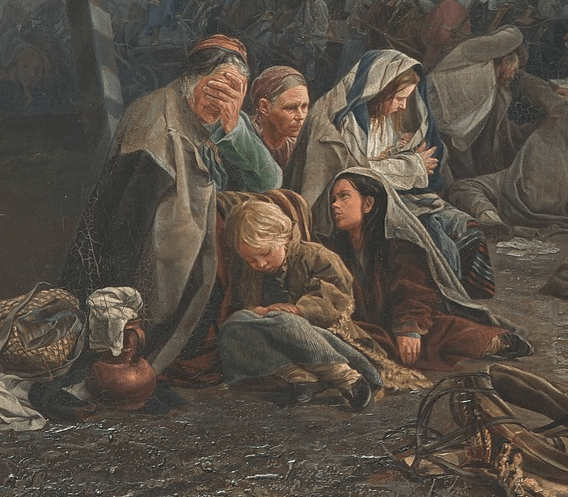
 In the left corner of the picture are the families of prisoners who voluntarily went into exile along with their husbands and fathers. They are exhausted and weakened. However, no one retreats and they will go all the way to the end, but not everyone will return. They are already mourning the dead…

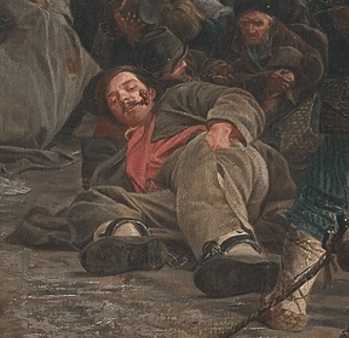
Nearby, a prisoner is seen smoking a pipe. It seems that he is completely indifferent to his own fate, he just goes with the flow, not thinking about tomorrow. 

The plot continues with a group of fighting people and a long line of exiles, escorted by a convoy, lost in the distance… This horizontal line is emphasized by a thin parallel line of a flock of birds, dissolving into the clouds. The whole scene is depicted by the artist against the backdrop of an open autumn steppe, under a sky covered with heavy gray clouds. The bleak landscape only enhances the gloomy impression that the picture makes ….

I hope you enjoyed this painting as much as I did

If you liked this article, subscribe , put likes, write comments!.
Share on social networks
Check out Our Latest Posts

Discover the painting “The Spring” by Arkady Plastov

Bilingual booksLire en FrançaisContact us
American LiteratureFrench LiteratureRussian Literature

Arkady Alexandrovich Plastov (Аркадий Александрович Пластов) (1893–1972) was born in a family of hereditary icon painters, and made a great contribution to the development of Russian culture. Beginning in 1935, he has been creating genre paintings, in which he embellished the life of the Soviet village. So an important place in his work was occupied by the image of the everyday life of peasants against the backdrop of their beautiful country.

The painting “Spring” is an oil on canvas which was painted in 1952. it is a genre scene from the life of a young peasant woman who came to the spring to get clean water. Effectively, there was no running water in the villages at this period, and someone had to go sometimes far to get water with buckets. 

In the foreground we see a girl standing on logs holding a yoke with large iron buckets in her hands.

The barefoot girl is dressed in a beautiful light dress with a miniature pattern, and a clean white scarf frames her head, from under which thick golden braids peek out.

The heroine of the picture is serious and completely focused on the process of collecting water.

 One of the bucket is already full, while she fills the other with a stream of clean, transparent water from a small spring. We can see splashing water on the side of the bucket, which creates the dynamics of the composition of the canvas. We can also admire how clean and transparent is the water that the artist managed to paint. The crystal freshness of cool water illuminated by the warm summer sun is literally felt.

Under the bucket, the spilled water formed a small pond, which was overgrown with reeds.

Help the site stay free, buy us a cup of coffeeAidez-nous à maintenir le site gratuit en nous offrant une tasse de café

Behind the girl’s back we see a lot of greenery, which occupies a large area of ​​the work. The vegetation is quite high and dense, which means that the spring is practically not noticeable from the outside. In the upper part of the picture, a blue sky with white clouds is slightly visible.

The color scheme is quite warm. This is expressed in the yellow-green colorful strokes of plants and the girl’s scarlet blush.  Also, solar accents are shown in the color spots of her clothes. There is a battle of contrasts. Light tones contrast with dark ones. Thus, the harmony of the painted picture is created.

This canvas by Arkady Plastov perfectly cheers up and evokes the warmest and most positive feelings. Due to the calm plot, pleasant shades of colors, the harmony of nature and peasant life is conveyed.

I hope you enjoyed this painting as much as I did

If you liked this article, subscribe , put likes, write comments!.
Share on social networks
Check out Our Latest Posts