
| Livres bilingues | Read in English | Nous contacter |
| Littérature américaine | Littérature française | Littérature russe |
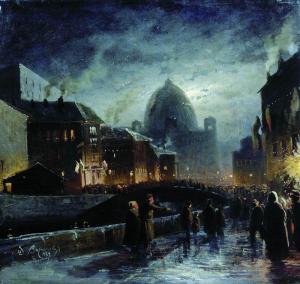
Chers lecteurs et abonnés, cette semaine j’ai fait une brève analyse et traduit le poème « L’Étrangère » d’Alexander Blok écrit en 1906 et qui reflète ses sentiments et réflexions pendant une période difficile. Comme toujours j’ai ajouté une peinture intitulée « Illumination à Saint-Pétersbourg » de Fiodor Vassiliev ainsi que l’explication de quelques mots.
Depuis que j’écris en anglais, français et russe j’ai également créé une page où vous pouvez retrouver le nom de tous les écrivains et peintres russes qui sont sur le site dans les 3 langues côte à côte. J’ajouterai les écrivains et artistes français et américains un peu plus tard.
Alors prenez un bon café et savourez, l’intégralité du poème est comme toujours en accès libre avec un lien vers la page en bas de notre petit extrait.
- Brève analyse du poème “L’Étrangère” d’Alexandre Blok
- Peinture “Illumination de Saint-Pétersbourg” par Fiodor Vassiliev
- Explication de quelques mots
- Traduction du poème “L’Étrangère” d’Alexandre Blok en français avec français et russe côte à côte
Brève analyse du poème “L’Étrangère” d’Alexandre Blok
Alexander Blok a écrit le poème « L’étrangère » après que sa femme l’ai quitté, le laissant écrasé par le désespoir et passant des journées entières à boire de façon excessive dans des établissements sales et bon marché. Le poème reflète les sentiments et les réflexions de l’auteur lors de moments difficiles pour lui-même et sa tentative de trouver une issue à sa mauvaise situation.
Dans ce poème, l’auteur décrit l’atmosphère sombre d’un restaurant sale où rien ne change et où la monotonie et l’absurdité vous rendent fou. Mais nous espérons la délivrance de notre héros lyrique sous la forme d’un mystérieux étranger. Cette femme qui passe entre les rangs des ivrognes vient d’un monde pur et lumineux et en la regardant et en sentant son parfum, le poète comprend l’horreur de sa situation et dans ses rêves, il s’envole et commence une nouvelle vie.
La fin du poème est ambiguë et peut être interprétée de deux manières différentes. Il se peut qu’il n’était pas comme les ivrognes qui l’entouraient et qu’il se soit rendu compte qu’il possédait encore un « trésor spirituel » dont il avait le droit de disposer, ou qu’il aurait pu simplement s’agir d’un délire d’ivrogne suivi d’une grave gueule de bois.
Peinture “Illumination de Saint-Pétersbourg” par Fiodor Vassiliev
Explication de quelques mots
дик: court masculin singulier de ди́кий (sauvage)

Уклю́чина
Dame de nage
Traduction du poème “L’Étrangère” d’Alexandre Blok en français avec français et russe côte à côte
| Незнакомка – Александр Блок | L’étrangère – Alexander Blok |
| Traduit par Akirill.com 09/17/2023 | |
| По вечерам над ресторанами | Le soir au dessus des restaurants |
| Горячий воздух дик и глух, | L’air chaud est sauvage et sourd, |
| И правит окриками пьяными | Et règne sur les cris des ivrognes |
| Весенний и тлетворный дух. | L’esprit printanier et pernicieux. |
| Вдали над пылью переулочной, | Bien au-dessus de la poussière de l’allée, |
| Над скукой загородных дач, | Au-dessus de l’ennui des maisons de campagne, |
| Чуть золотится крендель булочной, | Le bretzel de la boulangerie est légèrement doré, |
| И раздается детский плач. | Et le cri d’un enfant se fait entendre.d. |
| Читать далее … | Continuer la lecture … |
Nous mettons beaucoup d’efforts dans la qualité des articles et traductions, soutenez-nous avec un like et un abonnement ou sponsorisez-nous si vous les aimez. Nous sommes aussi sur Facebook et Twitter
- Poèmes et peinture, semaine du 29 mars 2026
- Poems and painting, Week of March 29, 2026
- Poèmes et peinture, semaine du 22 mars 2026
- Poems and painting, Week of March 22, 2026
- Poèmes et peinture, semaine du 15 mars 2026
- Poems and painting, Week of March 15, 2026
© 2023 Akirill.com – All Rights Reserved
 AKirill, Learn, apprenez, translation, traduction, livres bilingues, bilingual books