Découvrez le tableau “Parmi les vagues” d’Ivan Aïvazovski

Livres bilinguesRead in EnglishNous contacter
Littérature américaineLittérature françaiseLittérature russe

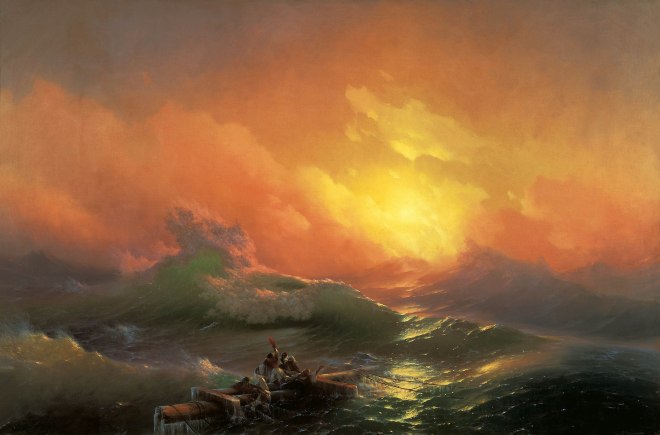
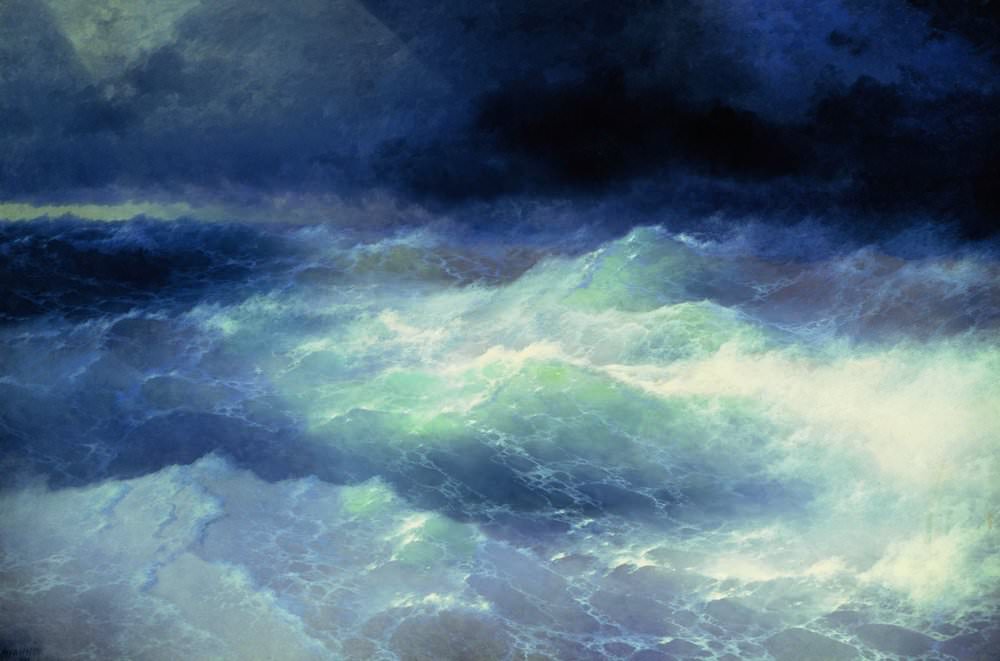
“Parmi les vagues” est l’une des peintures les plus spectaculaires d’Aïvazovski qui représente une tempête marine la nuit. Ce tableau est considéré comme le summum de l’habileté du peintre de marine car il est difficile d’imaginer une tâche plus difficile que l’image d’une immense colonne d’eau qui occupe la partie principale du tableau.

“Parmi les vagues” est une peinture d’une échelle impressionnante mesurant 285 X 429 cm, et sa taille souligne l’immensité et la puissance naturelle de la mer lors d’une tempête. Peut-être à cause de sa taille, la toile n’a pas été peinte dans son atelier, mais à la place, Ivan Aïvazovski l’a peinte dans la galerie d’art de Feodosia où elle se trouve aujourd’hui. En fait, la toile n’a été exposée nulle part ailleurs et n’a jamais quitté Feodosia. 

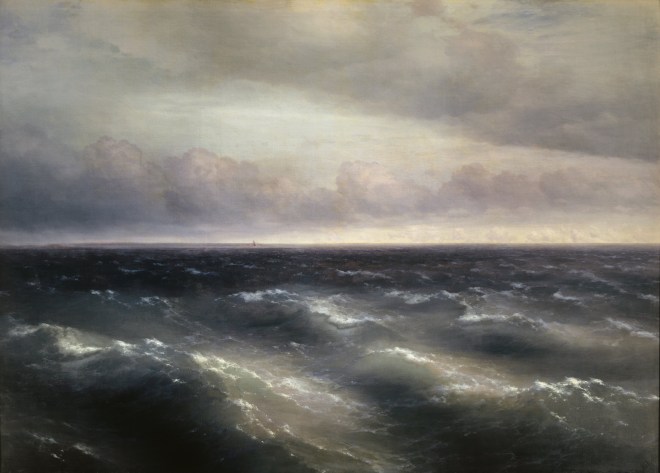
“Parmi les vagues” est la suite d’une œuvre distincte intitulée “La mer Noire” qui a été peinte en 1881.

Si vous regardez la peinture sous différents angles, le niveau de l’écume et la hauteur des vagues semblent changer.
Among the waves (Среди волн) by Ivan Aivazovsky (Иван Айвазовский)
Among the waves (Среди волн) by Ivan Aivazovsky (Иван Айвазовский) – 1898

Auteur : Ivan Aïvazovski (Иван Айвазовский) / Nom : Parmi les vagues (Среди волн) / Forme d’art : Peinture / Style d’art : Romantisme / Genre : Marine / Technique : Huile / Matière : Toile / Date de création : 1898 / Taille : 284 X 429 cm / Emplacement : Feodosia Art Gallery (nommé après d’IK Aivazovsky)

Aïvazovski avait déjà 81 ans lorsqu’il a peint la toile “Parmi les vagues” en 1898, et malgré son âge, il a créé la peinture en seulement 10 jours.

Au début, il a peint un petit bateau avec des marins qui ont pu s’échapper d’un navire en train de couler au centre de la toile, mais après une conversation avec un naval expérimenté, il l’a retiré. Aïvazovski était un peintre toujours à la recherche d’un maximum de réalisme et de véracité de ses œuvres et l’officier de marine avait fait remarquer qu’un si petit bateau n’aurait pas résisté à l’assaut de telles vagues et aurait coulé.

Pour créer la toile, une large gamme de couleurs claires, ainsi que des tons riches et profonds, ont été utilisés. Le résultat est que grâce à des nuances de couleurs incroyablement habilement sélectionnées, l’eau semble transparente et mouvante. C’est l’une des représentations artistiques les plus précises et les plus réalistes de la mer pendant une tempête.

Sur la toile, vous pouvez voir une mer orageuse roulée par des rafales de vent, de l’écume et la lumière argentée de la lune et des étoiles que vous ne pouvez pas voir. Une fine bande de couleur gris-bleu sur la gauche sépare la mer orageuse d’un ciel sombre et nuageux.

La peinture nous montre toute la beauté et la force d’une mer déchaînée permettant au spectateur d’en profiter sans objets tiers ni détails gênants.

J’espère que vous avez apprécié ce tableau autant que moi,

Vous pouvez également lire nos articles précédents sur d’autres peintures d’Ivan Aïvazovski
Si vous avez aimé cet article, abonnez-vous, mettez des likes, écrivez des commentaires !

Partager sur les réseaux sociaux

Découvrez nos derniers posts


© 2023 Akirill.com – All Rights Reserved
Discover the painting “Among The Waves” by Ivan Aivazovsky

Bilingual booksLire en FrançaisContact us
American LiteratureFrench LiteratureRussian Literature

“Among the Waves” is one of Aivazovsky’s most spectacular paintings which depicts a sea storm at night. This painting is considered the height of the skill of the marine painter because it is difficult to imagine a more difficult task than the image of a huge water column that occupies the main part of the painting.

“Among the Waves” is a painting of impressive scale measuring 285 X 429 cm, and its size emphasizes the immensity, and natural power of the sea during a storm. Maybe because of its size it was not painted in his workshop, but instead Ivan Aivazovsky painted “Among the Waves” in the art gallery of Feodosia where it remains today. Actually, the canvas was not exhibited anywhere else and never left Feodosia. 

“Among the Waves” is a continuation of a separate work called “The Black Sea” which was painted in 1881.

If you look at the painting from different angles, the level of foam and the height of the shafts appear to change.

Among the waves (Среди волн) by Ivan Aivazovsky (Иван Айвазовский)
Among the waves (Среди волн) by Ivan Aivazovsky (Иван Айвазовский) – 1898

Author: Ivan Aivazovsky (Иван Айвазовский) / Name: Among the waves (Среди волн) / Art form: Painting / Style of art: Romanticism / Genre: Marine / Technique: Oil / Material: Canvas / Date of creation: 1898 / Size: 284 X 429 cm / Location: Feodosia Art Gallery (named after I. K. Aivazovsky)

Aivazovsky was already 81 yeas old when he painted the canvas “Among the Waves” in 1898, and despite his age he created the painting in just 10 days.

At first he painted a small boat with sailors who were able to escape from a sinking ship in the center of the canvas but after a conversation with an experienced naval he removed it. Aivazovsky was a painter always striving for maximum realism and truthfulness of his works and the naval officer had remarked that such a small boat would not have withstood the onslaught of such waves and would have sunken. ecume

To create the canvas, a wide range lights colors, as well as rich, deep tones, was used.  The result thanks to an incredibly skillfully selected shades of colors is that the water seems transparent and moving. This is one of the most accurate and realistic artistic depictions of the sea during a storm.

On the canvas you can see an stormy sea rolling in gusts of wind, foam and the silvery light of the moon and stars which you cannot see. A thin strip of grayish-blue color on the left separates the stormy sea from a dark and cloudy sky.

The painting show us all the beauty and strength of a storming sea allowing the viewer to enjoy it without any third-party objects and distracting details.

I hope you enjoyed this painting as much as I did,

You can also read our earlier articles about other paintings by Ivan Aivazovsky

If you liked this article, subscribe , put likes, write comments!
Share on social networks
Check out Our Latest Posts


© 2023 Akirill.com – All Rights Reserved
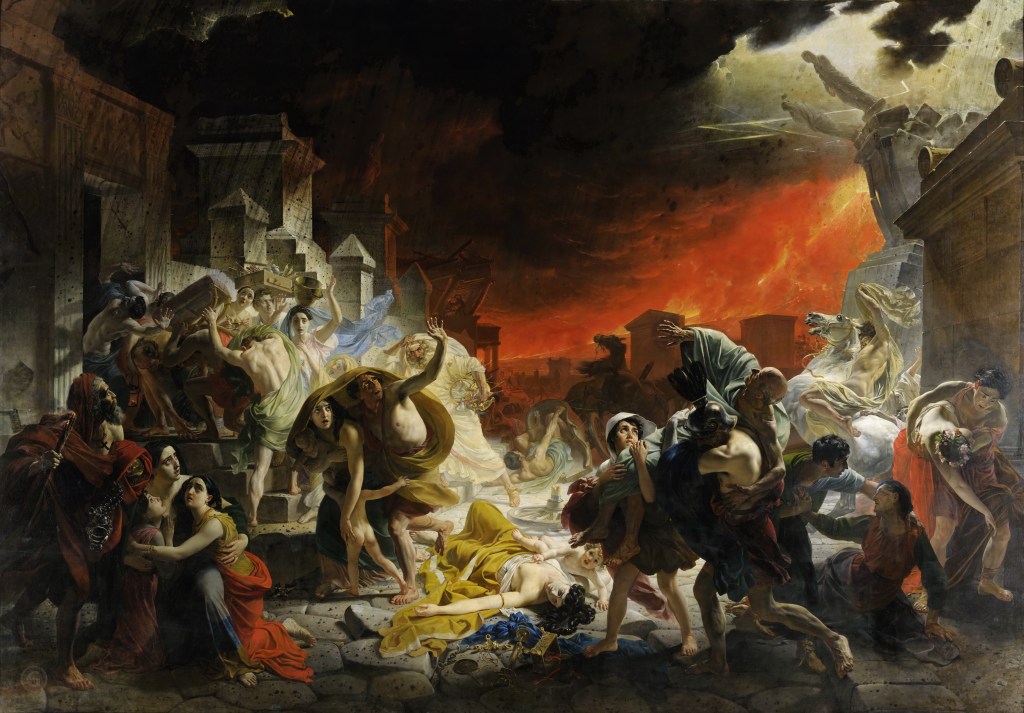
The Last Day of Pompeii by Karl Bryullov

Lire en Français

The canvas “The Last Day of Pompeii” was created at the intersection of classicism and romanticism. The composition is in the spirit of classicism in the way that all the episodes are enclosed in a triangle, but however the picture is devoted to the real tragedy of the people and not to an idealized image, which makes it a work in the style of romanticism.

“The Last Day of Pompeii” is an oiled painting by Karl Bryullov and is a monumental canvas of 456.5 by 651 cm which took almost 6 years from the first sketches to the appearance of the final version in 1833. This canvas is considered one of the most significant works of the artist and is now in the State Russian Museum

The Last Day of Pompeii by Karl Bryullov

In the summer of 1827, Karl Bryullov visited the excavations of Pompeii where he got the idea to paint a large canvas dedicated to the death of Pompeii, and even received permission from the Neapolitan King to take measurement and make sketches of any architectural structures discovered during the excavations that interested him.

Before starting the work on the canvas, Karl Bryullov carefully studied historical documents related to the eruption of Vesuvius reading eyewitness accounts of the events making his painting as accurate as possible.

He chose the Street of the Tombs (Strada dei Sepolcri or Via dei Sepolcri) which he visited in 1827 as the scene of action, which show people trying to escape the eruption of Vesuvius. The sky is covered with dark clouds, buildings are collapsing and long and sharp lightning cuts through the darkness. The tragedy exposes their feelings and show the essence of humain souls. Drapery plays an important role in the canvas and demonstrates the painter’s good acquaintance with the masterpieces of ancien art.

Countess Yulia Samoilova

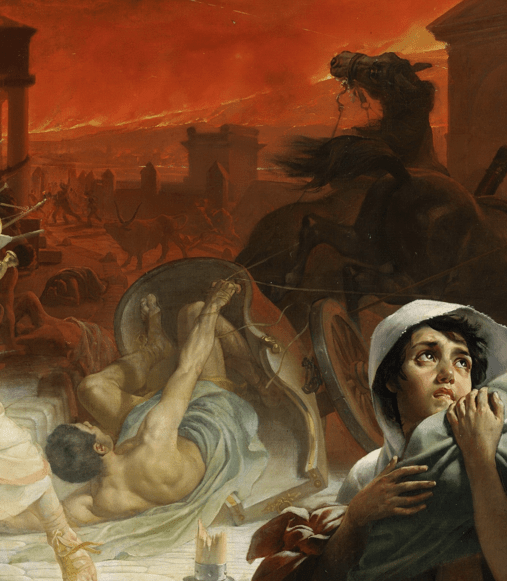
In the center of the picture is a noble lady fallen off a chariot with a young child who did not yet understand the death of his mother. Most likely, the model was Countess Yulia Samoilova, who was Bryullov’s mistress for many years and whom he depicted in several more images. This woman symbolizes the death of the ancient world, and at the same time the child reaching out to his mother is perceived as the beginning of a new world which should arise on the ruins of the former without breaking living ties with the past.

The Last Day of Pompeii (part mother and baby) by Karl Bryullov

The chariot from which the woman fell is still visible and is being pulled away by distraught horses.

On the right is another horse rearing up symbolizing the insane element.

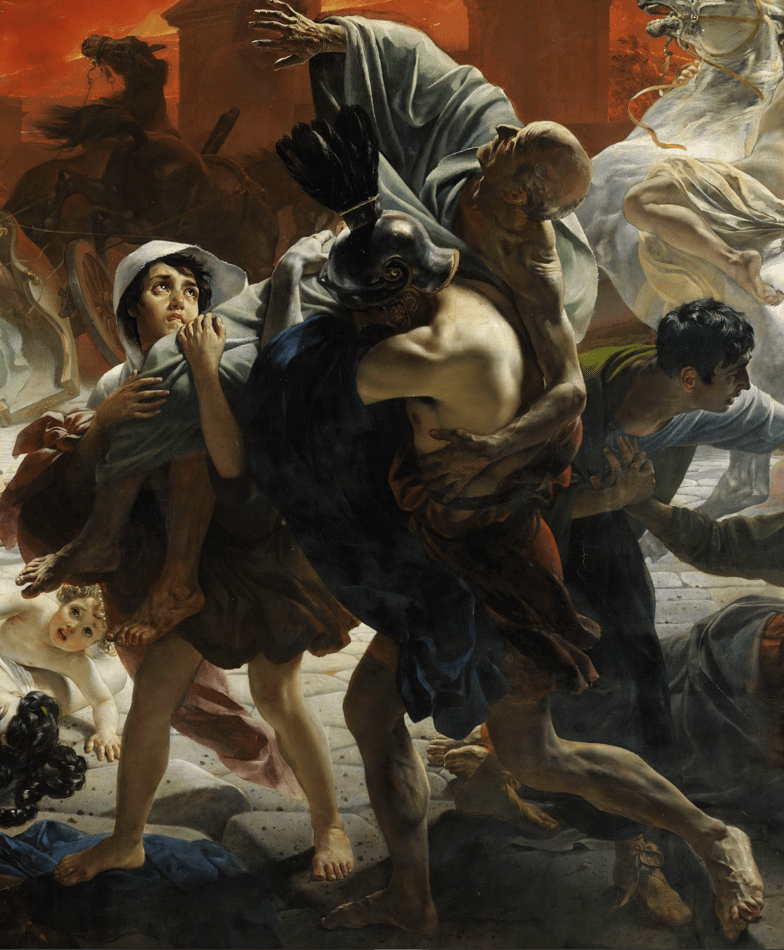
We can also see a young man trying to persuade his exhausted mother to run away with him, while she is pushing him away which gives us a vivid impression of maternal sacrifice.

The Last Day of Pompeii (part mother and son) by Karl Bryullov

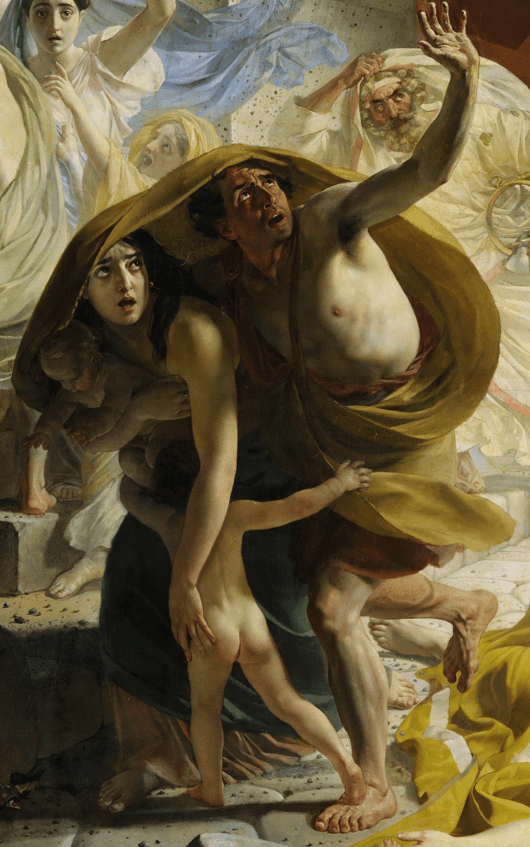
Two sons carry their old father forgetting about themselves and living only in fear for his life. And here is another family where the husband tried to cover his family. We can see that both parents watch the Vesuvius with horror

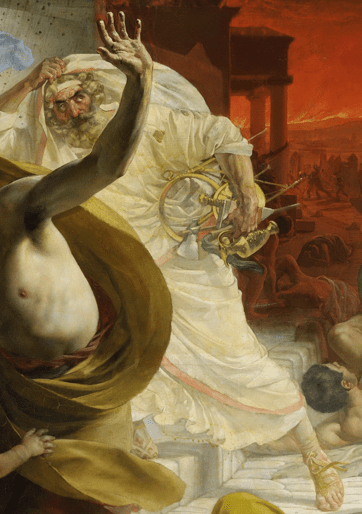
Karl Bryullov depicted Pagan priest trying to take his wealth with him. The pagan priest trying to escape can be seen as a symbol of the departure of the old world and paganism. At the same time he painted a Christian clergyman bravely looking at the furious Vesuvius, who can be identified by the cross on his chest. It is clear that Bryullov opposes Christianity to paganism and is not in favor of the latter. We also see a mother who has taken refuge close to the priest while enclosing her daughters with her arms in a protective gesture.

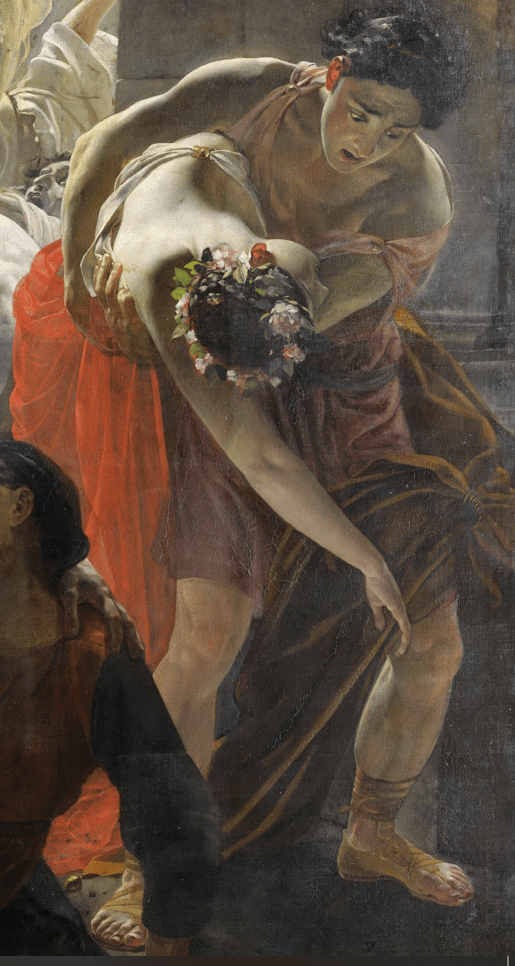
At the right edge of the canvas is a couple of newly wedded and one of the saddest scenes, showing that there are moment in life when grief turns out to be stronger than the fear of death.

The Last Day of Pompeii (part newly wedded) by Karl Bryullov

The author also depicted himself and his beloved among people who are trying to hide in the tomb. We can see the artist trying to save his most valuable things

The Last Day of Pompeii (part himself
) by Karl Bryullov

The buildings in his painting are collapsing depicting what really happens during an earthquake of 8 points

In ‘The Last Day of Pompeii’, the artist gives us the opportunity to meet different people and to sympathize with them. This is the story of a disaster very well painted with phenomenal lighting.

I hope you enjoyed this painting.

If you liked this article, subscribe , put likes, write comments!.
Share on social networks
Check out Our Latest Posts