
| Livres bilingues | Read in English | Contactez-nous |
| Littérature américaine | Littérature française | Littérature russe |
“Transporteurs de barges sur la Volga” est un tableau culte du grand peintre russe Ilya Efimovich Repin. La taille de la toile principale est de 62 cm sur 97 cm et est exposée dans la galerie Tretiakov. Le tableau a été créé dans la période 1870-1873 et a suscité des éloges internationalles pour sa représentation réaliste des difficultés des travailleurs. Les historiens de l’art définissent le genre de cette peinture comme du naturalisme avec des éléments de réalisme critique.
L’un des conflits de Repin était sa réticence à prêcher et à exprimer toute moralisation avec ses œuvres. Il a essayé de suivre les idées de l’art pur en ayant à la fois sa position civique et l’a inconditionnellement véhiculée dans ses œuvres. Les Barge Haulers sur la Volga sont dépourvus de moralisation et démontrent l’histoire humaine, d’une part, mais aussi, pour ainsi dire, repoussent les histoires de ces personnes à l’arrière-plan, exposant le nerf du travail des esclaves et de la division de classe.
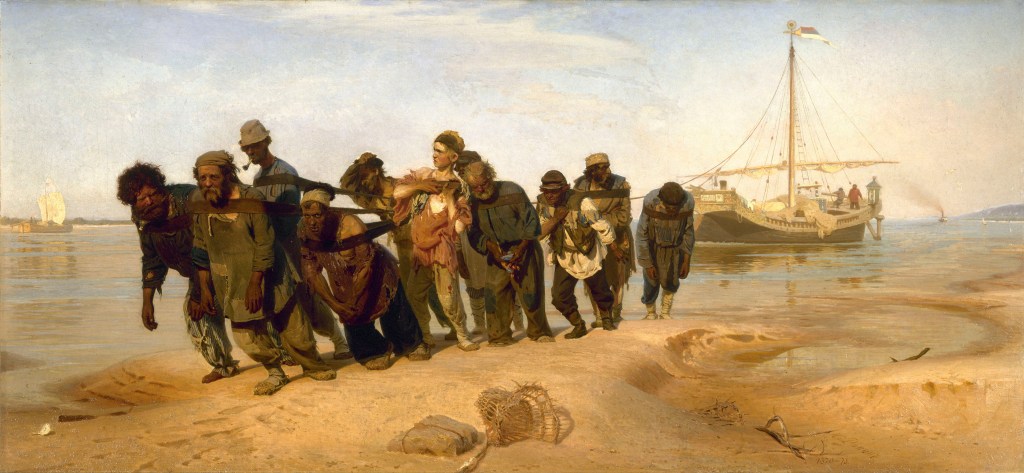
L’idée de la peinture est venue à Ilyia Repine en 1869 lorsqu’il a vu des transporteurs de barges sur la Neva et a été marqué par leur apparence sévère et épuisée. Ce sont des ouvriers du navire dont les tâches comprenaient tout ce qui concernait le navire et la cargaison, comme le chargement et le déchargement des marchandises, le retrait d’un navire lourd des hauts-fonds, la fermeture de trous, le renflouement de l’eau. Le transport de barge par les transporteurs a été officiellement interdit en 1929, et avant la révolution russe, on pouvait encore trouver des transporteurs par barge sur les petites rivières et les sections infranchissables des grands fleuves.
En mai 1870, Ilya se rendit sur la Volga où il fit la connaissance étroite des transporteurs de barges et dessina de nombreux croquis de personnages et de paysages. La même année, Ilya Repin a réalisé des croquis de la composition représentant deux solutions, différant principalement par le sens de déplacement du gang des barges.
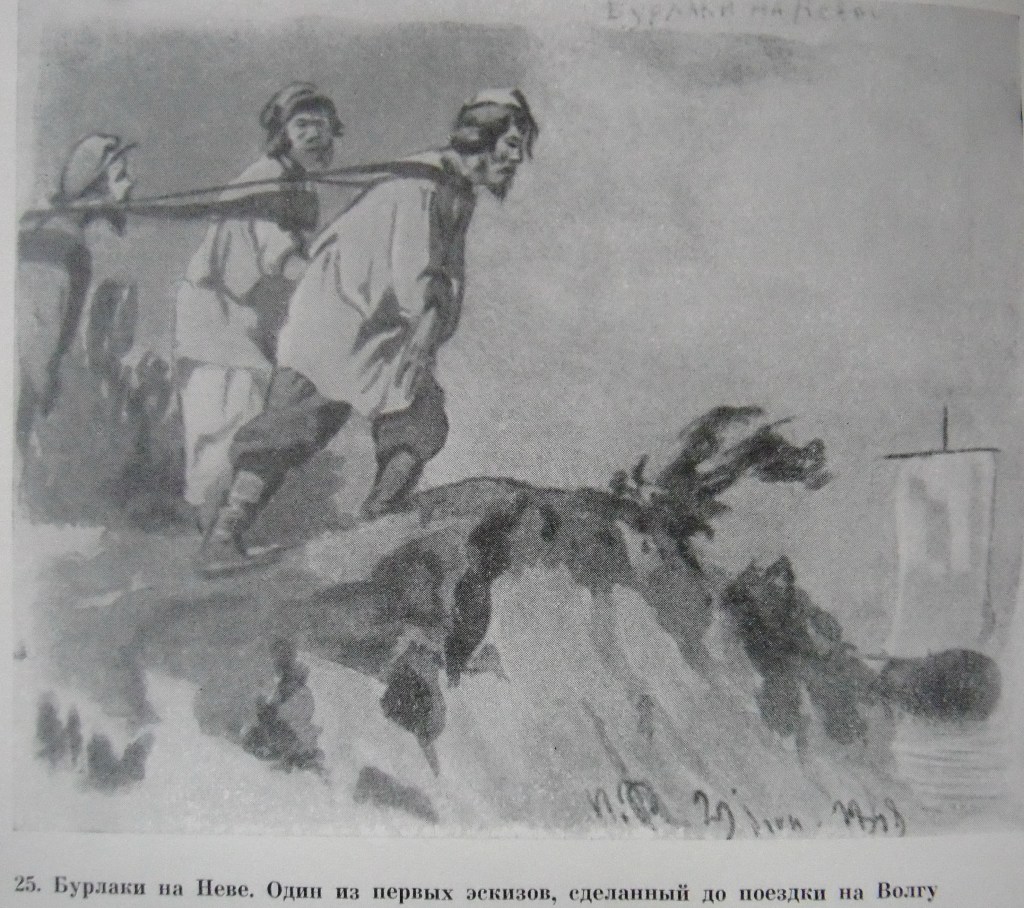
Une des premières esquisses
Été 1872, Repin retourna sur la Volga dans le village de Shiryaevo près de Samara et réécrivit l’image tout en conservant sa composition.
On croit souvent que Repin a écrit ses transporteurs de barges comme illustration d’un poème de Nikolai Alekseevitch Nekrasov, mais la vérité est que Repin n’a eu connaissance de ce poème que 2 ans après avoir terminé sa toile et n’était pas d’accord avec le poème.
La principale différence entre les «transporteurs de barges» de Repin et d’autres peintures de transporteurs de barges est que dans d’autres peintures, ils sont représentés comme une masse sombre, des gens aux visages indiscernables, semblables les uns aux autres, comme des fourmis tirant une énorme charge dans une fourmilière mais dans Repin « transporteurs de barges » chaque burlak est une personnalité, un individu, pas comme les autres.
Dans les années 30, une deuxième augmentation de la popularité des “Transporteurs de barges sur la Volga” s’est produite en URSS. Les “Transporteurs de barges sur la Volga” sont devenus une véritable icône, un standard de l’écriture picturale et un objet culte du réalisme social en URSS. L’illustration des «transporteurs de barges sur la Volga» remplissait tous les manuels de l’ère soviétique et constituait l’une des principales illustrations de la cruelle oppression du peuple par le régime tsariste criminel.
Que voit-on dans « Transporteurs de barges sur la Volga » ?
Il y a onze hommes, leur nombre étant déterminé d’après le poids du navire chargé, à raison d’environ 250 livres par personne. Ils tirent une péniche derrière eux et peuvent être considérés comme symbolisant l’Empire russe.
Les transporteurs de barge sont combinés en composition en 3 groupes clairement visibles.
Le premier groupe est composé de quatre personnages avec Kanin en tête, le second, également de quatre personnages, parmi lesquels l’image du jeune transporteur de barges Larka se détache et domine, et, enfin, le dernier groupe de trois, avec des figures moins significatives et expressives.
Dans le premier groupe, on voit à quel point tout est fort et magistralement arrangé. Il y a une unité compacte, mais avec une grande complexité du contour extérieur, ce qui lui donne de la vitalité. Les têtes sont placées de manière à ce que chacune d’elles soit clairement visible sur un fond libre, et représentant les personnages dans une forte inclinaison, Repin lève la tête pour que leurs visages soient visibles. Représentant frontalement les visages des transporteurs de barges du premier groupe, I. Repin ne fait que regarder directement le public à l’extrême droite (Ilka Sailor). Kanin regarde quelque part au loin, et le regard du rouquin est tourné vers Kanin. Cela permet d’atteindre la liberté d’expression. Les personnages principaux ne posent pas, mais vivent leur vie. Leur attrait pour le public en aurait fait des raisonneurs, ce qui était particulièrement dangereux dans l’image positive du sage Kanin.

“La stalle” – la deuxième image la plus puissante de l’image avec Kanin – représente visuellement le centre de toute la partie figurée de la composition. À droite et à gauche de celui-ci se trouve un nombre égal de figures de transporteurs de barges. Le groupe avec Larka est construit sur de forts contrastes d’images. La jeunesse de Larka, son impatience et son irritation de jeunesse s’opposent, d’une part, à l’épuisement d’un phtisique, et d’autre part, au calme flegmatique d’un vieil homme expérimenté qui sait s’adapter à toutes les situations. Appuyé contre l’épaule de son voisin, il bourre calmement sa pipe. L’étal est l’image la plus captivante par son lyrisme et son charme juvénile. Il est également mis en évidence en couleur. Son corps rose juvénile, les chiffons d’une chemise et d’un pantalon rouges tombants forment une tache colorée et lumineuse parmi les silhouettes sombres des transporteurs de barges.
Placée à côté du “Stall”, la figure d’un phtisique, avec sa forte inclinaison, relie le second groupe au premier et libère en même temps l’espace nécessaire devant le “Stall”.

La dernière figure du troisième groupe, représentée de face, la tête baissée, correspond à la figure extrême du premier groupe, comme si elle fermait toute la masse du gang. Le résultat est une sorte de rythme de mouvement ondulatoire.

Qui sont les gens de l’artel ?
Les croquis ont été conservés où Repin a indiqué les noms de certains des personnages.
Rasstriga-Kanin, le “bump” de l’artel est le premier sur le côté droit de la toile. Il avait l’habitude de chanter dans une chorale d’église, mais a été privé de la dignité de l’église et “a tiré la sangle” pendant 10 ans. Dans l’artel des transporteurs de barges, il a construit une carrière. Grâce à son intelligence et à sa persévérance, il est devenu le leader de l’équipe, le “bump”. C’est lui qui connaît le mieux le littoral et donne le rythme à tout le groupe. Les transporteurs de barge ont fait chaque pas de manière synchrone avec le pied droit, puis en tirant vers le haut le gauche. A partir de là, tout l’artel s’est déplacé comme un seul. Si quelqu’un perdait sa foulée, les gens se heurtaient aux épaules et le “bump” donnait l’ordre «foin – paille» (сено — солома), reprenant le mouvement au pas. Pour garder le rythme sur les sentiers étroits au-dessus des falaises, une grande habileté était requise de la part du contremaître.
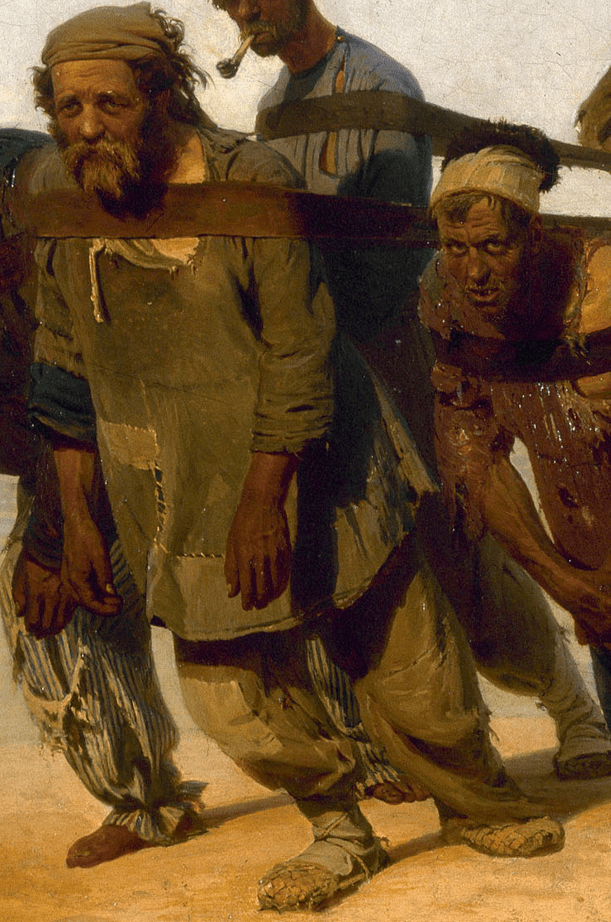
À côté de lui se trouve un géant à barbe noire, il est bronzé et recouvert de cheveux bouclés. Il est le « podshishelny », le bras droit du brigadier et l’homme le plus fort de tout l’artel. C’est un combattant de Nizhny Novgorod. En hiver, il gagne en participant à des combats. Et au printemps-automne “tire la sangle”. Il n’a pas plus de 40 ans et a encore assez de force physique. Il est placé dans l’équipe première, comme l’un des plus forts et des plus consciencieux.

Un peu derrière Rasstriga-Kanin, à sa gauche, se trouve Ilka le marin, qui était comme un comptable, achetait des vivres et donnait leurs salaires aux transporteurs de barges. Il sait travailler dur, donc il est aussi au premier rang. Mais il est clair que c’est une personne agressive. Lui seul nous transperce d’un regard méchant. Celui-ci jure facilement et vous envoie en enfer.

“Bondage” est le deuxième hack et marche derrière le Stall. Il est clairement paresseux, il marche droit, ne se fatigue pas dans son travail et essaie de déplacer une partie de son fardeau sur les épaules des autres. Il a réussi à dilapider le salaire pour tout le voyage et étant redevable à l’artel, maintenant il travaille pour se nourrir. Pourtant, il arrive toujours à fumer la pipe, c’est le mieux habillé de tous. Sa chemise n’est pas en guenilles, comme celles de ses camarades. Il porte un vrai chapeau, pas un chiffon noué. Très probablement, il fait partie des paysans qui ont une femme ou une mère à la maison qui s’occupe de ses vêtements.
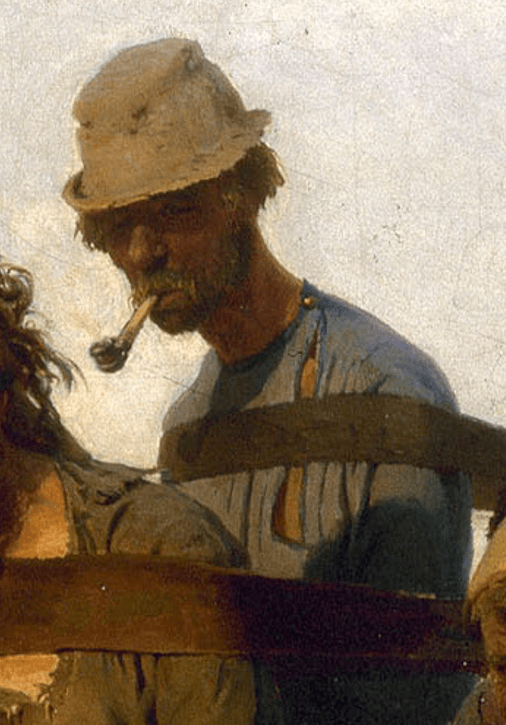
Derrière Ilka le marin se trouve Larka, le chef cuisinier et faucon (qui est responsable de la propreté des latrines sur le navire) et le plus jeune membre de l’artel. Le jeune garçon du village Larka nous frappe particulièrement. Peut-être que sa famille l’a envoyé gagner de l’argent supplémentaire ou qu’il a quitté la maison et essaie de se nourrir. Évidemment, c’est presque la première fois qu’il tire sur la sangle. Considérant ses devoirs plus que suffisants, Larka se dispute parfois et refuse avec défi de tirer la sangle. Maintenant, Il regarde le transporteur de péniche à côté de lui, qui clairement ne se donne pas trop de mal dans la ligne. L’homme paresseux fume même une pipe.

Les “hackers” sont simplement des négligents, qui parfois ne sont pas opposés à rejeter une partie du fardeau sur les épaules des autres.

Derrière lui, la tête de Kalmouk est visible. Selon Repin, c’était “un transporteur de péniches avec des yeux comme s’ils étaient traversés par des carex”. Il avait également un front large, ingénieux et intelligent; montrant que ce n’est pas un homme stupide… Il portait une chemise sans ceinture, les ports se sont décollés sur ses jambes noires nues.
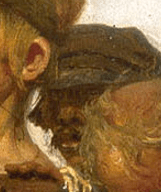
Derrière lui se trouve un homme d’environ 60 ans. Il est émacié, essuyant désespérément la sueur de son front avec sa manche. Très probablement, il souffre de consommation, et ce pourrait être sa dernière saison de burlach.

Dans le dernier groupe, nous voyons d’abord le superviseur, il s’assure que les autres ne sont pas paresseux et tire la sangle avec tout le monde. Contrairement aux autres il porte des bottes, et ses vêtements sont plus neufs.
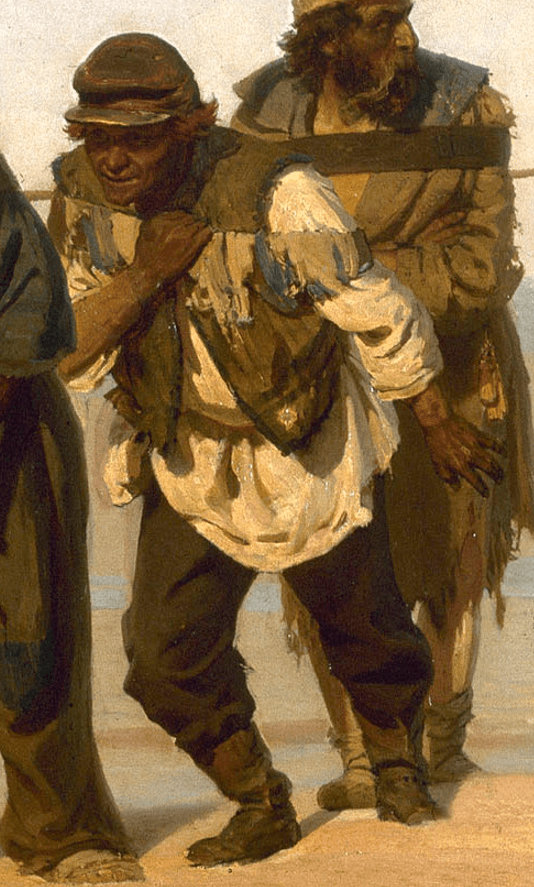
L’avant-dernier, est un grand Grec qui regarde avec colère la barge, où le propriétaire crie quelque chose aux transporteurs de barge.

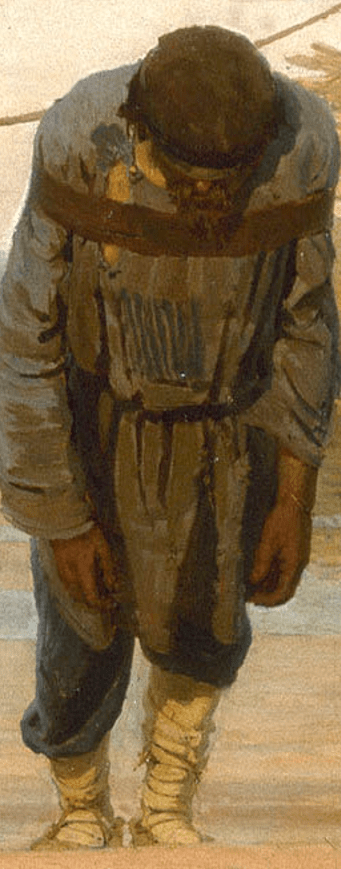
“Inerte” est la personne avec l’apparence la plus déprimante et vient en dernier. On dirait qu’il est sur le point de s’effondrer. Ses mains sont mollement baissées. La tête est si basse sur la poitrine que le visage n’est pas visible.
Habituellement, les derniers membres de «l’équipe» étaient expérimentés, mais faibles ou malades. Ils marchaient normalement un peu à l’écart, à leur rythme et regardaient leurs pieds, puisque leur fonction était de s’assurer que la ficelle ne touchait pas les pierres. Ainsi, sa posture abattue et à la traîne ne signifie pas qu’il est malade.
Autres détails
Le drapeau sur les voiliers depuis l’époque de Pierre le Grand était hissé sur le mât de poupe (sur les navires de guerre, le drapeau d’État noir-jaune-blanc, sur les navires marchands, le drapeau commercial blanc-bleu-rouge). Au mât était accrochée une girouette par laquelle les marins déterminaient la direction et la force du vent. Repin, habitué au drapeau militaire de l’État, confond que sur le tricolore commercial, la bande blanche doit être en haut et non en bas, comme d’habitude. Seulement dix ans plus tard, en 1883, le drapeau tricolore blanc-bleu-rouge est devenu le drapeau national russe. Mais on dit aussi que l’ordre des rayures sur le drapeau n’était pas traité avec trop de soin, et qu’il était parfois soulevé à l’envers comme dans le tableau.

Il est intéressant de noter que Repin, qui a étudié la vie des transporteurs de barges, a décrit assez correctement à quoi ressemblait le câble de remorquage et l’endroit de sa fixation qui est tout en haut du mât. En attachant la corde au sommet du mât, les transporteurs de barges laissent le mât supporter l’essentiel du poids de la remorque. Avec une telle fixation, le vecteur de force est le même que si la barque était sous voile, c’est-à-dire que le pilote a la possibilité de contrôler le mouvement du navire à l’aide du gouvernail.

Le pilote est l’homme à la barre du navire, et en fait son capitaine. Il gagne plus que tout l’artel réuni. Il donne des instructions aux haleurs de barge et manœuvre à la fois le gouvernail et les poulies qui règlent la longueur de la ligne de remorquage.
“La pipe à eau”, distributeur d’eau, est le charpentier qui calfate et répare les navires, surveille la sécurité des marchandises et en assume la responsabilité financière lors des chargements et déchargements. Aux termes de son contrat, il n’a pas le droit de quitter le navire pendant le voyage et se substitue au propriétaire, gérant en son nom.

Depuis le XVIe siècle, il était de coutume de décorer la coque des bateaux de la Volga avec des sculptures complexes car on croyait qu’elles aidaient le navire à s’élever à contre-courant et ce navire ne faisait pas exception et avait de belles sculptures.
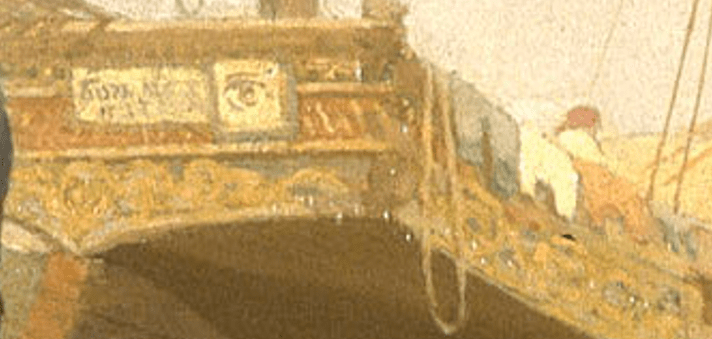
Lorsque Dostoïevski a vu «Transporteurs de barges sur la Volga», il était très heureux qu’Ilya Repine n’y ait mis aucune protestation sociale. Dostoïevski écrivit dans son journal qu’ils étaient «des transporteurs de péniches, de vrais transporteurs de péniches et rien de plus», et il ajouta que «aucun d’eux ne crie de l’image au spectateur:« Regardez comme je suis malheureux et dans quelle mesure vous devez au peuple !”
Les figures familières des transporteurs de barges sur la rive de la Volga sont un symbole éternel de patience illimitée, de travail acharné pour survivre, une sangle que les travailleurs ont dû tirer toute leur vie et de tristes échos du passé dans le présent.
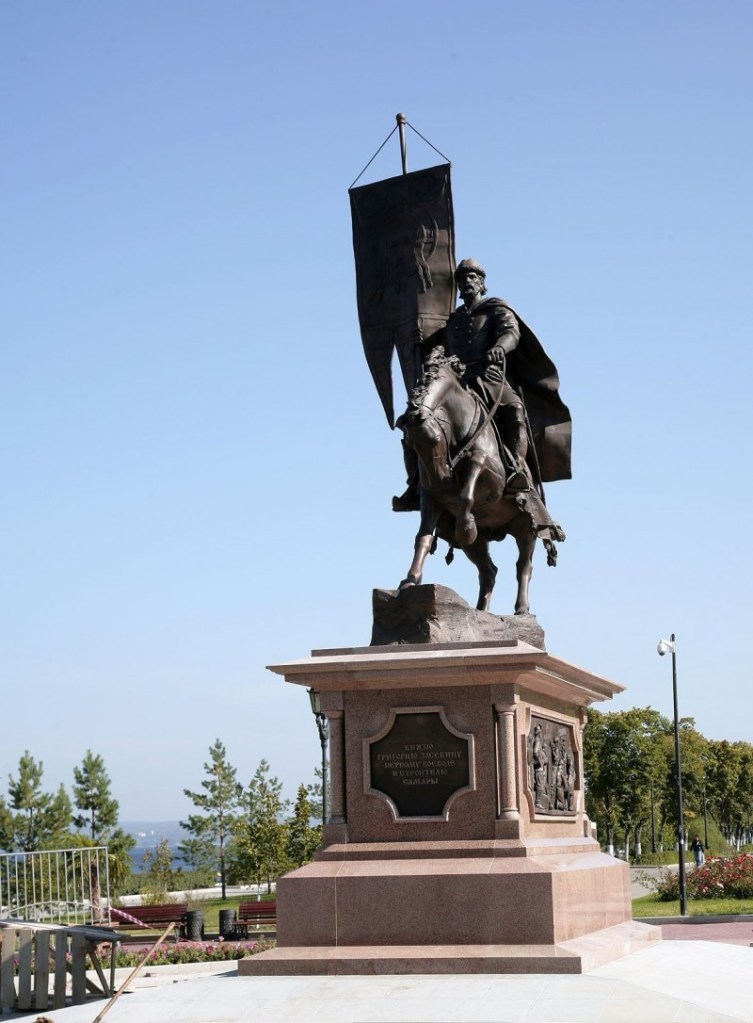
Vous pouvez trouver une magnifique sculpture de la peinture de “Barge Haulers on the Volga” par Ilya Repin à Samara.
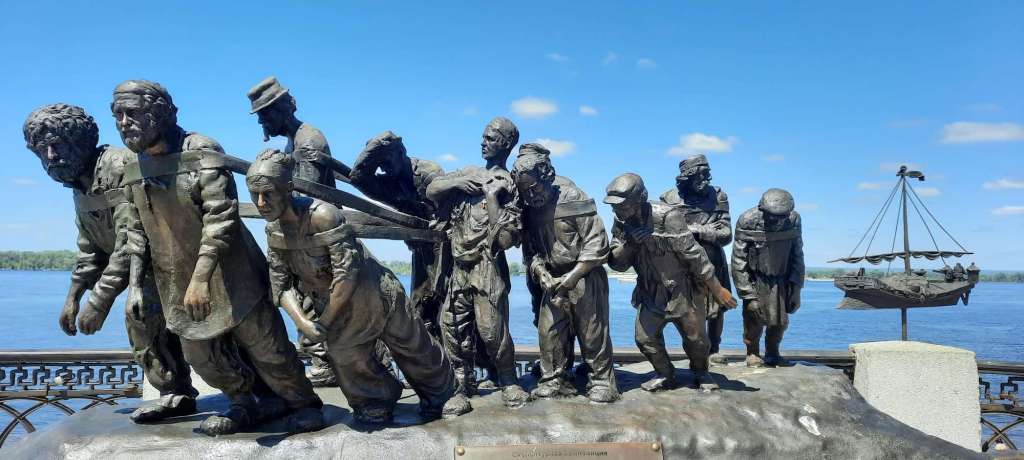
J’espère que vous avez apprécié cette toile autant que moi.
| Si vous avez aimé cet article, abonnez-vous, mettez des likes, écrivez des commentaires ! |
| Partager sur les réseaux sociaux |
| Découvrez nos derniers messages |






















 AKirill, Learn, apprenez, translation, traduction, livres bilingues, bilingual books