On this site we hope to help you learn, and to remove the difficulties caused by the difference of culture and language. Sur ce site nous espérons vous aider à apprendre, et à enlever la barrière causée par les différents languages et cultures.
Un autre superbe musée à visiter virtuellement est le Musée d’Orsey. Saviez-vous que le musée se trouvait dans une ancienne gare ? Vous pourrez également visiter l’une des plus grandes collections au monde de peintures et sculptures européennes de la fin du XIXe et du début du XXe siècle qui sont exposées dans ce musée.
La particularité du musée d’Orsey est que les expositions sont classées par ordre chronologique et non par personnalité, ce qui nous donne l’impression de visiter le passé et de voir l’histoire se dérouler devant nos yeux.
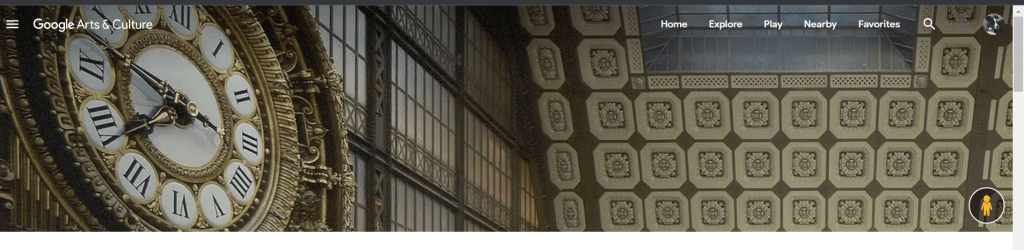
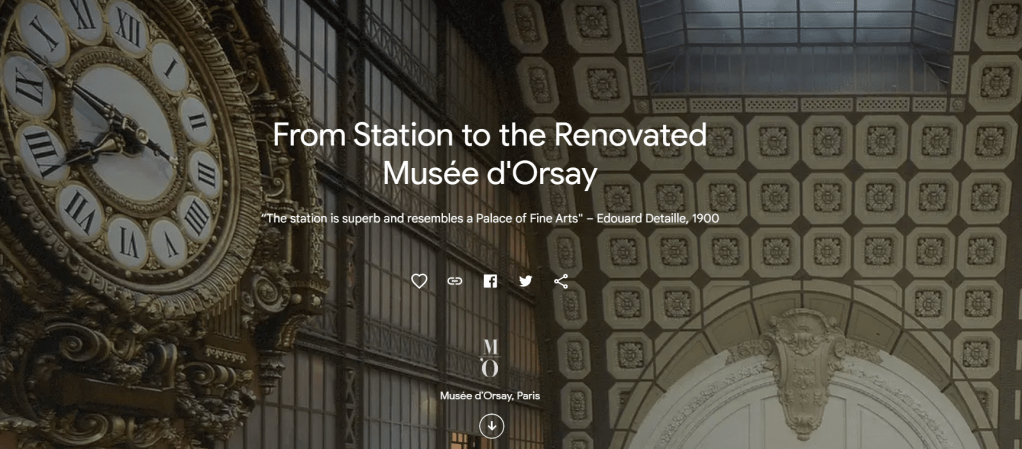
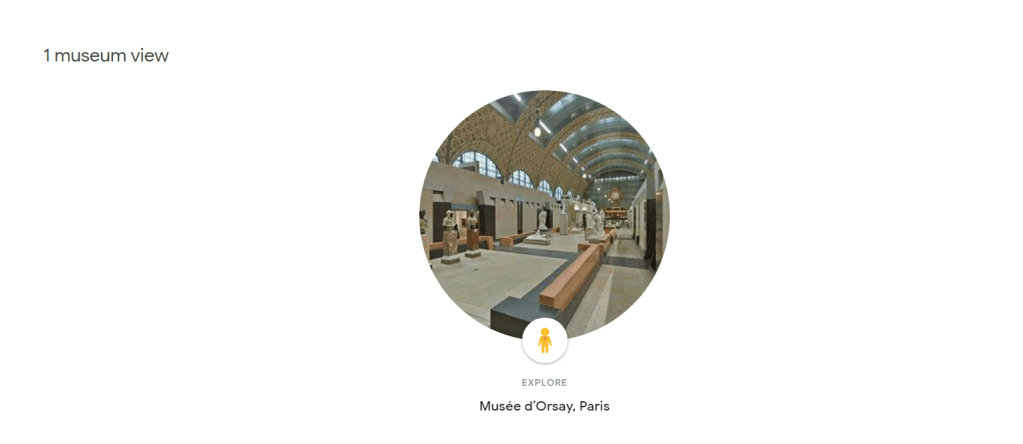
C’est la première chose que l’on voit sur la page et en cliquant sur l’icône jaune en bas à droite de l’image on peut directement visiter le musée.
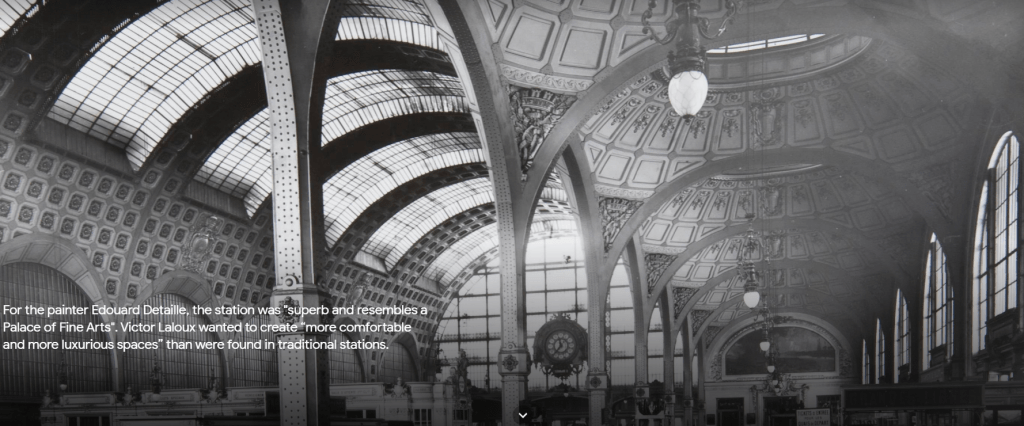
Mais il y a d’autres parties intéressantes sur la page. Voici l’histoire du Musée d’Orsey que j’ai beaucoup aimé
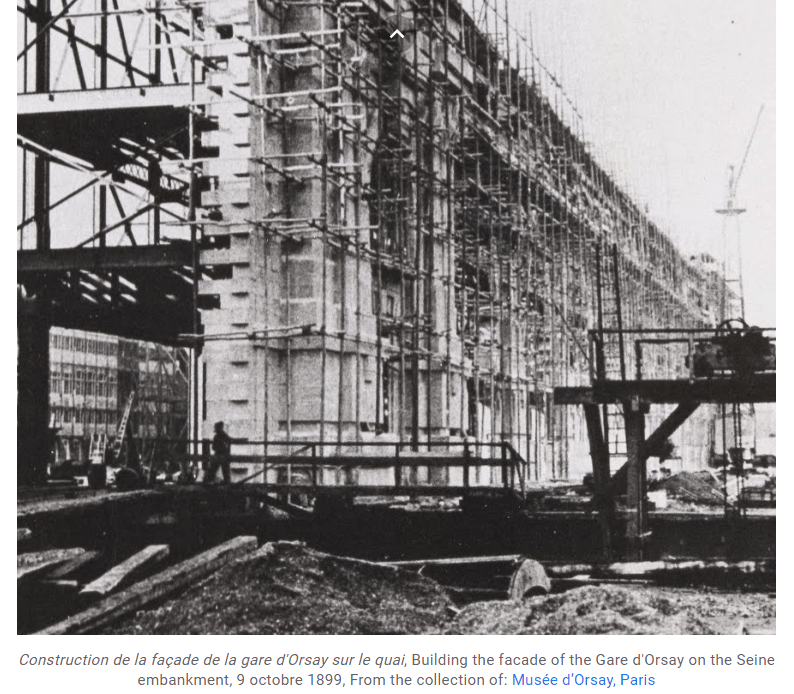
Et voici quelques photos de ma visite de l’histoire du musée
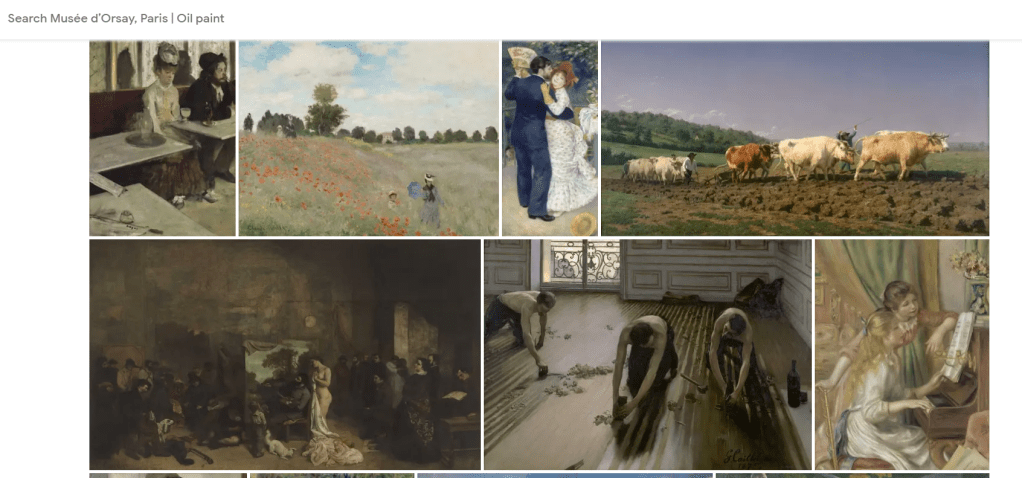
Ensuite, vous pouvez visiter les peintures par catégories.
Et voici quelques photos des peintures que j’ai visitées. Si vous passez la souris sur un tableau, le nom du tableau et de l’artiste s’affiche. Vous pouvez aussi cliquer sur le tableau qui le mettra sur une page entière avec ses détails.
Pour revenir au Musée d’Orsey virtuel je vous conseille de cliquer sur la flèche de retour de votre navigateur, je n’ai pas trouvé d’autre chemin pour revenir au musée.
La dernière partie est la visite virtuelle du musée proposée à la première ouverture du site
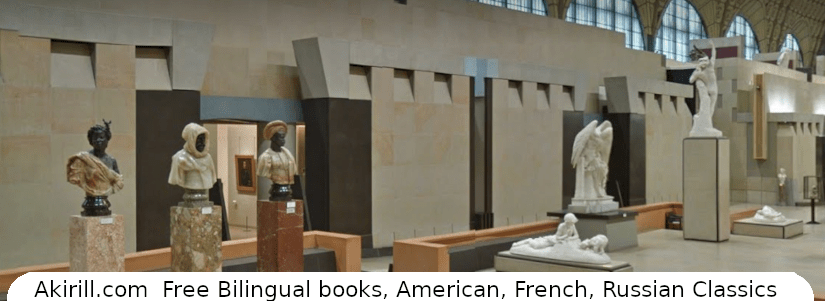
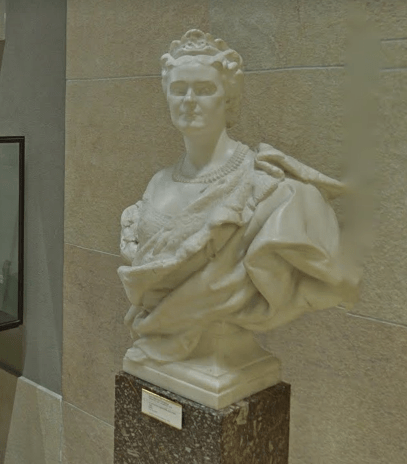
C’est aussi une belle visite, et voici quelques photos que j’en ai prises
Another beautiful museum to visit virtually is the Musée d’Orsey. Did you know that the museum was in an old gare station? Also you can enjoy one of the world’s largest collections of European paintings and sculptures of the late nineteenth and early twentieth centuries which are exposed in this museum.
The peculiarity of the Musée d’Orsey is that the exhibits are arranged in chronological order instead of according to personalities which give us the feeling of visiting the past and seeing history as it is being written.
This is the first thing we see on the page and by clicking on the yellow icon on the bottom right of the picture we can directly visit the museum.
But there are other interesting part on the page. The following is the history of the Musée d’Orsey which I really liked
These are a few pictures from my visit of the history of the museum
Then you can visit the paintings by categories
And here are a few pictures of the paintings I visited. If you pass the mouse on a painting the name of the painting and artist shows up. You can also click on the painting which will put it on a whole page with its details.
To go back to the virtual Musée d’Orsey I would advise to click on the go back arrow from your browser, I couldn’t find another way back to the museum.
The last part is the virtual visit of the museum as offer when you first open the site
It is also a beautiful visit, and here a few pictures I took of it
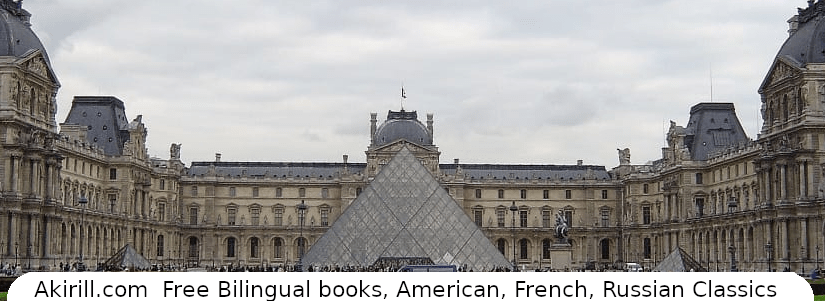
Saviez-vous que vous pouviez visiter le Louvre depuis votre maison ou n’importe quel endroit avec une bonne connexion Internet.
Le Louvre est l’un des musées d’art les plus visités au monde. Il abrite certaines des œuvres d’art les plus connues, notamment la Joconde et la Vénus de Milo, et comprend les meilleures œuvres d’art jusqu’au milieu du XIXe siècle, ainsi que des expositions de civilisations anciennes. Ses collections contiennent de l’art de l’Europe occidentale à l’Iran en passant par la Grèce, l’Égypte et le Moyen-Orient ; de l’Antiquité à 1848.
C’est la première page où choisir votre langue (en haut à gauche) et l’exposition que vous souhaitez visiter virtuellement.
Did you know you could visit the Louvre from your house or any place with a good internet.
The Louvre is one of the most visited art museum in the world. It is the home of some of the best-known works of art, including the Mona Lisa and the Venus de Milo and include the best works of art until the middle of the nineteenth century, as well as exhibits from ancient civilizations. Its collections contains art from Western Europe to Iran through Greece, Egypt and the Middle East; from antiquity to 1848.
This is the first page where to chose your language (on the top left) and the exposition you wish to virtually visit.
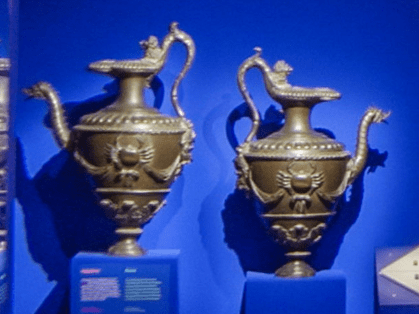
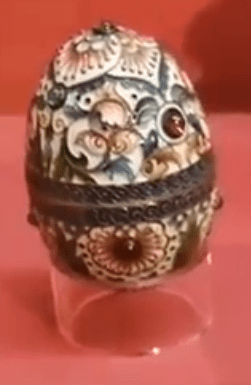
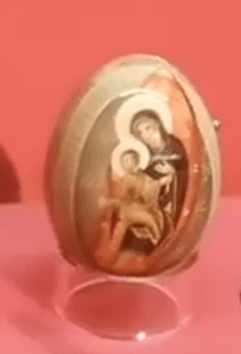
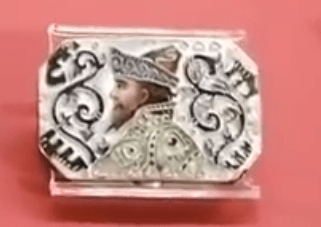
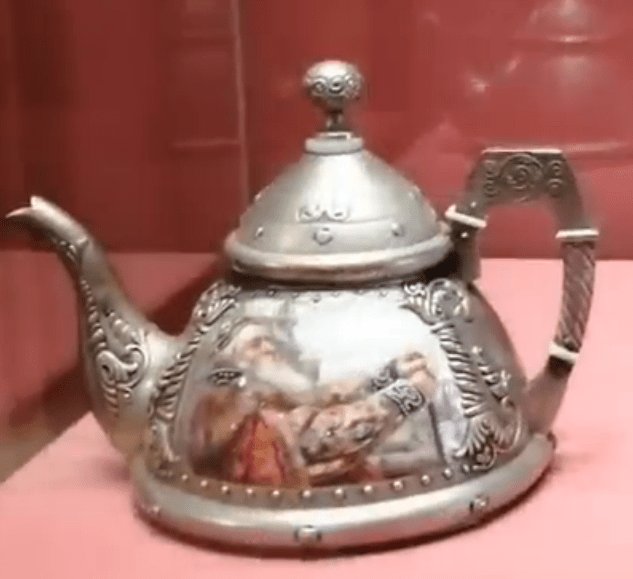
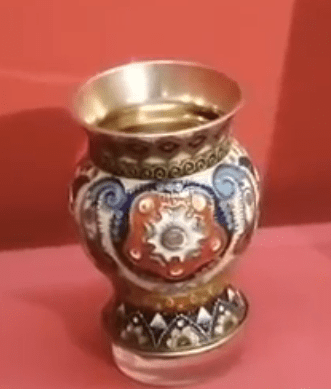
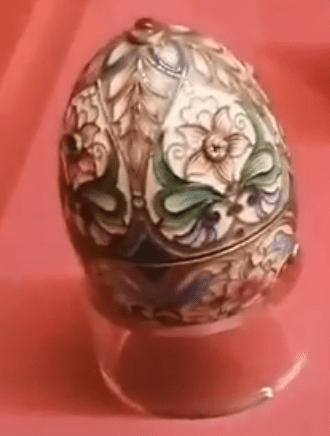
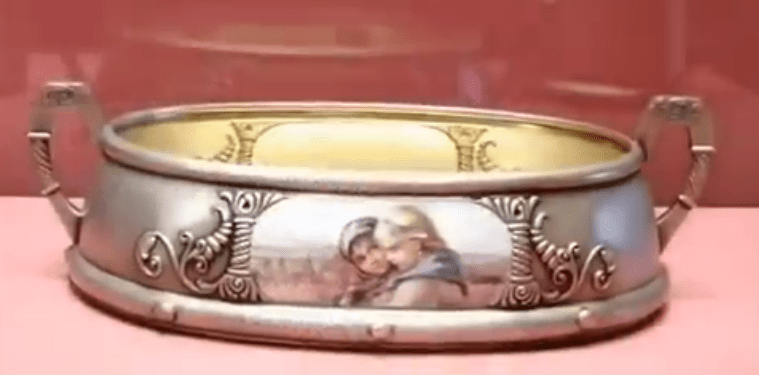
J’ai trouvé une vidéo très courte et agréable d’émail de Moscou à l’exposition Fabergé. J’aurais souhaité de la musique mais il y a des explications en russe pour ceux qui la comprennent. J’ai mis quelques photos de la vidéo et un lien pour que vous puissiez la regarder vous-même et j’espère l’apprécier autant que moi. Le signe montré à la fin de la vidéo dit: Service à thé et café O. Kurlyukov’s compagnie. Moscou. 1908-1917 . Argent, émail, nacre; monnayage, peinture, dorure.
I found a very short and nice video of a Moscow enamel at the Faberge exhibition. I would have wish for music but there are explanation in Russian for those who understand it. I put a few pictures of the video and a link so you can watch it yourself and I hope enjoy it as I did. The sign showed at the the end of the video say: Tea and coffee service O. Kurlyukov’s firm. Moscow. 1908-1917 . Silver, enamel, mother of pearl; coinage, painting, gilding.
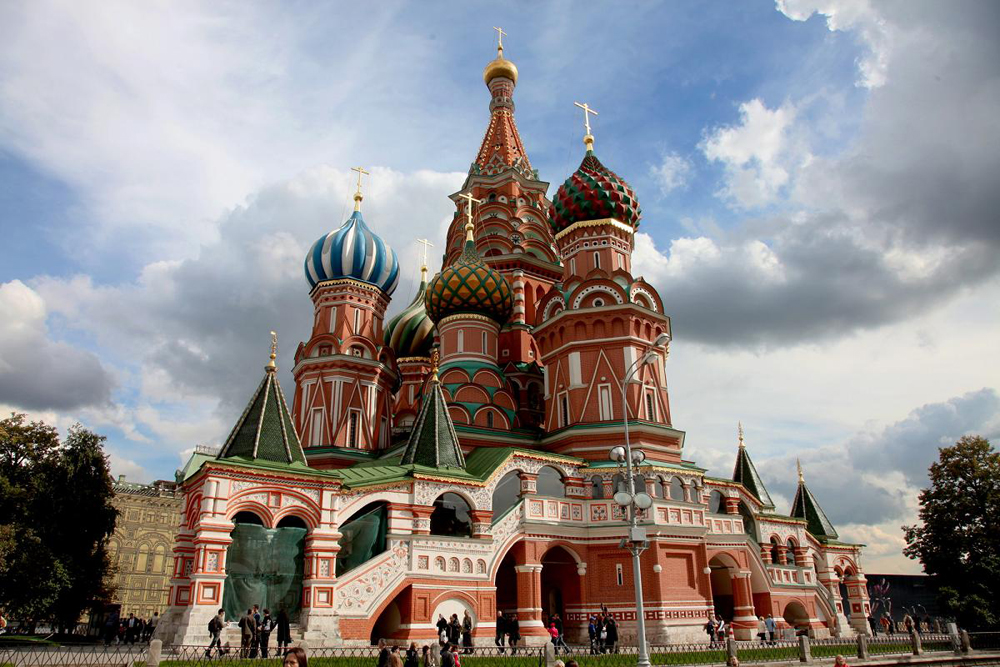
Saint Basil’s Cathedral, an architectural treasure of Moscow
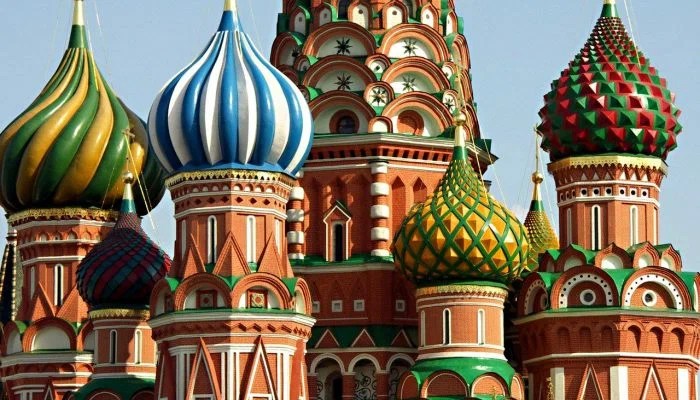
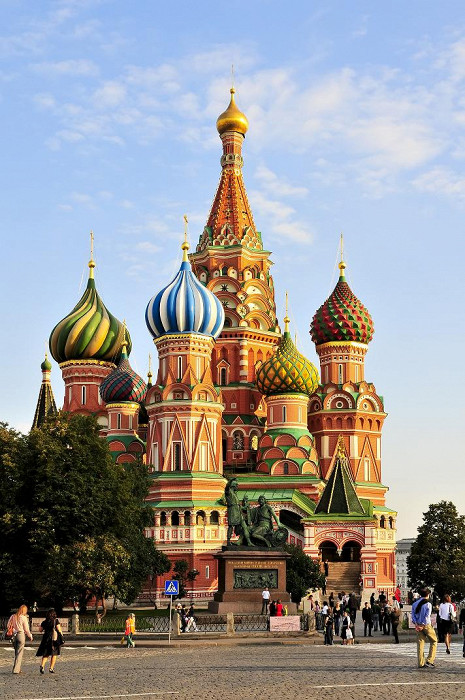
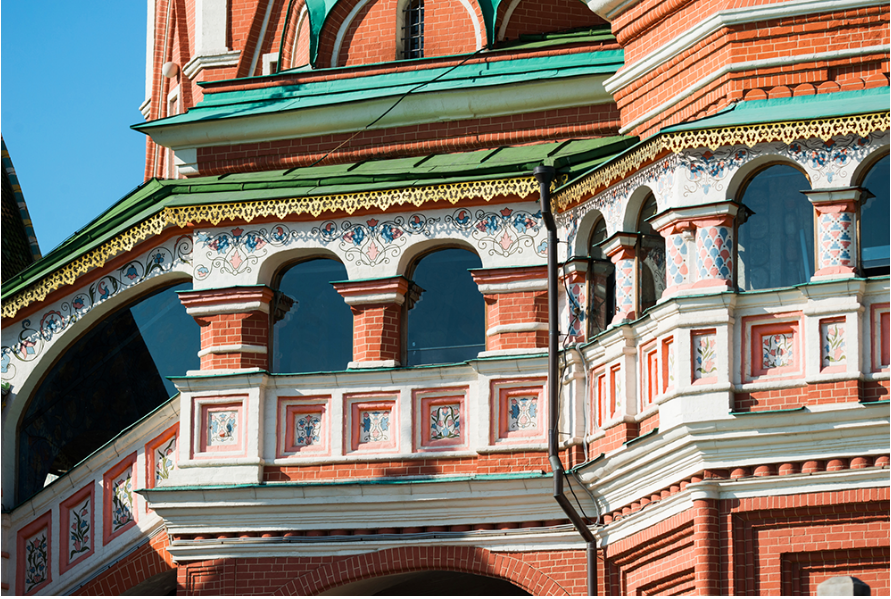
The extraordinarily beautiful and mysterious St. Basil’s Cathedral, or the Cathedral of the Intercession of the Virgin, on the Moat, flaunting on Red Square, is one of the most significant monuments of ancient Russian architecture of the 16th century. Neither before nor after it was built any such structure. It looks like a vault of eight churches, which surrounds the highest – the ninth. Such a temple still does not exist anywhere else in Russia. Even the bright pattern of the domes of the cathedral makes it look like a blooming Garden of Eden.
Saint Basil’s Cathedral
Each temple has its own entrance and lighting, however, the cathedral is a single building. The complexity and amazing combination of details of the St. Basil’s Cathedral are unparalleled in Russian architecture and had a huge impact on the development of Russian national architecture.
The cathedral was erected in 1555–1561. at the behest of Tsar Ivan the Terrible in honor of the conquest of the Kazan kingdom. It is believed that the architects who created it were deprived of sight. Even Stalin did not allow the building to be demolished, and during the war the temple was hidden from shelling. The cathedral is included in the Russian list of UNESCO World Heritage Sites and is a branch of the State Historical Museum.
The upper tier of the cathedral resembles a labyrinth, and the base is an eight-pointed star.
The cathedral unites ten churches (chapels), some of which were consecrated in honor of the saints, whose days of memory fell on the decisive battles for Kazan.
The central church was built in honor of the Intercession of the Virgin , around which separate churches are grouped in honor of: the Holy Trinity , the Entry of the Lord into Jerusalem , St. Nicholas of Velikoretsky , the Three Patriarchs: Alexander, John and Paul the New, Gregory of Armenia , Cyprian and Justina , Alexander Svirsky and Varlaam Khutynsky , placed on the same base-basement, and a chapel in honor of St. Basil the Blessed, after whose name the temple received a second, more well-known name.
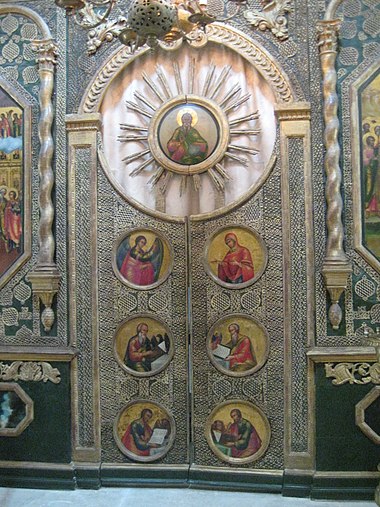
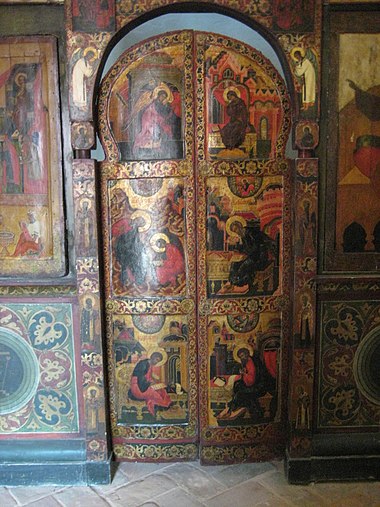
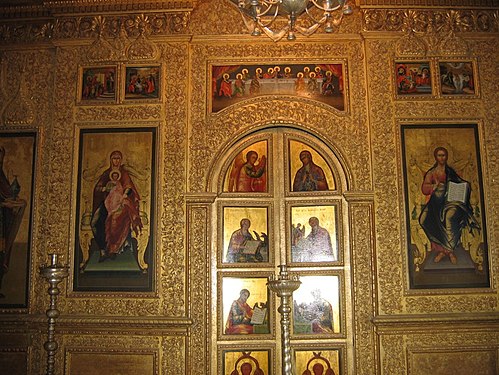
Royal Doors in the Church of the Intercession of the Blessed Virgin Mary, 2009Royal Doors of the Church of Cyprian and Justina 2012Royal Doors of the Church of the Entry of the Lord into Jerusalem, 2011Royal doors of the iconostasis of the Church of Varlaam Khutynsky, 2011Royal Doors of the Church of St. Nicholas Velikoretsky, 2007
The thickness of the walls of the foundation of St. Basil’s Cathedral reaches three meters. It is this thickness that allows it to securely hold as many as nine buildings. If you look at the foundation of the church, you can see that 8 small temples form an eight-pointed star – a symbol of the Virgin. There are larger churches in the ensemble of small churches. They are strictly oriented to the cardinal points and form symmetry. The main temple, with a huge dome and a tent, is the Protection of the Virgin, Her intercession.
During the campaigns of Ivan the Terrible to Kazan on today’s Red Square, “camping” wooden churches were erected in memory of the victories won.
On the day of the memory of Cyprian and Justina ( October 2, 1552), the next campaign ended with a victory over the Kazan Khanate and the annexation of the city to the Muscovite state. It was, the day after the Intercession of the Most Holy Theotokos, and Ivan the Terrible ordered to unite all the “marching” wooden churches into one stone temple in the name of the Intercession of the Virgin – Intercession Cathedral, but it stood only less than a year before to be dismantled, and finally a stone cathedral was laid in its place.
Already, in the autumn of 1554 were the first reliable mention of the construction of the Church of the Intercession of the Mother of God. The construction of this temple began in 1555 and lasted 6 years. The temple was built of brick, and its foundations , plinth and a number of details are made of white stone. In the western part of the cathedral there is a flat brick ceiling.
A legend about the architects Barma and Postnik which names became known only in 1895 told that they had been blinded by order of the the Tsar Ivan the Terrible so that they could no longer build such a temple, but Postnik could not be blinded, since for several years after the construction of the cathedral he participated in the creation of the Kazan Kremlin.
By 1559, in the fall, the temple main part was erected, and at the same period, all but the central church were consecrated.
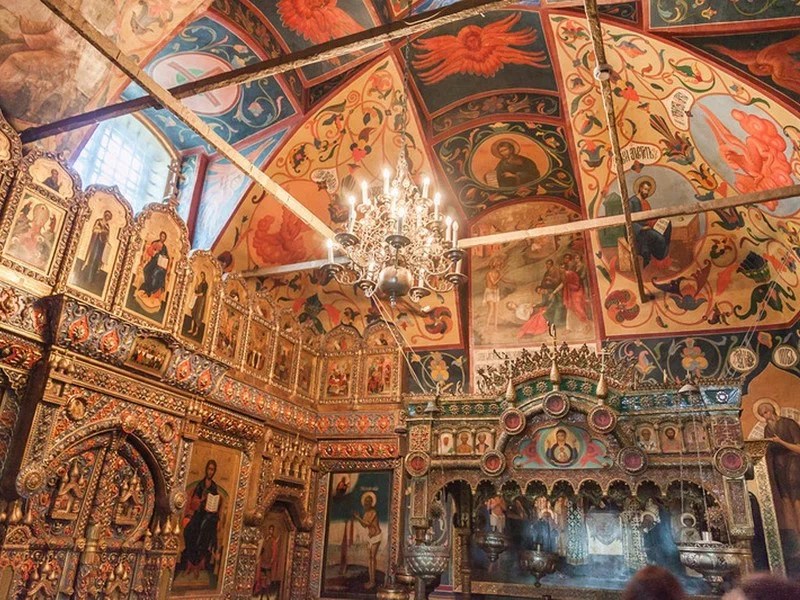
Despite the apparent grandiosity from the outside of St. Basil’s Cathedral the inside is quite small, accommodating a very small number of people during the service. That is because according to the plan of its creators, it should not have been too spacious, since during major church holidays the entire Red Square was the church, the place of execution, on which the clergy ascended, became a lectern, and the Pokrovsky Cathedral turned into the altar of an open-air temple. After all, there is no temple in Heavenly Jerusalem, but “there is only His Throne” … and the Intercession Cathedral – turned into an altar of a church in the open.
Finally, on June 29, 1561 according to the old calendar, the central Intercession Church of the cathedral was once consecrated in the name of the Intercession of the Most Holy Theotokos.
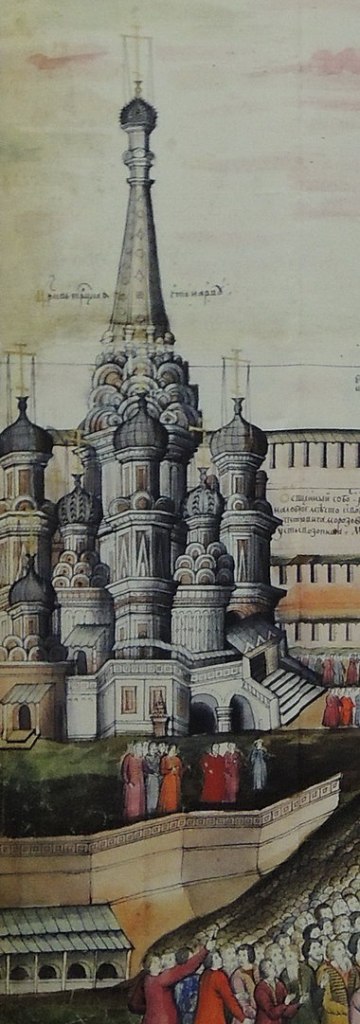
St. Basil’s Cathedral from the Book of the election of the Tsar and Grand Duke Mikhail Fedorovich, 1672 1673
The first changes to the Cathedral of the Intercession of the Virgin, on the Moat, took place almost immediately after construction and were associated with the name of the famous Moscow saint – St. Basil the Blessed. Before the appearance of a stone cathedral on this site, there was a wooden Trinity Church, where St. Basil often came to pray. In 1558, a lower church was added to the Pokrovsky Cathedral over the burial place of the Moscow miracle worker – St. Basil the Blessed. To build this temple, the builders dismantled part of the original cathedral.
Some historians believe that the cathedral was originally conceived as a likeness of the seven-tower Blachernae monastery with the Church of the Virgin , in which the miracle of the Intercession once took place . By its presence and location, it was supposed to assert a new state ideology: ” Moscow is the third Rome ” , and the eight chapel was there because of the dimension of the foundation” . Others believe that the very idea of a multi-chapel cathedral belonged to Metropolitan Macarius , who planned to recreate in the center of Moscow the image of the holy city of Jerusalem.
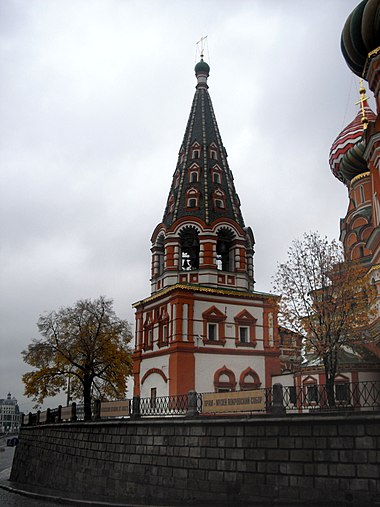
In the middle of the 16th century, the cathedral was painted in the fresco technique and imitated brickwork. There were no porches, and the St. Basil’s Church bell tower had a different look. It gave the cathedral a strict but elegant appearance which could be compare to a memorial with the eight separates churches symbolizing the days of the decisive battles for Kazan.
The original roof of the church burned downed at the end of the 16th century and the figured domes of the cathedral appeared instead of the original roof.
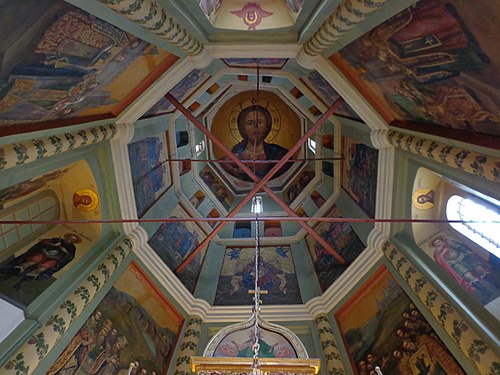
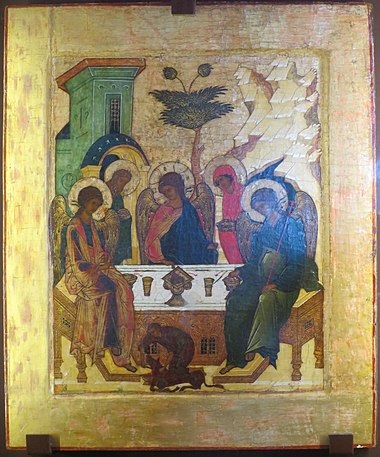
The Intercession Cathedral is richly decorated with wall paintings, has an impressive collection of ancient Russian icon painting and masterpieces of church applied art.
Until the reconstruction of the Great Bell Tower in the Kremlin in 1660, the cathedral was the tallest building in Moscow.
In the 1670 the wooden churches on Red Square were closed, then the cathedral was supplemented by a hipped bell tower, its heads were covered with iron, the porch was covered with tiles , and a bright colorful ornamental painting appeared on the cathedral. Finally the chapel of Blessed John of Moscow was added in 1672
Bell tower
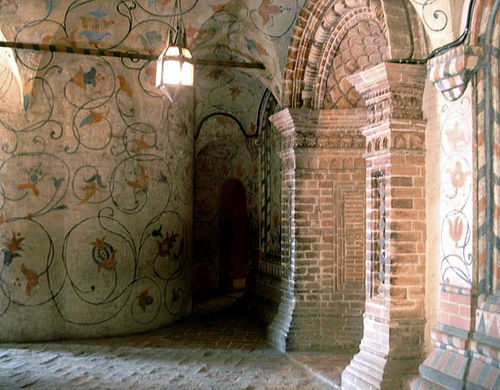
The cathedral was seriously renovated in 1680, with brick galleries replacing the wooden ones and the outer and inner galleries, platforms and parapets of the porches being painted with grass ornaments motifs.
In the 18 and 19 centuries Divine services were regularly performed in St. Basil’s Cathedral. As a rule, they were performed in an annex – a temple built in honor of St. Basil the Blessed, because the rest of the temples were cold. That is why the people got accustomed to the name – St. Basil’s Cathedral.
Divine services in the temple continued until the beginning of the 20th century. The last rector was Father John Vostorgov, now canonized among the saints in the host of new martyrs and confessors
In 1737, the temple almost completely burned out because of one of the strongest fires in Moscow. The restoration of the architecture and interiors of the cathedral was done under the leadership of the architect Ivan Michurin.
Painting by Giacomo Quarenghi “The Intercession Cathedral and the Spasskaya Tower of the Kremlin”, 1797
The cathedral was seriously repaired and rebuilt by decree of Catherine II from 1784 to 1786, and it was then that the walls of St. Basil’s Cathedral were painted with multi-colored paints and acquired their modern look. Before it was mainly painted in red and white colors.
After the Patriotic War of 1812, Alexander I decided to restore the temple and in 1817, the architect Osip Bove , while reconstructing Red Square with shopping malls, laid out the retaining wall of the temple with “wild” stone and installed a cast-iron fence. First along Moskvoretskaya Street, then in 1834, on the south side of the temple.
Red_Square_in_Moscow_(1801)_by_Fedor_Alekseev
In 1880, a manor on Pyatnitskaya street was added to the temple . Until 1918, the last rector of the temple , Father John lived in it .
In the 1890s, the temple was again seriously reconstructed. The floors were strengthened, and the Cathedral sacristy was decorated with colored stained-glass windows, designed by the architect Andrei Pavlinov.
Postcard early 20th century
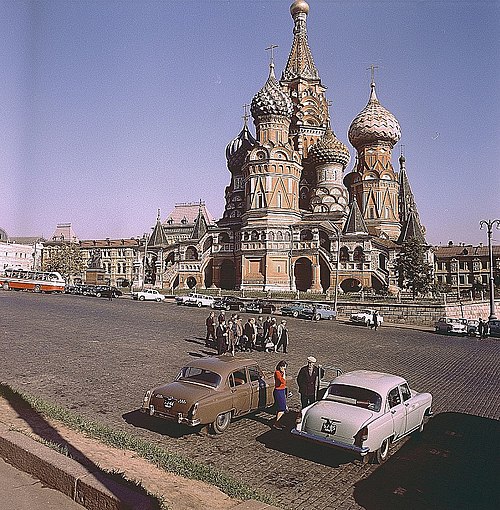
In 1918, the Intercession Cathedral became one of the first cultural objects taken under state protection as a monument of national and world significance. It is during this period that services were stopped in the upper churches and the museumification began.
1965
Archpriest John Kuznetsov became the first caretaker of the museum. In the 1920s, the cathedral was in dear need of repair and restoration work was carried out, led by architects Nikolai Kurdyukov and Alexander Alexandrovich Zhelyabuzhsky.
Basil’s Cathedral and the monument to Minin and Pozharsky
After the decision of 1923 to establish a historical and architectural museum in the cathedral, this one was opened to visitors on May 21, 1923.
Beginning in 1923 and until 1949 research was carried out in the museum because of legends which attributed to the temple a network of underground passages. And in 1924, walled-up room with a deep hole in the floor under the chapel of John the Merciful was found by the restorer and architect Dmitry Sukhov and the speleologist-historian Ignatius Stelletsky.
The window-loopholes of the room were bricked up both from the side of the river and from the side of Red Square. Ignatius Stelletsky wrote that the embrasures had the same approaches as for the cannons in the towers of Kitay-gorod and any of the monasteries which led him to the idea that in the 16th century the lower part of St. Basil’s Cathedral was intended for combat.
The Pokrovsky Cathedral museum became a branch of the State Historical Museum in 1928 and in 1929 the divine services were banned in the cathedral, and the bells were removed and melted down.
During the Great Patriotic War, the museum did not stop its work, although it was closed to visitors. St. Basil’s Cathedral was carefully disguised to save it from bombing. There is a legend that after the war, Stalin was offered to remove the cathedral under the pretext that it was interfering with the parade. It is believed that Kaganovich showed Stalin a model of the square, and in his presence he removed the model of the temple, suggesting that it be demolished. Stalin abruptly interrupted him: “Lazar, put it in its place!” Since then, no one has raised questions about the inviolability of the cathedral.
The cathedral began to be restored, on September 7, 1947, and the museum reopened on the day of the celebration of the 800th anniversary of Moscow.
From 1954 to 1955 the “brick-like” painting of the 16th century was returned to the cathedral, and at the same time the white-stone details of the décor was restored.
On November 18, 1991, the Russian Orthodox Church was allowed to hold regular services in the Kremlin cathedrals and St. Basil’s Cathedral but the first divine service took place on the patronal feast of the Intercession of the Most Holy Theotokos on October 1, 1991
Beginning in 2001 and ending ten years later the interiors of ten churches were restored, the icon of the Intercession of the Most Holy Theotokos was restored, and the basements were restored to their original appearance.
If you liked this article, subscribe , put likes, write comments!Share on social networksand you can alsoCheck out Our Latest Posts
A beautiful video of the Repin museum complex in the village of Shiryaevo close to Samara. It was sent to me by a friend. I hope you’ll enjoy it as much as I did.
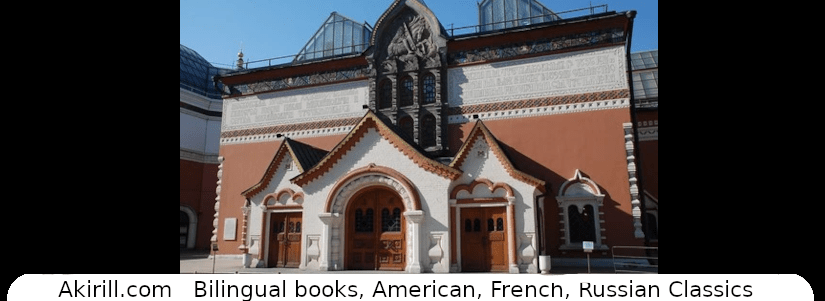
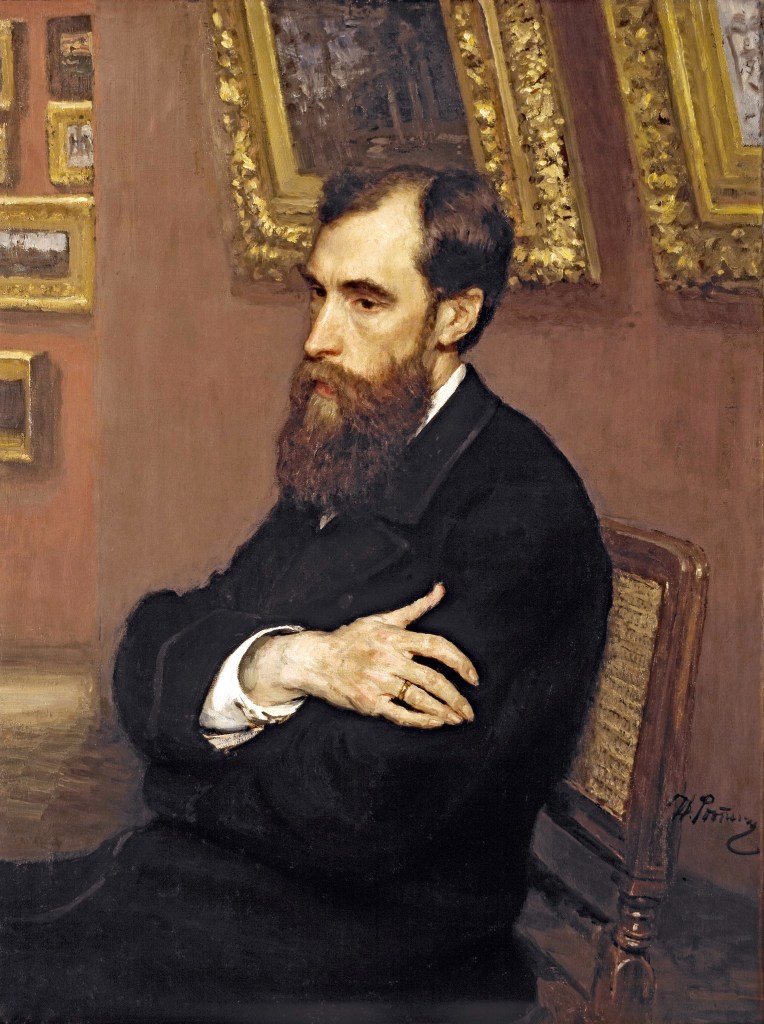
The State Tretyakov Gallery is a Moscow art museum which was founded in 1856 by Pavel Tretyakov. It was opened to the public in 1867 and transferred to Moscow in 1892. As of 2018, the exposition consisted of more than 180 000 items, including paintings, sculptures and items made out of precious metals created from the 11th to the 20th century.
After having created the Kostroma Linen Manufactory, which was quite a successful business, Pavel Mikhailovitch Tretyakov and his brother Sergei became interested in collecting paintings.
State Tretyakov Gallery
So, the gallery was founded in 1856, with the acquisition of “The Temptation” by Nikolai Schilder and “Skirmish with Finnish Smugglers” by Vasily Khudyakov, by Pavel Tretyuakov. He said:
For me, who truly and ardently love painting, there can be no better desire than to start a public, accessible repository of fine arts, bringing benefit to many, all pleasure. I would like to leave you the national gallery, that is, consisting of paintings by Russian artists
His brother Sergei was more interested in canvases of Western European masters widening the exhibitions.
In 1867 the Moscow City Gallery of Pavel and Sergei Tretyakov which at the time contained 1276 paintings, 471 drawings, 10 sculpture by Russian artists and 84 paintings by foreign masters was opened to the public.
In 1859, after that the brothers purchased more than 140 works from the Turkestan series of paintings and sketches by Vasily Vereshchagin they ran out of places for the exposition. A two-story building adjacent to southern wall of the mansion and turned toward the Church of St Nicholas in Tolmachi was build. Its construction was headed by the architect Alexander Kaminsky . In 1874 the collection was moved there and the gallery opened to the public.
By the end of the 1880s, the gallery building was repeatedly completed due to the growing collection which already occupied 14 rooms and constantly surpassed its exposition possibilities.
In 1882, the exposition area was expanded again at the expense of the garden surrounding the house. Three new halls appeared downstairs and upstairs which were located at an angle to the old building of the Gallery, parallel to Maly Tolmachecsky Lane.
It was followed in 1885 by the apparition of three halls on the top floor and five in the bottom.
In 1892 the fourth extension was completed and two large and one small halls were added on the upper floor, and three small ones below. and, after the death of his brother Sergei, Pavel donated the gallery, which at the time contained more than 2000 works of painting, sculpture and graphics, to Moscow.
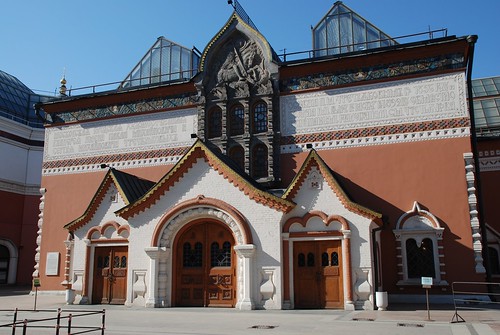
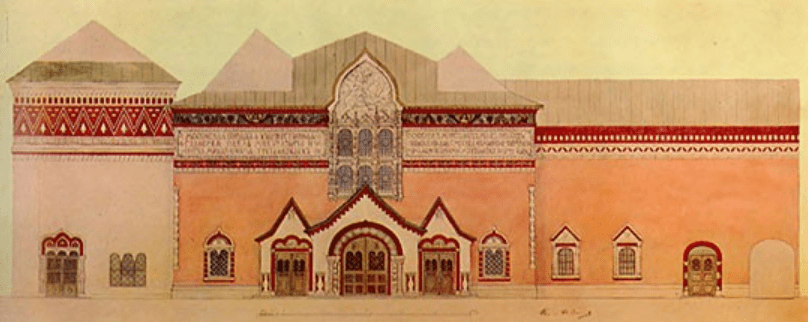
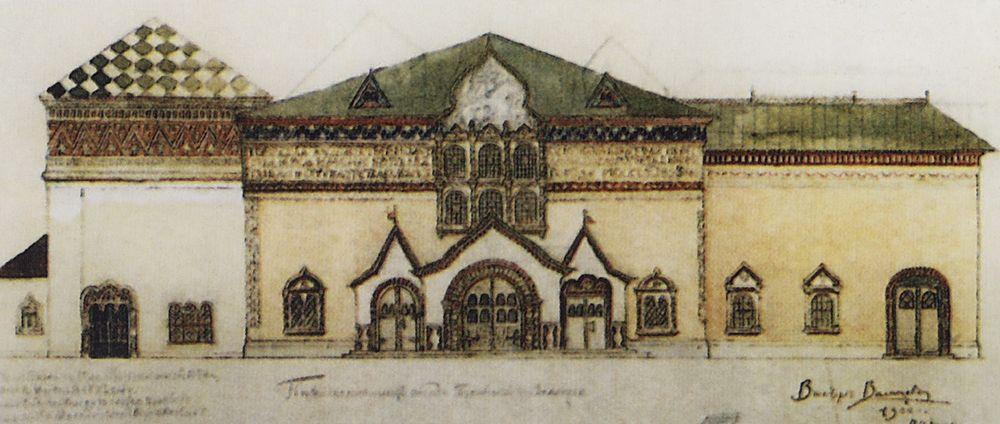
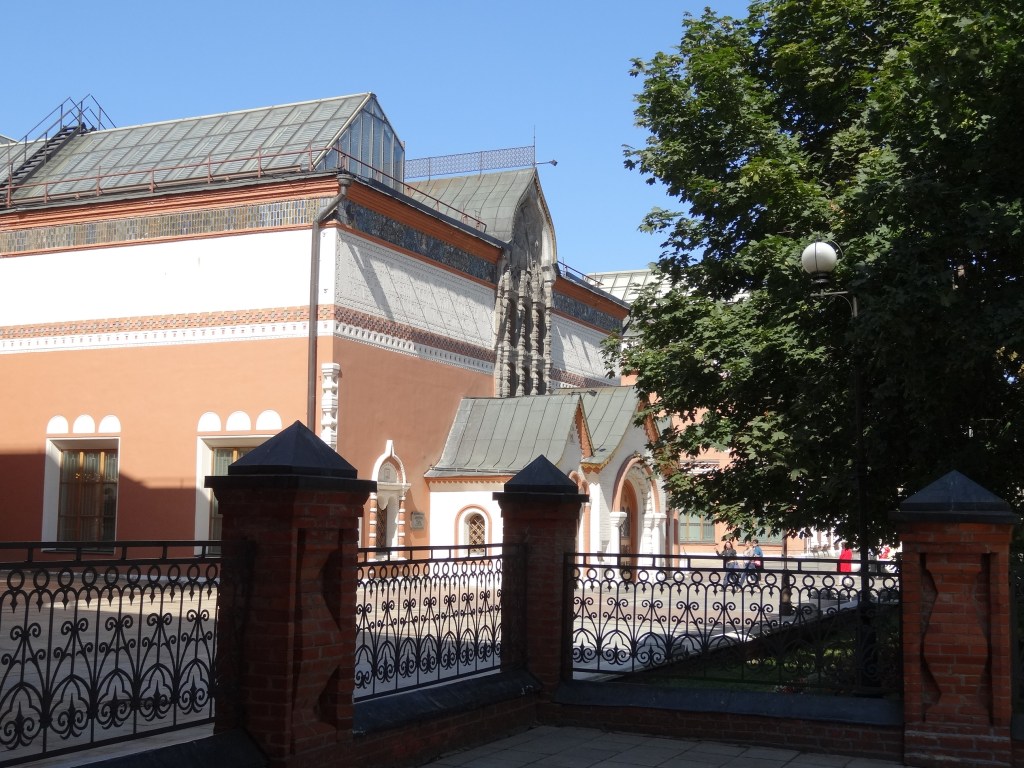
In may 1900, at a meeting of the Council of the gallery which included the artists V. M. Vasnetov, V. D. Polenov and a number of Moscow architects it was decided that the facade of the gallery should be built in the “Russian Style”. The work was entrusted to V. M. Vasnetsov and the construction of the new façade which became the emblem of the Tretyakov Gallery began in 1902 and ended in 1904.
On April 1913 Emmanuilovitch Grabar who was a prominent artist, architect and art historian was elected as a trustee of the Tretyakov Gallery. His reforms turned the Tretyakov Gallery into a Europeean-style museum with exposition built on a chronological basis and in december 1913, on the fifteenth anniversary of the death of the founder of the gallery, the reformed museum was opened to the public.
On June 1918 the Tretyakov Gallery was declared a State property of the Russian Federative Soviet Republic and became known as the State Tretyakov Gallery. Between 1918 and 1922, the gallery collection increased by almost 50% thanks to the numerous contributions from the State Museum Fund. But the drawback was that many exhibition halls were given over to storage for paintings.
A. V. Shchusev became the director of the gallery in 1926 and did a lot to expand the existing premises and build a new one. So in 1927, the Gallery received the former house of Sokolikov situated on Maly Tolomachevsky Lane. In 1928 after its restructuring, it was turned into a service building which housed the administration of the Gallery as well as a scientific department, a library, a department of manuscripts, and graphics funds. It was attached to the Gallery later with a special extension .
In 1928, the heating and ventilation was rebuilt and in 1929 the Gallery was finally electrified. Effectively before that time, the Gallery had been opened to visitors only during the daytime.
In 1929 the building of the Church of St Nicholas in Tolmachi closed and it was transferred to the Gallery in 1932. It became a storehouse for paintings until it was connected to the exposition halls by a newly built two story of which the top floor had been specially designed to display A. A. Ivanov’s painting “The Appearance of Christ to the People”. And a new passage between the halls was created to ensure the continuity of the view which resulted in an increased area of exposition and a new concept for the placement of works.
A. A. Ivanov’s painting “The Appearance of Christ to the People”
In 1936, according to the project of the architect A.V. Shchusev, a new two story building appeared on the north side of the main building. It included 4 spacious halls on each floor which were used for exhibitions and have been included in the main exhibition route since 1940.
On the night of August 11-12, 1941 two high-explosive bombs fell on the building as a result of a German air raid. The bombs destroyed the glass covering in several places of the roof and the interfloor ceiling of the upper hall N 6 and the lower one N 49 collapsed. The floors in the basement wardrobe were smashed, the main entrance was damaged and the heating and ventilation system failed.
A second bombing in the night of 12-13, 1941 destroyed a two story residential building next to the Gallery.
The restauration of the Gallery began in 1942 and by 1944 out of 52 halls, 40 had been renovated.
In May 1956, the 100th anniversary of the Gallery was celebrated and in 1955-1957, the A.A. Ivanov Hall was completed.
By the mid 1980 the need to expand again was felt because of the increased number of visitors.
In 1985 a depository was out in operation after 2 years of construction. And in 1986 the reconstruction of the main building of the Tretyakov Gallery began based on he idea of preserving the historical appearance of the building.
In 1989, on the south side of the main building a new building housing a conference hall, an information and computing center, a children’s studio and exhibition halls was built. Since most of the engineering systems and services were concentrated there it was called the Corps of Engineers.
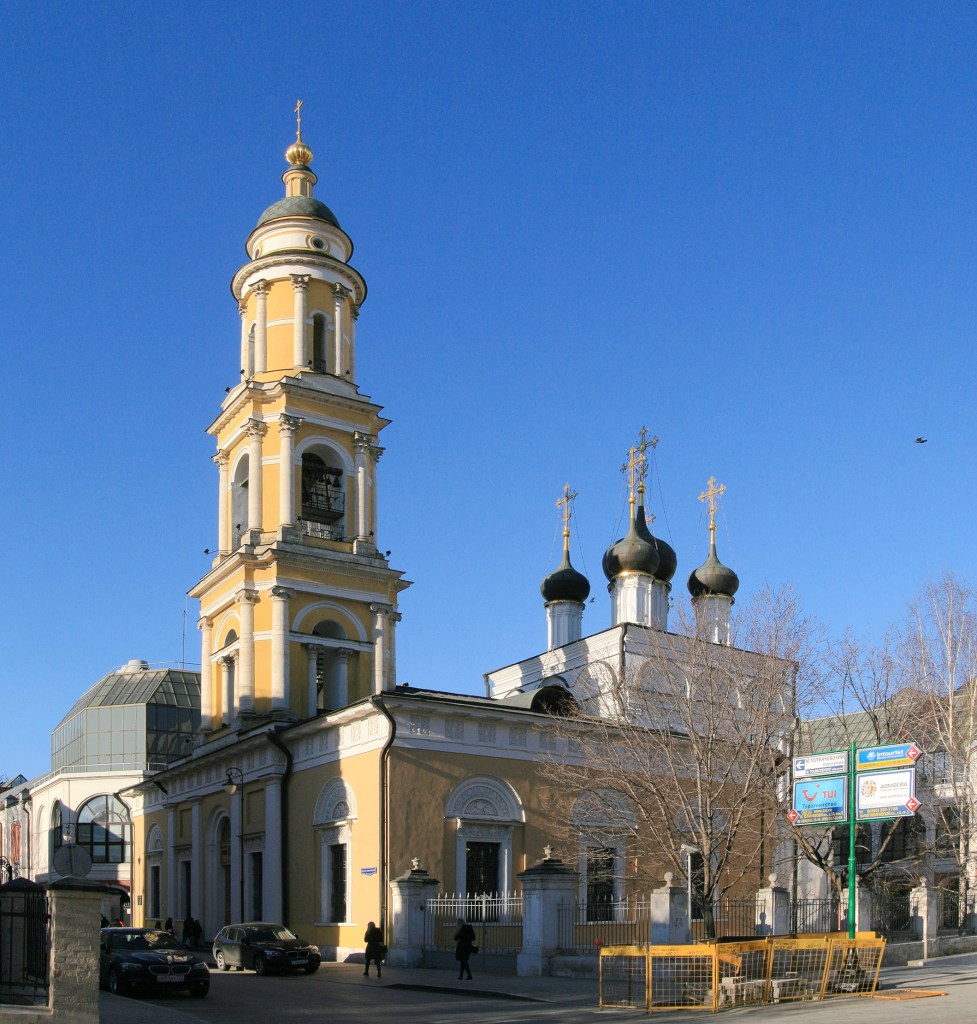
The reconstruction lasted from 1985 to 1995 and included the museum ensemble of the church of St. Nicholas in Tomachi which is an architectural monument of the 17th century.













































 AKirill, Learn, apprenez, translation, traduction, livres bilingues, bilingual books