
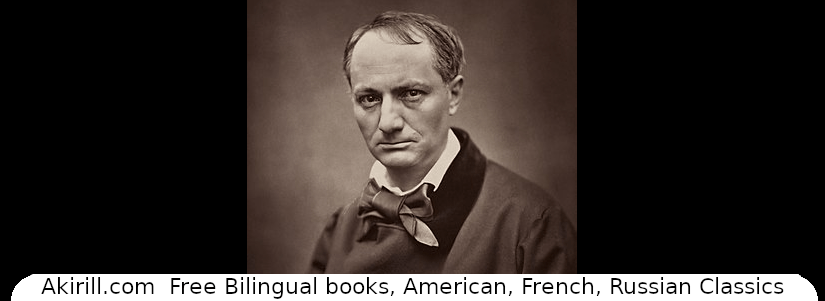
by Charles Baudelaire
Extract of The Flowers of Evil
| Download PDF |
French Literature – French Poetry – Charles Baudelaire
< < < Be Drunken
Crowds > > >
Callings
In a beautiful garden where the rays of the autumnal sun seemed to linger with delight, under a sky already greenish, in which golden clouds floated like voyaging continents, four fine children, four boys, doubtless tired of playing, were chatting away.
One said: “Yesterday I was taken to the theatre. In great, sad palaces, where in the background spread the sea and the sky, men and women, also serious and sad, but much more beautiful and much better dressed than any we see about, were talking with musical voices. They threatened one another, they entreated, they were disconsolate, and often they rested a hand on a dagger sunk within the sash. Ah! that is beautiful indeed! The women are much more beautiful and much greater than those that come to the house to visit us, and although with their great hollow eyes and their fiery cheeks they have a terrible look, you can not help loving them. You are afraid, you want to cry, and still you are content…. And then, what is stranger still, it all makes you want to be dressed the same, to say and to do the same things, to speak with the same voice….”
One of the four children, who for several moments had no longer been listening to his comrade’s talk, and had been watching with surprising fixity some point or other in the sky, said all at once: “Look, look down there!Do you see Him? He is sitting on that little isolated cloud, that little fiery cloud, which is moving slowly. He too, they say, He watches us.”
“Who? Who?” asked the others.
“God!” he answered, with the accent of perfect conviction.—”Ah! He is already quite far away; by and by you will not be able to see Him. Doubtless He is traveling to visit every land. Look, He is going to pass in back of that line of trees near the horizon…, and now He is going down behind the steeple…. Ah! you can’t see Him any longer!” And the child remained for some time turned in the same direction, fixing on the line which separates earth from the sky eyes in which burned an inexpressible glow of ecstasy and regret.
“He is a fool, that one, with his good God, whom he alone can see!” then said the third, whose whole person was marked with a singular vivacity and life. “I am going to tell you how something happened to me which has never happened to you, and which is a little more interesting than your theatre and your clouds…. Several days ago my parents took me on a trip with them, and as the inn where we stopped didn’t have enough beds for all of us, it was decided that I should sleep in the same bed as my nursery maid.” He drew his comrades quite close and spoke in a lower tone. “That was a strange performance, now! not to sleep alone, and to be in bed with your maid, in the dark. As I couldn’t sleep, I amused myself, while she was sleeping, by passing my hand over her arms, her neck, and her shoulders. She has a much thicker neck and arm than all other women, and her skin is so soft, so soft, that you might call it note-paper or silver paper. I liked it so much that I should have kept on for a long time, if I hadn’t been afraid, afraid at first of waking her, and then still afraid of I don’t know what. Then I buried my head in the hair which lay down her back, thick as a mane, and it smelled just as good, I assure you, as the flowers in the garden, right now. Try, when you can, to do as much, and you will see!”
The young author of this prodigious revelation, in telling his story, had his eyes wide open in a sort of stupefaction at what he still felt, and the rays of the setting sun, slipping across the sandy locks of his ruffled hair, illumined it like a sulphurous aureole of passion. It was easy to guess that this youngster would not lose his life seeking Divinity in the clouds, and that he would frequently discover it elsewhere.
At last the fourth spoke: “You know that I seldom find amusement at home. I am never taken to a play; my tutor is too stingy; God doesn’t bother about me and my ennui, and I haven’t a pretty nurse to fondle me. It has often seemed to me that I should just like to go forever straight ahead, without knowing where, without any one’s being worried, always to see new lands. I am never well off anywhere, and I always think I shall be better somewhere else. Oh well! I saw, at the last fair at the nearby village, three men who lived as I should like to. You paid no attention to them, you others. They were large, almost black, and very proud, although in rags, looking as though they had need of no one. Their great gloomy eyes became quite brilliant while they played their music; a music so astonishing that it made you want now to dance, now to cry, or to do both together, and it would almost make you go mad if you listened too long. One, drawing his bow across his violin, seemed to be whispering sorrow; another, making his hammer skip over the keys of a little piano hung by a strap about his neck, appeared to be mocking the plaint of his neighbor; while from time to time the third clashed his cymbals with extraordinary violence. They were so pleased with themselves that they went on playing their wild music even after the crowd had gone away. Finally they gathered together their sous, piled their luggage on their back, and left. I wanted to know where they lived, and I followed them from afar, right to the edge of the forest, and only then, I understood that they lived nowhere.
“Then one said: ‘Must we pitch the tent?’
“‘Goodness! No!’ answered the other. ‘It’s such a pleasant night!’
“The third spoke, while figuring up the collection: ‘These folks do not appreciate music, and their wives dance like bears. Fortunately, within a month we shall be in Austria, where we shall find more amiable folk.’
“‘Perhaps we’d do better to go toward Spain, for the season is forward; let us flee before the rains, and moisten nothing but our gullets,’ said one of the others.
“I remember everything, as you see. Then each one drank a cup of brandy and went to sleep, with his forehead toward the stars. At first I wanted to beg them to take me along with them and to teach me to play their instruments; but I didn’t dare, doubtless because it is always very difficult to come to a decision about anything, and also because I was afraid of being recaptured before we were out of France.”
The slightly interested air of the three other comrades made me realize that this fellow was already misunderstood. I looked at him closely; there was in in his eye and on his brow that indescribable fatal precocity which generally repells sympathy, and which, I know not why, aroused my own to the point that for a moment I had the queer notion that I might have a brother unknown to me.
The sun had set. The solemn night was come. The children separated, each going in ignorance, according to circumstance and chance, to reap his destiny, scandalize his relatives, and gravitate toward glory or toward dishonor.
Translated by Joseph T. Shipley
< < < Be Drunken
Crowds > > >
French Literature – French Poetry – Charles Baudelaire
Copyright holders – Public Domain
| If you liked this article, subscribe , put likes, write comments! Share on social networks Visit us on Facebook or Twitter |
- Poèmes et peinture, semaine du 29 mars 2026
- Poems and painting, Week of March 29, 2026
- Poèmes et peinture, semaine du 22 mars 2026
- Poems and painting, Week of March 22, 2026
- Poèmes et peinture, semaine du 15 mars 2026
- Poems and painting, Week of March 15, 2026
© 2023 Akirill.com – All Rights Reserved
 AKirill, Learn, apprenez, translation, traduction, livres bilingues, bilingual books