
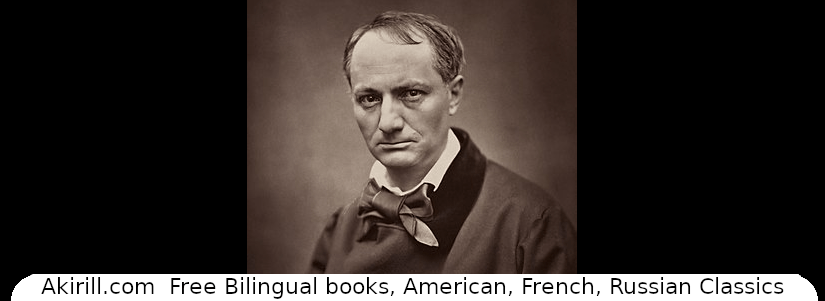
by Charles Baudelaire
Extract of The Flowers of Evil
| Download PDF |
French Literature – French Poetry – Charles Baudelaire
< < < Evening Twilight
“L’Invitation au Voyage” > > >
Good Dogs
TO MR. JOSEPH STEVENS
I have never, even before the young writers of my century, been ashamed of my admiration for Buffon; but to-day it is not the spirit of that painter of lofty nature that I would call to my assistance. No.
Much more willingly I call to Sterne, and I say to him: “Descend from heaven, or climb to me from the Elysian Fields, to inspire me in behalf of good dogs, of poor dogs, with a song worthy of thee, sentimental farceur, farceur incomparable. Come back astraddle that famous ass which will always accompany you in the memory of the future; and especially do not let that ass forget to carry, delicately hung between his lips, his immortal macaroons.”
Away with the academic muse! I have no business with that old prude. I invoke the familiar muse, the citizen, the boon companion, to aid me to sing the good dogs, the poor dogs, the dirty dogs, those whom every one drives away, pestiferous and lousy, except the poor, whose associates they are, and the poet, who sees them with fraternal eye.
Fie upon the foppish dog, upon the coxcomb quadruped, Dane, King Charles, pugdog or lapdog, so enamoured of himself that he darts inconsiderately between the legs or on the knees of the visitor, as if he were certain of pleasing, wild as a youngster, foolish as a flirt, often surly and insolent as a servant! Fie especially upon those four-pawed serpents, idle and shivering, that are called greyhounds, and that do not harbor in their pointed muzzle enough scent to follow the track of a friend, nor in their flattened head enough intelligence to play at dominoes!
To the kennel with all these plaguy parasites!
Let them slink to the kennel stuffed and sulky! I sing the dirty dog, the poor dog, the homeless dog, the stroller dog; the dog buffoon, the dog whose instinct, like that of the poor, the gypsy and the mountebank, is marvellously sharpened by necessity, that excellent mother, that true patron of intelligence!
I sing the distressful dogs, be they those that wander, alone, in the winding gullies of the great cities or those who have said to the forsaken man, with blinking spiritual eyes: “Take me with you, and of two miseries we shall make a sort of joy!”
“Whither go the dogs?” Nestor Roquepelan once said in an immortal leaflet which he has doubtless forgotten, and which I alone, and perhaps Saint-Beuve, recall today.
Where do the dogs go, you ask, heedless men? They go about their business.
Business engagements, affairs of love. Through the fog, through the snow, through the mire, under the biting dogstar, under the streaming rain, they come, they go, they hurry, they move along under carriages, excited by fleas, by passion, by duty or by need. Like us, they have risen bright and early, and they seek their livelihood or run to their pleasure.
There are some who sleep in a ruin in the suburbs and who come every day at a stated hour, to beg alms at the door of a Palais-Royal cook; others who run in troops, for more than five leagues, to partake of the repast which has been prepared for them through the charity of certain sexagenarian maids, whose unoccupied hearts are given over to beasts, since imbecile man wants them no more; others who, like runaway negroes, frantic with love, leave their province on certain days, to come to the city and romp for an hour with a handsome bitch, a little careless in her toilet, but proud and thankful.
And they are all very precise, without notebooks, without memoranda, without portfolios.
Do you know slothful Belgium, and have you, like me, admired all those vigorous dogs hitched to the cart of the butcher, of the milkmaid, of the baker, who give evidence in their triumphant barks, of the proud pleasure they feel in rivalling the horse?
And here are two that belong to a still more civilized order! Permit me to introduce you into the room of an absent mountebank. A bed, of painted wood, without curtains, with dragging covers stained with bugs; two cane chairs, a cast-iron stove, one or two disordered musical instruments. Oh, what sad furniture! But look, I pray you, at these two intelligent personages, clad in garments at once sumptuous and frayed, hooded like troubadours’ or soldiers, who are guarding, with the close watch of a sorcerer, the nameless something which simmers on the lighted stove, and from the center of which a long spoon stands forth, planted as one of those aerial masts which announce that the masonry is complete.
Is it not just that such zealous comedians should not set out without having well lined their stomachs with a strong, sound soup? And will you not forgive a little sensuality in these poor devils who all day have to face the indifference of the public and the injustice of a director who deems himself the whole show and who alone eats more soup than four actors?
How often have I contemplated, touched and smiling, all these four-footed philosophers, compliant, submissive or devoted slaves, whom the republican dictionary might well call “fellows,” [1] if the republic, too busied with the happiness of men, had time to respect the honor of dogs!
And how many times have I thought that perhaps there is somewhere (who knows, after all?), to reward so much courage, so much of patience and of labor, a special paradise for good dogs, for poor dogs, for dirty and afflicted dogs. Swedenborg affirms that there is one for the Turks and one for the Dutchmen!
The shepherds of Virgil and of Theocritus expected, as prize for their alternate songs, a good cheese, a flute from the best maker, or a she-goat with swelling udders. The poet who has sung the good dogs has received for reward a fine vest, of a color both faded and rich, which brings thoughts of the autumn suns, of the beauty of matured women and of the summers of Saint-Martin.
None of those who were present in the tavern of Rue Villa-Hermosa will forget with what petulance the painter was despoiled of his vest for the poet, so well had he understood that it is good and seemly to sing of poor dogs.
Thus a magnificent Italian tyrant, in the good old days, offered the divine Aretine a dagger rich with jewels, or a courtly gown, in exchange for a precious sonnet or a rare satiric poem.
And whenever the poet dons the painter’s vest, he is forced to think of the good dogs, of the dog philosophers, of the summers of Saint-Martin and of the beauty of full-blown women.
[1] “Officieux” was the term adopted by the Republic, to replace “domestique” and “valet,” and to indicate the equality of all—even master and man.
Translated by Joseph T. Shipley
< < < Evening Twilight
“L’Invitation au Voyage” > > >
French Literature – French Poetry – Charles Baudelaire
Copyright holders – Public Domain
| If you liked this article, subscribe , put likes, write comments! Share on social networks Visit us on Facebook or Twitter |
- Poèmes et peinture, semaine du 8 mars 2026
- Poems and painting, Week of March 8, 2026
- Poèmes et peinture, semaine du 1er mars 2026
- Poems and painting, Week of March 1st, 2026
- Poèmes et peinture, semaine du 22 février 2026
- Poems and painting, Week of February 22, 2026
© 2023 Akirill.com – All Rights Reserved
 AKirill, Learn, apprenez, translation, traduction, livres bilingues, bilingual books