
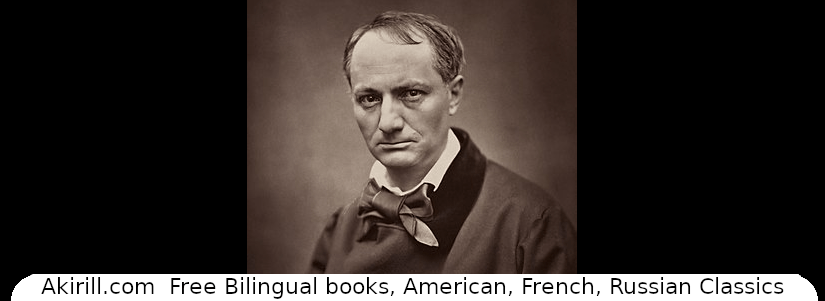
by Charles Baudelaire
Extract of The Flowers of Evil
| Download PDF |
French Literature – French Poetry – Charles Baudelaire
< < < “L’Invitation au Voyage”
Mademoiselle Bistoury > > >
Let us Flay the Poor
For a fortnight I was confined to my room, and I surrounded myself with the books of the day (sixteen or seventeen years ago); I mean those volumes which treat of the art of making people happy, wise and rich, in twenty-four hours. I had thus digested—swallowed, I should say—all the lucubrations of all those master-builders of the public weal, of those who advise all the poor to enslave themselves, and of those who persuade them they are all dethroned kings. There is, then, naught surprising in the fact that I was in a state of mind bordering on intoxication or stupidity.
It seemed to me merely that I felt, imprisoned in the depths of my intelligence, the obscure germ of an idea superior to all the old wives’ formulæ the cyclopedia of which I had just run through. But it was only the thought of a thought, a something infinitely vague.
And I went forth with a great thirst, for the impassioned taste of poor reading engenders a proportionate need of open air and of refreshment.
As I was about to enter a tavern, a beggar held out his hat to me, with one of those unforgettable glances that would tumble down thrones, if the mental moved the material, and if a mesmerist’s glance could ripen grapes.
At the same time, I heard a voice which whispered at my ear, a voice that I knew well: it was that of a good angel, or a good Demon, who is with me everywhere. Since Socrates had his good Demon, why may not I have my good Angel, and why may not I have the honor, like Socrates, of securing my brevet in folly, signed by the subtle Lélut and the well-advised Baillar get? [1]
There is this difference between the Demon of Socrates and my own, that his manifested itself only to warn, to forbid, to prevent, and that mine deigns to counsel, suggest, persuade. Poor Socrates had only a Demon prohibitor; mine is a great affirmator, mine is a Demon of action, or a Demon of combat.
Now, his voice whispered to me thus: “He alone is the equal of another, that proves it; and he alone is worthy of liberty, that can secure it.”
Immediately I leapt upon the beggar. With one punch, I stopped an eye, which became in a moment large as a ball. I broke one of my nails shattering two of his teeth, and as I did not feel strong enough, having been born delicate and having had but little practice in boxing, to beat the old fellow to death right away, I grasped him by one hand by the collar of his coat, and with the other I throttled him, and I set to work dashing his head against a wall. I must avow that I had first inspected the surroundings in a glance, and had made sure that in that deserted suburb I should be long enough out of the reach of a policeman.
Having then, with a kick in the back, hard enough to break his shoulderblade, felled the enfeebled sexagenarian, I seized a great branch of a tree which lay along the ground, and I beat him with the determined energy of cooks trying to make a beefsteak tender.
All at once,—O miracle! O joy of the philosopher who proves the excellence of his theory!—I saw that antique carcass turn about, straighten up with an energy I should never have suspected in so strangely disordered a machine—and, with a glance of hate that seemed to me good omen, the decrepit ruffian hurled himself upon me, blackened both my eyes, broke four teeth, and with the same branch beat me stiff as a jelly. By my energetic medication, I had restored to him pride and life.
Then I made any number of signs to him to make him understand that I considered the matter closed, and, rising with the satisfaction of a philosopher of the Porch, I said to him: “Sir, you are my equal! Kindly do me the honor of sharing my purse; and remember, if you are truly philanthropic, that you must apply to all your colleagues, when they ask for alms, the theory that I have had the sorrow of trying on your back.”
He swore to me that he understood my theory, and that he would obey my counsels.
[1] Famous Parisian alienists of the time.
Translated by Joseph T. Shipley
< < < “L’Invitation au Voyage”
Mademoiselle Bistoury > > >
French Literature – French Poetry – Charles Baudelaire
Copyright holders – Public Domain
| If you liked this article, subscribe , put likes, write comments! Share on social networks Visit us on Facebook or Twitter |
- Poèmes et peinture, semaine du 29 mars 2026
- Poems and painting, Week of March 29, 2026
- Poèmes et peinture, semaine du 22 mars 2026
- Poems and painting, Week of March 22, 2026
- Poèmes et peinture, semaine du 15 mars 2026
- Poems and painting, Week of March 15, 2026
© 2023 Akirill.com – All Rights Reserved
 AKirill, Learn, apprenez, translation, traduction, livres bilingues, bilingual books