Lisez le poème “Confession” d’Alexandre Pouchkine Anglais et russe côte à côte

Livres bilinguesRead in EnglishNous contacter
Littérature américaineLittérature françaiseLittérature russe

< < < Cerisier (Ru/Fr) / Cherry Tree (Ru/Eng) / Вишня (Рус/Анг.) / (Рус/ Фра.)
Heureux celui qui est choisi volontairement (Ru/Fr) / Happy is the one, who is chosen willfully (Ru/Eng) / Счастлив, кто избран своенравно (Рус/Анг.) / (Рус/ Фра.) > > >


Chers lecteurs et abonnés, cette semaine, j’ai traduit et fait une brève analyse du merveilleux poème d’amour “Confession” d’Alexandre Pouchkine. Comme d’habitude j’ai ajouté un beau tableau “Automne” d’Alexei Kondratyevich Savrasov. J’espère que vous les apprécierez autant que moi.

Brève analyse du poème “Confession” d’Alexandre Pouchkine

Alexandre Pouchkine a écrit le poème “Confession” en 1826 pour Alexandra, la fille adoptive de P. Osipova, mais il ne lui a jamais donné le poème et il n’a pas été publié de son vivant.

Pouchkine tombait souvent amoureux et parfois, il devait souffrir d’un amour non partagé, ce qu’il décrit dans ce poème. Dans “Confession” , le poète comprend le désespoir de son amour, décrivant ses sentiments comme une “stupidité malheureuse”

Continuez la lecture …

Peinture “Automne” par Alexeï Kondratievitch Savrassov


Traduction du poème “Confession” d’Alexandre Pouchkine en français avec français et russe côte à côte


Александр Пушкин — ПризнаниеConfession par Alexandre Pouchkine
Traduit par Akirill. com
Я вас люблю, — хоть я бешусь,Je vous aime, même si je suis en colère,
Хоть это труд и стыд напрасный,Bien que ce soit du travail et de la honte en vain,
И в этой глупости несчастнойEt cette malheureuse bêtise
У ваших ног я признаюсь!A vos pieds je l’avoue !
Мне не к лицу и не по летам…Cela ne me convient pas et cela ne convient pas à mon âge…
Пора, пора мне быть умней!Alors, il est temps pour moi d’être plus intelligent !
Но узнаю по всем приметамMais je reconnais par tous les signes
Болезнь любви в душе моей:La maladie de l’amour dans mon âme :
Читать далее …Continuez la lecture …


Nous mettons beaucoup d’efforts dans la qualité des articles et traductions, soutenez-nous avec un like et un abonnement ou sponsorisez-nous si vous les aimez. Nous sommes aussi sur Facebook et Twitter

Découvrez nos Derniers Posts


© 2023 Akirill.com – All Rights Reserved
Read the Poem “Confession” by Alexander Pushkin English and Russian side by side

Bilingual booksLire en FrançaisContact us
American LiteratureFrench LiteratureRussian Literature

< < < Cerisier (Ru/Fr) / Cherry Tree (Ru/Eng) / Вишня (Рус/Анг.) / (Рус/ Фра.)
Heureux celui qui est choisi volontairement (Ru/Fr) / Happy is the one, who is chosen willfully (Ru/Eng) / Счастлив, кто избран своенравно (Рус/Анг.) / (Рус/ Фра.) > > >


Dear readers and subscribers, this week I translated and did a short analysis of the wonderful love poem “Confession” by Alexander Pushkin. As usual I added a beautiful painting “Autumn” by Alexei Kondratyevich Savrasov. I hope you’ll enjoy them as much as I did.

Short analysis of the poem “Confession” by Alexander Pushkin

Alexander Pushkin wrote the poem “Confession” in 1826 for Alexandra, the adopted daughter of P. Osipova but he never gave her the poem and it was not published during his lifetime.

Pushkin often fell in love and sometimes, he had to suffer from unrequited love which is what he describes in this poem. In “Confession”, the poet undestands the hopelessness of his love, describing his feelings as “unhappy stupidity”

Continue reading …

Painting “Autumn” by Alexei Kondratyevich Savrasov


Translation of the poem “Confession” by Alexander Pushkin in English with English and Russian side by side


Александр Пушкин — ПризнаниеConfession by Alexander Pushkin
Translated by Akirill.com
Я вас люблю, — хоть я бешусь,I love you, even though I am mad,
Хоть это труд и стыд напрасный,Even though this is labor and shame in vain,
И в этой глупости несчастнойAnd this unfortunate stupidity
У ваших ног я признаюсь!at your feet I confess!
Мне не к лицу и не по летам…It doesn’t suit me and it doesn’t suit my years…
Пора, пора мне быть умней!Still, it’s time for me to be smarter!
Но узнаю по всем приметамBut I recognize by all the signs
Болезнь любви в душе моей:The disease of love in my soul: :
Читать далее ..
Continue reading ..


We put a lot of effort into the quality of the articles and translations, support us with a like and a subscription or sponsor us if you like them. We are also on Facebook and Twitter

Check out our Last Posts


© 2023 Akirill.com – All Rights Reserved
Découvrez le célèbre tableau “Les freux sont arrivées” d’Alexey Savrasov

Livres bilinguesRead in EnglishNous contacter
Littérature américaineLittérature françaiseLittérature russe

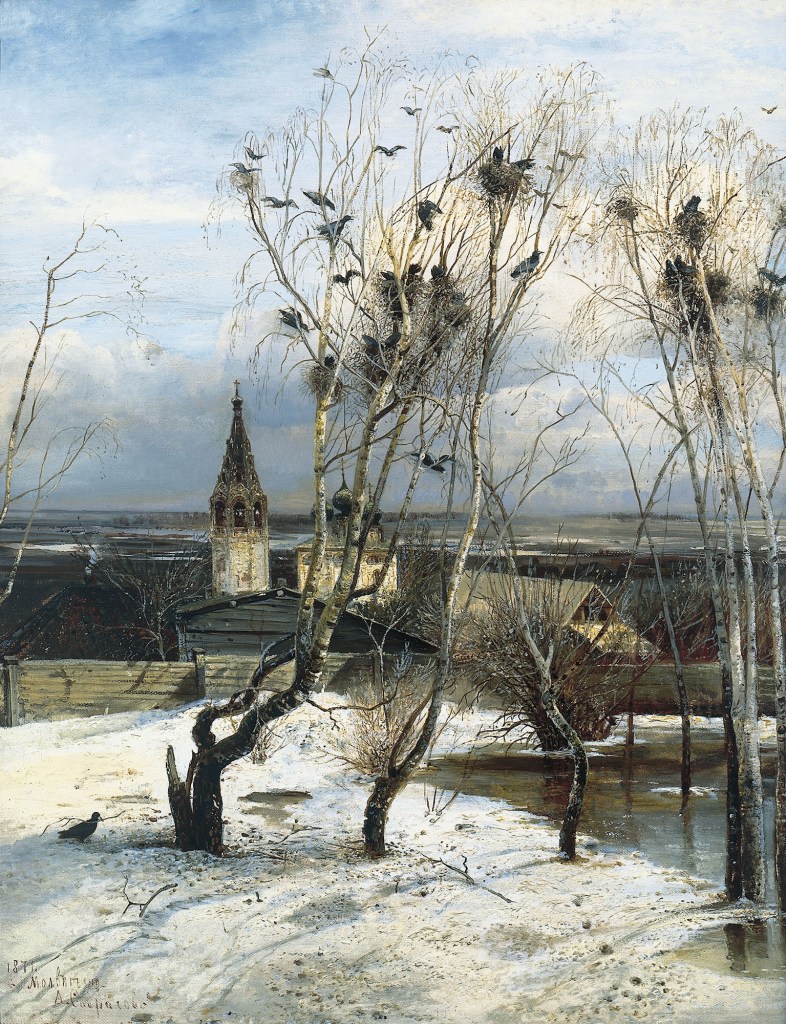
“Les freux sont arrivées” est considéré comme l’œuvre la plus célèbre de Savrassov. Dans ce tableau, l’artiste russe a montré un exemple d’une nouvelle vision du monde, très réaliste et supérieure aux classiques. “Les freux sont arrivées” a ouvert la voie au style lyrique dans la peinture russe et a marqué une nouvelle étape dans le développement de la peinture de paysage russe. Les connaisseurs de la peinture ont tellement aimé le tableau que l’artiste a dû répéter le tableau plusieurs fois.

“Les freux sont arrivées” (Грачи прилетели) est une huile sur toile de 62X48,5 cm peinte par Alexei Savrasov (Алексей Саврасов) en 1871. C’est un paysage réaliste qui se trouve maintenant à la Galerie nationale Tretiakov.

L’image représente un jour de printemps, couvert, mais d’après les premiers messagers du printemps que sont les freux, le printemps se fait déjà sentir et n’est pas loin. Les premiers oiseaux du printemps s’affairent sur trois bouleaux noueux : les jeunes couples construisent de nouveaux nids, les vieux renouvellent ceux de l’an dernier.

"The Rooks Have Arrived" by Alexey Savrasov

Alexei Savrasov, a commencé à écrire le futur chef-d’œuvre en mars 1871 dans le village de Molvitino (maintenant rebaptisé Susanino) où il n’a fait que des esquisses, finalisant la partie principale dans son atelier de Moscou.

Près de la moitié de la toile est occupée par le ciel. Des cumulus l’arpentent, les couleurs du ciel passent du gris blanchâtre au bleu pâle, une couleur très printanière. Il donne à l’image une légèreté extraordinaire.

Le soleil illumine de mille feux des troncs de bouleaux, une palissade en bois, les toits des cases du village, et le clocher en croupe de l’église de la Résurrection. Un autre signe que malgré l’abondance de nuances grises et bleutées, Savrasov a représenté une journée ensoleillée sont les ombres fines des troncs d’arbres sur la neige.

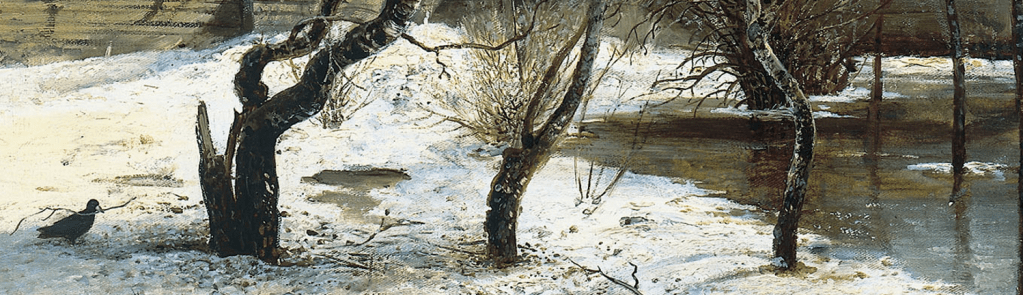
"The Rooks Have Arrived" part birches and birds by Alexey Savrasov

Au premier plan de l’image se trouvent plusieurs bouleaux tordus, encore nus. Leurs fines branches sont dirigées vers le haut, vers le soleil. De nombreuses corbeau freux font leur nid, volent de branche en branche, s’affairent. C’est l’arrivée de ces freux qui est un symbole du printemps à venir. Ils sont connus pour être des oiseaux migrateurs. Ils quittent leurs nids à l’automne, mais retournent dans ces terres chaudes au printemps. On peut aussi voir les traces d’oiseaux sur la neige. Il y a un saule caché derrière les bouleaux nus qui sert aussi de métaphore à la résurrection : avec ses branches, analogue des rameaux de palmier dans un climat froid, le dimanche des Rameaux était traditionnellement célébré en Rus’.

Au pied des bouleaux, il y a des taches sombres et dégelées dans la neige, et on peut déjà voir de petites flaques d’eau, signe qu’il fait plus chaud dehors. Pour rendre la couleur de la neige, l’artiste utilise diverses nuances de blanc, bleuté, gris. Au loin, au soleil, la croûte glacée semble même légèrement dorée.

Le ciel bleu-gris se reflète dans l’étang, qui s’est déjà débarrassé de la glace. Des arbres nus y sont également visibles. Savrasov a ajouté un peu de couleur vert pâle dans la zone où un buisson de genévrier est visible dans l’eau. 

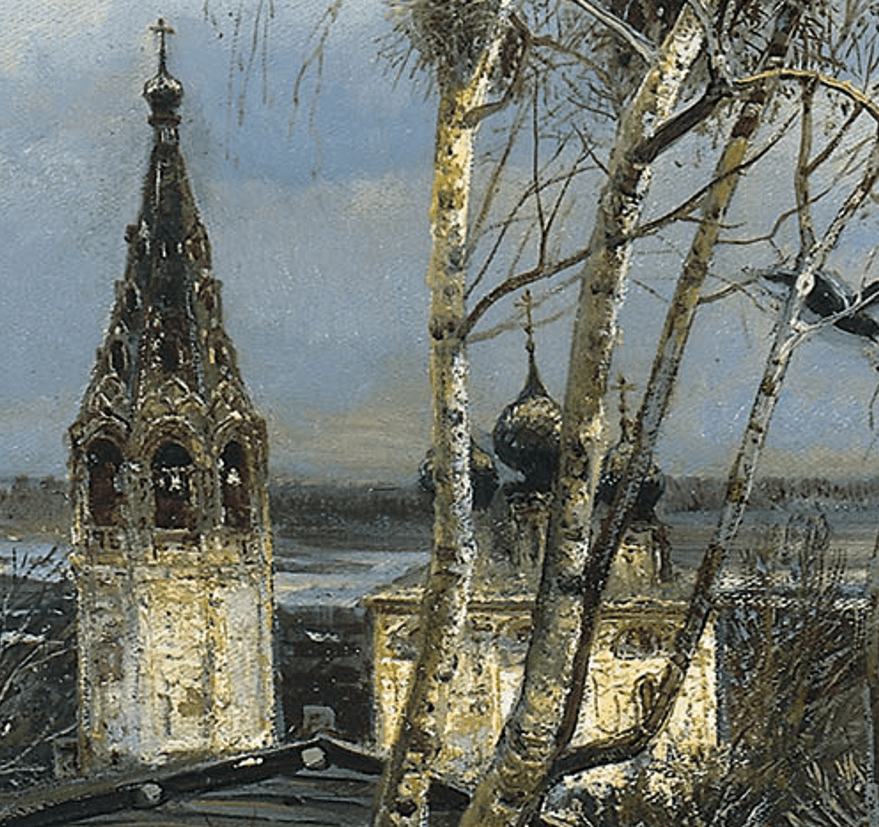
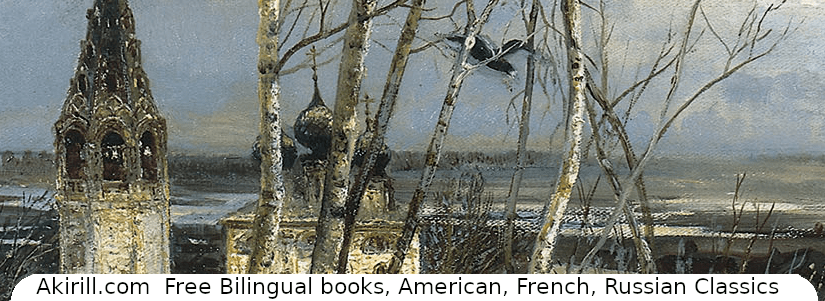
"The Rooks Have Arrived" part church by Alexey Savrasov

Il y a une église rurale avec un clocher en croupe visible derrière les bouleaux nous rappelant la résurrection du Christ. Les murs du temple et le clocher hexagonal sont blancs, du plâtre écaillé est visible ici et là. L’architecture de l’église suggère que nous avons devant nous un ancien bâtiment qui se dresse dans le village depuis des centaines d’années. C’est l’église orthodoxe de la résurrection du Christ dans le village de Molvitino (aujourd’hui Susanino). L’église a été construite à la fin du 17ème siècle et s’y trouve toujours aujourd’hui. 

"The Rooks Have Arrived" part fields by Alexey Savrasov

Derrière l’église, des champs sans fin s’ouvrent avec de la neige qui n’a pas encore complètement fondu.

En bas à gauche l’artiste a signé son tableau.

"The Rooks Have Arrived" signature by Alexey Savrasov

Pour améliorer le son spatial de l’image, Savrasov a légèrement perturbé la perspective. Le premier plan de l’image est représenté de telle manière que l’artiste semble être proche du sol. Mais sous cet angle, l’horizon devrait être assez bas, alors que sur la photo il est représenté approximativement au milieu de la toile, au niveau des coupoles des églises. Cela a été fait par l’artiste afin de mieux montrer les distances à plat, qui jouent un rôle sémantique et figuratif important dans l’image. 

Dans cette peinture, l’artiste a représenté de la manière la plus précise et la plus crédible le paysage russe, l’âme russe et leur nature.

Help the site stay free, buy us a cup of coffeeAidez-nous à maintenir le site gratuit en nous offrant une tasse de café

En 1997, lors de la célébration du 100e anniversaire de la mort du grand artiste, la Banque centrale de Russie a émis une pièce commémorative en argent avec un portrait d’Alexei Savrasov représenté dessus et un fragment de son célèbre tableau “Les freux sont arrivées”.

J’espère que cet article vous a plu

Si cet article vous a plu, abonnez-vous, mettez des likes, écrivez des commentaires !
Partager sur les réseaux sociaux
Découvrez nos derniers messages

Discover the famous painting “The Rooks Have Arrived” by Alexey Savrasov

Bilingual booksLire en FrançaisContact us
American LiteratureFrench LiteratureRussian Literature

“The Rooks Have Arrived” is considered Savrasov’s most famous work. In this painting the Russian artist showed an example of a new vision of the world, very realistic and superior to the classics. “The Rooks Have Arrived” opened the way for the lyrical style in Russian painting, and marked a new milestone in  the development of Russian landscape painting”. Connoisseurs of painting liked the painting so much that the artist had to repeat the painting several times.

“The Rooks Have Arrived” (Грачи прилетели) is an oil on canvas of 62X48.5 cm painted by Alexei Savrasov (Алексей Саврасов) in 1871. It is a realistic landscape which is now in the State Tretyakov Gallery.

The picture depicts a spring day, overcast, but according to the first messengers of spring which are the rooks, the spring is already felt and is not far away. The first spring birds fuss on three gnarled birch trees: Young couples build new nests, old birds renew last year’s ones.

"The Rooks Have Arrived" by Alexey Savrasov

Alexei Savrasov, began to write the future masterpiece in March 1871 in the village of Molvitino (now renamed Susanino) where he made only sketches, finalizing the main part in his Moscow workshop.

Almost half of the canvas is occupied by the sky. Cumulus clouds roam it, the colors of the sky change from whitish-gray to pale blue, a very spring color. It gives the picture an extraordinary lightness.

The sun brightly illuminates birch trunks, a wooden fence, the roofs of village huts, and the hipped bell tower of the Resurrection Church. Another sign that, despite the abundance of gray and bluish shades, Savrasov depicted a sunny day are the thin shadows from tree trunks on the snow.

"The Rooks Have Arrived" part birches and birds by Alexey Savrasov

In the foreground of the picture are several twisted, still bare birches. Their thin branches are directed upwards, towards the sun. There are many black rooks making their nests, flying from branch to branch, busying themselves. It is the arrival of these rooks that is a symbol of the coming spring. They are known to be migratory birds. They leave their nests in autumn, but return to these warm lands again in spring. We can also see the traces of birds on the snow. There is a willow hidden behind the bare birches which also serves as a metaphor for the resurrection: with its branches, an analogue of palm branches in a cold climate, Palm Sunday was traditionally celebrated in Rus’.

At the foot of the birches there are dark, thawed patches in the snow, and small puddles can already be seen, which is a sign that it is getting warmer outside. To convey the color of snow, the artist uses various shades of white, bluish, gray. In the distance, in the sun, the icy crust seems even light golden.

Blue-gray sky is reflected in the pond, which has already got rid of the ice. Bare trees are also visible in it. Savrasov added a little pale green color in the area where a juniper bush is visible in the water. .

"The Rooks Have Arrived" part church by Alexey Savrasov

There is an inconspicuous rural church with a hipped bell tower visible behind the birches reminding us of the resurrection of Christ. . The walls of the temple and the hexagonal bell tower are white, peeling plaster is visible here and there. The architecture of the church suggests that we have before us an ancient building that has stood in the village for hundreds of years. It is the Orthodox Church of the Resurrection of Christ in the village of Molvitino (now Susanino). The church was built at the end of the 17th century and still stands there now.

"The Rooks Have Arrived" part fields by Alexey Savrasov

Behind the church, endless fields open up with snow that has not completely melted yet.

On the bottom left the artist signed his painting.

"The Rooks Have Arrived" signature by Alexey Savrasov

To enhance the spatial sound of the image, Savrasov slightly disturbed the perspective. The foreground of the picture is depicted in such a way that the artist seems to be close to the ground. But from this angle , the horizon would have to be quite low, while in the picture it is depicted approximately in the middle of the canvas, at the level of church domes. This was done by the artist in order to better show the flat distances, which play an important semantic and figurative role in the picture. 

In this painting, the artist most accurately and believably depicted the Russian landscape, the Russian soul, and their nature.

Help the site stay free, buy us a cup of coffeeAidez-nous à maintenir le site gratuit en nous offrant une tasse de café

In 1997, when the 100th anniversary of the death of the great artist was celebrated, the Central Bank of Russia issued a commemorative silver coin with a portrait of Alexei Savrasov depicted on it and a fragment of his famous painting “The Rooks Have Arrived”.

I hope you enjoyed this article

If you liked this article, subscribe , put likes, write comments!
Share on social networks
Check out Our Latest Posts