On this site we hope to help you learn, and to remove the difficulties caused by the difference of culture and language. Sur ce site nous espérons vous aider à apprendre, et à enlever la barrière causée par les différents languages et cultures.
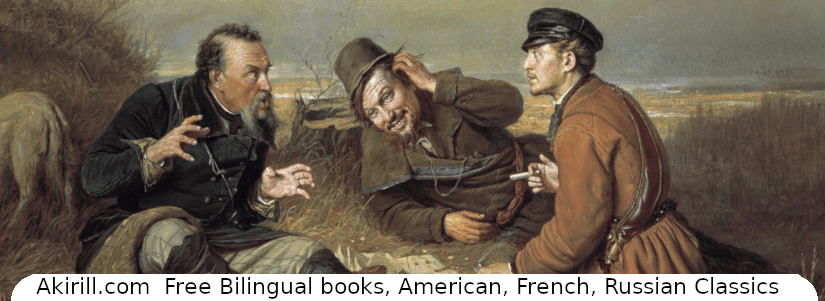
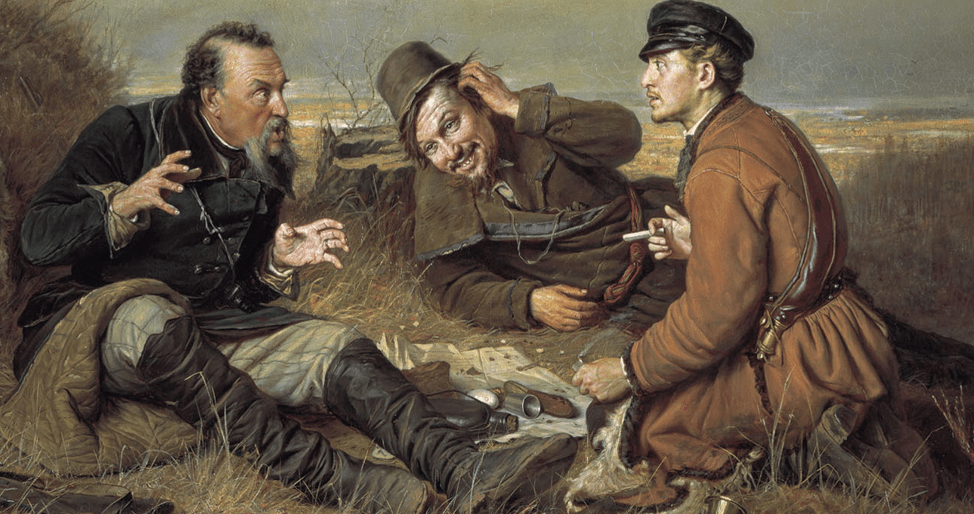
“Chasseurs au repos” a été peint par l’artiste russe Vasily Grigoryevich Perov en 1871. Il s’agit d’une huile sur toile de 119 X 183 cm qui se trouve à la Galerie Tretiakov, à Moscou. Si vous faites attention à la peinture, vous remarquerez que Perov a intentionnellement dessiné des absurdités dans les objets comme les proies, l’emplacement des fusils et le cor qui a été fait pour souligner l’atmosphère de la fiction de chasse.
Cette image est liée à la période tardive du travail de Perov, et si dans la première moitié de sa période de créativité il dépeint des images tristes de la vie populaire, dans la seconde moitié de son travail, Perov accorde plus d’attention aux scènes quotidiennes de la vie de les gens ordinaires.
hunters-at-rest- by Vasily Grigoryevich Perov 1871
Il existe 3 versions de ce tableau. En 1877, l’artiste a peint une copie du tableau avec une intrigue plus schématique, plus simple, et une palette de couleurs plus simple. Ce deuxième tableau est conservé au Musée russe et la troisième version du tableau se trouve au Musée d’art. VV Vereshchagin à Nikolaev.
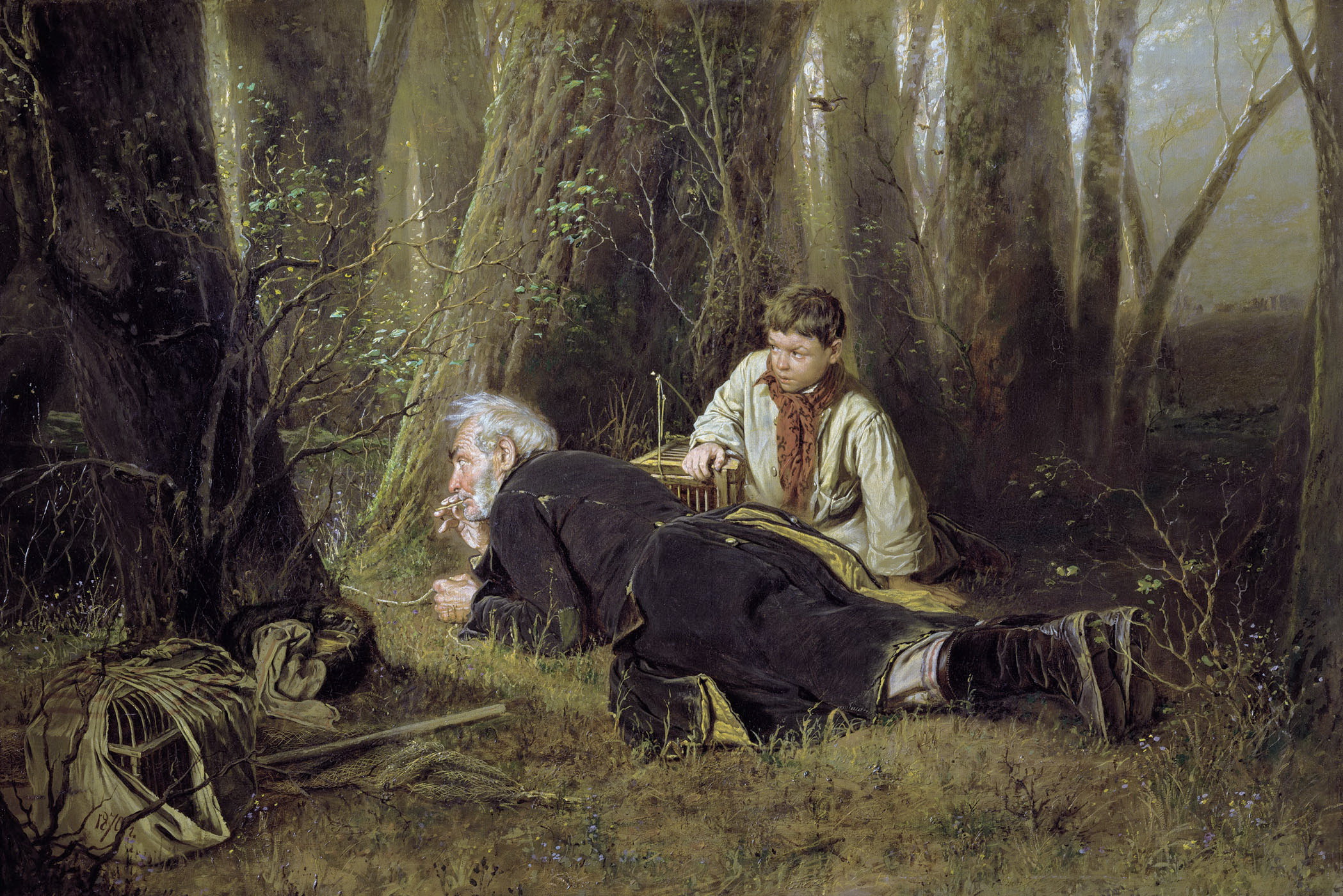
Vasily Grigorievich Perov était un chasseur passionné, c’était donc un sujet qui lui était familier. Déjà, en 1870, Perov avait peint la toile “Attrape-oiseaux”, pour laquelle il avait reçu le titre de professeur, ainsi qu’un poste d’enseignant à l’École de peinture, de sculpture et d’architecture de Moscou.
bird-catcher by Perov
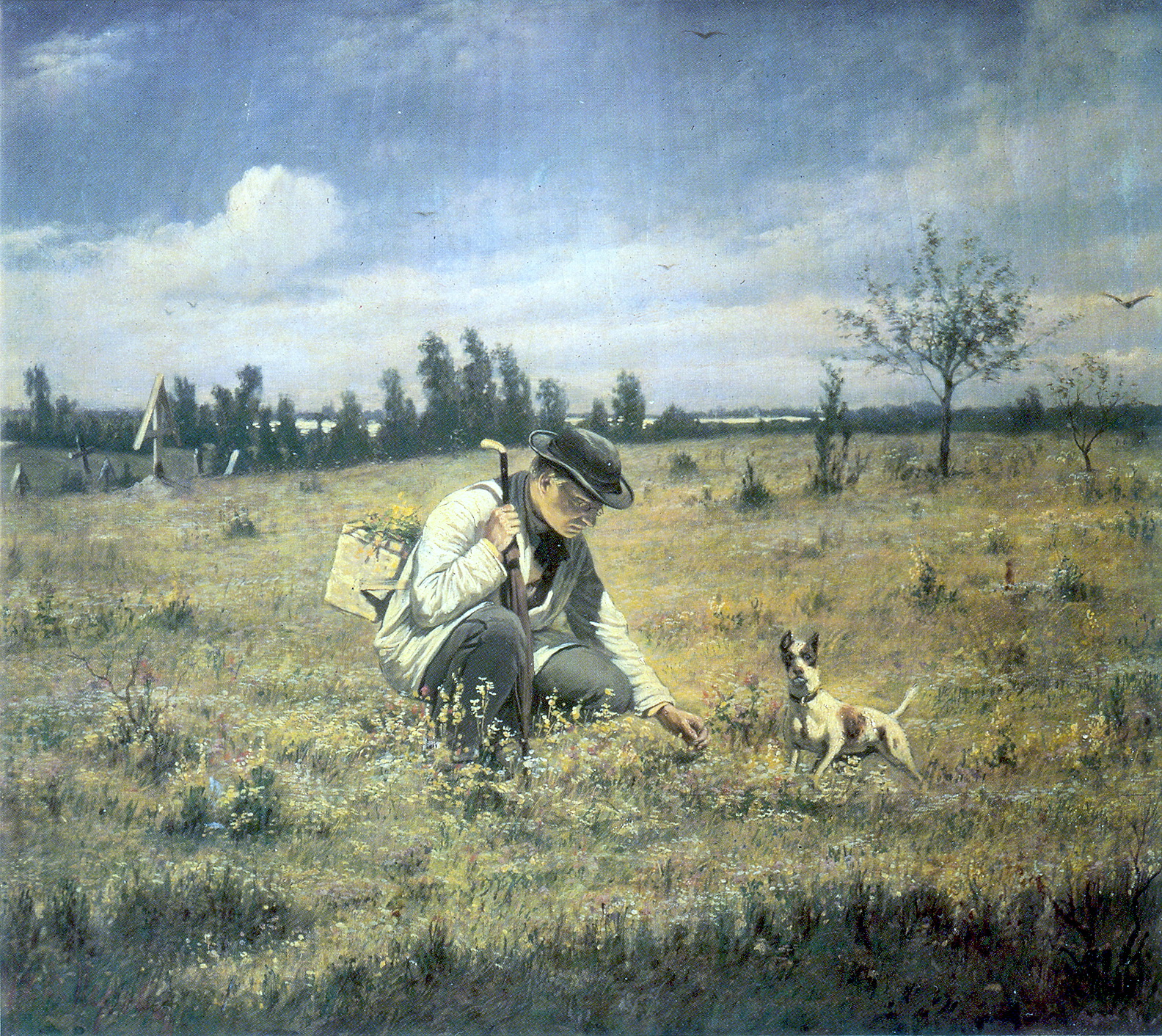
Au cours des années 70, l’artiste a également crée plusieurs autres tableaux consacrés au « thème de la chasse » : « Pêcheur » (1871), « Botaniste » (1874), « Pigeon » (1874), « Pêche » (1878).
“Botanist”-1874 – Perov “Fisherman” – 1871-by Perov“Fishing” – 1878 – by Perov“Pigeon” – 1874 – by Perov
“Chasseurs au repos” est basé sur certains amis de Perov Moscou. Il a dépeint DP Kuvshinnikov, un médecin bien connu à Moscou et un grand amateur de chasse au fusil pour l’image du narrateur. Le docteur VV Bessonov est devenu le prototype du chasseur sceptique et pour l’image d’un jeune chasseur, Perov a dépeint NM Nagornov, 26 ans.
Description de la peinture
“Chasseurs au repos” est une combinaison d’une peinture de genre quotidienne, d’un paysage et d’une nature morte dont les objets de chasse et de gibier.
Toute cette scène se déroule dans un paysage plutôt sombre. Le ciel est nuageux, les oiseaux migrateurs s’en vont, et l’herbe est déjà fanée, tout parle d’automne, d’endormissement, d’anticipation de l’hiver et apporte une nuance inquiétante à son contenu comique. Ce paysage sombre est utilisé pour concentrer l’attention du spectateur sur les personnages centraux de l’image.
La lumière de l’image est concentrée sur les visages et les mains des personnages. C’est une technique ancienne, de l’époque de la Renaissance, qui permet à l’artiste de révéler plus pleinement le monde intérieur de ses modèles.
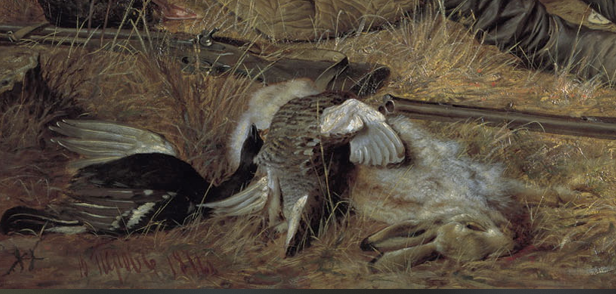
Contrairement à la nature triste au centre de la composition, l’artiste a placé trois chasseurs d’origines sociales différentes et d’excellente humeur. Tous unis par la chasse, on les voit se parler. Ils sont au repos après une chasse fructueuse comme en témoigne la peinture d’une carcasse de lièvre et d’une tétras des bois. Sur un chiffon étalé, il y a une miche de pain, une fiole d’alcool fort, des tasses.
L’homme aux moustaches grises sur la gauche est un chasseur âgé et expérimenté, apparemment l’un des nobles appauvris, qui parle avec enthousiasme et passion de ses “exploits” de chasse. Il semble gesticuler et presque sauter sur place, alors qu’il raconte son histoire avec passion, essayant d’appuyer son discours avec des mimiques impressionnantes pour faire croire aux jeunes qui ont peu vu.
Le second, plus jeune que le conteur, ressemble à un paysan. Il est allongé sur l’herbe fanée face au spectateur, appuyé sur le sol d’une main, et se frottant la tempe de l’autre, lissant ses cheveux ébouriffés arrachés sous son chapeau cabossé. Il écoute avec un intérêt visible l’orateur douloureusement éloquent avec un sourire narquois, pensant, nous avons entendu parler de tels miracles, mens davantage.
Le troisième, à droite, un jeune novice crédule bien vêtu, absorbe avidement chaque mot de son camarade expérimenté. Il se figea, emporté par la fable passionnante et croyant innocemment son camarade plus âgé, oubliant même d’allumer la cigarette qu’il tient dans sa main droite.
Hunter at Rest part dog by PerovHunter at Rest part game by PerovHunter at Rest part horn by PerovHunter at Rest part riffles by Perov
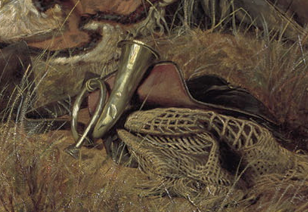
Les chasseurs notent des absurdités dans certains objets qui auraient été dessinés intentionnellement pour souligner l’atmosphère de la fiction de chasse. Par exemple, le cor est utilisé lorsque les chiens conduisent le gibier, et est inutile pour la chasse à la carabine et avec un seul chien. Les fusils reposent négligemment sur le sol et les proies ne peut pas être au même endroit car le lièvre vit dans une zone dégagée comme dans les champs ou la steppe et les tétras des bois sont des habitants des forêts.
La simplicité de la toile cache le contenu philosophique profond. Les héros d’âges différents symbolisent les cycles de la vie, lorsque la jeunesse naïve apprend le monde avec impatience, puis vient la maturité et l’expérience qui a beaucoup vu et est sceptique quant à la vie. En dernier, la maturité est remplacée par la vieillesse qui sait trouver du positif partout et se complaît souvent dans des souvenirs tombant sans cesse dans l’idéalisation du passé.
Le grand public est tombé sous le charme de la toile mais les critiques étaient mitigées. Donc, si Stasov a beaucoup apprécié l’image et l’a comparée aux histoires de chasse de Tourgueniev, alors Saltykov-Shchedrin l’a critiquée. Pour lui les visages des personnages semblaient trop simulés, cependant une telle technique permet de décrire plus clairement le caractère et le monde intérieur des personnages, et de révéler la composante symbolique de l’image.
Fiodor Mikhaïlovitch Dostoïevski a également mentionné le tableau dans son journal:
L’image est connue de tous depuis longtemps: «Chasseurs au repos»; l’un ment ardemment et délibérément, l’autre écoute et croit de toutes ses forces, et le troisième ne croit rien, se couche là et rit… Quel charme ! <…> On entend presque et on sait de quoi il parle, on connaît toute la tournure de ses mensonges, son style, ses sentiments.- FM Dostoïevski. Journal de l’écrivain
Un grand nombre de reproductions et de copies de la peinture ont été publiées à l’époque soviétique. Il y avait des légendes sur trois tableaux peints par Perov, mais le troisième tableau n’a été retrouvé qu’en 1984.
J’espère que vous avez apprécié ce tableau autant que moi
Si vous avez aimé cet article, abonnez-vous, mettez des likes, écrivez des commentaires !
“Hunters at Rest” was painted by the Russian artist Vasily Grigoryevich Perov in 1871. It is a 119 X 183 cm oil on canvas which is at the Tretyakov Gallery, in Moscow. If you pay attention to the painting you will notice that Perov intentionally drew some absurdities in the objects like the preys, the place of the riffles, and the horn which was done to emphasize the atmosphere of hunting fiction.
This picture is related to the late period of Perov’s work, and if in the first half of his period of creativity he depicted sad pictures of folk life, during the second half of his work, Perov paid more attention to everyday scenes from the life of ordinary people.
hunters-at-rest- by Vasily Grigoryevich Perov 1871
There are 3 versions of this painting. In 1877, the artist painted a copy of the painting with a plot more schematic, simpler, and a simpler color scheme. This second painting is kept in the Russian Museum, and the third version of the picture is in the Art Museum. V. V. Vereshchagin in Nikolaev.
Vasily Grigorievich Perov was a passionate hunter, so this was a topic familiar to him. Already, in 1870 Perov painted the canvas “Bird-catcher”, for which he received the title of professor, as well as a teacher’s position at the Moscow School of Painting, Sculpture and Architecture.
bird-catcher by Perov
During the 70s, the artist also creates several more paintings dedicated to the “hunting theme”: “Fisherman” ( 1871 ), “Botanist” ( 1874 ), “Pigeon” ( 1874 ), “Fishing” ( 1878 ).
“Botanist”-1874 – Perov “Fisherman” – 1871-by Perov“Fishing” – 1878 – by Perov“Pigeon” – 1874 – by Perov
“Hunters at Rest” is based some of Perov Moscow friends. He portrayed D. P. Kuvshinnikov, a well-known doctor in Moscow and a great lover of rifle hunting for the image of the narrator. The doctor V. V. Bessonov became the prototype of the skeptic hunter and for the image of a young hunter, Perov portrayed the 26-year-old N. M. Nagornov.
Description of the painting
“Hunters at Rest” is a combination of a genre everyday painting, a landscape , and a still life of hunting items and game.
This whole scene takes place against a rather gloomy landscape. The sky is cloudy, migratory birds are flying away, and the grass already faded, everything speaks of autumn, falling asleep, anticipation of winter and brings a disturbing undertone to its comic content. This gloomy landscape is used to concentrate the viewer’s attention on the central figures of the picture.
The light in the picture is concentrated on the faces and hands of the characters. It is an old technique, from the time of the Renaissance, which allows the artist to more fully reveal the inner world of his models.
In contrast to the sad nature in the center of the composition, the artist placed three hunters of different social origins and in excellent mood. All of them united by hunting, are seen talking to each other. They are at rest after a successful hunt as evidenced by the painting of a carcass of a hare and a black grouse. On a spread rag there is a loaf of bread, a flask of strong spirits, cups.
The gray-whiskered man on the left is an elderly, experienced hunter, apparently one of the impoverished nobles, who talks with enthusiasm and passion about his hunting “exploits”. He seems to be gesticulating and almost jumping on the spot, as he passionately tells his story, trying to support his speech with impressive facial expressions to make young people who have seen little believe him.
The second, younger than the storyteller, looks like a peasant. He lies on the faded grass facing the viewer, leaning on the ground with one hand, and rubbing his temple with the other, smoothing his disheveled hair knocked out from under his battered hat. He listens with visible interest to the painfully eloquent speaker with a sly smirk, thinking, we heard about such miracles, lie more.
The third, on the right, a gullible young novice neatly dressed, greedily absorbs every word of his experienced comrade. He froze, carried away by the exciting fable and innocently believing his older comrade, even forgetting to light the cigarette that he is holding in his right hand.
Hunter at Rest part dog by PerovHunter at Rest part game by PerovHunter at Rest part horn by PerovHunter at Rest part riffles by Perov
Hunters note absurdities in some objects which are believed to have been drawn intentionally to emphasize the atmosphere of hunting fiction. As exemple, the horn is used when dogs drive the game, and is useless for rifle hunting and with only one dog. The riffles are carelessly laying on the ground, and the prey cannot be in the same place since the hare lives in an open area like in fields, or steppe, and hazel grouses are forest dwellers.
The simplicity of the canvas hides the deep philosophical content . The heroes of different ages symbolize life cycles, when naive youth eagerly learns the world, then comes maturity and experience which has seen a lot and is skeptical about life. Last maturity is replaced by old age which knows how to find positive everywhere and often indulges in memories constantly falling into the idealization of the past.
The general public fell in love with the canvas but the critics were mixed. So, if Stasov highly appreciated the picture and compared it with Turgenev ‘s hunting stories , then Saltykov-Shchedrin criticized it. For him the faces of the characters seemed to be overly simulated, however such a technique allows to more clearly describe the character and inner world of the characters, and to reveal the symbolic component of the picture.
Fyodor Mikhailovich Dostoevsky also mentioned the painting in his diaries:
The picture has long been known to everyone: “Hunters at rest”; one lies ardently and deliberately, the other listens and believes with all his might, and the third does not believe anything, lay down right there and laughs … What a charm! <…> We almost hear and know what he is talking about, we know the whole turn of his lies, his style, his feelings.- F. M. Dostoevsky. Writer’s diary
A huge number of reproductions and copies of the painting were released in Soviet times. There were legends about three paintings painted by Perov, but the third painting was found only in 1984.
I hope you enjoyed this painting as much as I did
If you liked this article, subscribe , put likes, write comments!
“Duel”, qui est l’une des plus longues nouvelles d’Anton Pavlovitch Tchekhov, a été publiée pour la première fois en 1891. L’un des thèmes principaux de l’ouvrage est la mort morale d’une personne qui n’a ni but dans la vie ni directives morales. Mais, Tchekhov souligne qu’il y a toujours une possibilité de corriger les erreurs et son livre nous montre une personne qui subit une transformation de l’irresponsabilité et de l’égoïsme en une personne digne…
Ce livre fait maintenant partie de nos livres bilingues russe/anglais
La première mention de l’idée était dans une lettre de Tchekhov en 1888, quelques mois après un voyage dans le Caucase. Le travail sur l’histoire a commencé après son retour de Sakhaline à Moscou à la fin de 1890.
La première publication était dans le journal Novoe Vremya en 1891. Elle a été publiée dans une édition séparée par A. S. Suvorin en 1892, et est ensuite entrée dans les œuvres complètes d’A.P. Chekhov, publiées par A. F. Marx.
Il y a eu de nombreuses adaptations à l’écran du roman. Le premier intitulé “Duel” a été réalisé par Tatyana Berezantseva et Lev Rudnik en 1961 en URSS. Puis en 1963 “Duel” est réalisé par Charles Jarrott dans Charles Jarrott. Le suivant était en Allemagne, réalisé par Hans Schweikart en 1964. Puis il a été nommé “Bad Good Man” en URSS en 1973 qui a été réalisé par Iosif Kheifits. Les deux derniers étaient “Horses Carry me” en 1996 réalisé par Vladimir Motyl et “Duel” réalisé par Dover Koshashvili en 2010
Aperçu
Ivan Laevsky commence à sortir avec une femme mariée nommée Nadezhda. Pour être ensemble, ils partent et se rendent dans le Caucase, où ils commencent une nouvelle vie.
Mais peu de temps après le déménagement, les choses commencent à s’effondrer. Le personnage principal, Ivan Laevsky n’est plus fasciné par Nadezhda, et chaque jour sa situation financière devient de plus en plus précaire. Au lieu de régler ses problèmes, Ivan marche beaucoup et dépense de l’argent dans des tavernes et des jeux de hasard et s’endette. Il se plaint de ses difficultés à sa nouvelle connaissance Tom.
Nadezhda elle-même n’est pas heureuse et commence à sortir avec des hommes à côté alors qu’elle envisage de quitter Laevsky, puis son mari meurt et elle n’a que peu ou pas de choix. Elle n’a jamais travaillé, n’a pas de parents, si elle quitte Ivan, elle finira dans la pauvreté.
Un jour, Ivan est défié en duel par von Koren. Au début, il accepte volontiers, mais en y réfléchissant bien, le duel lui semble une entreprise absolument insensée et dangereuse. Contrairement à son habitude, il ne s’enfuit pas et décide de participer à ce duel d’honneur. Miraculeusement, le duel se termine bien. Ivan tire intentionnellement en l’air et son adversaire rate.
Laevsky a changé, réglant ses problèmes, remboursant ses dettes et il a même appris à respecter Nadezhda.
IL était huit heures du matin — l’heure où après une nuit chaude, étouffante, les officiers, les fonctionnaires et les nouveaux venus prenaient d’habitude leur bain de mer, avant d’aller boire au Pavillon du café ou du thé.
Ivane Anndréïtch Laïèvski, jeune homme de vingt-huit ans, blond et maigre, coiffé de la casquette du ministère des Finances, chaussé de pantoufles, rencontra sur la plage, parmi beaucoup d’autres connaissances, en allant se baigner, son ami, le médecin militaire Samoilénnko.
Avec sa grosse tête tondue et rouge, enfoncée dans les épaules, avec son grand nez, ses sourcils noirs, sa barbe grise, séparée en deux grosses touffes, replet et tassé, et avec sa voix rauque et profonde d’officier de province, ce Samoilénnko produisait de prime abord une impression désagréable de soudard aux bronches éraillées ; mais après deux ou trois jours de connaissance, son visage commençait à paraître extraordinairement bon, agréable et même beau. C’était, malgré sa gaucherie et son ton grossier, un homme paisible, excellent, infiniment serviable.
Il tutoyait, en ville, tout le monde, prêtait de l’argent à chacun, soignait, fiançait, mariait, réconciliait tout le monde, organisait des pique-niques où il grillait lui-même le chachlik et préparait une très bonne bouillabaisse de rascasses. Il faisait constamment des démarches pour quelqu’un et se réjouissait sans cesse de quelque chose. Il était, de l’avis général, irréprochable et n’avait que deux côtés faibles : en premier lieu, la honte de sa bonté qu’il tâchait de dissimuler sous un regard sévère et une feinte grossièreté; il aimait, en second lieu, que les infirmiers et les soldats l’appelassent Excellence, bien qu’il ne fût que conseiller d’État.
— Réponds à une question, Alexandre Davîdytch, commença Laïèvski quand ils furent entrés dans l’eau jusqu’aux épaules. Supposons que tu aies eu une liaison avec une femme aimée et sois resté plus de deux ans avec elle, puis, que tu aies, comme il arrive, cessé de l’aimer et senti qu’elle est pour toi une étrangère. Que ferais-tu en pareil cas?
— Bien simple. Va, petite mère, où bon te semble,
— et c’est tout.
— Facile à dire ! Mais si elle ne sait où aller? Si c’est une femme seule, sans famille, qui n’ait pas le sou et ne sache pas travailler…
— Eh bien? Je lui colle cinq cents roubles dans les dents, ou vingt-cinq roubles par mois, — et c’est tout…
Très simple !
— Admettons que tu aies les cinq cents roubles ou que tu puisses payer les vingt-cinq roubles par mois, mais la femme dont je te parle est une femme instruite et fière. Te déciderais-tu à lui offrir de l’argent? Et sous quelle forme?
Samoïlénnko voulut répondre, mais, à ce moment, une grosse vague les roula tous les deux, alla se briser sur la rive et reflua avec bruit sur les galets. Les amis sortirent de l’eau et s’habillèrent.
— Évidemment, il est difficile de vivre avec une femme que l’on n’aime pas, dit Samoïlénnko, faisant tomber du sable entré dans une de ses bottes. Mais il faut, Vânia, raisonner en être humain. Moi, en pareil cas, je n’aurais pas laissé voir que je ne l’aimais plus et serais resté avec elle jusqu’à la mort.
“Duel” which is one of the largest short stories by Anton Pavlovich Chekhov was first published in 1891. One of the main theme of the work is the moral death of a person who has neither a goal in life nor moral guidelines. But, Chekhov emphasizes that there is always an opportunity to correct mistakes and his book shows us a person who is undergoing a transformation from irresponsibility and selfishness to a worthy person…
This book is now part of our Russian/English bilingual books
The first mention of the idea was in a letter from Chekhov in 1888, a few months after a trip to the Caucasus. The work on the story began after his return from Sakhalin to Moscow at the end of 1890.
The first publication was in the Novoe Vremya newspaper in 1891. It was published as a separate edition by A.S. Suvorin in 1892, and later entered the collected works of A.P. Chekhov, published by A.F. Marx.
There were many screen adaptations of the novel. The first called “Duel was by Tatyana Berezantseva and Lev Rudnik in 1961 in USSR. Then in 1963 “Duel” was directed by Charles Jarrott in Charles Jarrott. The next was in Germany, directed by Hans Schweikart in 1964. Then there was named “Bad Good Man” in the USSR in 1973 which was directed by Iosif Kheifits. The two last one were “Horses Carry me” in 1996 directed by Vladimir Motyl and “Duel” directed by Dover Koshashvili in 2010
Overview
Ivan Laevsky begins dating a married woman named Nadezhda. In order to be together they just leave and go to the Caucasus, where they start a new life.
But soon after the move, things start to fall apart. The main character, Ivan Laevsky is no longer fascinated by Nadezhda, and his financial situation is becoming more and more precarious every day. Instead fixing his problems, Ivan walks a lot and spends money on taverns and gambling, getting into debt. He complains about his hardships to a new acquaintance Tom.
Nadezhda herself is not happy and begins dating men on the side as she is thinking about leaving Laevsky, Then her husband dies, and she is left with little or no choice. She never worked, has no relatives, if she leaves Ivan she will end up in poverty.
One Day Ivan is challenged to a duel by von Koren. At first, he willingly agrees, but thinking more about it, the duel seems to him an absolutely senseless and dangerous undertaking. Contrary to his usual practice, he does not run away and decides to participate in this duel of honor. Miraculously the duel ends happily. Ivan intentionally shoots into the air, and his opponent misses.
Laevsky has changed, fixing his problems, paying off his debts, and he even learned to respect Nadezhda.
It was eight o’clock in the morning—the time when the officers, the local officials, and the visitors usually took their morning dip in the sea after the hot, stifling night, and then went into the pavilion to drink tea or coffee. Ivan Andreitch Laevsky, a thin, fair young man of twenty-eight, wearing the cap of a clerk in the Ministry of Finance and with slippers on his feet, coming down to bathe, found a number of acquaintances on the beach, and among them his friend Samoylenko, the army doctor.
With his big cropped head, short neck, his red face, his big nose, his shaggy black eyebrows and grey whiskers, his stout puffy figure and his hoarse military bass, this Samoylenko made on every newcomer the unpleasant impression of a gruff bully; but two or three days after making his acquaintance, one began to think his face extraordinarily good-natured, kind, and even handsome. In spite of his clumsiness and rough manner, he was a peaceable man, of infinite kindliness and goodness of heart, always ready to be of use. He was on familiar terms with every one in the town, lent every one money, doctored every one, made matches, patched up quarrels, arranged picnics at which he cooked shashlik and an awfully good soup of grey mullets. He was always looking after other people’s affairs and trying to interest some one on their behalf, and was always delighted about something. The general opinion about him was that he was without faults of character. He had only two weaknesses: he was ashamed of his own good nature, and tried to disguise it by a surly expression and an assumed gruffness; and he liked his assistants and his soldiers to call him “Your Excellency,” although he was only a civil councillor.
“Answer one question for me, Alexandr Daviditch,” Laevsky began, when both he and Samoylenko were in the water up to their shoulders. “Suppose you had loved a woman and had been living with her for two or three years, and then left off caring for her, as one does, and began to feel that you had nothing in common with her. How would you behave in that case?”
“It’s very simple. ‘You go where you please, madam’—and that would be the end of it.”
“It’s easy to say that! But if she has nowhere to go? A woman with no friends or relations, without a farthing, who can’t work . . .”
“Well? Five hundred roubles down or an allowance of twenty-five roubles a month—and nothing more. It’s very simple.”
“Even supposing you have five hundred roubles and can pay twenty-five roubles a month, the woman I am speaking of is an educated woman and proud. Could you really bring yourself to offer her money? And how would you do it?”
Samoylenko was going to answer, but at that moment a big wave covered them both, then broke on the beach and rolled back noisily over the shingle. The friends got out and began dressing.
“Of course, it is difficult to live with a woman if you don’t love her,” said Samoylenko, shaking the sand out of his boots. “But one must look at the thing humanely, Vanya. If it were my case, I should never show a sign that I did not love her, and I should go on living with her till I died.”
He was at once ashamed of his own words; he pulled himself up and said:
“But for aught I care, there might be no females at all. Let them all go to the devil!”
The friends dressed and went into the pavilion. There Samoylenko was quite at home, and even had a special cup and saucer. Every morning they brought him on a tray a cup of coffee, a tall cut glass of iced water, and a tiny glass of brandy. He would first drink the brandy, then the hot coffee, then the iced water, and this must have been very nice, for after drinking it his eyes looked moist with pleasure, he would stroke his whiskers with both hands, and say, looking at the sea:
“A wonderfully magnificent view!”
After a long night spent in cheerless, unprofitable thoughts which prevented him from sleeping, and seemed to intensify the darkness and sultriness of the night, Laevsky felt listless and shattered. He felt no better for the bathe and the coffee.
“Let us go on with our talk, Alexandr Daviditch,” he said. “I won’t make a secret of it; I’ll speak to you openly as to a friend. Things are in a bad way with Nadyezhda Fyodorovna and me . . . a very bad way! Forgive me for forcing my private affairs upon you, but I must speak out.”
Samoylenko, who had a misgiving of what he was going to speak about, dropped his eyes and drummed with his fingers on the table.
“I’ve lived with her for two years and have ceased to love her,” Laevsky went on; “or, rather, I realised that I never had felt any love for her. . . . These two years have been a mistake.”
It was Laevsky’s habit as he talked to gaze attentively at the pink palms of his hands, to bite his nails, or to pinch his cuffs. And he did so now.
“I know very well you can’t help me,” he said. “But I tell you, because unsuccessful and superfluous people like me find their salvation in talking. I have to generalise about everything I do. I’m bound to look for an explanation and justification of my absurd existence in somebody else’s theories, in literary types—in the idea that we, upper-class Russians, are degenerating, for instance, and so on. Last night, for example, I comforted myself by thinking all the time: ‘Ah, how true Tolstoy is, how mercilessly true!’ And that did me good. Yes, really, brother, he is a great writer, say what you like!”
Le livre bilingue anglais/russe “Guerre et paix” est enfin terminé et il y a déjà 20 pages déverrouillées. Les autres sont terminés et seront publiés prochainement. J’ai également ajouté de nombreux contes de fées américains, vous pouvez les consulter sur Tous nos contes de fées américains . En parallèle je travaille sur les “bugs” du site et j’ai entièrement redésigné de nombreuses pages et en ai ajouté quelques-unes. L’un d’eux est la progression du site (Site Progress) afin que vous puissiez les suivre plus facilement.
The English/Russian bilingual book “War and Peace” is finally finished and there are already 20 pages unlocked. The others are done and will be published soon. I also added many americain fairy tales, you can check them out on All our American Fairy Tales. At the same time I am working on the “bugs” of the site and I completely redesigned many pages and added a few. One of them is the site progress so you will be able to follow them more easily.
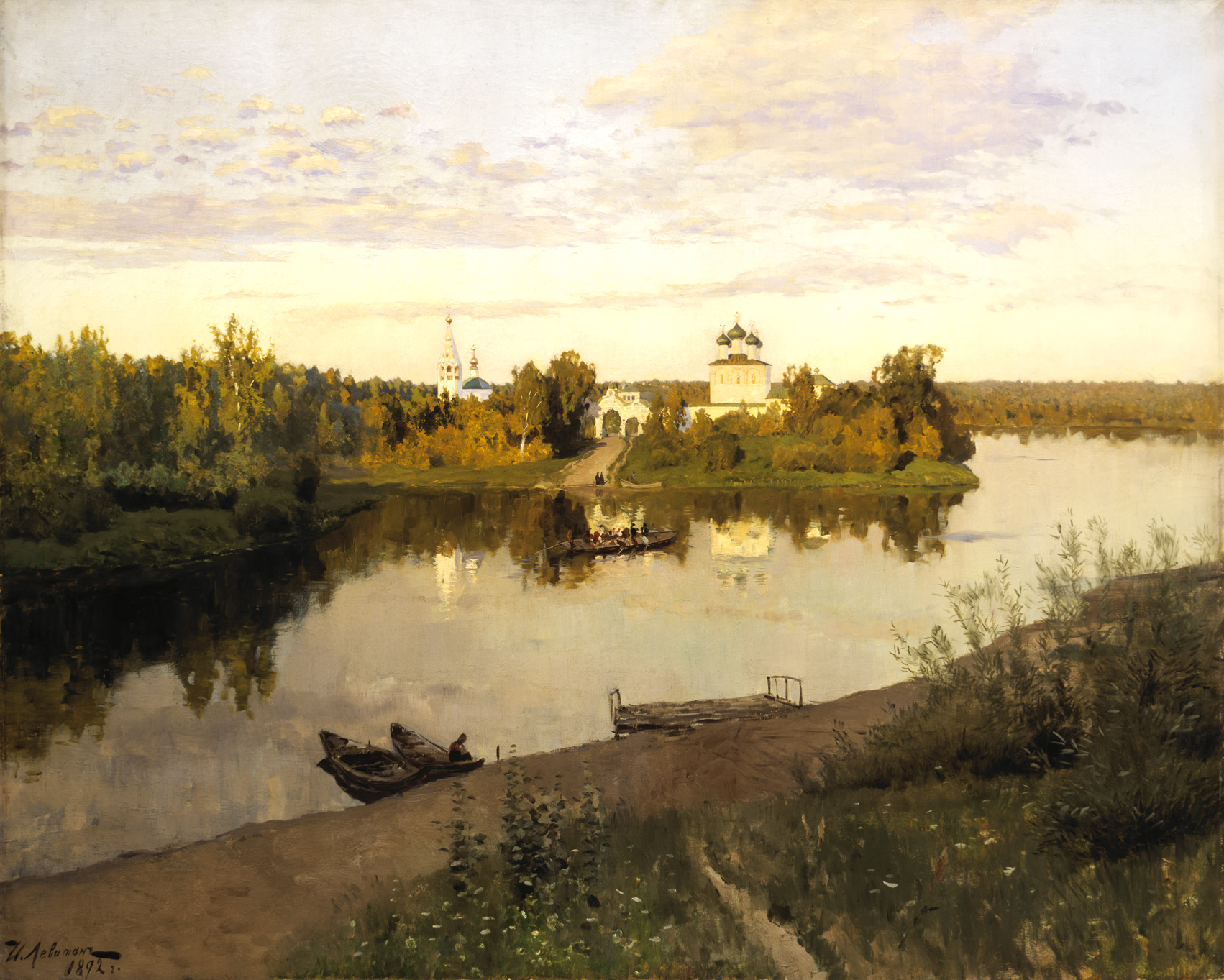
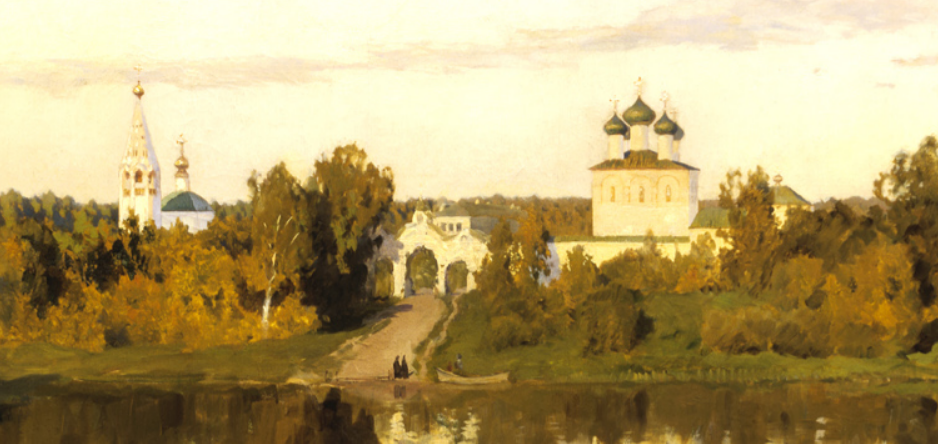
« Cloches du soir » (Вечерний звон) est un tableau du peintre russe Isaac Levitan (Исаак Ильич Левитан), qui est un maître reconnu du paysage lyrique. Il s’agit d’une belle huile sur toile de 87 X 107,6 cm qui a été peinte en 1892 et qui se trouve à la Galerie nationale Tretiakov depuis 1918. Ce tableau est aussi appelé « Monastère pour les fêtes » (Монастырь под праздник). “Cloches du soir” est considéré par certains chercheurs comme une variante du tableau antérieur représentant un monastère similaire et appelé “Couvent tranquil” “Тихая обитель” (1890).
Le critique d’art Vladimir Petrov a déclaré que malgré le motif similaire au “Couvent tranquil”, le tableau “Cloches du soir” “est néanmoins dépourvu de secondarité et a son propre charme unique, son propre” accord “”
Selon Sofya Prorokova, Levitan chantait souvent la chanson “Cloches du soir” du compositeur Alexander Alyabyev et cela pourrait être la raison du titre du tableau. Une autre version donnée, est que Levitan aurait pu choisir ce nom sous l’influence du recueil de poèmes de Yakov Polonsky “Cloches du soir”, publié en 1890.
« Cloches du soir » d’Isaac Levitan
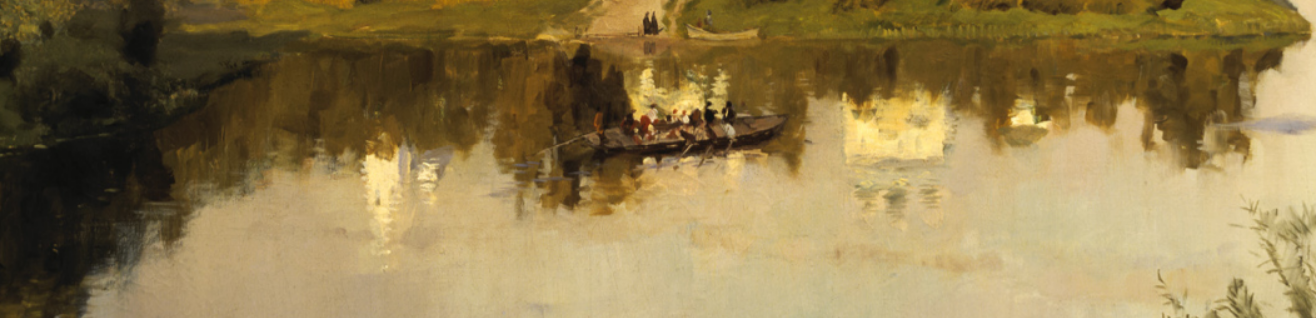
Devant le spectateur se trouve une large rivière qui semble couper l’image en diagonale. L’eau est calme. Des nuages roses du soir, peints dans des teintes d’or rose par le soleil couchant, flottent solennellement dans le ciel et se reflètent dans l’eau.
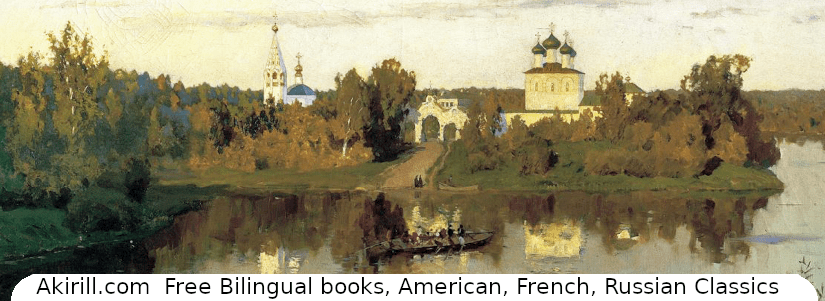
« Cloches du soir » d’Isaac Levitan partie monastère
Sur la rive opposée, envahie par la forêt, il y a un monastère avec un haut clocher qui s’élève au-dessus de la forêt. Il désigne la verticale métaphysique de la vie écrite par l’artiste : de la terre au ciel, du péché à la sainteté.
Les derniers rayons de soleil illuminent les murs blancs comme neige de son temple et de son clocher, les faisant paraître dorés. Grâce à leur reflet sur la surface de la rivière, l’accent mis sur les bâtiments du temple est rendu encore plus lumineux.
« Cloches du soir » d’Isaac Levitan partie reflection
Habituellement, les gens sont rares dans les peintures de Levitan, mais dans ce travail, afin d’améliorer ses caractéristiques réalistes, l’artiste a représenté un homme au croisement sur la rive proche dans un bateau, des gens sur un ferry au centre de la rivière, se dépêchant au service du soir, et deux moines les rencontrant.
« Cloches du soir » d’Isaac Levitan partie personnes
Description du tableau sur le site de la galerie Tretiakov :
« Les plans spatiaux du tableau sont présentés comme trois mondes différents. Le plus proche est un haut talus couvert d’ombre, d’où l’artiste regarde autour de lui. De l’autre côté du fleuve, naissant d’un jeu de mirages de reflets, dans les rayons du soleil couchant, une vision merveilleuse apparaît – un monastère. Enfin, le regard s’élève vers le ciel en suivant les nuages qui se fondent dans une douce lueur dorée. L’artiste transmet le désir de l’âme à ce monde enchanté de lumières et de sons qui disparaissent dans le lointain. Interrompant le mouvement vers le ciel avec des rythmes transversaux – la ligne du rivage, des ponts, un bateau, il crée le sentiment d’une image insaisissable. Dans cette distance séduisante, on ne peut que s’efforcer sans fin et langoureusement dans les rêves.
J’espère que vous avez apprécié ce tableau autant que moi.
Si vous avez aimé cet article, abonnez-vous, mettez des likes, écrivez des commentaires !
“Evening Bells” (Вечерний звон) is a painting by the Russian painter Isaac Levitan (Исаак Ильич Левитан), who is a recognized master of the lyrical landscape. It is a beautiful oil on canvas of 87 X 107.6 cm which was painted in 1892 and has been in the State Tretyakov Gallery since1918. This painting is also called “Monastery for the holidays” (Монастырь под праздник). “Evening Bells” is considered by some researchers as a variant of the earlier painting depicting a similar monastery and called ” Quiet Abode ” «Тихая обитель» (1890).
Art critic Vladimir Petrov said that despite the motif similar to the “Quiet Convent”, the painting “Evening Bells” “nevertheless is devoid of secondariness, and has its own, unique charm, its own” chord “”
According to Sofya Prorokova, Levitan often sand the song “Evening Bells” by composer Alexander Alyabyev and it might be the reason of the title of the painting. Another version given, is that Levitan could have chosen this name under the influence of Yakov Polonsky ‘s collection of poems “Evening Bells”, published in 1890.
“Evening Bells” by Isaac Levitan
In front of the viewer is a wide river which seems to cut the picture diagonally. The water is calm. Pink evening clouds painted in rose-gold hues by the setting sun, float solemnly in the sky and are reflected in the water.
“Evening Bells” by Isaac Levitan part monastery
On the opposite bank which is overgrown with forest, there is a monastery with a high bell tower soaring above the forest. It denotes the metaphysical vertical of life written by the artist: from earth to heaven, from sinfulness to holiness.
The last rays of sun brightly light the snow-white walls of his temple and bell tower, making them seem golden. Thanks to their reflection in the surface of the river, the emphasis on temple buildings is made even brighter.
“Evening Bells” by Isaac Levitan part reflection
Usually people are a rarity in Levitan’s paintings, but in this work, in order to enhance its realistic features, the artist depicted a man at the crossing on the near bank in a boat, people on a ferry in the center of the river, hurrying to the evening service, and two monks meeting them.
“Evening Bells” by Isaac Levitan part people
Description of the painting on the website of the Tretyakov Gallery:
“The spatial plans of the painting are presented as three different worlds. The near one is a high bank covered with shadow, from which the artist looks around. Across the river, growing out of a mirage game of reflections, in the rays of the setting sun, a wonderful vision appears – a monastery. Finally, the gaze rises into the sky following the clouds melting in a soft golden glow. The artist conveys the desire of the soul to this enchanted world of light and sounds disappearing into the distance. Interrupting the movement towards the sky with transverse rhythms – the line of the shore, bridges, a boat, he creates a feeling of an elusive image. In this alluring distance, one can only endlessly , languidly strive in dreams .
I hope you enjoyed this painting as much as I did.
If you liked this article, subscribe , put likes, write comments!
“Robinson Crusoe” écrit en six mois ou moins par Daniel Defoe, a été publié pour la première fois en avril 1719 et a marqué le début de la fiction réaliste en tant que genre littéraire. À la fin du XIXe siècle, ce livre avait plus d’éditions, de dérivés et de traductions que tout autre livre de la littérature occidentale.
Le livre s’est avéré si populaire que pendant la Seconde Guerre mondiale, les personnes qui ont décidé de rester et de se cacher dans les ruines de la ville de Varsovie occupée par les Allemands en 1945 ont été, après leur sauvetage par l’Armée rouge, appelées les Robinson Crusoes de Varsovie.
“Robinson Crusoe” a été inspiré par des histoires de naufragés de la vie réelle. On pense que la source d’inspiration la plus probable est le marin écossais Alexander Selkirk, qui a passé quatre ans sur l’île inhabitée de Más a Tierra dans les îles Juan Fernández au large de la côte chilienne, laquelle a été rebaptisée île Robinson Crusoé en 1966. Autres sources possibles pour le récit comprennent “Hayy ibn Yaqdhan” d’Ibn Tufail, un roman philosophique du XIIe siècle qui se déroule sur une île déserte, et le marin espagnol du XVIe siècle Pedro Serrano qui a été abandonné pendant sept ou huit ans sur une petite île déserte après avoir fait naufrage dans le années 1520.
Il y a deux thèmes principaux. Le premier est la lutte contre la nature et la création ou la réplication de la société. Cela se fait par l’utilisation de l’agriculture et Crusoe crée même une hiérarchie politique rudimentaire. Il y a aussi un thème religieux qui raconte comment Robinson se rapproche de Dieu. Il n’écoute pas les sermons dans une église mais passe plutôt du temps seul dans la nature avec seulement une Bible à lire. À cela s’ajoute sa description de la relation maître-serviteur idéalisée entre lui et Friday, qui peut également être vue en termes d’assimilation culturelle. Crusoe représente l’Européen “éclairée” et Friday est le “sauvage”. Pour Crusoe, Friday ne peut être racheté de ses mœurs culturelles que par l’assimilation de la culture européenne, mais Defoe utilise également Friday pour critiquer la colonisation espagnole des Amériques.
“Robinson Crusoe” a de nombreuses bandes dessinées, scènes, films et adaptations animées. La première bande dessinée a été réalisée par Classics Illustrated en 1943. La première adaptation scénique a été jouée en 1796 au théâtre Royal de Londres. En 1927, un film dramatique britannique muet produit par MA Wetherell est sorti. Le premier film d’animation est sorti en 1988 et la première adaptation télévisée était un film français réalisé en 1964 et mettant en vedette Robert Hoffmann.
Aperçu
“Robinson Crusoe” est présenté comme une autobiographie du personnage principal qui est un naufragé, lequel passe 28 ans sur une île déserte tropicale isolée. Defoe détaille la lutte d’un individu pour survivre dans un environnement fondamentalement hostile. Dans le cadre de son existence quotidienne, Robinson Crusoé fait face à de nombreuses difficultés, notamment la famine, la maladie et même le danger des cannibales, mais il récupère ce qu’il peut du naufrage et se fournit un abri ainsi que des meubles et des outils rudimentaires. Robinson ne rumine jamais au sujet de son isolement, préférant occuper son temps de manière productive et réussir dans un environnement peu prometteur. Il est un exemple du triomphe de l’esprit humain.
En 1632, je naquis à York, d’une bonne famille, mais qui n’était point de ce pays. Mon père, originaire de Brême, établi premièrement à Hull, après avoir acquis l’aisance et s’être retiré du commerce, était venu résider à York où il s’était allié, par ma mère, à la famille Robinson, une des meilleures de la province. C’est à cette alliance que je devais mon double nom de Robinson-Kreutznaer; mais, aujourd’hui, par une corruption de mots assez commune en Angleterre, on nous nomme, nous nous nommons et signons Crusoé. C’est ainsi que mes compagnons m’ont toujours appelé.
J’avais deux frères: l’aîné, lieutenant-colonel, en Flandre, d’un régiment d’infanterie anglaise, autrefois commandé par le fameux colonel Lockhart, fut tué à la bataille de Dunkerque contre les Espagnols; que devint l’autre? j’ignore quelle fut sa destinée; mon père et ma mère ne connurent pas mieux la mienne.
Troisième fils de la famille, et n’ayant appris aucun métier, ma tête commença de bonne heure à se remplir de pensées vagabondes. Mon père, qui était un bon vieillard, m’avait donné toute la somme de savoir qu’en général on peut acquérir par l’éducation domestique et dans une école gratuite. Il voulait me faire avocat; mais mon seul désir était d’aller sur mer, et cette inclination m’entraînait si résolument contre sa volonté et ses ordres, et malgré même toutes les prières et les sollicitations de ma mère et de mes parents, qu’il semblait qu’il y eût une fatalité dans cette propension naturelle vers un avenir de misère.
Mon père, homme grave et sage, me donnait de sérieux et d’excellents conseils contre ce qu’il prévoyait être mon dessein. Un matin, il m’appela dans sa chambre, où il était retenu par la goutte, et me réprimanda chaleureusement à ce sujet:—«Quelle autre raison as-tu, me dit-il, qu’un penchant aventureux, pour abandonner la maison paternelle et ta patrie, où tu pourrais être poussé, et où tu as l’assurance de faire ta fortune avec de l’application et de l’industrie, et l’assurance d’une vie d’aisance et de plaisir? Il n’y a que les hommes dans l’adversité ou les ambitieux qui s’en vont chercher aventure dans les pays étrangers, pour s’élever par entreprise et se rendre fameux par des actes en dehors de la voie commune. Ces choses sont de beaucoup trop au-dessus ou trop au-dessous de toi; ton état est le médiocre, ou ce qui peut être appelé la première condition du bas étage; une longue expérience me l’a fait reconnaître comme le meilleur dans le monde et le plus convenable au bonheur. Il n’est en proie ni aux misères, ni aux peines, ni aux travaux, ni aux souffrances des artisans: il n’est point troublé par l’orgueil, le luxe, l’ambition et l’envie des hautes classes. Tu peux juger du bonheur de cet état; c’est celui de la vie que les autres hommes jalousent; les rois, souvent, ont gémi des cruelles conséquences d’être nés pour les grandeurs, et ont souhaité d’être placés entre les deux extrêmes, entre les grands et les petits; enfin le sage l’a proclamé le juste point de la vraie félicité en implorant le ciel de le préserver de la pauvreté et de la richesse.
«Remarque bien ceci, et tu le vérifieras toujours: les calamités de la vie sont le partage de la plus haute et de la plus basse classe du genre humain; la condition moyenne éprouve le moins de désastres, et n’est point exposée à autant de vicissitudes que le haut et le bas de la société; elle est même sujette à moins de maladies et de troubles de corps et d’esprit que les deux autres, qui, par leurs débauches, leurs vices et leurs excès, ou par un trop rude travail, le manque du nécessaire, une insuffisante nourriture et la faim, attirent sur eux des misères et des maux, naturelle conséquence de leur manière de vivre. La condition moyenne s’accommode le mieux de toutes les vertus et de toutes les jouissances: la paix et l’abondance sont les compagnes d’une fortune médiocre. La tempérance, la modération, la tranquillité, la santé, la société, tous les agréables divertissements et tous les plaisirs désirables sont les bénédictions réservées à ce rang. Par cette voie, les hommes quittent le monde d’une façon douce, et passent doucement et uniment à travers, sans être accablés de travaux des mains ou de l’esprit; sans être vendus à la vie de servitude pour le pain de chaque jour; sans être harassés par des perplexités continuelles qui troublent la paix de l’âme et arrachent le corps au repos; sans être dévorés par les angoisses de l’envie ou la secrète et rongeante convoitise de l’ambition; au sein d’heureuses circonstances, ils glissent tout mollement à travers la société, et goûtent sensiblement les douceurs de la vie sans les amertumes, ayant le sentiment de leur bonheur et apprenant, par l’expérience journalière, à le connaître plus profondément.»
Ensuite il me pria instamment, et de la manière la plus affectueuse, de ne pas faire le jeune homme:—«Ne va pas te précipiter, me disait-il, au milieu des maux contre lesquels la nature et ta naissance semblent t’avoir prémuni; tu n’es pas dans la nécessité d’aller chercher ton pain; je te veux du bien, je ferai tous mes efforts pour te placer parfaitement dans la position de la vie qu’en ce moment je te recommande. Si tu n’étais pas aise et heureux dans le monde, ce serait par ta destinée ou tout à fait par l’erreur qu’il te faut éviter; je n’en serais en rien responsable, ayant ainsi satisfait à mes devoirs en t’éclairant sur des projets que je sais être ta ruine. En un mot, j’accomplirais franchement mes bonnes promesses si tu voulais te fixer ici suivant mon souhait, mais je ne voudrais pas tremper dans tes infortunes en favorisant ton éloignement. N’as-tu pas l’exemple de ton frère aîné, auprès de qui j’usai autrefois des mêmes instances pour le dissuader d’aller à la guerre des Pays-Bas, instances qui ne purent l’emporter sur ses jeunes désirs le poussant à se jeter dans l’armée, où il trouva la mort? Je ne cesserai jamais de prier pour toi, toutefois j’oserais te prédire, si tu faisais ce coup de tête, que Dieu ne te bénirait point, et, que, dans l’avenir, manquant de toute assistance, tu aurais toute la latitude de réfléchir sur le mépris de mes conseils.»
Je remarquai, vers la dernière partie de ce discours, qui était véritablement prophétique, quoique je ne suppose pas que mon père en ait eu le sentiment; je remarquai, dis-je, que des larmes coulaient abondamment sur sa face, surtout lorsqu’il me parla de la perte de mon frère, et qu’il était si ému, en me prédisant que j’aurais tout le loisir de me repentir, sans avoir personne pour m’assister, qu’il s’arrêta court, puis ajouta:—«J’ai le cœur trop plein, je ne saurais t’en dire davantage.»














 AKirill, Learn, apprenez, translation, traduction, livres bilingues, bilingual books