On this site we hope to help you learn, and to remove the difficulties caused by the difference of culture and language. Sur ce site nous espérons vous aider à apprendre, et à enlever la barrière causée par les différents languages et cultures.
A musical slide show of the photos I took during a little walk I had in Strasbourg. I followed the trams tracks from Elsau to the “Parc de l’Etoile” . The map is under the video if you want more details.
I hope you enjoyed the photos.
If you liked this article, subscribe , put likes, write comments!.
Un diaporama musical des photos que j’ai prises lors d’une petite balade à Strasbourg. J’ai suivi les voies des trams d’Elsau jusqu’au « Parc de l’Etoile ». La carte est sous la vidéo si vous voulez plus de détails.
This week I added more books of Dostoevsky in English as well as a few books from George Orwell, and “War and Peace” by Tolstoy, in Russian. You can find them on our English Literature page or on our Russian Literature page.
I hope you’ll find something to enjoy
If you liked this article, don’t forget to like and share.
Cette semaine j’ai ajouté plus de livres de Dostoïevski en anglais ainsi que quelques livres de George Orwell, et “La Guerre et la Paix” de Tolstoï, en russe. Vous pouvez les trouver sur notre page Littérature Anglaise ou sur notre page Littérature Russe .
J’espère que vous trouverez quelque chose à apprécier
Si vous avez aimé cet article, n’oubliez pas de liker et de partager.
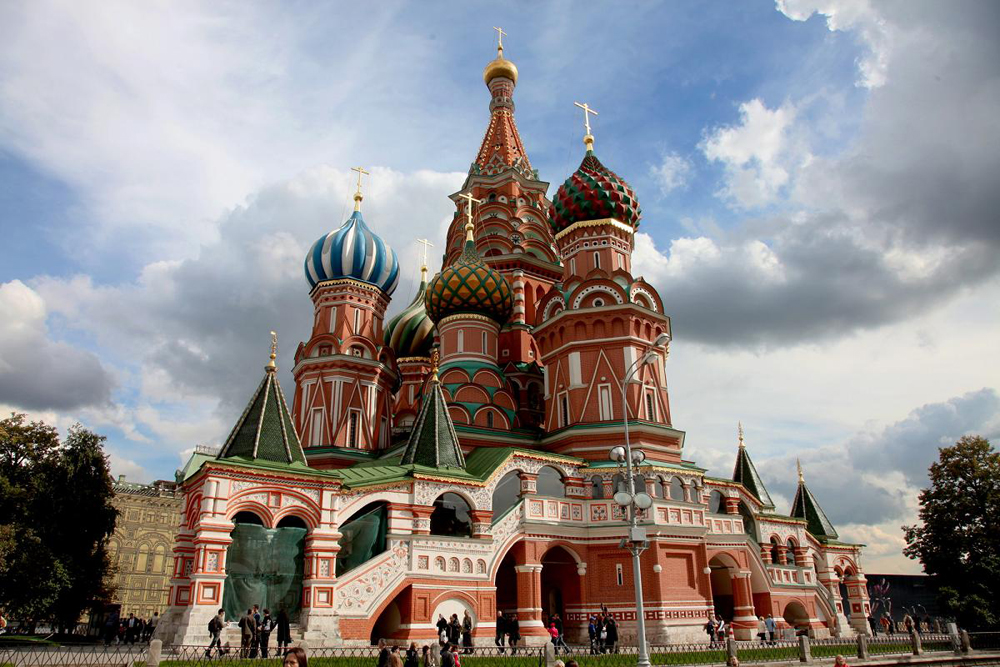
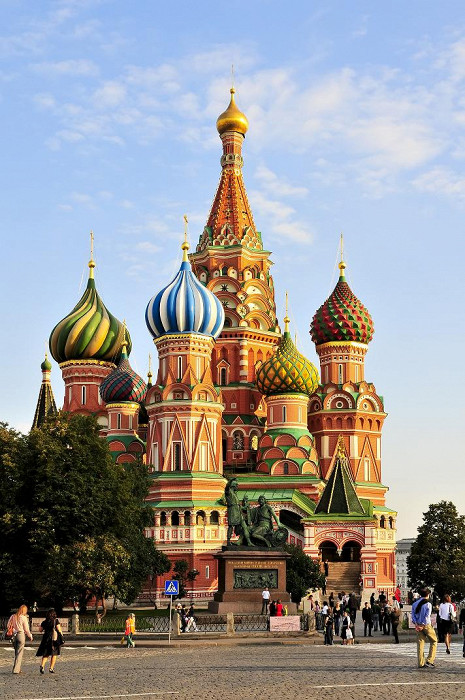
Saint Basil’s Cathedral, an architectural treasure of Moscow
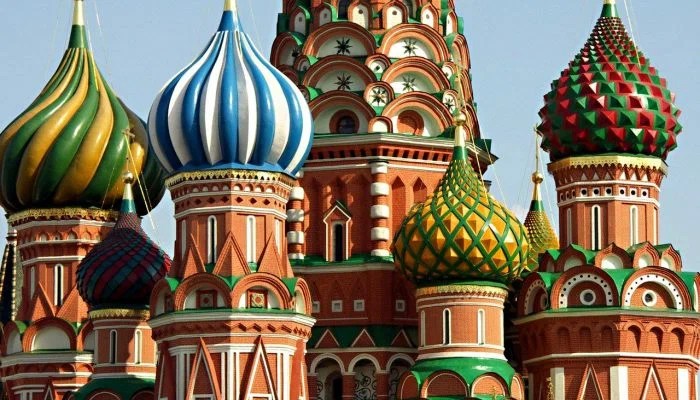
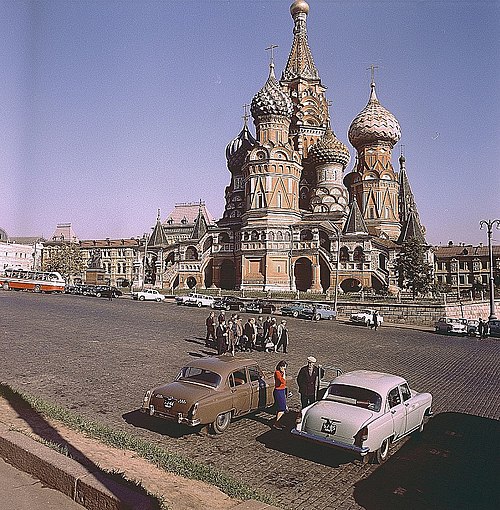
The extraordinarily beautiful and mysterious St. Basil’s Cathedral, or the Cathedral of the Intercession of the Virgin, on the Moat, flaunting on Red Square, is one of the most significant monuments of ancient Russian architecture of the 16th century. Neither before nor after it was built any such structure. It looks like a vault of eight churches, which surrounds the highest – the ninth. Such a temple still does not exist anywhere else in Russia. Even the bright pattern of the domes of the cathedral makes it look like a blooming Garden of Eden.
Saint Basil’s Cathedral
Each temple has its own entrance and lighting, however, the cathedral is a single building. The complexity and amazing combination of details of the St. Basil’s Cathedral are unparalleled in Russian architecture and had a huge impact on the development of Russian national architecture.
The cathedral was erected in 1555–1561. at the behest of Tsar Ivan the Terrible in honor of the conquest of the Kazan kingdom. It is believed that the architects who created it were deprived of sight. Even Stalin did not allow the building to be demolished, and during the war the temple was hidden from shelling. The cathedral is included in the Russian list of UNESCO World Heritage Sites and is a branch of the State Historical Museum.
The upper tier of the cathedral resembles a labyrinth, and the base is an eight-pointed star.
The cathedral unites ten churches (chapels), some of which were consecrated in honor of the saints, whose days of memory fell on the decisive battles for Kazan.
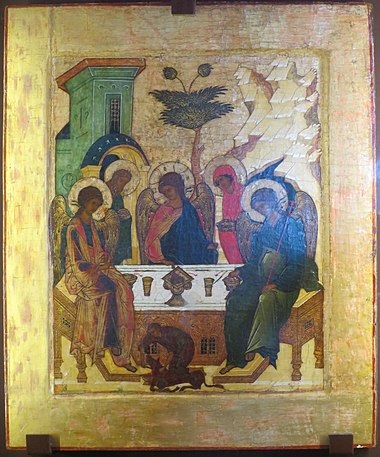
The central church was built in honor of the Intercession of the Virgin , around which separate churches are grouped in honor of: the Holy Trinity , the Entry of the Lord into Jerusalem , St. Nicholas of Velikoretsky , the Three Patriarchs: Alexander, John and Paul the New, Gregory of Armenia , Cyprian and Justina , Alexander Svirsky and Varlaam Khutynsky , placed on the same base-basement, and a chapel in honor of St. Basil the Blessed, after whose name the temple received a second, more well-known name.
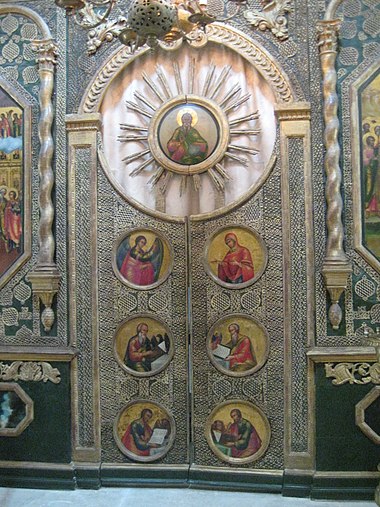
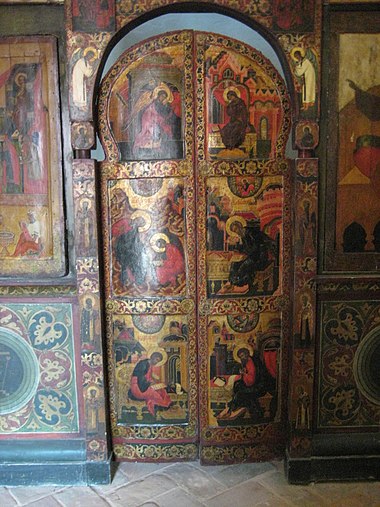
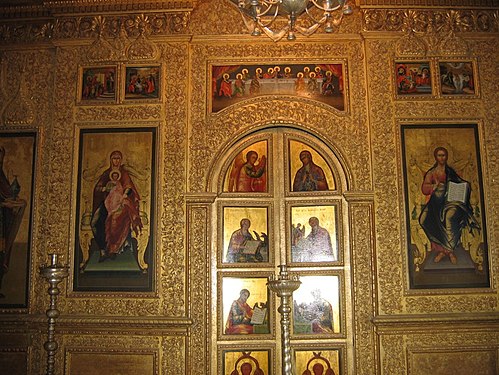
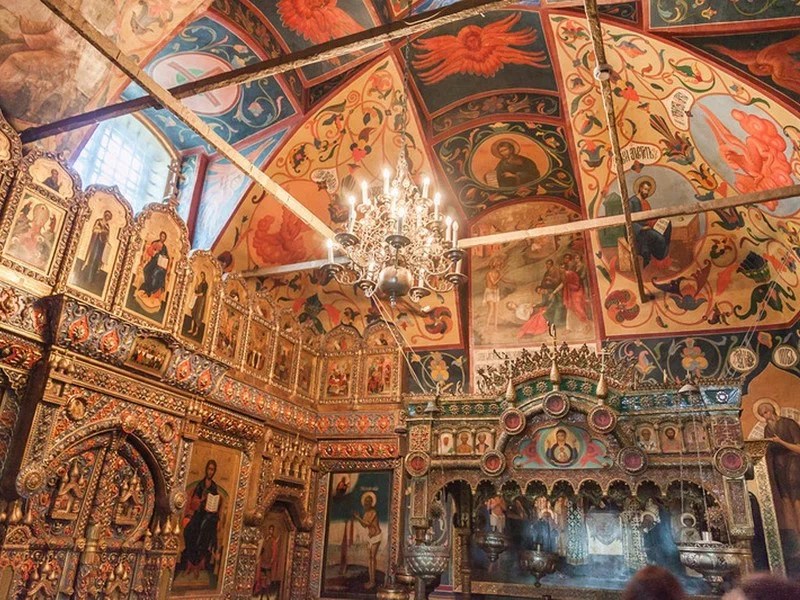
Royal Doors in the Church of the Intercession of the Blessed Virgin Mary, 2009Royal Doors of the Church of Cyprian and Justina 2012Royal Doors of the Church of the Entry of the Lord into Jerusalem, 2011Royal doors of the iconostasis of the Church of Varlaam Khutynsky, 2011Royal Doors of the Church of St. Nicholas Velikoretsky, 2007
The thickness of the walls of the foundation of St. Basil’s Cathedral reaches three meters. It is this thickness that allows it to securely hold as many as nine buildings. If you look at the foundation of the church, you can see that 8 small temples form an eight-pointed star – a symbol of the Virgin. There are larger churches in the ensemble of small churches. They are strictly oriented to the cardinal points and form symmetry. The main temple, with a huge dome and a tent, is the Protection of the Virgin, Her intercession.
During the campaigns of Ivan the Terrible to Kazan on today’s Red Square, “camping” wooden churches were erected in memory of the victories won.
On the day of the memory of Cyprian and Justina ( October 2, 1552), the next campaign ended with a victory over the Kazan Khanate and the annexation of the city to the Muscovite state. It was, the day after the Intercession of the Most Holy Theotokos, and Ivan the Terrible ordered to unite all the “marching” wooden churches into one stone temple in the name of the Intercession of the Virgin – Intercession Cathedral, but it stood only less than a year before to be dismantled, and finally a stone cathedral was laid in its place.
Already, in the autumn of 1554 were the first reliable mention of the construction of the Church of the Intercession of the Mother of God. The construction of this temple began in 1555 and lasted 6 years. The temple was built of brick, and its foundations , plinth and a number of details are made of white stone. In the western part of the cathedral there is a flat brick ceiling.
A legend about the architects Barma and Postnik which names became known only in 1895 told that they had been blinded by order of the the Tsar Ivan the Terrible so that they could no longer build such a temple, but Postnik could not be blinded, since for several years after the construction of the cathedral he participated in the creation of the Kazan Kremlin.
By 1559, in the fall, the temple main part was erected, and at the same period, all but the central church were consecrated.
Despite the apparent grandiosity from the outside of St. Basil’s Cathedral the inside is quite small, accommodating a very small number of people during the service. That is because according to the plan of its creators, it should not have been too spacious, since during major church holidays the entire Red Square was the church, the place of execution, on which the clergy ascended, became a lectern, and the Pokrovsky Cathedral turned into the altar of an open-air temple. After all, there is no temple in Heavenly Jerusalem, but “there is only His Throne” … and the Intercession Cathedral – turned into an altar of a church in the open.
Finally, on June 29, 1561 according to the old calendar, the central Intercession Church of the cathedral was once consecrated in the name of the Intercession of the Most Holy Theotokos.
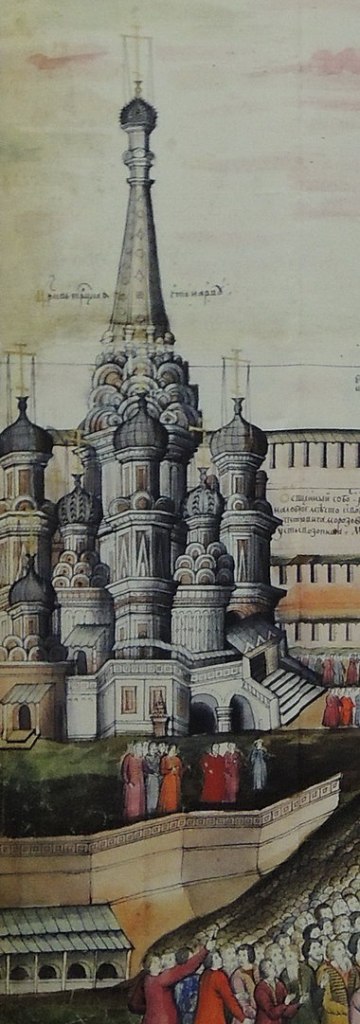
St. Basil’s Cathedral from the Book of the election of the Tsar and Grand Duke Mikhail Fedorovich, 1672 1673
The first changes to the Cathedral of the Intercession of the Virgin, on the Moat, took place almost immediately after construction and were associated with the name of the famous Moscow saint – St. Basil the Blessed. Before the appearance of a stone cathedral on this site, there was a wooden Trinity Church, where St. Basil often came to pray. In 1558, a lower church was added to the Pokrovsky Cathedral over the burial place of the Moscow miracle worker – St. Basil the Blessed. To build this temple, the builders dismantled part of the original cathedral.
Some historians believe that the cathedral was originally conceived as a likeness of the seven-tower Blachernae monastery with the Church of the Virgin , in which the miracle of the Intercession once took place . By its presence and location, it was supposed to assert a new state ideology: ” Moscow is the third Rome ” , and the eight chapel was there because of the dimension of the foundation” . Others believe that the very idea of a multi-chapel cathedral belonged to Metropolitan Macarius , who planned to recreate in the center of Moscow the image of the holy city of Jerusalem.
In the middle of the 16th century, the cathedral was painted in the fresco technique and imitated brickwork. There were no porches, and the St. Basil’s Church bell tower had a different look. It gave the cathedral a strict but elegant appearance which could be compare to a memorial with the eight separates churches symbolizing the days of the decisive battles for Kazan.
The original roof of the church burned downed at the end of the 16th century and the figured domes of the cathedral appeared instead of the original roof.
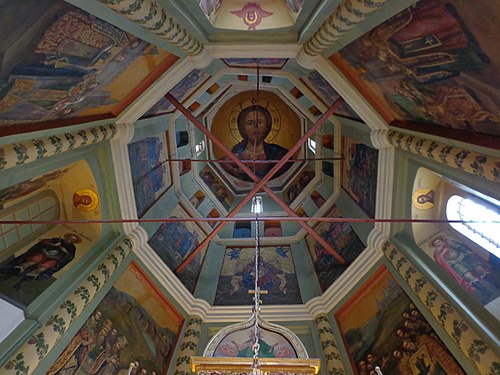
The Intercession Cathedral is richly decorated with wall paintings, has an impressive collection of ancient Russian icon painting and masterpieces of church applied art.
Until the reconstruction of the Great Bell Tower in the Kremlin in 1660, the cathedral was the tallest building in Moscow.
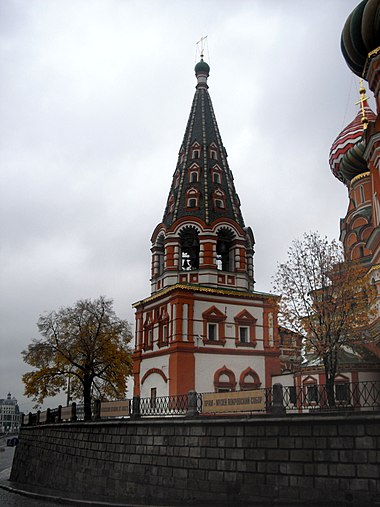
In the 1670 the wooden churches on Red Square were closed, then the cathedral was supplemented by a hipped bell tower, its heads were covered with iron, the porch was covered with tiles , and a bright colorful ornamental painting appeared on the cathedral. Finally the chapel of Blessed John of Moscow was added in 1672
Bell tower
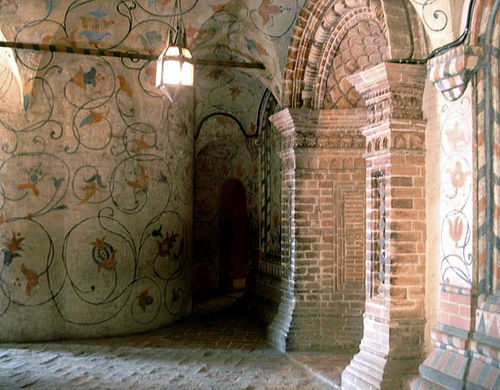
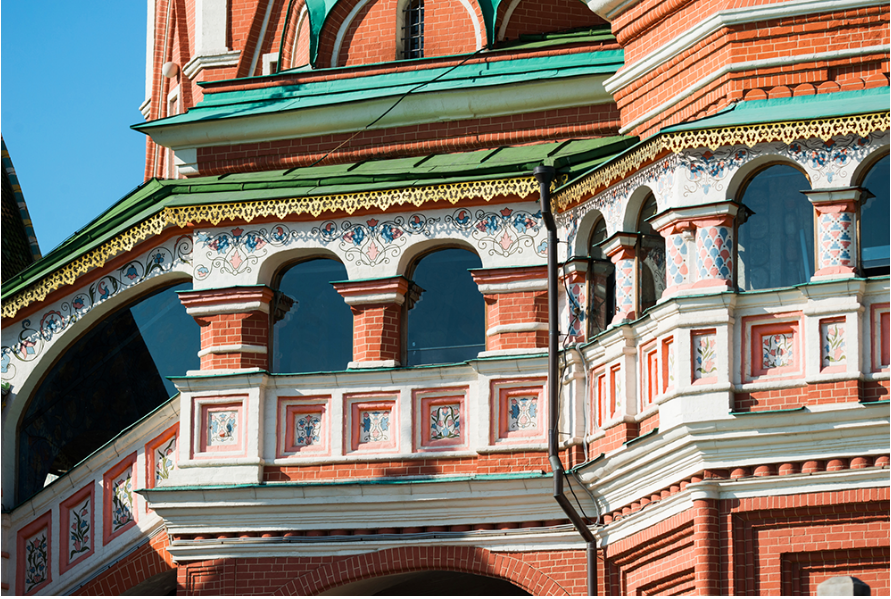
The cathedral was seriously renovated in 1680, with brick galleries replacing the wooden ones and the outer and inner galleries, platforms and parapets of the porches being painted with grass ornaments motifs.
In the 18 and 19 centuries Divine services were regularly performed in St. Basil’s Cathedral. As a rule, they were performed in an annex – a temple built in honor of St. Basil the Blessed, because the rest of the temples were cold. That is why the people got accustomed to the name – St. Basil’s Cathedral.
Divine services in the temple continued until the beginning of the 20th century. The last rector was Father John Vostorgov, now canonized among the saints in the host of new martyrs and confessors
In 1737, the temple almost completely burned out because of one of the strongest fires in Moscow. The restoration of the architecture and interiors of the cathedral was done under the leadership of the architect Ivan Michurin.
Painting by Giacomo Quarenghi “The Intercession Cathedral and the Spasskaya Tower of the Kremlin”, 1797
The cathedral was seriously repaired and rebuilt by decree of Catherine II from 1784 to 1786, and it was then that the walls of St. Basil’s Cathedral were painted with multi-colored paints and acquired their modern look. Before it was mainly painted in red and white colors.
After the Patriotic War of 1812, Alexander I decided to restore the temple and in 1817, the architect Osip Bove , while reconstructing Red Square with shopping malls, laid out the retaining wall of the temple with “wild” stone and installed a cast-iron fence. First along Moskvoretskaya Street, then in 1834, on the south side of the temple.
Red_Square_in_Moscow_(1801)_by_Fedor_Alekseev
In 1880, a manor on Pyatnitskaya street was added to the temple . Until 1918, the last rector of the temple , Father John lived in it .
In the 1890s, the temple was again seriously reconstructed. The floors were strengthened, and the Cathedral sacristy was decorated with colored stained-glass windows, designed by the architect Andrei Pavlinov.
Postcard early 20th century
In 1918, the Intercession Cathedral became one of the first cultural objects taken under state protection as a monument of national and world significance. It is during this period that services were stopped in the upper churches and the museumification began.
1965
Archpriest John Kuznetsov became the first caretaker of the museum. In the 1920s, the cathedral was in dear need of repair and restoration work was carried out, led by architects Nikolai Kurdyukov and Alexander Alexandrovich Zhelyabuzhsky.
Basil’s Cathedral and the monument to Minin and Pozharsky
After the decision of 1923 to establish a historical and architectural museum in the cathedral, this one was opened to visitors on May 21, 1923.
Beginning in 1923 and until 1949 research was carried out in the museum because of legends which attributed to the temple a network of underground passages. And in 1924, walled-up room with a deep hole in the floor under the chapel of John the Merciful was found by the restorer and architect Dmitry Sukhov and the speleologist-historian Ignatius Stelletsky.
The window-loopholes of the room were bricked up both from the side of the river and from the side of Red Square. Ignatius Stelletsky wrote that the embrasures had the same approaches as for the cannons in the towers of Kitay-gorod and any of the monasteries which led him to the idea that in the 16th century the lower part of St. Basil’s Cathedral was intended for combat.
The Pokrovsky Cathedral museum became a branch of the State Historical Museum in 1928 and in 1929 the divine services were banned in the cathedral, and the bells were removed and melted down.
During the Great Patriotic War, the museum did not stop its work, although it was closed to visitors. St. Basil’s Cathedral was carefully disguised to save it from bombing. There is a legend that after the war, Stalin was offered to remove the cathedral under the pretext that it was interfering with the parade. It is believed that Kaganovich showed Stalin a model of the square, and in his presence he removed the model of the temple, suggesting that it be demolished. Stalin abruptly interrupted him: “Lazar, put it in its place!” Since then, no one has raised questions about the inviolability of the cathedral.
The cathedral began to be restored, on September 7, 1947, and the museum reopened on the day of the celebration of the 800th anniversary of Moscow.
From 1954 to 1955 the “brick-like” painting of the 16th century was returned to the cathedral, and at the same time the white-stone details of the décor was restored.
On November 18, 1991, the Russian Orthodox Church was allowed to hold regular services in the Kremlin cathedrals and St. Basil’s Cathedral but the first divine service took place on the patronal feast of the Intercession of the Most Holy Theotokos on October 1, 1991
Beginning in 2001 and ending ten years later the interiors of ten churches were restored, the icon of the Intercession of the Most Holy Theotokos was restored, and the basements were restored to their original appearance.
If you liked this article, subscribe , put likes, write comments!Share on social networksand you can alsoCheck out Our Latest Posts
La cathédrale Saint-Basile, un trésor architectural de Moscou
La cathédrale Saint-Basile, extraordinairement belle et mystérieuse, ou la cathédrale de l’Intercession de la Vierge, sur les douves, s’étalant sur la Place Rouge, est l’un des monuments les plus importants de l’architecture russe ancienne du XVIe siècle. Ni avant ni après une telle structure n’a été construite. Elle ressemble à une voûte de huit églises, qui entoure la plus haute – la neuvième. Un tel temple n’existe toujours pas ailleurs en Russie. Même le motif lumineux des dômes de la cathédrale le fait ressembler à un jardin d’Eden en fleurs.
Saint Basil’s Cathedral
Chaque temple a sa propre entrée et son propre éclairage, cependant, la cathédrale est un seul bâtiment. La complexité et l’incroyable combinaison de détails de la cathédrale Saint-Basile sont sans précédent dans l’architecture Russe et ont eu un impact énorme sur le développement de l’architecture nationale russe.
La cathédrale a été érigée en 1555-1561. à la demande du tsar Ivan le Terrible en l’honneur de la conquête du royaume de Kazan. On pense que les architectes qui l’ont créé ont été privés de la vue. Même Staline n’a pas autorisé la démolition du bâtiment et pendant la guerre, le temple a été caché des bombardements. La cathédrale est inscrite sur la liste Russe des sites du patrimoine mondial de l’UNESCO et est une branche du Musée historique d’État.
Le niveau supérieur de la cathédrale ressemble à un labyrinthe et la base est une étoile à huit branches.
La cathédrale réunit dix églises (chapelles), dont certaines ont été consacrées en l’honneur des saints, dont les jours de mémoire sont tombés sur les batailles décisives pour Kazan.
L’église centrale a été construite en l’honneur de l’Intercession de la Vierge, autour de laquelle des églises séparées sont regroupées en l’honneur de : la Sainte Trinité, l’Entrée du Seigneur à Jérusalem, Saint-Nicolas de Velikoretsky, les Trois Patriarches : Alexandre, Jean et Paul le Nouveau, Grégoire d’Arménie, Cyprien et Justine, Alexandre Svirsky et Varlaam Khutynsky, placés sur le même soubassement, et une chapelle en l’honneur de saint Basile le Bienheureux, du nom duquel le temple reçut un second nom bien mieux connu.
Royal Doors in the Church of the Intercession of the Blessed Virgin Mary, 2009Royal Doors of the Church of Cyprian and Justina 2012Royal Doors of the Church of the Entry of the Lord into Jerusalem, 2011Royal doors of the iconostasis of the Church of Varlaam Khutynsky, 2011Royal Doors of the Church of St. Nicholas Velikoretsky, 2007
L’épaisseur des murs de la fondation de la cathédrale Saint-Basile atteint trois mètres. C’est cette épaisseur qui lui permet de tenir en toute sécurité jusqu’à neuf bâtiments. Si vous regardez les fondations de l’église, vous pouvez voir que 8 petits temples forment une étoile à huit branches – un symbole de la Vierge. Il y a de plus grandes églises dans l’ensemble des petites églises. Elles sont strictement orientés vers les points cardinaux et forment une symétrie. Le temple principal, avec un immense dôme et une tente, est la Protection de la Vierge, Son intercession.
Pendant les campagnes d’Ivan le Terrible à Kazan sur l’actuelle Place Rouge, des églises en bois de «camping» ont été érigées en mémoire des victoires remportées.
Le jour de la mémoire de Cyprien et Justine (2 octobre 1552), la campagne suivante se termina par une victoire sur le khanat de Kazan et l’annexion de la ville à l’État Moscovite. C’était le lendemain de l’intercession du Très Saint Théotokos, et Ivan le Terrible a ordonné de réunir toutes les églises en bois «en marche» en un seul temple de pierre au nom de l’intercession de la Vierge – la cathédrale de l’Intercession, mais elle n’est restée que moins d’un an avant d’être démantelée, et finalement une cathédrale en pierre a été posée à sa place.
Déjà, à l’automne 1554 était la première mention fiable de la construction de l’église de l’Intercession de la Mère de Dieu. La construction de ce temple a commencé en 1555 et a duré 6 ans. Le temple a été construit en brique et ses fondations, son socle et un certain nombre de détails sont en pierre blanche. Dans la partie ouest de la cathédrale, il y a un plafond en briques plates.
Une légende sur les architectes Barma et Postnik dont les noms ne furent connus qu’en 1895 racontait qu’ils avaient été aveuglés par ordre du Tsar Ivan le Terrible afin qu’ils ne puissent plus construire un tel temple, mais Postnik ne pouvait pas être aveuglé, car plusieurs années après la construction de la cathédrale, il a participé à la création du Kremlin de Kazan.
En 1559, à l’automne, la partie principale du temple a été érigée et, à la même période, toutes les églises sauf l’église centrale ont été consacrées.
Malgré l’apparente grandiosité de l’extérieur de la cathédrale Saint-Basile, l’intérieur est assez petit, pouvant accueillir un très petit nombre de personnes pendant le service.
En effet, selon le plan de ses créateurs, il n’aurait pas dû être trop spacieux, car pendant les grandes fêtes religieuses de l’église, toute la Place Rouge était l’église, le lieu d’exécution, sur lequel le clergé montait, devenait un lutrin, et la Cathédrale de Pokrovsky se transformait en l’autel d’un temple à ciel ouvert. Après tout, il n’y a pas de temple dans la Jérusalem Céleste, mais “il n’y a que Son Trône”… et la Cathédrale de l’Intercession – transformée en autel d’une église à ciel ouvert.
Enfin, le 29 juin 1561 selon l’ancien calendrier, l’église centrale d’intercession de la cathédrale a finallement été consacrée au nom de l’Intercession de la Très Sainte Théotokos.
St. Basil’s Cathedral from the Book of the election of the Tsar and Grand Duke Mikhail Fedorovich, 1672 1673
Les premiers changements apportés à la cathédrale de l’Intercession de la Vierge, sur les douves, ont eu lieu presque immédiatement après la construction et ont été associés au nom du célèbre saint de Moscou – Saint Basile le Bienheureux. Avant l’apparition d’une cathédrale de pierre sur ce site, il y avait une église de la Trinité en bois, où saint Basile venait souvent prier. En 1558, une église inférieure a été ajoutée à la cathédrale Pokrovsky au-dessus du lieu de sépulture du faiseur de miracles de Moscou – Saint-Basile le Bienheureux. Pour construire ce temple, les constructeurs ont démantelé une partie de la cathédrale d’origine.
Certains historiens pensent que la cathédrale a été conçue à l’origine comme une ressemblance du monastère des Blachernes à sept tours avec l’église de la Vierge, dans laquelle le miracle de l’Intercession a eu lieu. Par sa présence et son emplacement, elle était censée affirmer une nouvelle idéologie d’État : « Moscou est la troisième Rome », et la huitième chapelle était là en raison de la dimension de la fondation ». D’autres pensent que l’idée même d’une cathédrale à plusieurs chapelles appartenait au métropolite Macaire, qui prévoyait de recréer au centre de Moscou l’image de la ville sainte de Jérusalem.
Au milieu du XVIe siècle, la cathédrale fut peinte selon la technique de la fresque et imita la maçonnerie. Il n’y avait pas de porches, et le clocher de l’église Saint-Basile avait un aspect différent. Cela a donné à la cathédrale une apparence stricte mais élégante qui pourrait être comparée à un mémorial avec les huit églises séparées symbolisant les jours des batailles décisives pour Kazan .
Le toit d’origine de l’église a brûlé à la fin du 16ème siècle et les coupoles figurées de la cathédrale sont apparus à la place du toit d’origine.
La cathédrale de l’intercession est richement décorée de peintures murales, possède une impressionnante collection d’anciennes peintures d’icônes Russes et chefs-d’œuvre de l’art appliqué de l’église.
Jusqu’à la reconstruction du grand clocher du Kremlin en 1660, la cathédrale était le plus haut bâtiment de Moscou.
Dans les années de 1670, les églises en bois de la place Rouge ont été fermées, puis la cathédrale a été complétée par un clocher en croupe, ses têtes ont été recouvertes de fer, le porche a été recouvert de tuiles , et une peinture ornementale aux couleurs vives est apparue sur la cathédrale. Finallement la chapelle du bienheureux Jean de Moscou a été ajoutée en 1672.
Bell tower
La cathédrale a été sérieusement rénovée en 1680, avec des galeries en brique remplaçant celles en bois et les galeries extérieures et intérieures, les plates-formes et les parapets des porches étant peints avec des motifs d’ornements de plante.
Aux 18 et 19 siècles Des messes étaient régulièrement célébrées dans la cathédrale Saint-Basile. En règle générale, elles étaient exécutés dans une annexe – un temple construit en l’honneur de Saint Basile le Bienheureux, car le reste des temples était froid. C’est pourquoi les gens se sont habitués au nom de la cathédrale Saint-Basile.
Les messes dans le temple se sont poursuivis jusqu’au début du XXe siècle. Le dernier recteur était le père John Vostorgov, maintenant canonisé parmi les saints dans l’hôte de nouveaux martyrs et confesseurs
En 1737, le temple a presque complètement brûlé à cause de l’un des incendies les plus violents de Moscou. La restauration de l’architecture et des intérieurs de la cathédrale a été réalisée sous la direction de l’architecte Ivan Michurin.
Painting by Giacomo Quarenghi “The Intercession Cathedral and the Spasskaya Tower of the Kremlin”, 1797
La cathédrale a été sérieusement réparée et reconstruite par décret de Catherine II de 1784 à 1786, et c’est alors que les murs de la cathédrale Saint-Basile ont été peints avec des peintures multicolores et ont acquis leur aspect moderne. Avant, il était principalement peint en rouge et blanc.
Après la guerre patriotique de 1812, Alexandre Ier décide de restaurer le temple et en 1817, l’architecte Ossip Bove, tout en reconstruisant la Place Rouge avec des centres commerciaux, a aménagé le mur de soutènement du temple avec de la pierre “sauvage” et installé une clôture de fonte. D’abord le long de la rue Moskvoretskaya, puis en 1834, du côté sud du temple.
Red_Square_in_Moscow_(1801)_by_Fedor_Alekseev
En 1880, un manoir sur la rue Pyatnitskaya a été ajouté au temple. Jusqu’en 1918, le dernier recteur du temple, le père Jean y habita.
Dans les années 1890, le temple fut à nouveau sérieusement reconstruit. Les sols ont été renforcés et la sacristie de la cathédrale a été décorée de vitraux colorés, conçus par l’architecte Andrei Pavlinov.
Postcard early 20th century
En 1918, la cathédrale de l’Intercession est devenue l’un des premiers objets culturels pris sous la protection de l’État en tant que monument d’importance nationale et mondiale. C’est durant cette période que les messes furent arrêtées dans les églises hautes et que la muséification commença.
1965
L’archiprêtre John Kuznetsov est devenu le premier gardien du musée. Dans les années 1920, la cathédrale avait grand besoin de réparations et des travaux de restauration ont été dirigés par les architectes Nikolai Kurdyukov et Alexander Alexandrovich Zhelyabuzhsky.
Basil’s Cathedral and the monument to Minin and Pozharsky
Après la décision de 1923 d’établir un musée historique et architectural dans la cathédrale, celui-ci a ouvert aux visiteurs le 21 mai 1923.
A partir de 1923 et jusqu’en 1949, des recherches furent menées dans le musée à cause des légendes qui attribuaient au temple un réseau de passages souterrains. Et en 1924, une pièce murée avec un trou profond dans le sol sous la chapelle de Jean le Miséricordieux a été découverte par le restaurateur et architecte Dmitry Sukhov et le spéléologue-historien Ignatius Stelletsky.
Les meurtrières des fenêtres de la chambre étaient murées à la fois du côté du fleuve et du côté de la Place Rouge. Ignatius Stelletsky a écrit que les embrasures avaient les mêmes approches que pour les canons des tours de Kitay-gorod et de tous les monastères, ce qui l’a conduit à l’idée qu’au XVIe siècle, la partie inférieure de la cathédrale Saint-Basile était destinée au combat.
Le musée de la cathédrale Pokrovsky est devenu une branche du musée historique d’État en 1928 et en 1929, les messes ont été interdites dans la cathédrale, et les cloches ont été retirées et fondues.
Pendant la Grande Guerre patriotique, le musée n’a pas cessé ses travaux, bien qu’il ait été fermé aux visiteurs. La cathédrale Saint-Basile a été soigneusement déguisée pour la protéger des bombardements. Il y a une légende selon laquelle après la guerre, Staline s’est vu proposer d’enlever la cathédrale sous prétexte qu’elle interférait avec le défilé. On pense que Kaganovich a montré à Staline un modèle de la place et, en sa présence, il a enlevé le modèle du temple, suggérant qu’il soit démoli. Staline l’interrompit brusquement : « Lazar, remets-le à sa place ! Depuis lors, personne n’a soulevé de questions sur l’inviolabilité de la cathédrale.
La cathédrale a commencé à être restaurée, le 7 septembre 1947, et le musée a rouvert le jour de la célébration du 800e anniversaire de Moscou.
De 1954 à 1955, la peinture « en brique » du XVIe siècle a été restituée à la cathédrale, et en même temps les détails en pierre blanche du décor ont été restaurés.
Le 18 novembre 1991, l’Église orthodoxe russe a été autorisée à organiser des services réguliers dans les cathédrales du Kremlin et la cathédrale Saint-Basile, mais le premier service divin a eu lieu lors de la fête patronale de l’intercession du Très Saint Théotokos le 1er octobre 1991.
À partir de 2001 et se terminant dix ans plus tard, les intérieurs des dix églises ont été restaurés, l’icône de l’intercession du Très Saint Théotokos a été restaurée et les sous-sols ont retrouvé leur aspect d’origine.
Si cet article vous a plu, abonnez-vous, mettez des likes, écrivez des commentaires ! Partagez sur les réseaux sociaux et vous pouvez également consulter nos derniers articles
A beautiful video of the Repin museum complex in the village of Shiryaevo close to Samara. It was sent to me by a friend. I hope you’ll enjoy it as much as I did.
Une belle vidéo du complexe du musée Repin dans le village de Shiryaevo près de Samara. Elle m’a été envoyé par un ami. J’espère que vous l’apprécierez autant que moi.
Si vous avez aimé cet article, abonnez-vous, mettez des likes, écrivez des commentaires !
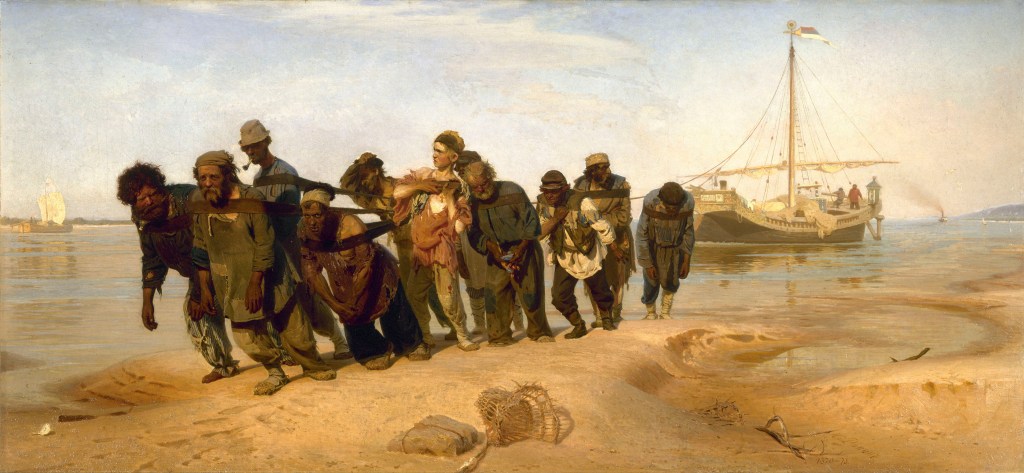
“Barge Haulers on the Volga” is a cult painting by the great Russian painter Ilya Efimovich Repin. The main canvas size is 62 cm by 97 cm and is exposed in the Tretyakov Gallery. The painting was created in the period 1870-1873, and drew international praise for his realistic portrayal of the hardships of working men. Art historians define the genre of this painting as naturalism with elements of critical realism.
One of Repin’s conflicts was his unwillingness to preach and express any moralizing with his works. He tried to follow the ideas of pure art having at the same time his civic position and unconditionally conveyed it in his works. The Barge Haulers on the Volga are devoid of moralizing and demonstrate human history, on the one hands, but also, as it were, push the stories of these people into the background, exposing the nerve of slave labor and class division.
Barge Haulers on the Volga by Ilya Repin
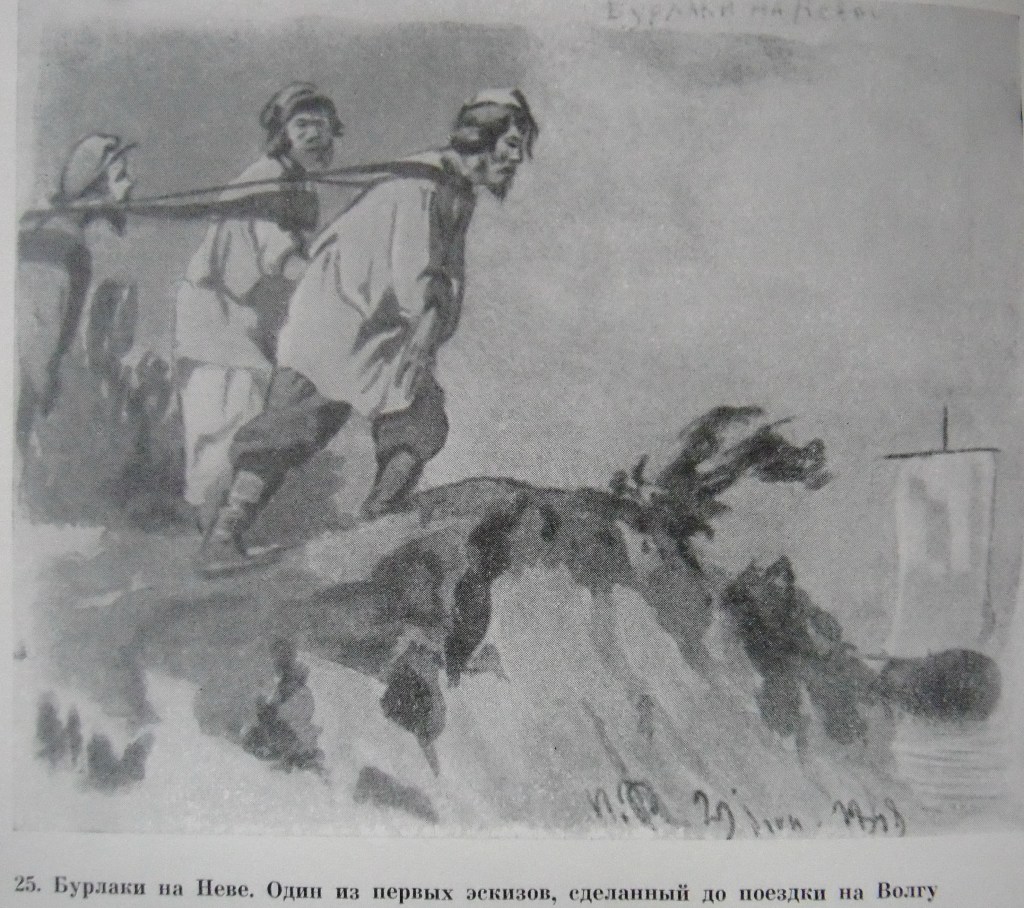
The idea for the painting came to Ilyia Repin back in 1869 when he saw barge haulers on the Neva and was stuck by their stern and exhausted appearance. These are ship workers which duties included everything related to the ship and cargo as loading and unloading goods, pulling a heavy ship from the shoals, closing up holes, bailing out water. Barge hauling was officially banned in 1929, and before the Russian revolution, barge haulers could still be found on small rivers and impassable sections of large rivers.
In May 1870, Ilya went to the Volga where he made close acquaintance with barge haulers and drew many sketches of figures and landscapes. In the same year, Ilya Repin made sketches of the composition representing two solutions, mainly differing in the direction of movement of the barge gang.
Barge haulers on the Neva. One of the first sketches
Summer 1872 Repin returned to the Volga in the village of Shiryaevo and rewrote the picture while retaining its composition.
It is often believed that Repin wrote his barge haulers as an illustration to a poem by Nikolai Alekseevitch Nekrasov, but the truth is that Repin did not know of this poem until 2 years after he finished his canvas and didn’t agree with it.
The main difference between Repin’s “Barge Haulers” and other paintings of barge haulers is that in other paintings they are represented as a dark mass, people with indistinguishable faces, similar to each other, like ants pulling a huge load into a anthill but in Repin’s “Barge Haulers” each burlak is a personality, an individual, not like anybody else.
In the 30th, a second rise in the popularity of “Barge haulers on the Volga” happened in the URSS. “Barge haulers on the Volga” became a true icon, a standard of pictorial writing and a cult object of social realism in the URSS. The illustration of “Barge haulers on the Volga” filled all the textbooks of the Soviet era, and were one of the main illustrations of the cruel oppression of the people by the criminal tsarist regime.
What can we see in “Barge haulers on the Volga” ?
There is eleven men, their number being decided according to the weight of the loaded vessel, at a rate of about 250 pounds per person. They are pulling a barge behind them can be seen as symbolizing the Russian Empire.
The barge haulers are compositionally combined into 3 clearly visible groups.
The first group consists of four figures with Kanin at the head, the second, also of four figures, among which the image of the young barge hauler Larka stands out and dominates, and, finally, the last group of three, less significant and expressive figures.
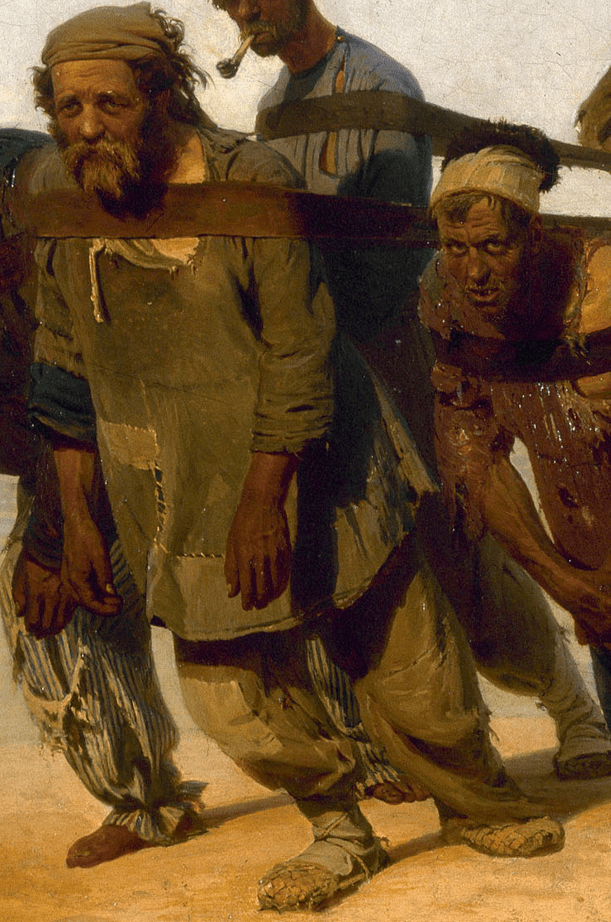
In the first group, we see how strong and masterfully everything is arranged. There is a compact unity, but with a great complexity of the outer contour, which gives it vitality. The heads are placed in such a way that each of them is clearly visible against a free background, and depicting the figures in a strong tilt, Repin raises their heads so that their faces are visible. Depicting the faces of the barge haulers of the first group frontally, I. Repin only makes the far right (Ilka Sailor) look directly at the audience. Kanin is looking somewhere in the distance, and the redhead’s gaze is turned to Kanin. This achieves freedom of expression. The main characters do not pose, but live their lives. Their appeal to the audience would have made them reasoners, which was especially dangerous in the positive image of the sage Kanin.
Part of Barge Haulers on the Volga by Ilya Repin
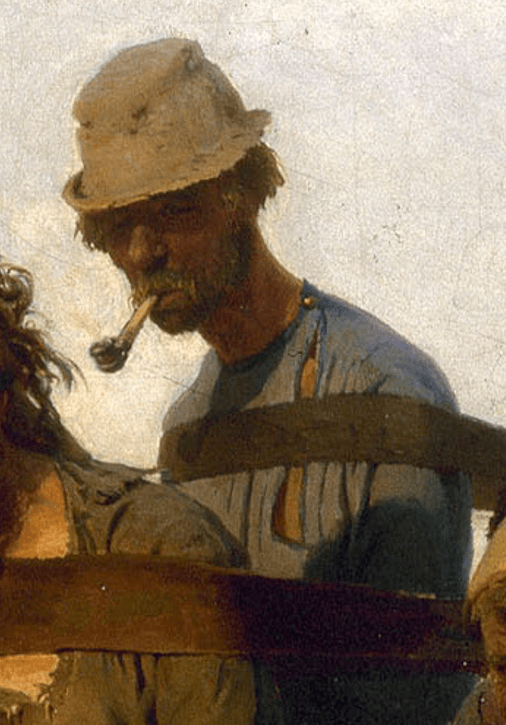
The stall – the second most powerful image in the picture along with Kanin – visually represents the center of the entire figured part of the composition. To the right and to the left of it is an equal number of figures of barge haulers. The group with Larka is built on sharp contrasts of images. The youth of Larka, his impatience and irritation of youth are opposed, on the one hand, by the exhaustion of a consumptive, and on the other, by the phlegmatic calm of an experienced old man who knows how to adapt to any situation. Leaning against his neighbor’s shoulder, he calmly fills his pipe. The stall is the most captivating image in its lyricism and youthful charm. It is also highlighted in color. His pink youthful body, rags of a red falling shirt and trousers form a bright colorful spot among the dark figures of barge haulers.
Placed next to the Stall, the figure of a consumptive, with its strong inclination, connects the second group with the first and at the same time frees up the necessary space in front of the Stall.
Part of Barge Haulers on the Volga by Ilya Repin
The last figure in the third group, depicted frontally, with a lowered head, corresponds with the extreme figure of the first group, as if closing the entire mass of the gang. The result is a kind of rhythm of wave-like movement.
Part of Barge Haulers on the Volga by Ilya Repin
Who are the people of the artel?
The sketches were preserved where Repin indicated the names of some of the characters.
Rasstriga-Kanin, the bump of the artel is the first on the right side of the canvas. He used to sing in a church choir, but had been deprived of church dignity and “pulling the strap” for 10 years. In the artel of barge haulers he built a career. Thanks to his intelligence and perseverance, he became the leader of the team, the “bump”. He knows the coastline best of all, and sets the pace for the whole group. The barge haulers did each step synchronously with the right foot, then pulling up the left. From this the whole artel moved as one. If someone lost his stride, people collided with their shoulders, and the bump gave the command “hay – straw” (сено — солома), resuming movement in step. To keep the rhythm on the narrow paths over the cliffs, great skill was required from the foreman.
Rasstriga-Kanin, the bump of the artel – Part of Barge Haulers on the Volga by Ilya Repin
Next to him is a black-bearded giant, he is tanned and overgrown with curly hair. He is the “podshishelny”, the right hand of the brigadier and the strongest man in the whole artel. He is a Nizhny Novgorod fighter. In winter, he earns by participating in fisticuffs. And in spring-autumn “pulls the strap”. He is not more than 40 years old, and still has enough physical strength. He is put in the first team, as one of the strongest and most conscientious.
the “podshishelny”, the right hand of the brigadier – Part of Barge Haulers on the Volga by Ilya Repin
A little behind Rasstriga-Kanin on his left is Ilka the sailor, who was something like an accountant, bought provisions and gave the barge haulers their salaries. He knows how to work hard, so he is also in the front row. But it is clear that he is a mean person. He alone pierces us with an unkind look. This one easily swears and sends you to hell.
Ilka the sailor – Part of Barge Haulers on the Volga by Ilya Repin
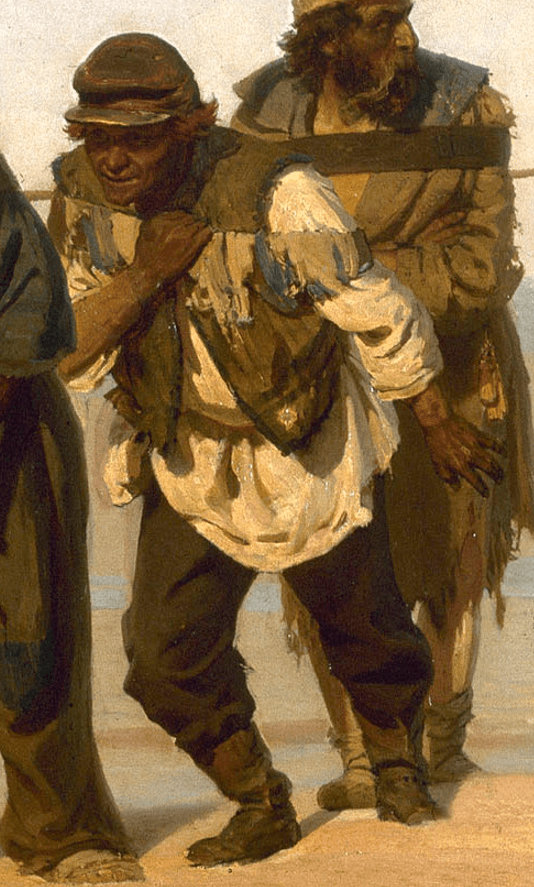
“Bondage” is the second hack and walks behind the Stall. He is clearly lazy, he walks straight, not straining in his work and trying to shift part of his burden onto the shoulders of others. He managed to squander the salary for the entire trip and being indebted to the artel, worked for food. Yet, he still manages to smoke a pipe, He is the best dressed of all. His shirt is not rags, like those of his comrades. He is wearing a real hat, not a tied rag. Most likely, he is from the peasants who has a wife or mother at home whom take care of his clothes.
Bondage – Part of Barge Haulers on the Volga by Ilya Repin
Behind Ilka the sailor is Larka, the cook and falcon headman (who is responsible for the cleanliness of the latrine on the ship) and the youngest member of the artel. The young village boy Larka is especially striking to us. Maybe his family sent him to earn extra money or he left home and is trying to feed himself. Obviously, this is almost the first time he pulls the strap. Considering his duties to be more than sufficient, Larka sometimes quarreled and defiantly refused to pull the strap. And now he looks at the barge hauler next to him, who is clearly groveling in the line. The lasy guy is even smoking a pipe
Larka, the cook and falcon headman – Part of Barge Haulers on the Volga by Ilya Repin
“Hackers” is simply a negligent one, who on occasion is not averse to sifting part of the burden onto the shoulders of others.
Hackers – Part of Barge Haulers on the Volga by Ilya Repin
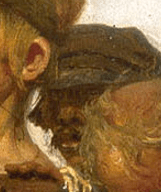
Behind him, the head of Kalmyk is visible. According to Repin, it was “a barge hauler with eyes as if cut through by sedge.” He also had a large, smart, intelligent forehead, showing that this is not a simpleton … He wore a shirt without belt, the ports have come off on bare black legs.
head of Kalmyk – Part of Barge Haulers on the Volga by Ilya Repin
Behind him is a man of about 60 years old. He is emaciated, desperately wiping sweat from his forehead with his sleeve. Most likely, he is ill with consumption, and this might be his last burlach season.
a man of about 60 years old – Part of Barge Haulers on the Volga by Ilya Repin
In the last group we first see the overseer, he makes sure that others are not lazy and pull the strap along with everyone else. Contrary to the others he wears boots, and his clothes are newer.
overseer – Part of Barge Haulers on the Volga by Ilya Repin
The penultimate one, is a tall Greek who looks angrily at the barge, where the owner is shouting something to the barge haulers
a tall Greek who – Part of Barge Haulers on the Volga by Ilya Repin
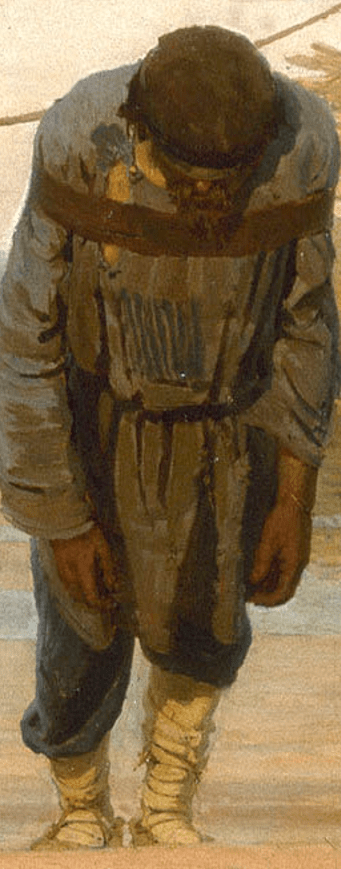
“Inert” is the person with the most depressing appearance and comes last. It feels like he’s about to collapse. His hands are limply lowered. The head is so low on the chest that the face is not visible. Usually the last in the “team” were experienced, but weak or sick. They normally walked a little apart, in their own rhythm and looked at their feet. Since their function was to ensure that the string did not touch the stones. So his downcast posture and lagging behind the rest does not mean that he is ill.
Inert – Part of Barge Haulers on the Volga by Ilya Repin
Other details
The flag on sailing ship since the time of Peter the Great was hoisted on the stern flagpole (On warships, the state black-yellow-white flag, on merchant ships, the commercial white-blue-red flag). On the mast a weather vane was hung by which the sailors determined the direction and strength of the wind. Repin accustomed to the state military flag, confused that on the trade tricolor, the white strip should be at the top, and not the bottom, as usual. Only ten years later, in 1883, the white-blue-red tricolore became the national Russian flag. But it is also said that the order of the stripes on the flag was not treated too carefully, and it was sometimes raised upside down as in the painting.
the flag – Part of Barge Haulers on the Volga by Ilya Repin
It is interesting that Repin, who studied the life of barge haulers, quite correctly depicted how the tow line looked and the place of his fastening which is the very top of the mast. By attaching the rope to the top of the mast, barge haulers let the mast carry the bulk of the weight of the towline. With such an attachment, the force vector is the same as if the bark is under sail, that is, the pilot has the Opportunity to control the movement of the ship with the help of the rudder.
the tow line – Part of Barge Haulers on the Volga by Ilya Repin
The pilot, is the man at the helm of the ship, and actually her captain. He earns more than the entire artel put together. He gives instructions to barge haulers and maneuvers both the rudder and the blocks that regulate the length of the tow line.
“The waterpipe”, water dispenser, is the carpenter who caulks and repairs the ships, monitors the safety of the goods, and bears financial responsibility for it during loadings and unloading. Under his contract, he does not have the right to leave the ship during the voyage and replaces the owner, managing on his behalf.
the pilot and waterpipe – Part of Barge Haulers on the Volga by Ilya Repin
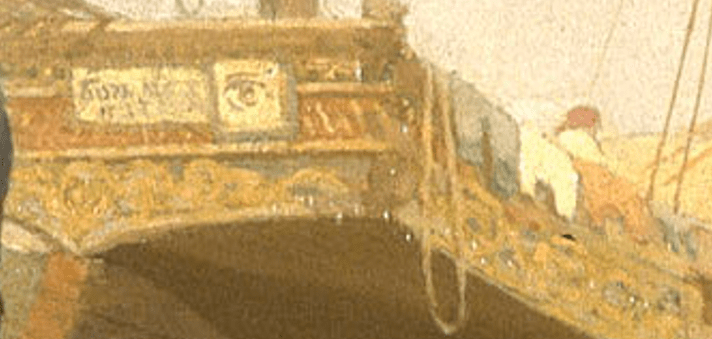
Since the 16th century, it was customary to decorate the Volga ships with intricate carvings since it was believed that they helped the ship to rise against the current and this ship was no exception and had beautiful carvings.
carvings – Part of Barge Haulers on the Volga by Ilya Repin
When Dostoevsky saw “Barge Haulers on the Volga”, he was very glad that Ilya Repin did not put any social protest in it. Dostoevsky wrote in his diary that they were “Barge haulers, real barge haulers and nothing more,” and he added that “None of them shouts from the picture to the viewer: “Look how unhappy I am and to what extent you owe the people!”
The familiar figures of the barge haulers on the bank of the Volga are an eternal symbol of unlimited patience, hard work for the sake of survival, a strap that the working people had to pull all their lives and sad echoes of the past in the present.
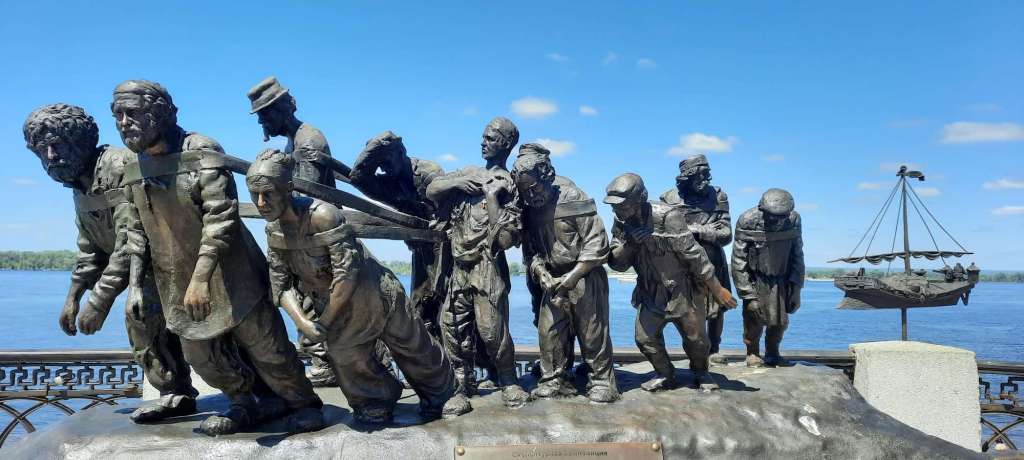
You can find a beautiful sculpture of the painting of “Barge Haulers on the Volga” by Ilya Repin in Samara.
Sculpture of the painting of “Barge Haulers on the Volga” by Ilya Repin in Samara
I hope you enjoyed this canvas as much as I did.
If you liked this article, subscribe , put likes, write comments!.






























 AKirill, Learn, apprenez, translation, traduction, livres bilingues, bilingual books