
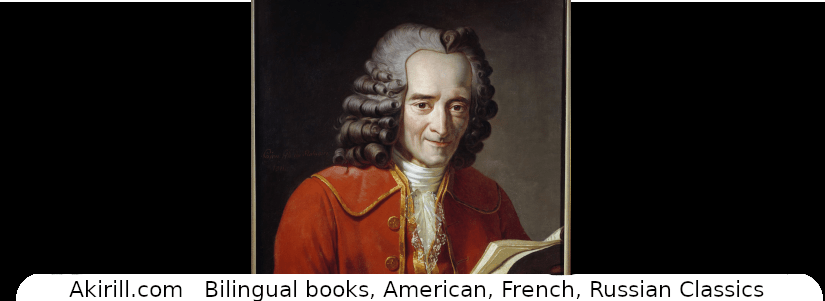
“Candide”, also called “l’Optimisme” is a French satire and the best-known work of Voltaire which was first published in 1759. It is a philosophical tale which is often hailed as a paradigmatic text of the Enlightenment, but it is also an ironic attack on its optimistic beliefs. Because the book openly derides government and church alike the work and its author were immediately denounced by both secular and religious authorities after its publication. Candide is now available in our bilingual book section (English/French)
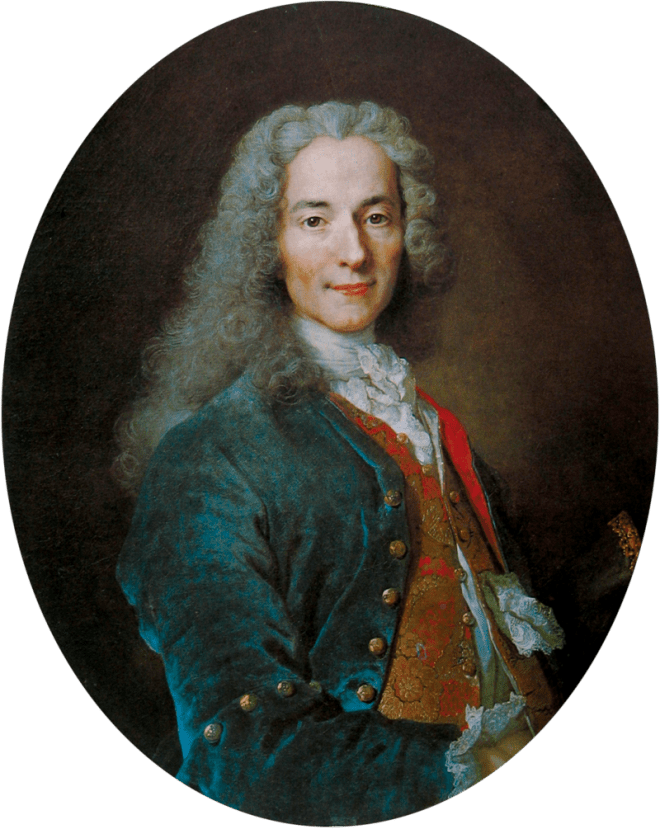
The Grand Council of Geneva and the administrators of Paris banned “Candide” by the end of February 1759, but it nevertheless succeeded in selling twenty thousand to thirty thousand copies by the end of the year in over twenty editions, making it a best seller. In 1762, Candide was listed in the Index Librorum Prohibitorum, the Roman Catholic Church’s list of prohibited books. For a long time, the United States considered “Candide” a seminal work of Western literature and banned it well into the twentieth century.
“Candide” was inspired by a number of historical events, most notably the Seven Years’ War and the 1755 Lisbon earthquake, tsunami and resulting fires of All Saints’ Day.
Behind a playful facade lies very harsh criticism of contemporary European civilization where European governments such as France, Prussia, Portugal and England are each attacked ruthlessly by the author which angered many.
In 1953 “Candide was adapted for the Radio anthology program “On Stage”. It was also adapted as a comic operetta which first opened in Broadway as a musical on December 1st, 1956. In 1973, the BBC produced a television adaptation of “Candide” In addition to the above, “Candide” was also made into a number of minor films and theatrical adaptations throughout the twentieth century.
| Help the site stay free, buy us a cup of coffee |  | Aidez-nous à maintenir le site gratuit en nous offrant une tasse de café |
Overview

Candide, our young and naive hero is schooled in an optimistic philosophy by his tutor Pangloss. He falls in love with the baron’s daughter, Cunégonde, and is forced to leave the castle when the baron learns of their love. Candide joins the army and it is the beginning of s series of hardships and disasters that he will encounter. He experiences the horrors of war, rape, theft, hanging, shipwrecks, earthquakes, cannibalism, and slavery. These experiences erode Candide’s optimistic belief.
Beginning of the play
I
HOW CANDIDE WAS BROUGHT UP IN A MAGNIFICENT CASTLE, AND HOW HE WAS EXPELLED THENCE.
In a castle of Westphalia, belonging to the Baron of Thunder-ten-Tronckh, lived a youth, whom nature had endowed with the most gentle manners. His countenance was a true picture of his soul. He combined a true judgment with simplicity of spirit, which was the reason, I apprehend, of his being called Candide. The old servants of the family suspected him to have been the son of the Baron’s sister, by a good, honest gentleman of the neighborhood, whom that young lady would never marry because he had been able to prove only seventy-one quarterings, the rest of his genealogical tree having been lost through the injuries of time.
The Baron was one of the most powerful lords in Westphalia, for his castle had not only a gate, but windows. His great hall, even, was[Pg 2] hung with tapestry. All the dogs of his farm-yards formed a pack of hounds at need; his grooms were his huntsmen; and the curate of the village was his grand almoner. They called him “My Lord,” and laughed at all his stories.
The Baron’s lady weighed about three hundred and fifty pounds, and was therefore a person of great consideration, and she did the honours of the house with a dignity that commanded still greater respect. Her daughter Cunegonde was seventeen years of age, fresh-coloured, comely, plump, and desirable. The Baron’s son seemed to be in every respect worthy of his father. The Preceptor Pangloss[1] was the oracle of the family, and little Candide heard his lessons with all the good faith of his age and character.
Pangloss was professor of metaphysico-theologico-cosmolo-nigology. He proved admirably that there is no effect without a cause, and that, in this best of all possible worlds, the Baron’s castle was the most magnificent of castles, and his lady the best of all possible Baronesses.
“It is demonstrable,” said he, “that things cannot be otherwise than as they are; for all being created for an end, all is necessarily for the best end. Observe, that the nose has been formed to bear spectacles—thus we have spectacles. Legs are visibly designed for stockings[Pg 3]—and we have stockings. Stones were made to be hewn, and to construct castles—therefore my lord has a magnificent castle; for the greatest baron in the province ought to be the best lodged. Pigs were made to be eaten—therefore we eat pork all the year round. Consequently they who assert that all is well have said a foolish thing, they should have said all is for the best.”
Candide listened attentively and believed innocently; for he thought Miss Cunegonde extremely beautiful, though he never had the courage to tell her so. He concluded that after the happiness of being born of Baron of Thunder-ten-Tronckh, the second degree of happiness was to be Miss Cunegonde, the third that of seeing her every day, and the fourth that of hearing Master Pangloss, the greatest philosopher of the whole province, and consequently of the whole world.
One day Cunegonde, while walking near the castle, in a little wood which they called a park, saw between the bushes, Dr. Pangloss giving a lesson in experimental natural philosophy to her mother’s chamber-maid, a little brown wench, very pretty and very docile. As Miss Cunegonde had a great disposition for the sciences, she breathlessly observed the repeated experiments of which she was a witness; she clearly perceived [Pg 4]the force of the Doctor’s reasons, the effects, and the causes; she turned back greatly flurried, quite pensive, and filled with the desire to be learned; dreaming that she might well be a sufficient reason for young Candide, and he for her.
She met Candide on reaching the castle and blushed; Candide blushed also; she wished him good morrow in a faltering tone, and Candide spoke to her without knowing what he said. The next day after dinner, as they went from table, Cunegonde and Candide found themselves behind a screen; Cunegonde let fall her handkerchief, Candide picked it up, she took him innocently by the hand, the youth as innocently kissed the young lady’s hand with particular vivacity, sensibility, and grace; their lips met, their eyes sparkled, their knees trembled, their hands strayed. Baron Thunder-ten-Tronckh passed near the screen and beholding this cause and effect chased Candide from the castle with great kicks on the backside; Cunegonde fainted away; she was boxed on the ears by the Baroness, as soon as she came to herself; and all was consternation in this most magnificent and most agreeable of all possible castles.
| If you liked this article, subscribe , put likes, write comments! |
| Share on social networks |
| Check out Our Latest Posts |










 AKirill, Learn, apprenez, translation, traduction, livres bilingues, bilingual books