On this site we hope to help you learn, and to remove the difficulties caused by the difference of culture and language. Sur ce site nous espérons vous aider à apprendre, et à enlever la barrière causée par les différents languages et cultures.
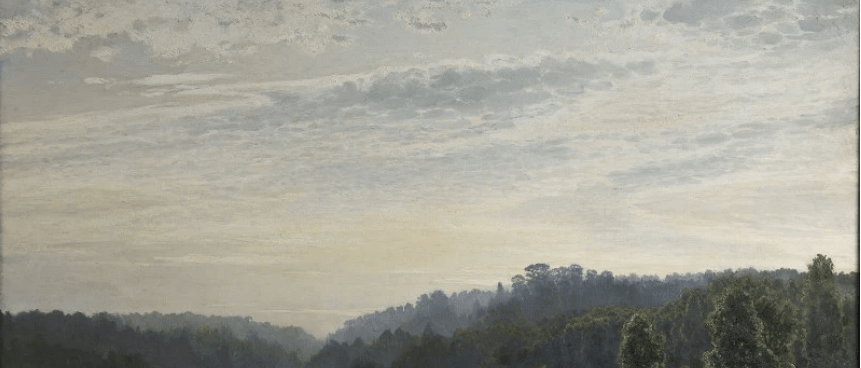
“Matin brumeux” (Туманное утро) est une huile sur toile monumentale de 108 X 144,5 cm, peinte en 1885 par I. I. Chichkine (И.И.Шишкин). Elle est située au Musée d’Art de Nizhny Novgorod, Nizhny Novgorod. C’est une belle vue panoramique d’un petit matin sur la rive de la rivière.
Même si Shiskin a peint principalement la vie de la forêt russe, il a parfois peint des champs et des prairies. Cette peinture n’est pas typique de Shishkin car généralement ses peintures dépeignent la nature à l’apogée de la beauté estivale au milieu de la journée.
« Matin brumeux » est une œuvre très harmonieuse peinte dans des tons verdâtres-argentés. Le tableau représente une rivière, sur les rives de laquelle pousse une forêt. La peinture capture le début d’une nouvelle journée et l’état paisible de la nature au petit matin au bord d’une rivière.
La rivière est encadrée par des rives pittoresques de couleur émeraude et est représentée dans de riches tons verts, ainsi que dans une couleur argentée représentant le brouillard.
Quelque part au loin, la forêt est enveloppée de brouillard, mais ici, sur la rive gauche de la rivière, sur laquelle l’auteur a montré de petits arbustes et des fleurs sauvages, le brouillard est à peine visible. La surface miroir de la rivière silencieuse reflète le ciel et les cimes majestueuses des arbres bouclés. Le mur dense de la forêt ressemble plus à une tente verte tissée, qui s’étend jusqu’à l’horizon. Les arbres de la forêt sur la rive opposée sont très majestueusement représentés. Le temps sans vent ne fait qu’ajouter à leur puissance. La forêt est dessinée très densément. Au loin un épais brouillard matinal ne s’est pas encore dissipé, et un voile bleuté recouvre une partie de la forêt et les berges du fleuve.
Le ciel est haut et sans fond et vous ne pouvez même pas voir les nuages flotter dessus. Après tout, ces nuages se sont transformés en un voile de dentelle blanche qui descend jusqu’à la cime des arbres. La lumière du soleil enveloppe chaque nuage et à partir de là, le voile de dentelle blanche devient doré annonçant l’aube et l’arrivée d’une belle journée.
L’élaboration caractéristique des détails est impressionnante et nous pouvons admirer la variété des nuances de couleurs qui traduisent le jeu des ombres et de la lumière.
Dans ce tableau, le peintre traduit la beauté d’un matin d’été ainsi que la fragilité et l’unicité de l’instant.
“Foggy morning” (Туманное утро) is a monumental oil on canvas of 108X144.5 cm, painted in 1885 by I. I. Shishkin (И.И.Шишкин ). The painting is situated in the Nizhny Novgorod Art Museum, Nizhny Novgorod. It is a beautiful panoramic view of an early morning on the bank of the river.
Even though Shiskin painted mainly the life of the Russian forest, he sometimes painted fields and meadows. This painting is not typical for Shishkin because usually his paintings depict nature in the prime of the summer beauty in the middle of the day.
“Foggy Morning” is a very harmonious work painted in greenish-silver tones. The painting depicts a full-flowing river, on the banks of which a forest grows. The painting captures the beginning of a new day and the peaceful state of the nature during an early morning on the bank of a river..
The river is framed by picturesque banks of emerald color and is shown in rich green tones, as well as silvery color representing the fog.
Somewhere in the distance the forest is shrouded in fog, but here, on the left bank of the river, on which the author showed small shrubs and wildflowers, the fog is barely visible. The mirror surface of the silent river reflects the sky and the majestic crowns of curly trees. The dense wall of the forest is more like a woven green tent, which stretches as far as the horizon. The trees in the forest on the opposite bank are depicted very majestically. Windless weather only adds to their power. The forest is drawn very densely. In the distance an heavy morning fog has not yet dissipated, and a bluish veil covers part of the forest and the river banks.
The sky is high and bottomless and you can’t even see the clouds floating on it. After all, these clouds turned into a white lace veil that descended right to the tops of the trees. Sunlight envelops every cloud and from this the white lace veil becomes golden heralding the dawn of the coming of a nice day.
The characteristic elaboration of details is impressive and we can admire the variety of color shades which convey the play of shadows and light.
In this painting, the painter conveys the beauty of a summer morning as well as the fragility and uniqueness of the moment.
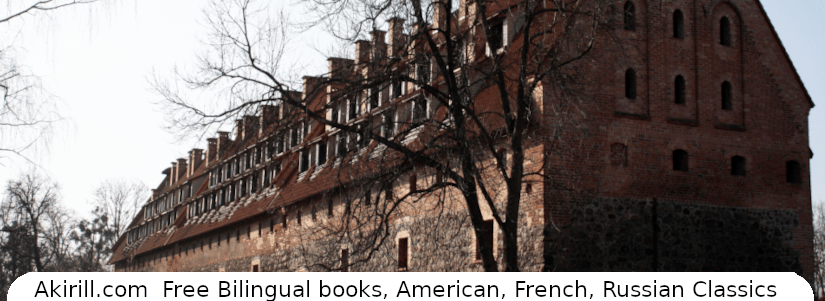
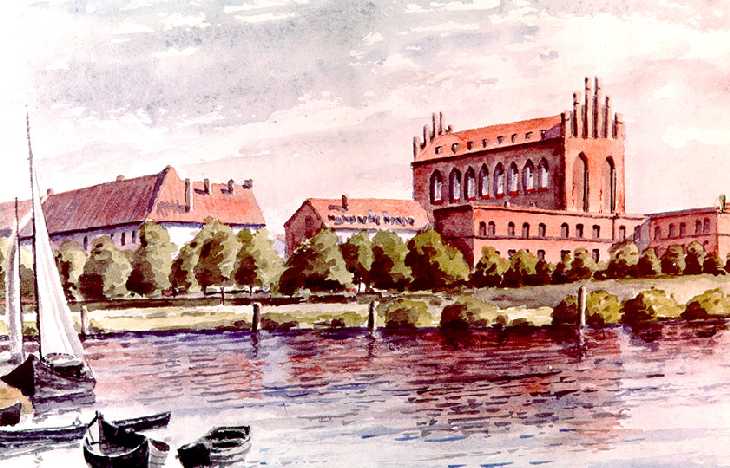
Le château de Preussisch Eylau est un château de l’Ordre Teutonique construit en 1325 et situé à Bagralionovsk, près de Kaliningrad. Il a reçu le statut de site du patrimoine culturel d’importance régionale par décret du gouvernement de Kaliningrad le 23 mars 2007. Le 11 octobre 2022, il a été vendu 7,6 millions de roubles à la société “GreenArtDevelopment” quatre ans après sa mise en vente. aux enchères
Dans les documents historiques, la première mention du château se produit en 1326, où il est appelé “Ile”, dans les archives de 1342 le nom mentionné est “Iladia”, en 1400 il s’appelle “Preissish-Ilov” (Preussisch-eylau). nom qui lui est resté.
Le grand maître de l’Ordre Teutonique Werner von Orseln ordonna la construction du château d’Ile en 1325. Le but principal de la forteresse était de protéger la capitale de la région Krulevets (Koenigsberg) du sud. Le commandant de Balga, maître Arnold von Eilenstein a supervisé la construction du château de Preussisch Eylau, qui à l’origine a été réalisé en pierres et en briques sur le site de la forteresse prussienne de Sutvrit.
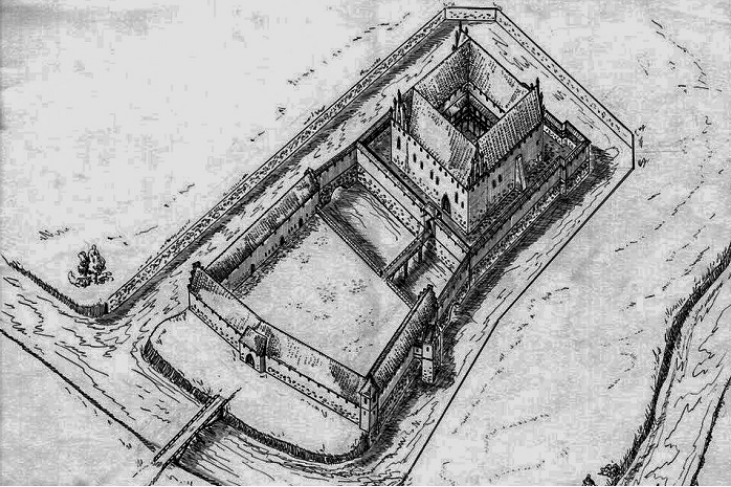
Un barrage avec un moulin a été construit, le niveau de l’eau est monté et le château s’est retrouvé sur une île. En 1330, une fortification en pierre de forme carrée de 41 m x 43 m a été édifiée, entourée de douves, d’une porte herse, d’une tour et d’un pont-levis. Un grand forburg de 120 x 140 mètres, qui était entouré de ses propres douves et d’un mur de forteresse de 1,6 mètre d’épaisseur avec un passage défensif, a été attaché à la fortification du côté est. Il y avait des écuries, une brasserie, des locaux pour les soldats de l’ordre, des ateliers de fabrication d’armes, une boulangerie, et d’autres dépendances.
The first settlements on the site of Tapiau are hundreds of years old. By Sendker -, CC BY-SA 3.0,
L’entrée principale de la citadelle du château Preussisch-Eylau se trouvait dans l’aile est du forburg. La chapelle du château qui était un attribut obligatoire d’un château d’ordre typique se trouvait dans l’aile sud, et une tour sanitaire se trouvait dans la partie nord.
Le premier étage était occupé par des dépendances, dont la cuisine, située sous le réfectoire, et des pièces de service. Au deuxième étage de l’aile ouest se trouvaient le logement et la résidence des frères de l’ordre, qui comprenait un réfectoire, une salle de réunion, les chambres des moines et les chambres occupées par le régisseur du château. Le troisième étage remplissait des fonctions défensives et était équipé d’un passage militaire et de meurtrières. Il y avait aussi une petite tour de guet ronde dans le coin nord-est. Pour avoir un accès facile à l’eau il y avait un puits dans la cour du château.
Jusqu’en 1347 le château de Preussisch Eylau fut la résidence de l’Ordre Pfleger, puis il abrita l’administration du Kammerat, appartenant à la commanderie de Balga.
En 1400, après avoir été frappé par la foudre, toutes les parties en bois du château ont brûlé. Puis le château de Preussisch Eylau passa au Grand Maître de l’Ordre Teutonique Heinrich von Plauen pour le service militaire en 1429.
Reconstruction of the plan of the original Tapiau castle complex. /Photo: mif-mira.ru
Le château de Preussisch Eylau a été capturé et partiellement endommagé par la population rebelle en 1454 mais il a été repris la même année et les dégâts ont été réparés.
Il a encore été attaqué en mai 1455 par une armée alliée à la Pologne qui n’est pas parvenue à s’en emparer alors que la garnison protégeant le château n’était composée que de deux douzaines de chevaliers et de soixante miliciens. Un siège n’a pas non plus réussi puisque de l’aide a été envoyée au château et que l’armée alliée à la Pologne a été vaincue.
Il y eut une autre tentative infructueuse de prendre le château en octobre 1455.
Le château de Preussisch Eylau et les terres environnantes ont été transférés à Heinrich Reuss von Plauen pour une utilisation à vie en 1492.
Plus de 4000 mercenaires polonais attaquèrent à nouveau le château en 1519, mais la garnison du château dirigée par le chevalier Friedrich Truchses Weltburg et le commandant de Courlande Firike repoussa les attaques successives.
Le château devint la résidence du domaine départemental de Hauptmann Preussisch Eylau en 1525 après une réforme et l’abolition de l’Ordre Teutonique. Puis il reçut les droits de la ville en 1585, et en 1587 ses armoiries.
À la fin du XVIIIe siècle, le château avait perdu sa vocation et une partie de son bâtiment a été démontée et utilisée pour construire de nouvelles structures.
Un incendie a endommagé le château de Preussisch Eylau en 1802 mais il ne fut pas restauré et le Forburg fut utilisé à des fins économiques. En 1814, il a été acheté par Heinrich Sigismund Valentini qui a construit une nouvelle maison à un kilomètre au nord-ouest du château après que le château ai commencé à s’effondrer dû à l’absence d’une partie du toit.
En 1831, un nouveau manoir Henrettenhof a été construit dans le style néoclassique. Il se trouve sur les fondations du fort de la forteresse Preussisch Eylau entre l’aile est, et la grange.
L’ancien manoir situé sur le territoire du château de Preussisch Eylau a été donné au magistrat de la ville de Preussisch-Eylau en 1932, et cette même année un musée couvrant la période de l’histoire de la région de l’âge de pierre aux événements de la Première Guerre mondiale y a été ouvert. Malheureusement, dans la période d’après-guerre, le bâtiment a été complètement démantelé.
Pendant la Seconde Guerre mondiale, le château n’a pas été gravement endommagé, et les quartiers d’habitation ont été utilisés jusqu’au début des années 1960.
Le château de Preussisch Eylau et le forburg ont été transférés à l’union des consommateurs du district en 1961 et ont été utilisés comme entrepôts.
En 1964, les bâtiments du château et le forburg ont été examinés par des employés des ateliers centraux scientifiques et de restauration du ministère de la Culture de l’URSS. L’état du château était très mauvais, car il n’a jamais été réparé après la guerre.
Un stand de tir a été construit à l’emplacement de l’aile ouest, qui a été démolie dans les années 1990. Dans le forburg survivant, le toit a commencé à s’effondrer à cause de chevrons pourris, des trous sont apparus en 1989 et en août 1990, la partie centrale a brûlé.
Au début des années 1990, il a été décidé de transformer le forburg en hôtel avec bar, mais l’idée a été abandonné.
Le 5 juin 2016, un incendie s’est déclaré dans le château, détruisant une partie de la toiture.
Le 29 août 2018, les autorités régionales ont tenté de vendre le château lors d’une vente aux enchères, mais elles n’y sont pas parvenues.
Ils ont de nouveau tenté de vendre le bâtiment en 2020, mais n’ont pas trouvé d’acheteur. Enfin, le château a été vendu pour 7,6 millions de roubles lors de la vente aux enchères de la société GreenArt Development en 2022. «GreenArtDevelopment» est enregistré à Saint-Pétersbourg et est engagé dans la location et la gestion immobilière.
J’espère que cet article vous a plu
Si vous avez aimé cet article, abonnez-vous, mettez des likes, écrivez des commentaires !
The Preussisch Eylau Castle is a castle of the Teutonic Order built in 1325 and located in Bagralionovsk, near Kaliningrad. It received the status of a cultural heritage site of regional significance by decree of the Government of the Kaliningrad on March 23, 2007. On October 11, 2022, it was sold 7.6 million rubles to the company “GreenArtDevelopment” four years after it was put up for auction
In historical documents, the first mention of the castle occurs in 1326, where it is called “Ile”, in the records of 1342 the name mentioned is “Iladia”, in 1400 the name changes once again and it becomes “Preissish-Ilov” (Preussisch-eylau), name which stuck.
The grand master of the Teutonic Order Werner von Orseln ordered the construction of Ile Castle in 1325. The main purpose of the fortress was to protect the capital of the region Krulevets (Koenigsberg) from the south. Balga Commander, master Arnold von Eilenstein supervised the construction of the Preussisch Eylau Castle, which was originally carried out from stones and brick on the site of the Prussian fortress of Sutvrit.
A dam with a mill was built, the water level rose and the castle ended up on an island. In 1330, a square-shaped stone fortification of 41 m x 43 m was built, surrounded by a moat, a portcullis gate, a tower and a drawbridge. A large forburg of 120 x 140 meters, which was surrounded by its own moat and a fortress wall, 1.6 meters thick with a defensive passage, was attached to the fortification on the eastern side. There were stables, a brewery, premises for the soldiers of the order, workshops for the manufacture of weapons, a bakery, and other outbuildings.
The first settlements on the site of Tapiau are hundreds of years old. By Sendker -, CC BY-SA 3.0,
The main entrance to the castle citadel Preussisch-Eylau was in the eastern wing from the forburg. The castle chapel which was an obligatory attribute of a typical order castle was in the southern wing, and a sanitary tower could be found in the northern part.
The first floor was occupied by outbuildings, including the kitchen, which was located under the refectory, and utility rooms. On the second floor of the western wing was the accommodation and residence of the brothers of the order, which included a refectory, a meeting room, the bedrooms of the monks and the chambers that were occupied by the manager of the castle. The third floor, performed defensive functions and was equipped with a military passage and loopholes. There was also a small round watchtower in the northeast corner. To have an easy access to water there was a well in the castle courtyard.
Until 1347 the Preussisch Eylau castle was the residence of the order pfleger, then it housed the administration of the kammerat, belonging to the Balga commandery.
In 1400, after being struck by lightning all wooden parts of the castle burned down. The Preussisch Eylau castle passed to the Grand Master of the Teutonic Order Heinrich von Plauen for military service in 1429.
Reconstruction of the plan of the original Tapiau castle complex. /Photo: mif-mira.ru
The Preussisch Eylau castle was captured and partially damaged by the rebellious population in 1454 but it was returned that same year and the damages were repaired.
It came under attack in May 1455 by a Polish-allied army which was unable to capture it even though the garnison protecting the castle was only composed of two dozen knights and sixty militias. A siege didn’t pan out neither since help was sent to the castle and the Polish-allied army was defeated.
There was another unsuccessful attempt to take the castle in October 1455.
The Preussisch Eylau castle and surrounding lands were transferred to Heinrich Reuss von Plauen for life use in 1492.
More than 4000 Polish mercenaries again repeatedly attacked the castle in 1519, but the castle garrison which was led by the knight Friedrich Truchses Weltburg and the Courland commander Firike repelled the successive attacks.
The castle became the residence of the departmental estate of Hauptmann Preussisch Eylau in 1525 after a reformation and the abolition of the Teutonic Order. Then it received city rights on 1585, and in 1587 its coat of arms.
By the end of the 18th century, the castle had lost its purpose and part of its building were disassembled and used to built new structures.
A fire damaged the Preussisch Eylau castle in 1802 but it was not restored and the Forburg was used for economic purposes. In 1814, it was bough by Heinrich Sigismund Valentini who built a new house a kilometer northwest of the castle after the castle began to collapse because of lack of part of the roof.
In 1831 a new Henrettenhof manor was built in the neoclassical style. It is on the foundations of the Preussisch Eylau fortress fort between the eastern wing and the barn.
The old manor building located on the territory of the Preussisch Eylau castle was given to the city magistrate of Preussish-Eylau in 1932, and this same year a museum covering the period of the regions history from the stone age to the events of the First World War was open there. Sadly, in the post war period the building was completely dismantled.
During the Second World War , the castle was not badly damaged, and the living quarters were used until the early 1960s.
The Preussisch Eylau castle and forburg were transferred to the district consumer union in 1961, and were used as storage facilities.
In 1964 the buildings of the castle and forburg were examined by employees of the central scientific and restoration workshops of the USSR Ministry of Culture. The condition of the castle was very poor, as it was never repaired after the war.
A shooting gallery was built on the site of the western wing, which was demolished in the 1990s. In the surviving forburg, the roof began to collapse because of rotten rafters, holes appeared in 1989 and in August 1990 the middle section burned down.
In the early 1990s, a decision was made to convert the forburg into a hotel with a bar, but it was abandoned.
On June 5, 2016, a fire broke out in the castle, destroying part of the roof.
On August 29, 2018, the regional authorities tried to sell the castle at an auction, but they didn’t succeed.
They again tried to sell the building in 2020, but could not find a buyer. Finally the castle was sold for 7.6 million rubles at the auction of the GreenArt Development company in 2022. “GreenArtDevelopment” is registered in St. Petersburg and is engaged in rental and property management.
I hope you enjoyed this article
If you liked this article, subscribe , put likes, write comments!
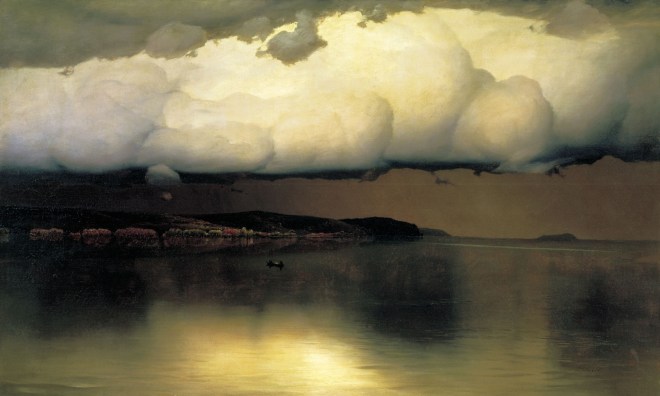
Le tableau « Calme » (Притихло), appelé « paysages d’humeur » est l’une des œuvres les plus célèbres et les plus significatives de Nikolai Dubovskoy (Николай Дубовской). Il s’agit d’un paysage qui est une huile sur toile de 76,5 X 128 cm achevé en 1890 et appartenant aujourd’hui au Musée d’État russe de Saint-Pétersbourg. La peinture a été exposée pour la première fois à la 18ème exposition de l’Association de l’Exposition d’Art Itinérante avec un grand succès. L’empereur Alexandre III l’a immédiatement acheté, et Nikolaï Dubovskoy a dû en faire une répétition pour Pavel Tretiakov qui voulait également l’acheter. La répétition de 86 X143 cm se trouve à la Galerie d’État Tretiakov à Moscou.
Nikolai Dubovskoy – Quiet – 1890
Lors de la peinture du tableau «Calme», l’artiste a utilisé un croquis peint sur la côte baltique. Dans l’une de ses lettres, Nikolai Dubovskoy a écrit: « Le motif de la création de cette image était ce sentiment excitant qui a pris possession de moi à plusieurs reprises en observant la nature à un moment de silence avant un gros orage ou dans les intervalles entre deux orages, quand il est difficile de respirer, quand vous sentez votre insignifiance à l’approche des éléments. Cet état de nature – le silence avant un orage – peut être exprimé en un mot, «Calme». C’est le titre de mon tableau. »
Il y a plusieurs autres répétitions de l’auteur de la peinture. L’une de 1896, se trouve au musée d’art de Poltava. Une autre, datée de 1913-1915, appartient au musée d’art régional de Samara.
Il y a aussi une répétition d’auteur non datée qui se trouve au Musée régional des beaux-arts de Rostov, ainsi qu’au Musée national d’art de Biélorussie. Il y a une répétition intitulée « Un nuage approche » de 1912 qui se trouve au Musée Novocherkassk de l’histoire des Cosaques du Don.
La collection Musée-Réserve historique, artistique et architectural de Vladimir-Souzdal comprend également une répétition de l’huile sur toile de 69 × 112 cm des années 1890, et dans la galerie d’art régionale de Vologda, il y a une répétition de « Calme. Un nuage arrive », daté de 1912.
A cloud is coming (1912, NMIDC)
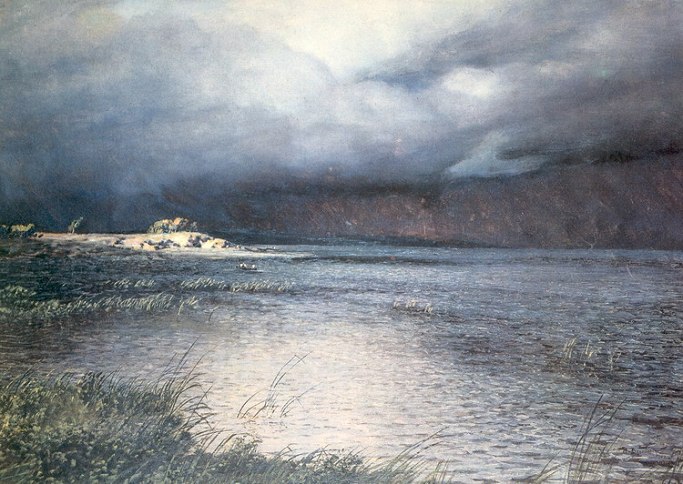
Une autre de 1890, également une huile sur toile de 85,6 × 133 cm est dans la collection du Zimmerli Museum de l’Université Rutgers situé à New Brunswic, New Jersey, États-Unis.
Quiet (1890, Zimmerli Museum, USA)
Description de la peinture
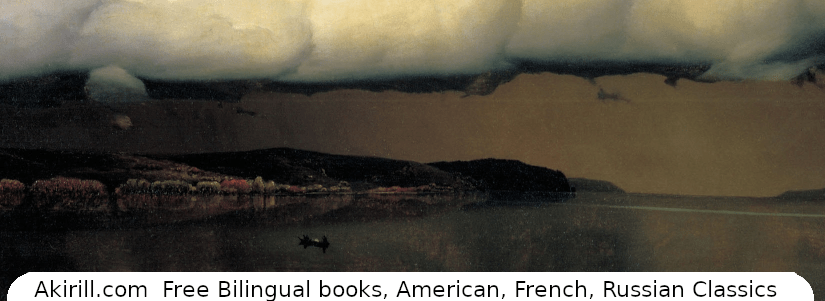
La peinture représente un paysage marin. Des nuages d’orage occupant presque toute la partie supérieure, pendent au-dessus de l’eau. Leur partie supérieure éclairée par le soleil ressemble à du coton blanc et la partie inférieure est remplie de noirceur inquiétante.
Nikolai Dubovskoy – Quiet – 1890
Il n’y a pas de vent, et les nuages clairs et sombres se reflètent dans l’eau lisse et noircie.
Au loin, vous pouvez voir la bande sombre de la côte, sur laquelle se trouvent des maisons d’un village. Les cimes rouge orangé vif des arbres et des buissons, se détachant sur le fond d’une forêt sombre, soulignent la tension de l’atmosphère.
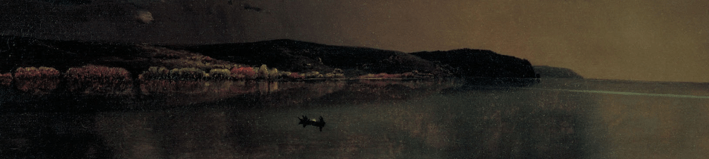
Nikolai Dubovskoy – Quiet – 1890 -part boat
Si vous regardez de près, sur la surface lisse et presque brillante de l’eau, vous pouvez voir un petit bateau qui se déplace vers le rivage avec un rameur. Mais la terre est encore loin, ce qui ne peut qu’inspirer la peur chez le propriétaire de ce bateau. Il semble que ce petit navire soit tellement sans défense contre un orage qui approche qu’il est sur le point de se perdre quelque part dans les vagues de la mer.
L’état de nature tendu avant la tempête est clairement ressenti, en regardant les nuages de pluie menaçants, il semble que quelque chose de terrible est sur le point de se produire. Mais le sentiment d’impuissance d’une personne devant les éléments naturels, exprimé par Dubovsky dans le tableau « Calme », ne doit pas être pris comme son contenu principal. On ne peut pas supposer que le but de l’artiste était la glorification des éléments et son pouvoir sur les gens. En témoigne le fait que pour l’image, il n’a pas choisi la tempête elle-même, mais le moment qui la précède. Un petit bateau se dirigeant vers le rivage et s’efforçant de l’atteindre le plus rapidement possible ne souligne pas du tout l’impuissance d’une personne car nous ne savons pas si le rameur atteindra le rivage en toute sécurité, cependant, dès que nous le remarquons, nous ne pouvons que souhaiter qu’il atteigne le rivage en toute sécurité.
J’espère que vous avez apprécié cette peinture autant que moi
Si vous avez aimé cet article, abonnez-vous, mettez des likes, écrivez des commentaires!
The painting “Quiet” (Притихло), which is referred as “landscapes of mood” is one of the most famous and most significant works of Nikolai Dubovskoy (Николай Дубовской). It is a landscape which is an oil on canvas of 76.5 X 128 cm completed in 1890 and now belonging to the State Russian Museum of Saint Petersburg. The painting was first exposed at the 18th exhibition of the Association of Traveling Art Exhibition with great success. Emperor Alexander III immediately purchased it, and Nikolai Dubovskoy had to make a copy for Pavel Tretyakov who also wanted to buy it. The copy of 86 X143 cm is in the State Tretyakov Gallery in Moscow.
Nikolai Dubovskoy – Quiet – 1890
When painting the painting “Quiet”, the artist used a sketch painted on the Baltic coast. In one of his letters, Nikolai Dubovskoy wrote: “The motive for creating this picture was that exciting feeling that took possession of me many times when observing nature at a moment of silence before a big thunderstorm or in the intervals between two thunderstorms, when it is difficult to breathe, when you feel your insignificance at the approach of the elements. This state in nature – the silence before a thunderstorm – can be expressed in one word, “Quiet”. This is the title of my painting.”
There are several more author’s repetitions of the painting. One from 1896, is in the Poltava Art Museum. Another one, dated 1913-1915, belongs to the Samara Regional Art Museum.
There is also an undated author’s repetition is in the Rostov Regional Museum of Fine Arts, as well as in The National Art Museum of Belarus. There is a repetition called “A cloud is approaching” from 1912 which is in the Novocherkassk Museum of the History of the Don Cossacks.
The collection Vladimir-Suzdal Historical, Artistic and Architectural Museum-Reserve also include a repetition of the oil on canvas of 69 × 112 cm from 1890s, and in the Vologda Regional Art Gallery there is a repetition of “Quiet. A cloud is coming”, dated 1912.
A cloud is coming (1912, NMIDC)
Another one from 1890, also an oil on canvas of 85.6 × 133 cm is in the collection of the Zimmerli Museum of Rutgers University situated in New Brunswic, New Jersey, USA.
Quiet (1890, Zimmerli Museum, USA)
The painting depicts a seascape. Thunderclouds occupying almost the entire upper part, hang over the water. Their upper part illuminated by the sun, resembles white cotton wool, and the lower part is filled with ominous blackness.
Nikolai Dubovskoy – Quiet – 1890
There is no wind, and light and dark clouds are reflected in the smooth and blackened water.
In the distance you can see the dark strip of the coast, on which there are houses of some village. Bright orange-red crowns of trees and bushes, standing out against the background of a dark forest, emphasize the tension of the atmosphere.
Nikolai Dubovskoy – Quiet – 1890 -part boat
If you look closely, on a smooth, almost glossy surface of the water, you can see a tiny boat that is moving towards the shore with a rower. But the land is still far away, which cannot but inspire fear in the owner of this boat. It seems that this small ship is so defenseless against an approaching thunderstorm that it is about to get lost somewhere in the sea waves.
The tense state of nature before the storm is clearly felt, looking at the menacing rain clouds, it seems that something terrible is about to happen. But the feeling of a person’s helplessness in front of the natural elements, expressed by Dubovsky in the painting “Quiet”, should not be taken as its main content. It cannot be assumed that the artist’s goal was the glorification of the elements and its power over people. This is evidenced by the fact that for the image he chose not the storm itself, but the moment preceding it. A small boat heading towards the shore and striving to reach it as quickly as possible does not at all emphasize the impotence of a person as we do not know whether the rower will reach the shore safely, however, as soon as we notice him, we cannot but wish that he reaches the shore safely.
I hope you enjoyed this painting as much as I did
If you liked this article, subscribe , put likes, write comments!
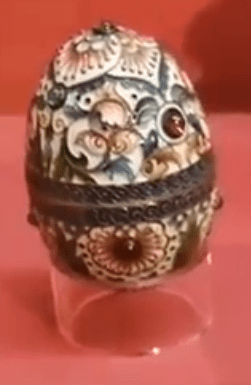
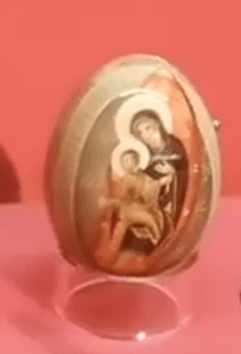
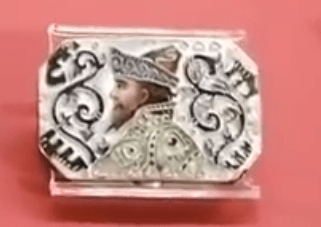
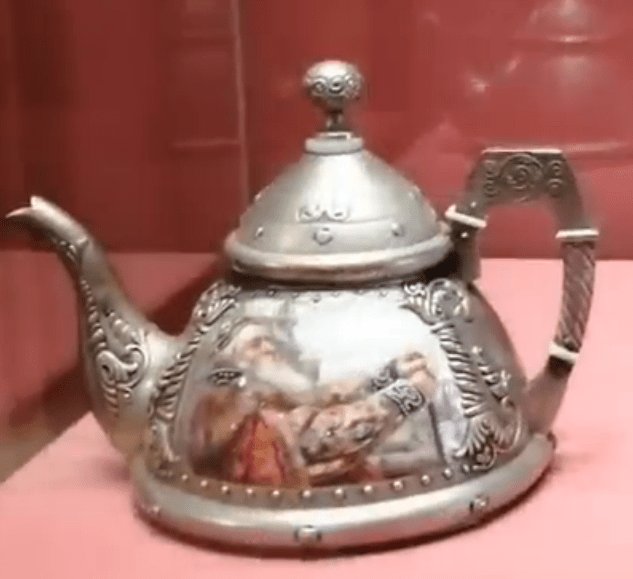
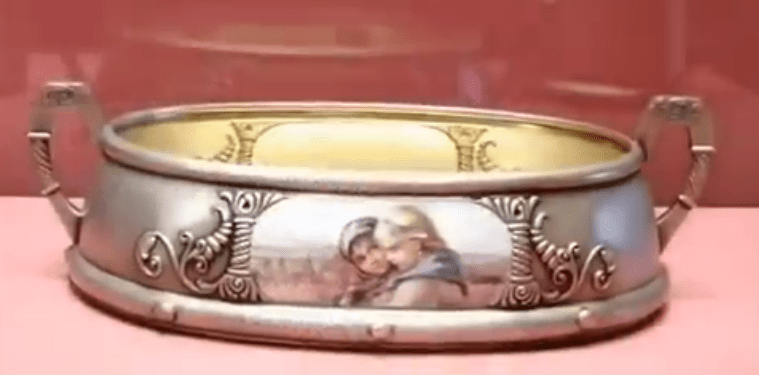
J’ai trouvé une vidéo très courte et agréable d’émail de Moscou à l’exposition Fabergé. J’aurais souhaité de la musique mais il y a des explications en russe pour ceux qui la comprennent. J’ai mis quelques photos de la vidéo et un lien pour que vous puissiez la regarder vous-même et j’espère l’apprécier autant que moi. Le signe montré à la fin de la vidéo dit: Service à thé et café O. Kurlyukov’s compagnie. Moscou. 1908-1917 . Argent, émail, nacre; monnayage, peinture, dorure.
I found a very short and nice video of a Moscow enamel at the Faberge exhibition. I would have wish for music but there are explanation in Russian for those who understand it. I put a few pictures of the video and a link so you can watch it yourself and I hope enjoy it as I did. The sign showed at the the end of the video say: Tea and coffee service O. Kurlyukov’s firm. Moscow. 1908-1917 . Silver, enamel, mother of pearl; coinage, painting, gilding.
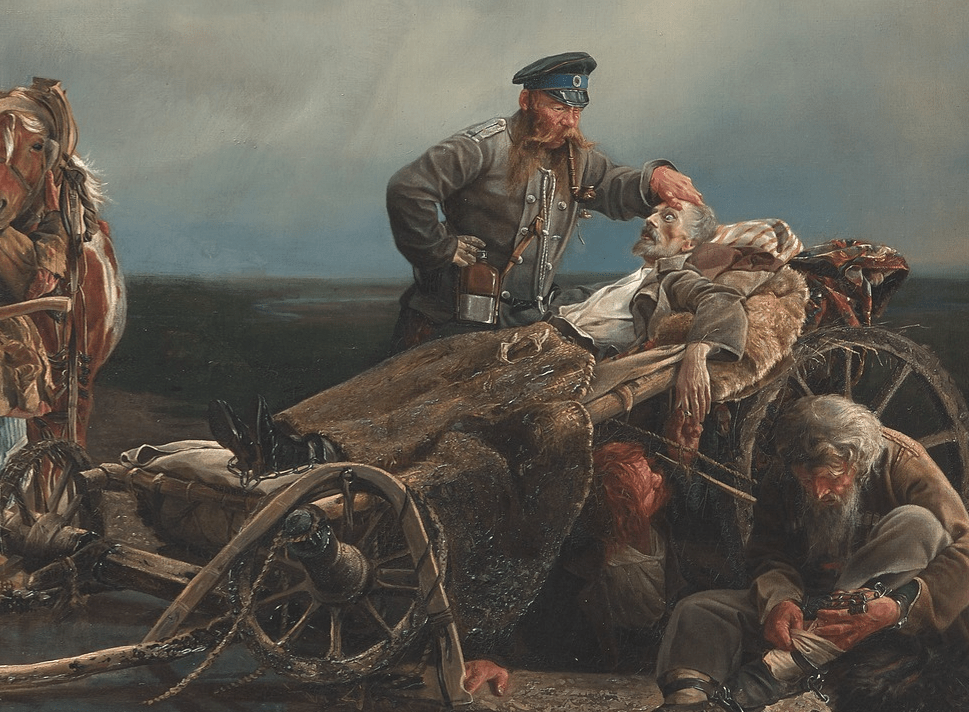
“The Halt of the Prisoners” (Привал арестантов) is a genre painting by the Russian artist Valery Yakobi (Валерия Якоби) completed in 1861. It is an oil on canvas of 98.6 × 143.5 cm situated at the State Tretyakov Gallery. It is difficult to imagine Russian genre painting of the 60s of the XIX century without this painting by Valery Ivanovich Jacobi, who created the true story of the royal penal servitude. It is one of the masterpieces of the 19th century, and this painting by Valery Jacobi immediately entered the history of art.
The painting “Halt of Prisoners” was presented by Valery Yakobi at the end of his studies at the Academy of Arts . For this painting, the Academy awarded him the title of class artist of the 1st degree and also a large gold medal .
In 1861-1862, the canvas was exhibited with great success at the exhibition of the Academy of Arts – the writer Fyodor Dostoevsky noted that Jacobi’s painting “amazes with amazing fidelity” and the public likes it “more than anyone else at the current exhibition”
This work made a great impression on the public, which rather vividly accepted the reforms of Emperor Alexander II.
Critics called this work frank and topical. Everyone was unanimous in their statements: the master managed to portray the actual problems of society. This work became the pinnacle of the artist’s work.
Valery Jacobi was the first of the Russian artists who turned to such a topic. The choice of subject was not accidental. Valery Ivanovich spent his childhood and youth in the east of Russia, where he personally observed the convicts who were driven past the house where the artist lived. Memories were so firmly planted in his head that the picture recreated from memory is striking in its realism and strength.
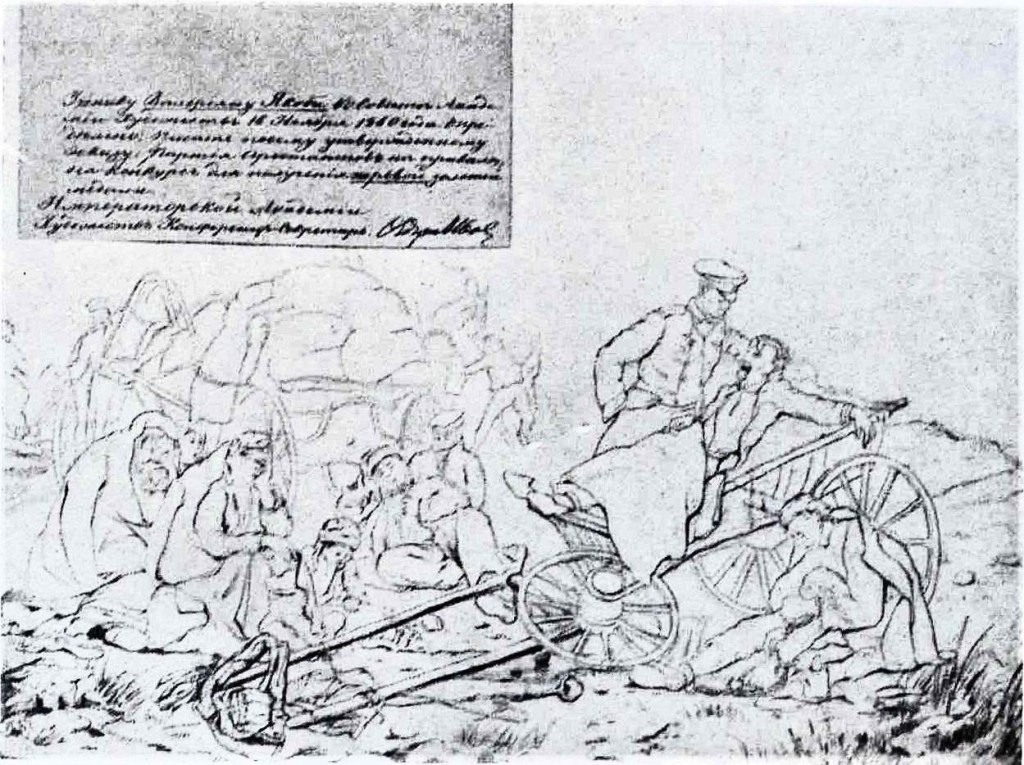
The collection of the State Tretyakov Gallery also contains a graphic sketch for the painting “Halt of Prisoners”
This first compositional sketch for the future canvas was submitted by Valery Jacobi for approval to the Council of the Academy of Arts in 1860. It is made in a purely contour technique, and the figures are outlined by a continuous line .
According to the description of art historian Alexei Sidorov, “from one edge of the figures, this line is thin and resembles a stroke of a cutter or a dry needle in a sketch engraving on copper; from the other edge of the same figures, the line tightens, becomes thicker, blacker, to a certain extent gives the figures <…> relief”; such an interpretation resembles a “marble bas-relief ” .
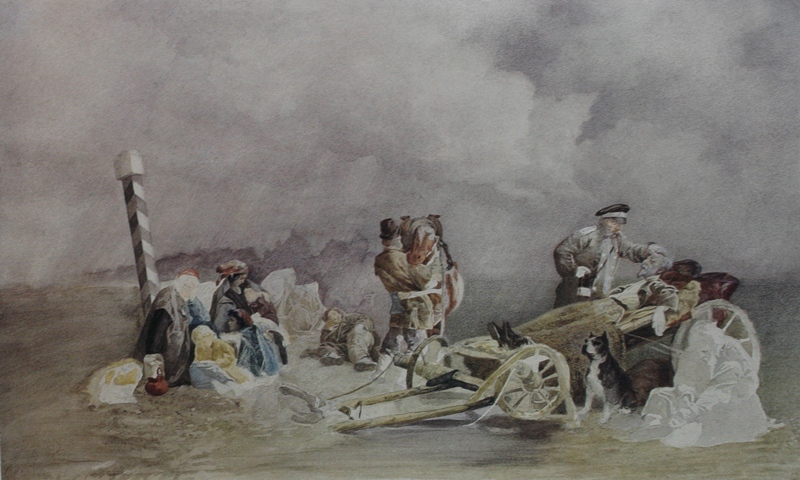
Another sketch of 36.5 × 58.7 cm , was executed in watercolor and white on paper. It is dated from 1861, and is kept in the State Russian Museum . In addition, the Russian Museum owns a reduced copy of the painting of the same name . It is an oil , paper on canvas, from the late 1860s – 1870s which is 53 × 75 cm , and was received in 1963 from the State Museum of the Revolution.
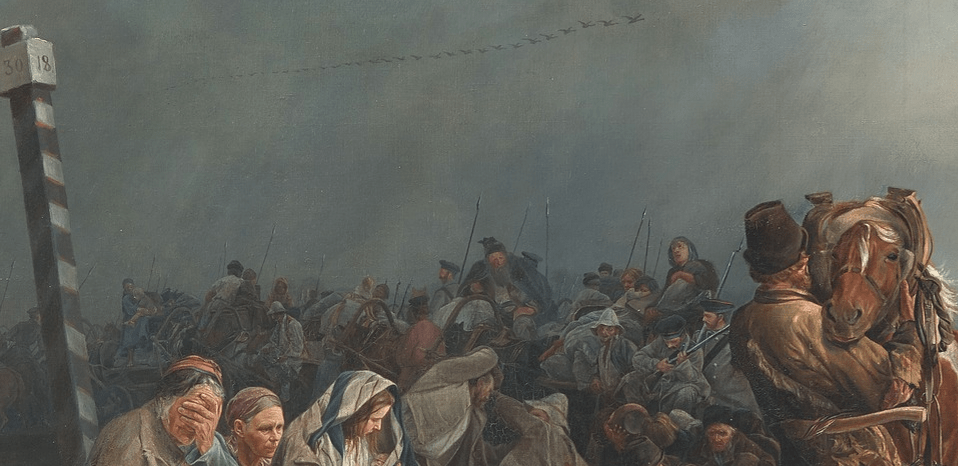
The painting depicts a group of prisoners stopping for a break. Probably, this halt was forced and caused by the breakdown of one of the carts.
Jacobi concentrates his main attention on the group around the deceased prisoner and the relatives who followed him along the stage, sitting at the milestone. At the same time, the artist uses a traditional academic technique, highlighting the main characters of the picture with light, grouping them in the spirit of classical “pyramids”. He managed to convey a complex range of feelings: from the despair of a family that has lost a person for whom they set off on a grueling journey, to the indifference of a gendarmerie officer who leaned over a dead prisoner. The rest of the exiles are depicted without detail, in gloomy silhouettes. The contrast of a dark stormy sky and bright light breaking through the dense cover of clouds, the predominance of gray and brown tones enhances the drama of the scene.
The Charter “On the Exiles” fixed and regulated the procedure for escorting, the issues of transporting exiles on carts, preventing escapes, women, freemen and the dead.
In this work, Jacobi managed with extraordinary persuasiveness to present various social types – from a tramp to an intellectual-political prisoner, whose life was cut short on the way.
On a broken road under a leaden sky with low rain clouds, standing by the cart is a stage officer, who with indifferent calmness ascertains the death of a prisoner (by opening his eyes), in order to leave him on the road and move on faster.
The central character of the composition is the deceased prisoner. He has an intelligent appearance, but is so emaciated that he looks like an old man. The dead prisoner is covered with matting . On his left hand, hanging lifelessly down, he wears a ring. The effect of the hopelessness of life is enhanced by another detail: another prisoner crept under the cart and is trying to pull off the ring from the finger of the deceased. In such a critical situation, the human essence is manifested.
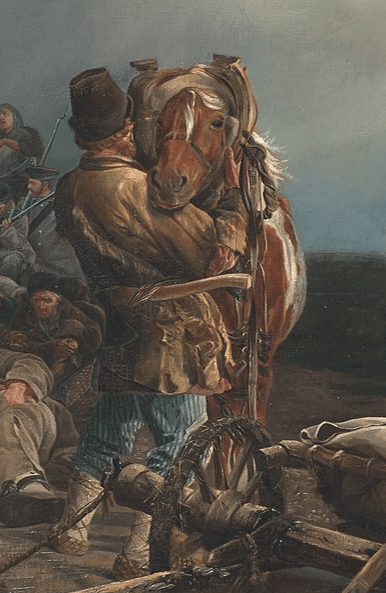
A man, dressed in a heavily torn caftan , is holding a harnessed horse.
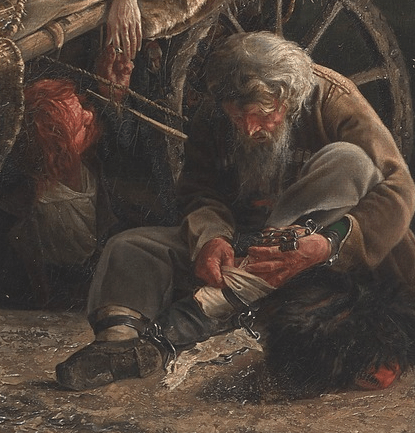
On the right side of the picture in the foreground is a seated prisoner in rags, who examines the wound on his leg, rubbed with shackles .
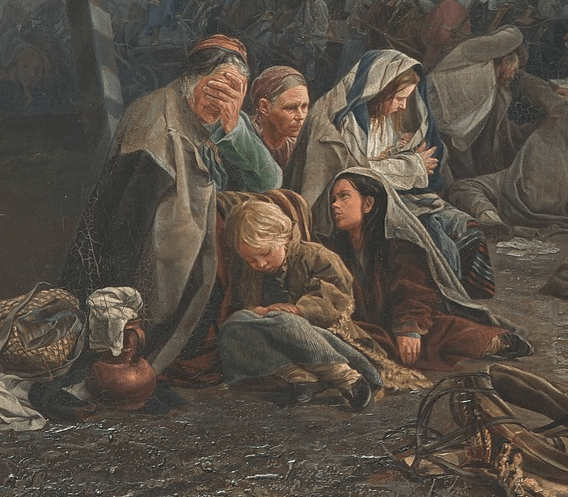
In the left corner of the picture are the families of prisoners who voluntarily went into exile along with their husbands and fathers. They are exhausted and weakened. However, no one retreats and they will go all the way to the end, but not everyone will return. They are already mourning the dead…
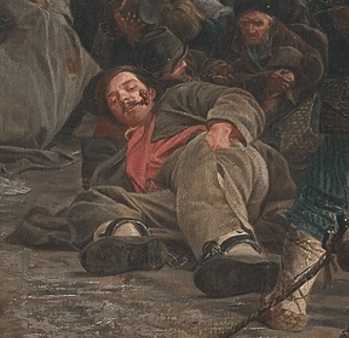
Nearby, a prisoner is seen smoking a pipe. It seems that he is completely indifferent to his own fate, he just goes with the flow, not thinking about tomorrow.
The plot continues with a group of fighting people and a long line of exiles, escorted by a convoy, lost in the distance… This horizontal line is emphasized by a thin parallel line of a flock of birds, dissolving into the clouds. The whole scene is depicted by the artist against the backdrop of an open autumn steppe, under a sky covered with heavy gray clouds. The bleak landscape only enhances the gloomy impression that the picture makes ….
I hope you enjoyed this painting as much as I did
If you liked this article, subscribe , put likes, write comments!.
« La Halte des prisonniers » (Привал арестантов) est une peinture de genre de l’artiste russe Valery Yakobi (Валерия Якоби) achevée en 1861. Il s’agit d’une huile sur toile de 98,6 × 143,5 cm située à la Galerie d’État Tretiakov. Il est difficile d’imaginer la peinture de genre russe des années 60 du XIXe siècle sans ce tableau de Valery Ivanovich Jacobi, qui a créé la véritable histoire de la servitude pénale royale. C’est l’un des chefs-d’œuvre du 19ème siècle, et ce tableau de Valery Jacobi est immédiatement entré dans l’histoire de l’art.
Le tableau « La Halte des prisonniers» a été présenté par Valery Yakobi à la fin de ses études à l’Académie des Arts. Pour ce tableau, l’Académie lui a décerné le titre d’artiste de classe du 1er degré et aussi une grande médaille d’or.
En 1861-1862, la toile a été exposée avec un grand succès à l’exposition de l’Académie des Arts – l’écrivain Fiodor Dostoïevski a noté que la peinture de Jacobi « étonne avec une fidélité étonnante » et le public l’aime « plus que quiconque à l’exposition actuelle »
Ce travail a fait une grande impression sur le public, qui a accepté de manière assez vivante les réformes de l’empereur Alexandre II.
Les critiques ont qualifié ce travail de franc et d’actualité. Tout le monde était unanime dans ses déclarations: le maître a réussi à dépeindre les problèmes réels de la société. Ce travail est devenu le summum du travail de l’artiste.
Valery Jacobi a été le premier des artistes russes à se tourner vers un tel sujet. Le choix du sujet n’était pas accidentel. Valery Ivanovich a passé son enfance et sa jeunesse dans l’est de la Russie, où il a personnellement observé les condamnés qui ont été conduits devant la maison où vivait l’artiste. Les souvenirs étaient si fermement ancrés dans sa tête que l’image recréée de mémoire frappe par son réalisme et sa force.
La collection de la Galerie d’État Tretiakov contient également une esquisse graphique pour le tableau « Halte des prisonniers »
Cette première esquisse de composition pour la future toile a été soumise par Valery Jacobi pour approbation au Conseil de l’Académie des Arts en 1860. Elle est réalisée dans une technique purement de contour, et les figures sont soulignées par une ligne continue.
Selon la description de l’historien de l’art Alexeï Sidorov, « d’un bord des figures, cette ligne est mince et ressemble à un trait de cutter ou à une aiguille sèche dans un croquis gravé sur cuivre ; de l’autre bord des mêmes figures, la ligne se resserre, devient plus épaisse, plus noire, donne dans une certaine mesure aux figures <… > relief»; une telle interprétation ressemble à un « bas-relief en marbre ».
Un autre croquis de 36,5 × 58,7 cm, a été exécuté à l’aquarelle et blanc sur papier. Il est daté de 1861 et est conservé au Musée d’État russe. En outre, le Musée russe possède une copie réduite de la peinture du même nom, une huile, papier sur toile, de la fin des années 1860 – 1870. Elle mesure 53 × 75 cm, et a été reçu en 1963 du Musée d’Etat de la Révolution.
La peinture représente un groupe de prisonniers s’arrêtant pour une pause. Probablement, cet arrêt a été forcé et causé par la panne de l’un des chariots.
Jacobi concentre son attention principale sur le groupe autour du prisonnier décédé et les proches qui l’ont suivi le long de la scène, assis au jalon. Dans le même temps, l’artiste utilise une technique académique traditionnelle, mettant en évidence les personnages principaux de l’image avec de la lumière, les regroupant dans l’esprit des « pyramides » classiques. Il a réussi à transmettre une gamme complexe de sentiments: du désespoir d’une famille qui a perdu une personne pour laquelle ils se sont lancés dans un voyage épuisant, à l’indifférence d’un officier de gendarmerie qui s’est penché sur un prisonnier mort. Le reste des exilés est représenté sans détail, par des silhouettes sombres. Le contraste d’un ciel orageux sombre et d’une lumière vive traversant la couverture dense de nuages, la prédominance des tons gris et bruns renforce le drame de la scène.
La Charte « Sur les exilés » fixait et réglementait la procédure d’escorte, les questions du transport des exilés sur des charrettes, la prévention des évasions, les femmes, les hommes libres et les morts.
Dans ce travail, Jacobi a réussi avec une persuasion extraordinaire à présenter divers types sociaux – d’un clochard à un prisonnier intellectuel et politique, dont la vie a été écourtée en cours de route.
Sur une route brisée sous un ciel de plomb avec de faibles nuages de pluie, debout près de la charrette se trouve un officier de scène, qui avec un calme indifférent constate la mort d’un prisonnier (en ouvrant ses yeux), afin de le laisser sur la route et d’aller plus vite.
Le personnage central de la composition est le prisonnier décédé. Il a une apparence intelligente, mais est tellement émacié qu’il ressemble à un vieil homme. Le prisonnier mort est recouvert d’e’un tapis. Sur sa main gauche, suspendu sans vie, il porte une bague. L’effet du désespoir de la vie est renforcé par un autre détail: un autre prisonnier s’est glissé sous la charrette et essaie de retirer la bague du doigt du défunt. Dans une situation aussi critique, l’essence humaine se manifeste.
Un homme, vêtu d’un caftan fortement déchiré, tient un cheval attelé.
Sur le côté droit de l’image au premier plan se trouve un prisonnier assis en haillons, qui examine la blessure sur sa jambe, frottée avec des chaînes.
Dans le coin gauche de l’image se trouvent les familles des prisonniers qui se sont volontairement exilés avec leurs maris et leurs pères. Elles sont épuisées et affaiblies. Cependant, personne ne se retire et ils iront jusqu’au bout, mais tout le monde ne reviendra pas. Ils pleurent déjà les morts…
À proximité, on voit un prisonnier fumer une pipe. Il semble qu’il soit complètement indifférent à son propre destin, il suit le courant, ne pensant pas à demain.
L’intrigue se poursuit avec un groupe de combattants et une longue lignée d’exilés, escortés par un convoi, perdus au loin… Cette ligne horizontale est soulignée par une mince ligne parallèle d’un troupeau d’oiseaux, se dissolvant dans les nuages. Toute la scène est représentée par l’artiste sur fond de steppe d’automne ouverte, sous un ciel couvert de lourds nuages gris. Le paysage sombre ne fait qu’accentuer l’impression sombre que l’image fait ….
J’espère que vous avez apprécié cette peinture autant que moi
Si vous avez aimé cet article, abonnez-vous, mettez des likes, écrivez des commentaires!
















 AKirill, Learn, apprenez, translation, traduction, livres bilingues, bilingual books