

| Livres bilingues | Read in English | Nous contacter |
| Littérature américaine | Littérature française | Littérature russe |
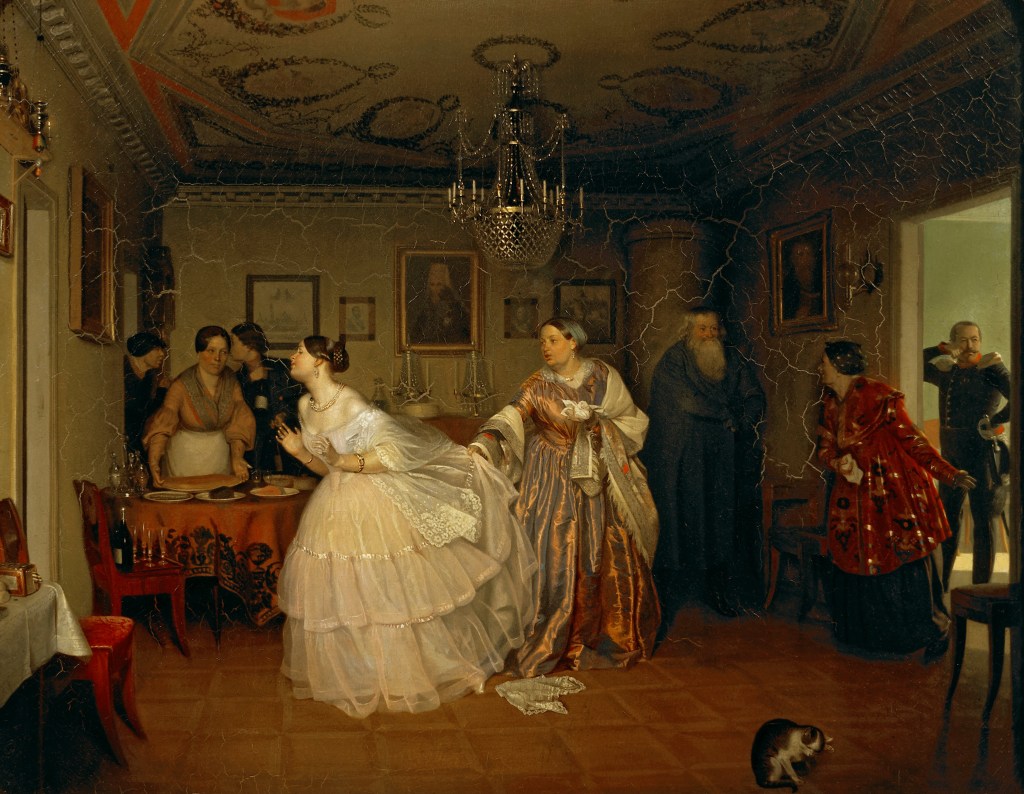
L’artiste russe Pavel Andreevich Fedotov a reçu le titre honorifique d’académicien pour son tableau «L’arrivée du marié (Fiançailles d’un major)», également connu sous le nom de «La Demande en mariage du major endetté». Cette toile est l’une des œuvres remarquables de la peinture russe de la première moitié du XIXe siècle et l’une des plus grandes réalisations de Fedotov. Créée en 1848 dans un style de « réalisme comique », il s’agit d’une huile sur toile de 58,3 × 75,4 cm décrivant les derniers instants de la préparation avant les fiançailles pour un marriage arrangé, et se trouve désormais à la Galerie nationale Tretiakov.
Lorsque le public a vu la peinture pour la première fois, le succès a été fulgurant. Tout Saint-Pétersbourg était mort de rire, les gens sont venus plus d’une fois à l’exposition pour voir à nouveau le «Wooing» du major. Qu’est-ce qui a provoqué une réaction aussi violente et fait autant rire le public ?
L’intrigue est basée sur un mariage de convenance ordinaire entre la fille d’un riche marchand et un major noble ruiné. À cette époque, de telles transactions étaient courantes : certains cherchaient à obtenir de l’argent, tandis que d’autres cherchaient à obtenir des titres dans la société.
Histoire de la création du tableau
Répétition du tableau
Description du tableau
Histoire de la création du tableau
Pavel Fedotov (Павел Федотов) a commencé à travailler sur “Fiançailles d’un major” (Сватовство майора) en 1848. À la demande de Karl Bryullov, il a reçu 700 roubles de l’Académie impériale des arts à utiliser sur des modèles, des costumes et d’autres matériaux.
Lors de la création du tableau “Fiançailles d’un major”, Fedotov a effectué de nombreux travaux préparatoires et de nombreux croquis qu’il a utilisés pour rechercher la composition de la scène, les images des personnages, ainsi que leurs poses et positions relatives dans le plan de La toile.
Voici quelques croquis pour ce tableau :

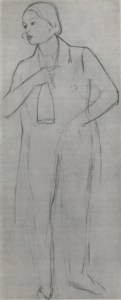
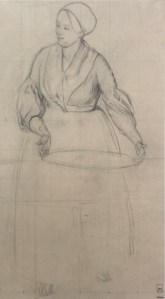

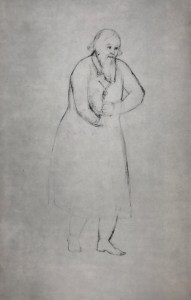
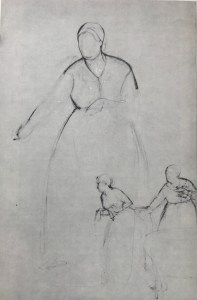
Presque immédiatement avant la sortie du tableau, Fedotov a écrit sa “Рацея” qui est une explication du tableau en vers, grâce à laquelle on peut comprendre plus en détail ce rôle simulé de chacun des héros de la toile. Pavel a lu sa “Рацея” à l’exposition de sa peinture, en 1849, où elle a eu un grand succès, le rendant très heureux. Sa satire était même comparée à celle de Gogol et d’Ostrov.
Répétition de la peinture
En 1852, Pavel Fedotov a terminé une répétition de la peinture “Fiançailles d’un major”, alternativement intitulée “Demoiselles d’honneur dans une maison de marchand” dans laquelle l’intrigue et la composition ont été conservées. Cette huile sur toile de 56 X 76 cm se trouve actuellement au Musée d’Etat Russe. Les deux peintures ont des différences significatives et nous les comparerons dans un autre article.

Description de la peinture
Comme si nous regardions par la fenêtre, nous voyons une famille de marchands souhaitant marier leur fille avec un noble, mais cela est fait très maladroitement.
Malgré le fait que l’arrivée de l’invité était attendue, il y a une agitation dans la pièce. La scène ressemble à une production théâtrale avec une action en constante évolution de la figure du major à la fille et la mère qui sont les personnages principaux de l’œuvre. Avec ce schéma de composition, l’auteur a souligné le manque de sincérité et le faux brillant de ce qui se passe. La relation des personnages se retrouve dans leurs gestes et leurs postures. En conséquence, une certaine dynamique se crée dans le sens de gauche à droite.
La scène se joue dans l’antichambre, ce qui n’est pas conforme à l’étiquette. Cela aurait dû être fait dans le salon ou la salle à manger.
La table n’est pas recouverte d’une nappe blanche, mais rose, avec une couture sur les bords qui serait plus appropriée dans un bureau ou un boudoir. On peut voir que l’action a probablement eu lieu le mercredi ou le vendredi, qui sont des jours de jeûne, car il n’y a que des collations maigres (hareng, saumon, caviar peu salé) sur la table qui est trop petite pour autant de collation.
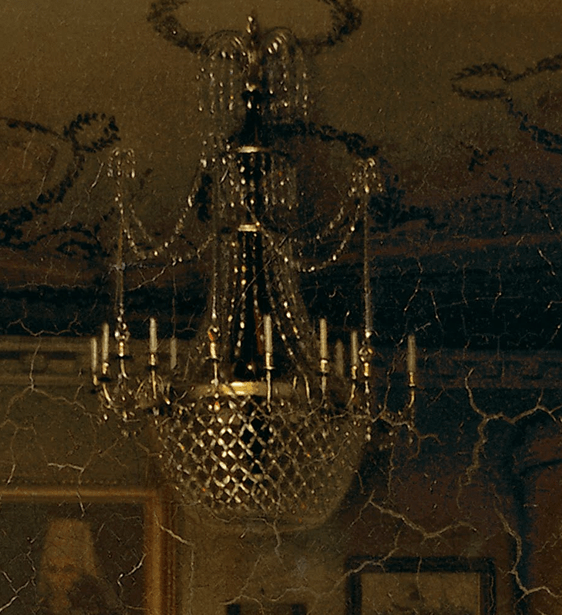

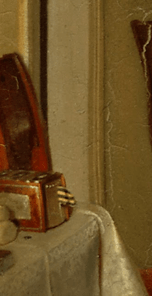

Une grande attention est portée aux détails, et montre de nombreux traits caractéristiques de la vie marchande. On voit que la pièce est remplie de choses démontrant la volonté des propriétaires de vivre « dans la capitale ». Mais si vous regardez bien, c’est une « mauvaise » combinaison d’objets divers qui trahit les habitudes patriarcales, et crée un effet comique.
Dans le coin gauche, il y a une table avec un psautier ainsi que des icônes avec des lampes sur une étagère, obligatoires dans toutes les maisons, mais impossibles dans cette pièce. Les aristocrates allaient prier dans la chapelle de la maison ou allaient à l’église et pouvaient avoir une icône dans la chambre, mais pas dans l’antichambre.
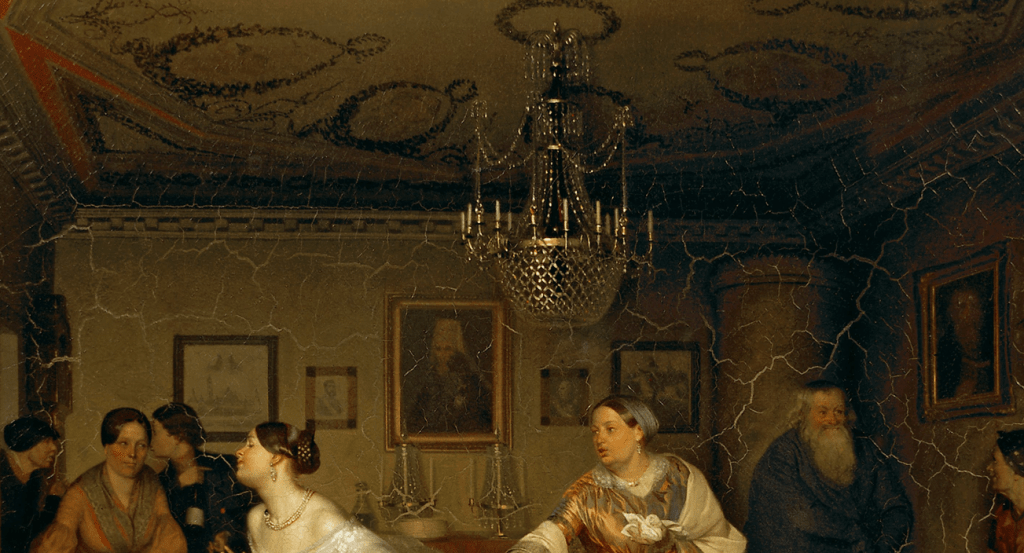
Le plafond, d’où pend un immense lustre, est peint de guirlandes de fleurs, de nymphes et d’amours.
Des peintures sont accrochées aux murs, mais leurs intrigues laissent entendre que le propriétaire ne connaît pas les arts.
Elles comprennent une lithographie avec une vue sur le monastère Nikolo-Ugresh, des portraits du métropolite, les généraux Kutuzov et Kulnev, ainsi que celui du propriétaire de la maison avec un livre à la main, pour souligner son alphabétisation.
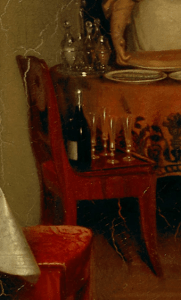
Le champagne dans cette maison, évidemment, est bu rarement et donc ils ne savent pas comment le servir avec grâce. Ils ont simplement posé le plateau avec la bouteille de champagne et les verres sur une chaise.

La mariée
Plus légère que celle de sa mère, la robe de la mariée contribue à la distinguer du groupe central en tant que personnage le plus important.
Même si la mariée porte une belle robe faite de mousseline et une quantité incommensurable de bijoux en or (bagues, colliers, boucles d’oreilles, bracelets), au dernier moment elle essaie de s’enfuir dans une autre pièce, se sentant nue dans cette nouvelle robe à la mode, qui est fabriqué selon la mode européenne et ne couvre pas ses épaules.
L’absurdité de la situation est accentuée par le fait que la tenue de la fille du marchand est destinée à un bal ou à un autre événement de soirée, et non pas à la rencontre du marié en journée, mais l’action, à en juger par les lampes éteintes, se déroule pendant la journée.
La mère
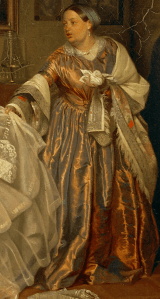
La mère de la mariée est vêtue à la nouvelle mode française et en même temps à l’ancienne mode russe. Elle porte une robe européenne à la mode en tissu irisé de type «chanzhan» et ne porte pas de corset dessous. Au lieu du bonnet, elle a un foulard de style philistin noué sur la tête accompagné d’un châle porté sur sa robe.
Alors que sa fille essaie de sortir en courant de la pièce, elle l’attrape par l’ourlet de sa robe pour l’arrêter. Sa posture et l’expression de son visage trahissent un caractère impérieux et volontaire et on peut en déduire que c’est probablement elle qui dirige tout dans la maison.
Le père
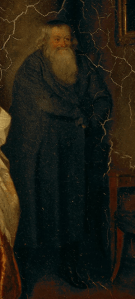
Son père, un paysan débonnaire à la barbe touffue, est à l’ombre dans un coin de la pièce. Il essaie de boutonner sa redingote “dernier cri” avec laquelle il n’est pas très familier.
L’entremetteuse
A gauche du major se trouve une simple entremetteuse vêtue d’un joli brocard rouge et d’une jupe sombre. Une écharpe sombre avec une petite fleur est nouée autour de sa tête. Ses vêtements sont une autre indication que le major n’est pas un noble héréditaire, sinon il aurait eu recours aux services d’une entremetteuse noble.
Venue avec le major, elle est déjà entrée dans la salle, et fait le lien entre le major, vers qui se dirige le mouvement de sa main, et le marchand, vers qui son regard est tourné.
Le major
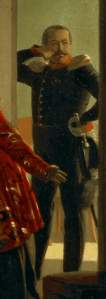
Il est probable que le marié soit devenu noble récemment, après avoir reçu le grade de major. Il n’a manifestement pas de manières raffinées, et on remarque qu’il a oublié d’apporter des fleurs à la mariée et à la future belle-mère.
Pour attirer notre attention, le major, vêtu d’un uniforme à épaulettes et armé d’un sabre, se tient dans l’embrasure de la porte en contre-jour. En même temps son visage est illuminé car il tourne la tête vers la gauche. Ses jambes sont placées de la même manière que la chaise, légèrement courbées, sa silhouette est tendue, ses yeux sont légèrement plissés et un sourire victorieux se cache dans sa moustache.
Il redresse sa moustache et toute son apparence montre une attitude professionnelle face à un « accord ».
Il est probable que des négociations avec les parents de la mariée aient été menées par l’entremetteuse à l’avance, et connaissant déjà la réponse, il pense maintenant à tous les avantages de son futur mariage.
Il ne voit pas encore ce qui se passe dans la pièce où se déroule l’action principale, et attend une invitation à entrer.
Soit dit en passant, pour créer la figure du major, Fedotov a peint son propre visage en se regardant dans un miroir, se donnant une mine de complaisance et corrigeant certains de ses traits.
Les serviteurs
Les personnages secondaires permettent de recréer l’atmosphère d’une maison de marchand.
A gauche du tableau, une vieille femme regardant avec curiosité depuis la pièce voisine, parle avec un gardien tenant une bouteille de vin. Il vient apparemment de l’apporter d’un magasin de vin et les deux serviteurs semblent papoter au sujet du marié.
Devant eux, la cuisinière pose un plat fraîchement cuit sur la table en regardant ce qui se passe dans la pièce.
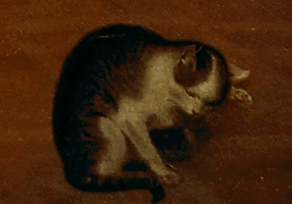
Le chat
Dans le coin inférieur droit du tableau, Pavel Fedotov représente un chat qui se nettoie : « Le chat lave les invités ».
Il y a un dicton associé à un chat qui se nettoie. Si l’animal se lave soigneusement, c’est pour les invités, et cela signifie que les invités viendront bientôt (les invités viendront au mariage).
Après avoir regardé ce tableau, nous nous demandons quel est le sort futur de la fille du marchand et du major : sont-ils heureux ? Comment la marchande se place-t-elle désormais dans la société, compte tenu de sa nouvelle relation avec un noble ? Il y a beaucoup de telles questions.
Dans les prochains articles, nous lirons et traduirons la Racea de Pavel Fedotov à propos de ses tableaux « Le matchmaking du major », puis nous comparerons le tableau original avec sa répétition.
J’espère que vous avez apprécié ce tableau autant que moi.
Poème au sujet du tableau “Fiançailles d’un Major” de Fedotov russe/français
| Si vous avez aimé cet article, abonnez-vous, mettez des likes, écrivez des commentaires ! |
Partager sur les réseaux sociaux |
Découvrez nos derniers posts |
- Poèmes et peinture, semaine du 29 mars 2026
- Poems and painting, Week of March 29, 2026
- Poèmes et peinture, semaine du 22 mars 2026
- Poems and painting, Week of March 22, 2026
- Poèmes et peinture, semaine du 15 mars 2026
- Poems and painting, Week of March 15, 2026
© 2023 Akirill.com – All Rights Reserved
 AKirill, Learn, apprenez, translation, traduction, livres bilingues, bilingual books