Read the poem “About prowess, exploits, glory” by Alexander Blok in English with English and Russian side by side

Bilingual booksLire en FrançaisContact us
American LiteratureFrench LiteratureRussian Literature

Dear readers and subscribers, this week I decided to translate a beautiful poem from Alexander Blok called “About prowess, exploits, glory”. This poem expresses his love for his wife as well as the way he is feeling after she betrayed him and left him for another. As usual I added a beautiful painting called “Ipatievsky Monastery on a winter night” by Alexei Kondratyevich Savrasov.

I hope you’ll enjoy this poem and painting as much as I did.


Short analysis of the poem “About prowess, exploits, glory” by Alexander Blok

Alexander Blok wrote the poem “About prowess, exploits, glory” in 1908, just after his wife Lyubov Mendeleeva left him. It should be noted that the couple separated and reunited several times, and it was during one of these periods of separation that this poem appeared. His wife was his muse and you can feel his pain at being left for another in each of the poem’s line.

In the first quatrain of the poem, Alexander Blok says that his love for his wife was so strong that for her, he abandoned exploits, fame and prowess and she became his muse. Her portrait which is on his desk “Was shining on the table in front of me” may mean that maybe his love was so strong that he forgot everything when he saw her shinning face in front of him, or maybe he compared his beloved “face in a simple frame” with an icon in which the gold paint reflects light creating the illusion that it is glowing from within, and used this comparison to emphasize the divine essence of his beloved.

Continue reading

Painting “Ipatievsky Monastery on a winter night” by Alexei Kondratyevich Savrasov
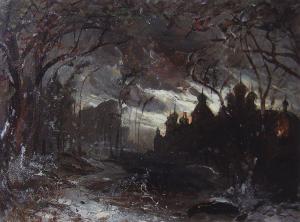
Ipatievsky Monastery on a winter night – Alexei Kondratyevich Savrasov

Translation of the poem “About prowess, exploits, glory” by Alexander Blok in English with English and Russian side by side

О доблестях, о подвигах, о славе – Александр БлокAbout prowess, exploits, glory by Alexander Blok
Translated by Akirill.com
11/06/2023
О доблестях, о подвигах, о славеAbout prowess, exploits, glory
Я забывал на горестной земле,I forgot on the sorrowful land,
Когда твое лицо в простой оправеWhen your face in a simple frame
Передо мной сияло на столе.Was shining on the table in front of me.
Но час настал, и ты ушла из дому.But the hour came, and you left home.
Я бросил в ночь заветное кольцо.I threw the treasured ring into the night.
Читать далееContinue reading

< < < Anna AkhmatovaJ’ai appris a vivre simplement, sagement (Ru/Fr) / I have learned to live simply, wisely (Ru/Eng) / Анна Ахматова Я научилась просто мудро жить (Рус/Анг.) / (Рус/ Фра.)
L’étrangère (Ru/Fr) / Stranger (Ru/Eng) / Незнакомка (Рус/Анг.) / (Рус/ Фра.) > > >


We put a lot of effort into the quality of the articles and translations, support us with a like and a subscription or sponsor us if you like them. We are also on Facebook and Twitter

Check out our Last Posts


© 2023 Akirill.com – All Rights Reserved

Lisez le poème “Incantation” d’Alexandre Pouchkine en français avec français et russe côte à côte

Livres bilinguesRead in EnglishNous contacter
Littérature américaineLittérature françaiseLittérature russe

Chers lecteurs et abonnés, cette semaine, j’ai traduit et fait une brève analyse du poème “Incantation” d’Alexandre Pouchkine avec le tableau ajouté “Ange avec une lampe” de Viktor Mikhaïlovitch Vasnetsov. J’espère que vous les apprécierez autant que moi.

Brève analyse du poème “Incantation” d’Alexandre Pouchkine

Le poème “Incantation” d’Alexandre Sergueïevitch Pouchkine a été écrit en 1830, pendant l’automne Boldino et est l’une des œuvres les plus célèbres des paroles d’amour du poète. Le poème “Incantation” est plein de mélancolie vivante, incitant la bien-aimée à revenir et maudissant tout ce qui l’a amenée à la tombe. Un appel à l’au-delà jette une ombre de mysticisme sur les mots, les plongeant dans les sensations “sombres” de la “folie”romantique. L’idée principale du poème est que l’amour est plus long que la vie.

Continuer la lecture …

Peinture “Ange avec une lampe” par Viktor Mikhaïlovitch Vasnetsov

Angel with a lamp by Victor Vasnetsov -1896

Traduction du poème “Incantation” d’Alexandre Pouchkine en français avec français et russe côte à côte

Заклинание – Александр ПушкинIncantation d’Alexandre Pouchkine
Traduit par Akirill.com
30/10/2023
О, если правда, что в ночи,Oh, s’il est vrai que la nuit,
Когда покоятся живые,Quand les vivants se reposent,
И с неба лунные лучиEt que du ciel les rayons de lune
Скользят на камни гробовые,Glissent sur les pierres tombales,
О, если правда, что тогдаOh, s’il est vrai qu’alors
Пустеют тихие могилы, —Les tombes tranquilles sont vides,
Я тень зову, я жду Леилы:J’appelle l’ombre, j’attends Leila :
Ко мне, мой друг, сюда, сюда!Viens à moi, mon amie, ici, ici !
Читать далее …Continuer la lecture …

<<< Heureux celui qui est choisi volontairement (Ru/Fr) / Happy is the one, who is chosen willfully (Ru/Eng) / Счастлив, кто избран своенравно (Рус/Анг.) / (Рус/ Фра.)
Je me souviens de la mer avant la tempête (Ru/Fr) / I remember the sea before the storm (Ru/Eng) / Я помню море пред грозою (Рус/Анг.) (Рус/ Фра.) >>>


Nous mettons beaucoup d’efforts dans la qualité des articles et traductions, soutenez-nous avec un like et un abonnement ou sponsorisez-nous si vous les aimez. Nous sommes aussi sur Facebook et Twitter

Découvrez nos Derniers Posts


© 2023 Akirill.com – All Rights Reserved

Read the poem “The spell” by Alexander Pushkin in English with English and Russian side by side

Bilingual booksLire en FrançaisContact us
American LiteratureFrench LiteratureRussian Literature

Dear readers and subscribers, this week I translated and did a short analysis of the poem “The Spell” by Alexander Pushkin with the added painting “Angel with a lamp ” by Viktor Mikhaylovich Vasnetsov. I hope you’ll enjoy them as much as I did.

Short analysis of the poem “The spell” by Alexander Pushkin

The poem “Spell” by Alexander Sergeevich Pushkin was written in 1830, during the Boldino autumn and is one of the most famous works in the poet’s love lyrics. The poem “The Spell” is full of living melancholy, conjuring the beloved to return and cursing everything that brought her to the grave. An appeal to the afterlife casts a shadow of mysticism on the words, immersing them in the “dark” sensations of romantic “madness”. The main idea of the poem is that love is longer than life. 

Continue reading …

Painting “Angel with a lamp ” by Viktor Mikhaylovich Vasnetsov

Angel with a lamp by Victor Vasnetsov -1896

Translation of the poem “The spell” by Alexander Pushkin in English with English and Russian side by side

Заклинание – Александр ПушкинThe spell by Alexander Pushkin
Translated by Akirill.com
30/10/2023
О, если правда, что в ночи,Oh, if it’s true that the night, 
Когда покоятся живые,When the living rest,
И с неба лунные лучиAnd from the sky the moonbeams
Скользят на камни гробовые,Slide on the tombstones,
О, если правда, что тогдаOh, if it’s true, then
Пустеют тихие могилы, —The quiet graves are empty,
Я тень зову, я жду Леилы:I’m calling the shadow, I’m waiting for Leila:
Ко мне, мой друг, сюда, сюда!Come to me, my friend, here, here!
Читать далее …Continue reading …

<<< Heureux celui qui est choisi volontairement (Ru/Fr) / Happy is the one, who is chosen willfully (Ru/Eng) / Счастлив, кто избран своенравно (Рус/Анг.) / (Рус/ Фра.)
Je me souviens de la mer avant la tempête (Ru/Fr) / I remember the sea before the storm (Ru/Eng) / Я помню море пред грозою (Рус/Анг.) (Рус/ Фра.) >>>


We put a lot of effort into the quality of the articles and translations, support us with a like and a subscription or sponsor us if you like them. We are also on Facebook and Twitter

Check out our Last Posts


© 2023 Akirill.com – All Rights Reserved

Lisez le poème “La Crête Volatile des Nuages s’éclaircit” d’Alexandre Pouchkine en français avec français et russe côte à côte avec une brève analyse du poème

Livres bilinguesRead in EnglishNous contacter
Littérature américaineLittérature françaiseLittérature russe

< < < Je me Souviens d’un Moment Merveilleux (Kern) (Ru/Fr) / I Remember a Wonderful Moment (Kern) (Ru/Eng) /Я помню чудное мгновенье (Керн) (Рус/Анг.) / (Рус/ Фра.)
Ma Muse (Ru/Fr) / My Muse (Ru/Eng) /Муза (Рус/Анг.) / (Рус/ Фра.) > > >


Chers lecteurs et abonnés, cette semaine, j’ai traduit et fait une brève analyse du merveilleux poème d’amour “La Crête Volatile des Nuages s’éclaircit” qui a été écrit en 1820 par Alexandre Pouchkine visitant Gurzuf, où il vivait avec la famille Raevsky alors qu’il était en exil dans la péninsule de Crimée. J’ai ajouté le tableau “Pouchkine en Crimée près des falaises de Gurzuf” d’Ivan Aïvazovski qui semblait parfait pour ce poème.

J’espère que vous les apprécierez autant que moi

Brève analyse du poème “La Crête Volatile des Nuages s’éclaircit” d’Alexandre Pouchkine

Alexandre Pouchkine a écrit le merveilleux poème d’amour “La crête Volatile des Nuages s’éclaircit” en 1820 alors qu’il était en exil caucasien dans la péninsule de Crimée, mais on sait que le nom original du poème était “Таврическая звезда” (Étoile Tauride).

Quand il a été publié, Pouchkine a demandé de supprimer les trois dernières lignes, mais cela n’a pas été fait et le poète a été horrifié que son amour secret soit révélé non seulement au grand public mais aussi à cette même jeune fille. Il n’avait pas à s’inquiéter car même de nos jours, il existe encore plusieurs hypothèses sur les personnes auxquelles il faisait référence. Il aurait pu s’agir d’Ekaterina Raevskaya, de Maria Golitsyna ou d’Ekaterina Karamzina.

Continuer la lecture …

Peinture “Pouchkine en Crimée près des falaises de Gurzuf” par Ivan Aïvazovski

Pushkin in the Crimea at the Gurzuf rocks - Ivan Aivazovsky
Pushkin in the Crimea at the Gurzuf rocks – Ivan Aivazovsky

Signification du mot

осеребрить: donner une teinte argentée, illuminer avec de la lumière argentée

Traduction du poème “La Crête Volatile des Nuages s’éclaircit” d’Alexandre Pouchkine en français avec français et russe côte à côte

Редеет облаков летучая гряда – Александр ПушкинLa Crête Volatile des Nuages s’éclaircit par Alexandre Pouchkine
Traduit par Akirill.com
10/07/2023
Редеет облаков летучая гряда;La crête volatile des nuages s’éclaircit;
Звезда печальная, вечерняя звезда,Étoile triste, étoile du soir,
Твой луч осеребрил увядшие равнины,Ton rayon a couvert de lumière argentée les plaines fanées,
И дремлющий залив, и черных скал вершины;Et la baie dormante, et les sommets des falaises noires;
Люблю твой слабый свет в небесной вышине:J’aime ta faible lumière dans les hauteurs célestes:
Он думы разбудил, уснувшие во мне.Elle a réveillé les pensées qui dormaient en moi.
Читать далее …Continuer la lecture …

Nous mettons beaucoup d’efforts dans la qualité des articles et traductions, soutenez-nous avec un like et un abonnement ou sponsorisez-nous si vous les aimez. Nous sommes aussi sur Facebook et Twitter

Découvrez nos Derniers Posts


© 2023 Akirill.com – All Rights Reserved

Read the poem “The Flying Ridge of Clouds is Thinning” by Alexander Pushkin in English with English and Russian side by side with analysis

Bilingual booksLire en FrançaisContact us
American LiteratureFrench LiteratureRussian Literature

< < < Je me Souviens d’un Moment Merveilleux (Kern) (Ru/Fr) / I Remember a Wonderful Moment (Kern) (Ru/Eng) /Я помню чудное мгновенье (Керн) (Рус/Анг.) / (Рус/ Фра.)
Ma Muse (Ru/Fr) / My Muse (Ru/Eng) /Муза (Рус/Анг.) / (Рус/ Фра.) > > >


Dear Readers and subscribers, this week, I translated and did a short analysis of the wonderful love poem “The Flying ridge of Clouds is thinning” which was written in 1820 by Alexander Pushkin visiting Gurzuf, where he lived with the Raevsky family while he was in exile in the Crimean Peninsula. I added the painting “Pushkin in the Crimea at the Gurzuf rocks” by Ivan Aivazovsky which seemed perfect for this poem.

I hope you’ll enjoy them as much as I did

Short analysis of the poem “The Flying Ridge of Clouds is Thinning” by Alexander Pushkin

Alexander Pushkin wrote the wonderful love poem “The Flying ridge of Clouds is thinning” in 1820 while in Caucasian exile on the Crimean Peninsula, but it is known that the original name of the poem was “Таврическая звезда” (Tauride Star).

When it was published Pushkin asked to remove the last three lines, but it was not done and the poet was horrified that his secret love would be reveled not only to the general public but also by that very maiden. He didn’t need to worry since even nowadays there are still several hypotheses about who he was referring to. It could have been Ekaterina Raevskaya, Maria Golitsyna, or Ekaterina Karamzina.

Continue reading …

Painting “Pushkin in the Crimea at the Gurzuf rocks” by Ivan Aivazovsky

Pushkin in the Crimea at the Gurzuf rocks - Ivan Aivazovsky
Pushkin in the Crimea at the Gurzuf rocks – Ivan Aivazovsky

Meaning of the word

осеребрить: paint silver, illuminate with silver light 

Translation of the poem “The Flying Ridge of Clouds is Thinning” by Alexander Pushkin in English with English and Russian side by side

Редеет облаков летучая гряда – Александр ПушкинThe Flying Ridge of Clouds is Thinning by Alexander Pushkin
Translated by Akirill.com
10/07/2023
Редеет облаков летучая гряда;The flying ridge of clouds is thinning;
Звезда печальная, вечерняя звезда,Sad star, evening star,
Твой луч осеребрил увядшие равнины,Your ray illuminated with silver light the withered plains,
И дремлющий залив, и черных скал вершины;And the slumbering bay, and the black rocky peaks;
Люблю твой слабый свет в небесной вышине:I love your faint light in the heavenly heights:
Он думы разбудил, уснувшие во мне.It awakened the thoughts that had fallen asleep in me.
Читать далее …Continue reading …

We put a lot of effort into the quality of the articles and translations, support us with a like and a subscription or sponsor us if you like them. We are also on Facebook and Twitter

Check out our Last Posts


© 2023 Akirill.com – All Rights Reserved

Lisez le poème “Confession” d’Alexandre Pouchkine Anglais et russe côte à côte

Livres bilinguesRead in EnglishNous contacter
Littérature américaineLittérature françaiseLittérature russe

< < < Cerisier (Ru/Fr) / Cherry Tree (Ru/Eng) / Вишня (Рус/Анг.) / (Рус/ Фра.)
Heureux celui qui est choisi volontairement (Ru/Fr) / Happy is the one, who is chosen willfully (Ru/Eng) / Счастлив, кто избран своенравно (Рус/Анг.) / (Рус/ Фра.) > > >


Chers lecteurs et abonnés, cette semaine, j’ai traduit et fait une brève analyse du merveilleux poème d’amour “Confession” d’Alexandre Pouchkine. Comme d’habitude j’ai ajouté un beau tableau “Automne” d’Alexei Kondratyevich Savrasov. J’espère que vous les apprécierez autant que moi.

Brève analyse du poème “Confession” d’Alexandre Pouchkine

Alexandre Pouchkine a écrit le poème “Confession” en 1826 pour Alexandra, la fille adoptive de P. Osipova, mais il ne lui a jamais donné le poème et il n’a pas été publié de son vivant.

Pouchkine tombait souvent amoureux et parfois, il devait souffrir d’un amour non partagé, ce qu’il décrit dans ce poème. Dans “Confession” , le poète comprend le désespoir de son amour, décrivant ses sentiments comme une “stupidité malheureuse”

Continuez la lecture …

Peinture “Automne” par Alexeï Kondratievitch Savrassov


Traduction du poème “Confession” d’Alexandre Pouchkine en français avec français et russe côte à côte


Александр Пушкин — ПризнаниеConfession par Alexandre Pouchkine
Traduit par Akirill. com
Я вас люблю, — хоть я бешусь,Je vous aime, même si je suis en colère,
Хоть это труд и стыд напрасный,Bien que ce soit du travail et de la honte en vain,
И в этой глупости несчастнойEt cette malheureuse bêtise
У ваших ног я признаюсь!A vos pieds je l’avoue !
Мне не к лицу и не по летам…Cela ne me convient pas et cela ne convient pas à mon âge…
Пора, пора мне быть умней!Alors, il est temps pour moi d’être plus intelligent !
Но узнаю по всем приметамMais je reconnais par tous les signes
Болезнь любви в душе моей:La maladie de l’amour dans mon âme :
Читать далее …Continuez la lecture …


Nous mettons beaucoup d’efforts dans la qualité des articles et traductions, soutenez-nous avec un like et un abonnement ou sponsorisez-nous si vous les aimez. Nous sommes aussi sur Facebook et Twitter

Découvrez nos Derniers Posts


© 2023 Akirill.com – All Rights Reserved

Read the Poem “Confession” by Alexander Pushkin English and Russian side by side

Bilingual booksLire en FrançaisContact us
American LiteratureFrench LiteratureRussian Literature

< < < Cerisier (Ru/Fr) / Cherry Tree (Ru/Eng) / Вишня (Рус/Анг.) / (Рус/ Фра.)
Heureux celui qui est choisi volontairement (Ru/Fr) / Happy is the one, who is chosen willfully (Ru/Eng) / Счастлив, кто избран своенравно (Рус/Анг.) / (Рус/ Фра.) > > >


Dear readers and subscribers, this week I translated and did a short analysis of the wonderful love poem “Confession” by Alexander Pushkin. As usual I added a beautiful painting “Autumn” by Alexei Kondratyevich Savrasov. I hope you’ll enjoy them as much as I did.

Short analysis of the poem “Confession” by Alexander Pushkin

Alexander Pushkin wrote the poem “Confession” in 1826 for Alexandra, the adopted daughter of P. Osipova but he never gave her the poem and it was not published during his lifetime.

Pushkin often fell in love and sometimes, he had to suffer from unrequited love which is what he describes in this poem. In “Confession”, the poet undestands the hopelessness of his love, describing his feelings as “unhappy stupidity”

Continue reading …

Painting “Autumn” by Alexei Kondratyevich Savrasov


Translation of the poem “Confession” by Alexander Pushkin in English with English and Russian side by side


Александр Пушкин — ПризнаниеConfession by Alexander Pushkin
Translated by Akirill.com
Я вас люблю, — хоть я бешусь,I love you, even though I am mad,
Хоть это труд и стыд напрасный,Even though this is labor and shame in vain,
И в этой глупости несчастнойAnd this unfortunate stupidity
У ваших ног я признаюсь!at your feet I confess!
Мне не к лицу и не по летам…It doesn’t suit me and it doesn’t suit my years…
Пора, пора мне быть умней!Still, it’s time for me to be smarter!
Но узнаю по всем приметамBut I recognize by all the signs
Болезнь любви в душе моей:The disease of love in my soul: :
Читать далее ..
Continue reading ..


We put a lot of effort into the quality of the articles and translations, support us with a like and a subscription or sponsor us if you like them. We are also on Facebook and Twitter

Check out our Last Posts


© 2023 Akirill.com – All Rights Reserved

Lire le Poème: Prière (Dans un moment difficile de la vie) de Mikhail Lermontov en français avec français et russe côte à côte

Livres bilinguesRead in EnglishNous contacter
Littérature américaineLittérature françaiseLittérature russe

Chers lecteurs et abonnés, cette semaine, j’ai traduit et fait une brève analyse d’un poème intitulé prière (Dans un moment difficile de la vie) écrit en 1839 par Mikhail Lermontov peu de temps après son retour d’exil. J’ai également ajouté le tableau “Icône Vladimir de la Mère de Dieu”. Comme toujours la totalité de l’article et de la traduction est librement accessible à tous sur le site. J’espère que vous les apprécierez autant que moi.

Brève analyse du poème “Prière” de Mikhail Lermontov

Le vers «Prière» (Dans un moment difficile de la vie), écrit par Lermontov en 1839, peu après son retour d’exil, est un exemple frappant de paroles religieuses et est très apprécié parmi les adeptes des enseignements chrétiens peu orthodoxes.

Lermontov a commencé sa carrière d’écrivain poétique comme un rebelle solitaire, son idéal était un esprit rebelle, se tenant au-dessus des lois humaines et divines, ce qui est très loin de l’humilité et de la soumission chrétiennes, et a amené beaucoup à considérer le poète comme un libre penseur et un athée.

Continuer la lecture …

Peinture “Icône de Vladimir de la mère de Dieu

L’icône Vladimir de la Mère de Dieu est la plus ancienne icône survivante connue et l’une des icônes miraculeuses les plus vénérées de l’Église orthodoxe russe.

Traduction du poème “Prière” de Mikhail Lermontov en français avec français et russe côte à côte

Молитва – Prière
Traduit par Akirill.com
09/25/2023
В минуту жизни труднуюDans un moment difficile de la vie
Теснится ль в сердце грусть,S’il y a de la tristesse dans mon cœur,
Одну молитву чуднуюUne merveilleuse prière
Твержу я наизусть.Je répète par cœur.
Есть сила благодатнаяIl y a un pouvoir de grâce
В созвучьи слов живых,Dans la consonance des paroles vivantes,
Читать далее …Continuer la lecture …

Nous mettons beaucoup d’efforts dans la qualité des articles et traductions, soutenez-nous avec un like et un abonnement ou sponsorisez-nous si vous les aimez. Nous sommes aussi sur Facebook et Twitter


Découvrez nos Derniers Posts


© 2023 Akirill.com – All Rights Reserved
Read the Poem: Prayer (In a difficult moment of life) by Mikhail Lermontov in English with English and Russian side by side

Bilingual booksLire en FrançaisContact us
American LiteratureFrench LiteratureRussian Literature

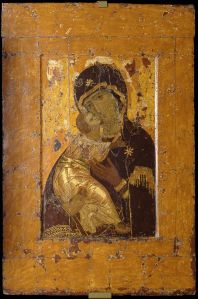
Dears readers and subscribers, this week I translated, and made a short analysis of a poem called prayer (In a difficult moment of life) written in 1839 by Mikhail Lermontov shortly after his return from exile. I also added the painting “Vladimir Icon of the Mother of God“. As always the totality of the article and translation is freely available to all on the site. I hope you will enjoy them as much as I did.

Short analysis of the poem “Prayer” by Mikhail Lermontov

The Verse “Prayer” (In a difficult moment of life) written by Lermontov in 1839, shortly after he returned from exile, is a vivid example of religious lyrics and is very highly valued among followers of unorthodox Christian teachings.

Lermontov began his poetic writer career as a lone rebel, his ideal was a rebellious spirit, standing above human and divine laws, which is very far from Christian humility and submission, which caused many to consider the poet freethinker and atheist.

Continue Reading

Painting “Vladimir Icon of the Mother of God

The Vladimir Icon of the Mother of God is the earliest known surviving and one of the most revered miraculous icons of the Russian Orthodox Church

Translation of the poem “Prayer” by Mikhail Lermontov in English with English and Russian side by side

Молитва – Prayer
Translated by Akirill.com
09/25/2023
В минуту жизни труднуюIn a difficult moment of life
Теснится ль в сердце грусть,If there is sadness in my heart,
Одну молитву чуднуюOne wonderful prayer
Твержу я наизусть.I repeat by heart.
Есть сила благодатнаяThere is a power of grace
В созвучьи слов живых,In the consonance of living words,
Читать далее ..
Continue reading ..

We put a lot of effort into the quality of the articles and translations, support us with a like and a subscription or sponsor us if you like them. We are also on Facebook and Twitter

Check out our Last Posts


© 2023 Akirill.com – All Rights Reserved
Lisez le poème “L’Étrangère” d’Alexandre Blok en français avec français et russe côte à côte

Livres bilinguesRead in EnglishNous contacter
Littérature américaineLittérature françaiseLittérature russe

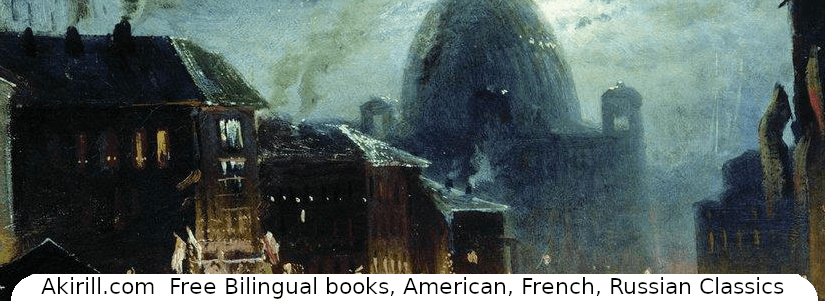
Chers lecteurs et abonnés, cette semaine j’ai fait une brève analyse et traduit le poème « L’Étrangère » d’Alexander Blok écrit en 1906 et qui reflète ses sentiments et réflexions pendant une période difficile. Comme toujours j’ai ajouté une peinture intitulée « Illumination à Saint-Pétersbourg » de Fiodor Vassiliev ainsi que l’explication de quelques mots.

Depuis que j’écris en anglais, français et russe j’ai également créé une page où vous pouvez retrouver le nom de tous les écrivains et peintres russes qui sont sur le site dans les 3 langues côte à côte. J’ajouterai les écrivains et artistes français et américains un peu plus tard.

Alors prenez un bon café et savourez, l’intégralité du poème est comme toujours en accès libre avec un lien vers la page en bas de notre petit extrait.


Brève analyse du poème “L’Étrangère” d’Alexandre Blok

Alexander Blok a écrit le poème « L’étrangère » après que sa femme l’ai quitté, le laissant écrasé par le désespoir et passant des journées entières à boire de façon excessive dans des établissements sales et bon marché. Le poème reflète les sentiments et les réflexions de l’auteur lors de moments difficiles pour lui-même et sa tentative de trouver une issue à sa mauvaise situation.

Dans ce poème, l’auteur décrit l’atmosphère sombre d’un restaurant sale où rien ne change et où la monotonie et l’absurdité vous rendent fou. Mais nous espérons la délivrance de notre héros lyrique sous la forme d’un mystérieux étranger. Cette femme qui passe entre les rangs des ivrognes vient d’un monde pur et lumineux et en la regardant et en sentant son parfum, le poète comprend l’horreur de sa situation et dans ses rêves, il s’envole et commence une nouvelle vie.

La fin du poème est ambiguë et peut être interprétée de deux manières différentes. Il se peut qu’il n’était pas comme les ivrognes qui l’entouraient et qu’il se soit rendu compte qu’il possédait encore un « trésor spirituel » dont il avait le droit de disposer, ou qu’il aurait pu simplement s’agir d’un délire d’ivrogne suivi d’une grave gueule de bois.

Peinture “Illumination de Saint-Pétersbourg” par Fiodor Vassiliev


Explication de quelques mots

дик: court masculin singulier de  ди́кий (sauvage)

Уклю́чина
Dame de nage

Traduction du poème “L’Étrangère” d’Alexandre Blok en français avec français et russe côte à côte

Незнакомка – Александр БлокL’étrangère – Alexander Blok
Traduit par Akirill.com
09/17/2023
По вечерам над ресторанамиLe soir au dessus des restaurants
Горячий воздух дик и глух,L’air chaud est sauvage et sourd,
И правит окриками пьянымиEt règne sur les cris des ivrognes
Весенний и тлетворный дух.L’esprit printanier et pernicieux.
Вдали над пылью переулочной,Bien au-dessus de la poussière de l’allée,
Над скукой загородных дач,Au-dessus de l’ennui des maisons de campagne,
Чуть золотится крендель булочной,Le bretzel de la boulangerie est légèrement doré,
И раздается детский плач.Et le cri d’un enfant se fait entendre.d.
Читать далее …Continuer la lecture …

Nous mettons beaucoup d’efforts dans la qualité des articles et traductions, soutenez-nous avec un like et un abonnement ou sponsorisez-nous si vous les aimez. Nous sommes aussi sur Facebook et Twitter


Découvrez nos Derniers Posts


© 2023 Akirill.com – All Rights Reserved