
History of Kikin chambers

Bilingual booksLire en FrançaisContact us
American LiteratureFrench LiteratureRussian Literature

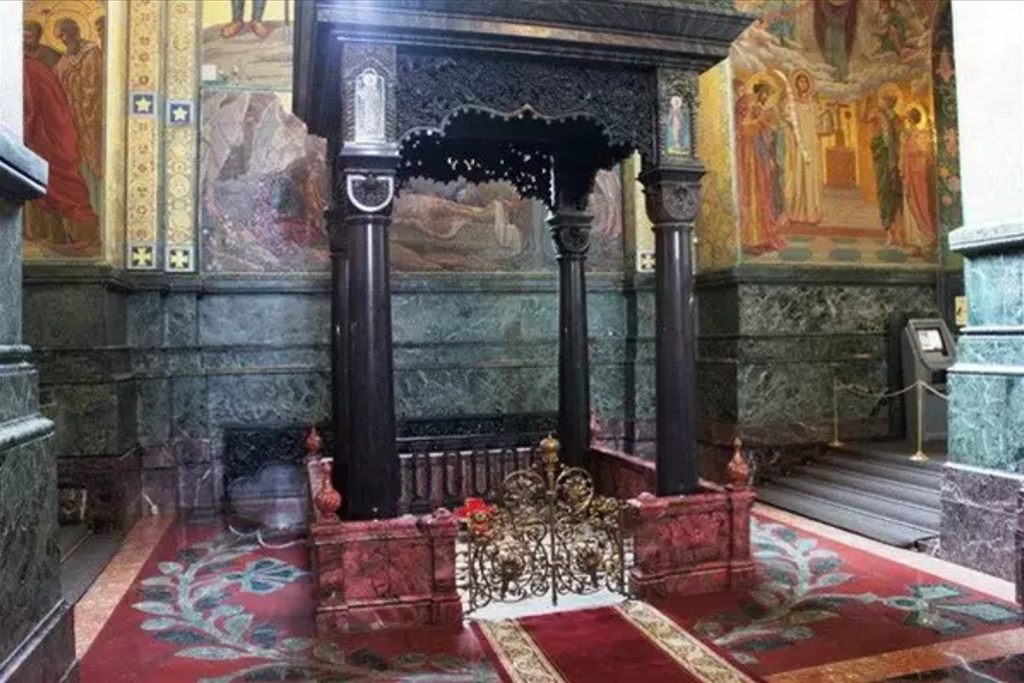
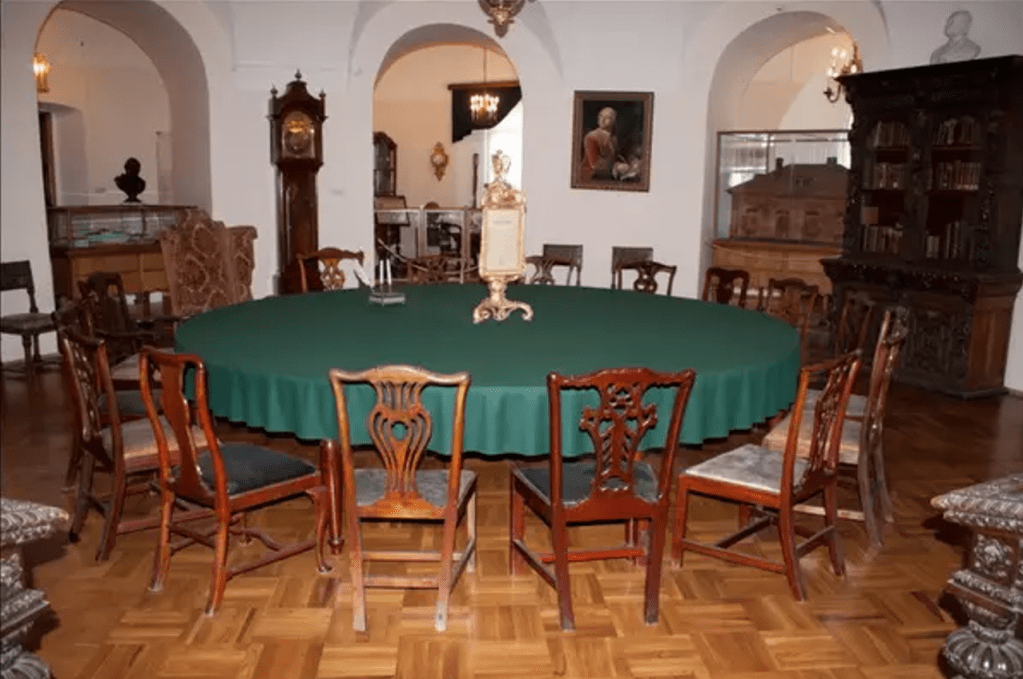
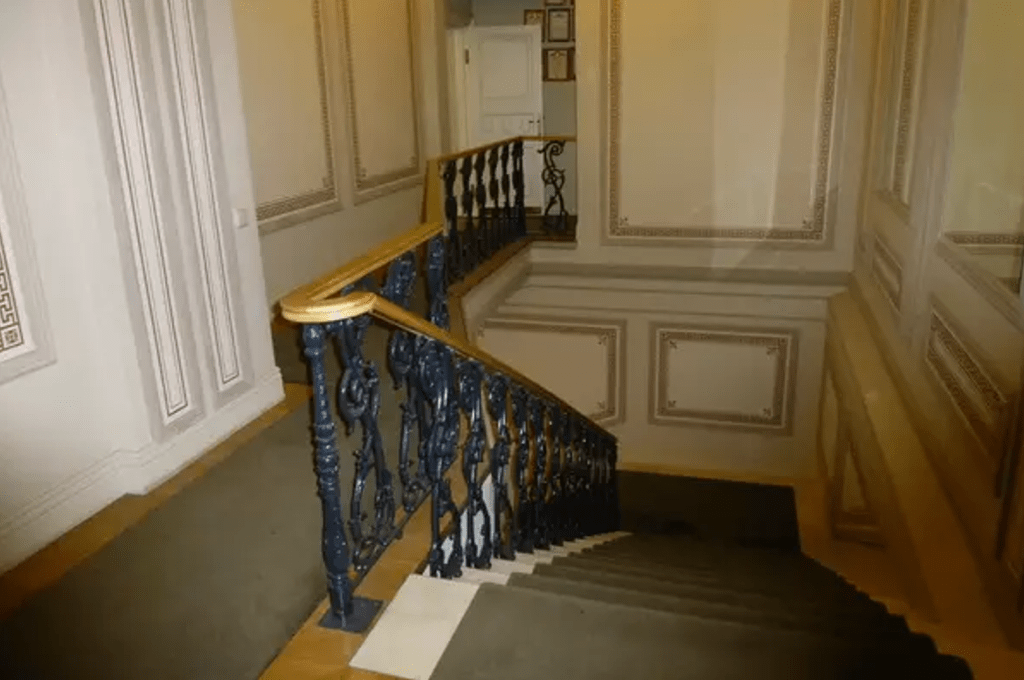
Kikin chambers is one of the oldest building in Saint Petersburg. This building is included in the Unified State Register of Cultural Heritage Objects of Russia. The mansion which was rebuilt several times is on Stavropolskaya street between the former Leningrad Radio Engineering Research Institute and a residential building built at the beginning of our century.

Авторство: Alex ‘Florstein’ Fedorov, CC BY-SA 4.0,

It is the only house of Alexander Kikin that still exist nowadays.

Alexander Vasilyevich Kikin was a proeminent nobleman and one of the associates of Peter the Great. He accompanied the tsar in the Azov campaign, then went to study shipbuilding in Hollands. After having been appointed head of the Saint Petersburg Admiralty in 1708, he was awarded the rank of Peter’s adviser for the Admiralty in 1712.

Alexander became one of the richest person in Russia and began to build himself a mansion. Sadly when a conflict arose between Peter I and Tsarevich Alexei, Kikin helped Alexei hide abroad sealing his own fate. In 1718, before his mansion was finished, he was taken into custody, sentenced to be wheeled and died a painful death on the chopping block.

The chambers were confiscated and all the properties of Kikin went to the treasury. The Winter Palace stands on Kikin’s second land plot now.

The construction of the chambers began in 1714 and ended in 1720. It is presumed that A. Schluter was the architect of the building. Its construction was carried out in two stages. Initially, the central part of the house was two-story, and two one-story wings, which were intended for household needs, adjoined it on both sides.

The windows and doorways of the Kikin chambers were framed with platbands, and the roof was covered with flat tiles. The building had side risalits, which were ledges located in the center and on the sides of the facades. Their feature was the presence of intricate decorative curls, the so-called volutes and shoulder blades. They performed not only decorative functions, but also constructive, as they contributed to the strengthening of the wall. Kikin’s chambers were decorated with a front porch, to which small stairs led from both sides. White balusters gave them a special, solemn look. The building was decorated with pediments, and it was crowned with a high roof with a fracture. The internal layout of the structure was very similar to the arrangement of rooms in the Peterhof Grand Palace. In 1720 a second floor was built over the side wings.

After the construction of the chambers was completed, the famous Kunstkamera and the library of Peter I were placed inside where they stayed until 1727.
After the execution of the owner in 1718, there was a belief among the people that the ghost of Kikin was wandering in the house and few people wanted to see the collection belonging to the tsar. The tsar resorting to cunning, promised everyone who visited the the Kunstkamera a glass of vodka or a cup of coffee in order to popularize the natural sciences. It worked and the exposition had many visitors.

In addition, Natalya Alekseevna, the tsar sister set up one of the first city theater in part of the building.

There is a well-known legend which says that once Peter the Great, walking along the banks of the Neva, saw a branch of a tree, which miraculously grew into his trunk and decided to build a new building for the Kunstkamera where he transferred his collection in 1727.

 In the 1720s, the Kikin Chambers were rebuilt by an unknown architect.

In 1733, a hospital, an office and the headquarters of the Horse Guards were opened in the Kikin Chambers. During the construction of barracks for the regiment of the Horse Guards next to the chambers, which were adapted for the regimental infirmary and office,  F. B. Rastrelli erected a bell tower with a dome and a cross over the middle part of the chambers. The Great Hall was then used for the regimental church.

In the 19th century the building was seriously damaged. In 1829, Kikin’s chambers were reconstructed according to the project of Alexander Staubert. He was extremely negligent in his approach and destroyed all the rich baroque decor that adorned the facade of the house. The pilasters were removed, the superstructure-bell tower by Rastrelli was demolished. The walls were covered with plaster, and he added 2 rooms to the building from the side of the embankment. In 1874, two symmetrical staircases were added to the building from the Neva side.

Help the site stay free, buy us a cup of coffeeAidez-nous à maintenir le site gratuit en nous offrant une tasse de café

During the Siege of Leningrad, the Kikin chambers were badly damaged by bombs and shells, and the building was repeatedly on fire. However, it was at this time that the plaster applied during the last restoration fell off, revealing the original facade of the early 18th century.

This made it possible to start recreating the facades in the forms of Petrine architecture. 

Immediately after the war, the implementation of an ambitious project by the architect I. Benois began to restore the Kikin chambers to their historical appearance. The pilasters were returned to their places, later superstructures to the building were demolished, and pediments were attached to the chambers from two sides. The restoration was completed in 1956.

In 1979, the authorities of St. Petersburg transferred the Kikin Chambers to the Children’s Music School No. 12. Since 1995, the school has been transformed into the St. Petersburg Musical Lyceum, which is located in this building to this day.

If you liked this article, subscribe , put likes, write comments!.
Share on social networks
Check out Our Latest Posts

Émail de Moscou à l’exposition Fabergé

Livres bilinguesRead in EnglishNous Contacter
Littérature américaineLittérature françaiseLittérature russe

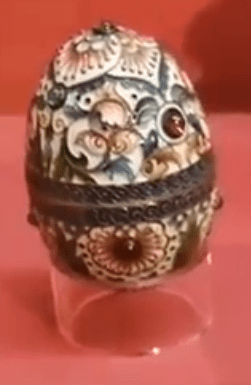
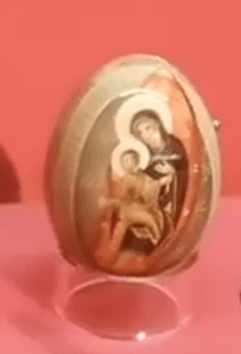
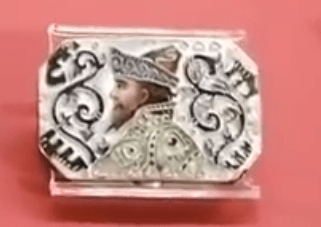
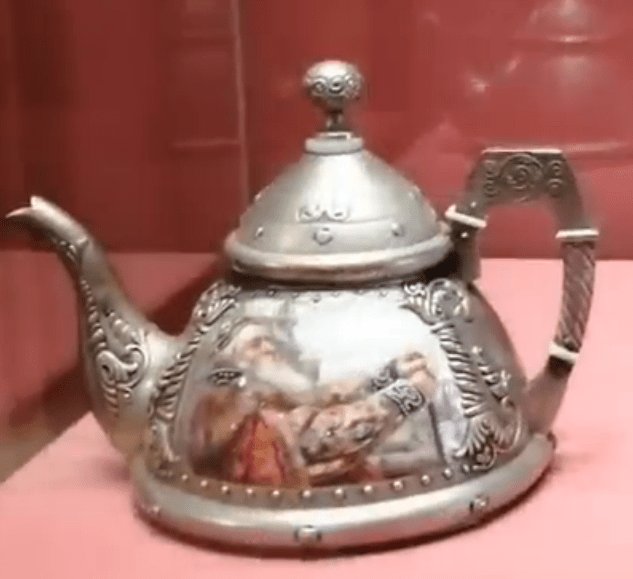
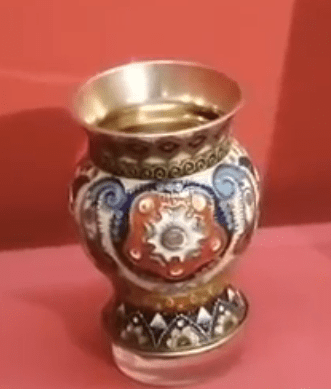
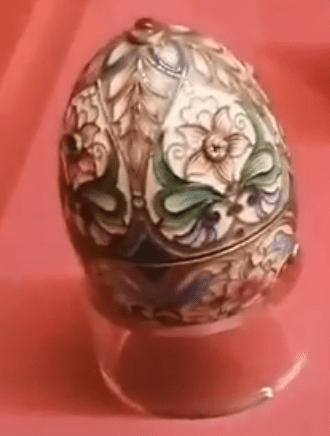
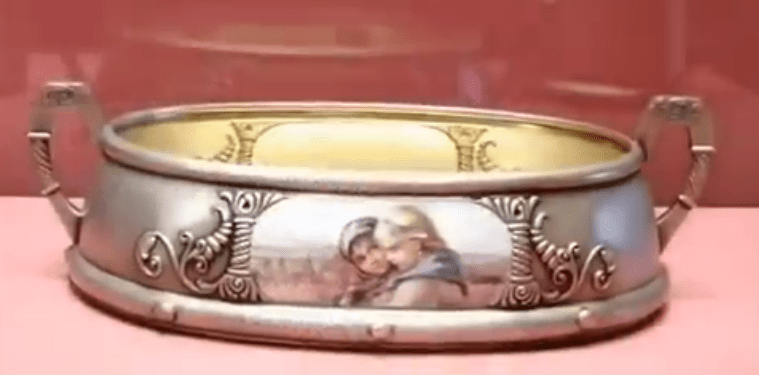
J’ai trouvé une vidéo très courte et agréable d’émail de Moscou à l’exposition Fabergé. J’aurais souhaité de la musique mais il y a des explications en russe pour ceux qui la comprennent. J’ai mis quelques photos de la vidéo et un lien pour que vous puissiez la regarder vous-même et j’espère l’apprécier autant que moi. Le signe montré à la fin de la vidéo dit: Service à thé et café O. Kurlyukov’s compagnie. Moscou. 1908-1917 . Argent, émail, nacre; monnayage, peinture, dorure.

Voir la vidéo : L’ émail de Moscou à l’exposition Fabergé

Help the site stay free, buy us a cup of coffeeAidez-nous à maintenir le site gratuit en nous offrant une tasse de café

If you liked this article, subscribe , put likes, write comments!.
Share on social networks
Check out Our Latest Posts

Moscow enamel at the Faberge exhibition

Bilingual booksLire en FrançaisContact us
American LiteratureFrench LiteratureRussian Literature

I found a very short and nice video of a Moscow enamel at the Faberge exhibition. I would have wish for music but there are explanation in Russian for those who understand it. I put a few pictures of the video and a link so you can watch it yourself and I hope enjoy it as I did. The sign showed at the the end of the video say: Tea and coffee service O. Kurlyukov’s firm. Moscow. 1908-1917 . Silver, enamel, mother of pearl; coinage, painting, gilding.

Watch the video: Moscow enamel at the Faberge exhibition

Help the site stay free, buy us a cup of coffeeAidez-nous à maintenir le site gratuit en nous offrant une tasse de café

If you liked this article, subscribe , put likes, write comments!.
Share on social networks
Check out Our Latest Posts

Discover the painting “Halt of the prisoners” by Valery Ivanovich Jacobi

Bilingual booksLire en FrançaisContact us
American LiteratureFrench LiteratureRussian Literature

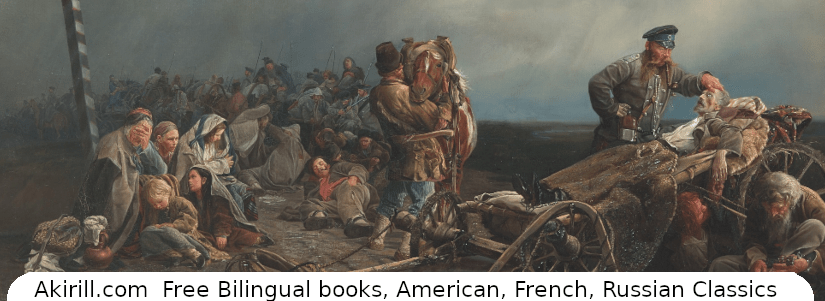
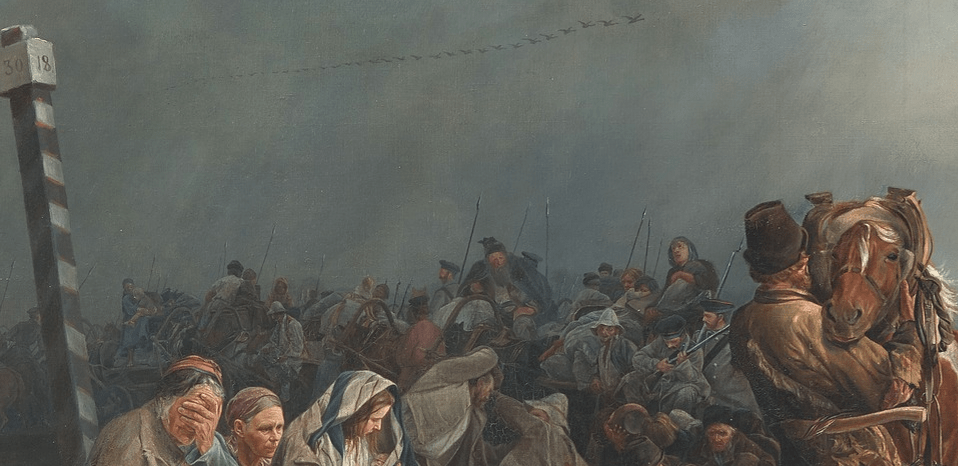
“The Halt of the Prisoners” (Привал арестантов) is a genre painting by the Russian artist Valery Yakobi  (Валерия Якоби) completed in 1861. It is an oil on canvas of 98.6 × 143.5 cm situated at the State Tretyakov Gallery.  It is difficult to imagine Russian genre painting of the 60s of the XIX century without this painting by Valery Ivanovich Jacobi, who created the true story of the royal penal servitude.  It is one of the masterpieces of the 19th century, and this painting by Valery Jacobi immediately entered the history of art. 

The painting “Halt of Prisoners” was presented by Valery Yakobi at the end of his studies at the Academy of Arts . For this painting, the Academy awarded him the title of class artist of the 1st degree and also a large gold medal  . 

In 1861-1862, the canvas was exhibited with great success at the exhibition of the Academy of Arts  – the writer Fyodor Dostoevsky noted that Jacobi’s painting “amazes with amazing fidelity” and the public likes it “more than anyone else at the current exhibition”  

 This work made a great impression on the public, which rather vividly accepted the reforms of Emperor Alexander II. 

Critics called this work frank and topical. Everyone was unanimous in their statements: the master managed to portray the actual problems of society. This work became the pinnacle of the artist’s work. 

Valery Jacobi was the first of the Russian artists who turned to such a topic.  The choice of subject was not accidental. Valery Ivanovich spent his childhood and youth in the east of Russia, where he personally observed the convicts who were driven past the house where the artist lived. Memories were so firmly planted in his head that the picture recreated from memory is striking in its realism and strength.

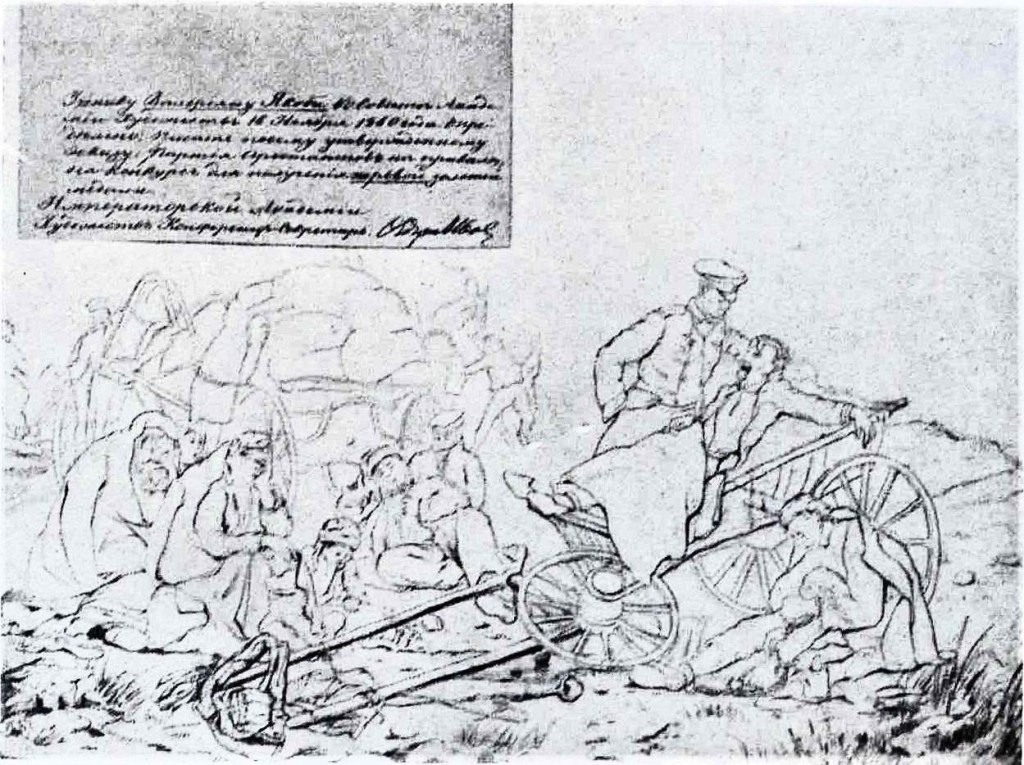
The collection of the State Tretyakov Gallery also contains a graphic sketch for the painting “Halt of Prisoners”

This first compositional sketch for the future canvas was submitted by Valery Jacobi for approval to the Council of the Academy of Arts in 1860. It is made in a purely contour technique, and the figures are outlined by a continuous line  . 

According to the description of art historian Alexei Sidorov, “from one edge of the figures, this line is thin and resembles a stroke of a cutter or a dry needle in a sketch engraving on copper; from the other edge of the same figures, the line tightens, becomes thicker, blacker, to a certain extent gives the figures <…> relief”; such an interpretation resembles a “marble bas-relief ”  .

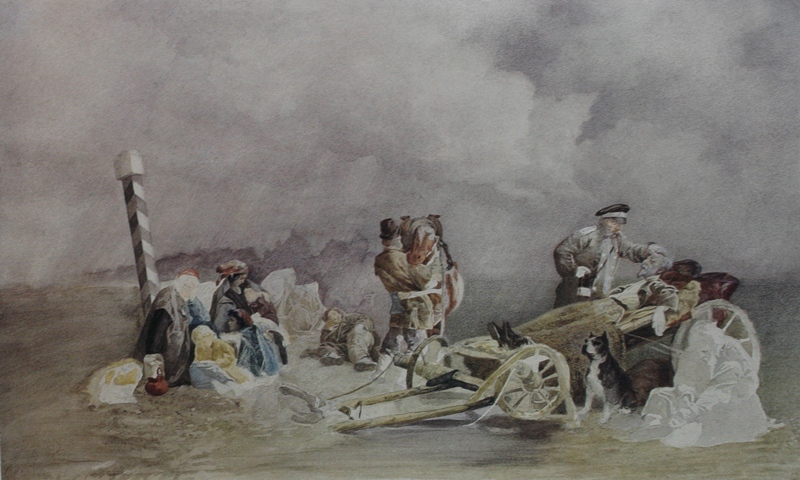
Another sketch of 36.5 × 58.7 cm  , was executed in watercolor and white on paper. It is dated from 1861, and is kept in the State Russian Museum  . In addition, the Russian Museum owns a reduced copy of the painting of the same name . It is an oil , paper on canvas, from the late 1860s – 1870s which is 53 × 75 cm , and was received in 1963 from the State Museum of the Revolution.

The painting depicts a group of prisoners stopping for a break. Probably, this halt was forced and caused by the breakdown of one of the carts. 

Jacobi concentrates his main attention on the group around the deceased prisoner and the relatives who followed him along the stage, sitting at the milestone. At the same time, the artist uses a traditional academic technique, highlighting the main characters of the picture with light, grouping them in the spirit of classical “pyramids”. He managed to convey a complex range of feelings: from the despair of a family that has lost a person for whom they set off on a grueling journey, to the indifference of a gendarmerie officer who leaned over a dead prisoner. The rest of the exiles are depicted without detail, in gloomy silhouettes. The contrast of a dark stormy sky and bright light breaking through the dense cover of clouds, the predominance of gray and brown tones enhances the drama of the scene. 

Help the site stay free, buy us a cup of coffeeAidez-nous à maintenir le site gratuit en nous offrant une tasse de café

The Charter “On the Exiles” fixed and regulated the procedure for escorting, the issues of transporting exiles on carts, preventing escapes, women, freemen and the dead.

In this work, Jacobi managed with extraordinary persuasiveness to present various social types – from a tramp to an intellectual-political prisoner, whose life was cut short on the way.

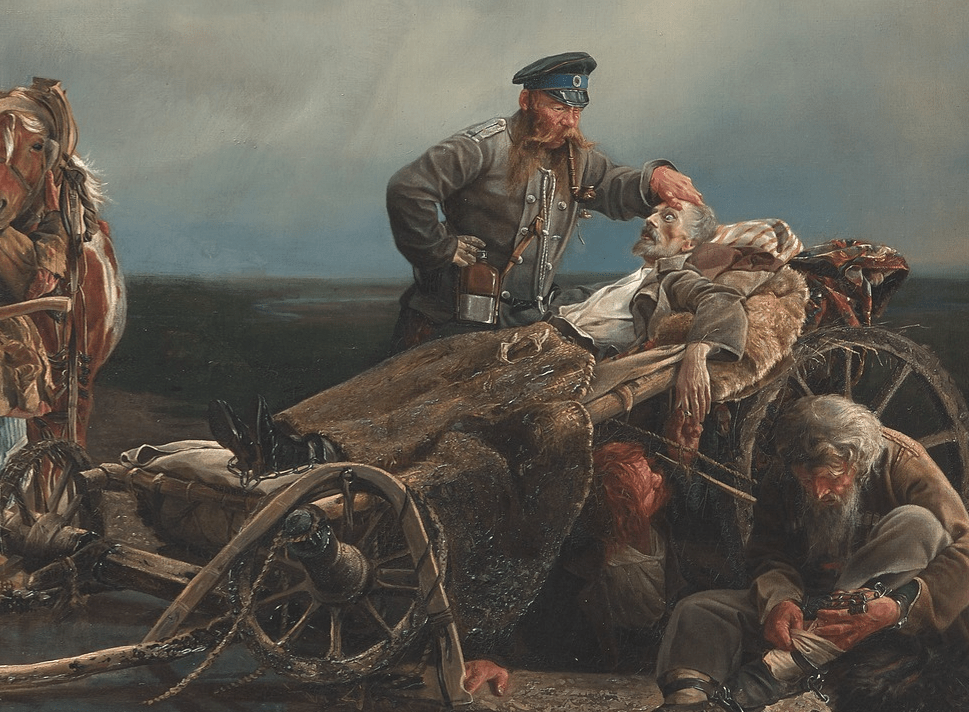
 On a broken road under a leaden sky with low rain clouds, standing by the cart is a stage officer, who with indifferent calmness ascertains the death of a prisoner (by opening his eyes), in order to leave him on the road and move on faster. 

The central character of the composition is the deceased prisoner. He has an intelligent appearance, but is so emaciated that he looks like an old man. The dead prisoner is covered with matting . On his left hand, hanging lifelessly down, he wears a ring. The effect of the hopelessness of life is enhanced by another detail: another prisoner crept under the cart and is trying to pull off the ring from the finger of the deceased. In such a critical situation, the human essence is manifested.

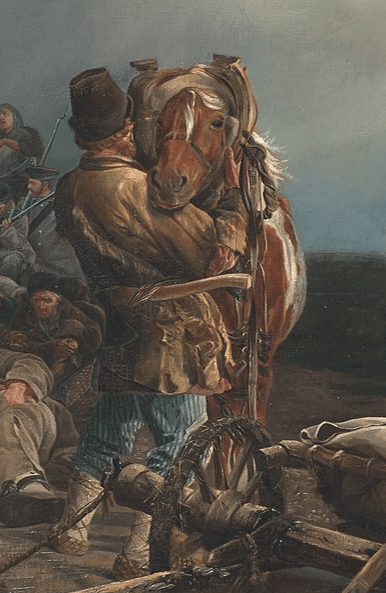
A man, dressed in a heavily torn caftan , is holding a harnessed horse. 

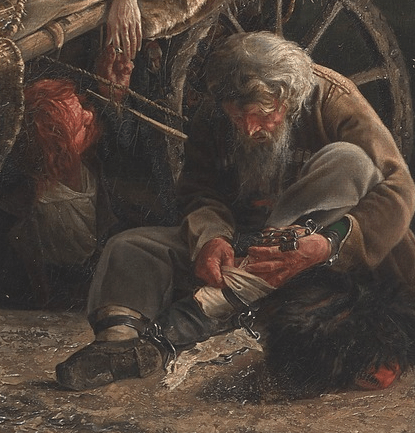
On the right side of the picture in the foreground is a seated prisoner in rags, who examines the wound on his leg, rubbed with shackles . 

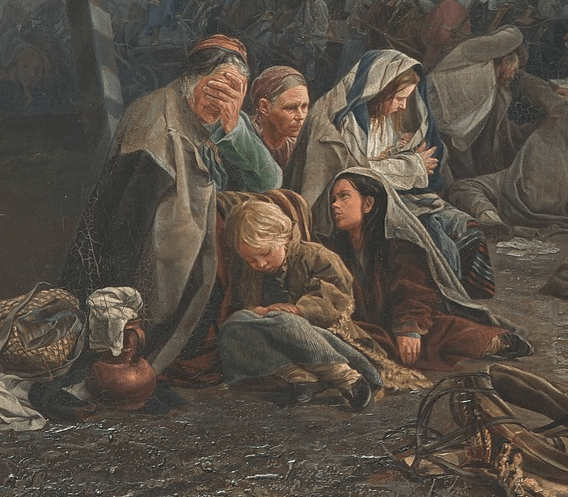
 In the left corner of the picture are the families of prisoners who voluntarily went into exile along with their husbands and fathers. They are exhausted and weakened. However, no one retreats and they will go all the way to the end, but not everyone will return. They are already mourning the dead…

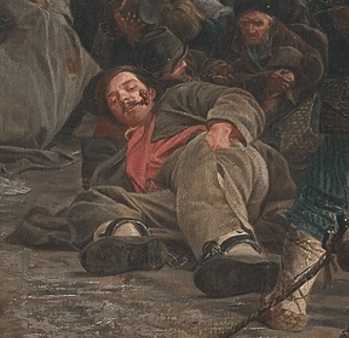
Nearby, a prisoner is seen smoking a pipe. It seems that he is completely indifferent to his own fate, he just goes with the flow, not thinking about tomorrow. 

The plot continues with a group of fighting people and a long line of exiles, escorted by a convoy, lost in the distance… This horizontal line is emphasized by a thin parallel line of a flock of birds, dissolving into the clouds. The whole scene is depicted by the artist against the backdrop of an open autumn steppe, under a sky covered with heavy gray clouds. The bleak landscape only enhances the gloomy impression that the picture makes ….

I hope you enjoyed this painting as much as I did

If you liked this article, subscribe , put likes, write comments!.
Share on social networks
Check out Our Latest Posts

Découvrez le tableau « La Halte des prisonniers » de Valery Ivanovich Jacobi

Livres bilinguesRead in EnglishNous Contacter
Littérature américainelittérature FrançaiseLittérature russe

« La Halte des prisonniers » (Привал арестантов) est une peinture de genre de l’artiste russe Valery Yakobi (Валерия Якоби) achevée en 1861. Il s’agit d’une huile sur toile de 98,6 × 143,5 cm située à la Galerie d’État Tretiakov. Il est difficile d’imaginer la peinture de genre russe des années 60 du XIXe siècle sans ce tableau de Valery Ivanovich Jacobi, qui a créé la véritable histoire de la servitude pénale royale. C’est l’un des chefs-d’œuvre du 19ème siècle, et ce tableau de Valery Jacobi est immédiatement entré dans l’histoire de l’art.

Le tableau « La Halte des prisonniers» a été présenté par Valery Yakobi à la fin de ses études à l’Académie des Arts. Pour ce tableau, l’Académie lui a décerné le titre d’artiste de classe du 1er degré et aussi une grande médaille d’or.

En 1861-1862, la toile a été exposée avec un grand succès à l’exposition de l’Académie des Arts – l’écrivain Fiodor Dostoïevski a noté que la peinture de Jacobi « étonne avec une fidélité étonnante » et le public l’aime « plus que quiconque à l’exposition actuelle »

Ce travail a fait une grande impression sur le public, qui a accepté de manière assez vivante les réformes de l’empereur Alexandre II.

Les critiques ont qualifié ce travail de franc et d’actualité. Tout le monde était unanime dans ses déclarations: le maître a réussi à dépeindre les problèmes réels de la société. Ce travail est devenu le summum du travail de l’artiste.

Valery Jacobi a été le premier des artistes russes à se tourner vers un tel sujet. Le choix du sujet n’était pas accidentel. Valery Ivanovich a passé son enfance et sa jeunesse dans l’est de la Russie, où il a personnellement observé les condamnés qui ont été conduits devant la maison où vivait l’artiste. Les souvenirs étaient si fermement ancrés dans sa tête que l’image recréée de mémoire frappe par son réalisme et sa force.

La collection de la Galerie d’État Tretiakov contient également une esquisse graphique pour le tableau « Halte des prisonniers »

Cette première esquisse de composition pour la future toile a été soumise par Valery Jacobi pour approbation au Conseil de l’Académie des Arts en 1860. Elle est réalisée dans une technique purement de contour, et les figures sont soulignées par une ligne continue.

Selon la description de l’historien de l’art Alexeï Sidorov, « d’un bord des figures, cette ligne est mince et ressemble à un trait de cutter ou à une aiguille sèche dans un croquis gravé sur cuivre ; de l’autre bord des mêmes figures, la ligne se resserre, devient plus épaisse, plus noire, donne dans une certaine mesure aux figures <… > relief»; une telle interprétation ressemble à un « bas-relief en marbre ».

Un autre croquis de 36,5 × 58,7 cm, a été exécuté à l’aquarelle et blanc sur papier. Il est daté de 1861 et est conservé au Musée d’État russe. En outre, le Musée russe possède une copie réduite de la peinture du même nom, une huile, papier sur toile, de la fin des années 1860 – 1870. Elle mesure 53 × 75 cm, et a été reçu en 1963 du Musée d’Etat de la Révolution.

La peinture représente un groupe de prisonniers s’arrêtant pour une pause. Probablement, cet arrêt a été forcé et causé par la panne de l’un des chariots.

Jacobi concentre son attention principale sur le groupe autour du prisonnier décédé et les proches qui l’ont suivi le long de la scène, assis au jalon. Dans le même temps, l’artiste utilise une technique académique traditionnelle, mettant en évidence les personnages principaux de l’image avec de la lumière, les regroupant dans l’esprit des « pyramides » classiques. Il a réussi à transmettre une gamme complexe de sentiments: du désespoir d’une famille qui a perdu une personne pour laquelle ils se sont lancés dans un voyage épuisant, à l’indifférence d’un officier de gendarmerie qui s’est penché sur un prisonnier mort. Le reste des exilés est représenté sans détail, par des silhouettes sombres. Le contraste d’un ciel orageux sombre et d’une lumière vive traversant la couverture dense de nuages, la prédominance des tons gris et bruns renforce le drame de la scène.

Help the site stay free, buy us a cup of coffeeAidez-nous à maintenir le site gratuit en nous offrant une tasse de café

La Charte « Sur les exilés » fixait et réglementait la procédure d’escorte, les questions du transport des exilés sur des charrettes, la prévention des évasions, les femmes, les hommes libres et les morts.

Dans ce travail, Jacobi a réussi avec une persuasion extraordinaire à présenter divers types sociaux – d’un clochard à un prisonnier intellectuel et politique, dont la vie a été écourtée en cours de route.

Sur une route brisée sous un ciel de plomb avec de faibles nuages de pluie, debout près de la charrette se trouve un officier de scène, qui avec un calme indifférent constate la mort d’un prisonnier (en ouvrant ses yeux), afin de le laisser sur la route et d’aller plus vite.

Le personnage central de la composition est le prisonnier décédé. Il a une apparence intelligente, mais est tellement émacié qu’il ressemble à un vieil homme. Le prisonnier mort est recouvert d’e’un tapis. Sur sa main gauche, suspendu sans vie, il porte une bague. L’effet du désespoir de la vie est renforcé par un autre détail: un autre prisonnier s’est glissé sous la charrette et essaie de retirer la bague du doigt du défunt. Dans une situation aussi critique, l’essence humaine se manifeste.

Un homme, vêtu d’un caftan fortement déchiré, tient un cheval attelé.

Sur le côté droit de l’image au premier plan se trouve un prisonnier assis en haillons, qui examine la blessure sur sa jambe, frottée avec des chaînes.

Dans le coin gauche de l’image se trouvent les familles des prisonniers qui se sont volontairement exilés avec leurs maris et leurs pères. Elles sont épuisées et affaiblies. Cependant, personne ne se retire et ils iront jusqu’au bout, mais tout le monde ne reviendra pas. Ils pleurent déjà les morts…

À proximité, on voit un prisonnier fumer une pipe. Il semble qu’il soit complètement indifférent à son propre destin, il suit le courant, ne pensant pas à demain.

L’intrigue se poursuit avec un groupe de combattants et une longue lignée d’exilés, escortés par un convoi, perdus au loin… Cette ligne horizontale est soulignée par une mince ligne parallèle d’un troupeau d’oiseaux, se dissolvant dans les nuages. Toute la scène est représentée par l’artiste sur fond de steppe d’automne ouverte, sous un ciel couvert de lourds nuages gris. Le paysage sombre ne fait qu’accentuer l’impression sombre que l’image fait ….

J’espère que vous avez apprécié cette peinture autant que moi

Si vous avez aimé cet article, abonnez-vous, mettez des likes, écrivez des commentaires!
Partager sur les réseaux sociaux
Consultez nos derniers articles

Découvrez le tableau « La Source » d’Arkady Plastov

Livres bilinguesRead in EnglishNous contacter
Littérature américainelittérature FrançaiseLittérature russe

Arkadi Alexandrovitch Plastov (Аркадий Александрович Пластов) (1893-1972) est né dans une famille de peintres d’icônes héréditaires et a apporté une grande contribution au développement de la culture russe. À partir de 1935, il a crée des peintures de genre, dans lesquelles il a embellit la vie du village soviétique. Ainsi, une place importante dans son travail a été occupée par l’image de la vie quotidienne des paysans dans le contexte de leur beau pays.

Le tableau «La Source » est une huile sur toile qui a été peinte en 1952. c’est une scène de genre de la vie d’une jeune paysanne qui venait à la source pour obtenir de l’eau potable. Effectivement, il n’y avait pas d’eau courante dans les villages à cette époque, et quelqu’un devait parfois aller loin pour aller chercher de l’eau avec des seaux.

Au premier plan, nous voyons une fille debout sur des bûches tenant un joug avec de grands seaux en fer dans ses mains.

La fille aux pieds nus est vêtue d’une belle robe légère avec un motif miniature, et une écharpe blanche propre encadre sa tête, sous laquelle d’épaisses tresses dorées se montrent.

L’héroïne de l’image est sérieuse et complètement concentrée sur le processus de collecte de l’eau.

L’un des seaux est déjà plein, tandis qu’elle remplit l’autre d’un jet d’eau propre et transparente provenant d’une petite source. Nous pouvons voir des éclaboussures d’eau sur le côté du seau, ce qui crée la dynamique de la composition de la toile. On peut aussi admirer à quel point l’eau que l’artiste a réussi à peindre est propre et transparente. La fraîcheur cristalline de l’eau fraîche éclairée par le chaud soleil d’été est littéralement ressentie.

Sous le seau, l’eau déversée forme un petit étang envahi de roseaux.

Derrière le dos de la fille, nous voyons beaucoup de verdure, qui occupe une grande partie de l’œuvre. La végétation est assez haute et dense, ce qui signifie que la source n’est pratiquement pas perceptible de l’extérieur. Dans la partie supérieure de l’image, un ciel bleu avec des nuages blancs est légèrement visible.

Help the site stay free, buy us a cup of coffeeAidez-nous à maintenir le site gratuit en nous offrant une tasse de café

La palette de couleurs est assez chaude. Cela s’exprime dans les traits colorés jaune-vert des plantes et les joues écarlates de la fille. En outre, des accents solaires sont montrés dans les taches de couleur de ses vêtements. Il y a une bataille de contrastes. Les tons clairs contrastent avec les tons sombres. Ainsi, l’harmonie de l’image peinte est créée.

Cette toile d’Arkady Plastov réconforte parfaitement et évoque les sentiments les plus chaleureux et les plus positifs. En raison de la tranquillité de la scène, des nuances de couleurs agréables, l’harmonie de la nature et de la vie paysanne est véhiculée.

J’espère que vous avez apprécié cette peinture autant que moi

If you liked this article, subscribe , put likes, write comments!.
Share on social networks
Check out Our Latest Posts

Découvrez le tableau de « Le tapis volant » de Vasnetsov

Livres bilinguesRead in EnglishNous contacter
Littérature américainelittérature FrançaisLittérature russe

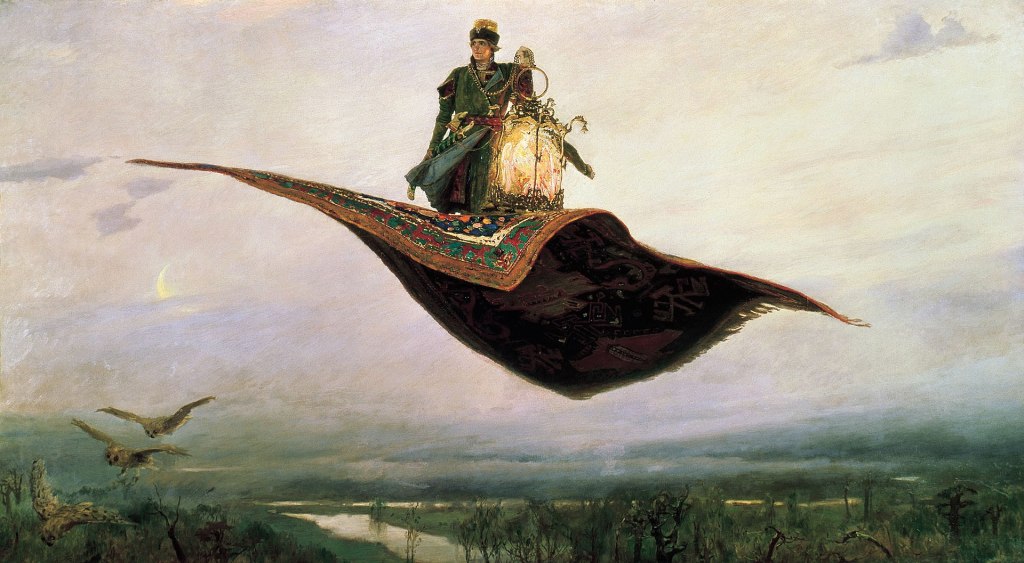
« Le Tapis volant ” est une gigantesque huile sur toile de 165×297 cm peinte par le célèbre peintre Viktor Mikhailovich Vasnetsov en 1880, Cette peinture est actuellement au Musée d’art d’État de Nijni Novgorod.

C’est la deuxième image de Vasnetsov, dans laquelle il s’est tourné vers les contes de fées et les mythes. Nous avons déjà écrit sur sa première photo qui était « Le Chevalier à la croisée des chemins ».

L’intrigue du ” Tapis volant ” est l’histoire de conte de fées d’Ivan Tsarevich, qui a poursuivi un phoenix, qui a pris l’habitude de voler des pommes dans le jardin royal.

Selon Vasnetsov lui-même, l’image était censée exprimer la grandeur des traditions russes et représenter un symbole de victoire sur l’espace. « Le Tapis volant ” reflète la foi dans l’avenir brillant du peuple russe, et dans cette œuvre, le peintre a mis tout son amour pour l’art populaire et sa propre compréhension de la sagesse des épopées populaires.

L’histoire du « tapis volant » a commencé avec Savva Mamontov, un philanthrope qui était le président du conseil d’administration du chemin de fer de Donetsk. Il a commandé trois toiles qui refléteraient les possibilités infinies pour les gens de se déplacer après la construction de la voie ferrée de Donetsk, et a insisté sur une intrigue fantastique, qui a été exposée dans la toile de Vasnetsov « Tapis volant ». Dans ce tableau, le moyen de transport magique devait devenir un symbole du transport le plus rapide, une illustration allégorique de l’éveil d’une nouvelle direction ferroviaire.

Cependant, les membres du conseil d’administration ont considéré les motifs de conte de fées inappropriés dans l’atmosphère de travail du bureau, de sorte que le philanthrope a acheté la toile et pendant longtemps, le tableau est resté dans la collection personnelle de Mamontov.

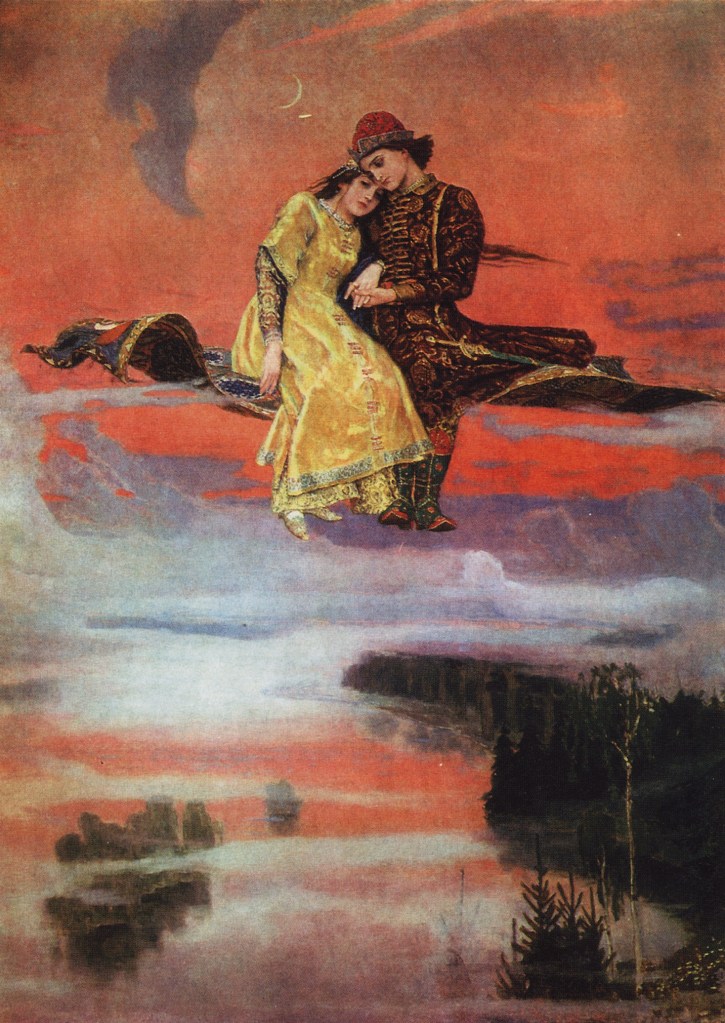
Au début, l’idée de l’artiste était différente de la version finale du tableau. Deux personnes étaient censées voler sur le tapis – le tsarévitch et sa bien-aimée, qui inclinait la tête sur l’épaule d’Ivan.

Mais après une longue recherche, Vasnetsov n’a laissé qu’un seul héros sur le tapis, lui remettant une cage avec un trophée sans précédent – un oiseau de feu.

Chaque image de cette image a sa propre signification symbolique. Si vous regardez attentivement la toile, vous remarquerez immédiatement que la partie supérieure de l’image est plus lumineuse et plus saturée. Les nuances roses avec lesquelles le soleil ornent le ciel indiquent symboliquement la victoire du héros du conte de fées, qui a surmonté toutes les difficultés. Il a pu échapper à la poursuite et a attrapé l’oiseau de feu, qui a pris l’habitude de voler des pommes dans le jardin royal. Mais l’oiseau de feu est la seule source de lumière à part entière sur l’image. Même la lune, visible en arrière-plan, ne peut pas se comparer à lui. Et pour dépeindre le monde réel, Vasnetsov a utilisé des demi-tons et des nuances déjà sombres.

Chaque personnage est fait de manière si réaliste qu’en regardant cette toile, il semble involontairement qu’un tel tapis existe vraiment quelque part.

Ivan Tsarevich, l’oiseau de feu et le tapis volant se distinguent comme un point coloré et lumineux sur le fond d’un paysage sans vie et terne. Les couleurs vives symbolisent le triomphe du rêve d’une personne devenu réalité.

Le tapis magique est représenté en vol et le prince se tient dessus debout. Ivan lui-même est la personnification du courage. Le tapis se presse simplement à travers le ciel, et ce qui est visible grace aux mouvements des vêtements du tsar et de ses cheveux.

Le tapis volant est accompagné de trois oiseaux. Ils sont représentés dans les mêmes couleurs que le monde qui les entoure. Ces grands hiboux volent devant le tapis et peuvent lui montrer le chemin. Le tapis magique est plein de motifs bizarres, dont certains rappellent douloureusement les runes magiques. Cela peut être la raison pour laquelle le tapis peut voler. Ce tapis magique lui-même ressemble à un énorme oiseau avec une tête incurvée et des ailes grandes ouvertes avec les coins du produit de tissage jouant le rôle de ses deux ailes, de plus la toile légèrement arquée vers le haut rend cette partie similaire au dos d’un oiseau. En regardant l’image, on remarque que le tapis semble flotter en douceur et rapidement dans l’air. Il s’élève au-dessus des étendues de la Russie, s’élève majestueusement au-dessus des forêts et du brouillard épais. En regardant ce travail, on peut apprécier à quel point le pays est vaste.

Ivan Tsarévitch debout sur le tapis comme un capitaine sur un navire céleste, est un signe de victoire, de confiance en soi. Il n’a pas peur de tomber et regarde avec confiance au loin. C’est la preuve qu’il n’y a pas d’obstacles insurmontables. On peut voir qu’Ivan Tsarévitch se dépêche à travers les plaines sans limites avec des rivières et des champs. Il revient d’un long voyage vers le trentième royaume où il a réussi à capturer l’oiseau de feu magique.

Toute l’expression faciale et la posture d’Ivan Tsarevich exprime la fierté du test qu’il a réussi. Son apparence est intéressante et ses vêtements ravissent et étonnent par leur richesse et leur luxe. Il est vêtu d’un caftan avec une longue robe qui est brodée de beaux motifs. Tout le caftan est décoré de dorures, et il y a beaucoup de pierres précieuses sur le bonnet. De tels vêtements n’étaient portés en Russie que par des gens nobles et riches. Sur la ceinture du prince se trouve un sac brodé contenant la clé de la cage. L’épée-trésorier scintille de la dorure avec laquelle elle est décorée, et une épaisse chaîne pend autour du cou du héros de l’image, à laquelle une cage en or a été attachée.

Viktor Vasnetsov a représenté la cage en détail. Tout est ajouré et merveilleux, et au sommet, chaque treillis se termine par des figures inhabituelles de dragons, dans les dents desquels il y a des cloches. Lorsque la cage se balance, une sonnerie agréable et mélodique se fait entendre.

Le bel oiseau de feu est assis sur un perchoir mince et gracieux, et autour de cet oiseau de feu une lumière brillante inhabituelle se propage. L’artiste utilise le blanc pour son image, qui symbolise sa pureté. L’oiseau de feu est un symbole de bonheur, de joie et de chance, mais malheureusement, tout le monde ne parvient pas à en attraper un. L’oiseau de feu brillant dans la cage est comme une grande lanterne qui éclaire le chemin du retour. Même par une nuit sombre, il montre le chemin au tsarévitch Ivan, qui, ayant atteint son objectif, s’efforce de rentrer chez lui.

Tout ce qui se passe dans l’image emmène le spectateur à la fin de la journée, à son coucher de soleil, lorsque le croissant de lune commence déjà à percer faiblement les nuages. Vous pouvez voir non seulement le ciel, mais aussi ce qui se trouve loin en dessous: c’est une forêt merveilleuse, et de magnifiques champs, et une rivière douce.

Cette peinture du « Tapis volant », peinte en 1880, est devenue si populaire aujourd’hui que ses reproductions peuvent être trouvées non seulement dans de nombreuses maisons et appartements privés, mais aussi dans des institutions telles que des écoles, des jardins d’enfants ou des cliniques en Russie. Et non seulement un adulte, mais aussi chaque enfant, sans hésitation, dira qui est son auteur et comment il s’appelle.

J’espère que vous avez apprécié cette peinture autant que moi

Help the site stay free, buy us a cup of coffeeAidez-nous à maintenir le site gratuit en nous offrant une tasse de café

If you liked this article, subscribe , put likes, write comments!.
Share on social networks
Check out Our Latest Posts

The Knight at the Crossroad by Viktor Mikhailovich Vasnetsov

Bilingual booksLire en FrançaisContact us
American LiteratureFrench LiteratureRussian Literature

Viktor Mikhailovich Vasnetsov (Виктор Васнецов) is a famous Russian painter, founder of the fairy-tale epic genre . The master created several versions of The Knight at the Crossroads. The first one was completed in 1877 and is significantly different from the subsequent ones. “The knight at the Crossroads” («Витязь на распутье») is an oil on canvas of 167 by 308 cm and was completed in 1882. It is now in the St. Petersburg State Russian Museum.

This is one of the philosophical works of the painter, and it encourages the viewer not only to contemplate, but also to think. And to think not only about the fate of the hero, but also about the deeper and eternal problems of good and evil, justice and deceit But also about the problem of choosing a future path in life, which probably disturb every person.


The first pencil sketches of “The knight at the Crossroads” appeared in the early 1870s. His “Forerunner” can be considered the picture of Viktor Mikhailovich “Warrior in a helmet with chain mail”, painted by him in 1877. 

“The Knight at the Crossroads” is a painting by the famous Russian artist Viktor Mikhailovich Vasnetsov. His inspiration for the creation of “The Knight at the Crossroads” was the old Russian epic “Ilya Muromets and the Robbers”: Once on the path of the hero there was a stone with a curious inscription.

«Витязь на распутье» Виктора Васнецова

According to the prediction, if Ilya turns in one direction – he will be killed, in the other – he will marry, in the third – he will gain wealth.

The man decided to try his luck and drove along the road that was supposed to bring him death. He met forty robbers, but managed to cope with them. Then he returned to the stone and wrote that the prediction did not come true. The same happened with other tracks. It seemed that the hero managed to deceive fate itself …

part of «Витязь на распутье» Виктора Васнецова

Ahead, the artist depicted a black cloud which can be a warning to Ilya Muromets of danger. But then the sky is clear and a little pinkish, probably the dawn, giving us hope. It might show that the path will be difficult and dangerous, but still lead to good. Probably, the knight will still decide to go ahead and defeat all dangers.

Initially, the author conceived to draw “The Knight at the Crossroads” facing the viewer. However, later Vasnetsov changed his mind and focused not on the key character, but on his confusion and difficulty in choosing a path. 

part of «Витязь на распутье» Виктора Васнецова

In front of the hero there is a stone on which it is written that if you go straight, it is impossible for anyone to stay alive. Because many years have passed, all other inscriptions on the stone have been erased. Ilya Muromets understands that he has only one path that will lead him to death.

Usually fairy tales and epics talk about three roads that are offered to the traveler to choose from. However, on his canvas, Vasnetsov decided to deviate from this important point. With this technique, he visually strengthened the disturbing plot of the picture, leaving the epic hero without an alternative choice of path.

Almost immediately behind the stone, solid earth turns into unsteady swampy soil. In the future, there is nothing that could inspire gratifying hope. There is a narrow path that goes to the left, winding between boulders. It leads to no one knows where and gradually dissolves. The prophetic stone says nothing about it. There is no third road, as it should be in fairy tales.

«Витязь на распутье» Виктора Васнецова


In the center of the work is Ilya Muromets. He is known as the most courageous and strong hero in Russia. His back is turned to us, so we do not see his face. His strong body is now relaxed and his shoulders slumped as if he had traveled for a very long time and was tired. We can see that he did not rush his horse across the wide field since only the tips of his boots were inserted into the stirrups. The hero is dressed in battle armor. Behind him is a large heavy round shield. A brown leather quiver, decorated with metal decorative overlays, is attached to the belt. The quiver is full of arrows. A massive mace hangs from the side. In his right hand, the knight holds a long, sharp spear on a red shaft. It is lowered with the tip down, the slightly bent arm of the hero weakly squeezes it. The warrior is calm and self-confident, ready even for an unexpected meeting with the enemy. On his feet he has high light green boots with a gilded edging at the top of the top.

The whole image speaks of his meditation, the figure of the hero is majestic and powerful. Thoughtfulness is visible in the bowed head. His spear is also tilted down. The author shows the unity between him and his brave friend, the horse, because despite the fact that the horse stands confidently, its head is tilted.

part of «Витязь на распутье» Виктора Васнецова

The spear that the warrior holds in his hand deserves special attention. The canvas depicts an infantry spear which is intended for foot soldiers. The riders were armed with cavalry. It is noteworthy that in previous studies there was no such feature.  Perhaps the rider is ready to lose his horse at any moment, and therefore it is the infantry spear in his hand.

The heroic horse is a match for the hero himself. It is strong, sleek, with a thick mane hanging almost to the ground, a silky tail, and powerful legs that firmly step on the ground. And now he meekly and patiently stands, with its head down, as if it was making a difficult decision. or maybe waiting for the decision of his master.

part of «Витязь на распутье» Виктора Васнецова

The terrain is depicted as swampy, there is almost no vegetation, stones are also scattered in the most gloomy tones.

Bones of people and animals are scattered across the field. And right in front of the stone we see the skulls of a man and a horse. Apparently, at one time they decided to cross the line on which the stone-prophet stands, but the prediction came true. Now black crows are circling over the field in anticipation of new prey.

The beautiful picture captures the moment of doom. At that moment, the knight does not yet know how his journey will end, and whether what the inscription on the stone predicts will come true. The picturesque plot of Vasnetsov’s creation fascinates with its fabulousness, tragedy, faith in the triumph of good over evil and darkness. and let us wonder if fate determines the fate of a person, or if we are responsible for our own lives.

I hope you enjoyed this painting as much as I did

Help the site stay free, buy us a cup of coffeeAidez-nous à maintenir le site gratuit en nous offrant une tasse de café

If you liked this article, subscribe , put likes, write comments!.
Share on social networks
Check out Our Latest Posts

Le Chevalier à la Croisée des Chemins de Viktor Mikhaïlovitch Vasnetsov

Livres bilinguesRead in EnglishNous contacter
Littérature américaineLittérature françaiseLittérature russe

Viktor Mikhailovich Vasnetsov (Виктор Васнецов) est un célèbre peintre russe, fondateur du genre épique des contes de fées. Le maître a créé plusieurs versions du tableau “Le Chevalier à la Croisée des Chemins “. Le premier a été achevé en 1877 et est sensiblement différent des suivants. “Le Chevalier à la Croisée des Chemins” (“Витязь на распутье”) est une huile sur toile de 167 sur 308 cm et a été achevée en 1882. Elle se trouve maintenant au Musée russe d’État de Saint-Pétersbourg.

C’est l’une des œuvres philosophiques du peintre, et elle encourage le spectateur non seulement à contempler, mais aussi à réfléchir. Et à penser non seulement au sort du héros, mais aussi aux problèmes plus profonds et éternels du bien et du mal, ainsi que celui de la justice et de la tromperie. Mais aussi au problème du choix d’un futur chemin dans la vie, qui dérange probablement tout le monde.

Les premières esquisses au crayon de la toile: “Le Chevalier à la Croisée des Chemins” apparaissent au début des années 1870. Son “précurseur” peut être considéré comme l’image de Viktor Mikhailovich “Guerrier Dans un Casque avec une Cotte de Mailles”, peinte par lui en 1877. 

“Le chevalier à la Croisée des Chemins” est une peinture du célèbre artiste russe Viktor Mikhailovich Vasnetsov. Son inspiration pour la création de: “Le chevalier à la croisée des chemins” était la vieille épopée russe “Ilya Muromets et les voleurs”: Une fois sur le chemin du héros, il y avait une pierre avec une curieuse inscription.

«Витязь на распутье» Виктора Васнецова

Selon la prédiction, si Ilya va dans une direction – il sera tué, dans l’autre – il se mariera, dans la troisième – il gagnera de la richesse.

L’homme a décidé de tenter sa chance et a conduit le long de la route qui était censée lui apporter la mort. Il a rencontré quarante voleurs, mais a réussi à faire face à eux. Puis il retourna à la pierre et écrivit que la prédiction ne s’était pas réalisée. La même chose s’est produite avec les autres routes. Il semblait que le héros avait réussi à tromper le destin lui-même…

part of «Витязь на распутье» Виктора Васнецова

Devant, l’artiste est représenté un nuage noir qui peut être un avertissement de danger pour Ilya Muromets. Mais ensuite le ciel est clair et un peu rosé, sans doute l’aube, qui nous redonne espoir. Cela pourrait montrer que le chemin sera difficile et dangereux, mais qu’il mènera toujours au bien. Probablement, le chevalier décidera toujours d’aller de l’avant et de vaincre tous les dangers.

Initialement, l’auteur a conçu de dessiner “Le chevalier à la croisée des chemins” face au spectateur. Cependant, plus tard, Vasnetsov a changé d’avis et s’est concentré non pas sur le personnage clé, mais sur sa confusion et sa difficulté à choisir une voie. 

part of «Витязь на распутье» Виктора Васнецова

Devant le héros se trouve une pierre sur laquelle il est écrit que si vous allez tout droit, il est impossible à quiconque de rester en vie. Parce que de nombreuses années se sont écoulées, toutes les autres inscriptions sur la pierre ont été effacées. Ilya Muromets comprend qu’il n’a qu’un seul chemin qui le mènera à la mort.

Habituellement, les contes de fées et les épopées parlent de trois routes proposées au voyageur. Cependant, sur sa toile, Vasnetsov a décidé de s’écarter de ce point important. Avec cette technique, il a renforcé visuellement l’intrigue inquiétante de l’image, laissant le héros épique sans autre choix de chemin.

Presque immédiatement derrière la pierre, la terre solide se transforme en sol marécageux instable. Dans l’avenir, il n’y a rien qui puisse inspirer un espoir gratifiant. Il y a un chemin étroit qui part à gauche en serpentant entre des rochers. Elle mène on ne sait où et se dissout peu à peu. La pierre prophétique n’en dit rien. Il n’y a pas de troisième route, comme il se doit dans les contes de fées.

«Витязь на распутье» Виктора Васнецова

Au centre de l’œuvre se trouve Ilya Muromets. Il est connu comme le héros le plus courageux et le plus fort de Russie. Il nous tourne le dos, nous ne voyons donc pas son visage. Son corps fort est maintenant détendu et ses épaules affaissées comme s’il avait voyagé pendant très longtemps et qu’il était fatigué. On peut voir qu’il n’a pas précipité son cheval à travers le vaste champ puisque seuls les bouts de ses bottes sont insérés dans les étriers. Le héros est vêtu d’une armure de combat. Derrière lui se trouve un grand bouclier rond et lourd. Un carquois en cuir marron, orné de superpositions décoratives en métal, est attaché à sa ceinture. Le carquois est plein de flèches. Une masse massive pend sur le côté. Dans sa main droite, le chevalier tient une longue lance pointue sur un manche rouge. Elle est abaissée avec la pointe vers le bas, le bras légèrement plié du héros la serre faiblement. Le guerrier est calme et sûr de lui, prêt même pour une rencontre inattendue avec l’ennemi. Aux pieds, il a de hautes bottes vert clair avec un liseré doré en haut du haut.

Toute l’image parle de sa méditation, la figure du héros est majestueuse et puissante. La méditation est visible dans la tête inclinée. Sa lance est également inclinée vers le bas. L’auteur montre l’unité entre lui et son brave ami, le cheval, car malgré le fait que le cheval se tient avec confiance, sa tête est inclinée.

part of «Витязь на распутье» Виктора Васнецова

La lance que le guerrier tient dans sa main mérite une attention particulière. La toile représente une lance d’infanterie destinée aux fantassins. Les cavaliers étaient armés de lances de cavalerie. Il est à noter que dans les études précédentes, il n’y avait pas une telle caractéristique. Peut-être que le cavalier est prêt à perdre son cheval à tout moment, et c’est donc la raison de la lance d’infanterie dans sa main.

Le cheval héroïque est un match pour le héros lui-même. Il est fort, élégant, avec une crinière épaisse qui pend presque jusqu’au sol, une queue soyeuse et des pattes puissantes qui marchent fermement sur le sol. Et maintenant, il se tient docilement et patiemment, la tête baissée, comme s’il prenait une décision difficile. ou peut-être attent-il la décision de son maître.

part of «Витязь на распутье» Виктора Васнецова

Le terrain est dépeint comme marécageux, il n’y a presque pas de végétation, les pierres sont également dispersées dans les tons les plus sombres.

Des ossements de personnes et d’animaux sont éparpillés sur le terrain. Et juste devant la pierre, nous voyons les crânes d’un homme et d’un cheval. Apparemment, à un moment donné, ils ont décidé de franchir la ligne sur laquelle se tient le prophète de pierre, mais la prédiction s’est réalisée. Maintenant, des corbeaux noirs tournent autour du champ en prévision d’une nouvelle proie.

La belle image capture le moment de malheur. À ce moment, le chevalier ne sait pas encore comment son voyage se terminera et si ce que prédit l’inscription sur la pierre se réalisera. L’intrigue pittoresque de la création de Vasnetsov fascine par son caractère fabuleux, sa tragédie, sa foi dans le triomphe du bien sur le mal et les ténèbres. et nous nous demandons si le destin détermine le sort d’une personne, ou si nous sommes responsables de notre propre vie.

J’espère que vous avez apprécié ce tableau autant que moi

Help the site stay free, buy us a cup of coffeeAidez-nous à maintenir le site gratuit en nous offrant une tasse de café

If you liked this article, subscribe , put likes, write comments!.
Share on social networks
Check out Our Latest Posts

What do you know about the novel “Demons” by Fyodor Mikhailovich Dostoevsky

Bilingual booksLire en FrançaisContact us
American LiteratureFrench LiteratureRussian Literature

The sixth novel by Fyodor Mikhailovich Dostoevsky “Demons” also called “The Possessed” was written in 1872. This is one of the most politicized works of the writer, which he wrote under the impression of the activities of the emerging terrorist and revolutionary movements in Russia. The novel became a kind of warning about a social catastrophe, which will lead to cruel methods of achieving the idea of ​​​​universal happiness and the principle “the end justifies the means.”

Cover of the first edition of “Demons” by Fyodor Mikhailovich Dostoevsky

Dostoevsky did not plan a grandiose thing: he wanted to express himself on the topic of the emerging “Nechaevism” and similar political phenomena on several pages. The work was not even conceived in an artistic style, but as a result, a prediction novel came out from under his pen, which has not lost its relevance so far.

Russian society rather coolly accepted the new novel, and some critics even declared the work “slander” and “nonsense”. Over time, the situation has changed little. Most supporters of the Russian revolutionary movement perceived “Demons” as a vicious caricature of their ideas. Such a reputation prevented the wide popularity of the work.

Unlike Russia, Western culture has appreciated the socio-moral depth of the novel. “Demons” by Fyodor Mikhailovich Dostoevsky had a huge influence on the philosophical literature of the turn of the 19th-20th centuries, of which Nietzsche and Camus were famous representatives .

The attitude towards “Demons” in the post-Soviet space has changed quite recently. Contemporaries understood the prophecy of Dostoevsky’s ideas, his desire to show the world the danger of radical revolutionary and atheistic ideas. The writer expressed the depth of alienation towards his characters in the title and epigraph, taken from Pushkin ‘s poem of the same name . Who is the main “demon” in the work?

Initially, “Demons” was supposed to become part of a single epic novel, but due to financial problems, the author could not realize his plan and his publisher Katkov set strict conditions for the work of the writer. So instead of a big novel, the author released five books: “Teenager”, “Crime and Punishment”, “Demons”, “The Brothers Karamazov”, “Idiot”.

Also, in the novel, you can find references to real people. as example, Dostoevsky ridiculed I.S. Turgenev with whom he didn’t agree on the liberal-Western ideology , using the image of Karamzinov. The prototype of Stavrogin is the head of the Petrashevsky circle, for participation in which the young Dostoevsky was almost executed. One more thing is the removal of the chapters (“At Tikhon’s”), where Stavrogin tells the elder about the molestation of the girl. It was banned in Russia and removed from the novel by the publisher himself. However, it is there that Stavrogin’s worldview clashes with Tikhon’s Christian morality, and the reader sees the defeat of the “demonic personality.” 

You can read it on our site in French, English , or Russian as well as in our bilingual section (Russian/English)

Fyodor Mikhailovich Dostoevsky

Extract of the book:

Chapter 1

IN UNDERTAKING to describe the recent and strange incidents in our town, till lately wrapped in uneventful obscurity, I find myself forced in absence of literary skill to begin my story rather far back, that is to say, with certain biographical details concerning that talented and highly-esteemed gentleman, Stepan Trofimovitch Verhovensky. I trust that these details may at least serve as an introduction, while my projected story itself will come later.

I will say at once that Stepan Trofimovitch had always filled a particular rôle among us, that of the progressive patriot, so to say, and he was passionately fond of playing the part—so much so that I really believe he could not have existed without it. Not that I would put him on a level with an actor at a theatre, God forbid, for I really have a respect for him. This may all have been the effect of habit, or rather, more exactly of a generous propensity he had from his earliest years for indulging in an agreeable day-dream in which he figured as a picturesque public character. He fondly loved, for instance, his position as a “persecuted” man and, so to speak, an “exile.” There is a sort of traditional glamour about those two little words that fascinated him once for all and, exalting him gradually in his own opinion, raised him in the course of years to a lofty pedestal very gratifying to vanity. In an English satire of the last century, Gulliver, returning from the land of the Lilliputians where the people were only three or four inches high, had grown so accustomed to consider himself a giant among them, that as he walked along the streets of London he could not help crying out to carriages and passers-by to be careful and get out of his way for fear he should crush them, imagining that they were little and he was still a giant. He was laughed at and abused for it, and rough coachmen even lashed at the giant with their whips. But was that just? What may not be done by habit? Habit had brought Stepan Trofimovitch almost to the same position, but in a more innocent and inoffensive form, if one may use such expressions, for he was a most excellent man.

I am even inclined to suppose that towards the end he had been entirely forgotten everywhere; but still it cannot be said that his name had never been known. It is beyond question that he had at one time belonged to a certain distinguished constellation of celebrated leaders of the last generation, and at one time—though only for the briefest moment—his name was pronounced by many hasty persons of that day almost as though it were on a level with the names of Tchaadaev, of Byelinsky, of Granovsky, and of Herzen, who had only just begun to write abroad. But Stepan Trofimovitch’s activity ceased almost at the moment it began, owing, so to say, to a “vortex of combined circumstances.” And would you believe it? It turned out afterwards that there had been no “vortex” and even no “circumstances,” at least in that connection. I only learned the other day to my intense amazement, though on the most unimpeachable authority, that Stepan Trofimovitch had lived among us in our province not as an “exile” as we were accustomed to believe, and had never even been under police supervision at all. Such is the force of imagination! All his life he sincerely believed that in certain spheres he was a constant cause of apprehension, that every step he took was watched and noted, and that each one of the three governors who succeeded one another during twenty years in our province came with special and uneasy ideas concerning him, which had, by higher powers, been impressed upon each before everything else, on receiving the appointment. Had anyone assured the honest man on the most irrefutable grounds that he had nothing to be afraid of, he would certainly have been offended. Yet Stepan Trofimovitch was a most intelligent and gifted man, even, so to say, a man of science, though indeed, in science … well, in fact he had not done such great things in science. I believe indeed he had done nothing at all. But that’s very often the case, of course, with men of science among us in Russia.

Continue to read

I hope you’ll enjoy this book.

Help the site stay free, buy us a cup of coffeeAidez-nous à maintenir le site gratuit en nous offrant une tasse de café

If you liked this article, subscribe , put likes, write comments!.
Share on social networks
Check out Our Latest Posts