On this site we hope to help you learn, and to remove the difficulties caused by the difference of culture and language. Sur ce site nous espérons vous aider à apprendre, et à enlever la barrière causée par les différents languages et cultures.
Dear readers and subscribers, I am thrilled to express my heartfelt gratitude to all our veterans on this Victory Day! Let us celebrate and honor the brave heroes who fought valiantly in the Second World War, defending our freedom and values with unwavering courage. Their sacrifices remind us of the great cost of liberty and the importance of remembrance.
In the spirit of remembrance and appreciation, I am excited to present to you 5 inspiring Russian films about WWII with English subtitles, which offer profound insights into the struggles and triumphs of that era, along with my translation of the beautiful poem “Do you remember, Alyosha, the roads of Smolensk?” by Konstantin Simonov. Written in 1941, this work beautifully captures the retreat of Soviet troops near Smolensk during that summer.
Together, let us ensure that the legacy of these courageous individuals lives on in our hearts and minds.
Then, I finally found the time to update the page All our posts….
The first “The Fire Bulge” tells about the heroic battle at the Kursk Bulge in the 1943 summer.
The Battle of Kursk represented a pivotal confrontation on the Eastern Front during World War II, taking place between the military forces of Nazi Germany and the Soviet Union near Kursk, in southwestern Russia, throughout the summer of 1943. This engagement resulted in a decisive victory for the Soviet forces. Significantly, the Battle of Kursk is acknowledged as the largest tank battle in recorded military history.
The second film “Breakthrough” is about the battle for the Dnieper River and the Soviet offensive operation in 1944.
The Battle of the Dnieper represented a critical military campaign that transpired in 1943 on the Eastern Front during World War II. As one of the largest operations of the conflict, it involved nearly four million troops at its zenith and spanned a front of 1,400 kilometers. Over a period of four months, five fronts of the Red Army systematically reclaimed the eastern bank of the Dnieper from German forces by executing a succession of assault river crossings to establish multiple lodgments on the western bank.
The Leningrad–Novgorod strategic offensive represented a pivotal campaign during World War II. Initiated by the Red Army on 14 January 1944, it targeted the German Army Group North, employing the forces of the Soviet Volkhov and Leningrad fronts alongside elements of the 2nd Baltic Front, with the objective of conclusively alleviating the siege of Leningrad. Within approximately two weeks, the Red Army succeeded in regaining control of the Moscow–Leningrad railway, and on 26 January 1944, Joseph Stalin announced the lifting of the siege of Leningrad, declaring that German forces had been expelled from the Leningrad Oblast. The end of the 900-day blockade was commemorated in Leningrad that day with a solemn 324-gun salute. The strategic offensive concluded a month later on 1 March.
The third film, “Direction of the Main Blow” is about Operation Bagration, which resulted in the complete liberation of Belarus from Nazi troops.
Operation Bagration was the codename for the 1944 Soviet strategic offensive in Byelorussia, which began on 22 June and concluded on 19 August 1944. This military campaign unfolded in Soviet Byelorussia on the Eastern Front during World War II, occurring shortly after the start of Operation Overlord in the west. Significantly, this operation forced Nazi Germany to confront challenges on two major fronts for the first time since the outbreak of the war.
The fourth film is The Battle of Berlin. 1945, the last months of the war. These are the days when the fate of enslaved Europe is decided.
The Battle of Berlin, officially designated as the Berlin Strategic Offensive Operation by the Soviet Union and widely recognized as the Fall of Berlin, represented one of the concluding significant offensives in the European theatre of World War II. Subsequent to the Vistula–Oder Offensive, which transpired from January to February 1945, the Red Army established a temporary pause at a line located 60 kilometers east of Berlin.
The fifth film, The Last Assault, is about the storming of the Reichstag, about the battle for every room, for every floor…
Translation of the poem “Do you remember, Alyosha, the roads of Smolensk?” by Konstantin Simonov in English with English and Russian side by side
Константин Симонов — Ты помнишь, Алеша, дороги Смоленщины
Do you remember, Alyosha, the roads of Smolensk?
Translated by Akirill.com
Ты помнишь, Алеша, дороги Смоленщины,
Do you remember, Alyosha, the roads of Smolensk,
Как шли бесконечные, злые дожди,
How endless, angry rains fell,
Как кринки несли нам усталые женщины,
How tired women brought us jugs,
Прижав, как детей, от дождя их к груди,
Pressing them to their chests like children from the rain,
USSR Victory over the Reichstag. 1945 – Victoire de l’URSS sur le Reichstag. 1945
Как слёзы они вытирали украдкою,
How they secretly wiped away their tears,
Как вслед нам шептали: -Господь вас спаси!-
How they whispered after us: – God save you! –
И снова себя называли солдатками,
And again they called themselves soldiers’ wives,
Как встарь повелось на великой Руси.
As was the custom in great Russia in the old days.
Слезами измеренный чаще, чем верстами,
Measured more often by tears than by miles,
Шел тракт, на пригорках скрываясь из глаз:
The road went, disappearing from sight on the hills:
We put a lot of effort into the quality of the articles and translations, support us with a like and a subscription or sponsor us if you like them. We are also on Facebook and Twitter
Chers lecteurs et abonnés, cette semaine nous parlerons de 3 formidables films russes qui peuvent constituer un bel ajout à votre collection de Noël. Mon préféré, une comédie, est “La Nuit de carnaval“. Ensuite, nous avons l’incontournable “L’Ironie du sort” et “Moscou ne croit pas aux larmes” . Tous ces films sont sous-titrés pour une compréhension plus facile. Voici quelques mots sur les films et leurs intrigues.
Je espère que vous les apprécierez autant que moi.
A propos de La Nuit de Carnaval (Карнава́льная ночь)
Un film que j’adore mais que je n’ai pu trouver qu’avec des sous-titres anglais est “La Nuit de Carnaval”. Il s’agit d’une comédie musicale soviétique bien-aimée qui est sortie en 1956. Réalisé par Eldar Ryazanov, ce film marque son premier long métrage indépendant sur grand écran. Il met également en valeur le talent incroyable de Lyudmila Gurchenko, qui joue ici son deuxième rôle après ses débuts dans “La route de la vérité”.
“La Nuit de Carnaval” a connu un immense succès et est devenu le film soviétique le plus rentable de 1956, avec un total remarquable de 48,64 millions de billets vendus. Ce chef-d’œuvre humoristique et musical continue d’enchanter le public avec son charme intemporel.
Synopsis de “La Nuit de Carnaval”
Les travailleurs de la Maison de la Culture étaient occupés à préparer le bal costumé annuel du Nouvel An. Ils étaient ravis de mettre en place un programme de divertissement qui apporterait beaucoup de plaisir et de joie. La programmation comprenait des performances solo incroyables, des chorégraphies captivantes, des numéros de cirque sensationnels et les mélodies envoûtantes d’un orchestre de jazz. Un magicien devait également réaliser des tours époustouflants, et des clowns ajouteraient rires et bonheur à l’événement.
Cependant, lorsque le directeur par intérim, Serafim Ivanovich Ogurtsov, examina le programme, il ne l’aima pas. Il voulait rendre l’événement plus sérieux et bureaucratique. Il proposa d’avoir des discours d’un orateur et d’un conférencier, qui se trouvaient être un astronome. Ogurtsov voulait également limiter la musique à des morceaux classiques et faire jouer des musiciens plus âgés de l’ensemble de chant et de danse.
Les travailleurs ne voulaient pas changer leur programme original. Ils ne pouvaient pas imaginer remplacer la célébration joyeuse par une célébration ennuyeuse. Ils utilisèrent donc des astuces malines pour distraire et déstabiliser Ogurtsov, et ils s’unirent pour faire échouer ses plans.
Malgré les défis, les travailleurs parvinrent à réaliser leur programme tel qu’ils l’avaient prévu. Chaque performance était une défiance contre les idées d’Ogurtsov. Ils célébrèrent l’arrivée de la nouvelle année en 1957 avec joie et unité, exactement comme ils l’avaient prévu dès le départ.
A propos de L’Ironie du sort (Иро́ния судьбы́, и́ли С лёгким па́ром!)
“L’Ironie du sort” est un téléfilm en deux parties réalisé par Eldar Ryazanov. Il a été créé en 1975 et a été diffusé pour la première fois en Union soviétique le 1er janvier 1976, dans le cadre du “Premier programme central de télévision”. Le film a connu un immense succès et le nombre de spectateurs pour la première diffusion est estimé à environ 100 millions. En raison de sa grande popularité, il a été rediffusé le 7 février.
Le film a continué de fasciner les spectateurs et, selon Fyodor Razzakov, en 1978, il avait été regardé à la télévision par environ 250 millions de personnes. De plus, une version raccourcie du film a été diffusée dans les salles de cinéma, attirant environ 7 millions de spectateurs.
Le succès de “L’Ironie du sort” n’est pas passé inaperçu. En 1977, il a reçu le prestigieux Prix d’État de l’URSS, consolidant ainsi son importance dans le cinéma soviétique.
Une tradition remarquable associée à ce film est sa diffusion annuelle à la télévision le 31 décembre. Cette tradition perdure au fil des années et en fait une partie appréciée des célébrations du Nouvel An pour de nombreuses personnes.
Synopsis de “L’Ironie du sort“
Épisode 1
À Moscou, Pavel se rend chez son ami d’enfance Zhenya pour l’inviter à la traditionnelle soirée du Nouvel An au bain public. Zhenya, un chirurgien, vit avec sa mère et prévoit de demander sa fiancée, Galya, en mariage. Cependant, il révèle accidentellement sa précédente demande en mariage à une autre femme et donne les clés de son appartement à Moscou à Galya pour prouver son engagement.
Bien que Pavel échoue à lui parler, Zhenya se rend quand même au bain public et retrouve deux autres amis, Sasha et Misha. Ils découvrent alors la future union de Zhenya et célèbrent en buvant beaucoup, puis se dirigent vers l’aéroport pour faire leurs adieux à Pavel, qui s’envole pour Leningrad afin de rendre visite à sa femme.
Ivres, ils embarquent involontairement Zhenya dans l’avion, pensant que sa future épouse l’attend à Leningrad. Zhenya se réveille à Leningrad, persuadé d’être à Moscou, et entre inconsciemment dans le mauvais appartement. La propriétaire, Nadya, essaie de le réveiller, mais Zhenya croit être chez lui.
Le fiancé de Nadya, Ippolit, arrive et devient jaloux. Zhenya s’en va mais réalise ensuite qu’il n’a pas les fonds nécessaires pour un billet de retour à Moscou, alors il retourne voir Nadya pour lui demander un prêt. Il appelle Galya et tente d’expliquer sa situation, mais elle raccroche en entendant le mot Leningrad.
Zhenya et Nadya passent le réveillon ensemble, tandis qu’Ippolit conduit à travers les rues glacées de Leningrad, entrelaçant ainsi leurs destins au cours de cette nuit mouvementée.
Épisode 2
Zhenya et Nadya commencent à s’apprécier l’un l’autre. Ippolit s’excuse auprès de Nadya pour sa jalousie. Ensuite, Ippolit surprend Zhenya chez sa fiancée encore une fois, et ils se battent. Nadya met les deux hommes à la porte. Zhenya trouve habilement un moyen de revenir et Nadya l’invite à rester.
Zhenya devient de plus en plus confiant. Il jette la photo d’Ippolit par la fenêtre et dit qu’il ne veut pas se précipiter pour rentrer chez lui. Nadya l’accompagne à la gare et lui achète un billet pour retourner à Moscou, mais Zhenya jette le billet par la fenêtre et déchire la photo.
Plus tard, un Ippolit ivre vient à l’appartement. Nadya réalise qu’elle ne peut pas avoir d’avenir avec Zhenya considérant leur épreuve du réveillon du Nouvel An comme rien de plus qu’une illusion. Zhenya retourne à Moscou et dit à sa mère qu’il ne veut pas se remettre avec sa bien-aimée.
Zhenya s’endort dans son propre appartement. Nadya vient le visiter à Moscou, lui apportant sa mallette oubliée. Elle s’assoit à côté de lui pendant qu’il dort. Quand Zhenya se réveille, il voit Nadya et ils réalisent leur forte connexion. Ils décident de rester ensemble pour le reste de leur vie.
Regarder le film “L’Ironie du sort” (Sous-titres français et anglais)
A propos de “Moscou ne croit pas aux larmes” Москва́ слеза́м не ве́рит
Moscou ne croit pas aux larmes est un célèbre film soviétique mélodramatique réalisé par Vladimir Menshov. Il a été diffusé en URSS à la fin de 1979, avec la première ayant lieu au cinéma Zvezdny à Moscou. Le film a connu un immense succès, attirant environ 90 millions de spectateurs pendant sa diffusion.
La reconnaissance internationale pour ce chef-d’œuvre est venue en 1981 lorsqu’il a remporté l’Oscar du meilleur film en langue étrangère. En plus de cette accolade prestigieuse, “Moscou ne croit pas aux larmes” a également reçu le Prix d’État de l’URSS. La grande première mondiale du film a eu lieu le 11 février 1980, captivant le public avec son histoire captivante et son exécution brillante.
Synopsis de “Moscou ne croit pas aux larmes”
Dans cette histoire captivante qui se déroule à Moscou en 1958, nous suivons les destins entrelacés de trois amis originaires de provinces. Katerina, une femme travailleuse, travaille dans une usine de construction de machines. Antonina, timide et simple, trouve le bonheur dans son mariage et travaille en tant que peintre. Lyudmila rêve d’épouser un Moscovite de haut rang et travaille dans une boulangerie. Katerina tombe amoureuse d’un beau cameraman, Rodion, mais il la quitte lorsqu’il découvre ses origines et son travail.
Vingt ans plus tard, Antonina est heureusement mariée avec trois fils, Lyudmila travaille dans une blanchisserie après avoir divorcé de Sergei, et Katerina a réussi professionnellement mais aspire à une famille complète.
Katerina rencontre Gosha, un mécanicien, et tombe amoureuse de lui, mais doit relever le défi de lui révéler son statut social. Rodion réapparaît dans la vie de Katerina et crée un fossé entre elle et Gosha, qui disparaît. Cependant, le mari d’Antonina, Nikolai, se charge de chercher Gosha et finit par le retrouver, puis le convainc de revenir vers Katerina. Ils se réconcilient et partagent un dîner sincère ensemble, exprimant leur désir mutuel.
Cette histoire dépeint avec beauté les complexités de l’amour, des ambitions personnelles et des différences sociales sur fond de Moscou des années 1950.
Nous mettons beaucoup d’efforts dans la qualité des articles et traductions, soutenez-nous avec un like et un abonnement ou sponsorisez-nous si vous les aimez.Nous sommes aussi surFacebook et Twitter
Dear readers and subscribers, I am thrilled to present three remarkable Russian movies that will be a splendid addition to your holiday collection. The first is the delightful comedy ” Carnival Night,” directed by Eldar Ryazanov, offering an evening filled with laughter, joy, and romance. Next on the list is the iconic “The Irony of Fate, or Enjoy Your Bath!” also directed by Ryazanov, which has become a beloved part of Russian New Year’s traditions. Lastly, we have the Academy Award-winning masterpiece “Moscow does not believe in tears,” directed by Vladimir Menshov, exploring the lives of three women in 1950s Moscow. All of them have subtitles for an easier understanding. Following are a few words about the movies and their plots.
A movie I love but could find only with English subtitles is Carnival Night. This is is a beloved Soviet comedy musical film that was released in 1956. Directed by Eldar Ryazanov, this movie marked his first independent feature film on the big screen. It also showcased the incredible talent of Lyudmila Gurchenko, who played her second role in this film after her debut in “The Road of Truth.”
“Carnival Night” gained immense popularity and became the top-grossing Soviet film in 1956, with a remarkable total of 48.64 million tickets sold. This humorous and musical masterpiece continues to enchant audiences with its timeless charm.
The plot of “Carnival Night”
The workers at the House of Culture were busy preparing for the annual New Year’s costume ball. They were excited to put together an entertainment program that would bring lots of fun and joy. The lineup included amazing solo performances, captivating dance routines, thrilling circus acts, and the enchanting melodies of a jazz orchestra. A magician was also going to perform mind-bending tricks, and clowns would add laughter and happiness to the event.
However, when the acting director, Serafim Ivanovich Ogurtsov, reviewed the program, he didn’t like it. He wanted to make the event more serious and bureaucratic. He suggested having speeches from a speaker and a lecturer, who happened to be an astronomer. Ogurtsov also wanted to limit the music to classical pieces and have elderly musicians from the song and dance ensemble perform.
The workers didn’t want to change their original program. They couldn’t imagine replacing the joyful celebration with a boring one. So, they used clever tricks to distract and confuse Ogurtsov, and they joined together to stop his plans.
Despite the challenges, the workers managed to perform their program as planned. Each performance was a defiance against Ogurtsov’s ideas. They celebrated the arrival of the New Year in 1957 with joy and unity, just like they had planned in the first place.
“Irony of Fate or Enjoy Your Bath!” is a two-part television film directed by Eldar Ryazanov. It was created in 1975 and was first shown in the Soviet Union on January 1, 1976, under the “First Central Television Program”. The film gained immense popularity and the audience of the first show is estimated to be around 100 million viewers. Due to popular demand, it was repeated on February 7.
The film continued to captivate audiences and, according to Fyodor Razzakov, by 1978, it had been watched on TV by approximately 250 million people. Additionally, a shortened version of the film was screened in cinemas, where it attracted an audience of about 7 million viewers.
The success of “Irony of Fate or Enjoy Your Bath!” did not go unrecognized. In 1977, it was awarded the prestigious USSR State Prize, further solidifying its significance in Soviet cinema.
One remarkable tradition associated with the film is its annual television broadcast on December 31. This tradition has prevailed throughout the years, making it a beloved part of New Year’s celebrations for many.
The plot of “Irony of Fate“
Episode 1
In Moscow, Pavel goes to invite his childhood friend Zhenya to the traditional New Year’s Eve gathering at the bathhouse. Zhenya, a surgeon, lives with his mother and plans to propose to his fiancée, Galya. However, he accidentally reveals his past proposal to another woman and gives Galya the keys to his Moscow apartment to prove his commitment.
Though Pavel fails to talk to him, Zhenya still goes to the bathhouse and meets two other friends, Sasha and Misha. They find out, then celebrate Zhenya’s upcoming marriage drinking heavily, then head to the airport to bid farewell to Pavel, who is flying to Leningrad to visit his wife.
While drunk, they accidentally put Zhenya on the plane, thinking his bride is waiting for him in Leningrad. Zhenya wakes up in Leningrad, thinking he is in Moscow, and unknowingly enters the wrong apartment. The owner, Nadya, tries to wake him, but Zhenya believes it is his own apartment.
Nadya’s fiancé, Ippolit, arrives and becomes jealous. Zhenya leaves but when realizing he lacks the funds for a return ticket to Moscow returns to ask Nadya for a loan. He calls Galya and attempts to explain his situation, but she hangs up upon hearing Leningrad mentioned.
Zhenya and Nadya celebrate the New Year together while Ippolit drives through the icy streets of Leningrad, intertwining their fates on this eventful night.
Episode 2
Zhenya and Nadya start to like each other. Ippolit apologizes to Nadya for being jealous. Then, Ippolit catches Zhenya at his fiancée’s place again, and they fight. Nadya kicks both men out. Zhenya cleverly finds a way to return and Nadya invites him to stay.
Zhenya becomes more confident. He throws Ippolit’s picture out the window and says he doesn’t want to rush back home. Nadya takes him to the train station and buys him a ticket back to Moscow, but Zhenya throws the ticket out the window and tears up the picture.
Later, a drunk Ippolit comes to the apartment. Nadya realizes she can’t have a future with Zhenya considering their New Year’s Eve ordeal as nothing more than a delusion. Zhenya goes back to Moscow and tells his mother that he doesn’t want to get back with his beloved.
Zhenya falls asleep in his own apartment. Nadya comes to visit him in Moscow, bringing his forgotten briefcase. She sits next to him while he sleeps. When Zhenya wakes up, he sees Nadya and they realize their strong connection. They decide to stay together forever.
“Moscow Does Not Believe in Tears” is a renowned Soviet melodramatic film directed by Vladimir Menshov. It was released in the USSR at the end of 1979, with the premiere taking place at the Moscow Zvezdny cinema. The film garnered immense popularity, attracting approximately 90 million viewers during its run.
The international recognition for this masterpiece came in 1981 when it won the Academy Award for “Best Foreign Language Film.” Alongside this prestigious accolade, “Moscow Doesn’t Believe in Tears” also received the USSR State Prize. The grand world premiere of the film took place on February 11, 1980, captivating audiences with its compelling storyline and brilliant execution.
The plot of “Moscow Does Not Believe in Tears”
In this captivating story set in Moscow in 1958, we follow the intertwined destinies of three friends from the provinces. Katerina, a hardworking woman, works at a machine-building plant. Antonina, shy and simple, finds happiness in her marriage and works as a painter. Lyudmila dreams of marrying a high-status Muscovite and works at a bakery. Katerina falls in love with a handsome cameraman, Rodion, but he leaves her when he learns about her background and job.
Twenty years later, Antonina is happily married with three sons, Lyudmila works at a dry cleaners after divorcing Sergei, and Katerina is successful professionally but longs for a complete family.
Katerina meets Gosha, a mechanic, and falls in love with him, but faces the challenge of revealing her social status to him. Rodion reenters Katerina’s life and creates a rift between her and Gosha, who disappears. However, Antonina’s husband, Nikolai, takes it upon himself to find Gosha and eventually found him then convinces him to return to Katerina. They reconcile and share a heartfelt dinner together, expressing their longing for each other.
This story beautifully depicts the complexities of love, personal ambitions, and social differences against the backdrop of 1950s Moscow.
We put a lot of effort into the quality of the articles and translations, support us with a like and a subscription or sponsor us if you like them. We are also on Facebook and Twitter
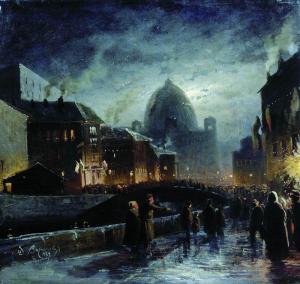
Chers lecteurs et abonnés, cette semaine j’ai fait une brève analyse et traduit le poème « L’Étrangère » d’Alexander Blok écrit en 1906 et qui reflète ses sentiments et réflexions pendant une période difficile. Comme toujours j’ai ajouté une peinture intitulée « Illumination à Saint-Pétersbourg » de Fiodor Vassiliev ainsi que l’explication de quelques mots.
Depuis que j’écris en anglais, français et russe j’ai également créé une page où vous pouvez retrouver le nom de tous les écrivains et peintres russes qui sont sur le site dans les 3 langues côte à côte. J’ajouterai les écrivains et artistes français et américains un peu plus tard.
Alors prenez un bon café et savourez, l’intégralité du poème est comme toujours en accès libre avec un lien vers la page en bas de notre petit extrait.
Brève analyse du poème “L’Étrangère” d’Alexandre Blok
Alexander Blok a écrit le poème « L’étrangère » après que sa femme l’ai quitté, le laissant écrasé par le désespoir et passant des journées entières à boire de façon excessive dans des établissements sales et bon marché. Le poème reflète les sentiments et les réflexions de l’auteur lors de moments difficiles pour lui-même et sa tentative de trouver une issue à sa mauvaise situation.
Dans ce poème, l’auteur décrit l’atmosphère sombre d’un restaurant sale où rien ne change et où la monotonie et l’absurdité vous rendent fou. Mais nous espérons la délivrance de notre héros lyrique sous la forme d’un mystérieux étranger. Cette femme qui passe entre les rangs des ivrognes vient d’un monde pur et lumineux et en la regardant et en sentant son parfum, le poète comprend l’horreur de sa situation et dans ses rêves, il s’envole et commence une nouvelle vie.
La fin du poème est ambiguë et peut être interprétée de deux manières différentes. Il se peut qu’il n’était pas comme les ivrognes qui l’entouraient et qu’il se soit rendu compte qu’il possédait encore un « trésor spirituel » dont il avait le droit de disposer, ou qu’il aurait pu simplement s’agir d’un délire d’ivrogne suivi d’une grave gueule de bois.
Nous mettons beaucoup d’efforts dans la qualité des articles et traductions, soutenez-nous avec un like et un abonnement ou sponsorisez-nous si vous les aimez.Nous sommes aussi surFacebook et Twitter
Dears Readers and subscribers, this week I made a short analysis and translated the poem “Stranger” by Alexander Blok written in 1906 and which reflects the author’s feelings and reflections during hard time. As always I added a painting called “Illumination in St. Petersburg” by Fyodor Vasilyev as well as the explanation of a few words.
Since I have been writing in English, French and Russian I also created a page where you can find the name of all Russian writers and painters who are on the site in the 3 languages next to each other. I will add the French and Americain writers and artist a bit later.
So have a nice cup of coffee and enjoy, the entire poem as always is freely accessible with a link to the page at the bottom of our little extract.
Short analysis of the poem “Stranger” by Alexander Blok
Alexander Blok wrote the poem “Stranger” after his wife left him causing him to be crushed by despair and spending whole days of binge drinking in dirty and cheap establishments. It reflects the author’s feelings and reflections during hard time for himself and an attempt to find a way out of his bad situation.
In this poem the author describes the gloomy atmosphere of a dirty restaurant. where nothing changes and the monotony and meaninglessness drives you crazy. But hope for deliverance to our lyrical hero in the form of a mysterious stranger. This woman passing between the drunken rows comes from a pure and bright world and looking at her and smelling her perfume, the poet understands the horror of his situation and in his dreams, he flies away and begins a new life.
The ending of the poem is ambiguous and can be interpreted in two different manners. It can be that he was not like the drunks around him and realized that he still had a “spiritual treasure” that he had the right to dispose of, or it could have simply be a drunken delirium followed by a severe hangover
We put a lot of effort into the quality of the articles and translations, support us with a like and a subscription or sponsor us if you like them. We are also on Facebook and Twitter
Ce poème écrit pendant la Grande Guerre patriotique par A. Akhmatova parle autant d’aujourd’hui que de cette période. “Courage” parle de la nécessité de préserver la culture et la langue russe et, je pense que ses paroles sont importantes pour nous tous, ainsi que pour nos différentes cultures et langues.
Analyse du poème “Courage” d’Akhmatova
A. Akhmatova a eu une vie très difficile et a été directement témoin de nombreux tournants dans l’histoire russe. Elle n’a pas accepté la révolution mais a refusé de quitter son pays. Son travail n’a pas été reconnu par le gouvernement soviétique et a fait l’objet de vives critiques.
Lors de l’évacuation, en raison de la Grande Guerre patriotique, Akhmatova a commencé à travailler à la création du cycle patriotique «Vents de Guerre», qui comprend le poème «Courage» en 1941.
Dans ce poème, elle souligne que la privation physique et la souffrance ne sont rien comparées à la perte du patrimoine culturel que les nazis ont cherché à détruire en comprenant leur importance.
Elle pensait que les écrivains et les poètes devaient préserver la « Parole Russe » et « Les Grands Mots Russe » et les transmettre aux générations futures, peu importe ce qu’ils devaient endurer.
Elle était convaincue que la riche culture russe devrait aider le peuple à survivre. Cela avait été prouvé maintes et maintes fois dans le passé et se répéterait certainement à l’avenir, comme c’est le cas maintenant.
Pour elle, la grandeur d’un pays n’était pas déterminée par le niveau de son développement économique ou politique, mais par la présence d’une puissance spirituelle particulière. Cette force, renforcée par le courage du peuple, est le fondement puissant du peuple, qui ne peut être écrasé.
Анна Ахматова — Мужество: Стих
Anna Akhmatova – Courage : versets
Мы знаем, что ныне лежит на весах И что совершается ныне. Час мужества пробил на наших часах, И мужество нас не покинет.
Nous savons ce qui est maintenant sur la balance et ce qui se passe maintenant. L’heure du courage a sonné à nos montres, Et le courage ne nous quittera pas.
Не страшно под пулями мертвыми лечь, Не горько остаться без крова, И мы сохраним тебя, русская речь, Великое русское слово.
Ce n’est pas effrayant de se coucher mort sous les balles, Ce n’est pas amer de rester sans abri, Et nous te sauverons, langue russe, Grand mot russe.
Свободным и чистым тебя пронесем,
И внукам дадим, и от плена спасем
Навеки.
Nous vous transporterons libres et purs,
Et nous vous donnerons à nos petits-enfants, et vous sauverons de la captivité
This poem written during the Great Patriotic War by A. Akhmatova speaks of today as much as it did of this period. “Courage is about the need to preserve Russian culture and language and I believe that her words are important to all of us, as well as our different cultures and languages.
Analysis of the poem “Courage” by Akhmatova
A. Akhmatova had very difficult life and directly witnessed many turning points in the Russian history. She did not accept the revolution but refuse to leave her country. Her work was not recognize by the Soviet government and was subjected to fierce criticism.
During the evacuation, due to the Great Patriotic War Akhmatova began to work on the creation of the patriotic cycle “Winds of War”, which includes the poem “Courage” in 1941.
In this poem, she emphasizes that physical deprivation and suffering are nothing compared to the loss of cultural heritage which the Nazis sought to destroy understanding their importance.
She thought that the writers and poets had to preserve the “Russian speech” and “The Great Russian Word” and pass it on to future generations, no matter what they had to endure.
She was sure that the rich Russian culture should help the people survive which had been proven time and time again in the past and would certainly be repeated in the future, as it is now.
For her, the greatness of a country is determined not by the level of its economic or political development, but by the presence of a special spiritual power. This strength, reinforced by the courage of people, is the powerful foundation of the people, which cannot be crushed.
Анна Ахматова — Мужество: Стих
Anna Akhmatova – Courage: Verse
Мы знаем, что ныне лежит на весах И что совершается ныне. Час мужества пробил на наших часах, И мужество нас не покинет.
We know what is now on the scales And what is happening now. The hour of courage has struck on our watches, And courage will not leave us.
Не страшно под пулями мертвыми лечь, Не горько остаться без крова, И мы сохраним тебя, русская речь, Великое русское слово.
It’s not scary to lie dead under the bullets, It’s not bitter to without shelter, And we will save you, Russian speech, Great Russian word.
Свободным и чистым тебя пронесем,
И внукам дадим, и от плена спасем
Навеки.
We will carry you free and clean,
And we will give you to our grandchildren, and save you from captivity
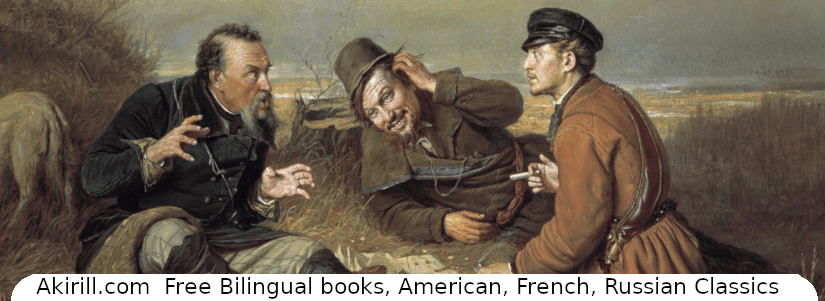
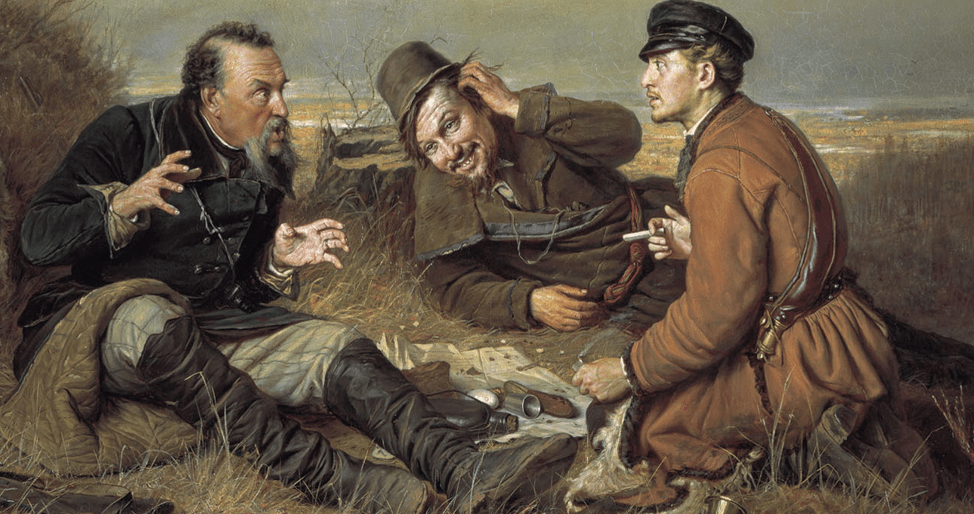
“Chasseurs au repos” a été peint par l’artiste russe Vasily Grigoryevich Perov en 1871. Il s’agit d’une huile sur toile de 119 X 183 cm qui se trouve à la Galerie Tretiakov, à Moscou. Si vous faites attention à la peinture, vous remarquerez que Perov a intentionnellement dessiné des absurdités dans les objets comme les proies, l’emplacement des fusils et le cor qui a été fait pour souligner l’atmosphère de la fiction de chasse.
Cette image est liée à la période tardive du travail de Perov, et si dans la première moitié de sa période de créativité il dépeint des images tristes de la vie populaire, dans la seconde moitié de son travail, Perov accorde plus d’attention aux scènes quotidiennes de la vie de les gens ordinaires.
hunters-at-rest- by Vasily Grigoryevich Perov 1871
Il existe 3 versions de ce tableau. En 1877, l’artiste a peint une copie du tableau avec une intrigue plus schématique, plus simple, et une palette de couleurs plus simple. Ce deuxième tableau est conservé au Musée russe et la troisième version du tableau se trouve au Musée d’art. VV Vereshchagin à Nikolaev.
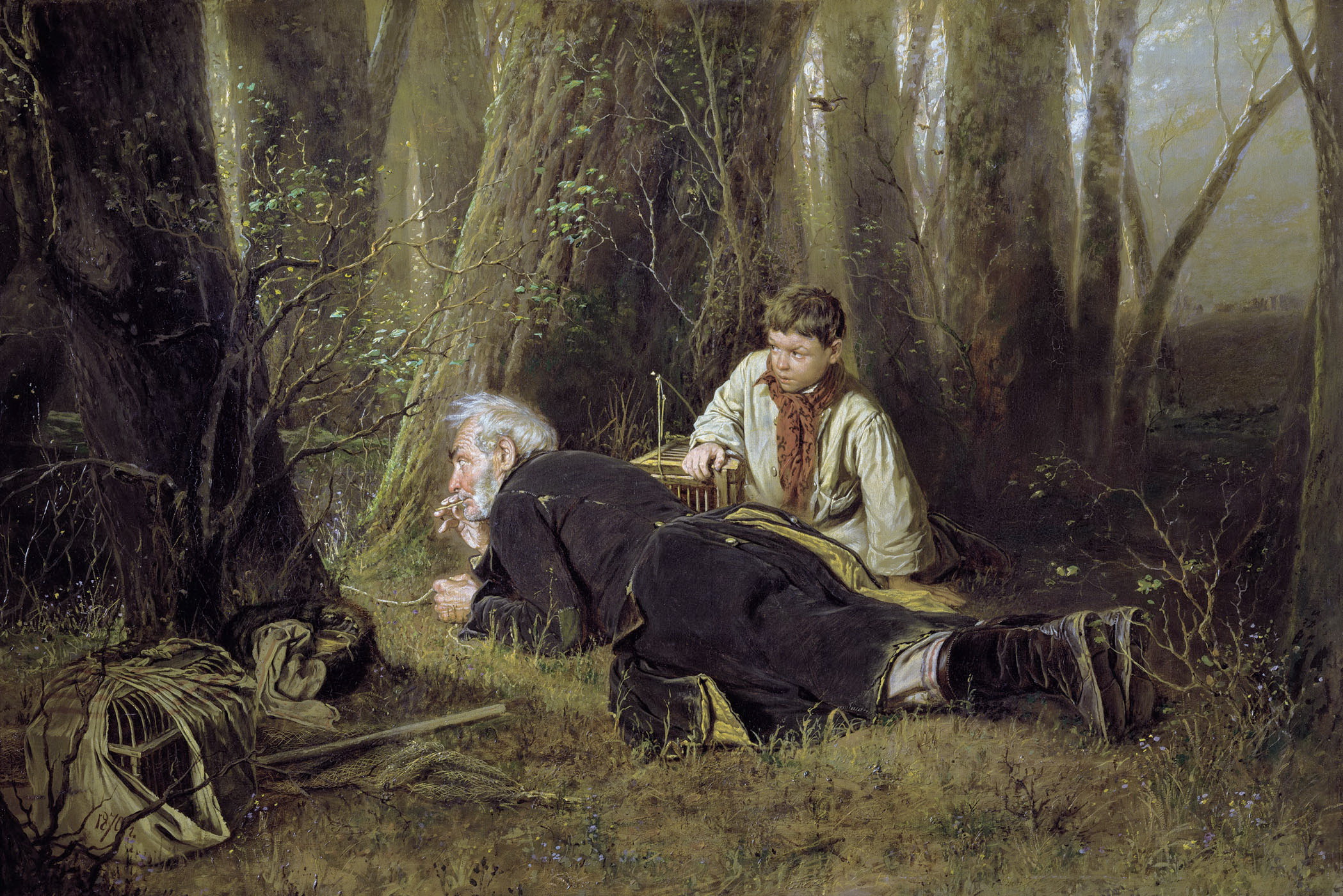
Vasily Grigorievich Perov était un chasseur passionné, c’était donc un sujet qui lui était familier. Déjà, en 1870, Perov avait peint la toile “Attrape-oiseaux”, pour laquelle il avait reçu le titre de professeur, ainsi qu’un poste d’enseignant à l’École de peinture, de sculpture et d’architecture de Moscou.
bird-catcher by Perov
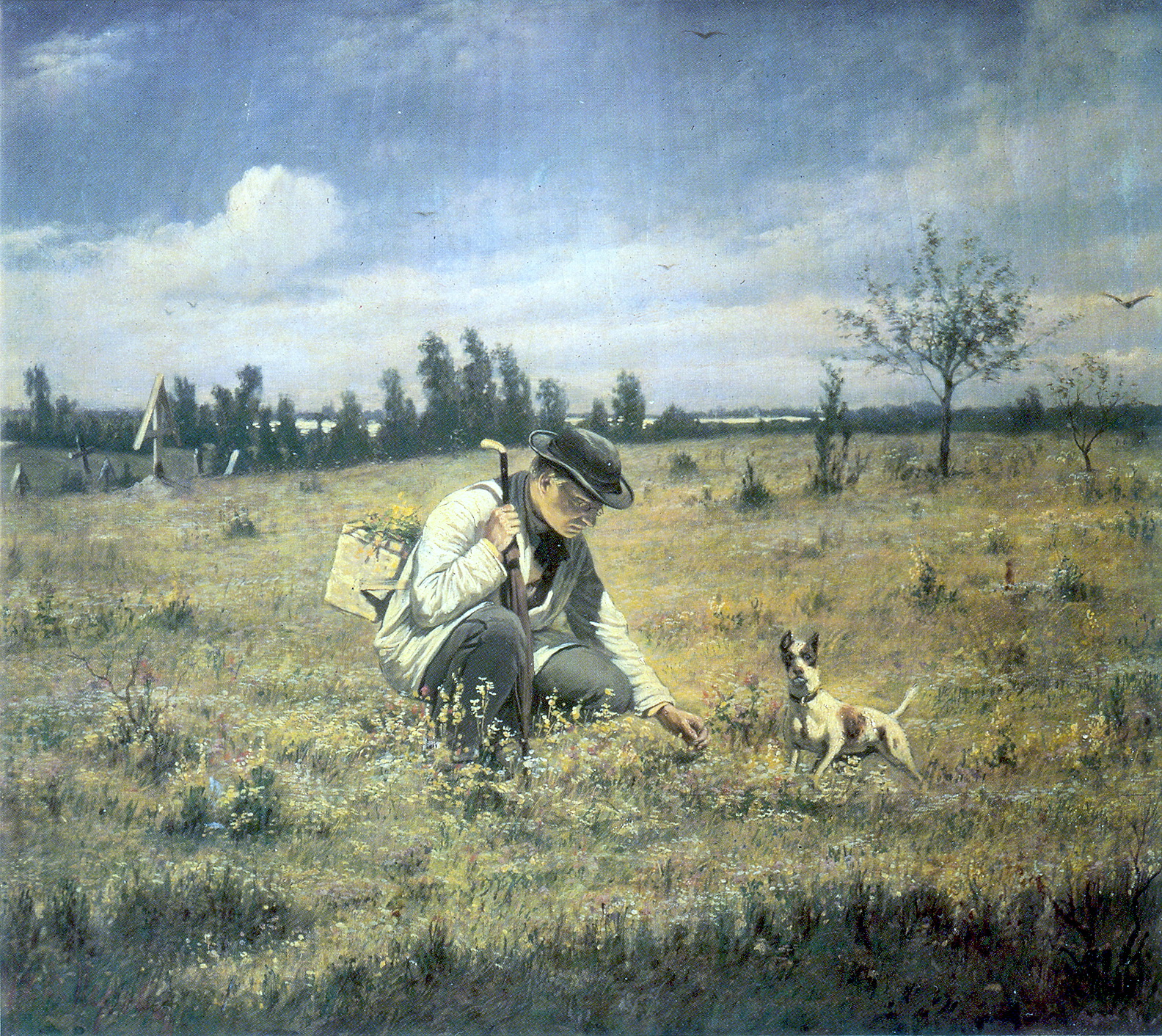
Au cours des années 70, l’artiste a également crée plusieurs autres tableaux consacrés au « thème de la chasse » : « Pêcheur » (1871), « Botaniste » (1874), « Pigeon » (1874), « Pêche » (1878).
“Botanist”-1874 – Perov “Fisherman” – 1871-by Perov“Fishing” – 1878 – by Perov“Pigeon” – 1874 – by Perov
“Chasseurs au repos” est basé sur certains amis de Perov Moscou. Il a dépeint DP Kuvshinnikov, un médecin bien connu à Moscou et un grand amateur de chasse au fusil pour l’image du narrateur. Le docteur VV Bessonov est devenu le prototype du chasseur sceptique et pour l’image d’un jeune chasseur, Perov a dépeint NM Nagornov, 26 ans.
Description de la peinture
“Chasseurs au repos” est une combinaison d’une peinture de genre quotidienne, d’un paysage et d’une nature morte dont les objets de chasse et de gibier.
Toute cette scène se déroule dans un paysage plutôt sombre. Le ciel est nuageux, les oiseaux migrateurs s’en vont, et l’herbe est déjà fanée, tout parle d’automne, d’endormissement, d’anticipation de l’hiver et apporte une nuance inquiétante à son contenu comique. Ce paysage sombre est utilisé pour concentrer l’attention du spectateur sur les personnages centraux de l’image.
La lumière de l’image est concentrée sur les visages et les mains des personnages. C’est une technique ancienne, de l’époque de la Renaissance, qui permet à l’artiste de révéler plus pleinement le monde intérieur de ses modèles.
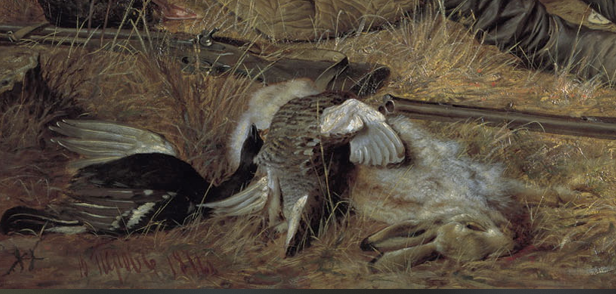
Contrairement à la nature triste au centre de la composition, l’artiste a placé trois chasseurs d’origines sociales différentes et d’excellente humeur. Tous unis par la chasse, on les voit se parler. Ils sont au repos après une chasse fructueuse comme en témoigne la peinture d’une carcasse de lièvre et d’une tétras des bois. Sur un chiffon étalé, il y a une miche de pain, une fiole d’alcool fort, des tasses.
L’homme aux moustaches grises sur la gauche est un chasseur âgé et expérimenté, apparemment l’un des nobles appauvris, qui parle avec enthousiasme et passion de ses “exploits” de chasse. Il semble gesticuler et presque sauter sur place, alors qu’il raconte son histoire avec passion, essayant d’appuyer son discours avec des mimiques impressionnantes pour faire croire aux jeunes qui ont peu vu.
Le second, plus jeune que le conteur, ressemble à un paysan. Il est allongé sur l’herbe fanée face au spectateur, appuyé sur le sol d’une main, et se frottant la tempe de l’autre, lissant ses cheveux ébouriffés arrachés sous son chapeau cabossé. Il écoute avec un intérêt visible l’orateur douloureusement éloquent avec un sourire narquois, pensant, nous avons entendu parler de tels miracles, mens davantage.
Le troisième, à droite, un jeune novice crédule bien vêtu, absorbe avidement chaque mot de son camarade expérimenté. Il se figea, emporté par la fable passionnante et croyant innocemment son camarade plus âgé, oubliant même d’allumer la cigarette qu’il tient dans sa main droite.
Hunter at Rest part dog by PerovHunter at Rest part game by PerovHunter at Rest part horn by PerovHunter at Rest part riffles by Perov
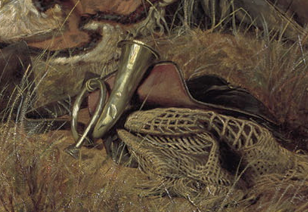
Les chasseurs notent des absurdités dans certains objets qui auraient été dessinés intentionnellement pour souligner l’atmosphère de la fiction de chasse. Par exemple, le cor est utilisé lorsque les chiens conduisent le gibier, et est inutile pour la chasse à la carabine et avec un seul chien. Les fusils reposent négligemment sur le sol et les proies ne peut pas être au même endroit car le lièvre vit dans une zone dégagée comme dans les champs ou la steppe et les tétras des bois sont des habitants des forêts.
La simplicité de la toile cache le contenu philosophique profond. Les héros d’âges différents symbolisent les cycles de la vie, lorsque la jeunesse naïve apprend le monde avec impatience, puis vient la maturité et l’expérience qui a beaucoup vu et est sceptique quant à la vie. En dernier, la maturité est remplacée par la vieillesse qui sait trouver du positif partout et se complaît souvent dans des souvenirs tombant sans cesse dans l’idéalisation du passé.
Le grand public est tombé sous le charme de la toile mais les critiques étaient mitigées. Donc, si Stasov a beaucoup apprécié l’image et l’a comparée aux histoires de chasse de Tourgueniev, alors Saltykov-Shchedrin l’a critiquée. Pour lui les visages des personnages semblaient trop simulés, cependant une telle technique permet de décrire plus clairement le caractère et le monde intérieur des personnages, et de révéler la composante symbolique de l’image.
Fiodor Mikhaïlovitch Dostoïevski a également mentionné le tableau dans son journal:
L’image est connue de tous depuis longtemps: «Chasseurs au repos»; l’un ment ardemment et délibérément, l’autre écoute et croit de toutes ses forces, et le troisième ne croit rien, se couche là et rit… Quel charme ! <…> On entend presque et on sait de quoi il parle, on connaît toute la tournure de ses mensonges, son style, ses sentiments.- FM Dostoïevski. Journal de l’écrivain
Un grand nombre de reproductions et de copies de la peinture ont été publiées à l’époque soviétique. Il y avait des légendes sur trois tableaux peints par Perov, mais le troisième tableau n’a été retrouvé qu’en 1984.
J’espère que vous avez apprécié ce tableau autant que moi
Si vous avez aimé cet article, abonnez-vous, mettez des likes, écrivez des commentaires !
“Hunters at Rest” was painted by the Russian artist Vasily Grigoryevich Perov in 1871. It is a 119 X 183 cm oil on canvas which is at the Tretyakov Gallery, in Moscow. If you pay attention to the painting you will notice that Perov intentionally drew some absurdities in the objects like the preys, the place of the riffles, and the horn which was done to emphasize the atmosphere of hunting fiction.
This picture is related to the late period of Perov’s work, and if in the first half of his period of creativity he depicted sad pictures of folk life, during the second half of his work, Perov paid more attention to everyday scenes from the life of ordinary people.
hunters-at-rest- by Vasily Grigoryevich Perov 1871
There are 3 versions of this painting. In 1877, the artist painted a copy of the painting with a plot more schematic, simpler, and a simpler color scheme. This second painting is kept in the Russian Museum, and the third version of the picture is in the Art Museum. V. V. Vereshchagin in Nikolaev.
Vasily Grigorievich Perov was a passionate hunter, so this was a topic familiar to him. Already, in 1870 Perov painted the canvas “Bird-catcher”, for which he received the title of professor, as well as a teacher’s position at the Moscow School of Painting, Sculpture and Architecture.
bird-catcher by Perov
During the 70s, the artist also creates several more paintings dedicated to the “hunting theme”: “Fisherman” ( 1871 ), “Botanist” ( 1874 ), “Pigeon” ( 1874 ), “Fishing” ( 1878 ).
“Botanist”-1874 – Perov “Fisherman” – 1871-by Perov“Fishing” – 1878 – by Perov“Pigeon” – 1874 – by Perov
“Hunters at Rest” is based some of Perov Moscow friends. He portrayed D. P. Kuvshinnikov, a well-known doctor in Moscow and a great lover of rifle hunting for the image of the narrator. The doctor V. V. Bessonov became the prototype of the skeptic hunter and for the image of a young hunter, Perov portrayed the 26-year-old N. M. Nagornov.
Description of the painting
“Hunters at Rest” is a combination of a genre everyday painting, a landscape , and a still life of hunting items and game.
This whole scene takes place against a rather gloomy landscape. The sky is cloudy, migratory birds are flying away, and the grass already faded, everything speaks of autumn, falling asleep, anticipation of winter and brings a disturbing undertone to its comic content. This gloomy landscape is used to concentrate the viewer’s attention on the central figures of the picture.
The light in the picture is concentrated on the faces and hands of the characters. It is an old technique, from the time of the Renaissance, which allows the artist to more fully reveal the inner world of his models.
In contrast to the sad nature in the center of the composition, the artist placed three hunters of different social origins and in excellent mood. All of them united by hunting, are seen talking to each other. They are at rest after a successful hunt as evidenced by the painting of a carcass of a hare and a black grouse. On a spread rag there is a loaf of bread, a flask of strong spirits, cups.
The gray-whiskered man on the left is an elderly, experienced hunter, apparently one of the impoverished nobles, who talks with enthusiasm and passion about his hunting “exploits”. He seems to be gesticulating and almost jumping on the spot, as he passionately tells his story, trying to support his speech with impressive facial expressions to make young people who have seen little believe him.
The second, younger than the storyteller, looks like a peasant. He lies on the faded grass facing the viewer, leaning on the ground with one hand, and rubbing his temple with the other, smoothing his disheveled hair knocked out from under his battered hat. He listens with visible interest to the painfully eloquent speaker with a sly smirk, thinking, we heard about such miracles, lie more.
The third, on the right, a gullible young novice neatly dressed, greedily absorbs every word of his experienced comrade. He froze, carried away by the exciting fable and innocently believing his older comrade, even forgetting to light the cigarette that he is holding in his right hand.
Hunter at Rest part dog by PerovHunter at Rest part game by PerovHunter at Rest part horn by PerovHunter at Rest part riffles by Perov
Hunters note absurdities in some objects which are believed to have been drawn intentionally to emphasize the atmosphere of hunting fiction. As exemple, the horn is used when dogs drive the game, and is useless for rifle hunting and with only one dog. The riffles are carelessly laying on the ground, and the prey cannot be in the same place since the hare lives in an open area like in fields, or steppe, and hazel grouses are forest dwellers.
The simplicity of the canvas hides the deep philosophical content . The heroes of different ages symbolize life cycles, when naive youth eagerly learns the world, then comes maturity and experience which has seen a lot and is skeptical about life. Last maturity is replaced by old age which knows how to find positive everywhere and often indulges in memories constantly falling into the idealization of the past.
The general public fell in love with the canvas but the critics were mixed. So, if Stasov highly appreciated the picture and compared it with Turgenev ‘s hunting stories , then Saltykov-Shchedrin criticized it. For him the faces of the characters seemed to be overly simulated, however such a technique allows to more clearly describe the character and inner world of the characters, and to reveal the symbolic component of the picture.
Fyodor Mikhailovich Dostoevsky also mentioned the painting in his diaries:
The picture has long been known to everyone: “Hunters at rest”; one lies ardently and deliberately, the other listens and believes with all his might, and the third does not believe anything, lay down right there and laughs … What a charm! <…> We almost hear and know what he is talking about, we know the whole turn of his lies, his style, his feelings.- F. M. Dostoevsky. Writer’s diary
A huge number of reproductions and copies of the painting were released in Soviet times. There were legends about three paintings painted by Perov, but the third painting was found only in 1984.
I hope you enjoyed this painting as much as I did
If you liked this article, subscribe , put likes, write comments!
Saint Basil’s Cathedral, an architectural treasure of Moscow
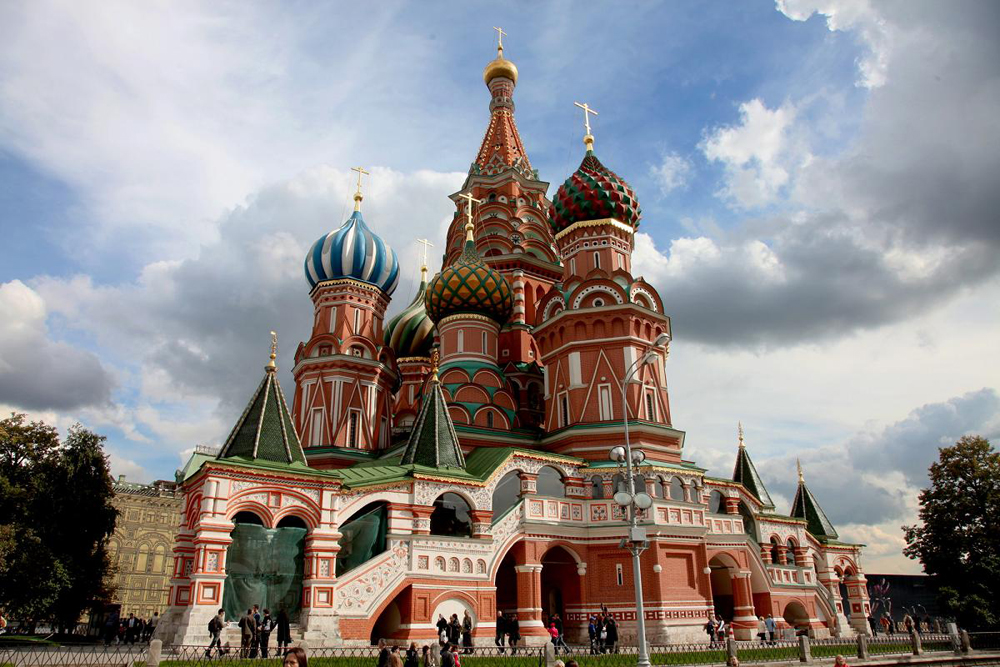
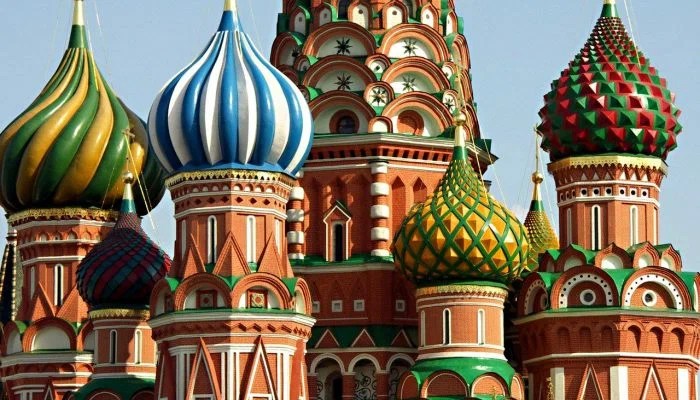
The extraordinarily beautiful and mysterious St. Basil’s Cathedral, or the Cathedral of the Intercession of the Virgin, on the Moat, flaunting on Red Square, is one of the most significant monuments of ancient Russian architecture of the 16th century. Neither before nor after it was built any such structure. It looks like a vault of eight churches, which surrounds the highest – the ninth. Such a temple still does not exist anywhere else in Russia. Even the bright pattern of the domes of the cathedral makes it look like a blooming Garden of Eden.
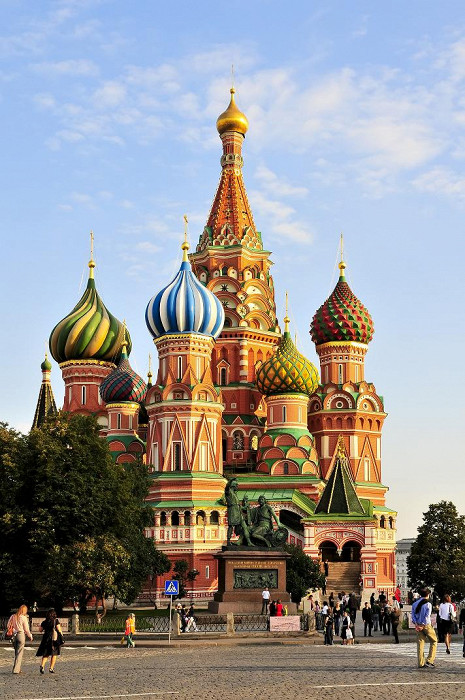
Saint Basil’s Cathedral
Each temple has its own entrance and lighting, however, the cathedral is a single building. The complexity and amazing combination of details of the St. Basil’s Cathedral are unparalleled in Russian architecture and had a huge impact on the development of Russian national architecture.
The cathedral was erected in 1555–1561. at the behest of Tsar Ivan the Terrible in honor of the conquest of the Kazan kingdom. It is believed that the architects who created it were deprived of sight. Even Stalin did not allow the building to be demolished, and during the war the temple was hidden from shelling. The cathedral is included in the Russian list of UNESCO World Heritage Sites and is a branch of the State Historical Museum.
The upper tier of the cathedral resembles a labyrinth, and the base is an eight-pointed star.
The cathedral unites ten churches (chapels), some of which were consecrated in honor of the saints, whose days of memory fell on the decisive battles for Kazan.
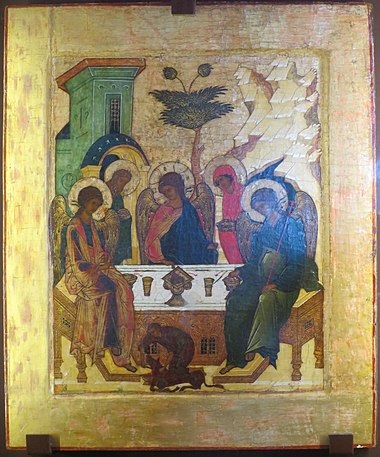
The central church was built in honor of the Intercession of the Virgin , around which separate churches are grouped in honor of: the Holy Trinity , the Entry of the Lord into Jerusalem , St. Nicholas of Velikoretsky , the Three Patriarchs: Alexander, John and Paul the New, Gregory of Armenia , Cyprian and Justina , Alexander Svirsky and Varlaam Khutynsky , placed on the same base-basement, and a chapel in honor of St. Basil the Blessed, after whose name the temple received a second, more well-known name.
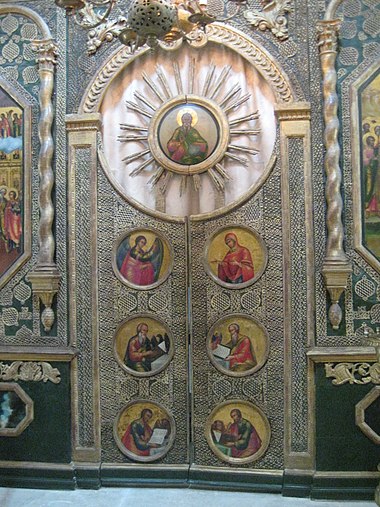
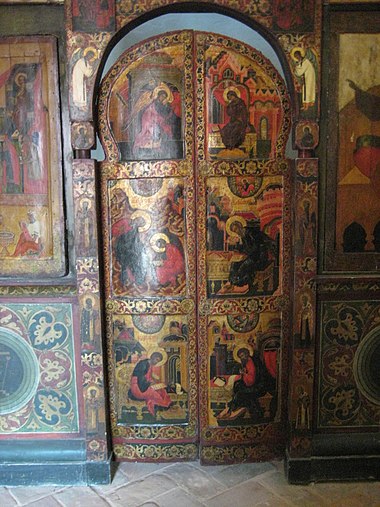
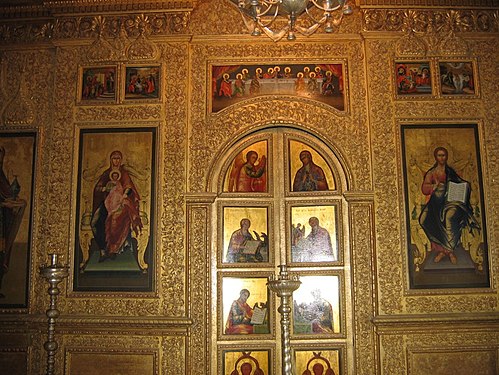
Royal Doors in the Church of the Intercession of the Blessed Virgin Mary, 2009Royal Doors of the Church of Cyprian and Justina 2012Royal Doors of the Church of the Entry of the Lord into Jerusalem, 2011Royal doors of the iconostasis of the Church of Varlaam Khutynsky, 2011Royal Doors of the Church of St. Nicholas Velikoretsky, 2007
The thickness of the walls of the foundation of St. Basil’s Cathedral reaches three meters. It is this thickness that allows it to securely hold as many as nine buildings. If you look at the foundation of the church, you can see that 8 small temples form an eight-pointed star – a symbol of the Virgin. There are larger churches in the ensemble of small churches. They are strictly oriented to the cardinal points and form symmetry. The main temple, with a huge dome and a tent, is the Protection of the Virgin, Her intercession.
During the campaigns of Ivan the Terrible to Kazan on today’s Red Square, “camping” wooden churches were erected in memory of the victories won.
On the day of the memory of Cyprian and Justina ( October 2, 1552), the next campaign ended with a victory over the Kazan Khanate and the annexation of the city to the Muscovite state. It was, the day after the Intercession of the Most Holy Theotokos, and Ivan the Terrible ordered to unite all the “marching” wooden churches into one stone temple in the name of the Intercession of the Virgin – Intercession Cathedral, but it stood only less than a year before to be dismantled, and finally a stone cathedral was laid in its place.
Already, in the autumn of 1554 were the first reliable mention of the construction of the Church of the Intercession of the Mother of God. The construction of this temple began in 1555 and lasted 6 years. The temple was built of brick, and its foundations , plinth and a number of details are made of white stone. In the western part of the cathedral there is a flat brick ceiling.
A legend about the architects Barma and Postnik which names became known only in 1895 told that they had been blinded by order of the the Tsar Ivan the Terrible so that they could no longer build such a temple, but Postnik could not be blinded, since for several years after the construction of the cathedral he participated in the creation of the Kazan Kremlin.
By 1559, in the fall, the temple main part was erected, and at the same period, all but the central church were consecrated.
Despite the apparent grandiosity from the outside of St. Basil’s Cathedral the inside is quite small, accommodating a very small number of people during the service. That is because according to the plan of its creators, it should not have been too spacious, since during major church holidays the entire Red Square was the church, the place of execution, on which the clergy ascended, became a lectern, and the Pokrovsky Cathedral turned into the altar of an open-air temple. After all, there is no temple in Heavenly Jerusalem, but “there is only His Throne” … and the Intercession Cathedral – turned into an altar of a church in the open.
Finally, on June 29, 1561 according to the old calendar, the central Intercession Church of the cathedral was once consecrated in the name of the Intercession of the Most Holy Theotokos.
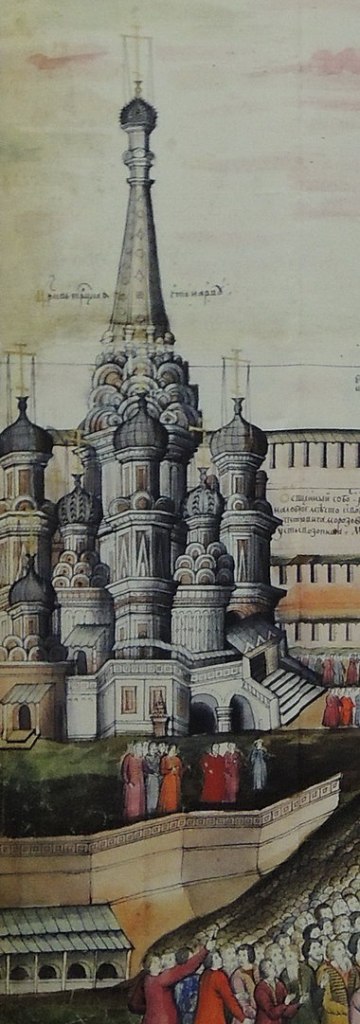
St. Basil’s Cathedral from the Book of the election of the Tsar and Grand Duke Mikhail Fedorovich, 1672 1673
The first changes to the Cathedral of the Intercession of the Virgin, on the Moat, took place almost immediately after construction and were associated with the name of the famous Moscow saint – St. Basil the Blessed. Before the appearance of a stone cathedral on this site, there was a wooden Trinity Church, where St. Basil often came to pray. In 1558, a lower church was added to the Pokrovsky Cathedral over the burial place of the Moscow miracle worker – St. Basil the Blessed. To build this temple, the builders dismantled part of the original cathedral.
Some historians believe that the cathedral was originally conceived as a likeness of the seven-tower Blachernae monastery with the Church of the Virgin , in which the miracle of the Intercession once took place . By its presence and location, it was supposed to assert a new state ideology: ” Moscow is the third Rome ” , and the eight chapel was there because of the dimension of the foundation” . Others believe that the very idea of a multi-chapel cathedral belonged to Metropolitan Macarius , who planned to recreate in the center of Moscow the image of the holy city of Jerusalem.
In the middle of the 16th century, the cathedral was painted in the fresco technique and imitated brickwork. There were no porches, and the St. Basil’s Church bell tower had a different look. It gave the cathedral a strict but elegant appearance which could be compare to a memorial with the eight separates churches symbolizing the days of the decisive battles for Kazan.
The original roof of the church burned downed at the end of the 16th century and the figured domes of the cathedral appeared instead of the original roof.
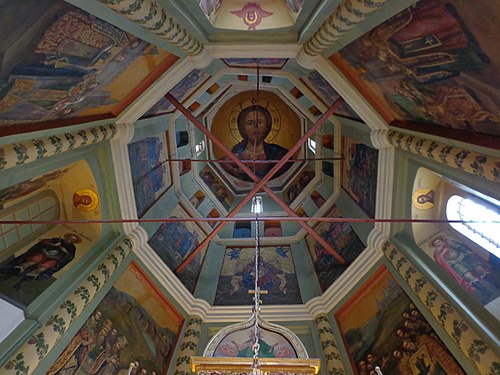
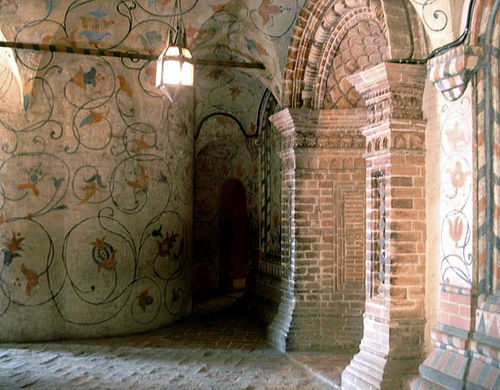
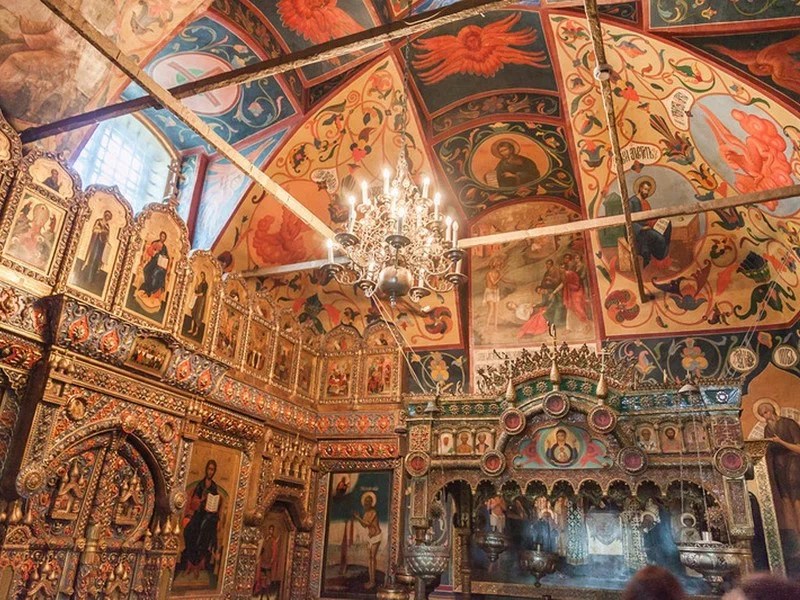
The Intercession Cathedral is richly decorated with wall paintings, has an impressive collection of ancient Russian icon painting and masterpieces of church applied art.
Until the reconstruction of the Great Bell Tower in the Kremlin in 1660, the cathedral was the tallest building in Moscow.
In the 1670 the wooden churches on Red Square were closed, then the cathedral was supplemented by a hipped bell tower, its heads were covered with iron, the porch was covered with tiles , and a bright colorful ornamental painting appeared on the cathedral. Finally the chapel of Blessed John of Moscow was added in 1672
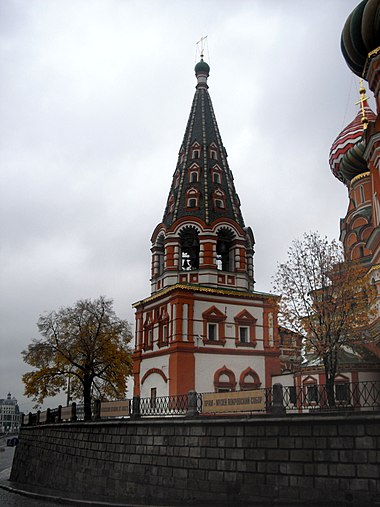
Bell tower
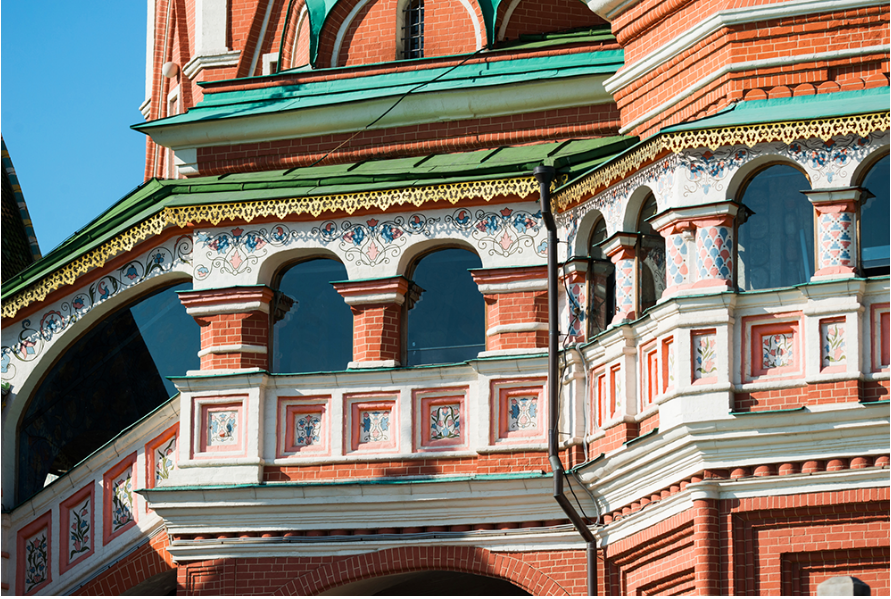
The cathedral was seriously renovated in 1680, with brick galleries replacing the wooden ones and the outer and inner galleries, platforms and parapets of the porches being painted with grass ornaments motifs.
In the 18 and 19 centuries Divine services were regularly performed in St. Basil’s Cathedral. As a rule, they were performed in an annex – a temple built in honor of St. Basil the Blessed, because the rest of the temples were cold. That is why the people got accustomed to the name – St. Basil’s Cathedral.
Divine services in the temple continued until the beginning of the 20th century. The last rector was Father John Vostorgov, now canonized among the saints in the host of new martyrs and confessors
In 1737, the temple almost completely burned out because of one of the strongest fires in Moscow. The restoration of the architecture and interiors of the cathedral was done under the leadership of the architect Ivan Michurin.
Painting by Giacomo Quarenghi “The Intercession Cathedral and the Spasskaya Tower of the Kremlin”, 1797
The cathedral was seriously repaired and rebuilt by decree of Catherine II from 1784 to 1786, and it was then that the walls of St. Basil’s Cathedral were painted with multi-colored paints and acquired their modern look. Before it was mainly painted in red and white colors.
After the Patriotic War of 1812, Alexander I decided to restore the temple and in 1817, the architect Osip Bove , while reconstructing Red Square with shopping malls, laid out the retaining wall of the temple with “wild” stone and installed a cast-iron fence. First along Moskvoretskaya Street, then in 1834, on the south side of the temple.
Red_Square_in_Moscow_(1801)_by_Fedor_Alekseev
In 1880, a manor on Pyatnitskaya street was added to the temple . Until 1918, the last rector of the temple , Father John lived in it .
In the 1890s, the temple was again seriously reconstructed. The floors were strengthened, and the Cathedral sacristy was decorated with colored stained-glass windows, designed by the architect Andrei Pavlinov.
Postcard early 20th century
In 1918, the Intercession Cathedral became one of the first cultural objects taken under state protection as a monument of national and world significance. It is during this period that services were stopped in the upper churches and the museumification began.
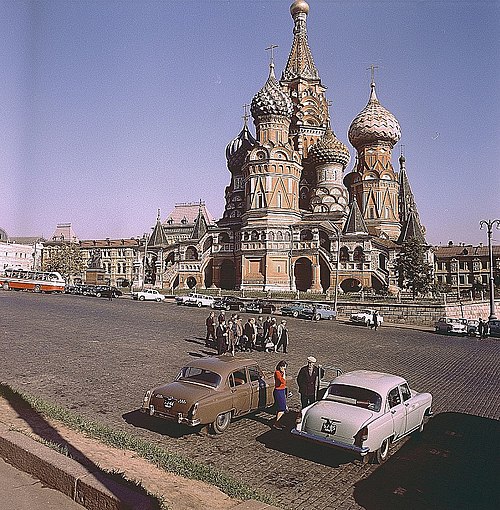
1965
Archpriest John Kuznetsov became the first caretaker of the museum. In the 1920s, the cathedral was in dear need of repair and restoration work was carried out, led by architects Nikolai Kurdyukov and Alexander Alexandrovich Zhelyabuzhsky.
Basil’s Cathedral and the monument to Minin and Pozharsky
After the decision of 1923 to establish a historical and architectural museum in the cathedral, this one was opened to visitors on May 21, 1923.
Beginning in 1923 and until 1949 research was carried out in the museum because of legends which attributed to the temple a network of underground passages. And in 1924, walled-up room with a deep hole in the floor under the chapel of John the Merciful was found by the restorer and architect Dmitry Sukhov and the speleologist-historian Ignatius Stelletsky.
The window-loopholes of the room were bricked up both from the side of the river and from the side of Red Square. Ignatius Stelletsky wrote that the embrasures had the same approaches as for the cannons in the towers of Kitay-gorod and any of the monasteries which led him to the idea that in the 16th century the lower part of St. Basil’s Cathedral was intended for combat.
The Pokrovsky Cathedral museum became a branch of the State Historical Museum in 1928 and in 1929 the divine services were banned in the cathedral, and the bells were removed and melted down.
During the Great Patriotic War, the museum did not stop its work, although it was closed to visitors. St. Basil’s Cathedral was carefully disguised to save it from bombing. There is a legend that after the war, Stalin was offered to remove the cathedral under the pretext that it was interfering with the parade. It is believed that Kaganovich showed Stalin a model of the square, and in his presence he removed the model of the temple, suggesting that it be demolished. Stalin abruptly interrupted him: “Lazar, put it in its place!” Since then, no one has raised questions about the inviolability of the cathedral.
The cathedral began to be restored, on September 7, 1947, and the museum reopened on the day of the celebration of the 800th anniversary of Moscow.
From 1954 to 1955 the “brick-like” painting of the 16th century was returned to the cathedral, and at the same time the white-stone details of the décor was restored.
On November 18, 1991, the Russian Orthodox Church was allowed to hold regular services in the Kremlin cathedrals and St. Basil’s Cathedral but the first divine service took place on the patronal feast of the Intercession of the Most Holy Theotokos on October 1, 1991
Beginning in 2001 and ending ten years later the interiors of ten churches were restored, the icon of the Intercession of the Most Holy Theotokos was restored, and the basements were restored to their original appearance.
If you liked this article, subscribe , put likes, write comments!Share on social networksand you can alsoCheck out Our Latest Posts


























 AKirill, Learn, apprenez, translation, traduction, livres bilingues, bilingual books