Poem “Clair de Lune” by Paul Verlaine in English and French with the painting “Moonlit Night in Crimea”

Bilingual books Lire en FrançaisContact us
American Literature French Literature Russian Literature

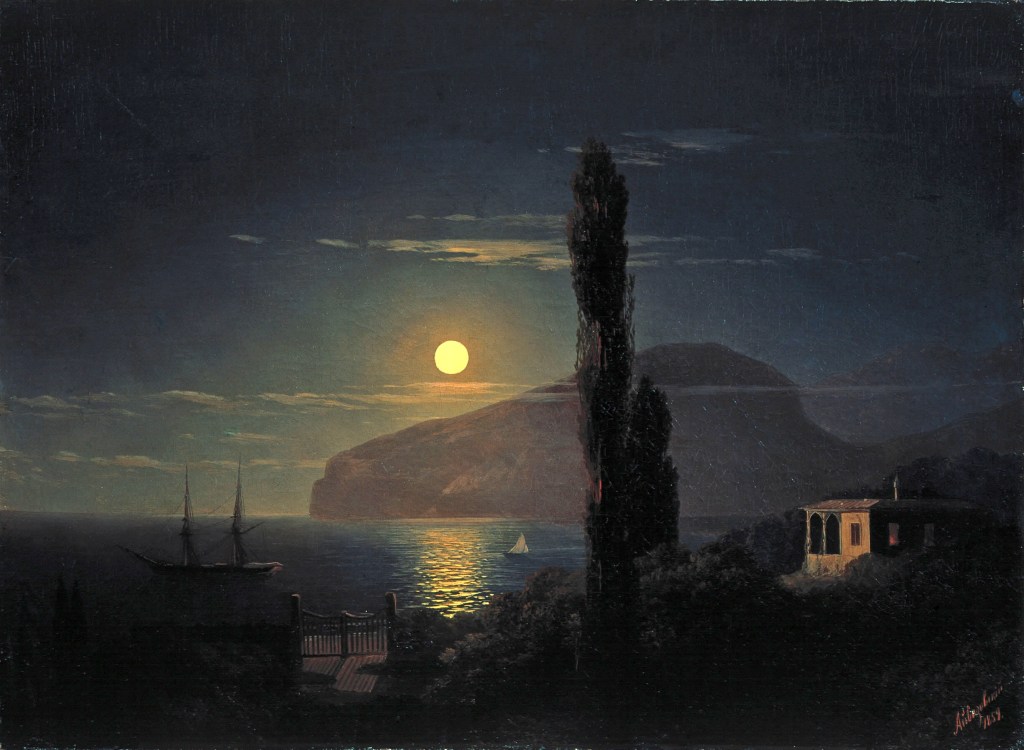
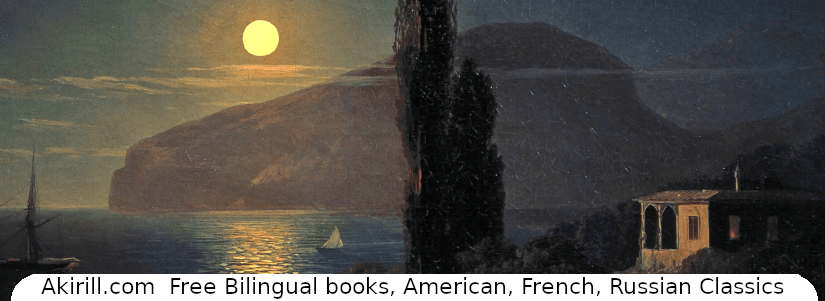
This week I put side by side in French and English the poem “Clair de Lune” by Paul Verlaine. And since an article doesn’t seem complete to me without picture, I added the painting “Moonlit night in Crimea” which is an oil on canvas of 56,4×76 cm painted by Ivan Aivazovsky in 1859, and is situated in the State Russian Museum.

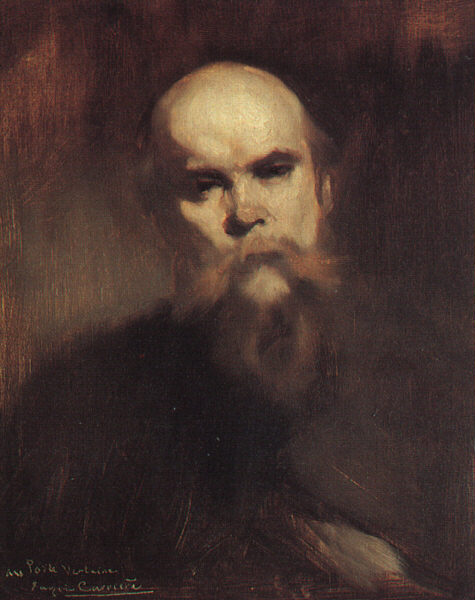
Paul Verlaine by Eugène Carrière 1890
Clair de lune de Paul VerlaineClair de lune by Paul Verlaine
Translated by Gertrude Hall
Moonlit night in Crimea 1859 by Ivan Aivazovsky
Лунная ночь в Крыму Айвазовского
Moonlit night in Crimea 1859 by Ivan Aivazovsky / Лунная ночь в Крыму Айвазовского

Votre âme est un paysage choisiYour soul is as a moonlit landscape fair,
Que vont charmant masques et bergamasquesPeopled with maskers delicate and dim,
Jouant du luth et dansant et quasiThat play on lutes and dance and have an air
Tristes sous leurs déguisements fantasques.Of being sad in their fantastic trim.
Tout en chantant sur le mode mineurThe while they celebrate in minor strain
L’amour vainqueur et la vie opportune,Triumphant love, effective enterprise,
Ils n’ont pas l’air de croire à leur bonheurThey have an air of knowing all is vain,—
Et leur chanson se mêle au clair de lune,And through the quiet moonlight their songs rise,
Au calme clair de lune triste et beau,The melancholy moonlight, sweet and lone,
Qui fait rêver les oiseaux dans les arbresThat makes to dream the birds upon the tree,
Et sangloter d’extase les jets d’eau,And in their polished basins of white stone
Les grands jets d’eau sveltes parmi les marbres.The fountains tall to sob with ecstasy.

I hope you enjoyed this poem and painting as much as I did

You can find other French, American or Russian poem on their pages, as well as more bilingual poems if you like them
If you liked this article, subscribe , put likes, write comments!
Share on social networks
Check out Our Latest Posts


© 2023 Akirill.com – All Rights Reserved

Lisez le poème “Une tempête” d’Emily Dickinson en anglais et en français côte à côte

Livres bilinguesRead in EnglishNous contacter
Littérature américaineLittérature françaiseLittérature russe

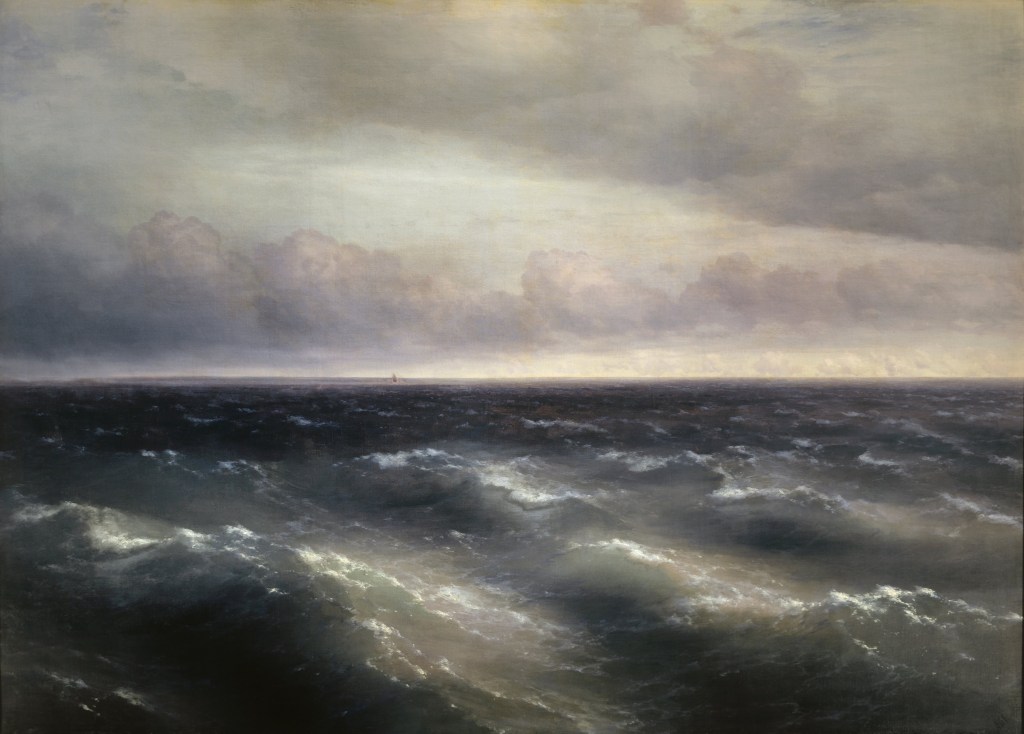
Je ne sais pas pourquoi, mais le mot tempête me fait toujours penser à la mer, alors aujourd’hui j’ai inclus le tableau “Vent fort” peint par le peintre Russe Ivan Aivazovsky en 1856.

A tempestUne tempête
Traduit par Akirill.com

Vent fort d’Ivan Aivazovsky – 1856

Strong Wind by Ivan Aivazovsky - 1856 Vent fort d'Ivan Aivazovsky - 1856
An awful tempest mashed the air,Une terrible tempête a écrasé l’air,
The clouds were gaunt and few;Les nuages ​​étaient décharnés et peu nombreux;
A black, as of a spectre’s cloak,Un noir, comme un manteau d’un spectre,
Hid heaven and earth from view.Caché le ciel et la terre du regard.
The creatures chuckled on the roofsLes créatures riaient sur les toits
And whistled in the air,Et sifflaient dans l’air,
And shook their fists and gnashed their teeth.Et agitaient leurs poings et grinçaient des dents.
And swung their frenzied hair.Et balançaient leurs cheveux frénétiques.
The morning lit, the birds arose;Le matin s’illumina, les oiseaux se levèrent ;
The monster’s faded eyesLes yeux fanés du monstre
Turned slowly to his native coast,Tourné lentement vers sa côte natale,
And peace was Paradise!Et la paix était le Paradis !

J’espère que vous avez apprécié ce poème autant que moi.

Si vous voulez plus de poèmes de cet auteur, vous pouvez visiter sa page. Les poèmes sont en anglais.

Si vous avez aimé cet article, abonnez-vous, mettez des likes, écrivez des commentaires !

Partager sur les réseaux sociaux

Découvrez nos derniers posts


© 2023 Akirill.com – All Rights Reserved

Read the poem “A Tempest” by Emily Dickinson in English and French side by side

Bilingual booksLire en FrançaisContact us
American LiteratureFrench LiteratureRussian Literature

I do not know why, but the word tempest always make me think of the sea, so today I included the painting “Strong Wind” painted by the Russian painter Ivan Aivazovsky in 1856.

A tempestUne tempête
Traduit par Akirill.com

Strong Wind by Ivan Aivazovsky – 1856

Strong Wind by Ivan Aivazovsky - 1856
An awful tempest mashed the air,Une terrible tempête a écrasé l’air,
The clouds were gaunt and few;Les nuages ​​étaient décharnés et peu nombreux;
A black, as of a spectre’s cloak,Un noir, comme un manteau d’un spectre,
Hid heaven and earth from view.Caché le ciel et la terre du regard.
The creatures chuckled on the roofsLes créatures riaient sur les toits
And whistled in the air,Et sifflaient dans l’air,
And shook their fists and gnashed their teeth.Et agitaient leurs poings et grinçaient des dents.
And swung their frenzied hair.Et balançaient leurs cheveux frénétiques.
The morning lit, the birds arose;Le matin s’illumina, les oiseaux se levèrent ;
The monster’s faded eyesLes yeux fanés du monstre
Turned slowly to his native coast,Tourné lentement vers sa côte natale,
And peace was Paradise!Et la paix était le Paradis !

I hope you enjoyed this poem as much as I did.

If you want more poems from this author, you can visit her page.

If you liked this article, subscribe , put likes, write comments!
Share on social networks
Check out Our Latest Posts


© 2023 Akirill.com – All Rights Reserved

Découvrez le tableau “Parmi les vagues” d’Ivan Aïvazovski

Livres bilinguesRead in EnglishNous contacter
Littérature américaineLittérature françaiseLittérature russe

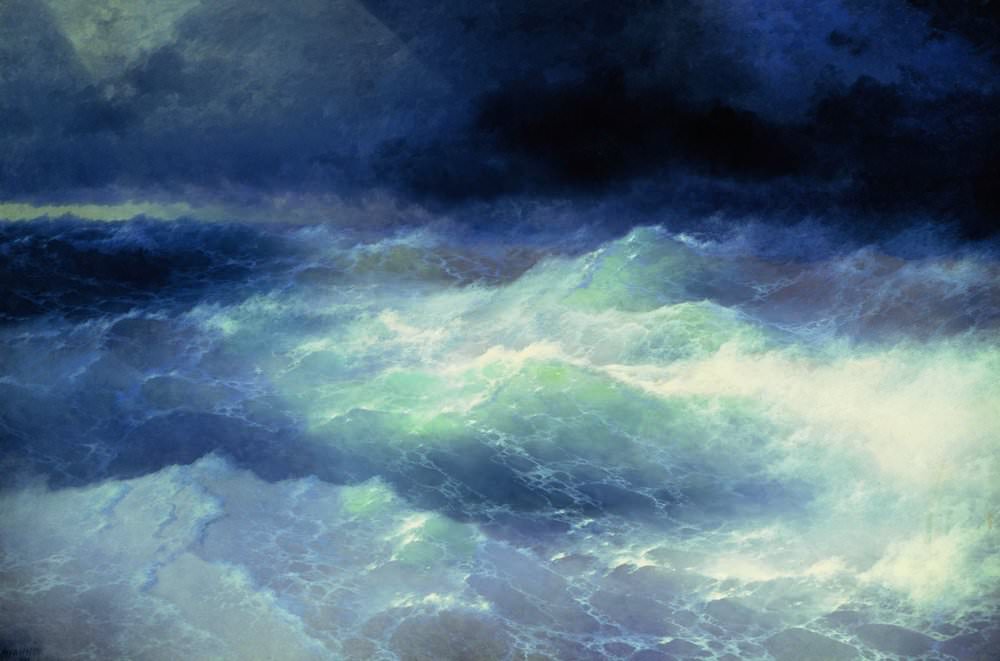
“Parmi les vagues” est l’une des peintures les plus spectaculaires d’Aïvazovski qui représente une tempête marine la nuit. Ce tableau est considéré comme le summum de l’habileté du peintre de marine car il est difficile d’imaginer une tâche plus difficile que l’image d’une immense colonne d’eau qui occupe la partie principale du tableau.

“Parmi les vagues” est une peinture d’une échelle impressionnante mesurant 285 X 429 cm, et sa taille souligne l’immensité et la puissance naturelle de la mer lors d’une tempête. Peut-être à cause de sa taille, la toile n’a pas été peinte dans son atelier, mais à la place, Ivan Aïvazovski l’a peinte dans la galerie d’art de Feodosia où elle se trouve aujourd’hui. En fait, la toile n’a été exposée nulle part ailleurs et n’a jamais quitté Feodosia. 

“Parmi les vagues” est la suite d’une œuvre distincte intitulée “La mer Noire” qui a été peinte en 1881.

Si vous regardez la peinture sous différents angles, le niveau de l’écume et la hauteur des vagues semblent changer.

Among the waves (Среди волн) by Ivan Aivazovsky (Иван Айвазовский)
Among the waves (Среди волн) by Ivan Aivazovsky (Иван Айвазовский) – 1898

Auteur : Ivan Aïvazovski (Иван Айвазовский) / Nom : Parmi les vagues (Среди волн) / Forme d’art : Peinture / Style d’art : Romantisme / Genre : Marine / Technique : Huile / Matière : Toile / Date de création : 1898 / Taille : 284 X 429 cm / Emplacement : Feodosia Art Gallery (nommé après d’IK Aivazovsky)

Aïvazovski avait déjà 81 ans lorsqu’il a peint la toile “Parmi les vagues” en 1898, et malgré son âge, il a créé la peinture en seulement 10 jours.

Au début, il a peint un petit bateau avec des marins qui ont pu s’échapper d’un navire en train de couler au centre de la toile, mais après une conversation avec un naval expérimenté, il l’a retiré. Aïvazovski était un peintre toujours à la recherche d’un maximum de réalisme et de véracité de ses œuvres et l’officier de marine avait fait remarquer qu’un si petit bateau n’aurait pas résisté à l’assaut de telles vagues et aurait coulé.

Pour créer la toile, une large gamme de couleurs claires, ainsi que des tons riches et profonds, ont été utilisés. Le résultat est que grâce à des nuances de couleurs incroyablement habilement sélectionnées, l’eau semble transparente et mouvante. C’est l’une des représentations artistiques les plus précises et les plus réalistes de la mer pendant une tempête.

Sur la toile, vous pouvez voir une mer orageuse roulée par des rafales de vent, de l’écume et la lumière argentée de la lune et des étoiles que vous ne pouvez pas voir. Une fine bande de couleur gris-bleu sur la gauche sépare la mer orageuse d’un ciel sombre et nuageux.

La peinture nous montre toute la beauté et la force d’une mer déchaînée permettant au spectateur d’en profiter sans objets tiers ni détails gênants.

J’espère que vous avez apprécié ce tableau autant que moi,

Vous pouvez également lire nos articles précédents sur d’autres peintures d’Ivan Aïvazovski

Si vous avez aimé cet article, abonnez-vous, mettez des likes, écrivez des commentaires !

Partager sur les réseaux sociaux

Découvrez nos derniers posts


© 2023 Akirill.com – All Rights Reserved

Discover the painting “Among The Waves” by Ivan Aivazovsky

Bilingual booksLire en FrançaisContact us
American LiteratureFrench LiteratureRussian Literature

“Among the Waves” is one of Aivazovsky’s most spectacular paintings which depicts a sea storm at night. This painting is considered the height of the skill of the marine painter because it is difficult to imagine a more difficult task than the image of a huge water column that occupies the main part of the painting.

“Among the Waves” is a painting of impressive scale measuring 285 X 429 cm, and its size emphasizes the immensity, and natural power of the sea during a storm. Maybe because of its size it was not painted in his workshop, but instead Ivan Aivazovsky painted “Among the Waves” in the art gallery of Feodosia where it remains today. Actually, the canvas was not exhibited anywhere else and never left Feodosia. 

“Among the Waves” is a continuation of a separate work called “The Black Sea” which was painted in 1881.

If you look at the painting from different angles, the level of foam and the height of the shafts appear to change.

Among the waves (Среди волн) by Ivan Aivazovsky (Иван Айвазовский)
Among the waves (Среди волн) by Ivan Aivazovsky (Иван Айвазовский) – 1898

Author: Ivan Aivazovsky (Иван Айвазовский) / Name: Among the waves (Среди волн) / Art form: Painting / Style of art: Romanticism / Genre: Marine / Technique: Oil / Material: Canvas / Date of creation: 1898 / Size: 284 X 429 cm / Location: Feodosia Art Gallery (named after I. K. Aivazovsky)

Aivazovsky was already 81 yeas old when he painted the canvas “Among the Waves” in 1898, and despite his age he created the painting in just 10 days.

At first he painted a small boat with sailors who were able to escape from a sinking ship in the center of the canvas but after a conversation with an experienced naval he removed it. Aivazovsky was a painter always striving for maximum realism and truthfulness of his works and the naval officer had remarked that such a small boat would not have withstood the onslaught of such waves and would have sunken. ecume

To create the canvas, a wide range lights colors, as well as rich, deep tones, was used.  The result thanks to an incredibly skillfully selected shades of colors is that the water seems transparent and moving. This is one of the most accurate and realistic artistic depictions of the sea during a storm.

On the canvas you can see an stormy sea rolling in gusts of wind, foam and the silvery light of the moon and stars which you cannot see. A thin strip of grayish-blue color on the left separates the stormy sea from a dark and cloudy sky.

The painting show us all the beauty and strength of a storming sea allowing the viewer to enjoy it without any third-party objects and distracting details.

I hope you enjoyed this painting as much as I did,

You can also read our earlier articles about other paintings by Ivan Aivazovsky

If you liked this article, subscribe , put likes, write comments!
Share on social networks
Check out Our Latest Posts


© 2023 Akirill.com – All Rights Reserved
Découvrez le tableau “La Mer Noire” d’Ivan Aïvazovski

Livres bilinguesRead in EnglishNous contacter
Littérature américaineLittérature françaiseLittérature russe

Ivan Aïvazovski (Иван Айвазовский) est le plus célèbre peintre de marine russe, un véritable poète de la mer dont les œuvres sont largement connues dans le monde entier.

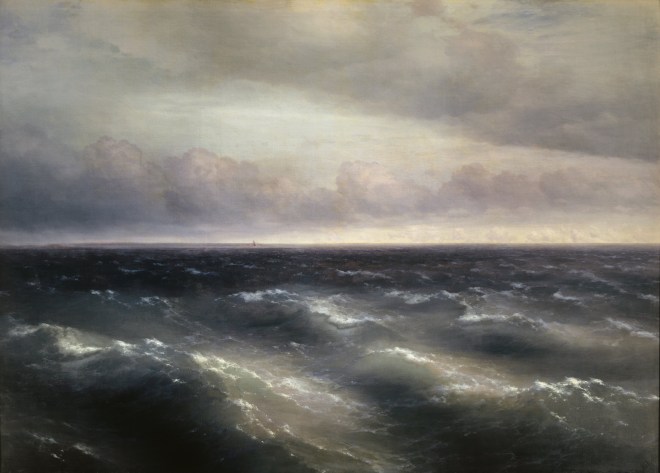
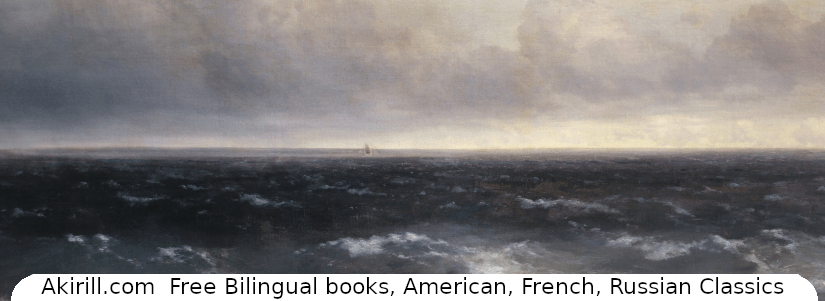
Le tableau “La mer Noire” (Черное море) qu’il a peint en 1881 est l’une de ses peintures les plus significatives, et est même considérée par beaucoup comme l’apogée de son travail. Il s’agit d’une large huile sur toile de 149 X 208 cm représentant la Mer Noire au moment du début d’une tempête. Peint dans le style du romantisme, ce tableau de marine se trouve aujourd’hui à la galerie nationale Tretiakov, à Moscou

Le tableau « La Mer Noire » est saisissant par son ampleur et sa profondeur. La mer semble si sauvage et indomptable, le bateau si petit.

Le premier nom du tableau était “Une tempête commence à éclater sur la mer Noire” et même s’il s’agit d’une toile large, ce n’est pas la plus grande des œuvres d’Aïvazovski. Il a peint une suite du tableau « La Mer Noire » dans une œuvre distincte intitulée “Parmi les vagues”. Celle ci peut être considérée comme une immense toile.

Dans le tableau, « La Mer Noire », la palette très habilement choisie par Ivan Aïvazovski, décrit la véritable essence de l’élément marin et l’origine du nom de la Mer Noire devient immédiatement claire.

Au premier plan, il y a la soi-disant «vague d’Aïvazovski». Il s’agit d’une vague avec des boucles de mousse, une vague translucide obtenue par la technique du glacis. L’eau a déjà pris une teinte plombée profonde, et les crêtes des vagues annoncent le début d’une tempête. 

Dans presque toutes les peintures marines, les personnages ne sont qu’un moyen de souligner la puissance des éléments, et au centre de la toile, on peut voir un bateau solitaire s’élever fièrement au-dessus de la surface de la mer, mais si loin et semblant si petit, tellement sans défense. Être par un tel temps en pleine mer est mortel. Connaissant la nature rude et imprévisible de la mer Noire, on ne peut que sympathiser avec les marins qui y sont entrés dans une tempête. 

Ce voilier peut être vu comme un symbole de l’insignifiance de l’homme face à l’univers et en même temps le signe d’une envie de voyager romantique.

Mais grâce à la ligne blanche frappante de l’horizon qui divise le tableau en deux, nous nous demandons maintenant si le temps va changer et offrir au voilier l’occasion de rejoindre ses côtes natales en toute sécurité.


En arrière-plan un ciel gris sombre couvert de nuages ​​menace une averse prolongée et un orage dangereux. 

En regardant la photo, on a l’impression d’être soi-même sur la mer Noire au moment de la tempête et on sent les éléments approcher.

J’espère que vous apprécierez ce tableau autant que moi

Vous pouvez également lire notre article précédent sur La 9ème Vague par Ivan Aivazovsky

Si vous avez aimé cet article, abonnez-vous, mettez des likes, écrivez des commentaires !

Partager sur les réseaux sociaux

Découvrez nos derniers posts


© 2023 Akirill.com – All Rights Reserved
Discover the painting “The Black Sea” by Ivan Aivazovsky

Bilingual booksLire en FrançaisContact us
American LiteratureFrench LiteratureRussian Literature

Ivan Aivazovsky (Иван Айвазовский) is the most famous Russian marine painter, a true poet of the sea whose works are widely known all over the world.

The canvas “The Black Sea” (Черное море) which he painted in 1881 is one of his most significant paintings, and is even is considered by many to be the pinnacle of his work. It is a wide oil on canvas of 149 X 208 cm depicting the Black Sea at the moment of the beginning of a storm. Painted in the romanticism style, this marina painting is now at the State Tretyakov gallery, in Moscow

The painting “The Black Sea” is striking in its scale and depth. The sea seems so wild and indomitable, the boat so tiny.

The first name of the painting was “A storm begins to break out on the Black Sea” and even though it is a wide canvas it is not the largest of Aivazovsky’s works.  He painted a continuation of the picture “The Black Sea” in a separate work called “Among the Waves”, and which can be considered a huge canvas.

In the painting, “The Black Sea”, the palette which is very skillfully chosen by Ivan Aivazovsky, describes the real essence of the sea element and the origin of the name of the Black Sea immediately becomes clear.

In the foreground there is the so-called “Aivazovsky’s wave”. This is a wave with foam curls, a translucent wave obtained by the glazing technique. The water has already taken on a deep leaden hue, and the crests of the waves show the beginning of a storm. 

In almost all marine paintings, people are just a way to emphasize the power of the elements, and in the center of the canvas we can see a lonely boat proudly rising above the sea surface, but so far and seeming so tiny, so defenseless. To be in such weather in the middle of the open sea is deadly. Knowing the harsh and unpredictable nature of the Black Sea, one can only sympathize with the sailors who got into a storm on it.

This sailboat can be seen as a symbol of the insignificance of man in front of the universe and at the same time a sign of a romantic wanderlust.

But thanks to the striking white line of the horizon which divides the painting in half we now wonder if the weather will change and provide an opportunity for the sailboat to get to its native shores safely.

 In the background a gloomy gray sky covered with clouds threatens a prolonged downpour and a dangerous thunderstorm. 

Looking at the picture, it feels like you yourself are on the Black Sea at the time of the storm and you feel the approaching elements.

I hope you enjoy this painting as much as I did

You can also read our earlier article about The 9th Wave by Ivan Aivazovsky

If you liked this article, subscribe , put likes, write comments!
Share on social networks
Check out Our Latest Posts


© 2023 Akirill.com – All Rights Reserved
The 9th Wave by Ivan Aivazovsky

Bilingual booksLire en FrançaisContact us
American LiteratureFrench LiteratureRussian Literature

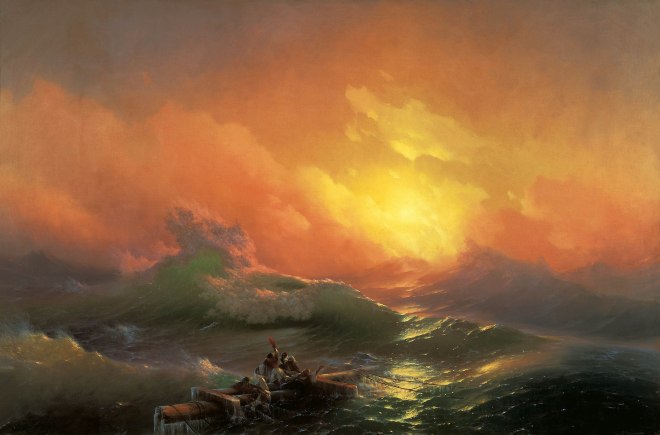
The canvas of “The 9th Wave” by Ivan Aivazovsky is recognized all over the world as an unsurpassed masterpiece and is one of the most famous work of this great Russian artist, who especially liked to paint on the marine theme. This painting is both an ode to the invincible and unpredictable water element and, the indestructible human spirit.

The canvas ‘The 9th Wave’ will not leave anyone indifferent, the 9th wave is a symbol of doom, the desire of survive is a symbol of hope. They create in the picture more than just a confrontation, they ask a question that the viewer has to answer.

The 9th wave is a symbol of fatal danger, the highest rise of a formidable, irresistible force. The symbol of the 9th wave comes from the old folk belief that during a sea storm the 9th wave is the strongest and most dangerous, often fatal. The term is often used in a figurative and metaphorical sense.

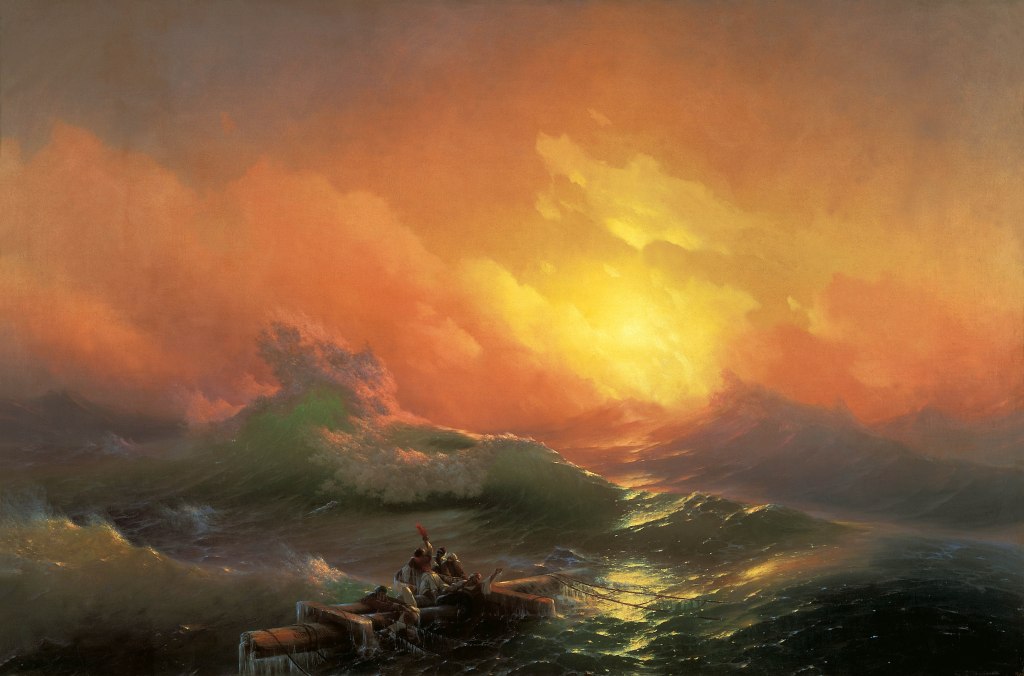
The artist painted “The 9th Wave” in 1850 in Feodosia and this canvas is perhaps the most outstanding work of art of the marine painter and of all Russian painting. It was painted in oil on canvas and measure 221 X 332cm. It was painted in only 11 days and was immediately bought by Nicholas I for the Hermitage. In 1897, the canvas was transferred to the collection of the State Russian Museum in St Petersburg where it is still today.

In the canvas the night storm has passed and now people are clinging the mast in their last strength in the struggle for their lives. They are exhausted and waiting to see what the new day will bring them. The painting does not depict the storm but its consequences.

It is believed that “The 9th Wave” was created according of the artist’s own recollections after surviving a shipwreck in the Bay of Biscay in 1844.

The main characteristic of the canvas is its duality. “The 9th Wave” canvas can be interpreted with a share of optimism in which men survived the shipwreck or it can be perceived as the triumph of the elements over man.

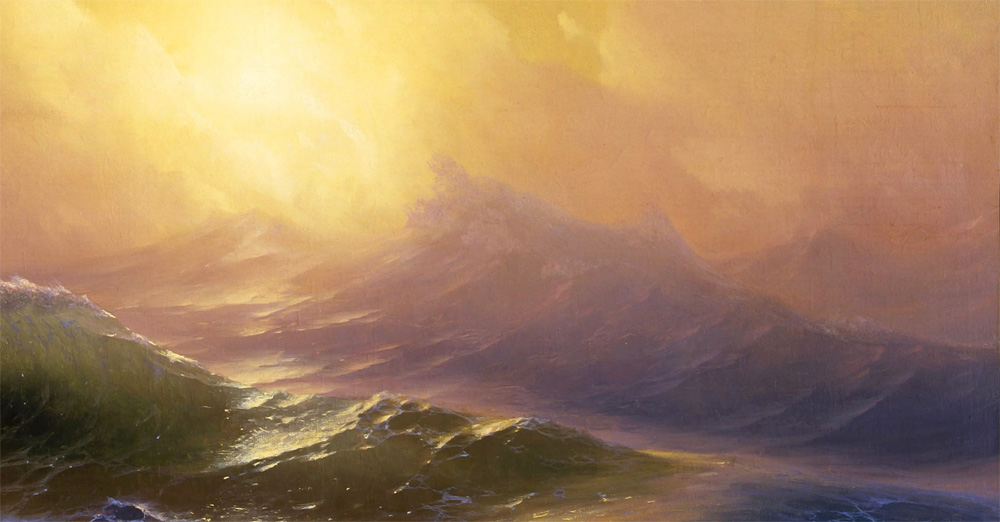
When we look at the canvas, we see the first rays of the sun breaking through which brings hope of survival to the sailors who have been wrecked.

The glare of the sun’s rays on the restless sea is so mysterious that it gives the canvas volume and realism. The coloring of the canvas is amazing and it is sometimes impossible to determine where the sea begins and the sky ends.

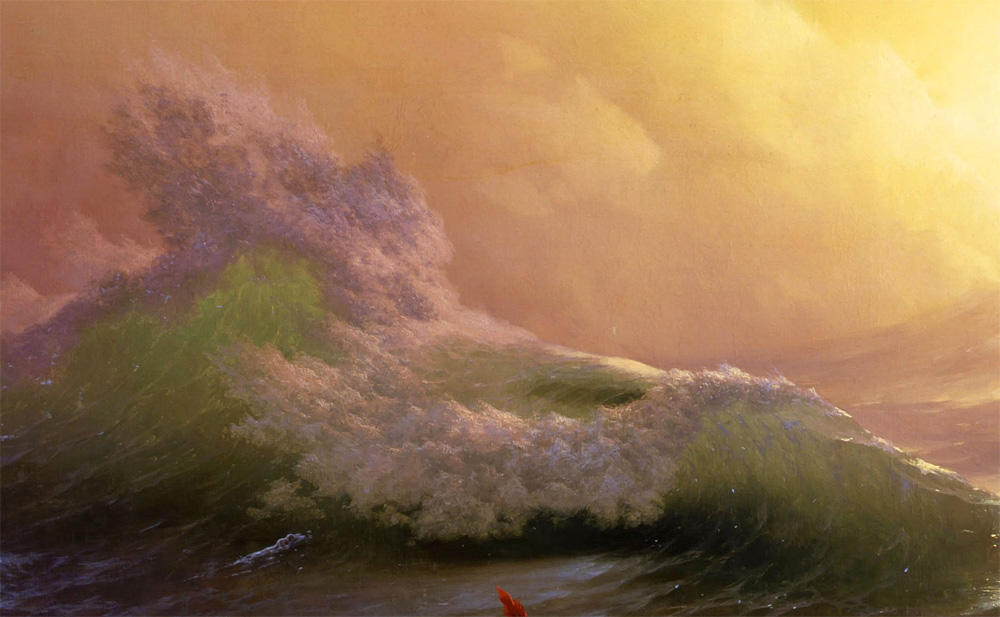
The image of the sea speaks of the last night storm which destroyed the ship, and the dark abyss of the waves brings fear. But the sea is not calm yet, we can see larges waves inflated by the wind. It seems that the waves oscillate, there the 9th wave, the huge last wave of the outgoing storm is coming and the survivors are waiting for it with fear.

The fragment of the mast is huge showing us the size of the sunken ship. It looks like a cross, which can be interpreted as a symbol of salvation or a symbol of crucifixion. On it are only a small handful of people showing us the size of the catastrophe and when we take into account the fact that the average crew of a ship at that time was more than a hundred people, the whole horror of the night storm is felt.

The red handkerchief which is waved by one of the surviving sailors may symbolize an antithesis to the white flag and people’s unwillingness to surrender or it can symbolize new blood

The picture on an emotional level shows the superiority of the elements over the fragile life of a person.

This canvas has now become legend itself and has been at many exhibitions held in different countries of the world I hope you enjoyed it.

You can also read our article about the painting “The Black Sea” by Ivan Aivazovsky

If you liked this article, subscribe , put likes, write comments!
Share on social networks
Check out Our Latest Posts

Sources

Analysis and description of Aivazovsky’s painting “The Ninth Wave”


© 2022 Akirill.com – All Rights Reserved
La 9ème Vague d’Ivan Aïvazovski

Livres bilinguesRead in EnglishNous contacter
Littérature américaineLittérature françaiseLittérature russe

La peinture de “La 9ème Vague” d’Ivan Aïvazovski est reconnue dans le monde entier comme un chef-d’œuvre inégalé et est l’une des œuvres les plus célèbres de ce grand artiste russe, qui aimait particulièrement peindre le thème marin. Ce tableau est à la fois une ode à l’invincible et imprévisible élément de l’eau et, à l’indestructible esprit humain .

Le tableau ‘La 9ème Vague’ ne laissera personne indifférent, la 9ème vague est un symbole de malheur, le désir de survivre est un symbole d’espoir. Ils créent dans l’image plus qu’une simple confrontation, ils posent une question à laquelle le spectateur doit répondre.

La 9ème vague est un symbole de danger mortel, la plus haute montée d’une force redoutable et irrésistible. Le symbolisme de la 9ème vague vient de la vieille croyance populaire selon laquelle, lors d’une tempête en mer, la 9ème vague est la plus forte et la plus dangereuse, souvent mortelle. Le terme est souvent utilisé dans un sens figuratif et métaphorique.

L’artiste a peint “La 9ème Vague” en 1850 à Feodosia et cette toile est peut-être l’œuvre d’art la plus remarquable du peintre de marine et de toute la peinture russe. Elle a été peinte à l’huile sur toile et mesure 221 X 332cm. La toile a été peinte en seulement 11 jours et a été immédiatement acheté par Nicolas Ier pour l’Ermitage. En 1897, ‘la 9ème Vague” a été transférée à la collection du Musée d’État Russe de Saint-Pétersbourg où elle se trouve encore aujourd’hui.

Sur la toile, la tempête nocturne est passée et maintenant les gens s’accrochent au mât avec leurs dernières forces dans la lutte pour leur vie. Ils sont épuisés et attendent de voir ce que le nouveau jour leur apportera. La toile ne représente pas la tempête mais ses conséquences.

On pense que la “9ème Vague” a été créée selon les propres souvenirs de l’artiste après avoir survécu à un naufrage dans le golfe de Gascogne en 1844.

La principale caractéristique de la peinture est sa dualité. La peinture de “La 9ème Vague” peut être interprétée avec une part d’optimisme dans laquelle les hommes ont survécu au naufrage ou elle peut être perçue comme le triomphe des éléments sur l’homme.

Quand on regarde le tableau, on voit percer les premiers rayons du soleil qui apportent l’espoir de survie aux marins naufragés.

L’éclat des rayons du soleil sur la mer agitée est si mystérieux qu’il donne au tableau volume et réalisme. La coloration de la toile est étonnante et il est parfois impossible de déterminer où commence la mer et où finit le ciel.

L’image de la mer parle de la dernière tempête nocturne qui a détruit le navire, et l’abîme sombre des vagues fait peur. Mais la mer n’est pas encore calme, on voit de grosses vagues gonflées par le vent. Il semble que les vagues oscillent, là, la 9ème vague, l’énorme dernière vague de la tempête sortante arrive et les survivants l’attendent avec peur.

Le fragment du mât est énorme nous montrant la taille du navire coulé. Il ressemble à une croix, qui peut être interprétée comme un symbole de salut ou un symbole de crucifixion. Il n’y a qu’une petite poignée de personnes ce qui nous montrent l’ampleur de la catastrophe et quand on tient compte du fait que l’équipage moyen d’un navire à cette époque était de plus d’une centaine de personnes, toute l’horreur de la tempête nocturne se fait sentir .

Le mouchoir rouge qui est agité par l’un des marins survivants peut symboliser une antithèse au drapeau blanc et la réticence des gens à se rendre ou il peut symboliser du sang neuf.

L’image sur le plan émotionnel montre la supériorité des éléments sur la vie fragile d’une personne.

Cette toile est maintenant devenue une légende elle-même et a fait l’objet de nombreuses expositions organisées dans différents pays du monde. J’espère qu’elle vous a plu.

Vous pouvez également lire notre article sur le tableau “La Mer Noire” d’Ivan Aïvazovski

Si vous avez aimé cet article, abonnez-vous, mettez des likes, écrivez des commentaires !
Partager sur les réseaux sociaux
Découvrez nos derniers messages

Sources

Analysis and description of Aivazovsky’s painting “The Ninth Wave”


© 2022 Akirill.com – All Rights Reserved