On this site we hope to help you learn, and to remove the difficulties caused by the difference of culture and language. Sur ce site nous espérons vous aider à apprendre, et à enlever la barrière causée par les différents languages et cultures.
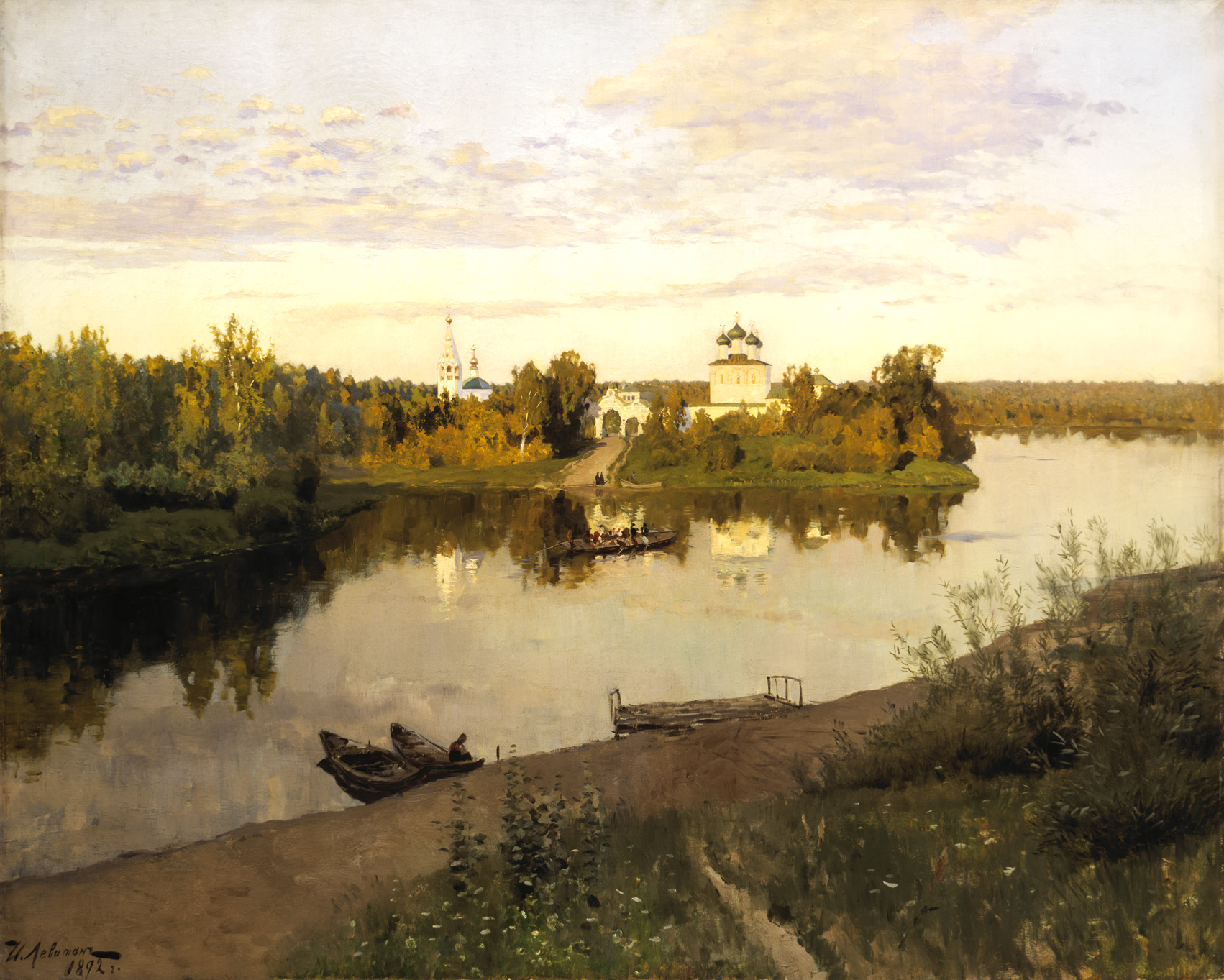
« Cloches du soir » (Вечерний звон) est un tableau du peintre russe Isaac Levitan (Исаак Ильич Левитан), qui est un maître reconnu du paysage lyrique. Il s’agit d’une belle huile sur toile de 87 X 107,6 cm qui a été peinte en 1892 et qui se trouve à la Galerie nationale Tretiakov depuis 1918. Ce tableau est aussi appelé « Monastère pour les fêtes » (Монастырь под праздник). “Cloches du soir” est considéré par certains chercheurs comme une variante du tableau antérieur représentant un monastère similaire et appelé “Couvent tranquil” “Тихая обитель” (1890).
Le critique d’art Vladimir Petrov a déclaré que malgré le motif similaire au “Couvent tranquil”, le tableau “Cloches du soir” “est néanmoins dépourvu de secondarité et a son propre charme unique, son propre” accord “”
Selon Sofya Prorokova, Levitan chantait souvent la chanson “Cloches du soir” du compositeur Alexander Alyabyev et cela pourrait être la raison du titre du tableau. Une autre version donnée, est que Levitan aurait pu choisir ce nom sous l’influence du recueil de poèmes de Yakov Polonsky “Cloches du soir”, publié en 1890.
« Cloches du soir » d’Isaac Levitan
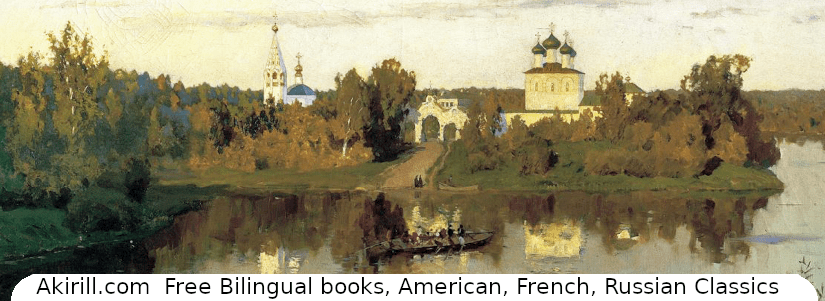
Devant le spectateur se trouve une large rivière qui semble couper l’image en diagonale. L’eau est calme. Des nuages roses du soir, peints dans des teintes d’or rose par le soleil couchant, flottent solennellement dans le ciel et se reflètent dans l’eau.
« Cloches du soir » d’Isaac Levitan partie monastère
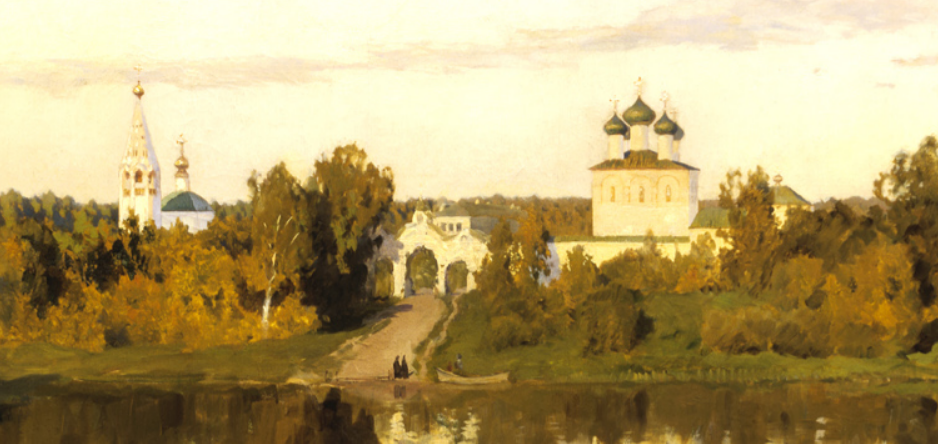
Sur la rive opposée, envahie par la forêt, il y a un monastère avec un haut clocher qui s’élève au-dessus de la forêt. Il désigne la verticale métaphysique de la vie écrite par l’artiste : de la terre au ciel, du péché à la sainteté.
Les derniers rayons de soleil illuminent les murs blancs comme neige de son temple et de son clocher, les faisant paraître dorés. Grâce à leur reflet sur la surface de la rivière, l’accent mis sur les bâtiments du temple est rendu encore plus lumineux.
« Cloches du soir » d’Isaac Levitan partie reflection
Habituellement, les gens sont rares dans les peintures de Levitan, mais dans ce travail, afin d’améliorer ses caractéristiques réalistes, l’artiste a représenté un homme au croisement sur la rive proche dans un bateau, des gens sur un ferry au centre de la rivière, se dépêchant au service du soir, et deux moines les rencontrant.
« Cloches du soir » d’Isaac Levitan partie personnes
Description du tableau sur le site de la galerie Tretiakov :
« Les plans spatiaux du tableau sont présentés comme trois mondes différents. Le plus proche est un haut talus couvert d’ombre, d’où l’artiste regarde autour de lui. De l’autre côté du fleuve, naissant d’un jeu de mirages de reflets, dans les rayons du soleil couchant, une vision merveilleuse apparaît – un monastère. Enfin, le regard s’élève vers le ciel en suivant les nuages qui se fondent dans une douce lueur dorée. L’artiste transmet le désir de l’âme à ce monde enchanté de lumières et de sons qui disparaissent dans le lointain. Interrompant le mouvement vers le ciel avec des rythmes transversaux – la ligne du rivage, des ponts, un bateau, il crée le sentiment d’une image insaisissable. Dans cette distance séduisante, on ne peut que s’efforcer sans fin et langoureusement dans les rêves.
J’espère que vous avez apprécié ce tableau autant que moi.
Si vous avez aimé cet article, abonnez-vous, mettez des likes, écrivez des commentaires !
“Evening Bells” (Вечерний звон) is a painting by the Russian painter Isaac Levitan (Исаак Ильич Левитан), who is a recognized master of the lyrical landscape. It is a beautiful oil on canvas of 87 X 107.6 cm which was painted in 1892 and has been in the State Tretyakov Gallery since1918. This painting is also called “Monastery for the holidays” (Монастырь под праздник). “Evening Bells” is considered by some researchers as a variant of the earlier painting depicting a similar monastery and called ” Quiet Abode ” «Тихая обитель» (1890).
Art critic Vladimir Petrov said that despite the motif similar to the “Quiet Convent”, the painting “Evening Bells” “nevertheless is devoid of secondariness, and has its own, unique charm, its own” chord “”
According to Sofya Prorokova, Levitan often sand the song “Evening Bells” by composer Alexander Alyabyev and it might be the reason of the title of the painting. Another version given, is that Levitan could have chosen this name under the influence of Yakov Polonsky ‘s collection of poems “Evening Bells”, published in 1890.
“Evening Bells” by Isaac Levitan
In front of the viewer is a wide river which seems to cut the picture diagonally. The water is calm. Pink evening clouds painted in rose-gold hues by the setting sun, float solemnly in the sky and are reflected in the water.
“Evening Bells” by Isaac Levitan part monastery
On the opposite bank which is overgrown with forest, there is a monastery with a high bell tower soaring above the forest. It denotes the metaphysical vertical of life written by the artist: from earth to heaven, from sinfulness to holiness.
The last rays of sun brightly light the snow-white walls of his temple and bell tower, making them seem golden. Thanks to their reflection in the surface of the river, the emphasis on temple buildings is made even brighter.
“Evening Bells” by Isaac Levitan part reflection
Usually people are a rarity in Levitan’s paintings, but in this work, in order to enhance its realistic features, the artist depicted a man at the crossing on the near bank in a boat, people on a ferry in the center of the river, hurrying to the evening service, and two monks meeting them.
“Evening Bells” by Isaac Levitan part people
Description of the painting on the website of the Tretyakov Gallery:
“The spatial plans of the painting are presented as three different worlds. The near one is a high bank covered with shadow, from which the artist looks around. Across the river, growing out of a mirage game of reflections, in the rays of the setting sun, a wonderful vision appears – a monastery. Finally, the gaze rises into the sky following the clouds melting in a soft golden glow. The artist conveys the desire of the soul to this enchanted world of light and sounds disappearing into the distance. Interrupting the movement towards the sky with transverse rhythms – the line of the shore, bridges, a boat, he creates a feeling of an elusive image. In this alluring distance, one can only endlessly , languidly strive in dreams .
I hope you enjoyed this painting as much as I did.
If you liked this article, subscribe , put likes, write comments!
“Robinson Crusoe” écrit en six mois ou moins par Daniel Defoe, a été publié pour la première fois en avril 1719 et a marqué le début de la fiction réaliste en tant que genre littéraire. À la fin du XIXe siècle, ce livre avait plus d’éditions, de dérivés et de traductions que tout autre livre de la littérature occidentale.
Le livre s’est avéré si populaire que pendant la Seconde Guerre mondiale, les personnes qui ont décidé de rester et de se cacher dans les ruines de la ville de Varsovie occupée par les Allemands en 1945 ont été, après leur sauvetage par l’Armée rouge, appelées les Robinson Crusoes de Varsovie.
“Robinson Crusoe” a été inspiré par des histoires de naufragés de la vie réelle. On pense que la source d’inspiration la plus probable est le marin écossais Alexander Selkirk, qui a passé quatre ans sur l’île inhabitée de Más a Tierra dans les îles Juan Fernández au large de la côte chilienne, laquelle a été rebaptisée île Robinson Crusoé en 1966. Autres sources possibles pour le récit comprennent “Hayy ibn Yaqdhan” d’Ibn Tufail, un roman philosophique du XIIe siècle qui se déroule sur une île déserte, et le marin espagnol du XVIe siècle Pedro Serrano qui a été abandonné pendant sept ou huit ans sur une petite île déserte après avoir fait naufrage dans le années 1520.
Il y a deux thèmes principaux. Le premier est la lutte contre la nature et la création ou la réplication de la société. Cela se fait par l’utilisation de l’agriculture et Crusoe crée même une hiérarchie politique rudimentaire. Il y a aussi un thème religieux qui raconte comment Robinson se rapproche de Dieu. Il n’écoute pas les sermons dans une église mais passe plutôt du temps seul dans la nature avec seulement une Bible à lire. À cela s’ajoute sa description de la relation maître-serviteur idéalisée entre lui et Friday, qui peut également être vue en termes d’assimilation culturelle. Crusoe représente l’Européen “éclairée” et Friday est le “sauvage”. Pour Crusoe, Friday ne peut être racheté de ses mœurs culturelles que par l’assimilation de la culture européenne, mais Defoe utilise également Friday pour critiquer la colonisation espagnole des Amériques.
“Robinson Crusoe” a de nombreuses bandes dessinées, scènes, films et adaptations animées. La première bande dessinée a été réalisée par Classics Illustrated en 1943. La première adaptation scénique a été jouée en 1796 au théâtre Royal de Londres. En 1927, un film dramatique britannique muet produit par MA Wetherell est sorti. Le premier film d’animation est sorti en 1988 et la première adaptation télévisée était un film français réalisé en 1964 et mettant en vedette Robert Hoffmann.
Aperçu
“Robinson Crusoe” est présenté comme une autobiographie du personnage principal qui est un naufragé, lequel passe 28 ans sur une île déserte tropicale isolée. Defoe détaille la lutte d’un individu pour survivre dans un environnement fondamentalement hostile. Dans le cadre de son existence quotidienne, Robinson Crusoé fait face à de nombreuses difficultés, notamment la famine, la maladie et même le danger des cannibales, mais il récupère ce qu’il peut du naufrage et se fournit un abri ainsi que des meubles et des outils rudimentaires. Robinson ne rumine jamais au sujet de son isolement, préférant occuper son temps de manière productive et réussir dans un environnement peu prometteur. Il est un exemple du triomphe de l’esprit humain.
En 1632, je naquis à York, d’une bonne famille, mais qui n’était point de ce pays. Mon père, originaire de Brême, établi premièrement à Hull, après avoir acquis l’aisance et s’être retiré du commerce, était venu résider à York où il s’était allié, par ma mère, à la famille Robinson, une des meilleures de la province. C’est à cette alliance que je devais mon double nom de Robinson-Kreutznaer; mais, aujourd’hui, par une corruption de mots assez commune en Angleterre, on nous nomme, nous nous nommons et signons Crusoé. C’est ainsi que mes compagnons m’ont toujours appelé.
J’avais deux frères: l’aîné, lieutenant-colonel, en Flandre, d’un régiment d’infanterie anglaise, autrefois commandé par le fameux colonel Lockhart, fut tué à la bataille de Dunkerque contre les Espagnols; que devint l’autre? j’ignore quelle fut sa destinée; mon père et ma mère ne connurent pas mieux la mienne.
Troisième fils de la famille, et n’ayant appris aucun métier, ma tête commença de bonne heure à se remplir de pensées vagabondes. Mon père, qui était un bon vieillard, m’avait donné toute la somme de savoir qu’en général on peut acquérir par l’éducation domestique et dans une école gratuite. Il voulait me faire avocat; mais mon seul désir était d’aller sur mer, et cette inclination m’entraînait si résolument contre sa volonté et ses ordres, et malgré même toutes les prières et les sollicitations de ma mère et de mes parents, qu’il semblait qu’il y eût une fatalité dans cette propension naturelle vers un avenir de misère.
Mon père, homme grave et sage, me donnait de sérieux et d’excellents conseils contre ce qu’il prévoyait être mon dessein. Un matin, il m’appela dans sa chambre, où il était retenu par la goutte, et me réprimanda chaleureusement à ce sujet:—«Quelle autre raison as-tu, me dit-il, qu’un penchant aventureux, pour abandonner la maison paternelle et ta patrie, où tu pourrais être poussé, et où tu as l’assurance de faire ta fortune avec de l’application et de l’industrie, et l’assurance d’une vie d’aisance et de plaisir? Il n’y a que les hommes dans l’adversité ou les ambitieux qui s’en vont chercher aventure dans les pays étrangers, pour s’élever par entreprise et se rendre fameux par des actes en dehors de la voie commune. Ces choses sont de beaucoup trop au-dessus ou trop au-dessous de toi; ton état est le médiocre, ou ce qui peut être appelé la première condition du bas étage; une longue expérience me l’a fait reconnaître comme le meilleur dans le monde et le plus convenable au bonheur. Il n’est en proie ni aux misères, ni aux peines, ni aux travaux, ni aux souffrances des artisans: il n’est point troublé par l’orgueil, le luxe, l’ambition et l’envie des hautes classes. Tu peux juger du bonheur de cet état; c’est celui de la vie que les autres hommes jalousent; les rois, souvent, ont gémi des cruelles conséquences d’être nés pour les grandeurs, et ont souhaité d’être placés entre les deux extrêmes, entre les grands et les petits; enfin le sage l’a proclamé le juste point de la vraie félicité en implorant le ciel de le préserver de la pauvreté et de la richesse.
«Remarque bien ceci, et tu le vérifieras toujours: les calamités de la vie sont le partage de la plus haute et de la plus basse classe du genre humain; la condition moyenne éprouve le moins de désastres, et n’est point exposée à autant de vicissitudes que le haut et le bas de la société; elle est même sujette à moins de maladies et de troubles de corps et d’esprit que les deux autres, qui, par leurs débauches, leurs vices et leurs excès, ou par un trop rude travail, le manque du nécessaire, une insuffisante nourriture et la faim, attirent sur eux des misères et des maux, naturelle conséquence de leur manière de vivre. La condition moyenne s’accommode le mieux de toutes les vertus et de toutes les jouissances: la paix et l’abondance sont les compagnes d’une fortune médiocre. La tempérance, la modération, la tranquillité, la santé, la société, tous les agréables divertissements et tous les plaisirs désirables sont les bénédictions réservées à ce rang. Par cette voie, les hommes quittent le monde d’une façon douce, et passent doucement et uniment à travers, sans être accablés de travaux des mains ou de l’esprit; sans être vendus à la vie de servitude pour le pain de chaque jour; sans être harassés par des perplexités continuelles qui troublent la paix de l’âme et arrachent le corps au repos; sans être dévorés par les angoisses de l’envie ou la secrète et rongeante convoitise de l’ambition; au sein d’heureuses circonstances, ils glissent tout mollement à travers la société, et goûtent sensiblement les douceurs de la vie sans les amertumes, ayant le sentiment de leur bonheur et apprenant, par l’expérience journalière, à le connaître plus profondément.»
Ensuite il me pria instamment, et de la manière la plus affectueuse, de ne pas faire le jeune homme:—«Ne va pas te précipiter, me disait-il, au milieu des maux contre lesquels la nature et ta naissance semblent t’avoir prémuni; tu n’es pas dans la nécessité d’aller chercher ton pain; je te veux du bien, je ferai tous mes efforts pour te placer parfaitement dans la position de la vie qu’en ce moment je te recommande. Si tu n’étais pas aise et heureux dans le monde, ce serait par ta destinée ou tout à fait par l’erreur qu’il te faut éviter; je n’en serais en rien responsable, ayant ainsi satisfait à mes devoirs en t’éclairant sur des projets que je sais être ta ruine. En un mot, j’accomplirais franchement mes bonnes promesses si tu voulais te fixer ici suivant mon souhait, mais je ne voudrais pas tremper dans tes infortunes en favorisant ton éloignement. N’as-tu pas l’exemple de ton frère aîné, auprès de qui j’usai autrefois des mêmes instances pour le dissuader d’aller à la guerre des Pays-Bas, instances qui ne purent l’emporter sur ses jeunes désirs le poussant à se jeter dans l’armée, où il trouva la mort? Je ne cesserai jamais de prier pour toi, toutefois j’oserais te prédire, si tu faisais ce coup de tête, que Dieu ne te bénirait point, et, que, dans l’avenir, manquant de toute assistance, tu aurais toute la latitude de réfléchir sur le mépris de mes conseils.»
Je remarquai, vers la dernière partie de ce discours, qui était véritablement prophétique, quoique je ne suppose pas que mon père en ait eu le sentiment; je remarquai, dis-je, que des larmes coulaient abondamment sur sa face, surtout lorsqu’il me parla de la perte de mon frère, et qu’il était si ému, en me prédisant que j’aurais tout le loisir de me repentir, sans avoir personne pour m’assister, qu’il s’arrêta court, puis ajouta:—«J’ai le cœur trop plein, je ne saurais t’en dire davantage.»
“Robinson Crusoe” written in six months or less by Daniel Defoe, was first published on April 1719 and marked the beginning of realistic fiction as a literary genre. By the end of the 19th century this book had more editions, spin-off and translations than any other book of western literature.
The book proved to be so popular that during World War II, people who decided to stay and hide in the ruins of the German-occupied city of Warsaw in 1945 were, after after their rescue by the Red Army, called the Robinson Crusoes of Warsaw.
“Robinson Crusoe” was inspired by stories of real-life castaways. The most probable source of inspiration is thought to be Scottish sailor Alexander Selkirk, who spent four years on the uninhabited island of Más a Tierra in the Juan Fernández Islands off the Chilean coast which one, was renamed Robinson Crusoe Island in 1966. Other possible sources for the narrative include Ibn Tufail’s “Hayy ibn Yaqdhan” a twelfth-century philosophical novel which is set on a desert island, and Spanish sixteenth-century sailor Pedro Serrano who was marooned for seven or eight years on a small desert island after shipwrecking in the 1520s.
There are two main themes. The first is the fight against nature and the creation or replication of society. This is done through the use agriculture and Crusoe even creates a rudimentary political hierarchy. There is also a religious theme which tells the story of how Robinson becomes closer to God. He doesn’t listen to sermons in a church but instead he spends time alone amongst nature with only a Bible to read. Added to that is his depiction of the idealized master-servant relationship between himself and Friday which can also be seen in terms of cultural assimilation. Crusoe represents the “enlightened” European and Friday is the “savage”. For Crusoe, Friday can only be redeemed from his cultural manners through assimilation into the European culture, but Defoe also uses Friday to criticize the Spanish colonization of the Americas.
“Robinson Crusoe” has many comics, stage, films, and animated adaptations. The first comic was done by Classics Illustrated in 1943. The first stage adaptation was played in 1796 at the theatre Royal in London. In 1927, a silent British drama film produced by M. A. Wetherell came out. The first animated came out in 1988 and the first TV adaptation was a French film made in 1964 and staring Robert Hoffmann.
Overview
“Robinson Crusoe” is presented as an autobiography of the title character who is a castaway who spends 28 years on a remote tropical desert island. Defoe details an individual’s struggle to survive in basically hostile surroundings. As part of his day-to-day existence, Robinson Crusoe faces many hardships including starvation, illness, and even danger from cannibals, but he salvages what he can from the shipwreck and provides himself with shelter and rudimentary furniture and tools. Robinson never broods about his isolation preferring to occupy his time productively and succeed in an unpromising environment. He is an example of the triumph of the human spirit.
I was born in the year 1632, in the city of York, of a good family, though not of that country, my father being a foreigner of Bremen, who settled first at Hull. He got a good estate by merchandise, and leaving off his trade, lived afterwards at York, from whence he had married my mother, whose relations were named Robinson, a very good family in that country, and from whom I was called Robinson Kreutznaer; but, by the usual corruption of words in England, we are now called—nay we call ourselves and write our name—Crusoe; and so my companions always called me.
I had two elder brothers, one of whom was lieutenant-colonel to an English regiment of foot in Flanders, formerly commanded by the famous Colonel Lockhart, and was killed at the battle near Dunkirk against the Spaniards. What became of my second brother I never knew, any more than my father or mother knew what became of me.
Being the third son of the family and not bred to any trade, my head began to be filled very early with rambling thoughts. My father, who was very ancient, had given me a competent share of learning, as far as house-education and a country free school generally go, and designed me for the law; but I would be satisfied with nothing but going to sea; and my inclination to this led me so strongly against the will, nay, the commands of my father, and against all the entreaties and persuasions of my mother and other friends, that there seemed to be something fatal in that propensity of nature, tending directly to the life of misery which was to befall me.
My father, a wise and grave man, gave me serious and excellent counsel against what he foresaw was my design. He called me one morning into his chamber, where he was confined by the gout, and expostulated very warmly with me upon this subject. He asked me what reasons, more than a mere wandering inclination, I had for leaving father’s house and my native country, where I might be well introduced, and had a prospect of raising my fortune by application and industry, with a life of ease and pleasure. He told me it was men of desperate fortunes on one hand, or of aspiring, superior fortunes on the other, who went abroad upon adventures, to rise by enterprise, and make themselves famous in undertakings of a nature out of the common road; that these things were all either too far above me or too far below me; that mine was the middle state, or what might be called the upper station of low life, which he had found, by long experience, was the best state in the world, the most suited to human happiness, not exposed to the miseries and hardships, the labour and sufferings of the mechanic part of mankind, and not embarrassed with the pride, luxury, ambition, and envy of the upper part of mankind. He told me I might judge of the happiness of this state by this one thing—viz. that this was the state of life which all other people envied; that kings have frequently lamented the miserable consequence of being born to great things, and wished they had been placed in the middle of the two extremes, between the mean and the great; that the wise man gave his testimony to this, as the standard of felicity, when he prayed to have neither poverty nor riches.
He bade me observe it, and I should always find that the calamities of life were shared among the upper and lower part of mankind, but that the middle station had the fewest disasters, and was not exposed to so many vicissitudes as the higher or lower part of mankind; nay, they were not subjected to so many distempers and uneasinesses, either of body or mind, as those were who, by vicious living, luxury, and extravagances on the one hand, or by hard labour, want of necessaries, and mean or insufficient diet on the other hand, bring distemper upon themselves by the natural consequences of their way of living; that the middle station of life was calculated for all kind of virtue and all kind of enjoyments; that peace and plenty were the handmaids of a middle fortune; that temperance, moderation, quietness, health, society, all agreeable diversions, and all desirable pleasures, were the blessings attending the middle station of life; that this way men went silently and smoothly through the world, and comfortably out of it, not embarrassed with the labours of the hands or of the head, not sold to a life of slavery for daily bread, nor harassed with perplexed circumstances, which rob the soul of peace and the body of rest, nor enraged with the passion of envy, or the secret burning lust of ambition for great things; but, in easy circumstances, sliding gently through the world, and sensibly tasting the sweets of living, without the bitter; feeling that they are happy, and learning by every day’s experience to know it more sensibly.
After this he pressed me earnestly, and in the most affectionate manner, not to play the young man, nor to precipitate myself into miseries which nature, and the station of life I was born in, seemed to have provided against; that I was under no necessity of seeking my bread; that he would do well for me, and endeavour to enter me fairly into the station of life which he had just been recommending to me; and that if I was not very easy and happy in the world, it must be my mere fate or fault that must hinder it; and that he should have nothing to answer for, having thus discharged his duty in warning me against measures which he knew would be to my hurt; in a word, that as he would do very kind things for me if I would stay and settle at home as he directed, so he would not have so much hand in my misfortunes as to give me any encouragement to go away; and to close all, he told me I had my elder brother for an example, to whom he had used the same earnest persuasions to keep him from going into the Low Country wars, but could not prevail, his young desires prompting him to run into the army, where he was killed; and though he said he would not cease to pray for me, yet he would venture to say to me, that if I did take this foolish step, God would not bless me, and I should have leisure hereafter to reflect upon having neglected his counsel when there might be none to assist in my recovery.
I observed in this last part of his discourse, which was truly prophetic, though I suppose my father did not know it to be so himself—I say, I observed the tears run down his face very plentifully, especially when he spoke of my brother who was killed: and that when he spoke of my having leisure to repent, and none to assist me, he was so moved that he broke off the discourse, and told me his heart was so full he could say no more to me.
I was sincerely affected with this discourse, and, indeed, who could be otherwise? and I resolved not to think of going abroad any more, but to settle at home according to my father’s desire. But alas! a few days wore it all off; and, in short, to prevent any of my father’s further importunities, in a few weeks after I resolved to run quite away from him. However, I did not act quite so hastily as the first heat of my resolution prompted; but I took my mother at a time when I thought her a little more pleasant than ordinary, and told her that my thoughts were so entirely bent upon seeing the world that I should never settle to anything with resolution enough to go through with it, and my father had better give me his consent than force me to go without it; that I was now eighteen years old, which was too late to go apprentice to a trade or clerk to an attorney; that I was sure if I did I should never serve out my time, but I should certainly run away from my master before my time was out, and go to sea; and if she would speak to my father to let me go one voyage abroad, if I came home again, and did not like it, I would go no more; and I would promise, by a double diligence, to recover the time that I had lost.
This put my mother into a great passion; she told me she knew it would be to no purpose to speak to my father upon any such subject; that he knew too well what was my interest to give his consent to anything so much for my hurt; and that she wondered how I could think of any such thing after the discourse I had had with my father, and such kind and tender expressions as she knew my father had used to me; and that, in short, if I would ruin myself, there was no help for me; but I might depend I should never have their consent to it; that for her part she would not have so much hand in my destruction; and I should never have it to say that my mother was willing when my father was not.
Though my mother refused to move it to my father, yet I heard afterwards that she reported all the discourse to him, and that my father, after showing a great concern at it, said to her, with a sigh, “That boy might be happy if he would stay at home; but if he goes abroad, he will be the most miserable wretch that ever was born: I can give no consent to it.”
It was not till almost a year after this that I broke loose, though, in the meantime, I continued obstinately deaf to all proposals of settling to business, and frequently expostulated with my father and mother about their being so positively determined against what they knew my inclinations prompted me to. But being one day at Hull, where I went casually, and without any purpose of making an elopement at that time; but, I say, being there, and one of my companions being about to sail to London in his father’s ship, and prompting me to go with them with the common allurement of seafaring men, that it should cost me nothing for my passage, I consulted neither father nor mother any more, nor so much as sent them word of it; but leaving them to hear of it as they might, without asking God’s blessing or my father’s, without any consideration of circumstances or consequences, and in an ill hour, God knows, on the 1st of September 1651, I went on board a ship bound for London. Never any young adventurer’s misfortunes, I believe, began sooner, or continued longer than mine. The ship was no sooner out of the Humber than the wind began to blow and the sea to rise in a most frightful manner; and, as I had never been at sea before, I was most inexpressibly sick in body and terrified in mind. I began now seriously to reflect upon what I had done, and how justly I was overtaken by the judgment of Heaven for my wicked leaving my father’s house, and abandoning my duty. All the good counsels of my parents, my father’s tears and my mother’s entreaties, came now fresh into my mind; and my conscience, which was not yet come to the pitch of hardness to which it has since, reproached me with the contempt of advice, and the breach of my duty to God and my father.
All this while the storm increased, and the sea went very high, though nothing like what I have seen many times since; no, nor what I saw a few days after; but it was enough to affect me then, who was but a young sailor, and had never known anything of the matter. I expected every wave would have swallowed us up, and that every time the ship fell down, as I thought it did, in the trough or hollow of the sea, we should never rise more; in this agony of mind, I made many vows and resolutions that if it would please God to spare my life in this one voyage, if ever I got once my foot upon dry land again, I would go directly home to my father, and never set it into a ship again while I lived; that I would take his advice, and never run myself into such miseries as these any more. Now I saw plainly the goodness of his observations about the middle station of life, how easy, how comfortably he had lived all his days, and never had been exposed to tempests at sea or troubles on shore; and I resolved that I would, like a true repenting prodigal, go home to my father.
These wise and sober thoughts continued all the while the storm lasted, and indeed some time after; but the next day the wind was abated, and the sea calmer, and I began to be a little inured to it; however, I was very grave for all that day, being also a little sea-sick still; but towards night the weather cleared up, the wind was quite over, and a charming fine evening followed; the sun went down perfectly clear, and rose so the next morning; and having little or no wind, and a smooth sea, the sun shining upon it, the sight was, as I thought, the most delightful that ever I saw.
Cette semaine j’ai travaillé sur le livre bilingue “Guerre et Paix” de Tolstoï qui est presque terminé donc je n’ai mis que 2 nouveaux livres sur le site. Le premier en anglais est The Underground City; Or, The Black Indies, de Jules Vernes ou PDF . Le second également de Jules Vernes mais en français est L’ARCHIPEL EN FEU ou PDF
Joyeux Thanksgiving à vous tous – puissiez-vous passer une excellente journée entouré de ceux que vous aimez le plus. En cette occasion spéciale, j’ai décidé de publier un petit poème d’action de grâce d’Ella Wheeler Wilcox.
Thanksgiving
(Action de grâces)
par
Ella Wheeler Wilcox
We walk on starry fields of white
And do not see the daisies;
For blessings common in our sight
We rarely offer praises.
We sigh for some supreme delight
To crown our lives with splendor,
And quite ignore our daily store
Of pleasures sweet and tender.
Nous marchons sur des champs étoilés de blanc
Et ne voyons pas les marguerites ;
Pour les bénédictions communes à nos yeux
Nous offrons rarement des louanges.
Nous soupirons après quelque délice suprême
Pour couronner nos vies de splendeur,
Et ignorons tout à fait notre réserve quotidienne
De plaisirs doux et tendres.
Our cares are bold and push their way
Upon our thought and feeling.
They hand about us all the day,
Our time from pleasure stealing.
So unobtrusive many a joy
We pass by and forget it,
But worry strives to own our lives,
And conquers if we let it.
Nos soucis sont audacieux et poussent leur chemin
Sur nos pensées et nos sentiments.
Ils passent autour de nous toute la journée,
Notre temps de vol de plaisir.
Si discrètes bien des joies
Nous passons à côté et l’oublions,
Mais l’inquiétude s’efforce de posséder nos vies,
Et conquiert si nous la laissons faire.
There’s not a day in all the year
But holds some hidden pleasure,
And looking back, joys oft appear
To brim the past’s wide measure.
But blessings are like friends, I hold,
Who love and labor near us.
We ought to raise our notes of praise
While living hearts can hear us.
Il n’y a pas un jour dans toute l’année
Qui recèle un plaisir caché,
Et en regardant en arrière, les joies apparaissent souvent
Pour déborder la large mesure du passé.
Mais les bénédictions sont comme des amis, je tiens,
Qui aiment et travaillent près de nous.
Nous devons élever nos notes de louange
Tandis que les cœurs vivants peuvent nous entendre.
Full many a blessing wears the guise
Of worry or of trouble;
Far-seeing is the soul, and wise,
Who knows the mask is double.
But he who has the faith and strength
To thank his God for sorrow
Has found a joy without alloy
To gladden every morrow.
Beaucoup de bénédictions portent l’apparence
d’inquiétude ou de trouble ;
L’âme est clairvoyante, et sage,
Qui sait que le masque est double.
Mais celui qui a la foi et la force
Pour remercier son Dieu de la douleur
A trouvé une joie sans alliage
Pour réjouir chaque lendemain.
We ought to make the moments notes
Of happy, glad Thanksgiving;
The hours and days a silent phrase
Of music we are living.
And so the theme should swell and grow
As weeks and months pass o’er us,
And rise sublime at this good time,
A grand Thanksgiving chorus.
Nous devons faire des notes de moments
De Thanksgiving heureux et joyeux;
Les heures et les jours une phrase silencieuse
De la musique que nous vivons.
Et ainsi le thème devrait gonfler et grandir
Au fur et à mesure que les semaines et les mois passent sur nous,
Et s’élever sublime à ce bon moment,
Un grand chœur de Thanksgiving.
If you liked this article, subscribe , put likes, write comments!
Happy Thanksgiving, to all of you —may you have a great day surrounded by those you love most. On this special occasion I decided to post a little thanksgiving poem from Ella Wheeler Wilcox.
Thanksgiving
by
Ella Wheeler Wilcox
We walk on starry fields of white And do not see the daisies; For blessings common in our sight We rarely offer praises. We sigh for some supreme delight To crown our lives with splendor, And quite ignore our daily store Of pleasures sweet and tender.
Our cares are bold and push their way Upon our thought and feeling. They hand about us all the day, Our time from pleasure stealing. So unobtrusive many a joy We pass by and forget it, But worry strives to own our lives, And conquers if we let it.
There’s not a day in all the year But holds some hidden pleasure, And looking back, joys oft appear To brim the past’s wide measure. But blessings are like friends, I hold, Who love and labor near us. We ought to raise our notes of praise While living hearts can hear us.
Full many a blessing wears the guise Of worry or of trouble; Far-seeing is the soul, and wise, Who knows the mask is double. But he who has the faith and strength To thank his God for sorrow Has found a joy without alloy To gladden every morrow.
We ought to make the moments notes Of happy, glad Thanksgiving; The hours and days a silent phrase Of music we are living. And so the theme should swell and grow As weeks and months pass o’er us, And rise sublime at this good time, A grand Thanksgiving chorus.
If you liked this article, subscribe , put likes, write comments!
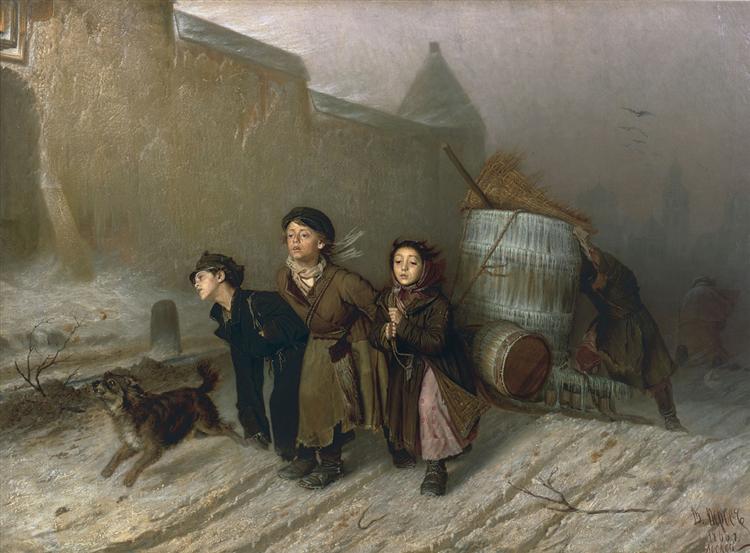
“Troïka”, qui est la plus grande peinture de genre de Perov et probablement l’une des plus émouvantes est devenue l’une des peintures les plus célèbres et les plus dramatiques de l’artiste. Il s’agit d’une huile sur toile de 123,5 × 167,5 cm qui a été peinte en 1866. Cette œuvre exceptionnelle se trouve actuellement à Moscou à la Galerie nationale Tretiakov.
La « Troïka (Тройка) » aussi appelée (« Apprentis porteurs d’eau ») touche à une question sociale importante qui est le problème du travail des enfants pendant une période difficile pour la Russie. Après l’abolition du servage, la situation ne s’est pas immédiatement améliorée et les gens ont vécu dans la pauvreté. L’inégalité était également importante. Vasily Perov (Василий Перов) a reçu le titre d’académicien de la peinture pour ce travail.
“Troïka” de Vasily Perov 1866
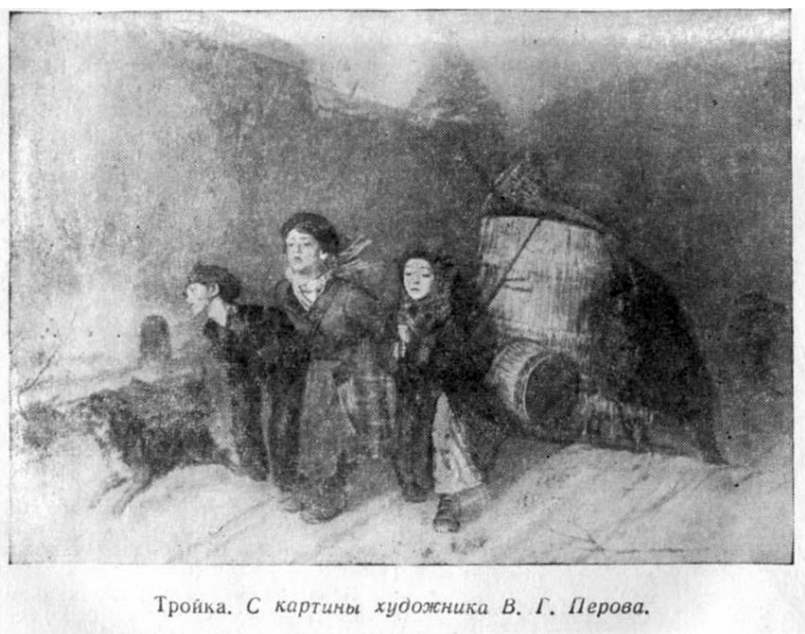
Dans les premières esquisses de ce tableau, telles que conçues par l’auteur, les visages des enfants étaient censés être non pas enfantins mais émaciés et extrêmement douloureux à regarder. Plus tard, l’artiste a abandonné son idée originale et leurs visages sont devenus jolis et spiritualisés, mais avec des traces de désespoir total.
Esquisse « Troïka » 1865 par Vasily Perov
Perov a longtemps cherché un héros convenable, la plupart de l’œuvre était déjà peinte mais il n’a pas pu trouver la figure centrale de l’œuvre. Heureusement, il a rencontré une paysanne avec son fils dans la rue et a réussi à persuader la femme de lui permettre de peindre un portrait de son fils. Le garçon appelé Vasya était le dernier espoir et la joie de la veuve qui avait enterré ses autres enfants. Trois ans plus tard, la pauvre femme est venue chez l’artiste, et il a eu de la peine à reconnaitre la mère de Vasya.
Elle a dit que son fils était tombé malade et était mort de la variole et a demandé à acheter le tableau représentant son fils de Perov.
L’artiste a expliqué que le tableau était vendu depuis longtemps mais il a emmené la pauvre femme à la galerie, où elle est tombée à genoux devant le tableau et a commencé à prier. En voyant cette scène, Perov a été tellement touché qu’il a décidé de peindre un portrait de son fils pour la femme.
Un an plus tard, la femme a reçu un portrait de son fils dans un cadre doré, et quelques mois plus tard, Perov a reçu une lettre de réponse avec des mots de sincère gratitude.
Vasily Perov a utilisé des tons gris-brun sombres. Le seul point lumineux de la photo est la jupe bleu-violet de la fille. Les tons traduisent la tragédie de la scène, tandis que l’atmosphère est aggravée par la rue sombre et déserte de la ville.
“Troïka” partie oiseaux par Vasily Perov
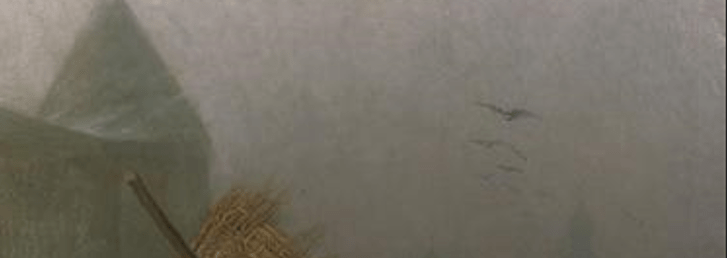
L’image représente un petit matin qui peut être vu avec le vol d’oiseaux se précipitant de la ville vers les champs. Il fait encore sombre, il commence à peine à faire jour et il y a un blizzard très froid.
“Troika” part barrel by Vasily Perov
On peut voir la pente du boulevard Rozhdestvensky et les murs du couvent de la Mère de Dieu-Rozhdestvensky qui sont devenus l’arrière-plan de l’image.
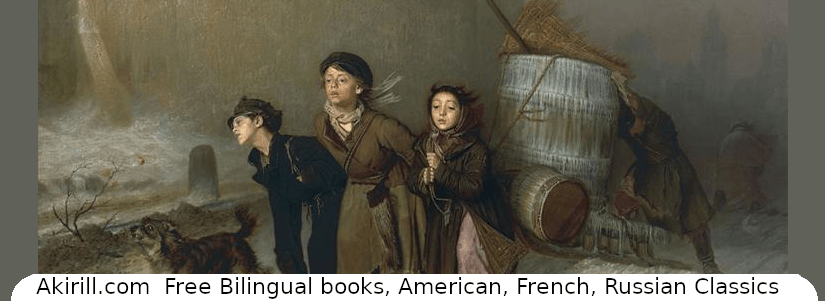
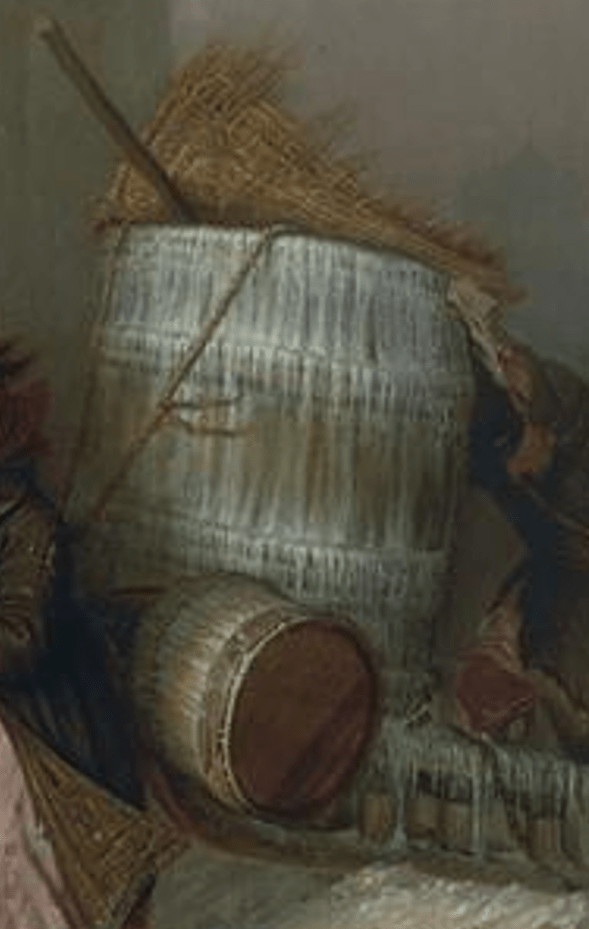
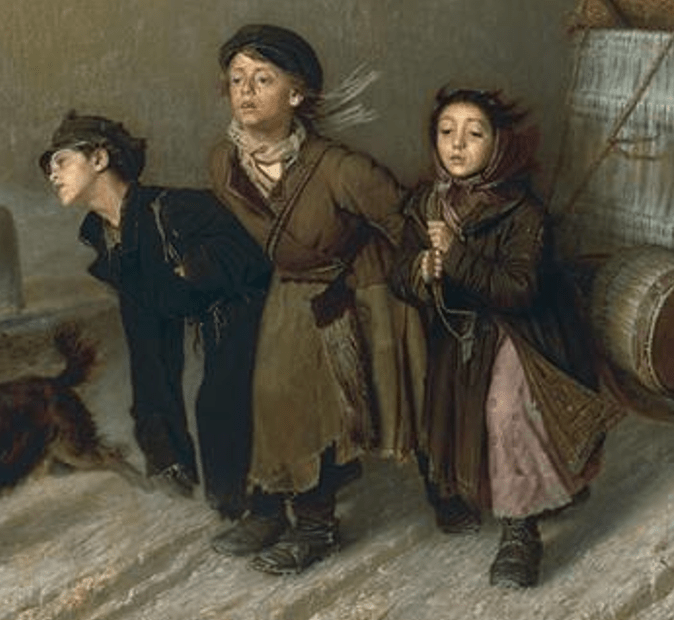
Au centre se trouvent trois trois enfants épuisés qui, comme en équipe, tirent un traîneau chargé d’un énorme et lourd tonneau en bois. Il est rempli d’eau jusqu’en haut et recouvert d’une sorte de toile de jute. L’eau qui coule gèle avec des glaçons à la surface du baril, ce qui montre une fois de plus à quel point il doit faire froid.
À côté du traîneau se trouve un seau en bois qui semble très lourd, et avec lequel les enfants ont probablement puisé de l’eau dans un trou de glace. Tout montre que le tonneau est très lourd, chaque pas est fait avec beaucoup de difficulté.
“Troïka” partie enfants de Vasily Perov
Un vent glacial souffle sur le visage des trois enfants vêtus de vêtements très modestes, voire pauvres. Ils portent de vieux manteaux et des bottes. Ils ont des casquettes sur la tête qui sont très probablement destinées à l’automne et non à l’hiver. Ils sont très petits, le plus âgé d’entre eux n’a probablement que 12, 13 ans. Il est le chef du groupe, il est clair qu’il assume la charge principale de la fille qui a environ 10 ans et tire de toutes ses forces. Le garçon de gauche est le plus jeune, pas plus de 8 ou 9 ans, mais il tire la sangle aussi fort qu’il le peut. Un tel travail n’est pas du tout pour de si jeunes enfants et leurs visages sont pleins de souffrance et de désespoir.
“Troïka” partie homme par Vasily Perov
Derrière le baril, nous voyons un adulte maigre qui les aide à porter le fardeau. Il est aussi habillé modestement. On voit que son quotidien n’en est pas moins difficile.
«Troïka» en partie chien par Vasily Perov
Le chariot est accompagné d’un chien courant à droite devant les enfants.
J’espère que vous avez apprécié ce tableau autant que moi.
Si cet article vous a plu, abonnez-vous, mettez des likes, écrivez des commentaires !
“Troika”, which is Perov ‘s largest genre painting and probably one of the most emotional became one of the artist’s most famous and dramatic paintings. It is an oil on canvas of 123,5 × 167,5 cm which was painted in 1866. This outstanding work is presently in Moscow at the State Tretyakov Gallery.
“Troika (Тройка)” also called (“Apprentices Carrying Water”) touches on an important social issue which is the problem of child labor during a difficult period for Russia. After the abolition of serfdom the situation did not immediately improve, and people lived in poverty. Inequality was also important. Vasily Perov (Василий Перов) was awarded the title of academician of painting for this work.
“Troika” by Vasily Perov 1866
In the initial sketches for this painting, as conceived by the author, children’s faces were supposed to be not childishly but emaciated and extremely painful to look at. Later the artist abandoned his original idea and their faces became pretty and spiritualized, but with traces of complete hopelessness.
“Troika” sketch 1865 by Vasily Perov
Perov looked for a suitable hero for a long time, most of the work had already been painted but he could not find the central figure of the work. Fortunately, he met a peasant woman with her son on the street and managed to persuade the woman to allow her to paint a portrait of her son, The boy called Vasya was the last hope and joy of the widow who had buried her other children. Three years later, the poor woman came to the artist, and he hardly recognized Vasya’s mother.
She said that her son fell ill and died of smallpox, and asked to buy the painting depicting her son from Perov.
The artist explained that the painting had long been sold but he took the poor woman to the gallery, where she fell on her knees in front of the painting and began to pray. Seeing this scene, Perov was so touched that he decided to paint a portrait of her son for the woman.
A year later, the woman received a portrait of her son in a gilded frame, and a few months later Perov received a response letter with words of sincere gratitude.
Vasily Perov used gloomy gray-brown tones. The only bright spot in the picture is the blue-violet skirt of the girl. The tones convey the tragedy of the scene, while the atmosphere is aggravated by the gloomy deserted street of the city.
“Troika” part birds by Vasily Perov
The picture depicts an early morning which can be seen with the flock of birds rushing from the city to the fields. It’s still dark, just getting light and there is a very cold, blizzard.
“Troika” part barrel by Vasily Perov
We can see the slope of Rozhdestvensky Boulevard, and the walls of the Mother of God-Rozhdestvensky Convent which became the background of the picture.
In the center there is three three exhausted children, who as if in a team, are pulling a sleigh loaded with a huge, heavy, wooden barrel. It is filled to the top with water, and covered with some kind of sackcloth. The pouring water freezes with icicles on the surface of the barrel, which once again makes it clear how cold it must be.
Next to the sleigh lies a wooden bucket looking very heavy, and with which the children probably drew water from an ice hole. Everything shows that the barrel is very heavy, each step is taken with great difficulty.
“Troika” part children by Vasily Perov
An icy wind blows in the face of the three children who are dressed in very modest, even poor clothes. They wear old caftans and boots. They have caps on their heads which are most likely intended for autumn and not for winter. They are very small, the oldest of them is probably only 12, 13 years old. He is the leader of the group, it is clear that he takes on the main load of the girl who is about 10 and pulls with all her might. The boy on the left is the youngest, no more than 8 or 9 years old, but he pulls the strap as hard as he can. Such work is not at all for such young children and their faces are full of suffering, and hopelessness.
“Troika” part man by Vasily Perov
Behind the barrel we see a thin built adult helping them to carry the burden. He is also dressed modestly. It can be seen that his everyday life is no less difficult.
“Troika” part dog by Vasily Perov
The wagon is accompanied by a dog running on the right in front of the children.
I hope you enjoyed this painting as much as I did.
If you liked this article, subscribe , put likes, write comments!












 AKirill, Learn, apprenez, translation, traduction, livres bilingues, bilingual books