On this site we hope to help you learn, and to remove the difficulties caused by the difference of culture and language. Sur ce site nous espérons vous aider à apprendre, et à enlever la barrière causée par les différents languages et cultures.
Chers lecteurs et abonnés, cette semaine a été vraiment passionnante alors que je me plongeais dans la poésie américaine, française et russe, ajoutant de beaux poèmes dans trois langues différentes à notre collection. J’ai également eu le plaisir de créer la page pour les arts américains, où j’ai présenté notre premier tableau américain du talentueux Thomas Hill. Son chef-d’œuvre de 1865, Vue de la vallée de Yosemite, a laissé une empreinte indélébile dans l’histoire et reste impressionnant à ce jour. Il est incroyable de penser qu’il a autrefois orné l’arrière-plan du déjeuner inaugural de Barack Obama, rendant hommage à la signature monumentale du Yosemite Grant par Lincoln. Si vous souhaitez en savoir plus sur Thomas Hill, vous pouvez continuer à lire sa brève biographie sur notre site Web. Je suis convaincue que vous trouverez quelque chose de vraiment agréable dans nos dernières offres.
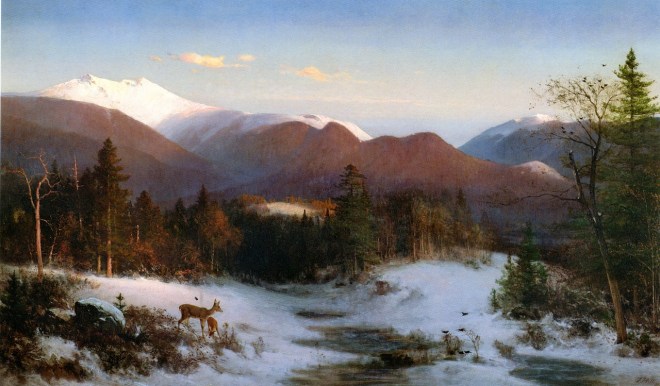
Paul Laurence DunbarHenry Van DykeEdgar_Guest_1935Guillaume Apollinaire André Marie ChénierAfanasy FetNikolai GumilevKonstantin Batyushkov1Thomas Hill – View of the Yosemite Valley, in California -1865
Thomas Hill – View of the Yosemite Valley, in California -1865
Nous mettons beaucoup d’efforts dans la qualité des articles et traductions, soutenez-nous avec un like et un abonnement ou sponsorisez-nous si vous les aimez.Nous sommes aussi surFacebook et Twitter
Dear readers and subscribers, this week has been truly exciting as I delved into American, French, and Russian poetry, adding beautiful poems in three different languages to our collection. I also had the pleasure of creating the page for American arts, where I showcased our first American painting by the talented Thomas Hill. His 1865 masterpiece, View of the Yosemite Valley, has left an indelible mark on history and remains awe-inspiring to this day. It’s incredible to think that it once graced the backdrop of Barack Obama’s inaugural luncheon, paying homage to Lincoln’s monumental signing of the Yosemite Grant. If you’d like to know more about Thomas Hill, you can continue reading his short biography on our website. I’m confident that you will find something truly enjoyable in our latest offerings.
Paul Laurence DunbarHenry Van DykeEdgar_Guest_1935Guillaume Apollinaire André Marie ChénierAfanasy FetNikolai GumilevKonstantin Batyushkov1Thomas Hill – View of the Yosemite Valley, in California -1865
Thomas Hill – View of the Yosemite Valley, in California -1865
We put a lot of effort into the quality of the articles and translations, support us with a like and a subscription or sponsor us if you like them. We are also on Facebook and Twitter
Chers lecteurs et abonnés, cette semaine, je suis ravie de partager avec vous notre nouvelle collection de poèmes américains, français et russes. De plus, j’ai inclus le célèbre chef-d’œuvre “Bal du moulin de la Galette” de Pierre-Auguste Renoir, l’une de ses œuvres impressionnistes les plus célèbres. Pour finir sur une note chaleureuse, nos oisillons sauvés se portent bien et ont atteint l’étape de pouvoir se nourrir seuls avec de la nourriture humide.
Pierre-Auguste Renoir (1841 – 1919) était un artiste français influent connu pour ses importantes contributions au développement du style impressionniste. Il était un passionné de la beauté et surtout de la sensualité féminine. … Lire la suite …
J’espère que vous trouverez quelque chose à apprécier.
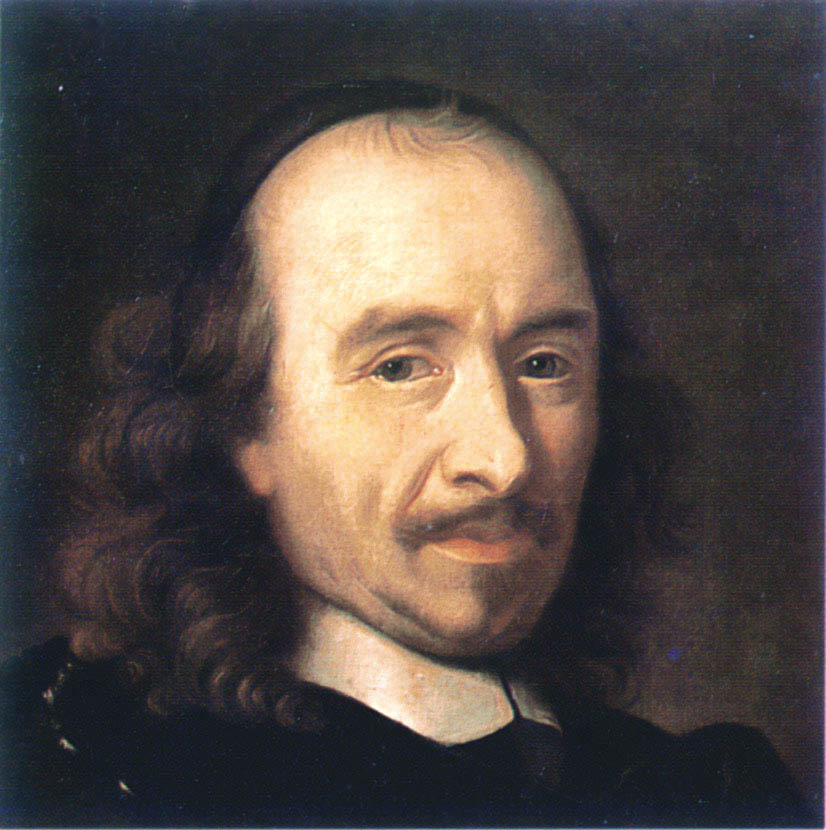
William Cullen BryantEmma LazarusClark Ashton SmithPierre CorneillePierre Jules Théophile Gautier Guy De MaupassantMarina TsvetaevaVladimir Mayakovsky 1910Velimir Khlebnikov 1908Dance at Le moulin de la Galette – 1876
Nous mettons beaucoup d’efforts dans la qualité des articles et traductions, soutenez-nous avec un like et un abonnement ou sponsorisez-nous si vous les aimez.Nous sommes aussi surFacebook et Twitter
Dear readers and subscribers, this week I am thrilled to share with you our new collection of American, French and Russian poems. In addition, I have included the beloved masterpiece “The Dance at The Moulin de la Galette” by Pierre-Auguste Renoir, one of his most celebrated Impressionist works. On a heartwarming note, our rescued baby birds are thriving and have reached the milestone of being able to feed themselves with wet food.
Pierre-Auguste Renoir (1841 – 1919) was an influential French artist known for his significant contributions to the development of the Impressionist style. He was a passionate celebrator of beauty and especially feminine sensuality. … Continue reading …
I hope you’ll find something to enjoy.
William Cullen BryantEmma LazarusClark Ashton SmithPierre CorneillePierre Jules Théophile Gautier Guy De MaupassantMarina TsvetaevaVladimir Mayakovsky 1910Velimir Khlebnikov 1908Dance at Le moulin de la Galette – 1876
We put a lot of effort into the quality of the articles and translations, support us with a like and a subscription or sponsor us if you like them. We are also on Facebook and Twitter
Dear readers and subscribers, I wish you and your family an amazing Independence day.
Always stand firm in your beliefs, champion what is just, and pursue your heart’s desires. True freedom resides in a fearless mind. Have a joyous Independence Day celebration!
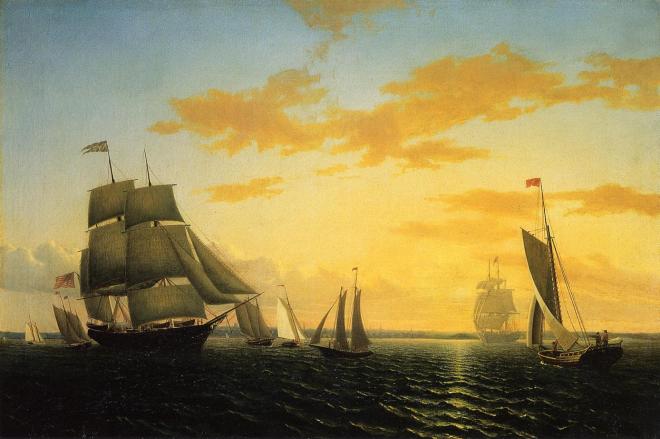
Longfellow witnessed the growth of a young country, which significantly inspired many of his poems. “The Building of the Ship,” although seemingly a straightforward poetic portrayal of ship construction, actually serves as a metaphor for the development of America. As the country gradually came together, akin to the ships constructed near Longfellow’s home in Portland, Maine, a sense of unity and progress emerged. I trust that you will derive as much pleasure from this poem as I did.
The Building of the Ship
“Build me straight, O worthy Master! Stanch and strong, a goodly vessel, That shall laugh at all disaster, And with wave and whirlwind wrestle!”
The merchant’s word Delighted the Master heard; For his heart was in his work, and the heart Giveth grace unto every Art.
A quiet smile played round his lips, As the eddies and dimples of the tide Play round the bows of ships, That steadily at anchor ride. And with a voice that was full of glee, He answered, “Erelong we will launch A vessel as goodly, and strong, and stanch, As ever weathered a wintry sea!” And first with nicest skill and art, Perfect and finished in every part, A little model the Master wrought, Which should be to the larger plan What the child is to the man, Its counterpart in miniature; That with a hand more swift and sure The greater labor might be brought To answer to his inward thought. And as he labored, his mind ran o’er The various ships that were built of yore, And above them all, and strangest of all Towered the Great Harry, crank and tall, Whose picture was hanging on the wall, With bows and stern raised high in air, And balconies hanging here and there, And signal lanterns and flags afloat, And eight round towers, like those that frown From some old castle, looking down Upon the drawbridge and the moat. And he said with a smile, “Our ship, I wis, Shall be of another form than this!” It was of another form, indeed; Built for freight, and yet for speed, A beautiful and gallant craft; Broad in the beam, that the stress of the blast, Pressing down upon sail and mast, Might not the sharp bows overwhelm; Broad in the beam, but sloping aft With graceful curve and slow degrees, That she might be docile to the helm, And that the currents of parted seas, Closing behind, with mighty force, Might aid and not impede her course.
In the ship-yard stood the Master, With the model of the vessel, That should laugh at all disaster, And with wave and whirlwind wrestle!
Covering many a rood of ground, Lay the timber piled around; Timber of chestnut, and elm, and oak, And scattered here and there, with these, The knarred and crooked cedar knees; Brought from regions far away, From Pascagoula’s sunny bay, And the banks of the roaring Roanoke! Ah! what a wondrous thing it is To note how many wheels of toil One thought, one word, can set in motion! There’s not a ship that sails the ocean, But every climate, every soil, Must bring its tribute, great or small, And help to build the wooden wall!
The sun was rising o’er the sea, And long the level shadows lay, As if they, too, the beams would be Of some great, airy argosy. Framed and launched in a single day. That silent architect, the sun, Had hewn and laid them every one, Ere the work of man was yet begun. Beside the Master, when he spoke, A youth, against an anchor leaning, Listened, to catch his slightest meaning. Only the long waves, as they broke In ripples on the pebbly beach, Interrupted the old man’s speech. Beautiful they were, in sooth, The old man and the fiery youth! The old man, in whose busy brain Many a ship that sailed the main Was modelled o’er and o’er again;— The fiery youth, who was to be the heir of his dexterity, The heir of his house, and his daughter’s hand, When he had built and launched from land What the elder head had planned.
“Thus,” said he, “will we build this ship! Lay square the blocks upon the slip, And follow well this plan of mine. Choose the timbers with greatest care; Of all that is unsound beware; For only what is sound and strong To this vessel stall belong. Cedar of Maine and Georgia pine Here together shall combine. A goodly frame, and a goodly fame, And the UNION be her name! For the day that gives her to the sea Shall give my daughter unto thee!”
The Master’s word Enraptured the young man heard; And as he turned his face aside, With a look of joy and a thrill of pride, Standing before Her father’s door, He saw the form of his promised bride. The sun shone on her golden hair, And her cheek was glowing fresh and fair, With the breath of morn and the soft sea air. Like a beauteous barge was she, Still at rest on the sandy beach, Just beyond the billow’s reach; But he Was the restless, seething, stormy sea! Ah, how skilful grows the hand That obeyeth Love’s command! It is the heart, and not the brain, That to the highest doth attain, And he who followeth Love’s behest Far excelleth all the rest!
Thus with the rising of the sun Was the noble task begun And soon throughout the ship-yard’s bounds Were heard the intermingled sounds Of axes and of mallets, plied With vigorous arms on every side; Plied so deftly and so well, That, ere the shadows of evening fell, The keel of oak for a noble ship, Scarfed and bolted, straight and strong Was lying ready, and stretched along The blocks, well placed upon the slip. Happy, thrice happy, every one Who sees his labor well begun, And not perplexed and multiplied, By idly waiting for time and tide!
And when the hot, long day was o’er, The young man at the Master’s door Sat with the maiden calm and still. And within the porch, a little more Removed beyond the evening chill, The father sat, and told them tales Of wrecks in the great September gales, Of pirates coasting the Spanish Main, And ships that never came back again, The chance and change of a sailor’s life, Want and plenty, rest and strife, His roving fancy, like the wind, That nothing can stay and nothing can bind, And the magic charm of foreign lands, With shadows of palms, and shining sands, Where the tumbling surf, O’er the coral reefs of Madagascar, Washes the feet of the swarthy Lascar, As he lies alone and asleep on the turf. And the trembling maiden held her breath At the tales of that awful, pitiless sea, With all its terror and mystery, The dim, dark sea, so like unto Death, That divides and yet unites mankind! And whenever the old man paused, a gleam From the bowl of his pipe would awhile illume The silent group in the twilight gloom, And thoughtful faces, as in a dream; And for a moment one might mark What had been hidden by the dark, That the head of the maiden lay at rest, Tenderly, on the young man’s breast!
Day by day the vessel grew, With timbers fashioned strong and true, Stemson and keelson and sternson-knee, Till, framed with perfect symmetry, A skeleton ship rose up to view! And around the bows and along the side The heavy hammers and mallets plied, Till after many a week, at length, Wonderful for form and strength, Sublime in its enormous bulk, Loomed aloft the shadowy hulk! And around it columns of smoke, up-wreathing. Rose from the boiling, bubbling, seething Caldron, that glowed, And overflowed With the black tar, heated for the sheathing. And amid the clamors Of clattering hammers, He who listened heard now and then The song of the Master and his men:
—”Build me straight, O worthy Master. Stanch and strong, a goodly vessel, That shall laugh at all disaster, And with wave and whirlwind wrestle!”
With oaken brace and copper band, Lay the rudder on the sand, That, like a thought, should have control Over the movement of the whole; And near it the anchor, whose giant hand Would reach down and grapple with the land, And immovable and fast Hold the great ship against the bellowing blast! And at the bows an image stood, By a cunning artist carved in wood, With robes of white, that far behind Seemed to be fluttering in the wind. It was not shaped in a classic mould, Not like a Nymph or Goddess of old, Or Naiad rising from the water, But modelled from the Master’s daughter! On many a dreary and misty night, ‘T will be seen by the rays of the signal light, Speeding along through the rain and the dark, Like a ghost in its snow-white sark, The pilot of some phantom bark, Guiding the vessel, in its flight, By a path none other knows aright! Behold, at last, Each tall and tapering mast Is swung into its place; Shrouds and stays Holding it firm and fast!
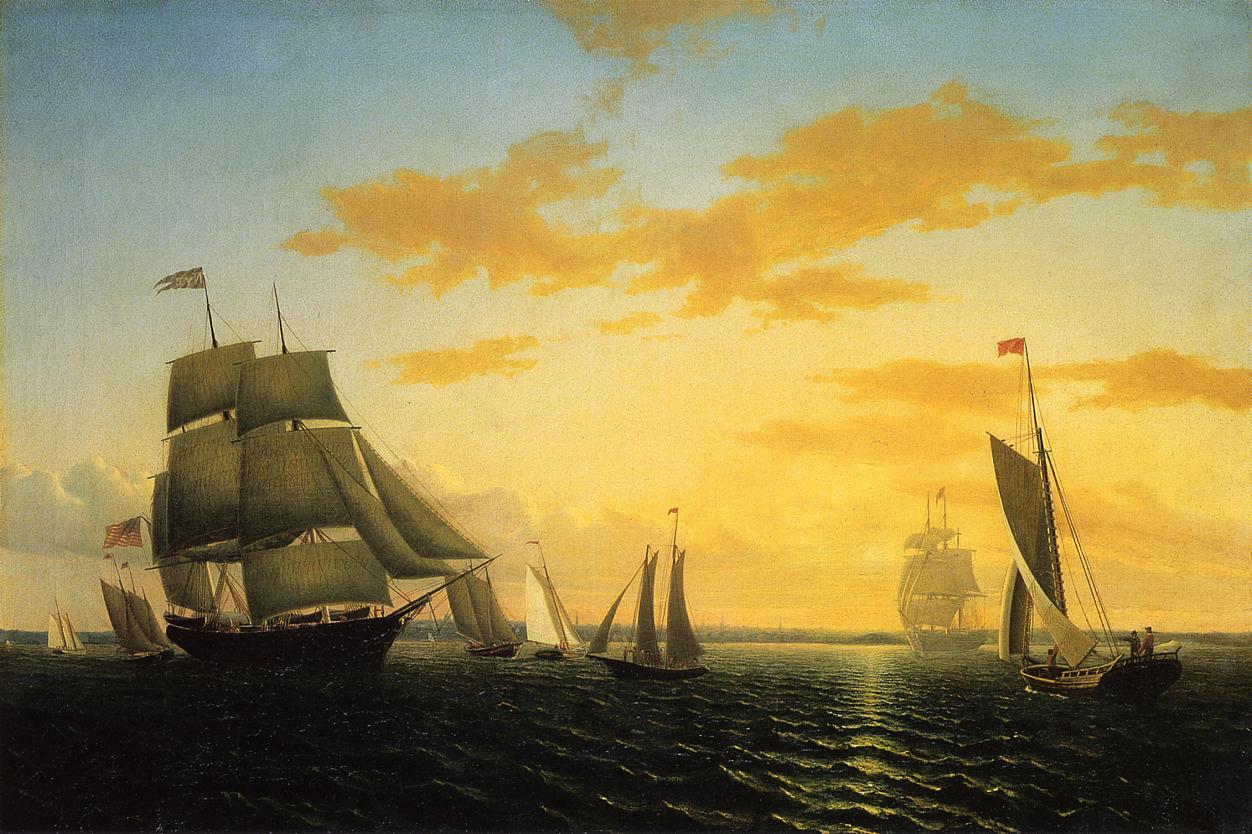
Long ago, In the deer-haunted forests of Maine, When upon mountain and plain Lay the snow, They fell,—those lordly pines! Those grand, majestic pines! ‘Mid shouts and cheers The jaded steers, Panting beneath the goad, Dragged down the weary, winding road Those captive kings so straight and tall, To be shorn of their streaming hair, And, naked and bare, To feel the stress and the strain Of the wind and the reeling main, Whose roar Would remind them forevermore Of their native forests they should not see again.
And everywhere The slender, graceful spars Poise aloft in the air, And at the mast-head, White, blue, and red, A flag unrolls the stripes and stars. Ah! when the wanderer, lonely, friendless, In foreign harbors shall behold That flag unrolled, ‘T will be as a friendly hand Stretched out from his native land, Filling his heart with memories sweet and endless!
All is finished! and at length Has come the bridal day Of beauty and of strength. To-day the vessel shall be launched! With fleecy clouds the sky is blanched, And o’er the bay, Slowly, in all his splendors dight, The great sun rises to behold the sight.
The ocean old, Centuries old, Strong as youth, and as uncontrolled, Paces restless to and fro, Up and down the sands of gold. His beating heart is not at rest; And far and wide, With ceaseless flow, His beard of snow Heaves with the heaving of his breast. He waits impatient for his bride. There she stands, With her foot upon the sands, Decked with flags and streamers gay, In honor of her marriage day, Her snow-white signals fluttering, blending, Round her like a veil descending, Ready to be The bride of the gray old sea.
On the deck another bride Is standing by her lover’s side. Shadows from the flags and shrouds, Like the shadows cast by clouds, Broken by many a sunny fleck, Fall around them on the deck.
The prayer is said, The service read, The joyous bridegroom bows his head; And in tear’s the good old Master Shakes the brown hand of his son, Kisses his daughter’s glowing cheek In silence, for he cannot speak, And ever faster Down his own the tears begin to run. The worthy pastor— The shepherd of that wandering flock, That has the ocean for its wold, That has the vessel for its fold, Leaping ever from rock to rock— Spake, with accents mild and clear, Words of warning, words of cheer, But tedious to the bridegroom’s ear. He knew the chart Of the sailor’s heart, All its pleasures and its griefs, All its shallows and rocky reefs, All those secret currents, that flow With such resistless undertow, And lift and drift, with terrible force, The will from its moorings and its course. Therefore he spake, and thus said he:— “Like unto ships far off at sea, Outward or homeward bound, are we. Before, behind, and all around, Floats and swings the horizon’s bound, Seems at its distant rim to rise And climb the crystal wall of the skies, And then again to turn and sink, As if we could slide from its outer brink. Ah! it is not the sea, It is not the sea that sinks and shelves, But ourselves That rock and rise With endless and uneasy motion, Now touching the very skies, Now sinking into the depths of ocean. Ah! if our souls but poise and swing Like the compass in its brazen ring, Ever level and ever true To the toil and the task we have to do, We shall sail securely, and safely reach The Fortunate Isles, on whose shining beach The sights we see, and the sounds we hear, Will be those of joy and not of fear!”
Then the Master, With a gesture of command, Waved his hand; And at the word, Loud and sudden there was heard, All around them and below, The sound of hammers, blow on blow, Knocking away the shores and spurs. And see! she stirs! She starts,—she moves,—she seems to feel The thrill of life along her keel, And, spurning with her foot the ground, With one exulting, joyous bound, She leaps into the ocean’s arms!
And lo! from the assembled crowd There rose a shout, prolonged and loud, That to the ocean seemed to say, “Take her, O bridegroom, old and gray, Take her to thy protecting arms, With all her youth and all her charms!”
How beautiful she is! How fair She lies within those arms, that press Her form with many a soft caress Of tenderness and watchful care! Sail forth into the sea, O ship! Through wind and wave, right onward steer! The moistened eye, the trembling lip, Are not the signs of doubt or fear.
Sail forth into the sea of life, O gentle, loving, trusting wife, And safe from all adversity Upon the bosom of that sea Thy comings and thy goings be! For gentleness and love and trust Prevail o’er angry wave and gust; And in the wreck of noble lives Something immortal still survives!
Thou, too, sail on, O Ship of State! Sail on, O UNION, strong and great! Humanity with all its fears, With all the hopes of future years, Is hanging breathless on thy fate! We know what Master laid thy keel, What Workmen wrought thy ribs of steel, Who made each mast, and sail, and rope, What anvils rang, what hammers beat, In what a forge and what a heat Were shaped the anchors of thy hope! Fear not each sudden sound and shock, ‘T is of the wave and not the rock; ‘T is but the flapping of the sail, And not a rent made by the gale! In spite of rock and tempest’s roar, In spite of false lights on the shore, Sail on, nor fear to breast the sea Our hearts, our hopes, are all with thee, Our hearts, our hopes, our prayers, our tears, Our faith triumphant o’er our fears, Are all with thee,—are all with thee!
We put a lot of effort into the quality of the articles and translations, support us with a like and a subscription or sponsor us if you like them. We are also on Facebook and Twitter
Chers lecteurs et abonnés, quelle merveilleuse semaine cela a été ! J’ai consacré mon temps à explorer et à étendre le monde de la poésie américaine, française et russe, ajoutant une délicieuse collection de nouveaux poèmes dans ces trois langues. Notre tableau de la semaine est “A l’Elysée Montmartre” par Henri de Toulouse-Lautrec.
Comte Henri Marie Raymond de Toulouse-Lautrec-Monfa (1864 – 1901), ou mieux connu sous le nom de Toulouse-Lautrec, était un extraordinaire peintre français. Sa profonde immersion dans la vie vibrante et dramatique de Paris à la fin du XIXe siècle lui a permis de créer une collection d’images envoûtante, raffinée et stimulante, dépeignant parfois les événements extravagants de l’époque.. … Lire la suite …
Nos jeunes corbeau et corneille se tiennent joyeusement compagnie et font des progrès impressionnants, même s’ils dépendent tous les deux de moi pour leur nourriture et leur eau. Quand Pacha a commencé à manger dans le bol, Teash a fait de même et est maintenant capable d’avaler et de boire un peu !
J’espère que vous trouverez quelque chose à apprécier
Nous mettons beaucoup d’efforts dans la qualité des articles et traductions, soutenez-nous avec un like et un abonnement ou sponsorisez-nous si vous les aimez.Nous sommes aussi surFacebook et Twitter
Dear readers and subscribers, what a wonderful week it has been! I’ve dedicated my time to exploring and expanding the world of American, French, and Russian poetry, adding a delightful collection of new poems in all three languages. Our painting this week is “At the Elysée Montmartre” by Henri de Toulouse-Lautrec.
Comte Henri Marie Raymond de Toulouse-Lautrec-Monfa (1864 – 1901), or better known as Toulouse-Lautrec, was an extraordinary French painter. His deep immersion in the vibrant and dramatic life of Paris during the late 19th century allowed him to create a mesmerizing, refined, and thought-provoking collection of images depicting the sometimes extravagant events of the era. … Continue reading …
Our young crow and raven are happily keeping each other company and showing great progress, even though they both rely on me for their food and water. When Pacha started eating from the bowl, Teash followed suit and is now able to swallow and drink a bit. !
We put a lot of effort into the quality of the articles and translations, support us with a like and a subscription or sponsor us if you like them. We are also on Facebook and Twitter
Chers lecteurs et abonnés, j’ai passé une semaine incroyable à travailler sur la poésie américaine, française et russe, et je suis ravie de partager avec vous les nouveaux poèmes que j’ai ajoutés dans ces trois langues.
De plus, je suis heureuse de vous présenter un nouvel ajout à notre collection – le célèbre peintre français, Eugène Delacroix, renommé pour son chef-d’œuvre, La Bataille de Nancy.
Ferdinand Victor Eugène Delacroix (1798-1863) incarnait véritablement l’essence du romantisme français, captivant les amateurs d’art avec ses créations vibrantes et émouvantes. Vous pouvez en apprendre davantage sur Eugène Delacroix ici. J’espère que vous trouverez quelque chose de vraiment plaisant dans nos dernières actualités.
Et enfin, j’ai trouvé un peu de temps pour écrire sur les progrès de notre bébé corneille et l’adoption temporaire d’un jeune corbeau. J’avais espéré que cela rendrait Teash plus sauvage mais il semble que l’effet contraire se produise. Vous pouvez lire l’article, incluant une courte vidéo et des photos : Nouvelles de notre petite corneille et d’un deuxième sauvetage, un jeune corbeau en suivant le lien.
Natalie Clifford Barney 1898Claude McKayWalt Whitman Pierre Jules Théophile Gautier Alphonse de LamartinePaul_Verlaine by Frédéric BazilleAnna AkhmatovaAfanasy FetValéri BrioussovEugene Delacroix – The Battle of Nancy – 1831
Nous mettons beaucoup d’efforts dans la qualité des articles et traductions, soutenez-nous avec un like et un abonnement ou sponsorisez-nous si vous les aimez.Nous sommes aussi surFacebook et Twitter
Dear readers and subscribers, I had an amazing week working on American, French, and Russian poetry, and I’m thrilled to share with you the new poems I’ve added in these three languages.
In addition, I’m excited to introduce a new addition to our collection – the famous French painter, Eugene Delacroix, renowned for his masterpiece, The Battle of Nancy.
Ferdinand Victor Eugène Delacroix (1798 –1863) truly embodied the essence of French Romanticism, captivating art enthusiasts with his vibrant and emotive creations. You can find out more about Eugène Delacroixhere. I’m hoping you’ll find something truly enjoyable in our latest updates.
And last but not least I finally found a bit of time to write about the progress of our baby crow and the temporary adoption of a young raven. I had hope that it would make Teash wilder but the opposite seems to be going on. You can read the article including a short video and pictures: News of our little crow and a second rescue, a young raven by following the link.
Natalie Clifford Barney 1898Claude McKayWalt Whitman Pierre Jules Théophile Gautier Alphonse de LamartinePaul_Verlaine by Frédéric BazilleAnna AkhmatovaAfanasy FetValéri BrioussovEugene Delacroix – The Battle of Nancy – 1831
We put a lot of effort into the quality of the articles and translations, support us with a like and a subscription or sponsor us if you like them. We are also on Facebook and Twitter
Chers lecteurs et abonnés, j’ai passé une semaine incroyablement productive en m’immergeant dans le monde de la poésie américaine, française et russe. Je suis enthousiasmée de partager non seulement de nouveaux poèmes dans ces trois langues, mais aussi de vous présenter l’œuvre exquise du célèbre peintre français, Edgar Degas.
Pour la semaine à venir, j’ai sélectionné sa peinture envoûtante “Cours de danse (Classe de ballet)” à mettre en avant, une œuvre qui incarne vraiment l’essence de son génie.
Notre petit bébé corbeau a maintenant la compagnie d’un proche trouvé trempé et marchant sur le bord d’une route à quatre voies essayant de monter sur le trottoir sans succès. Le laisser là, incapable de remonter dans les grand arbres, aurait été une condamnation à mort, alors je l’ai ramené à la maison. Comme vous pouvez le voir, il (oui je crois que c’est un mâle) est plus âgé, mais a également un caractère et une couleur des yeux différents qui me font croire qu’ils ne sont pas exactement de la même espèce. Ce qui est amusant, c’est que même si elle fait la moitié de sa taille, elle nous protège, moi et son perchoir, mais ils jouent ensemble et se suivent. (la bague de la femelle est rouge, celle du male est bleue)
Je vais essayer d’écrire et de faire une courte vidéo sur nos 2 bébés oiseaux sauvés mardi s’ils me laissent seule 5 minutes…
Prenez un moment pour apprécier Edgar Degas (1834-1917), un artiste impressionniste français véritablement influent connu pour ses captivantes œuvres au pastel et sa capacité à saisir l’esprit du mouvement dans ses peintures à l’huile.
Je vous invite chaleureusement à explorer davantage le monde d’Edgar Degas en découvrant la minie-biographie d’Edgar Degas, et j’espère que vous trouverez quelque chose de délicieux à apprécier cette semaine.
Henry Van DykeEdgar_Guest_1935Emma LazarusGuillaume Apollinaire Louis AragonAndré Marie ChénierMarina TsvetaevaNikolai GumilevKonstantin Batyushkov1Degas – Dance class – 1874
Nous mettons beaucoup d’efforts dans la qualité des articles et traductions, soutenez-nous avec un like et un abonnement ou sponsorisez-nous si vous les aimez.Nous sommes aussi surFacebook et Twitter